

Chapter-wise Worksheets for Class 12 Mathematics: Chapter 02 Inverse Trigonometric Functions Worksheet
Review targeted academic worksheets with the CBSE Class 12 Mathematics Inverse Trigonometric Functions Worksheet Set 01. Built according to official educational standards for the 2026-27 term, these downloadable Class 12 Mathematics resources support effective daily practice and detailed self-evaluation for Chapter 02 Inverse Trigonometric Functions Worksheet.
Practice Class 12 Mathematics Worksheets: Chapter 02 Inverse Trigonometric Functions Worksheet
Access the complete worksheet PDF for Class 12 Mathematics below. Regular practice with these targeted academic tasks builds familiarity with standard question patterns and helps secure higher marks in final school examinations.
CBSE Class 12 Mathematics Inverse Trigonometric Functions (1). Students can download these worksheets and practice them. This will help them to get better marks in examinations. Also refer to other worksheets for the same chapter and other subjects too. Use them for better understanding of the subjects.
MULTIPLE CHOICE QUESTIONS
Question. tan-1 √3 – sec-1 (-2) is equal to
(a) π
(b) –π/3
(c) π/3
(d) 2π/3
Answer : B
Question. Principal value of tan-1 (-1) is
(a) π/4
(b) −π/2
(c) 5π/4
(d) −π/4
Answer : D
Question. The principle value of sin-1(sin2π/3) is
(a) 2π/3
(b) π/3
(c) −π/6
(d) π/6
Answer : B
Question. Simplified form of cos-1 (4x3 – 3x)
(a) 3 sin-1x
(b) 3 cos-1x
(c) π – 3 sin-1x
(d) None of these
Answer : B
Question. cos-1(cos 7π/6) is equal to
(a) 7π/6
(b) 5π/6
(c) π/3
(d) π/6
Answer : B
Question. The value of cos-1(1/2) + 2sin-1(1/2) is equal to
(a) π/4
(b) π/6
(c) 2π/3
(d) 5π/6
Answer : B
Question. sin-1 x = y Then
(a) 0 ≤ y ≤ π
(b) –π/2 ≤ y ≤ π/2
(c) 0 < y < π
(d) –π/2 < y < –π/2
Answer : B
Question. Principal value of sin-1(1/√2)
(a) π/4
(b) 3π/4
(c) 5π/4
(d) None of these
Answer : A
Question. The principal value of cosec-1 (-2) is
(a) –2π/3
(b) π/6
(c) 2π/3
(d) –π/6
Answer : D
Question. The value of expression 2 sec-1 (2) + sin-1 (1/2) is
(a) π/6
(b) 5π/6
(c) 7π/6
(d) 1
Answer : B
Question. The principle value of sin-1 (√3/2) is
(a) 2π/3
(b) π/6
(c) π/4
(d) π/3
Answer : D
Question. sin[π/3 – sin-1(-1/2)] is equal to
(a) 1//2
(b) 1/3
(c) 1/4
(d) 1
Answer : D
CASE STUDY QUESTIONS
Case Study 1
A group of students of class XII visited India Gate on an education trip. The teacher and students had interest in history as well. The teacher narrated that India Gate, official name Delhi Memorial, originally called All-India War Memorial, monumental sandstone arch in New Delhi, dedicated to the troops of British India who died in wars fought between 1914 and 1919. The teacher also said that India Gate, which is located at the eastern end of the Raj path (formerly called the Kingsway), is about 138 feet (42 metrs) in height.
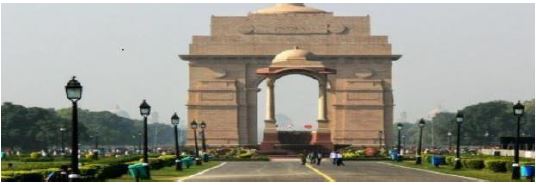
Question. What is the angle of elevation if they are standing at a distance of 42m away from the monument?
a) tan−1 1
b) sin−1 1
c) cos−1 1
d) sec−1 1
Answer : A
Question. They want to see the tower at an angle of sec−1 1/2. So, they want to know the distance where they should stand and hence find the distance.
a) 42 m
b) 20.12 m
c) 25.24 m
d) 24.64 m
Answer : C
Question. If the altitude of the Sun is at cos−1 1/2, then the height of the vertical tower that will cast a shadow of length 20 m is
a) 20√3 m
b) 20/ √3 m
c) 15/ √3 m
d) 15√3 m
Answer : A
Question. The ratio of the length of a rod and its shadow is 1:2. The angle of elevation of the Sun is
a) sin−1 1/2
b) cos−1 1/2
c) tan−1 1/2
d) cot−1 1/2
Answer : A
Question. Domain of sin−1 𝑥 is……..
a) (-1, 1)
b) {-1,1}
c) [ -1,1]
d) none of these
Answer : C
Case Study 2
A Satellite flying at height h is watching the top of the two tallest mountains in Uttarakhand and Karnataka, them being Nanda Devi (height 7,816m) and Mullayanagiri (height 1,930 m). The angles of depression from the satellite, to the top of Nanda Devi and Mullayanagiri are cot−1 √3 andtan−1 √3 respectively. If the distance between the peaks of the two mountains is 1937 km, and the satellite is vertically above the midpoint of the distance between the two mountains.
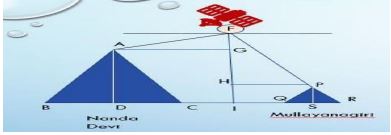
Question. The distance of the satellite from the top of Nanda Devi is
a) 1139.4 km
b) 577.52 km
c) 1937 km
d) 1025.36 km
Answer : A
Question. The distance of the satellite from the top of Mullayanagiri is
a) 1139.4 km
b) 577.52 km
c) 1937 km
d) 1025.36 km
Answer : C
Question. The distance of the satellite from the ground is
a) 1139.4 km
b) 577.52 km
c) 1937 km
d) 1025.36 km
Answer : A
Question. What is the angle of elevation if a man is standing at a distance of 7816m from Nanda Devi?
a) sec−1 2
b) cot−1 1
c) sin−1 √3
d) cos−1 1/2
Answer : A
ONE MARK QUESTIONS
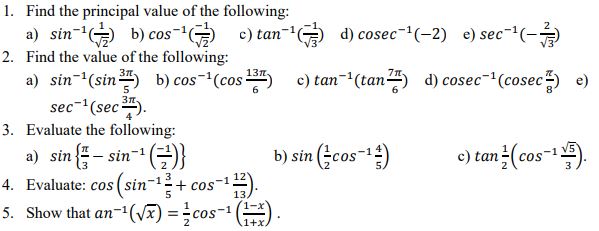
Question. Find the principal value of the following:
a) \( \sin^{-1}\left(\frac{1}{\sqrt{2}}\right) \)
b) \( \cos^{-1}\left(\frac{\sqrt{3}}{2}\right) \)
c) \( \tan^{-1}\left(-\frac{1}{\sqrt{3}}\right) \)
d) \( \csc^{-1}(-2) \)
e) \( \sec^{-1}\left(-\frac{2}{\sqrt{3}}\right) \)
Answer:
a) Let \( \sin^{-1}\left(\frac{1}{\sqrt{2}}\right) = \theta \). Since the principal value branch of \( \sin^{-1} \) is \( [-\frac{\pi}{2}, \frac{\pi}{2}] \), we have:
\( \sin\theta = \frac{1}{\sqrt{2}} \implies \theta = \frac{\pi}{4} \)
b) Let \( \cos^{-1}\left(\frac{\sqrt{3}}{2}\right) = \theta \). Since the principal value branch of \( \cos^{-1} \) is \( [0, \pi] \), we have:
\( \cos\theta = \frac{\sqrt{3}}{2} \implies \theta = \frac{\pi}{6} \)
c) Let \( \tan^{-1}\left(-\frac{1}{\sqrt{3}}\right) = \theta \). Since the principal value branch of \( \tan^{-1} \) is \( (-\frac{\pi}{2}, \frac{\pi}{2}) \), we have:
\( \tan\theta = -\frac{1}{\sqrt{3}} \implies \theta = -\frac{\pi}{6} \)
d) Let \( \csc^{-1}(-2) = \theta \). Since the principal value branch of \( \csc^{-1} \) is \( [-\frac{\pi}{2}, \frac{\pi}{2}] - \{0\} \), we have:
\( \csc\theta = -2 \implies \sin\theta = -\frac{1}{2} \implies \theta = -\frac{\pi}{6} \)
e) Let \( \sec^{-1}\left(-\frac{2}{\sqrt{3}}\right) = \theta \). Since the principal value branch of \( \sec^{-1} \) is \( [0, \pi] - \{\frac{\pi}{2}\} \), we have:
\( \sec\theta = -\frac{2}{\sqrt{3}} \implies \cos\theta = -\frac{\sqrt{3}}{2} \implies \theta = \pi - \frac{\pi}{6} = \frac{5\pi}{6} \)
Question. Find the value of the following:
a) \( \sin^{-1}\left(\sin \frac{3\pi}{5}\right) \)
b) \( \cos^{-1}\left(\cos \frac{13\pi}{6}\right) \)
c) \( \tan^{-1}\left(\tan \frac{7\pi}{6}\right) \)
d) \( \csc^{-1}\left(\csc \frac{\pi}{8}\right) \)
e) \( \sec^{-1}\left(\sec \frac{3\pi}{4}\right) \)
Answer:
a) \( \sin^{-1}\left(\sin \frac{3\pi}{5}\right) = \sin^{-1}\left(\sin\left(\pi - \frac{2\pi}{5}\right)\right) = \sin^{-1}\left(\sin \frac{2\pi}{5}\right) = \frac{2\pi}{5} \) (since \( \frac{2\pi}{5} \in [-\frac{\pi}{2}, \frac{\pi}{2}] \)).
b) \( \cos^{-1}\left(\cos \frac{13\pi}{6}\right) = \cos^{-1}\left(\cos\left(2\pi + \frac{\pi}{6}\right)\right) = \cos^{-1}\left(\cos \frac{\pi}{6}\right) = \frac{\pi}{6} \) (since \( \frac{\pi}{6} \in [0, \pi] \)).
c) \( \tan^{-1}\left(\tan \frac{7\pi}{6}\right) = \tan^{-1}\left(\tan\left(\pi + \frac{\pi}{6}\right)\right) = \tan^{-1}\left(\tan \frac{\pi}{6}\right) = \frac{\pi}{6} \) (since \( \frac{\pi}{6} \in (-\frac{\pi}{2}, \frac{\pi}{2}) \)).
d) \( \csc^{-1}\left(\csc \frac{\pi}{8}\right) = \frac{\pi}{8} \) (since \( \frac{\pi}{8} \in [-\frac{\pi}{2}, \frac{\pi}{2}] - \{0\} \)).
e) \( \sec^{-1}\left(\sec \frac{3\pi}{4}\right) = \frac{3\pi}{4} \) (since \( \frac{3\pi}{4} \in [0, \pi] - \{\frac{\pi}{2}\} \)).
Question. Evaluate the following:
a) \( \sin\left\{ \frac{\pi}{3} - \sin^{-1}\left(-\frac{1}{2}\right) \right\} \)
b) \( \sin\left( \frac{1}{2}\cos^{-1}\frac{1}{9} \right) \)
c) \( \tan\left[ \frac{1}{2}\cos^{-1}\left(\frac{\sqrt{5}}{3}\right) \right] \)
Answer:
a) \( \sin\left\{ \frac{\pi}{3} - \sin^{-1}\left(-\frac{1}{2}\right) \right\} = \sin\left\{ \frac{\pi}{3} - \left(-\frac{\pi}{6}\right) \right\} = \sin\left( \frac{\pi}{3} + \frac{\pi}{6} \right) = \sin\left(\frac{\pi}{2}\right) = 1 \).
b) Let \( \cos^{-1}\frac{1}{9} = \theta \implies \cos\theta = \frac{1}{9} \).
We know that:
\( \sin\frac{\theta}{2} = \sqrt{\frac{1 - \cos\theta}{2}} = \sqrt{\frac{1 - \frac{1}{9}}{2}} = \sqrt{\frac{8}{18}} = \sqrt{\frac{4}{9}} = \frac{2}{3} \).
c) Let \( \cos^{-1}\left(\frac{\sqrt{5}}{3}\right) = \theta \implies \cos\theta = \frac{\sqrt{5}}{3} \).
We need to find:
\( \tan\frac{\theta}{2} = \sqrt{\frac{1-\cos\theta}{1+\cos\theta}} = \sqrt{\frac{1-\frac{\sqrt{5}}{3}}{1+\frac{\sqrt{5}}{3}}} = \sqrt{\frac{3-\sqrt{5}}{3+\sqrt{5}}} = \sqrt{\frac{(3-\sqrt{5})^2}{9-5}} = \frac{3-\sqrt{5}}{2} \).
Question. Evaluate: \( \cos\left( \sin^{-1}\frac{3}{5} + \cos^{-1}\frac{12}{13} \right) \)
Answer: Let \( A = \sin^{-1}\frac{3}{5} \implies \sin A = \frac{3}{5} \) and \( \cos A = \sqrt{1 - \left(\frac{3}{5}\right)^2} = \frac{4}{5} \).
Let \( B = \cos^{-1}\frac{12}{13} \implies \cos B = \frac{12}{13} \) and \( \sin B = \sqrt{1 - \left(\frac{12}{13}\right)^2} = \frac{5}{13} \).
We need to find:
\( \cos(A+B) = \cos A \cos B - \sin A \sin B \)
\( = \left(\frac{4}{5}\right)\left(\frac{12}{13}\right) - \left(\frac{3}{5}\right)\left(\frac{5}{13}\right) \)
\( = \frac{48}{65} - \frac{15}{65} = \frac{33}{65} \).
Question. Show that \( \tan^{-1}(\sqrt{x}) = \frac{1}{2}\cos^{-1}\left( \frac{1-x}{1+x} \right) \).
Answer: Let \( \tan^{-1}\sqrt{x} = \theta \implies \tan\theta = \sqrt{x} \implies \tan^2\theta = x \).
Now, let's consider the Right Hand Side (R.H.S):
\( \text{R.H.S} = \frac{1}{2}\cos^{-1}\left( \frac{1-x}{1+x} \right) \)
Substituting \( x = \tan^2\theta \):
\( = \frac{1}{2}\cos^{-1}\left( \frac{1-\tan^2\theta}{1+\tan^2\theta} \right) \)
Since \( \cos(2\theta) = \frac{1-\tan^2\theta}{1+\tan^2\theta} \), we have:
\( = \frac{1}{2}\cos^{-1}(\cos(2\theta)) \)
\( = \frac{1}{2}(2\theta) \)
\( = \theta \)
\( = \tan^{-1}\sqrt{x} = \text{L.H.S} \).
Hence proved.
FOUR MARKS QUESTIONS
Question. Prove that \( \tan^{-1}\left( \frac{\sqrt{1+x^2} + \sqrt{1-x^2}}{\sqrt{1+x^2} - \sqrt{1-x^2}} \right) = \frac{\pi}{4} + \frac{1}{2}\cos^{-1}x^2 \).
Answer: Let \( x^2 = \cos(2\theta) \implies 2\theta = \cos^{-1}x^2 \implies \theta = \frac{1}{2}\cos^{-1}x^2 \).
We know that:
\( 1 + x^2 = 1 + \cos(2\theta) = 2\cos^2\theta \implies \sqrt{1+x^2} = \sqrt{2}\cos\theta \)
\( 1 - x^2 = 1 - \cos(2\theta) = 2\sin^2\theta \implies \sqrt{1-x^2} = \sqrt{2}\sin\theta \)
Substituting these into the Left Hand Side (L.H.S):
\( \text{L.H.S} = \tan^{-1}\left( \frac{\sqrt{2}\cos\theta + \sqrt{2}\sin\theta}{\sqrt{2}\cos\theta - \sqrt{2}\sin\theta} \right) \)
\( = \tan^{-1}\left( \frac{\cos\theta + \sin\theta}{\cos\theta - \sin\theta} \right) \)
Dividing the numerator and denominator by \( \cos\theta \):
\( = \tan^{-1}\left( \frac{1 + \tan\theta}{1 - \tan\theta} \right) \)
\( = \tan^{-1}\left( \tan\left( \frac{\pi}{4} + \theta \right) \right) \)
\( = \frac{\pi}{4} + \theta \)
Substituting back \( \theta = \frac{1}{2}\cos^{-1}x^2 \):
\( = \frac{\pi}{4} + \frac{1}{2}\cos^{-1}x^2 = \text{R.H.S} \).
Hence proved.
Question. Prove that \( \tan^{-1}\frac{1}{4} + \tan^{-1}\frac{2}{9} = \frac{1}{2}\cos^{-1}\frac{3}{5} \).
Answer: Let's evaluate the Left Hand Side (L.H.S):
\( \text{L.H.S} = \tan^{-1}\frac{1}{4} + \tan^{-1}\frac{2}{9} \)
Using the formula \( \tan^{-1}a + \tan^{-1}b = \tan^{-1}\left( \frac{a+b}{1-ab} \right) \) (since \( ab = \frac{2}{36} < 1 \)):
\( = \tan^{-1}\left( \frac{\frac{1}{4} + \frac{2}{9}}{1 - \frac{1}{4}\cdot\frac{2}{9}} \right) \)
\( = \tan^{-1}\left( \frac{\frac{17}{36}}{\frac{34}{36}} \right) \)
\( = \tan^{-1}\left( \frac{17}{34} \right) = \tan^{-1}\frac{1}{2} \)
Let \( \tan^{-1}\frac{1}{2} = \theta \implies \tan\theta = \frac{1}{2} \).
We know that:
\( \cos(2\theta) = \frac{1 - \tan^2\theta}{1 + \tan^2\theta} = \frac{1 - \left(\frac{1}{2}\right)^2}{1 + \left(\frac{1}{2}\right)^2} = \frac{1 - \frac{1}{4}}{1 + \frac{1}{4}} = \frac{\frac{3}{4}}{\frac{5}{4}} = \frac{3}{5} \)
\( \Rightarrow 2\theta = \cos^{-1}\frac{3}{5} \implies \theta = \frac{1}{2}\cos^{-1}\frac{3}{5} \).
Therefore,
\( \tan^{-1}\frac{1}{4} + \tan^{-1}\frac{2}{9} = \frac{1}{2}\cos^{-1}\frac{3}{5} \).
Hence proved.
Question. Prove that \( \cot^{-1}\left(\frac{ab+1}{a-b}\right) + \cot^{-1}\left(\frac{bc+1}{b-c}\right) + \cot^{-1}\left(\frac{ca+1}{c-a}\right) = 0 \). (NCERT EXEMPLAR)
Answer: We know that \( \cot^{-1}\left(\frac{xy+1}{y-x}\right) = \tan^{-1}y - \tan^{-1}x \) (for \( x, y > 0 \)).
Let's rewrite each term using this property:
\( \cot^{-1}\left(\frac{ab+1}{a-b}\right) = \tan^{-1}a - \tan^{-1}b \)
\( \cot^{-1}\left(\frac{bc+1}{b-c}\right) = \tan^{-1}b - \tan^{-1}c \)
\( \cot^{-1}\left(\frac{ca+1}{c-a}\right) = \tan^{-1}c - \tan^{-1}a \)
Adding these three terms together:
\( \text{L.H.S} = (\tan^{-1}a - \tan^{-1}b) + (\tan^{-1}b - \tan^{-1}c) + (\tan^{-1}c - \tan^{-1}a) \)
\( = 0 = \text{R.H.S} \).
Hence proved.
Question. Prove that \( \tan^{-1}\frac{3}{4} + \tan^{-1}\frac{3}{5} - \tan^{-1}\frac{8}{19} = \frac{\pi}{4} \).
Answer: Let's first combine the first two terms of the Left Hand Side (L.H.S):
\( \tan^{-1}\frac{3}{4} + \tan^{-1}\frac{3}{5} = \tan^{-1}\left( \frac{\frac{3}{4} + \frac{3}{5}}{1 - \frac{3}{4}\cdot\frac{3}{5}} \right) \)
\( = \tan^{-1}\left( \frac{\frac{27}{20}}{\frac{11}{20}} \right) = \tan^{-1}\frac{27}{11} \)
Now, let's subtract the third term:
\( \text{L.H.S} = \tan^{-1}\frac{27}{11} - \tan^{-1}\frac{8}{19} \)
Using the formula \( \tan^{-1}x - \tan^{-1}y = \tan^{-1}\left( \frac{x-y}{1+xy} \right) \):
\( = \tan^{-1}\left( \frac{\frac{27}{11} - \frac{8}{19}}{1 + \frac{27}{11}\cdot\frac{8}{19}} \right) \)
\( = \tan^{-1}\left( \frac{27 \times 19 - 8 \times 11}{11 \times 19 + 27 \times 8} \right) \)
Since \( 27 \times 19 - 8 \times 11 = 513 - 88 = 425 \) and \( 11 \times 19 + 27 \times 8 = 209 + 216 = 425 \), we have:
\( = \tan^{-1}\left( \frac{425}{425} \right) = \tan^{-1}(1) = \frac{\pi}{4} = \text{R.H.S} \).
Hence proved.
Question. Prove that \( \cos^{-1}\frac{4}{5} + \cos^{-1}\frac{12}{13} = \cos^{-1}\frac{33}{65} \).
Answer: Let \( A = \cos^{-1}\frac{4}{5} \implies \cos A = \frac{4}{5} \) and \( \sin A = \sqrt{1 - \left(\frac{4}{5}\right)^2} = \frac{3}{5} \).
Let \( B = \cos^{-1}\frac{12}{13} \implies \cos B = \frac{12}{13} \) and \( \sin B = \sqrt{1 - \left(\frac{12}{13}\right)^2} = \frac{5}{13} \).
Now, let's consider:
\( \cos(A+B) = \cos A \cos B - \sin A \sin B \)
\( = \left(\frac{4}{5}\right)\left(\frac{12}{13}\right) - \left(\frac{3}{5}\right)\left(\frac{5}{13}\right) \)
\( = \frac{48}{65} - \frac{15}{65} = \frac{33}{65} \)
\( \Rightarrow A + B = \cos^{-1}\frac{33}{65} \)
Substituting back \( A \) and \( B \):
\( \cos^{-1}\frac{4}{5} + \cos^{-1}\frac{12}{13} = \cos^{-1}\frac{33}{65} \).
Hence proved.
Question. Solve for x: \( \sin^{-1}(1 - x) - 2\sin^{-1}x = \frac{\pi}{2} \).
Answer: Given equation is:
\( \sin^{-1}(1 - x) - 2\sin^{-1}x = \frac{\pi}{2} \)
\( \Rightarrow \sin^{-1}(1 - x) = \frac{\pi}{2} + 2\sin^{-1}x \)
Taking sine on both sides:
\( 1 - x = \sin\left( \frac{\pi}{2} + 2\sin^{-1}x \right) \)
Since \( \sin\left(\frac{\pi}{2} + \theta\right) = \cos\theta \), we have:
\( 1 - x = \cos(2\sin^{-1}x) \)
We know that \( \cos(2\theta) = 1 - 2\sin^2\theta \). Let \( \theta = \sin^{-1}x \):
\( 1 - x = 1 - 2\left[\sin(\sin^{-1}x)\right]^2 \)
\( \Rightarrow 1 - x = 1 - 2x^2 \)
\( \Rightarrow 2x^2 - x = 0 \)
\( \Rightarrow x(2x - 1) = 0 \)
\( \Rightarrow x = 0 \) or \( x = \frac{1}{2} \).
Let us verify both values in the original equation:
- For \( x = 0 \):
\( \text{L.H.S} = \sin^{-1}(1) - 2\sin^{-1}(0) = \frac{\pi}{2} - 0 = \frac{\pi}{2} \) (Satisfied)
- For \( x = \frac{1}{2} \):
\( \text{L.H.S} = \sin^{-1}\left(\frac{1}{2}\right) - 2\sin^{-1}\left(\frac{1}{2}\right) = \frac{\pi}{6} - 2\left(\frac{\pi}{6}\right) = -\frac{\pi}{6} \neq \frac{\pi}{2} \) (Not satisfied)
Therefore, the only solution is \( x = 0 \).
Question. If \( \cos^{-1}\frac{x}{a} + \cos^{-1}\frac{y}{b} = \theta \), then prove that \( \frac{x^2}{a^2} - \frac{2xy}{ab}\cos\theta + \frac{y^2}{b^2} = \sin^2\theta \). (NCERT EXEMPLAR)
Answer: We know that \( \cos^{-1}A + \cos^{-1}B = \cos^{-1}\left( AB - \sqrt{1-A^2}\sqrt{1-B^2} \right) \).
Using this identity:
\( \cos^{-1}\left( \frac{xy}{ab} - \sqrt{1 - \frac{x^2}{a^2}}\sqrt{1 - \frac{y^2}{b^2}} \right) = \theta \)
\( \Rightarrow \frac{xy}{ab} - \sqrt{1 - \frac{x^2}{a^2}}\sqrt{1 - \frac{y^2}{b^2}} = \cos\theta \)
\( \Rightarrow \frac{xy}{ab} - \cos\theta = \sqrt{1 - \frac{x^2}{a^2}}\sqrt{1 - \frac{y^2}{b^2}} \)
Squaring both sides:
\( \left( \frac{xy}{ab} - \cos\theta \right)^2 = \left( 1 - \frac{x^2}{a^2} \right)\left( 1 - \frac{y^2}{b^2} \right) \)
\( \Rightarrow \frac{x^2 y^2}{a^2 b^2} - \frac{2xy}{ab}\cos\theta + \cos^2\theta = 1 - \frac{x^2}{a^2} - \frac{y^2}{b^2} + \frac{x^2 y^2}{a^2 b^2} \)
Canceling \( \frac{x^2 y^2}{a^2 b^2} \) from both sides and rearranging:
\( \frac{x^2}{a^2} - \frac{2xy}{ab}\cos\theta + \frac{y^2}{b^2} = 1 - \cos^2\theta \)
\( \Rightarrow \frac{x^2}{a^2} - \frac{2xy}{ab}\cos\theta + \frac{y^2}{b^2} = \sin^2\theta \).
Hence proved.
Question. Prove that \( \tan\left( \frac{\pi}{4} + \frac{1}{2}\cos^{-1}\frac{a}{b} \right) + \tan\left( \frac{\pi}{4} - \frac{1}{2}\cos^{-1}\frac{a}{b} \right) = \frac{2b}{a} \). (CBSE 2010, 2013)
Answer: Let \( \frac{1}{2}\cos^{-1}\frac{a}{b} = \theta \implies \cos^{-1}\frac{a}{b} = 2\theta \implies \cos(2\theta) = \frac{a}{b} \).
The Left Hand Side (L.H.S) becomes:
\( \text{L.H.S} = \tan\left( \frac{\pi}{4} + \theta \right) + \tan\left( \frac{\pi}{4} - \theta \right) \)
\( = \frac{1 + \tan\theta}{1 - \tan\theta} + \frac{1 - \tan\theta}{1 + \tan\theta} \)
\( = \frac{(1 + \tan\theta)^2 + (1 - \tan\theta)^2}{1 - \tan^2\theta} \)
\( = \frac{2(1 + \tan^2\theta)}{1 - \tan^2\theta} \)
\( = 2 \left( \frac{1 + \tan^2\theta}{1 - \tan^2\theta} \right) \)
We know that \( \cos(2\theta) = \frac{1 - \tan^2\theta}{1 + \tan^2\theta} \), so:
\( = \frac{2}{\cos(2\theta)} \)
Substituting \( \cos(2\theta) = \frac{a}{b} \):
\( = \frac{2}{\frac{a}{b}} = \frac{2b}{a} = \text{R.H.S} \).
Hence proved.
Question. Solve for x: \( \cos^{-1}\left( \frac{x^2 - 1}{x^2 + 1} \right) + \tan^{-1}\left( \frac{2x}{x^2 - 1} \right) = \frac{2\pi}{3} \).
Answer: Let \( x = \tan\theta \). Then:
\( \cos^{-1}\left( \frac{x^2 - 1}{x^2 + 1} \right) = \cos^{-1}\left( -\frac{1 - \tan^2\theta}{1 + \tan^2\theta} \right) = \cos^{-1}(-\cos 2\theta) = \pi - \cos^{-1}(\cos 2\theta) = \pi - 2\theta \)
And:
\( \tan^{-1}\left( \frac{2x}{x^2 - 1} \right) = \tan^{-1}\left( -\frac{2\tan\theta}{1 - \tan^2\theta} \right) = \tan^{-1}(-\tan 2\theta) = -2\theta \)
Substituting these into the given equation:
\( (\pi - 2\theta) + (-2\theta) = \frac{2\pi}{3} \)
\( \Rightarrow \pi - 4\theta = \frac{2\pi}{3} \)
\( \Rightarrow 4\theta = \pi - \frac{2\pi}{3} = \frac{\pi}{3} \)
\( \Rightarrow \theta = \frac{\pi}{12} \)
Therefore:
\( x = \tan\left( \frac{\pi}{12} \right) = 2 - \sqrt{3} \).
Question. Solve for x: \( \tan^{-1}\left( \frac{x-1}{x-2} \right) + \tan^{-1}\left( \frac{x+1}{x+2} \right) = \frac{\pi}{4} \).
Answer: Given equation is:
\( \tan^{-1}\left( \frac{x-1}{x-2} \right) + \tan^{-1}\left( \frac{x+1}{x+2} \right) = \frac{\pi}{4} \)
Using the formula \( \tan^{-1}A + \tan^{-1}B = \tan^{-1}\left( \frac{A+B}{1-AB} \right) \):
\( \tan^{-1}\left[ \frac{\frac{x-1}{x-2} + \frac{x+1}{x+2}}{1 - \left(\frac{x-1}{x-2}\right)\left(\frac{x+1}{x+2}\right)} \right] = \frac{\pi}{4} \)
Taking tangent on both sides:
\( \frac{\frac{(x-1)(x+2) + (x+1)(x-2)}{(x-2)(x+2)}}{\frac{(x-2)(x+2) - (x-1)(x+1)}{(x-2)(x+2)}} = 1 \)
\( \Rightarrow \frac{(x^2 + x - 2) + (x^2 - x - 2)}{(x^2 - 4) - (x^2 - 1)} = 1 \)
\( \Rightarrow \frac{2x^2 - 4}{-3} = 1 \)
\( \Rightarrow 2x^2 - 4 = -3 \)
\( \Rightarrow 2x^2 = 1 \)
\( \Rightarrow x^2 = \frac{1}{2} \)
\( \Rightarrow x = \pm\frac{1}{\sqrt{2}} \).
Free study material for Mathematics
Chapter 02 Inverse Trigonometric Functions Worksheet Printable Worksheets and Exercises for Class 12 Mathematics
Practice Exercises for Class 12 Mathematics Chapter 02 Inverse Trigonometric Functions Worksheet
Review targeted practice exercises for Class 12 Mathematics Chapter 02 Inverse Trigonometric Functions Worksheet. Curated to match official CBSE guidelines, these printable problem sets support daily revision and improve overall test readiness.
Step-by-Step Solutions and Practice Guidelines
Designed around the official curriculum for Class 12 Mathematics, these practice sheets guarantee standard compliance. Reviewing step-by-step solutions after completion sharpens your accuracy and clarifies complex sub-topics within Chapter 02 Inverse Trigonometric Functions Worksheet.
Enhance Speed with Online Practice
Consistent engagement with these exercises builds familiarity with recurring exam themes. If specific areas within Chapter 02 Inverse Trigonometric Functions Worksheet cause trouble, utilize our dedicated NCERT solutions for Class 12 Mathematics to clear up doubts immediately.
FAQs
You can download the latest chapter-wise printable worksheets for Class 12 Mathematics Chapter 02 Inverse Trigonometric Functions Worksheet for free from StudiesToday.com. These have been made as per the latest CBSE curriculum for this academic year.
Yes, Class 12 Mathematics worksheets for Chapter 02 Inverse Trigonometric Functions Worksheet focus on activity-based learning and also competency-style questions. This helps students to apply theoretical knowledge to practical scenarios.
Yes, we have provided solved worksheets for Class 12 Mathematics Chapter 02 Inverse Trigonometric Functions Worksheet to help students verify their answers instantly.
Yes, our Class 12 Mathematics test sheets are mobile-friendly PDFs and can be printed by teachers for classroom.
For Chapter 02 Inverse Trigonometric Functions Worksheet, regular practice with our worksheets will improve question-handling speed and help students understand all technical terms and diagrams.