

Official Class 12 Mathematics Worksheets: Chapter 05 Continuity and Differentiability
Access comprehensive chapter-wise worksheets for Chapter 05 Continuity and Differentiability using the CBSE Class 12 Mathematics Continuity And Differentiability Worksheet Set 03. Designed to align with the 2026-27 academic syllabus for Class 12 Mathematics, these printable practice sets help students reinforce key concepts and improve their overall exam readiness.
Solved Practice Worksheets for Mathematics
Navigate directly to the solved Mathematics worksheets using the digital viewer below. Each practice set includes detailed step-by-step solutions, allowing students to instantly cross-check their work and identify areas requiring further revision.
CBSE Class 12 Mathematics Continuity And Differentiability Worksheet 3. The Continuity And Differentiability questions in the worksheets have been specifically designed by best mathematics teachers so that the students can practise them to clear their Continuity And Differentiability concepts and get better marks in class 12 mathematics tests and examinations. Students can free download these Continuity And Differentiability worksheets in pdf and practice them. This will help them to get better marks in examinations. Also refer to other worksheets for the Continuity And Differentiability chapter and other subjects too. Use them for better understanding of the subjects.
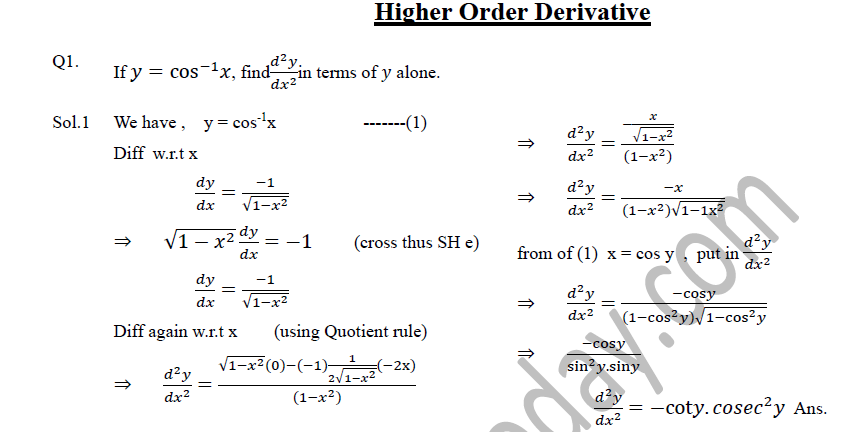

Question. If \( y = \cos^{-1}x \), find \( \frac{d^2y}{dx^2} \) in terms of \( y \) alone.
Answer: We have, \( y = \cos^{-1}x \ldots\ldots(1) \)
Diff w.r.t x
\( \frac{dy}{dx} = \frac{-1}{\sqrt{1-x^2}} \)
\( \Rightarrow \sqrt{1-x^2}\frac{dy}{dx} = -1 \quad \text{(cross mult.)} \)
\( \frac{dy}{dx} = \frac{-1}{\sqrt{1-x^2}} \)
Diff again w.r.t x (using Quotient rule)
\( \Rightarrow \frac{d^2y}{dx^2} = \frac{\sqrt{1-x^2}(0) - (-1)\frac{1}{2\sqrt{1-x^2}}(-2x)}{(1-x^2)} \)
\( \Rightarrow \frac{d^2y}{dx^2} = \frac{-\frac{x}{\sqrt{1-x^2}}}{(1-x^2)} \)
\( \Rightarrow \frac{d^2y}{dx^2} = \frac{-x}{(1-x^2)\sqrt{1-x^2}} \)
from (1) \( x = \cos y \), put in \( \frac{d^2y}{dx^2} \)
\( \Rightarrow \frac{d^2y}{dx^2} = \frac{-\cos y}{(1-\cos^2 y)\sqrt{1-\cos^2 y}} \)
\( \Rightarrow \frac{-\cos y}{\sin^2 y \cdot \sin y} \)
\( \frac{d^2y}{dx^2} = -\cot y \cdot \csc^2 y \) Ans.
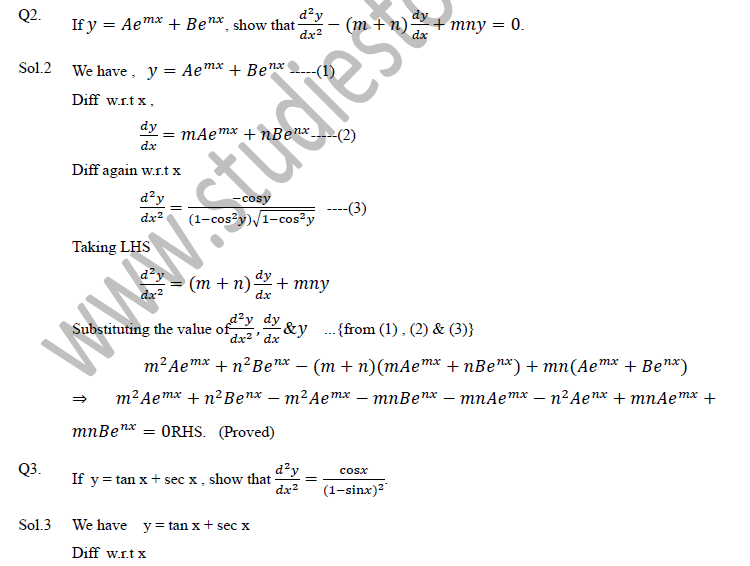
Question. If \( y = Ae^{mx} + Be^{nx} \), show that \( \frac{d^2y}{dx^2} - (m + n)\frac{dy}{dx} + mny = 0 \).
Answer: We have, \( y = Ae^{mx} + Be^{nx} \ldots\ldots(1) \)
Diff w.r.t x ,
\( \frac{dy}{dx} = mAe^{mx} + nBe^{nx} \ldots\ldots(2) \)
Diff again w.r.t x
\( \frac{d^2y}{dx^2} = m^2Ae^{mx} + n^2Be^{nx} \ldots\ldots(3) \)
Taking LHS
\( \frac{d^2y}{dx^2} - (m + n)\frac{dy}{dx} + mny \ Bir \)
Substituting the value of \( \frac{d^2y}{dx^2}, \frac{dy}{dx} \) & \( y \ldots\ldots\{\text{from (1), (2) \& (3)\} \)
\( m^2Ae^{mx} + n^2Be^{nx} - (m + n)(mAe^{mx} + nBe^{nx}) + mn(Ae^{mx} + Be^{nx}) \)
\( \Rightarrow m^2Ae^{mx} + n^2Be^{nx} - m^2Ae^{mx} - mnBe^{nx} - mnAe^{mx} - n^2Be^{nx} + mnAe^{mx} + mnBe^{nx} = 0 \) RHS. (Proved)
Question. If \( y = \tan x + \sec x \), show that \( \frac{d^2y}{dx^2} = \frac{\cos x}{(1-\sin x)^2} \).
Answer: We have \( y = \tan x + \sec x \)
Diff w.r.t x
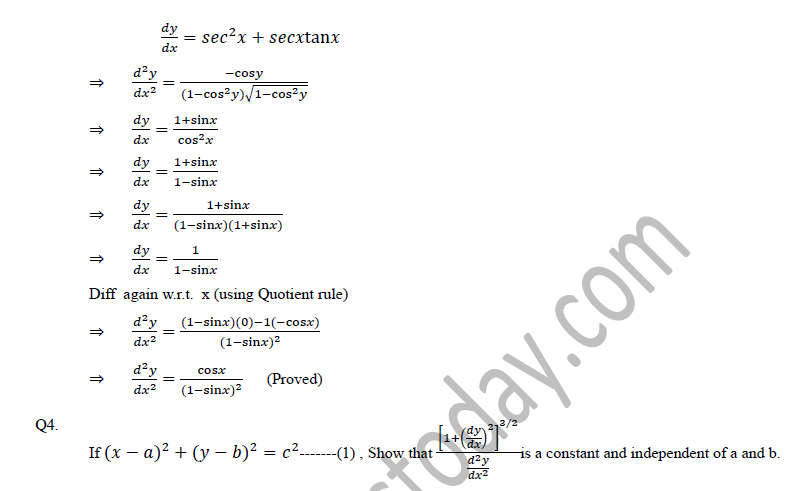
\( \frac{dy}{dx} = \sec^2 x + \sec x\tan x \)
\( \Rightarrow \frac{dy}{dx} = \frac{1+\sin x}{\cos^2 x} \)
\( \Rightarrow \frac{dy}{dx} = \frac{1+\sin x}{1-\sin^2 x} \)
\( \Rightarrow \frac{dy}{dx} = \frac{1+\sin x}{(1-\sin x)(1+\sin x)} \)
\( \Rightarrow \frac{dy}{dx} = \frac{1}{1-\sin x} \)
Diff again w.r.t. x (using Quotient rule)
\( \Rightarrow \frac{d^2y}{dx^2} = \frac{(1-\sin x)(0) - 1(-\cos x)}{(1-\sin x)^2} \)
\( \Rightarrow \frac{d^2y}{dx^2} = \frac{\cos x}{(1-\sin x)^2} \) (Proved)
Question. If \( (x - a)^2 + (y - b)^2 = c^2 \ldots\ldots(1) \), Show that \( \frac{\left[1+\left(\frac{dy}{dx}\right)^2\right]^{3/2}}{\frac{d^2y}{dx^2}} \) is a constant and independent of a and b.
Answer: We have, \( (x - a)^2 + (y - b)^2 = c^2 \ldots\ldots(1) \)
Diff w.r.t. x
\( 2(x - a) + 2(y - b)\frac{dy}{dx} = 0 \)
\( \Rightarrow (x - a) + (y - b)\frac{dy}{dx} = 0 \)
\( \Rightarrow \frac{dy}{dx} = \frac{-(x - a)}{(y - b)} \ldots\ldots(2) \)
Diff again w.r.t. x (Quotient rule on RHS)
\( \Rightarrow \frac{d^2y}{dx^2} = -\left[\frac{(y-b)(1) - (x-a)\frac{dy}{dx}}{(y-b)^2}\right] \)
\( \Rightarrow \frac{d^2y}{dx^2} = -\left[\frac{(y-b) + (x-a)\left(\frac{x-a}{y-b}\right)}{(y-b)^2}\right] \ldots\ldots\{\text{from eq. (2)\} \)
\( \Rightarrow \frac{d^2y}{dx^2} = -\left[\frac{(y-b)^2 + (x-a)^2}{(y-b)^3}\right] \)
\( \Rightarrow \frac{d^2y}{dx^2} = \frac{-(c^2)}{(y-b)^3} \ldots\ldots\{\text{From eq. (1)\} \)
Consider \( \frac{\left[1+\left(\frac{dy}{dx}\right)^2\right]^{3/2}}{\left(\frac{d^2y}{dx^2}\right)} \)
\( = \frac{\left(1 + \frac{(x-a)^2}{(y-b)^2}\right)^{3/2}}{\frac{-c^2}{(y-b)^3}} \)
\( = \frac{\left(\frac{(x-a)^2 + (y-b)^2}{(y-b)^2}\right)^{3/2}}{\frac{-c^2}{(y-b)^3}} \)
\( = \frac{\left[\frac{c^2}{(y-b)^2}\right]^{3/2}}{\frac{-c^2}{(y-b)^3}} \)
\( = \frac{\frac{c^3}{(y-b)^3}}{\frac{-c^2}{(y-b)^3}} \)
\( = \frac{c^3}{-c^2} = -c \) which is a constant and independent of a and b. (Proved)
Question. If \( x = a(\theta - \sin\theta) \) and \( y = a(1 + \cos\theta) \) find \( \frac{d^2y}{dx^2} \).
Answer: We have ,
\( x = a(\theta - \sin\theta) \qquad y = a(1 + \cos\theta) \)
Diff w.r.t. \( \theta \qquad \) Diff w.r.t \( \theta \)
\( \frac{dx}{d\theta} = a(1 - \cos\theta) \ldots\ldots(1) \qquad \frac{dy}{d\theta} = a(-\sin\theta) \)
Now \( \frac{dy}{dx} = \frac{dy/d\theta}{dx/d\theta} \)
\( \Rightarrow \frac{dy}{dx} = \frac{-a\sin\theta}{a(1-\cos\theta)} \)
\( \Rightarrow \frac{dy}{dx} = \frac{-\sin\theta}{1-\cos\theta} = \frac{-2\sin(\theta/2)\cdot\cos(\theta/2)}{2\sin^2(\theta/2)} \)
\( \Rightarrow \frac{dy}{dx} = -\cot(\theta/2) \)
Now Diff w.r.t x
\( \frac{d^2y}{dx^2} = -\left[-\csc^2\left(\frac{\theta}{2}\right)\right] \cdot \frac{1}{2} \cdot \frac{d\theta}{dx} \quad \{\text{main step}\} \)
\( \Rightarrow \frac{d^2y}{dx^2} = \frac{1}{2}\csc^2\left(\frac{\theta}{2}\right) \cdot \frac{1}{a(1-\cos\theta)} \ldots\ldots\{\text{from eq. (1)\} \)
\( \Rightarrow \frac{d^2y}{dx^2} = \frac{1}{2a} \cdot \csc^2\left(\frac{\theta}{2}\right) \cdot \frac{1}{2\sin^2(\theta/2)} \)
\( \Rightarrow \frac{d^2y}{dx^2} = \frac{1}{4a}\csc^4\left(\frac{\theta}{2}\right) \) Ans.
Question. If \( x = a(\cos\theta + \theta\sin\theta) \) & \( y = a(\sin\theta - \theta\cos\theta) \). Find \( \frac{d^2y}{dx^2} \) at \( \theta = \frac{\pi}{3} \).
Answer: We have, \( x = a(\cos\theta + \theta\sin\theta) \)
Diff w.r.t \( \theta \)
\( \frac{dx}{d\theta} = a[-\sin\theta + \theta\cdot\cos\theta + \sin\theta] \)
\( \frac{dx}{d\theta} = a\theta\cos\theta \ldots\ldots(1) \)
\( y = a(\sin\theta - \theta\cos\theta) \)
Diff w.r.t. \( \theta \)
\( \frac{dy}{d\theta} = a(\cos\theta - (-\theta\sin\theta + \cos\theta)) \)
\( \Rightarrow \frac{dy}{d\theta} = a\theta\sin\theta \)
Now \( \frac{dy}{dx} = \frac{dy/d\theta}{dx/d\theta} \)
\( \Rightarrow \frac{dy}{dx} = \frac{a\theta\sin\theta}{a\theta\cos\theta} = \tan\theta \)
Diff now w.r.t. 'x'
\( \frac{d^2y}{dx^2} = \sec^2\theta \cdot \frac{d\theta}{dx} \)
\( \Rightarrow \frac{d^2y}{dx^2} = \sec^2\theta \cdot \frac{1}{a\theta\cos\theta} = \frac{1}{a\theta} \cdot \sec^3\theta \)
\( \Rightarrow \left(\frac{d^2y}{dx^2}\right)_{\theta=\pi/3} = \frac{1}{a \cdot \frac{\pi}{3}}\sec^3(\pi/3) \)
\( \Rightarrow \left(\frac{d^2y}{dx^2}\right)_{\theta=\pi/3} = \frac{3}{a\pi}(2)^3 \ldots\ldots\{\cos\frac{\pi}{3} = 1/2 \therefore \sec\pi/3 = 2\} \)
\( \Rightarrow \left(\frac{d^2y}{dx^2}\right)_{\theta=\pi/3} = \frac{24}{a\pi} \) Ans.
Question. Find A and B so that \( y = A\sin(3x) + B\cos(3x) \) satisfies the equation \( \frac{d^2y}{dx^2} + 4\frac{dy}{dx} + 3y = 10\cos(3x) \).
Answer: We have, \( y = A\sin(3x) + B\cos(3x) \)
Diff w.r.t. x
\( \frac{dy}{dx} = 3A\cdot\cos(3x) - 3B\sin(3x) \)
Diff again w.r.t. x
\( \frac{d^2y}{dx^2} = -9A\sin(3x) - 9B\cos(3x) \)
given equation :
\( \frac{d^2y}{dx^2} + \frac{4dy}{dx} + 3y = 10\cos(3x) \)
subst. The values of \( \frac{d^2y}{dx^2}, \frac{dy}{dx}, y \)
\( -9A\sin(3x) - 9B\cos(3x) + 4(3A\cos(3x) - 3B\sin(3x)) + 3(A\sin(3x) + B\cos(3x)) = 10\cos(3x) \)
\( \Rightarrow -9A\sin(3x) - 9B\cos(3x) + 12A\cos(3x) - 12B\sin(3x) + 3(A\sin(3x) + B\cos(3x)) = 10\cos(3x) \)
\( \Rightarrow \sin(3x)[-9A - 12B + 3A] + \cos(3x)[-9B + 12A + 3B] = 10\cos(3x) \)
\( \Rightarrow \sin(3x)(-6A - 12B) + \cos(3x)(-6B + 12A) = 10\cos(3x) \)
equating the coefficients of \( \sin(3x) \) and \( \cos(3x) \) on both sides.
We have, \( -6A - 12B = 0 \)
and \( -6B + 12A = 10 \)
solving these two equations we get
\( A = \frac{2}{3}, B = \frac{-1}{3} \) Ans.
Question. If \( x = a\cos\theta + b\sin\theta \) and \( y = a\sin\theta - b\cos\theta \), show that \( y^2 \frac{d^2y}{dx^2} - x \frac{dy}{dx} + y = 0 \).
Answer: We have, \( x = a\cos\theta + b\sin\theta \qquad y = a\sin\theta - b\cos\theta \)
Diff w.r.t \( \theta \)
\( \frac{dx}{d\theta} = -a\sin\theta + b\cos\theta \qquad \frac{dy}{d\theta} = a\cos\theta + b\sin\theta \)
\( \frac{dx}{d\theta} = -(a\sin\theta - b\cos\theta) \qquad \frac{dy}{d\theta} = x \)
\( \frac{dx}{d\theta} = -y \)
Now \( \frac{dy}{dx} = \frac{dy/d\theta}{dx/d\theta} = -\frac{x}{y} \)
\( \Rightarrow y \frac{dy}{dx} = -x \ldots\ldots(1) \)
Diff again w.r.t x (product rule on LHS)
\( \Rightarrow y\cdot\frac{d^2y}{dx^2} + \frac{dy}{dx}\cdot\frac{dy}{dx} = -1 \)
\( \Rightarrow y\frac{d^2y}{dx^2} + \frac{dy}{dx}\left(\frac{-x}{y}\right) = -1 \ldots\ldots\{\text{from eq. (1)\} \)
\( \Rightarrow y^2\frac{d^2y}{dx^2} - x\frac{dy}{dx} = -y \)
\( \Rightarrow y^2\frac{d^2y}{dx^2} - x\frac{dy}{dx} + y = 0 \) (Proved)
Implicit Functions And General Differentiation
Question. If \( \log(x^2 + y^2) = 2\tan^{-1}\left(\frac{y}{x}\right) \), show that \( \frac{dy}{dx} = \frac{x+y}{x-y} \).
Answer: We have, \( \log(x^2 + y^2) = 2\tan^{-1}\left(\frac{y}{x}\right) \)
Diff. w.r.t. x
\( \frac{1}{x^2+y^2} \cdot \left(2x + 2y\frac{dy}{dx}\right) = 2 \cdot \frac{1}{1+\frac{y^2}{x^2}} \cdot \left[\frac{x\cdot\frac{dy}{dx}-y(1)}{x^2}\right] \)
\( \Rightarrow \frac{2}{x^2+y^2}\left(x + y\frac{dy}{dx}\right) = 2 \cdot \frac{x^2}{x^2+y^2}\left(\frac{xdy/dx-y}{x^2}\right) \)
\( \Rightarrow x + y\frac{dy}{dx} = x\frac{dy}{dx} - y \)
\( \Rightarrow x + y = x\frac{dy}{dx} - y\frac{dy}{dx} \)
\( \Rightarrow x + y = (x - y)\frac{dy}{dx} \)
\( \Rightarrow \frac{dy}{dx} = \frac{x+y}{x-y} \) (Proved)
Question. If \( x\sqrt{1+y} + y\sqrt{1+x} = 0 \), show that \( \frac{dy}{dx} = -\frac{1}{(1+x)^2} \).
Answer: We have, \( x\sqrt{1+y} + y\sqrt{1+x} = 0 \)
\( \Rightarrow x\sqrt{1+y} = -y\sqrt{1+x} \)
squaring
\( \Rightarrow x^2(1 + y) = y^2(1 + x) \)
\( \Rightarrow x^2 + x^2y = y^2 + y^2x \)
\( \Rightarrow x^2 - y^2 = y^2x - x^2y \)
\( \Rightarrow (x + y)(x - y) = yx(y - x) \)
\( \Rightarrow (x + y)(x - y) = -yx(x - y) \)
\( \Rightarrow x + y = -yx \)
\( \Rightarrow y + yx = -x \)
\( \Rightarrow y(1 + x) = -x \)
\( \Rightarrow y = -\frac{x}{1+x} \)
Diff w.r.t. x (Quotient rule)
\( \Rightarrow \frac{dy}{dx} = \frac{(1+x)(-1) - (-x)(1)}{(1+x)^2} \)
\( \Rightarrow \frac{dy}{dx} = \frac{-1-x+x}{(1+x)^2} \)
\( \Rightarrow \frac{dy}{dx} = -\frac{1}{(1+x)^2} \) (Proved)
Please click the link below to download CBSE Class 12 Mathematics Continuity And Differentiability Worksheet 3
Free study material for Mathematics
Download Class 12 Mathematics Chapter 05 Continuity and Differentiability Practice Worksheets
Practice Exercises for Class 12 Mathematics Chapter 05 Continuity and Differentiability
Access structured practice worksheets for Chapter 05 Continuity and Differentiability aligned with the 2026 CBSE curriculum. These downloadable exercises for Class 12 Mathematics help students build accuracy and reinforce core concepts for upcoming school tests.
Step-by-Step Solutions and Practice Guidelines
Each worksheet draws directly from authorized standard textbooks to maintain academic accuracy. Evaluating your finished exercises against expert-verified solutions helps master the formal presentation standards expected in school evaluations.
Enhance Speed with Online Practice
Consistent engagement with these exercises builds familiarity with recurring exam themes. If specific areas within Chapter 05 Continuity and Differentiability cause trouble, utilize our dedicated NCERT solutions for Class 12 Mathematics to clear up doubts immediately.
FAQs
You can download the latest chapter-wise printable worksheets for Class 12 Mathematics Chapter 05 Continuity and Differentiability for free from StudiesToday.com. These have been made as per the latest CBSE curriculum for this academic year.
Yes, Class 12 Mathematics worksheets for Chapter 05 Continuity and Differentiability focus on activity-based learning and also competency-style questions. This helps students to apply theoretical knowledge to practical scenarios.
Yes, we have provided solved worksheets for Class 12 Mathematics Chapter 05 Continuity and Differentiability to help students verify their answers instantly.
Yes, our Class 12 Mathematics test sheets are mobile-friendly PDFs and can be printed by teachers for classroom.
For Chapter 05 Continuity and Differentiability, regular practice with our worksheets will improve question-handling speed and help students understand all technical terms and diagrams.