

Official Class 12 Mathematics Worksheets: Indefinite and Definite Integrals
Explore structured practice materials through the CBSE Class 12 Mathematics Indefinite And Definite Integrals Worksheet Set 06. Tailored for Class 12 learners, utilizing these Mathematics worksheets ensures thorough preparation and strengthens problem-solving accuracy before final school evaluations.
Solved Practice Worksheets for Mathematics
Navigate directly to the solved Mathematics worksheets using the digital viewer below. Each practice set includes detailed step-by-step solutions, allowing students to instantly cross-check their work and identify areas requiring further revision.
CBSE Class 12 Mathematics Indefinite and Definite Integrals (6). Students can download these worksheets and practice them. This will help them to get better marks in examinations. Also refer to other worksheets for the same chapter and other subjects too. Use them for better understanding of the subjects.
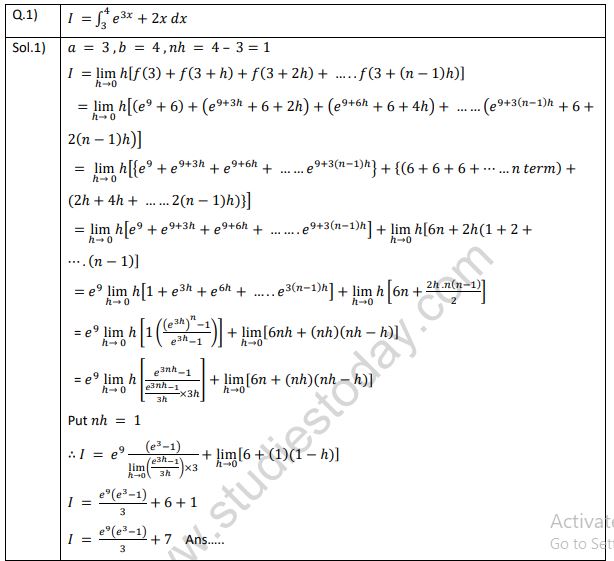
Question. Evaluate: \[ I = \int_{3}^{4} e^{3x} + 2x \, dx \]
Answer:
\( a = 3, b = 4, nh = 4 - 3 = 1 \)
\[ I = \lim_{h \to 0} h [f(3) + f(3+h) + f(3+2h) + \dots + f(3+(n-1)h)] \]
\[ = \lim_{h \to 0} h [(e^9 + 6) + (e^{9+3h} + 6 + 2h) + (e^{9+6h} + 6 + 4h) + \dots + (e^{9+3(n-1)h} + 6 + 2(n-1)h)] \]
\[ = \lim_{h \to 0} h [\{e^9 + e^{9+3h} + e^{9+6h} + \dots + e^{9+3(n-1)h}\} + \{(6 + 6 + 6 + \dots n \text{ term}) + (2h + 4h + \dots 2(n-1)h)\}] \]
\[ = \lim_{h \to 0} h [e^9 + e^{9+3h} + e^{9+6h} + \dots + e^{9+3(n-1)h}] + \lim_{h \to 0} h [6n + 2h(1 + 2 + \dots + (n-1))] \]
\[ = e^9 \lim_{h \to 0} h [1 + e^{3h} + e^{6h} + \dots + e^{3(n-1)h}] + \lim_{h \to 0} h \left[6n + \frac{2h \cdot n(n-1)}{2}\right] \]
\[ = e^9 \lim_{h \to 0} h \left[1 \left(\frac{(e^{3h})^n - 1}{e^{3h}-1}\right)\right] + \lim_{h \to 0} [6nh + (nh)(nh - h)] \]
\[ = e^9 \lim_{h \to 0} h \left[\frac{e^{3nh} - 1}{\frac{e^{3h}-1}{3h} \times 3h}\right] + \lim_{h \to 0} [6nh + (nh)(nh - h)] \]
Put \( nh = 1 \):
\[ \therefore I = e^9 \frac{(e^3 - 1)}{\lim_{h \to 0} \left(\frac{e^{3h}-1}{3h}\right) \times 3} + \lim_{h \to 0} [6 + (1)(1 - h)] \]
\[ I = \frac{e^9(e^3 - 1)}{3} + 6 + 1 \]
\[ I = \frac{e^9(e^3 - 1)}{3} + 7 \quad \text{Ans.} \]
Question. Evaluate: \[ I = \int_{\frac{\pi}{2}}^{\pi} e^x \left(\frac{1-\sin x}{1-\cos x}\right) \, dx \]
Answer:
\[ I = \int_{\frac{\pi}{2}}^{\pi} e^x \left(\frac{1-\sin x}{1-\cos x}\right) \, dx \target{} \]
\[ I = \int_{\frac{\pi}{2}}^{\pi} e^x \left(\frac{1-2 \sin \frac{x}{2} \cdot \cos \frac{x}{2}}{2 \sin^2 \frac{x}{2}}\right) \, dx \]
\[ I = \int_{\frac{\pi}{2}}^{\pi} e^x \left(\frac{1}{2} \csc^2 \left(\frac{x}{2}\right) - \cot \left(\frac{x}{2}\right)\right) \, dx \]
\[ I = \int_{\frac{\pi}{2}}^{\pi} e^x \cot \left(\frac{x}{2}\right) \, dx + \frac{1}{2} \int_{\frac{\pi}{2}}^{\pi} e^x \cdot \csc^2 \left(\frac{x}{2}\right) \, dx \]
\[ I = - \left[ \left(\cot \frac{x}{2} \cdot e^x\right)_{\pi/2}^{\pi} - \int_{\pi/2}^{\pi} -\frac{1}{2} \cdot \csc^2 \left(\frac{x}{2}\right) e^x \, dx \right] + \frac{1}{2} \int_{\frac{\pi}{2}}^{\pi} e^x \csc^2 \left(\frac{x}{2}\right) \, dx \]
\[ I = - \left[ \cot \frac{\pi}{2} \cdot e^{\pi} - \cot \frac{\pi}{4} \cdot e^{\pi/2} \right] - \frac{1}{2} \int_{\frac{\pi}{2}}^{\pi} e^x \csc^2 \left(\frac{x}{2}\right) \, dx + \frac{1}{2} \int_{\frac{\pi}{2}}^{\pi} e^x \csc^2 \left(\frac{x}{2}\right) \, dx \]
\[ I = - \left[0 - e^{\pi/2}\right] \quad \dots \{\because \cot \left(\frac{\pi}{2}\right) = 0, \cot \left(\frac{\pi}{4}\right) = 1\} \]
\[ \therefore I = e^{\frac{\pi}{2}} \quad \text{Ans.} \]
Question. Evaluate: \[ I = \int_{0}^{\frac{\pi}{2}} \sin(2x) \cdot \tan^{-1}(\sin x) \, dx \]
Answer:
\[ I = 2 \int_{0}^{\frac{\pi}{2}} \sin x \cdot \cos x \cdot \tan^{-1}(\sin x) \, dx \]
Put \( \sin x = t \), when \( x = 0 \Rightarrow t = 0 \)
\( \cos x \, dx = dt \), when \( x = \frac{\pi}{2} \Rightarrow t = 1 \)
\[ \therefore I = 2 \int_{0}^{1} t \cdot \tan^{-1}(t) \, dt \]
\[ = 2 \left[ \left( \tan^{-1} t \cdot \frac{t^2}{2} \right)_{0}^{1} - \int_{0}^{1} \frac{1}{1+t^2} \cdot \frac{t^2}{2} \, dt \right] \]
\[ = 2 \left[ \left(\frac{\pi}{4} \cdot \frac{1}{2}\right) - 0 - \frac{1}{2} \int_{0}^{1} \frac{t^2}{1+t^2} \, dt \right] \]
\[ = 2 \left[ \frac{\pi}{8} - \frac{1}{2} \int_{0}^{1} \frac{1+t^2-1}{1+t^2} \, dt \right] \]
\[ = \frac{\pi}{4} - \int_{0}^{1} 1 - \frac{1}{1+t^2} \, dt \]
\[ = \frac{\pi}{4} - [t - \tan^{-1} t]_{0}^{1} \]
\[ = \frac{\pi}{4} - \left[\left(1 - \frac{\pi}{4}\right) - 0\right] \]
\[ I = \frac{\pi}{2} - 1 \quad \text{Ans.} \]
Question. Evaluate: \[ I = \int_{0}^{\frac{\pi}{2}} \frac{x+\sin x}{1+\cos x} \, dx \]
Answer:
\[ I = \int_{0}^{\frac{\pi}{2}} \frac{x+2 \sin\left(\frac{x}{2}\right) \cdot \cos\left(\frac{x}{2}\right)}{2 \cos^2\left(\frac{x}{2}\right)} \, dx \]
\[ I = \int_{0}^{\frac{\pi}{2}} \left( \frac{x}{2\cos^2(x/2)} + \frac{2 \sin\left(\frac{x}{2}\right) \cdot \cos\left(\frac{x}{2}\right)}{2 \cos^2\left(\frac{x}{2}\right)} \right) \, dx \]
\[ I = \int_{0}^{\frac{\pi}{2}} \left( \frac{1}{2} x \sec^2 \left(\frac{x}{2}\right) + \tan \left(\frac{x}{2}\right) \right) \, dx \]
\[ I = \frac{1}{2} \int_{0}^{\frac{\pi}{2}} x \cdot \sec^2 \left(\frac{x}{2}\right) \, dx + \int_{0}^{\frac{\pi}{2}} \tan \left(\frac{x}{2}\right) \, dx \]
\[ I = \frac{1}{2} \left[ \left(x \cdot \tan \left(\frac{x}{2}\right) \cdot 2\right)_{0}^{\pi/2} - \int_{0}^{\frac{\pi}{2}} 1 \cdot \tan \left(\frac{x}{2}\right) \cdot 2 \, dx \right] + \int_{0}^{\frac{\pi}{2}} \tan \left(\frac{x}{2}\right) \, dx \]
\[ I = \frac{1}{2} \left[ \left(\frac{\pi}{2} \cdot \tan \frac{\pi}{4} \cdot 2\right) - 0 \right] - \int_{0}^{\frac{\pi}{2}} \tan \frac{x}{2} \, dx + \int_{0}^{\frac{\pi}{2}} \tan \frac{x}{2} \, dx \]
\[ I = \frac{1}{2} \left[\frac{\pi}{1}\right] = \frac{\pi}{2} \quad \text{Ans.} \]
Question. Evaluate: \[ I = \int_{0}^{\frac{\pi}{4}} \sin^3(2t) \cdot \cos(2t) \, dt \]
Answer:
Put \( \sin(2t) = z \)
\( \therefore 2 \cos(2t) \, dt = dz \), when \( t = 0 \Rightarrow z = 0 \)
\( \cos(2t) \, dt = \frac{dz}{2} \), when \( t = \frac{\pi}{4} \Rightarrow z = 1 \)
\[ \therefore I = \frac{1}{2} \int_{0}^{1} z^3 \, dz \]
\[ = \frac{1}{2} \left(\frac{z^4}{4}\right)_{0}^{1} \]
\[ = \frac{1}{2} \left(\frac{1}{4} - 0\right) \]
\[ I = \frac{1}{8} \quad \text{Ans.} \target{} \]
Question. Evaluate: \[ I = \int_{4}^{9} \frac{\sqrt{x}}{\left(30-x^{\frac{3}{2}}\right)^2} \, dx \]
Answer:
Put \( 30 - x^{3/2} = t \), when \( x = 4 \Rightarrow t = 30 - 8 = 22 \)
\( -\frac{3}{2} x^{1/2} \, dx = dt \), when \( x = 9 \Rightarrow t = 30 - 27 = 3 \)
\( \sqrt{x} \, dx = \frac{-2}{3} \, dt \)
\[ \therefore I = \frac{-2}{3} \int_{22}^{3} \frac{dt}{t^2} \]
\[ = \frac{-2}{3} \left(-\frac{1}{t}\right)_{22}^{3} \]
\[ = \frac{2}{3} \left[\frac{1}{3} - \frac{1}{22}\right] \]
\[ = \frac{2}{3} \left( \frac{22-3}{66} \right) = \frac{2(19)}{3 \times 66} = \frac{19}{99} \quad \text{Ans.} \]
Question. Evaluate: \[ \int_{0}^{\frac{\pi}{2}} \sqrt{\sin\varphi} \cdot \cos^5\varphi \, d\varphi \]
Answer:
\[ I = \int_{0}^{\frac{\pi}{2}} \sqrt{\sin\varphi} \cdot \cos^4\varphi \cdot \cos\varphi \, d\varphi \]
Put \( \sin\varphi = t \), when \( \varphi = 0 \Rightarrow t = 0 \)
\( \cos\varphi \, d\varphi = dt \), when \( \varphi = \frac{\pi}{2} \Rightarrow t = 1 \)
\[ \therefore I = \int_{0}^{1} \sqrt{t} (1 - \sin^2\varphi)^2 \cdot dt \]
\[ = \int_{0}^{1} \sqrt{t}(1 - t^2)^2 \, dt \]
\[ = \int_{0}^{1} \sqrt{t}(1 + t^4 - 2t^2) \, dt \]
\[ = \int_{0}^{1} \left( \sqrt{t} + t^{9/2} - 2t^{5/2} \right) \, dt \]
\[ = \left( \frac{2}{3} t^{3/2} + \frac{2}{11} t^{11/2} - 2 \cdot \frac{2}{7} t^{7/2} \right)_{0}^{1} \]
\[ = \left( \frac{2}{3} + \frac{2}{11} - \frac{4}{7} \right) - (0) \]
\[ = \frac{154+42-132}{231} \]
\[ = \frac{64}{231} \quad \text{Ans.} \]
Question. Evaluate: \[ I = \int_{0}^{1} \sin^{-1} \left(\frac{2x}{1+x^2}\right) \, dx \]
Answer:
\[ I = \int_{0}^{1} \sin^{-1} \left(\frac{2x}{1+x^2}\right) \, dx \]
\[ I = 2 \int_{0}^{1} \tan^{-1}x \, dx \quad \dots \left\{\because 2\tan^{-1}x = \sin^{-1} \left(\frac{2x}{1+x^2}\right)\right\} \]
\[ I = 2 \int_{0}^{1} \tan^{-1} x \cdot 1 \, dx \]
\[ = 2 \left[ (\tan^{-1}x \cdot x)_{0}^{1} - \int_{0}^{1} \frac{1}{1+x^2} \cdot x \, dx \right] \]
Put \( 1 + x^2 = t \), when \( x = 0 \Rightarrow t = 1 \)
\( x \, dx = \frac{dt}{2} \), when \( x = 1 \Rightarrow t = 2 \)
\[ \therefore I = 2 \left[ \left(\frac{\pi}{4} \cdot 1\right) - (0) - \frac{1}{2} \int_{1}^{2} \frac{dt}{t} \right] \]
\[ = 2 \left[ \frac{\pi}{4} - \frac{1}{2} (\log t)_{1}^{2} \right] \]
\[ = 2 \left[ \frac{\pi}{4} - \frac{1}{2} (\log 2 - \log 1) \right] \]
\[ = 2 \left[ \frac{\pi}{4} - \frac{1}{2} \log 2 \right] \quad \dots \{\because \log 1 = 0\} \]
\[ I = \frac{\pi}{2} - \log 2 \quad \text{Ans.} \]
Question. Evaluate: \[ I = \int_{0}^{1} \frac{1}{\sqrt{1+x}-\sqrt{x}} \, dx \]
Answer:
Rationalize:
\[ I = \int_{0}^{1} \frac{\sqrt{1+x}+\sqrt{x}}{1+x-x} \, dx \]
\[ I = \left[ \frac{2}{3} (1 + x)^{3/2} + \frac{2}{3} x^{3/2} \right]_{0}^{1} \]
\[ = \frac{2}{3} \left[ (2)^{3/2} + (1)^{3/2} \right] - \frac{2}{3} \left[ (1)^{3/2} + 0 \right] \]
\[ = \frac{2}{3} (2\sqrt{2} + 1) - \frac{2}{3} (1) \]
\[ = \frac{4\sqrt{2}}{3} + \frac{2}{3} - \frac{2}{3} \]
\[ I = \frac{4\sqrt{2}}{3} \quad \text{ans.} \]
Question. Evaluate: \[ I = \int_{0}^{1} \frac{2x+3}{5x^2+1} \, dx \]
Answer:
\[ I = \int_{0}^{1} \frac{2x+3}{5x^2+1} \, dx \quad (\text{separate}) \]
\[ I = 2 \int_{0}^{1} \frac{x}{5x^2+1} \, dx + 3 \int_{0}^{1} \frac{1}{5x^2+1} \, dx \]
Put \( 5x^2 + 1 = t \), when \( x = 0 \Rightarrow t = 1 \)
\( 10x \, dx = dt \), when \( x = 1 \Rightarrow t = 6 \)
\( x \, dx = \frac{dt}{10} \)
\[ \therefore I = \frac{2}{10} \int_{1}^{6} \frac{dt}{t} + \frac{3}{5} \int_{0}^{1} \frac{1}{x^2+\left(\frac{1}{\sqrt{5}}\right)^2} \, dt \]
\[ = \frac{1}{5} [\log t]_{1}^{6} + \frac{3}{5} \times \sqrt{5} \left[ \tan^{-1}(x\sqrt{5}) \right]_{0}^{1} \]
\[ = \frac{1}{5} \left[ (\log 6 - \log 1) + \frac{3}{\sqrt{5}} (\tan^{-1}\sqrt{5} - \tan^{-1}0) \right] \]
\[ I = \frac{1}{5} \log 6 + \frac{3}{\sqrt{5}} \tan^{-1}(\sqrt{5}) \quad \text{ans.} \]
Please click the link below to download CBSE Class 12 Mathematics Indefinite and Definite Integrals (6)
Free study material for Mathematics
Free CBSE Practice Worksheets: Class 12 Mathematics Indefinite and Definite Integrals
Practice Exercises for Class 12 Mathematics Indefinite and Definite Integrals
Explore reliable practice questions for Indefinite and Definite Integrals tailored for Class 12 Mathematics learners. Use these structured worksheets to evaluate exam preparedness and strengthen problem-solving skills throughout the 2026 academic session.
Step-by-Step Solutions and Practice Guidelines
Designed around the official curriculum for Class 12 Mathematics, these practice sheets guarantee standard compliance. Reviewing step-by-step solutions after completion sharpens your accuracy and clarifies complex sub-topics within Indefinite and Definite Integrals.
Enhance Speed with Online Practice
Wrap up your chapter revision by testing your knowledge against standard objective question formats. Explore our full library of free, up-to-date printable assignments to maximize your academic results in upcoming CBSE evaluations.
FAQs
You can download the latest chapter-wise printable worksheets for Class 12 Mathematics Indefinite and Definite Integrals for free from StudiesToday.com. These have been made as per the latest CBSE curriculum for this academic year.
Yes, Class 12 Mathematics worksheets for Indefinite and Definite Integrals focus on activity-based learning and also competency-style questions. This helps students to apply theoretical knowledge to practical scenarios.
Yes, we have provided solved worksheets for Class 12 Mathematics Indefinite and Definite Integrals to help students verify their answers instantly.
Yes, our Class 12 Mathematics test sheets are mobile-friendly PDFs and can be printed by teachers for classroom.
For Indefinite and Definite Integrals, regular practice with our worksheets will improve question-handling speed and help students understand all technical terms and diagrams.