

Chapter-wise Worksheets for Class 12 Mathematics: Chapter 04 Determinants
Access comprehensive chapter-wise worksheets for Chapter 04 Determinants using the CBSE Class 12 Mathematics Determinants Worksheet Set 01. Designed to align with the 2026-27 academic syllabus for Class 12 Mathematics, these printable practice sets help students reinforce key concepts and improve their overall exam readiness.
Practice Class 12 Mathematics Worksheets: Chapter 04 Determinants
Access the complete worksheet PDF for Class 12 Mathematics below. Regular practice with these targeted academic tasks builds familiarity with standard question patterns and helps secure higher marks in final school examinations.
CBSE Class 12 Mathematics Determinants Worksheet (1). The Determinants questions in the worksheets have been specifically designed by best mathematics teachers so that the students can practise them to clear their Determinants concepts and get better marks in class 12 mathematics tests and examinations. Students can free download these Determinants worksheets in pdf and practice them. This will help them to get better marks in examinations. Also refer to other worksheets for the Determinants chapter and other subjects too. Use them for better understanding of the subjects.
Question. If A and B are invertible matrices then which of the following is not correct
(a) AdjA = |A|.A–1
(b) det(A–1) = (det A)–1
(c) (AB)–1 = B–1 A–1
(d) (A + B)–1 = A–1 + B–1
Answer : D
Question. If A is a square matrix of order 3, such that A(adjA) = 10I, then |adj A| is equal to
(a) 1
(b) 10
(c) 100
(d) 1000
Answer : C
Question. Let A be a square matrix of order 3 × 3 and k a scalar, then |kA| is equal to
(a) k |A|
(b) |k| |A|
(c) k3 |A|
(d) none of these
Answer : C
Question. Let A be a non-angular square matrix of order 3 × 3, then |A . adj A| is equal to
(a) |A|3
(b) |A|2
(c) |A|
(d) 3|A|
Answer : A
Question. Let A be a square matrix of order 2 × 2, then |KA| is equal to
(a) K|A|
(b) K2|A|
(c) K3|A|
(d) 2K|A|
Answer : B
CASE STUDY QUESTIONS
1. Manjit wants to donate a rectangular plot of land for a school in his village. When he was asked to give dimensions of the plot, he told that if its length is decreased by 50 m and breadth is increased by 50 m, then its area will remain same, but if length is decreased by 10 m and breadth is decreased by 20 m, then its area will decrease by 5300 m2.
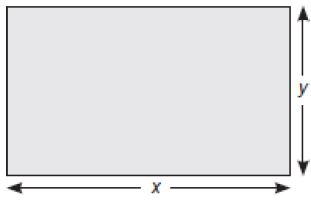
information given above, answer the following questions:
Question. The equations in terms of X and Y are
(i) x – y = 50, 2x – y = 550
(ii) x – y = 50, 2x + y = 550
(iii) x + y = 50, 2x + y = 550
(iv) x + y = 50, 2x + y = 550
Answer : II
Question. The value of x (length of rectangular field) is
(i) 150 m
(ii) 400 m
(iii) 200 m
(iv) 320 m
Answer : III
Question. The value of y (breadth of rectangular field) is
(i) 150 m
(ii) 200 m
(iii) 430 m
(iv) 350 m
Answer : I
Question. How much is the area of rectangular field?
(i) 60000 sq m.
(ii) 30000 sq m.
(iii) 30000 m
(iv) 3000 m
Answer : II
2 Read the following text and answer the following questions on the basis of the same:
Two schools Oxford and Navdeep want to award their selected students on the values of sincerity, truthfulness and helpfulness. Oxford wants to award Ex each, y each and z each for the three respective values to 3,2 and 1 students respectively with a total award money of 1600. Navdeep wants to spend 2300 to award its 4, 1 and 3 students on the respective values (by giving the same amount to the three values as before). The total amount of the award for one prize on each is ₹900.

Question. Value of x + y + z is
(a) 800
(b) 900
(c) 1000
(d) 1200
Answer : B
Question. Value of 4x + y + 3z is
(a) 1600
(b) 2300
(c) 900
(d) 1200
Answer : B
Question. The value of y is
(a) 200
(b) 250
(c) 300
(d) 350
Answer : C
Question. The value of 2x + 3 y = ⋯ … … … ..
(a) 1000
(b) 1100
(c) 1200
(d) 1300
Answer : D
Question. The value of y − x = ⋯ … … … …
(a) 100
(b) 200
(c) 300
(d) 400
Answer : A
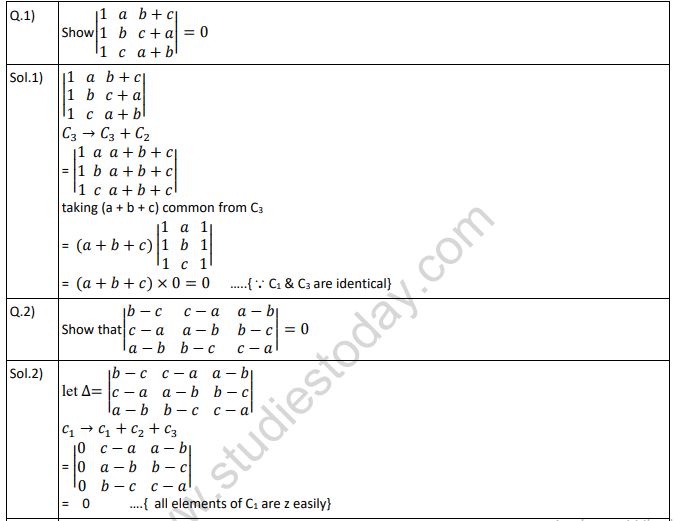
Question. Show \[ \begin{vmatrix} 1 & a & b + c \\ 1 & b & c + a \\ 1 & c & a + b \end{vmatrix} = 0 \]
Answer:
\[ \begin{vmatrix} 1 & a & b + c \\ 1 & b & c + a \\ 1 & c & a + b \end{vmatrix} \] Applying \( C_3 \to C_3 + C_2 \):
\[ = \begin{vmatrix} 1 & a & a + b + c \\ 1 & b & a + b + c \\ 1 & c & a + b + c \end{vmatrix} \] taking \( (a + b + c) \) common from \( C_3 \):
\[ = (a + b + c) \begin{vmatrix} 1 & a & 1 \\ 1 & b & 1 \\ 1 & c & 1 \end{vmatrix} \]
\[ = (a + b + c) \times 0 = 0 \quad \dots \{ \because C_1 \text{ \& } C_3 \text{ are identical} \} \]
Question. Show that \[ \begin{vmatrix} b - c & c - a & a - b \\ c - a & a - b & b - c \\ a - b & b - c & c - a \end{vmatrix} = 0 \]
Answer:
let \( \Delta = \begin{vmatrix} b - c & c - a & a - b \\ c - a & a - b & b - c \\ a - b & b - c & c - a \end{vmatrix} \)
Applying \( C_1 \to C_1 + C_2 + C_3 \):
\[ = \begin{vmatrix} 0 & c - a & a - b \\ 0 & a - b & b - c \\ 0 & b - c & c - a \end{vmatrix} \]
\[ = 0 \quad \dots \{ \text{all elements of } C_1 \text{ are zero} \} \]
Question. Show that \[ \begin{vmatrix} \sin\alpha & \cos\alpha & \sin(\alpha + S) \\ \sin\beta & \cos\beta & \sin(\beta + S) \\ \sin\gamma & \cos\gamma & \sin(\gamma + S) \end{vmatrix} = 0 \]
Answer:
\[ \Delta = \begin{vmatrix} \sin\alpha & \cos\alpha & \sin\alpha \cdot \cos S + \cos\alpha \cdot \sin S \\ \sin\beta & \cos\beta & \sin\beta \cdot \cos S + \cos\beta \cdot \sin S \\ \sin\gamma & \cos\gamma & \sin\gamma \cdot \cos S + \cos\gamma \cdot \sin S \end{vmatrix} \] Applying sum property in \( C_3 \):
\[ = \begin{vmatrix} \sin\alpha & \cos\alpha & \sin\alpha \cdot \cos S \\ \sin\beta & \cos\beta & \sin\beta \cdot \cos S \\ \sin\gamma & \cos\gamma & \sin\gamma \cdot \cos S \end{vmatrix} + \begin{vmatrix} \sin\alpha & \cos\alpha & \cos\alpha \cdot \sin S \\ \sin\beta & \cos\beta & \cos\beta \cdot \sin S \\ \sin\gamma & \cos\gamma & \cos\gamma \cdot \sin S \end{vmatrix} \]
\[ = \cos S \begin{vmatrix} \sin\alpha & \cos\alpha & \sin\alpha \\ \sin\beta & \cos\beta & \sin\beta \\ \sin\gamma & \cos\gamma & \sin\gamma \end{vmatrix} + \sin S \begin{vmatrix} \sin\alpha & \cos\alpha & \cos\alpha \\ \sin\beta & \cos\beta & \cos\beta \\ \sin\gamma & \cos\gamma & \cos\gamma \end{vmatrix} \]
\[ = \cos S(0) + \sin S(0) = 0 \quad \text{ans.} \]
Question. If \( a, b, c \) are in A.P., find the value of \[ \begin{vmatrix} 2y + 4 & 5y + 7 & 8y + a \\ 3y + 5 & 6y + 8 & 9y + b \\ 4y + 6 & 7y + 9 & 10y + c \end{vmatrix} \]
Answer:
let \( \Delta = \begin{vmatrix} 2y + 4 & 5y + 7 & 8y + a \\ 3y + 5 & 6y + 8 & 9y + b \\ 4y + 6 & 7y + 9 & 10y + c \end{vmatrix} \)
given \( a, b, c \) are in A.P. \( \Rightarrow a + c = 2b \)
Applying \( R_1 \to R_1 + R_3 \):
\[ = \begin{vmatrix} 6y + 10 & 12y + 16 & 18y + a + c \\ 3y + 5 & 6y + 8 & 9y + b \\ 4y + 6 & 7y + 9 & 10y + c \end{vmatrix} \]
\[ = \begin{vmatrix} 6y + 10 & 12y + 16 & 18y + 2b \\ 3y + 5 & 6y + 8 & 9y + b \\ 4y + 6 & 7y + 9 & 10y + c \end{vmatrix} \quad \dots \{ \because a + c = 2b \} \]
taking \( 2 \) common from \( R_1 \):
\[ = 2 \begin{vmatrix} 3y + 5 & 6y + 8 & 9y + b \\ 3y + 5 & 6y + 8 & 9y + b \\ 4y + 6 & 7y + 9 & 10y + c \end{vmatrix} \]
clearly \( R_1 \) and \( R_2 \) are identical
\[ \therefore 2 \times 0 = 0 \quad \text{ans.} \]
Question. Show that \[ \begin{vmatrix} (a^x + a^{-x})^2 & (a^x - a^{-x})^2 & 1 \\ (a^y + a^{-y})^2 & (a^y - a^{-y})^2 & 1 \\ (a^z + a^{-z})^2 & (a^z - a^{-z})^2 & 1 \end{vmatrix} = 0 \]
Answer:
Applying \( C_1 \to C_1 - C_2 \):
\[ = \begin{vmatrix} (a^x + a^{-x})^2 - (a^x - a^{-x})^2 & (a^x - a^{-x})^2 & 1 \\ (a^y + a^{-y})^2 - (a^y - a^{-y})^2 & (a^y - a^{-y})^2 & 1 \\ (a^z + a^{-z})^2 - (a^z - a^{-z})^2 & (a^z - a^{-z})^2 & 1 \end{vmatrix} \]
\[ = \begin{vmatrix} 4 & (a^x - a^{-x})^2 & 1 \\ 4 & (a^y - a^{-y})^2 & 1 \\ 4 & (a^z - a^{-z})^2 & 1 \end{vmatrix} \quad \dots \{ \because (a + b)^2 - (a - b)^2 = 4ab \text{ where } 4ab = 4a^x \cdot a^{-x} = 4 \} \]
\[ = 4 \begin{vmatrix} 1 & (a^x - a^{-x})^2 & 1 \\ 1 & (a^y - a^{-y})^2 & 1 \\ 1 & (a^z - a^{-z})^2 & 1 \end{vmatrix} \]
\[ = 4 \times 0 = 0 \quad \dots \{ \because C_1 \text{ \& } C_3 \text{ are identical} \} \]
Question. Show that \[ \begin{vmatrix} 41 & 1 & 5 \\ 79 & 7 & 9 \\ 29 & 5 & 3 \end{vmatrix} = 0 \]
Answer:
let \( \Delta = \begin{vmatrix} 41 & 1 & 5 \\ 79 & 7 & 9 \\ 29 & 5 & 3 \end{vmatrix} \)
Applying \( C_2 \to C_2 + 8C_3 \):
\[ = \begin{vmatrix} 41 & 41 & 5 \\ 79 & 79 & 9 \\ 29 & 29 & 3 \end{vmatrix} \]
\[ = 0 \quad \dots \{ \because C_1 \text{ \& } C_2 \text{ are identical} \} \]
Question. Show \[ \begin{vmatrix} b^2c^2 & bc & b + c \\ c^2a^2 & ca & c + a \\ a^2b^2 & ab & a + b \end{vmatrix} = 0 \]
Answer:
Applying \( R_1 \to aR_1 \), \( R_2 \to bR_2 \) and \( R_3 \to cR_3 \):
\[ = \frac{1}{abc} \begin{vmatrix} ab^2c^2 & abc & ab + ac \\ bc^2a^2 & abc & bc + ab \\ ca^2b^2 & abc & ca + bc \end{vmatrix} \]
taking \( abc \) common from \( C_1 \) and \( C_2 \):
\[ = \frac{1}{abc} \cdot (abc)(abc) \begin{vmatrix} bc & 1 & ab + ac \\ ca & 1 & bc + ab \\ ab & 1 & ca + bc \end{vmatrix} \]
Applying \( C_3 \to C_3 + C_1 \):
\[ = abc \begin{vmatrix} bc & 1 & ab + bc + ca \\ ca & 1 & ab + bc + ca \\ ab & 1 & ab + bc + ca \end{vmatrix} \]
taking \( (ab + bc + ca) \) common from \( C_3 \):
\[ = abc(ab + bc + ca) \begin{vmatrix} bc & 1 & 1 \\ ca & 1 & 1 \\ ab & 1 & 1 \end{vmatrix} \]
\[ = abc(ab + bc + ca)(0) = 0 \quad \dots \{ \because C_2 \text{ \& } C_3 \text{ are identical} \} \]
Question. Show that \[ \begin{vmatrix} 1 & a & a^2 - bc \\ 1 & b & b^2 - ca \\ 1 & c & c^2 - ab \end{vmatrix} = 0 \]
Answer:
let \( \Delta = \begin{vmatrix} 1 & a & a^2 - bc \\ 1 & b & b^2 - ca \\ 1 & c & c^2 - ab \end{vmatrix} \)
Applying sum property in \( C_3 \):
\[ = \begin{vmatrix} 1 & a & a^2 \\ 1 & b & b^2 \\ 1 & c & c^2 \end{vmatrix} - \begin{vmatrix} 1 & a & bc \\ 1 & b & ca \\ 1 & c & ab \end{vmatrix} \]
For the second determinant, applying \( R_1 \to aR_1, R_2 \to bR_2, R_3 \to cR_3 \):
\[ = \begin{vmatrix} 1 & a & a^2 \\ 1 & b & b^2 \\ 1 & c & c^2 \end{vmatrix} - \frac{1}{abc} \begin{vmatrix} a & a^2 & abc \\ b & b^2 & abc \\ c & c^2 & abc \end{vmatrix} \]
taking \( abc \) common from \( C_3 \) in the second determinant:
\[ = \begin{vmatrix} 1 & a & a^2 \\ 1 & b & b^2 \\ 1 & c & c^2 \end{vmatrix} - \frac{abc}{abc} \begin{vmatrix} a & a^2 & 1 \\ b & b^2 & 1 \\ c & c^2 & 1 \end{vmatrix} \]
Applying \( C_2 \leftrightarrow C_3 \) on the second determinant:
\[ = \begin{vmatrix} 1 & a & a^2 \\ 1 & b & b^2 \\ 1 & c & c^2 \end{vmatrix} + \begin{vmatrix} a & 1 & a^2 \\ b & 1 & b^2 \\ c & 1 & c^2 \end{vmatrix} \]
again \( C_1 \leftrightarrow C_2 \) on the second determinant:
\[ = \begin{vmatrix} 1 & a & a^2 \\ 1 & b & b^2 \\ 1 & c & c^2 \end{vmatrix} - \begin{vmatrix} 1 & a & a^2 \\ 1 & b & b^2 \\ 1 & c & c^2 \end{vmatrix} \]
\[ = 0 \quad \text{ans.} \]
Question. If \( a, b, c \) are the \( p^{\text{th}}, q^{\text{th}} \text{ and } r^{\text{th}} \) terms of G.P., then show that \[ \begin{vmatrix} \log a & p & 1 \\ \log b & q & 1 \\ \log c & r & 1 \end{vmatrix} = 0 \]
Answer:
We know \( n^{\text{th}} \) term of G.P.: \( a_n = A R^{n-1} \)
here let \( A \to \text{1}^{\text{st}} \text{ term and } R \to \text{common ratio} \)
\[ \therefore a_p = a = A R^{p-1} ; \quad a_q = b = A R^{q-1} ; \quad a_r = c = A R^{r-1} \]
taking log on both sides:
\[ \log a = \log(A R^{p-1}) ; \quad \log b = \log(A R^{q-1}) ; \quad \log c = \log(A R^{r-1}) \]
\[ \Rightarrow \log a = \log A + (p-1)\log R \]
\[ \log b = \log A + (q-1)\log R \]
\[ \log c = \log A + (r-1)\log R \]
Now let \( \Delta = \begin{vmatrix} \log a & p & 1 \\ \log b & q & 1 \\ \log c & r & 1 \end{vmatrix} \)
putting values of \( \log a \), \( \log b \) and \( \log c \):
\[ = \begin{vmatrix} \log A + (p - 1)\log R & p & 1 \\ \log A + (q - 1)\log R & q & 1 \\ \log A + (r - 1)\log R & r & 1 \end{vmatrix} \]
Applying sum property in \( C_1 \):
\[ = \begin{vmatrix} \log A & p & 1 \\ \log A & q & 1 \\ \log A & r & 1 \end{vmatrix} + \begin{vmatrix} (p - 1)\log R & p & 1 \\ (q - 1)\log R & q & 1 \\ (r - 1)\log R & r & 1 \end{vmatrix} \]
\[ = \log A \begin{vmatrix} 1 & p & 1 \\ 1 & q & 1 \\ 1 & r & 1 \end{vmatrix} + \log R \begin{vmatrix} p - 1 & p & 1 \\ q - 1 & q & 1 \\ r - 1 & r & 1 \end{vmatrix} \]
Applying \( C_1 \to C_1 + C_3 \) on the second determinant:
\[ = \log A \begin{vmatrix} 1 & p & 1 \\ 1 & q & 1 \\ 1 & r & 1 \end{vmatrix} + \log R \begin{vmatrix} p & p & 1 \\ q & q & 1 \\ r & r & 1 \end{vmatrix} \]
\[ = \log A \times (0) + \log R \times (0) \]
\[ = 0 + 0 = 0 \quad \text{ans.} \]
Question. Show \[ \begin{vmatrix} a & b & c \\ x & y & z \\ p & q & r \end{vmatrix} = \begin{vmatrix} y & b & q \\ x & a & p \\ z & c & r \end{vmatrix} \]
Answer:
let \( \Delta = \begin{vmatrix} a & b & c \\ x & y & z \\ p & q & r \end{vmatrix} \)
\[ = \begin{vmatrix} a & x & p \\ b & y & q \\ c & z & r \end{vmatrix} \quad \dots \{ \because |A| = |A'| \} \]
Applying \( C_1 \leftrightarrow C_2 \):
\[ = - \begin{vmatrix} x & a & p \\ y & b & q \\ z & c & r \end{vmatrix} \]
Applying \( R_2 \leftrightarrow R_1 \):
\[ = (-)(-) \begin{vmatrix} y & b & q \\ x & a & p \\ z & c & r \end{vmatrix} \]
\[ = \begin{vmatrix} y & b & q \\ x & a & p \\ z & c & r \end{vmatrix} = \text{RHS Proved} \]
Please click the link below to download CBSE Class 12 Mathematics Determinants Worksheet (1)
Free study material for Mathematics
Free CBSE Practice Worksheets: Class 12 Mathematics Chapter 04 Determinants
Practice Exercises for Class 12 Mathematics Chapter 04 Determinants
Review targeted practice exercises for Class 12 Mathematics Chapter 04 Determinants. Curated to match official CBSE guidelines, these printable problem sets support daily revision and improve overall test readiness.
Step-by-Step Solutions and Practice Guidelines
Built using official NCERT guidelines for Class 12 Mathematics, these practice sheets provide reliable academic support. Cross-reference your completed work with our detailed solutions to learn standard answer-writing formats for CBSE exams.
Enhance Speed with Online Practice
Wrap up your chapter revision by testing your knowledge against standard objective question formats. Explore our full library of free, up-to-date printable assignments to maximize your academic results in upcoming CBSE evaluations.
FAQs
You can download the latest chapter-wise printable worksheets for Class 12 Mathematics Chapter 04 Determinants for free from StudiesToday.com. These have been made as per the latest CBSE curriculum for this academic year.
Yes, Class 12 Mathematics worksheets for Chapter 04 Determinants focus on activity-based learning and also competency-style questions. This helps students to apply theoretical knowledge to practical scenarios.
Yes, we have provided solved worksheets for Class 12 Mathematics Chapter 04 Determinants to help students verify their answers instantly.
Yes, our Class 12 Mathematics test sheets are mobile-friendly PDFs and can be printed by teachers for classroom.
For Chapter 04 Determinants, regular practice with our worksheets will improve question-handling speed and help students understand all technical terms and diagrams.