

Official Class 12 Mathematics Worksheets: Chapter 04 Determinants
Review targeted academic worksheets with the CBSE Class 12 Mathematics Determinants Worksheet Set 05. Built according to official educational standards for the 2026-27 term, these downloadable Class 12 Mathematics resources support effective daily practice and detailed self-evaluation for Chapter 04 Determinants.
Solved Practice Worksheets for Mathematics
Access the complete worksheet PDF for Class 12 Mathematics below. Regular practice with these targeted academic tasks builds familiarity with standard question patterns and helps secure higher marks in final school examinations.
CBSE Class 12 Mathematics Determinants Worksheet (5). The Determinants questions in the worksheets have been specifically designed by best mathematics teachers so that the students can practise them to clear their Determinants concepts and get better marks in class 12 mathematics tests and examinations. Students can free download these Determinants worksheets in pdf and practice them. This will help them to get better marks in examinations. Also refer to other worksheets for the Determinants chapter and other subjects too. Use them for better understanding of the subjects.
Solving System of Linear Equations (Matrix Method)
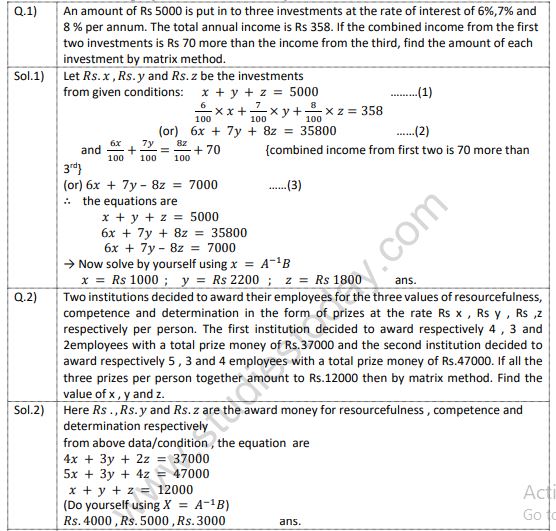
Question. An amount of Rs 5000 is put in to three investments at the rate of interest of 6%,7% and 8% per annum. The total annual income is Rs 358. If the combined income from the first two investments is Rs 70 more than the income from the third, find the amount of each investment by matrix method.
Answer: Let \( \text{Rs. } x \), \( \text{Rs. } y \) and \( \text{Rs. } z \) be the investments
from given conditions:
\[ x + y + z = 5000 \qquad \dots\dots(1) \]
\[ \frac{6}{100} \times x + \frac{7}{100} \times y + \frac{8}{100} \times z = 358 \]
\[ \text{(or) } 6x + 7y + 8z = 35800 \qquad \dots\dots(2) \]
and
\[ \frac{6x}{100} + \frac{7y}{100} = \frac{8z}{100} + 70 \quad \text{{combined income from first two is 70 more than 3rd}} \]
\[ \text{(or) } 6x + 7y - 8z = 7000 \qquad \dots\dots(3) \]
\( \therefore \) the equations are
\[ x + y + z = 5000 \]
\[ 6x + 7y + 8z = 35800 \]
\[ 6x + 7y - 8z = 7000 \]
\( \rightarrow \) Now solve by yourself using \( X = A^{-1}B \)
\( x = \text{Rs } 1000 \); \( y = \text{Rs } 2200 \); \( z = \text{Rs } 1800 \) ans.
Question. Two institutions decided to award their employees for the three values of resourcefulness, competence and determination in the form of prizes at the rate Rs x, Rs y, Rs z respectively per person. The first institution decided to award respectively 4, 3 and 2 employees with a total prize money of Rs.37000 and the second institution decided to award respectively 5, 3 and 4 employees with a total prize money of Rs.47000. If all the three prizes per person together amount to Rs.12000 then by matrix method. Find the value of x, y and z.
Answer: Here \( \text{Rs. } x \), \( \text{Rs. } y \) and \( \text{Rs. } z \) are the award money for resourcefulness, competence and determination respectively.
from above data/condition, the equations are:
\[ 4x + 3y + 2z = 37000 \]
\[ 5x + 3y + 4z = 47000 \]
\[ x + y + z = 12000 \]
(Do yourself using \( X = A^{-1}B \))
\( \text{Rs. } 4000 \), \( \text{Rs. } 5000 \), \( \text{Rs. } 3000 \) ans.
Question. Two school’s P and Q decided to award prizes for (1) academic (2) sports (3) all-rounder achievements. School P awarded Rs 12000 to 3, 1, 1 students while Q awarded Rs 7,000 to 1, 0, 2 students in the above categories. All the three prizes amount to Rs 6000. Find matrix representation of the above situation form equations and solve them by matrix method to find value of each prize. Do you agree that prizes should be given for honestly and good character also? Give reasons.
Answer: Let \( \text{Rs. } x \), \( \text{Rs. } y \), and \( \text{Rs. } z \) are the awarded money for academic, sports and all rounder achievement respectively.
the matrix form is
\[ \begin{bmatrix} 3 & 1 & 1 \newline 1 & 0 & 2 \newline 1 & 1 & 1 \end{bmatrix} \begin{bmatrix} x \newline y \newline z \end{bmatrix} = \begin{bmatrix} 12000 \newline 7000 \newline 6000 \end{bmatrix} \]
(or) \( AX = B \Rightarrow X = A^{-1}B \)
Equations are:
\[ 3x + y + z = 12000 \]
\[ x + 0y + 2z = 7000 \]
and \( x + y + z = 600 \)
\( \text{Rs. } 3000 \), \( \text{Rs. } 1000 \text{ and } \text{Rs. } 2000 \) ans.
Properties of Determinants & Adjoint
Question. Show that \( A = \begin{bmatrix} 2 & -3 \newline 3 & 4 \end{bmatrix} \) satisfies the equation \( f(x) = x^2 - 6x + 17 = 0 \). Hence find \( A^{-1} \).
Answer: We have \( A = \begin{bmatrix} 2 & -3 \newline 3 & 4 \end{bmatrix} \)
\[ A^2 = \begin{bmatrix} 2 & -3 \newline 3 & 4 \end{bmatrix} \begin{bmatrix} 2 & -3 \newline 3 & 4 \end{bmatrix} = \begin{bmatrix} -5 & -18 \newline 18 & 7 \end{bmatrix} \]
given \( f(x) = x^2 - 6x + 17 \)
\[ \Rightarrow f(A) = A^2 - 6A + 17I \]
\[ = \begin{bmatrix} -5 & -18 \newline 18 & 7 \end{bmatrix} - \begin{bmatrix} 12 & -18 \newline 18 & 24 \end{bmatrix} + \begin{bmatrix} 17 & 0 \newline 0 & 17 \end{bmatrix} \]
\[ A^2 - 6A + 17I = \begin{bmatrix} 0 & 0 \newline 0 & 0 \end{bmatrix} = 0 \]
Clearly \( A \) satisfies the equation \( x^2 - 6x + 17 = 0 \).
Now we have, \( A^2 - 6A + 17I = 0 \)
Pre-multiply by \( A^{-1} \)
\[ \Rightarrow A^{-1}A^2 - 6A^{-1}A + 17A^{-1}I = A^{-1}0 \]
\[ \Rightarrow A^{-1}A \cdot A - 6I + 17A^{-1} = 0 \]
\[ \Rightarrow IA - 6I + 17A^{-1} = 0 \]
\[ \Rightarrow A - 6I + 17A^{-1} = 0 \]
\[ \Rightarrow 17A^{-1} = 6I - A \]
\[ \Rightarrow 17A^{-1} = \begin{bmatrix} 6 & 0 \newline 0 & 6 \end{bmatrix} - \begin{bmatrix} 2 & -3 \newline 3 & 4 \end{bmatrix} = \begin{bmatrix} 4 & 3 \newline -3 & 2 \end{bmatrix} \]
\[ \Rightarrow A^{-1} = \frac{1}{17} \begin{bmatrix} 4 & 3 \newline -3 & 2 \end{bmatrix} \quad \text{ans.} \]
Question. If \( A = \begin{bmatrix} 1 & 1 & 1 \newline 1 & 2 & -3 \newline 2 & -1 & 3 \end{bmatrix} \) show that \( A^3 - 6A^2 + 5A + 11 I = 0 \) and hence find \( A^{-1} \).
Answer:
\[ A = \begin{bmatrix} 1 & 1 & 1 \newline 1 & 2 & -3 \newline 2 & -1 & 3 \end{bmatrix} \]
\[ A^2 = A \cdot A = \begin{bmatrix} 1 & 1 & 1 \newline 1 & 2 & -3 \newline 2 & -1 & 3 \end{bmatrix} \begin{bmatrix} 1 & 1 & 1 \newline 1 & 2 & -3 \newline 2 & -1 & 3 \end{bmatrix} = \begin{bmatrix} 4 & 2 & 1 \newline -3 & 8 & -14 \newline 7 & -3 & 14 \end{bmatrix} \]
\[ A^3 = A^2 \cdot A = \begin{bmatrix} 4 & 2 & 1 \newline -3 & 8 & -14 \newline 7 & -3 & 14 \end{bmatrix} \begin{bmatrix} 1 & 1 & 1 \newline 1 & 2 & -3 \newline 2 & -1 & 3 \end{bmatrix} = \begin{bmatrix} 8 & 7 & 1 \newline -23 & 27 & -69 \newline 32 & -13 & 58 \end{bmatrix} \]
Now \( A^3 - 6A^2 + 5A + 11 I \)
\[ = \begin{bmatrix} 8 & 7 & 1 \newline -23 & 27 & -69 \newline 32 & -13 & 58 \end{bmatrix} - 6 \begin{bmatrix} 4 & 2 & 1 \newline -3 & 8 & -14 \newline 7 & -3 & 14 \end{bmatrix} + 5 \begin{bmatrix} 1 & 1 & 1 \newline 1 & 2 & -3 \newline 2 & -1 & 3 \end{bmatrix} + 11 \begin{bmatrix} 1 & 0 & 0 \newline 0 & 1 & 0 \newline 0 & 0 & 1 \end{bmatrix} \]
\[ = \begin{bmatrix} 0 & 0 & 0 \newline 0 & 0 & 0 \newline 0 & 0 & 0 \end{bmatrix} = 0 \quad \text{(proved)} \]
(ii) we have \( A^3 - 6A^2 + 5A + 11 I = 0 \)
Pre-multiply by \( A^{-1} \)
\[ \Rightarrow A^{-1}A^3 - 6A^{-1}A^2 + 5AA^{-1} + 11A^{-1}I = A^{-1}0 \]
\[ \Rightarrow A^{-1}A \cdot A^2 - 6A^{-1}A \cdot A + 5I + 11A^{-1}I = 0 \]
\[ \Rightarrow I A^2 - 6 I A + 5 I + 11A^{-1} = 0 \]
\[ \Rightarrow A^2 - 6 A + 5 I + 11A^{-1} = 0 \]
\[ \Rightarrow 11A^{-1} = 6A - A^2 - 5 I \]
\[ = 6 \begin{bmatrix} 1 & 1 & 1 \newline 1 & 2 & -3 \newline 2 & -1 & 3 \end{bmatrix} - \begin{bmatrix} 4 & 2 & 1 \newline -3 & 8 & -14 \newline 7 & -3 & 14 \end{bmatrix} - \begin{bmatrix} 5 & 0 & 0 \newline 0 & 5 & 0 \newline 0 & 0 & 5 \end{bmatrix} \]
\[ \Rightarrow 11A^{-1} = \begin{bmatrix} -3 & 4 & 5 \newline 9 & -1 & -4 \newline 5 & -3 & -1 \end{bmatrix} \]
\[ \Rightarrow A^{-1} = \frac{1}{11} \begin{bmatrix} -3 & 4 & 5 \newline 9 & -1 & -4 \newline 5 & -3 & -1 \end{bmatrix} \quad \text{ans.} \]
Question. If \( B \begin{bmatrix} 1 & -2 \newline 1 & 4 \end{bmatrix} = \begin{bmatrix} 6 & 0 \newline 0 & 6 \end{bmatrix} \). Find matrix B using inverse concept.
Answer: Let \( A = \begin{bmatrix} 1 & -2 \newline 1 & 4 \end{bmatrix} \) and \( C = \begin{bmatrix} 6 & 0 \newline 0 & 6 \end{bmatrix} \)
then we have, \( ABA = C \) (Correction: \( BA = C \))
post multiply by \( A^{-1} \)
\[ \Rightarrow BAA^{-1} = CA^{-1} \]
\[ \Rightarrow B I = CA^{-1} \]
\[ \Rightarrow B = CA^{-1} \]
\[ |A| = 4 + 2 = 6 \newline \]
\[ (Adj A) = \begin{bmatrix} 4 & 2 \newline -1 & 1 \end{bmatrix} \]
\[ A^{-1} = \frac{1}{6} \begin{bmatrix} 4 & 2 \newline -1 & 1 \end{bmatrix} \]
Now \( B = CA^{-1} \)
\[ B = \frac{1}{6} \begin{bmatrix} 6 & 0 \newline 0 & 6 \end{bmatrix} \begin{bmatrix} 4 & 2 \newline -1 & 1 \end{bmatrix} \]
\[ B = \begin{bmatrix} 1 & 0 \newline 0 & 1 \end{bmatrix} \begin{bmatrix} 4 & 2 \newline 1 & 1 \end{bmatrix} = \begin{bmatrix} 4 & 2 \newline -1 & 1 \end{bmatrix} \quad \text{ans.} \]
Question. Find matrix A if \( \begin{bmatrix} 2 & 1 \newline 3 & 2 \end{bmatrix} A \begin{bmatrix} 3 & 2 \newline 5 & -3 \end{bmatrix} = \begin{bmatrix} 1 & 0 \newline 0 & 1 \end{bmatrix} \).
Answer: Let \( B = \begin{bmatrix} 2 & 1 \newline 3 & 2 \end{bmatrix} \), \( C = \begin{bmatrix} 3 & 2 \newline 5 & -3 \end{bmatrix} \) and \( D = \begin{bmatrix} 1 & 0 \newline 0 & 1 \end{bmatrix} \)
then we have \( B A C = D \)
pre-multiply by \( B^{-1} \) and post multiply by \( C^{-1} \)
\[ \Rightarrow B B^{-1} A C C^{-1} = B^{-1} DC^{-1} \]
\[ \Rightarrow I A I = B^{-1} DC^{-1} \]
\[ \Rightarrow A = B^{-1} DC^{-1} \]
\[ B^{-1} = \begin{bmatrix} 2 & -1 \newline -3 & 2 \end{bmatrix} \]
and \( C^{-1} = \begin{bmatrix} 3 & 2 \newline 5 & 3 \end{bmatrix} \quad \text{(find yourself)} \]
\[ A = \begin{bmatrix} 2 & -1 \newline -3 & 2 \end{bmatrix} \begin{bmatrix} 1 & 0 \newline 0 & 1 \end{bmatrix} \begin{bmatrix} 3 & 2 \newline 5 & 3 \end{bmatrix} \]
\[ A = \begin{bmatrix} 3 & -1 \newline -3 & 2 \end{bmatrix} \begin{bmatrix} 3 & 2 \newline 5 & 3 \end{bmatrix} = \begin{bmatrix} 1 & 1 \newline 1 & 0 \end{bmatrix} \]
\[ \therefore A = \begin{bmatrix} 1 & 1 \newline 1 & 0 \end{bmatrix} \quad \text{Ans.} \]
Question. If A = \( \begin{bmatrix} 3 & 2 \\ 7 & 5 \end{bmatrix} \) and B = \( \begin{bmatrix} 6 & 7 \\ 8 & 9 \end{bmatrix} \) verify that \( (AB)^{-1} = B^{-1}A^{-1} \).
Answer: We are given the matrices:
\( A = \begin{bmatrix} 3 & 2 \\ 7 & 5 \end{bmatrix} \quad \text{and} \quad B = \begin{bmatrix} 6 & 7 \\ 8 & 9 \end{bmatrix} \)
First, we calculate the determinants of both matrices:
\( |A| = 3(5) - 2(7) = 15 - 14 = 1 \)
\( |B| = 6(9) - 7(8) = 54 - 56 = -2 \)
Now, we find their adjoint matrices:
\( adj(A) = \begin{bmatrix} 5 & -2 \\ -7 & 3 \end{bmatrix} \)
\( adj(B) = \begin{bmatrix} 9 & -7 \\ -8 & 6 \end{bmatrix} \)
Thus, the individual matrix inverses are:
\( A^{-1} = \frac{1}{1} \begin{bmatrix} 5 & -2 \\ -7 & 3 \end{bmatrix} = \begin{bmatrix} 5 & -2 \\ -7 & 3 \end{bmatrix} \)
\( B^{-1} = -\frac{1}{2} \begin{bmatrix} 9 & -7 \\ -8 & 6 \end{bmatrix} \)
Next, we calculate the product matrix \( AB \):
\( AB = \begin{bmatrix} 3 & 2 \\ 7 & 5 \end{bmatrix} \begin{bmatrix} 6 & 7 \\ 8 & 9 \end{bmatrix} = \begin{bmatrix} 3(6) + 2(8) & 3(7) + 2(9) \\ 7(6) + 5(8) & 7(7) + 5(9) \end{bmatrix} = \begin{bmatrix} 34 & 39 \\ 82 & 94 \end{bmatrix} \)
Let us find the determinant and adjoint of \( AB \):
\( |AB| = 34(94) - 39(82) = 3196 - 3198 = -2 \)
\( adj(AB) = \begin{bmatrix} 94 & -39 \\ -82 & 34 \end{bmatrix} \)
Therefore, the left-hand side is:
\( L.H.S. = (AB)^{-1} = -\frac{1}{2} \begin{bmatrix} 94 & -39 \\ -82 & 34 \end{bmatrix} \)
Now, we compute the right-hand side \( B^{-1}A^{-1} \):
\( R.H.S. = B^{-1}A^{-1} = -\frac{1}{2} \begin{bmatrix} 9 & -7 \\ -8 & 6 \end{bmatrix} \begin{bmatrix} 5 & -2 \\ -7 & 3 \end{bmatrix} \)
\( = -\frac{1}{2} \begin{bmatrix} 9(5) + (-7)(-7) & 9(-2) + (-7)(3) \\ -8(5) + 6(-7) & -8(-2) + 6(3) \end{bmatrix} \)
\( \implies R.H.S. = -\frac{1}{2} \begin{bmatrix} 45 + 49 & -18 - 21 \\ -40 - 42 & 16 + 18 \end{bmatrix} = -\frac{1}{2} \begin{bmatrix} 94 & -39 \\ -82 & 34 \end{bmatrix} \)
Comparing both sides, we see that \( L.H.S. = R.H.S. \)
Thus, the relation \( (AB)^{-1} = B^{-1}A^{-1} \) is verified.
Question. If \( A = \begin{bmatrix} 1 & \tan x \newline -\tan x & 1 \end{bmatrix} \) show that \( A' A^{-1} = \begin{bmatrix} \cos(2x) & -\sin(2x) \newline \sin(2x) & \cos(2x) \end{bmatrix} \)
Answer: \[ A' = \begin{bmatrix} 1 & -\tan x \newline \tan x & 1 \end{bmatrix} \]
\[ |A| = 1 + \tan^2 x \]
\[ A^{-1} = \frac{1}{|A|} \cdot \text{Adj } A = \frac{1}{1+\tan^2 x} \begin{bmatrix} 1 & -\tan x \newline \tan x & 1 \end{bmatrix} \]
Taking LHS \( A' A^{-1} \)
\[ = \begin{bmatrix} 1 & -\tan x \newline \tan x & 1 \end{bmatrix} \frac{1}{1+\tan^2 x} \begin{bmatrix} 1 & -\tan x \newline \tan x & 1 \end{bmatrix} \]
\[ = \frac{1}{1+\tan^2 x} \begin{bmatrix} 1 - \tan^2 x & -2\tan x \newline 2\tan x & 1 - \tan^2 x \end{bmatrix} \]
\[ = \begin{bmatrix} \frac{1-\tan^2 x}{1+\tan^2 x} & \frac{-2\tan x}{1+\tan^2 x} \newline \frac{2\tan x}{1+\tan^2 x} & \frac{1-\tan^2 x}{1+\tan^2 x} \end{bmatrix} \]
\[ = \begin{bmatrix} \cos(2x) & -\sin(2x) \newline \sin(2x) & \cos(2x) \end{bmatrix} = \text{RHS} \quad \text{ans.} \]
Question.
(a) Find area of \( \Delta\text{ABC} \) whose vertices are A(3, 8), B(–4, 2), C(5, –1).
(b) Find equation of line joining A(3, 5) & B(4, 2) using determinants.
(c) Find value of \( \lambda \) so that points (1, –5), (–4, 7) and (\( \lambda \), 7) are collinear.
Answer: (a) A(3, 8), B(–4, 2), C(5, –1)
\[ \text{Area of } \Delta\text{ABC} = \frac{1}{2} \begin{vmatrix} 3 & 8 & 1 \newline -4 & 2 & 1 \newline 5 & -1 & 1 \end{vmatrix} \]
\[ = \frac{1}{2} |3(2 + 1) - 8(-4 - 5) + 1(4 - 10)| \]
\[ = \frac{1}{2} |9 + 72 - 6| = \frac{75}{2} \text{ square units} \]
(b) equation of Ab is given by
\[ \begin{vmatrix} x & y & 1 \newline 3 & 5 & 1 \newline 4 & 2 & 1 \end{vmatrix} = 0 \]
\[ \Rightarrow x(5 - 2) - y(3 - 4) + 1(6 - 20) = 0 \]
\[ \Rightarrow 3x + y - 14 = 0 \quad \text{ans.} \]
(c) since (1, –5), (–4, 5) and (\( \lambda \), 7) are collinear
Area of \( \Delta = 0 \)
\[ \therefore \frac{1}{2} \begin{vmatrix} 1 & -5 & 1 \newline -4 & 5 & 1 \newline \lambda & 7 & 1 \end{vmatrix} = 0 \]
\[ \Rightarrow 1(5 - 7) + 5(-4 - \lambda) + 1(-28 - 5\lambda) = 0 \]
\[ \Rightarrow -2 - 20 - 5\lambda - 28 - 5\lambda = 0 \]
\[ \Rightarrow -10\lambda = -50 \]
\[ \lambda = -5 \quad \text{ans.} \delta \]
Please click the link below to download CBSE Class 12 Mathematics Determinants Worksheet (5).
Free study material for Mathematics
Free CBSE Practice Worksheets: Class 12 Mathematics Chapter 04 Determinants
Download Chapter Worksheets: Class 12 Mathematics
Access structured practice worksheets for Chapter 04 Determinants aligned with the 2026 CBSE curriculum. These downloadable exercises for Class 12 Mathematics help students build accuracy and reinforce core concepts for upcoming school tests.
Concept Clarification for Chapter 04 Determinants
Each worksheet draws directly from authorized standard textbooks to maintain academic accuracy. Evaluating your finished exercises against expert-verified solutions helps master the formal presentation standards expected in school evaluations.
Effective Revision Strategies for School Exams
Wrap up your chapter revision by testing your knowledge against standard objective question formats. Explore our full library of free, up-to-date printable assignments to maximize your academic results in upcoming CBSE evaluations.
FAQs
You can download the latest chapter-wise printable worksheets for Class 12 Mathematics Chapter 04 Determinants for free from StudiesToday.com. These have been made as per the latest CBSE curriculum for this academic year.
Yes, Class 12 Mathematics worksheets for Chapter 04 Determinants focus on activity-based learning and also competency-style questions. This helps students to apply theoretical knowledge to practical scenarios.
Yes, we have provided solved worksheets for Class 12 Mathematics Chapter 04 Determinants to help students verify their answers instantly.
Yes, our Class 12 Mathematics test sheets are mobile-friendly PDFs and can be printed by teachers for classroom.
For Chapter 04 Determinants, regular practice with our worksheets will improve question-handling speed and help students understand all technical terms and diagrams.