

Multiple Choice Questions (MCQs) for Class 3 General Knowledge: Earth and Universe
Access targeted multiple-choice questions for Earth and Universe designed to align with the latest CBSE academic syllabus for Class 3 General Knowledge. These objective practice sets help students evaluate their conceptual understanding and improve exam readiness.
Practice Earth and Universe MCQs for Class 3 General Knowledge
View or download the dedicated Earth and Universe MCQ resource below. Practicing these 50 objective questions regularly builds familiarity with standard exam patterns and helps secure higher marks in final General Knowledge evaluations.
Question. What constitutes the solar system?
(a) Earth
(b) Moon
(c) Sun
(d) All of these
Answer : D
Question. The sun attracts all the other objects in the Solar System because
(a) of its magnetic pull.
(b) of the magnetic pull of other planets.
(c) it is at the center of the solar system.
(d) the Sun is so large, that its gravity attracts everything.
Answer : D
Question. Which planet is no longer considered a part of our solar system?
(a) Jupiter
(b) Uranus
(c) Pluto
(d) Neptune
Answer : C
Question. The nearest planet to the Sun is ___________.
(a) Jupiter
(b) Earth
(c) Mercury
(d) None of these
Answer : C
Question. The heaviest planet of our solar system is __________.
(a) Saturn
(b) Mars
(c) Earth
(d) Jupiter
Answer : D
Question. Look at the following pictures and find out the correct order of planets from nearest to farthest from the Sun.

(a) (i), (ii), (iii), (iv)
(b) (iv), (i), (ii), (iii)
(c) (ii), (iii), (iv), (i)
(d) (iii), (i), (ii), (iv)
Answer : B
Question. Who was the first person to walk on the Moon?
(a) Kalpana Chawala
(b) A.P.J. Abdul Kalam
(c) Galileo
(d) Neil Armstrong
Answer : D
Question. What is the Sun ?
(a) A star
(b) A planet
(c) A galaxy
(d) A comet
Answer : A
Question. Seventh planet from sun is
(a) Jupiter
(b) Venus
(c) Uranus
(d) Saturn
Answer : C
Question. The biggest planet is
(a) Jupiter
(b) Venus
(c) Uranus
(d) Saturn
Answer : A
Question. The hottest planet is
(a) Jupiter
(b) Mars
(c) Venus
(d) Mercury
Answer : D
Question. What is an astronomer likely to use?
(a) Stethoscope
(b) Microscope
(c) Telescope
(d) Scissors
Answer : C
Question. What is the center of the solar system?
(a) Moon
(b) Earth
(c) Sun
(d) Neptune
Answer : C
Question. Which of the following shine(s) due to sun’s light?
A. Sun B. Moon C. Earth
(a) A only
(b) Both A and B
(c) B only
(d) A, B and C
Answer : C
Question. The Earth completes one revolution in
(a) one hour
(b) one year
(c) one day
(d) one month
Answer : B
Question. Earth is a _________.
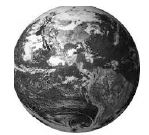
(a) planet
(b) comet
(c) star
(d) satellite
Answer : A
Question. What is energy captured from the Sun's rays called?
(a) Solar power
(b) Nuclear power
(c) Wind power
(d) Hydro-electric power
Answer : A
Question. Which is the lightest planet in our solar system?
(a) Mercury
(b) Mars
(c) Uranus
(d) Saturn
Answer : D
Question. ________ and ________ are the nearest Earth's neighbours.
(a) Venus, Mars
(b) Venus, Jupiter
(c) Mars, Mercury
(d) Uranus, Jupiter
Answer : A
Question. Which planet in our Solar System is known as the 'Red Planet'?
(a) Mercury
(b) Venus
(c) Mars
(d) Jupiter
Answer : C
Question. Which of the following represents outer planets?
(a) Planets between Earth and Uranus
(b) Planets in gaseous state
(c) Planets without satellites
(d) Asteroids
Answer : B
Question. Why is Earth called the blue planet?
(a) The Earth’s atmosphere scatters the light and creates a blue effect.
(b) The scientists have discovered that the colour of the Earth is blue.
(c) 70% of Earth’s surface is covered by water.
(d) Both (a) and (b)
Answer : D
Question. Why does the Moon change its shape every night?
(a) It is natural for moon to change its shape.
(b) The atmosphere on moon’s surface differs every day, therefore it changes its shape.
(c) It only appears that the moon is changing shape.
(d) None of the above
Answer : C
Question. If your weight is 60 kg, then on moon you would weigh __________.
(a) 10 kg
(b) 6 kg
(c) 600 kg
(d) 100 kg
Answer : A
Question. Study the following pictures:

Which among these is the hottest?
Answer : A
Question. Based on the fact that the statements given below are true or false, find the correct sequence.
A. Jupiter does not have rings.
B. Uranus has 11 rings.
C. Pluto is a large planet.
(a) T F T
(b) F T F
(c) F F T
(d) T T F
Answer : B
Question. The imaginary line dividing the Earth into two halves is called an.
(a) equator
(b) half line
(c) orbit
(d) path
Answer : A
Question. Which of these shapes does the Moon never take?

Answer : D
Question. The Earth rotates from
(a) East to West
(b) North to South
(c) South to North
(d) West to East
Answer : D
Question. When we observe a ship sailing away from the shore, the lower part of the ship disappears first from the sight. Then at last, the flag at the top pole disappears.
This is possible only if the Earth is:
(a) round shaped
(b) zid-zag shaped
(c) slate shaped
(d) flat
Answer : A
Question. How does the Moon shines even though it does not have its own light?
(a) There is water on Moon’s surface.
(b) It shines due to the Sun’s light.
(c) It shines due to the thick layer of gases surrounding it.
(d) It shines due to stars surrounding it.
Answer : B
Question. Which of the following is a source of heat and light to all living organisms?
(a) Wood
(b) Coal
(c) Sun
(d) Moon
Answer : C
Question. We are able to see the moon because it .........................
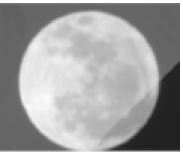
(a) gives out light.
(b) is a glowing star.
(c) reflects light from the Sun.
(d) reflects light from the Earth.
Answer : C
Question. Which part of the Earth is the coolest?
(a) Crust
(b) Core
(c) Mantle
(d) None of these
Answer : A
Question. Which three planets are in correct order?
(a) Mercury, Venus, Earth
(b) Earth, Mercury, Venus
(c) Venus, Mercury, Earth
(d) Mercury, Mars, Earth
Answer : A
Question. Identify the celestial body nearest to Earth.
(a) Sun
(b) Moon
(c) Mars
(d) Venus
Answer : B
Question. Which of the following revolves(s) around the Sun ?
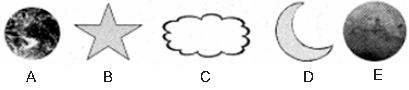
(a) (A) & (E)
(b) (A), (B) & (C)
(c) (A), (B), (D) & (E)
(d) (A), (B), (C) & (E)
Answer : A
Question. I revolve around the Sun. I am the first member of the solar system. I am the hottest of all the other members. What am I?
(a) Earth
(b) Mercury
(c) Mars
(d) Jupiter
Answer : B
Question. Which one of the following is NOT a constellation?
(a) Orion
(b) Ursa Major
(c) Ursa Minor
(d) Oxion
Answer : D
Question. In which layer of Earth is iron and nickel in solid state?
(a) Crust
(b) Mantle
(c) Inner core
(d) Outer core
Answer : C
Question. Why do astronauts wear oxygen mask on Moon?
(a) There is no atmosphere or oxygen on Moon to breathe.
(b) To avoid suffocation after a long flight in space craft.
(c) To be used in case of emergency.
(d) None of these
Answer : A
Question. Why there is no life on the Moon? Choose the correct option.
(a) Because Moon is a natural satellite of the Earth.
(b) Because there are huge holes on the moon called craters.
(c) Because it does not have its own light.
(d) Because there is no water or air on the Moon.
Answer : D
Question. Read the sentence and unscramble the given words.
The spinning movement of the Earth on its axis is called
| T | A | O | I | T | N | R | O |
(a) Revolution
(b) Rotates
(c) Atmosphere
(d) Rotation
Answer : D
Question. Why is Sun important to the Earth?
1. It rotates around the Earth to give us seasons.
2. It provides heat to enable living things to survive on Earth.
3. It provides green plants with light energy to make food.
(a) 1 and 2 only
(b) 2 and 3 only
(c) 3 only
(d) 1 and 3 only
Answer : B
Question. Fill in the blanks with the words given in the box and select the correct option.
| 24 hours, One year, Atmosphere, Axis, Ozone layer, Two years, Stratosphere, 48 hours |
Earth rotates on its own _______. It takes _______ for one rotation. It also moves around the Sun. It takes _______ to complete one revolution. The Earth is covered by a layer of gases called the _______.
(a) Axis, 48 hours, Two years, Atmosphere
(b) Axis, 24 hours, Two years, Stratosphere
(c) Axis, 24 hours, One year, Atmosphere
(d) Axis, 48 hours, One year, Ozone layer
Answer : C
Free study material for General Knowledge
Multiple Choice Questions (MCQs) for Class 3 General Knowledge Earth and Universe
Class 3 General Knowledge Earth and Universe Objective Test Questions
Review structured objective questions for Class 3 General Knowledge Earth and Universe. Built according to official CBSE guidelines, these MCQ sets support daily revision and core concept reinforcement.
NCERT-Aligned Objective Questions and Solutions
Built using the official NCERT book for Class 3, these General Knowledge objective sets provide reliable academic guidance. Pair your practice with our recommended NCERT solutions to master optimal problem-solving approaches.
Next Steps in Your Exam Preparation
Explore our broader library of printable assignments, chapter notes, and mock tests designed to support continuous revision and secure higher marks in CBSE assessments.
FAQs
You can get most exhaustive CBSE Class 3 General Knowledge Earth and Universe MCQs for free on StudiesToday.com. These MCQs for Class 3 General Knowledge are updated for the 2026-27 academic session as per CBSE examination standards.
Yes, our CBSE Class 3 General Knowledge Earth and Universe MCQs include the latest type of questions, such as Assertion-Reasoning and Case-based MCQs. 50% of the CBSE paper is now competency-based.
By solving our CBSE Class 3 General Knowledge Earth and Universe MCQs, Class 3 students can improve their accuracy and speed which is important as objective questions provide a chance to secure 100% marks in the General Knowledge.
Yes, General Knowledge MCQs for Class 3 have answer key and brief explanations to help students understand logic behind the correct option as its important for 2026 competency-focused CBSE exams.
Yes, you can also access online interactive tests for CBSE Class 3 General Knowledge Earth and Universe MCQs on StudiesToday.com as they provide instant answers and score to help you track your progress in General Knowledge.