

Download Class 12 Physics Concept Summaries: CBSE Class 12 Physics Optics Notes
Access comprehensive revision notes for Chapter 09 Ray Optics and Optical Instruments using the CBSE Class 12 Physics Optics Notes. Designed to align with the 2026-27 academic syllabus for Class 12 Physics, these concept summaries help students streamline their exam preparation and review complex topics efficiently.
Access Chapter 09 Ray Optics and Optical Instruments Notes and Study Material
Navigate directly to the revision notes for Chapter 09 Ray Optics and Optical Instruments using the digital viewer below. Each summary is structured to highlight high-weightage sections, allowing students to instantly access critical definitions and focus on core exam topics.
OPTICS
RAY OPTICS
GIST
1. Reflection by convex and concave mirrors.
a.Mirror formula 1/v+1/ u =1/f , where u is the object distance, v is the image distance and f is the focal length.
b.Magnification m=-v/u=f-v/f=f/f-u m is -ve for real images and +ve for virtual images.
2. Refraction
a.Ray of light bends when it enters from one medium to the other, having different optical densities.
b. Sun can be seen before actual sunrise and after actual sunset due to Atmospheric refraction
c. An object under water ( any medium ) appears to be raised due to refraction when observed inclined
n =Re al depth/apparent depth and
Shift in the position (apparent) of object is x=1(1-1/n) Where t is the actual depth of the medium
d.Snell’s law states that for a given colour of light, the ratio of sine of the angle of incidence to sine of angle of refraction is a constant.
sini/sinr=n2/n1
e. Absolute refractive index is the ratio between the velocities of light in vacuum to the velocity of light in medium. For air n=1.
n=c/v
f. When a ray of light travels from denser to rarer medium and if the angle of incidence is greater than critical angle, the ray of light is reflected back to the denser medium. This phenomenon is called Total internal reflection.
SinC =nR/nD
g. Diamond has a high refractive index, resulting with a low critical angle (C=24.40). This promotes a multiple total internal reflection causing its brilliance and luster. Some examples of total internal reflection are formation of mirage and working of an optical fibre.
h. When light falls on a convex refracting surface, it bends and the relation between U, V and R is
given by n2/V-n1/u=n2-n1 /R
i. Lensmaker’s formula or thin lens formula is given by
1/f=(nL-nm/nm)(1/R1-1/R2)
j. For Convex Lens R1 +ve R2 –ve Concave lens R1-ve R2 +ve The way in which a lens behaves as converging or diverging depends upon the values of nL and nm.
When two lenses are kept in contact the equivalent focal length is given by
1/F=1/f1+1/f2 f1 & P=P1+P2
1/F=1/f2+1/f2
-d/f1f2 & P=P1+P2-dP1P2
When kept at d distance k.the lens formulais given by 1/v-1/u=1/f
k. The lens formula is given by
1/v - 1/u = 1/f
l. When light passes through a glass prism it undergoes refraction.
The expression for refractive index is
Sin (A + D/2) / Sin (A/2)
As the angle of incidence increases, the angle of deviation decreases, reaches a minimum value and then increases. This minimum value is called angle of minimum deviation “D”.
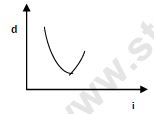
When d=D, angle of incidence = angle of emergence and the refracted ray is parallel to the base of the prism.
m. For a small angled prism d=(n-1)A
n. When white light (poly chromatic or composite) is passed through a glass prism, It splits up into its component colours (Monochromatic). This phenomenon is called Dispersion.
o. Scattering of light takes place when size of the particle is very small when compared to the wavelength of light
p. Intensity of scattered light is Iα x1/λ4
q. The following properties or phenomena can be explained by scattering.
(i) Sky is blue.
(ii) Sky is reddish at the time of sunrise and sunset
(iii) Infra red photography used in foggy days.
(iv) Orange colour of black Box
(v) Yellow light used in vehicles on foggy days.
(vi) Red light used in signals.
r. Rainbow is formed due to a combined effect of dispersion, refraction and reflection of sunlight by spherical water droplets of rain.
QUESTIONS
REFLECTION
1. One half of the reflecting surface of a concave mirror is coated with black paint. How will the image be affected? (1)
Ans. Brightness decreases
2. Why a concave mirror is preferred for shaving? (1)
Ans. Enlarged image
3. Show that the mirror formula holds good for plane mirror. (1)
Ans. Show that V=-U)
4. Mirrors in search lights are parabolic and not spherical. Why? (2)
Ans. Produce intense parallel beam)
5. Using the mirror formula show that a virtual image is obtained when an object is placed in between the principal focus and pole of the concave mirror.
6. Using the mirror formula show that for a concave mirror, when the object is placed at the centre of curvature, the image is formed at the centre of curvature. (2)
8. Find the position of an object, which when placed in front of a concave mirror of focal length 20cm, produces a virtual image which is twice the size of the object. (2)
Ans. 10cm
9. * Plot a graph between 1/u and 1/v for a concave mirror. What does the slope of the graph yield? (2)
Ans. Straight line, slope =u/v=1/m
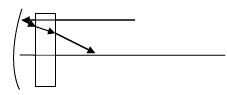
10. * An object is placed 20cm away from a concave mirror of focal length10cm. A parallel glass slab which produces a deviation of 3 cm is placed in front of the mirror such that the reflected ray passes through it. Draw a ray diagram for the image formation and find the position of the final image formed.
REFRACTION AND LENSES
1. Which of the following properties of light: Velocity, wavelength and frequency, changes during the phenomenon (i) reflection (ii) refraction (2)
Ans. (i) No change (ii) velocity, wavelength change)
2. *A convex lens is combined with a concave lens. Draw a ray diagram to show the image formed by the combination, for an object placed in between f and 2f of the convex lens. Compare the Power of the convex and concave lenses so that the image formed is real. (3)
Ans. f of convex lens must be less than f of concave lens to produce real image. So power of Convex greater than that of concave)
3*.Derive a relation between the focal length and radius of curvature of a Plano convex lens made of glass. Compare the relation with that of a concave mirror. What can you conclude? Justify your answer.
Ans. (f=2R) both are same. But applicable always in mirrors, but for lenses only in specific cases, the relation can be applied.)
4.* Show that a concave lens made up of glass when placed in air can act as a converging lens if and only if the refractive index of air is greater than that of glass.
Ans. (For concave lens
Please click the link below to download pdf file for CBSE Class 12 Physics Optics.
Free study material for Physics
Chapter 09 Ray Optics and Optical Instruments Concepts and Summary for Class 12 Physics
Quick Revision Notes: Chapter 09 Ray Optics and Optical Instruments (CBSE)
Access structured revision notes for Chapter 09 Ray Optics and Optical Instruments designed in alignment with the latest CBSE curriculum for Class 12 Physics. These summaries help clarify core themes and support effective daily study.
Expert Study Material for Class 12 Physics
Cross-reference your comprehension with comprehensive NCERT solutions for Class 12 to ensure absolute clarity across all sub-topics in this chapter.
Complete Your Chapter Revision
Explore our broader library of printable assignments, chapter notes, and mock tests designed to support continuous revision and secure higher marks in CBSE assessments.
FAQs
You can download the teacher prepared revision notes for CBSE Class 12 Physics Optics Notes from StudiesToday.com. These notes are designed as per 2026-27 academic session to help Class 12 students get the best study material for Physics.
Yes, our CBSE Class 12 Physics Optics Notes include 50% competency-based questions with focus on core logic, keyword definitions, and the practical application of Physics principles which is important for getting more marks in 2026 CBSE exams.
Yes, our CBSE Class 12 Physics Optics Notes provide a detailed, topic wise breakdown of the chapter. Fundamental definitions, complex numerical formulas and all topics of CBSE syllabus in Class 12 is covered.
These notes for Physics are organized into bullet points and easy-to-read charts. By using CBSE Class 12 Physics Optics Notes, Class 12 students fast revise formulas, key definitions before the exams.
No, all study resources on StudiesToday, including CBSE Class 12 Physics Optics Notes, are available for immediate free download. Class 12 Physics study material is available in PDF and can be downloaded on mobile.