

Revision Notes for Class 12 Physics: Chapter 11 Dual Nature of Radiation and Matter
Access comprehensive revision notes for Chapter 11 Dual Nature of Radiation and Matter using the CBSE Class 12 Physics Dual Nature Of Matter Radiation Formulae. Designed to align with the 2026-27 academic syllabus for Class 12 Physics, these concept summaries help students streamline their exam preparation and review complex topics efficiently.
Review Chapter 11 Dual Nature of Radiation and Matter for Class 12 Physics
Navigate directly to the revision notes for Chapter 11 Dual Nature of Radiation and Matter using the digital viewer below. Each summary is structured to highlight high-weightage sections, allowing students to instantly access critical definitions and focus on core exam topics.
DUAL NATURE OF MATTER & RADITION
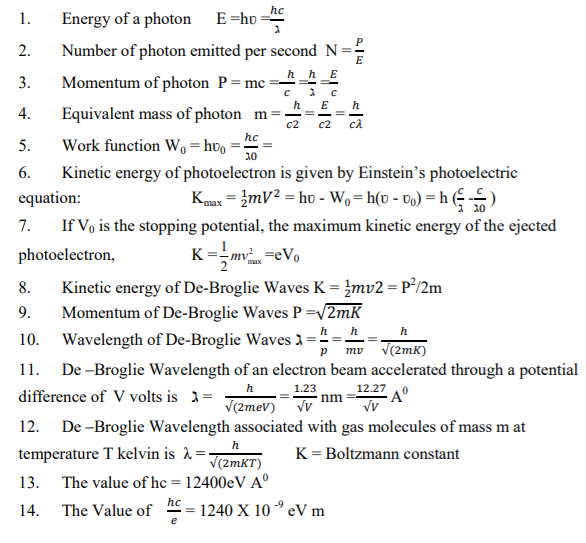
LIST OF FORMULA
Level-I:- Numerical direct formula based (1 mark,2 mark)
1. If the maximum kinetic energy of electrons emitted by a photocell is 4ev.What is the Stopping potential?
2. What is the energy associated in joules with a photon of wavelength 4000A0?
3. The photoelectric cut-off voltage in a certain experiment is 1.5V.Waht is the maximum Kinetic energy?
4. Calculate the work function of a metal in eV.If its threshold wavelength is 6800A0?
5. What is the momentum of a photon of energy 120 MeV?
6. What is the de-broglie wavelength (in A0) associated with an electron accelerated through a Potential of 100V?
7.Calculate the ratio of de-Broglie wavelength associated with a deuteron moving with velocity 2V and an alpha particle moving with velocity V?
8. The work function of cesium metal is 2.14eV.When light of frequency 6 X 10¹⁴ Hz is incident on the metal surface, photoemission of electrons occurs. What is the (a) Maximum kinetic energy of the emitted electron and (b) Stopping potential of the emitted photoelectron?
9.In an experiment on photoelectric effect, the slope of the cut-off voltage versus frequency of incident light is found to be 4.12 X 10⁻¹⁵Vs.Calculate the value of Planck’s constant.
10. The threshold frequency for a certain metal is 3.3 X10¹⁴Hz is incident on the metal; Predicts the cut-off voltage for photoelectric emission.
LEVEL-2
1.An electron and an alpha particle have same kinetic energy. Which of these particles has the shortest de- Broglie wavelength?
2.The de Broglie wavelength of an electron is 1 A0. Find the velocity of the electron.
3.Determine the accelerating potential required for an electron to have a de-Broglie wavelength of 1 Å
4.An electron, an alpha particle and a proton have the same kinetic energy, which one of these particles has (i) the shortest and (ii) the largest, de, Broglie wavelength?
5.In an experiment on photo electric emission , following observations were made;
( i ) wave length of incident light = 1.98 x 10⁻⁷m
( ii ) stopping potential = 2.5 V.
Find ( a ) kinetic energy of photo electrons with maximum speed
( b ) work function & ( c ) threshold frequency
6. Monochromatic light of wavelength 632.8 nm is produced by a helium-neon laser. The power emitted is 9.42 mW.
(a) Find the energy and momentum of each photon in the light beam,
(b) How many photons per second, on the average, arrive at a target irradiated by this beam? (Assume the beam to have uniform cross-section which is less than the target area), and (c) How fast does a hydrogen atom have to travel in order to have the same momentum as that of the photon?
7. In an experiment on photoelectric effect, the slope of the cut-off voltage versus frequency of incident light is found to be 4.12 × 10⁻¹⁵ V s. Calculate the value of Planck’s constant
8. The threshold frequency for a certain metal is 3.3 × 10¹⁴ Hz. If light of frequency 8.2 × 10¹⁴ Hz is incident on the metal, predict the cutoff voltage for the photoelectric emission.
9. The work function for a certain metal is 4.2 eV. Will this metal give photoelectric emission for incident radiation of wavelength 330 nm?
10. Light of wavelength 488 nm is produced by an argon laser which is used in the photoelectric effect. When light from this spectral line is incident on the emitter, the stopping (cut-off) potential of photoelectrons is 0.38 V. Find the work function of the material from which the emitter is made.
Please click the link below to download CBSE Class 12 Phyiscs - Dual nature of matter radaition Formulae
Free study material for Physics
Download CBSE Revision Notes: Class 12 Physics Chapter 11 Dual Nature of Radiation and Matter
About Chapter 11 Dual Nature of Radiation and Matter Revision Notes
Review targeted chapter notes for Class 12 Physics Chapter 11 Dual Nature of Radiation and Matter. Built according to official CBSE guidelines, these summaries highlight high-yield topics frequently tested in school evaluations.
How to Use These Revision Notes
Cross-reference your comprehension with comprehensive NCERT solutions for Class 12 to ensure absolute clarity across all sub-topics in this chapter.
Enhance Practice with MCQs and Worksheets
Follow up your revision by attempting the interactive online Physics MCQ test and practice worksheets for this chapter to verify your mastery. All platform resources are free to access.
FAQs
You can download the teacher prepared revision notes for CBSE Class 12 Physics Dual Nature Of Matter Radiation Formulae from StudiesToday.com. These notes are designed as per 2026-27 academic session to help Class 12 students get the best study material for Physics.
Yes, our CBSE Class 12 Physics Dual Nature Of Matter Radiation Formulae include 50% competency-based questions with focus on core logic, keyword definitions, and the practical application of Physics principles which is important for getting more marks in 2026 CBSE exams.
Yes, our CBSE Class 12 Physics Dual Nature Of Matter Radiation Formulae provide a detailed, topic wise breakdown of the chapter. Fundamental definitions, complex numerical formulas and all topics of CBSE syllabus in Class 12 is covered.
These notes for Physics are organized into bullet points and easy-to-read charts. By using CBSE Class 12 Physics Dual Nature Of Matter Radiation Formulae, Class 12 students fast revise formulas, key definitions before the exams.
No, all study resources on StudiesToday, including CBSE Class 12 Physics Dual Nature Of Matter Radiation Formulae, are available for immediate free download. Class 12 Physics study material is available in PDF and can be downloaded on mobile.