

Official Class 12 Physics Revision Material: CBSE Class 12 Physics Dual Nature Of Matter And Radiation Notes Set 02
Access comprehensive revision notes for Chapter 11 Dual Nature of Radiation and Matter using the CBSE Class 12 Physics Dual Nature Of Matter And Radiation Notes Set 02. Designed to align with the 2026-27 academic syllabus for Class 12 Physics, these concept summaries help students streamline their exam preparation and review complex topics efficiently.
Chapter-wise Concept Summaries: Chapter 11 Dual Nature of Radiation and Matter
Access the complete concept summary PDF for Chapter 11 Dual Nature of Radiation and Matter below. Regular review of these targeted notes builds familiarity with complex Class 12 Physics themes and helps secure higher marks in final school evaluations.
7. DUAL NATURE OF MATTER & RADIATION
GIST
1. The elementary particle in an atom having negative charge of magnitude 1.6 x 10⁻¹⁹ C and mass of 9.1 x 10⁻¹⁹ kg is called electron.
2. There are four types of electron emission, namely, Thermionic Emission, Photoelectric Emission, Field Emission and secondary emission.
3. The minimum energy required by an electron to escape from the metal surface is called work function.
5. Work function is conveniently expressed in electron volts ( e V ).
6. One electron volt is the energy gained or lost by an electron while passing through a potential difference of one volt.
7. The phenomenon of emission of electrons from metal surface when suitable high frequency radiation incidents on it is called photoelectric effect. The electrons thus emitted are called photo electrons.
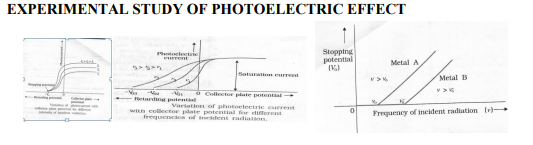
8. The electric current in the circuit constituting the photo electrons is called photoelectric current. It depends on the intensity of incident radiation, potential difference applied between the two electrodes and the nature of the material.
9. The minimum negative voltage required to stop completely the photo electric current is called stopping potential.
10The frequency of incident radiation below which no photo electric effect takes place is called threshold frequency.
Laws of photoelectric effect:
1. The photoelectric emission is an instantaneous process.
2. For a given metal and frequency of radiation the photoelectric current is directly proportional to the intensity of incident radiation.
3. For a given metal if the frequency of incident radiation below its threshold frequency then no photoelectric effect takes place.
4. The maximum kinetic energy of photo electron is directly proportional to the frequency of incident radiation and independent of its intensity.
Please refer to the link below for CBSE Class 12 Physics Notes - Dual Nature of Matter and Radiation
Free study material for Physics
Download CBSE Revision Notes: Class 12 Physics Chapter 11 Dual Nature of Radiation and Matter
Quick Revision Notes: Chapter 11 Dual Nature of Radiation and Matter (CBSE)
Explore reliable chapter overviews for Chapter 11 Dual Nature of Radiation and Matter tailored for Class 12 learners. Use these structured points to grasp difficult themes and ensure solid preparation for upcoming assessments.
Expert Study Material for Class 12 Physics
Each chapter summary is structured around standard CBSE textbooks, allowing students to check their understanding and clarify complex ideas early in their revision.
Complete Your Chapter Revision
Wrap up your chapter revision by testing your knowledge against standard question formats. Everything on our platform is provided free of charge.
FAQs
You can download the teacher prepared revision notes for CBSE Class 12 Physics Dual Nature Of Matter And Radiation Notes Set 02 from StudiesToday.com. These notes are designed as per 2026-27 academic session to help Class 12 students get the best study material for Physics.
Yes, our CBSE Class 12 Physics Dual Nature Of Matter And Radiation Notes Set 02 include 50% competency-based questions with focus on core logic, keyword definitions, and the practical application of Physics principles which is important for getting more marks in 2026 CBSE exams.
Yes, our CBSE Class 12 Physics Dual Nature Of Matter And Radiation Notes Set 02 provide a detailed, topic wise breakdown of the chapter. Fundamental definitions, complex numerical formulas and all topics of CBSE syllabus in Class 12 is covered.
These notes for Physics are organized into bullet points and easy-to-read charts. By using CBSE Class 12 Physics Dual Nature Of Matter And Radiation Notes Set 02, Class 12 students fast revise formulas, key definitions before the exams.
No, all study resources on StudiesToday, including CBSE Class 12 Physics Dual Nature Of Matter And Radiation Notes Set 02, are available for immediate free download. Class 12 Physics study material is available in PDF and can be downloaded on mobile.