

Physics Concept Notes for Class 12: Chapter 11 Dual Nature of Radiation and Matter
Explore reliable concept summaries and revision materials through the CBSE Class 12 Physics Dual Nature Of Radiation And Matter Notes Set 01. Tailored for Class 12 learners, utilizing these notes for Physics Chapter 11 Dual Nature of Radiation and Matter ensures thorough preparation and strengthens core academic definitions before final evaluations.
Download Chapter 11 Dual Nature of Radiation and Matter Revision Notes PDF
View or download the dedicated Chapter 11 Dual Nature of Radiation and Matter revision resource below. Engaging with these structured concept notes daily ensures continuous academic progress and mastery of the 2026-27 curriculum for Physics.
Dual Nature Of Radiation And Matter MCQ Questions with Answers Class 12 Physics
Question- The particle nature of light is not confirmed by
(a) photoelectric effect
(b) scattering of X-rays by electrons
(c) diffraction of electrons
(d) compton effect
Answer-(c)
Question- The photoelectric current does not depend upon the
(i) frequency of incident light
(ii) work function of the metal
(iii) stopping potential
(iv) intensity of incident light
(a) (i) and (iv) only
(b) (ii) and (iii) only
(c) (iii) only
(d) (ii) only
Answer-(c)
Question- A discharge takes place between the two electrodes on applying the electric field to the gas in the discharge tube. The cause of this fluorescence was attributed to
(a) the radiations which appeared to be coming from the anode
(b) the radiation which appeared to be coming from the cathode
(c) the protons coming from the cathode
(d) the protons coming from the anode
Answer-(b)
Question- Photoelectric emmision occurs only when the incident light has more than a certain minimum
(a) power
(b) wavelength
(c) intensity
(d) frequency
Answer-(d)
Question- In photoelectric effect, electrons are ejected from metals, if the incident light has a certain minimum
(a) wavelength
(b) frequency
(c) amplitude
(d) angle of incidence
Answer-(b)
Question- Which of the following when falls on a metal will emit photoelectrons ?
(a) UV radiations
(b) Infrared radiation
(c ) Radio waves
(d) Microwaves
Answer-(a)
Question- Photons are deflected by
(a) electric field only
(b) magnetic field only
(c) electromagnetic field
(d) None of these
Answer-(d)
Question- The work-function of a metal is
(a) the minimum current required to take out electron from the metal surface
(b) the maximum frequency required to take out electron from the metal surface
(c) the minimum amount of energy required to take out the electron from the metal surface
(d) None of these
Answer-(c)
Question- The work function of a metal is independent of
(i) nature of the surface of the metal
(ii) dimensions of the metal
(iii) properties of the metal
(iv) abundance of the metal
(a) (i) only
(b) (i) and (iii)
(c) (ii) and (iii)
(d) (ii) and (iv)
Answer-(d)
Question- Which of the following metals is not sensitive to visible light?
(a) Caesium
(b) Sodium
(c) Rubidium
(d) Cadmium
Answer-(d)
Question- Cathode ray consists of
(a) photons
(b) electrons
(c) protons
(d) α-particles
Answer-(b)
Question- A photosensitive substance emits _____when illuminated by light.
(a) only protons
(b) only neutrons
(c) electrons and protons
(d) only electrons
Answer-(d)
Question- Particle like behavior of light arises from the fact that each quanta of light has definite ...X... and a fixed value of ...Y.. just like a particle, Here, X and Y refer to
(a) frequency, energy
(b) shape, volume
(c) energy, frequency
(d) energy, momentum
Answer-(d)
Question- In a photon-particle collision, the quantity that does not remain conserved is
(a) total energy
(b) total momentum
(c) number of photons
(d) None of these
Answer-(c)
Question- In which of the following, emission of electrons does not take place?
(a) Thermionic emission
(b) X-rays emission
(c) Photoelectric emission
(d) Secondary emission
Answer-(b)
Question- It is essential to consider light as a stream of photons to explain
(a) diffraction of light
(b) refraction of light
(c) photoelectric effect
(d) reflection of light
Answer-(c)
Question- Photoelectric effect can be explained by
(a) wave theory of light
(b) Bohr’s theory
(c) quantum theory of light
(d) corpuscular theory of light
Answer-(d)
Question- The theory of quantisation of electric charge was given by
(a) William Crookes
(b) J. J. Thomson
(c) R.A. Millikan
(d) Wilhelm Hallwachs
Answer-(c)
Question- In Einstein’s picture of Photoelectric emission, the photoelectric emission does not take place by
(a) continuous emission of energy from radiation
(b) continuous absorption of energy from radiation
(c) discrete absorption of energy from radiation
(d) discrete emission of energy from radiation
Answer-(b)
Question- The wave theory of light does not explain
(a) polarisation
(b) diffraction
(c) photocurrent
(d) interference
Answer-(c)
Question- Electrically, photons are
(a) positively charged
(b) negatively charged
(c) neutral
(d) strongly charged, may be positive or negative
Answer- (c)
Question- Of the following properties, the photon does not possess
(a) rest mass
(b) momentum
(c) energy
(d) frequency
Answer-(a)
Question- The stopping potential is directly related to
(a) the work function of the metal
(b) intensity of incident radiation
(c) the saturation current for the given frequency
(d) the kinetic energy gained by the photoelectrons
Answer-(d)
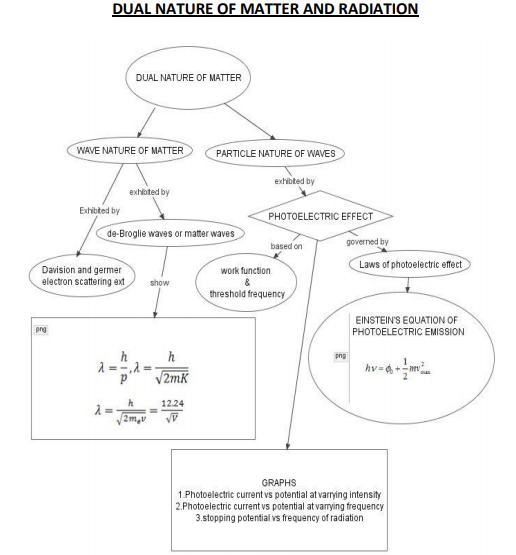
Please click the link below to download pdf file for CBSE Class 12 Physics Dual Nature Of Radiation And Matter Notes Set A
Free study material for Physics
Chapter 11 Dual Nature of Radiation and Matter Concepts and Summary for Class 12 Physics
Download Chapter Summary: Class 12 Physics Chapter 11 Dual Nature of Radiation and Matter
Review targeted chapter notes for Class 12 Physics Chapter 11 Dual Nature of Radiation and Matter. Built according to official CBSE guidelines, these summaries highlight high-yield topics frequently tested in school evaluations.
Concept Clarification for Chapter 11 Dual Nature of Radiation and Matter
Built using the official NCERT book for Class 12 Physics, these notes provide reliable academic guidance. Pair your summary review with our recommended NCERT solutions to master optimal problem-solving approaches.
Additional Study Resources for Class 12 Physics
Wrap up your chapter revision by testing your knowledge against standard question formats. Everything on our platform is provided free of charge.
FAQs
You can download the teacher prepared revision notes for CBSE Class 12 Physics Dual Nature Of Radiation And Matter Notes Set 01 from StudiesToday.com. These notes are designed as per 2026-27 academic session to help Class 12 students get the best study material for Physics.
Yes, our CBSE Class 12 Physics Dual Nature Of Radiation And Matter Notes Set 01 include 50% competency-based questions with focus on core logic, keyword definitions, and the practical application of Physics principles which is important for getting more marks in 2026 CBSE exams.
Yes, our CBSE Class 12 Physics Dual Nature Of Radiation And Matter Notes Set 01 provide a detailed, topic wise breakdown of the chapter. Fundamental definitions, complex numerical formulas and all topics of CBSE syllabus in Class 12 is covered.
These notes for Physics are organized into bullet points and easy-to-read charts. By using CBSE Class 12 Physics Dual Nature Of Radiation And Matter Notes Set 01, Class 12 students fast revise formulas, key definitions before the exams.
No, all study resources on StudiesToday, including CBSE Class 12 Physics Dual Nature Of Radiation And Matter Notes Set 01, are available for immediate free download. Class 12 Physics study material is available in PDF and can be downloaded on mobile.