

Physics Concept Notes for Class 12: Chapter 14 Semiconductor Electronics Materials Devices and Simple Circuits
Explore reliable concept summaries and revision materials through the CBSE Class 12 Physics Electronic Devices Notes Set 02. Tailored for Class 12 learners, utilizing these notes for Physics Chapter 14 Semiconductor Electronics Materials Devices and Simple Circuits ensures thorough preparation and strengthens core academic definitions before final evaluations.
Download Chapter 14 Semiconductor Electronics Materials Devices and Simple Circuits Revision Notes PDF
Access the complete concept summary PDF for Chapter 14 Semiconductor Electronics Materials Devices and Simple Circuits below. Regular review of these targeted notes builds familiarity with complex Class 12 Physics themes and helps secure higher marks in final school evaluations.
9. ELECTRONIC DEVICES
GIST
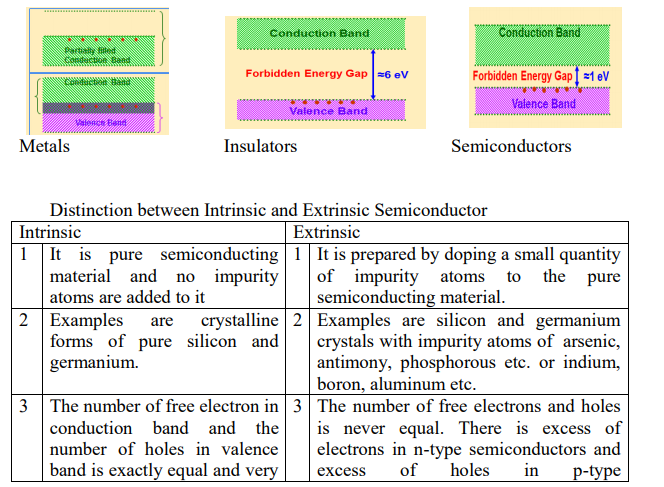
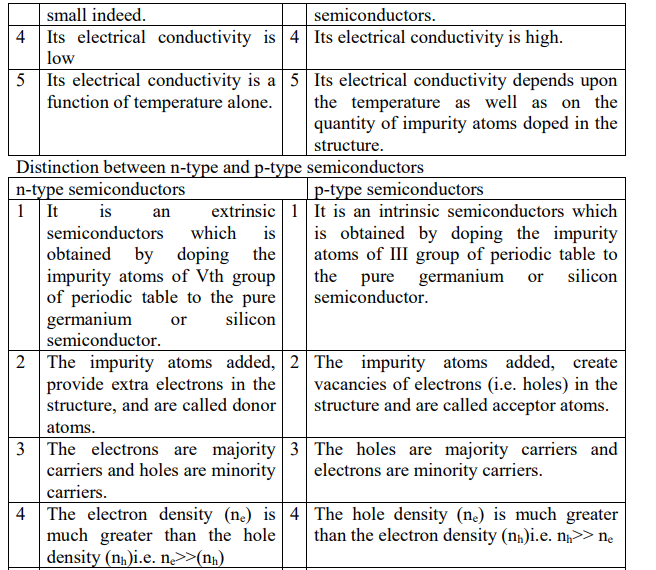
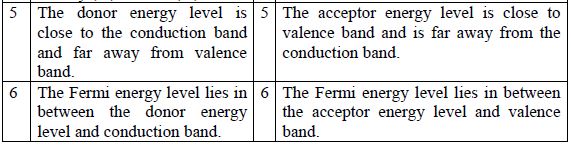
1. In metals, the conduction band and valence band partly overlap each other and there is no forbidden energy gap.
2. In insulators, the conduction band is empty and valence band is completely filled and forbidden gap is quite large = 6 eV. No electron from valence band can cross over to conduction band at room temperature, even if electric field is applied. Hence there is no conductivity of the insulators.
3. In semiconductors, the conduction band is empty and valence band is totally filled. But the forbidden gap between conduction band and valence band is quite small, which is about 1 eV. No electron from valence band can cross over to conduction band. Therefore, the semiconductor behaves as insulator. At room temperature, some electrons in the valence band acquire thermal energy, greater than energy gap of 1 eV and jump over to the conduction band where they are free to move under the influence of even a small electric field. Due
P-n junction diode
Two important processes occur during the formation of p-n junction diffusion and drift. The motion of majority charge carriers give rise to diffusion current.
Due to the space charge on n-side junction and negative space charge region on p-side the electric field is set up and potential barrier develops at the junction electric field e- on p-side moves to n and holes from n-side to p-side which is called drift current.
In equilibrium state, there is no current across p-n junction and potential barrier across p-n junction has maximum value.
The width of the depletion region and magnitude of barrier potential depends on the nature of semiconductor and doping concentration on two sides of p-n junction.
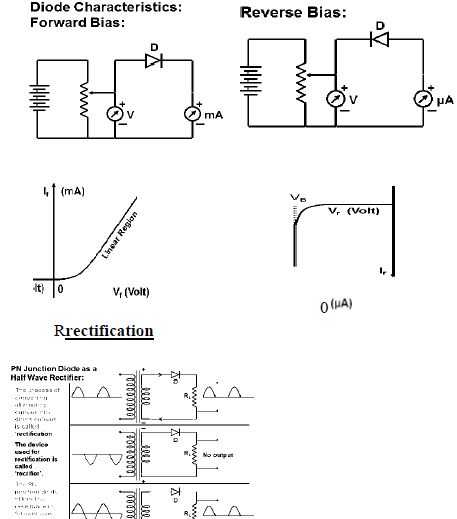
Forward Bias
P-n junction is FB when p-type connected to the +ve of battery and n-type connected to –ve battery Potential barrier is reduced and width of depletion layer decreases.
Reverse Bias
P-n junction in RB p-type connected to the –ve battery and n-type connected to +ve Resistance of p-n junction is high to the flow of current.
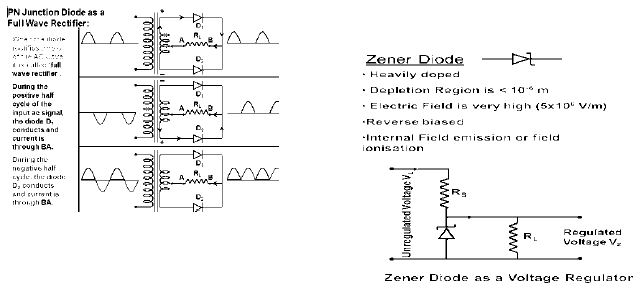
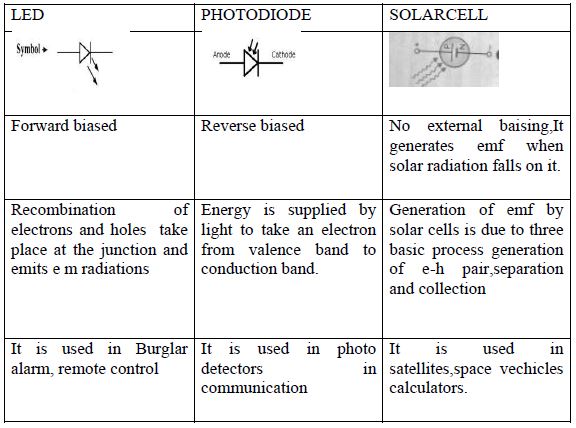
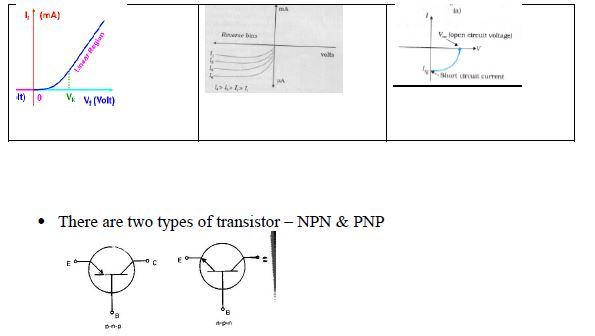
Please refer to the link below for CBSE Class 12 Physics Notes - Electronic Devices
Free study material for Physics
Download CBSE Revision Notes: Class 12 Physics Chapter 14 Semiconductor Electronics Materials Devices and Simple Circuits
Key Concepts and Summary for Class 12 Physics Chapter 14 Semiconductor Electronics Materials Devices and Simple Circuits
Review targeted chapter notes for Class 12 Physics Chapter 14 Semiconductor Electronics Materials Devices and Simple Circuits. Built according to official CBSE guidelines, these summaries highlight high-yield topics frequently tested in school evaluations.
NCERT-Aligned Chapter Summary and Notes
Cross-reference your comprehension with comprehensive NCERT solutions for Class 12 to ensure absolute clarity across all sub-topics in this chapter.
Next Steps in Your Exam Preparation
Follow up your revision by attempting the interactive online Physics MCQ test and practice worksheets for this chapter to verify your mastery. All platform resources are free to access.
FAQs
You can download the teacher prepared revision notes for CBSE Class 12 Physics Electronic Devices Notes Set 02 from StudiesToday.com. These notes are designed as per 2026-27 academic session to help Class 12 students get the best study material for Physics.
Yes, our CBSE Class 12 Physics Electronic Devices Notes Set 02 include 50% competency-based questions with focus on core logic, keyword definitions, and the practical application of Physics principles which is important for getting more marks in 2026 CBSE exams.
Yes, our CBSE Class 12 Physics Electronic Devices Notes Set 02 provide a detailed, topic wise breakdown of the chapter. Fundamental definitions, complex numerical formulas and all topics of CBSE syllabus in Class 12 is covered.
These notes for Physics are organized into bullet points and easy-to-read charts. By using CBSE Class 12 Physics Electronic Devices Notes Set 02, Class 12 students fast revise formulas, key definitions before the exams.
No, all study resources on StudiesToday, including CBSE Class 12 Physics Electronic Devices Notes Set 02, are available for immediate free download. Class 12 Physics study material is available in PDF and can be downloaded on mobile.