

Official Class 12 Physics Revision Material: CBSE Class 12 Physics Electronic Devices Formulae
Review targeted revision notes for Class 12 Physics with the CBSE Class 12 Physics Electronic Devices Formulae. Built according to official educational guidelines for the 2026-27 academic year, these downloadable summaries for Chapter 14 Semiconductor Electronics Materials Devices and Simple Circuits support daily study and last-minute exam readiness.
Chapter-wise Concept Summaries: Chapter 14 Semiconductor Electronics Materials Devices and Simple Circuits
View or download the dedicated Chapter 14 Semiconductor Electronics Materials Devices and Simple Circuits revision resource below. Engaging with these structured concept notes daily ensures continuous academic progress and mastery of the 2026-27 curriculum for Physics.
understand the chapter and score better marks in the examinations. 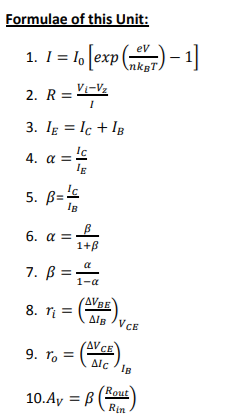
11. (a) OR operation, Y= A+B
(b) AND operation Y=A.B
(c) NOT operation Y= A
12. Combination of gates
(a) NAND gate is combination of AND and NOT gates.
(b) NOR gate is combination of NOT and OR gates.
(c) XOR gate is combination of two NOT gates, two AND gates and one OR gate.
Level -01
(Numerical direct formula Based)
Q.1 : What is relation between voltage gain and trans conductor of a trimester amplifier?
Ans :- Voltage gain = Trans – Conductance X Output resistance.
Q. 2 : A transistor is being used as a common emitter amplifier. What is the value of phase difference, if any ,between the collector-emitter voltage and input signal?
Ans.: 1800 or π radian
Q.3. Write is the phase relationship between the output and input voltage in the common faze transmitter amplifier?
Ans: Output voltage is in phase with the input signal voltage.
Q.4. Write the relation between current gains ∞ or β.
Ans:

Q.5. Calculate the Current gain β of a transistor, if the current gain ∞ = 0.98
Ans:

Q. 6 For a Transmitter the value of β is 100, what is the value of ∞ .
Ans:

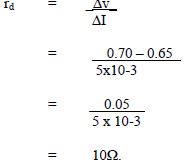
Q.7. When the voltage drop across a p.n. Junction is increased from 0.65 v to 0.70, the charge in the diode current is 5 ma . What is the dynamic resistance of the diode ?
Dynamic resistance of junction diode is
Ans:
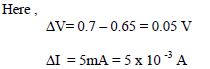
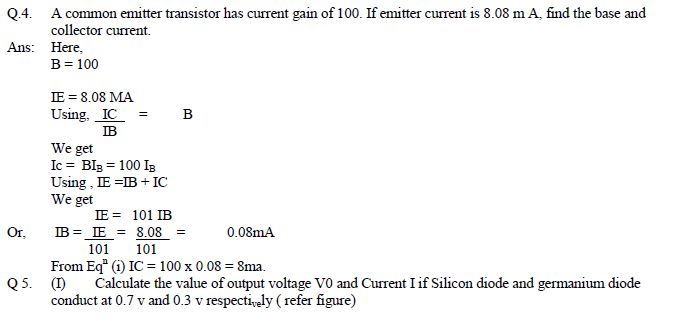
Q.8. p – n – p transistor circuit, the collector is 10 ma , If 90 % of the reach the Collector, find emitter and base currents.
Ans: Here, I E = 10 m A
As 90 % of the holes reach the collector, so the collector current ,
I c = 90 % of I E = 90/100 IE
I E = 100/900 Ic = 100/90 x 10 = 11 m A.
Base Current, I B = I E – I c = 11-10 = 1 mA.
Q.9. A photodiode is fabricated froma semi conductor with band gap of 2.8 e V . Can it detect a wave of 6000 nm? Justify.
Ans : Energy Corresponding to Wave length 6000 nm is
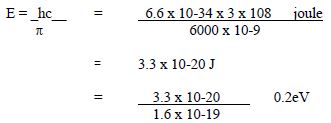
The photon energy ( E = 0.2 ev ) of given waveleanth is much less then band gap ( Eg. ) , hance it caneot detevt the given wavelength.
Q.10. The number of silicon atoms per m3 is 5 x 10²² atom per 33 of Anesenice and 5 x 10²⁰ per m3 atoms of Indian. Calculate the number of electrons and holes . Given that Ni = 1.5 X 10¹⁶ per m3 . In the material N-type on P-Type?
Ans : Arnesic is n-type impurty and indium is P-type impurity Number of electron, ne = n0 – nA = 5 x 10²² – 5 x 1020= 4.95 x 10²²m-3
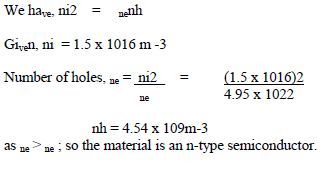
Q.1. When the voltage drop across a p-n junction diode is incrase from 0.65 v to 0.70 v , the change in the diode current is 5mA. What is the dynamic resistance of the diode?
Q.2. Diode used in figure has a constant voltage drop at 0.5 V at all current and a maximum power rating of 100mw. What should be the value of resistance R, coneected in series for maximum current.
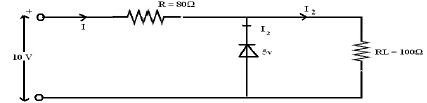
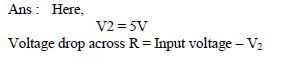
Q.9. On the figure shown, find out the current passing through RL and Zener diode :

Please click the link below to download CBSE Class 12 Phyiscs - Electronic Devices Formulae
Free study material for Physics
Download CBSE Revision Notes: Class 12 Physics Chapter 14 Semiconductor Electronics Materials Devices and Simple Circuits
About Chapter 14 Semiconductor Electronics Materials Devices and Simple Circuits Revision Notes
Access structured revision notes for Chapter 14 Semiconductor Electronics Materials Devices and Simple Circuits designed in alignment with the latest CBSE curriculum for Class 12 Physics. These summaries help clarify core themes and support effective daily study.
How to Use These Revision Notes
Each chapter summary is structured around standard CBSE textbooks, allowing students to check their understanding and clarify complex ideas early in their revision.
Enhance Practice with MCQs and Worksheets
Explore our broader library of printable assignments, chapter notes, and mock tests designed to support continuous revision and secure higher marks in CBSE assessments.
FAQs
You can download the teacher prepared revision notes for CBSE Class 12 Physics Electronic Devices Formulae from StudiesToday.com. These notes are designed as per 2026-27 academic session to help Class 12 students get the best study material for Physics.
Yes, our CBSE Class 12 Physics Electronic Devices Formulae include 50% competency-based questions with focus on core logic, keyword definitions, and the practical application of Physics principles which is important for getting more marks in 2026 CBSE exams.
Yes, our CBSE Class 12 Physics Electronic Devices Formulae provide a detailed, topic wise breakdown of the chapter. Fundamental definitions, complex numerical formulas and all topics of CBSE syllabus in Class 12 is covered.
These notes for Physics are organized into bullet points and easy-to-read charts. By using CBSE Class 12 Physics Electronic Devices Formulae, Class 12 students fast revise formulas, key definitions before the exams.
No, all study resources on StudiesToday, including CBSE Class 12 Physics Electronic Devices Formulae, are available for immediate free download. Class 12 Physics study material is available in PDF and can be downloaded on mobile.