

Download Class 12 Physics Concept Summaries: CBSE Class 12 Physics Electromagnetic Waves Notes Set 03
Access comprehensive revision notes for Chapter 08 Electromagnetic Waves using the CBSE Class 12 Physics Electromagnetic Waves Notes Set 03. Designed to align with the 2026-27 academic syllabus for Class 12 Physics, these concept summaries help students streamline their exam preparation and review complex topics efficiently.
Access Chapter 08 Electromagnetic Waves Notes and Study Material
View or download the dedicated Chapter 08 Electromagnetic Waves revision resource below. Engaging with these structured concept notes daily ensures continuous academic progress and mastery of the 2026-27 curriculum for Physics.
Ch: Electromagnetic Waves
Class XII Physics
Chapter Notes
Top Concepts
1. Displacement current is due to time-varying electric field and is given by
id =EΦ dφE /dt
Displacement current acts as a source of magnetic field in exactly the same way as conduction current.
2. Electromagnetic waves are produced only by charges that are accelerating, since acceleration is absolute, and not a relative phenomenon. An electric charge oscillating harmonically with frequency , produces electromagnetic waves of the same frequency v. An electric dipole is a basic source of electromagnetic waves.
3. Electromagnetic waves with wavelength of the order of a few metres were first produced and detected in the laboratory by Hertz in 1887. He thus verified a basic prediction of Maxwell’s equations.
4. Electric and magnetic fields oscillate sinusoidally in space and time in an electromagnetic wave. The oscillating electric and magnetic fields, E and B are perpendicular to each other, and to the direction of propagation of the electromagnetic wave.
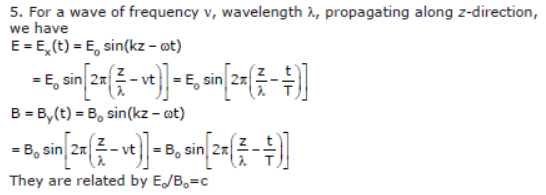
6. The speed c of electromagnetic wave in vacuum is related to 0 and 0 (the free space permeability and permittivity constants) as follows:
c =1/ √μoεo
The value of c equals the speed of light obtained from optical measurements. Light is an electromagnetic wave; c is, therefore, also the speed of light. Electromagnetic waves other than light also have the same velocity c in free space.
The speed of light, or of electromagnetic waves in a material medium is given by v 1/ √με
where μ is the permeability of the medium and ε its permittivity.
7. Electromagnetic waves carry energy as they travel through space and this energy is shared equally by the electric and magnetic fields.
8. If in a region of space in which there exist electric and magnetic fields , there exists Energy Density (Energy per unit volume) associated with these fields given by and E and B
 (0.1)
(0.1)
where we are assuming that the concerned space consists of vacuum only.
9. Electromagnetic waves transport momentum as well. When these waves strike a surface, a pressure is exerted on the surface. If total energy transferred to a surface in time t is U, total momentum delivered to this surface is p = U/c.
10. The spectrum of electromagnetic waves stretches, in principle, over an infinite range of wavelengths. The classification of electromagnetic waves according to frequency is the electromagnetic spectrum. There is no sharp division between one kind of wave and the next. The classification has more to do with the way these waves are produced and detected. Different regions are known by different names; Υ-rays, X-rays, ultraviolet rays, visible rays, infrared rays, microwaves and radio waves in order of increasing wavelength from 10-2 Å or 10-12 m to 106 m.
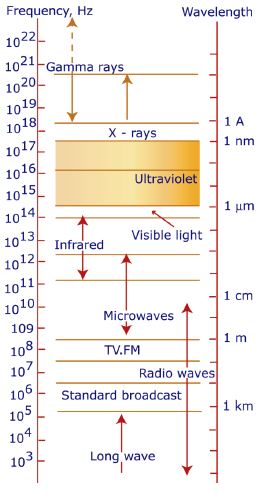
11.
(a) Radio Waves: Produced by accelerated motion of charges in wires. They are used in radio and television communication systems. They are generally in the frequency range from 500 kHz to about 1000 MHz.
(b) Microwaves: These are short wavelength radio waves with frequencies in the gigahertz range. Due to their short wavelengths, they are suitable for radar systems used in aircraft navigation. Microwave ovens use them for cooking.
(c) Infrared Waves: These are produced by hot bodies and molecules. They lie in the low frequency or long wavelength end of the visible spectrum.
(d) Visible Light: The spectrum runs from about 4x10¹⁴Hz to about 7x10¹⁴Hz . Our eyes are sensitive to this range of wavelengths.
(e) Ultraviolet light: It covers wavelengths ranging from 400 nm to 0.6 nm. The sun is an important source of UV rays.
(f) X-rays: These cover the range 10 nm to about10-4 nm.
(g) Gamma Rays: These lie in the upper frequency range of the spectrum, and have wavelengths in the range 10 -10 - 10 -14 m.
Please click the link below to download pdf file for CBSE Class 12 Physics Notes - Electromagnetic Waves.
Free study material for Physics
Study Material and Revision Notes for Class 12 Physics Chapter 08 Electromagnetic Waves
Key Concepts and Summary for Class 12 Physics Chapter 08 Electromagnetic Waves
Explore reliable chapter overviews for Chapter 08 Electromagnetic Waves tailored for Class 12 learners. Use these structured points to grasp difficult themes and ensure solid preparation for upcoming assessments.
NCERT-Aligned Chapter Summary and Notes
Each chapter summary is structured around standard CBSE textbooks, allowing students to check their understanding and clarify complex ideas early in their revision.
Next Steps in Your Exam Preparation
Explore our broader library of printable assignments, chapter notes, and mock tests designed to support continuous revision and secure higher marks in CBSE assessments.
FAQs
You can download the teacher prepared revision notes for CBSE Class 12 Physics Electromagnetic Waves Notes Set 03 from StudiesToday.com. These notes are designed as per 2026-27 academic session to help Class 12 students get the best study material for Physics.
Yes, our CBSE Class 12 Physics Electromagnetic Waves Notes Set 03 include 50% competency-based questions with focus on core logic, keyword definitions, and the practical application of Physics principles which is important for getting more marks in 2026 CBSE exams.
Yes, our CBSE Class 12 Physics Electromagnetic Waves Notes Set 03 provide a detailed, topic wise breakdown of the chapter. Fundamental definitions, complex numerical formulas and all topics of CBSE syllabus in Class 12 is covered.
These notes for Physics are organized into bullet points and easy-to-read charts. By using CBSE Class 12 Physics Electromagnetic Waves Notes Set 03, Class 12 students fast revise formulas, key definitions before the exams.
No, all study resources on StudiesToday, including CBSE Class 12 Physics Electromagnetic Waves Notes Set 03, are available for immediate free download. Class 12 Physics study material is available in PDF and can be downloaded on mobile.