

Revision Notes for Class 12 Physics: Chapter 03 Current Electricity
Review targeted revision notes for Class 12 Physics with the CBSE Class 12 Physics Current Electricity Notes Set 03. Built according to official educational guidelines for the 2026-27 academic year, these downloadable summaries for Chapter 03 Current Electricity support daily study and last-minute exam readiness.
Review Chapter 03 Current Electricity for Class 12 Physics
Access the complete concept summary PDF for Chapter 03 Current Electricity below. Regular review of these targeted notes builds familiarity with complex Class 12 Physics themes and helps secure higher marks in final school evaluations.
CBSE Class 12 Physics Notes - Current Electricity CBSE,CCE and NCERT students can refer to the attached file. All educational material on the website has been prepared by the best teachers having more than 20 years of teaching experience in various schools. The study material available on our website for all CBSE classes and subjects have been prepared by teachers from all over the country. All study material has been carefully designed keeping into mind the latest CBSE examination trends.
Class XII: Physics
Ch 3: Current Electricity
Chapter Notes
Top Concepts
1. Current through a given area of a conductor is the net charge passing per unit time through the area.
2. The current density vector gives current per unit area flowing through area ( A) when it is held normal to the direction of charge flow. Note that the direction of is in the direction of current flow.
3. Drift speed, which is the magnitude of this velocity, is enormously small as compared to the thermal speed, which is not a vector and is much larger.
4. When a conducting substance is brought under the influence of an electric field , free charges (e.g. free electrons in metals) moveunder the influence of this field in such a manner, that the current density due to their motion is proportional to the applied electric field.where is a constant of proportionality called electrical conductivity. This statement is one possible form of Ohm’s law.
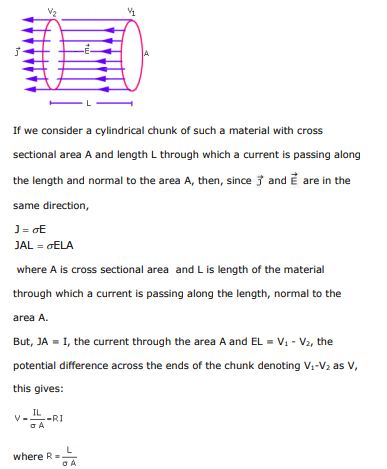
is called resistance of the material.
in this form, ohm law can be stated as linear relationshipThe potential difference (voltage) across an ideal conductor is proportional to the current through it.
Also, download the notes for electromagnetic waves class 12 in PDF format.
5. Emf (Electromotive force) is the name given to a non-electrostatic agency. Typically, it is a battery, in which a chemical process achieves this task of doing work in driving the positive charge from a low potential to a high potential. The effect of such a source is measured in terms of work done per uni charge in moving a charge once around the circuit. This is denoted by.
6. Metals have low resistivity: Range of varies from 10–8 Ω m to 10–6 Ω m. Insulators like glass and rubber have high resistivity: Range of varies from 1022 to 1024 times greater than that of metals. Semiconductors like Si and Ge lie roughly in the middle range of resistivity on a logarithmic scale.
7. Current density j gives the amount of charge flowing per second per unit area normal to the flow.
J = nq vd
where n is the number density (number per unit volume) of charge carriers each of charge q and vd is the drift velocity of the charge carriers. For electrons q = –e. If j is normal to a cross – sectional area A and is constant over the area, the magnitude of the current I through the area is nevd A.
Please refer to the link below for CBSE Class 12 Physics Notes - Current Electricity
Free study material for Physics
Study Material and Revision Notes for Class 12 Physics Chapter 03 Current Electricity
Quick Revision Notes: Chapter 03 Current Electricity (CBSE)
Explore reliable chapter overviews for Chapter 03 Current Electricity tailored for Class 12 learners. Use these structured points to grasp difficult themes and ensure solid preparation for upcoming assessments.
Expert Study Material for Class 12 Physics
Each chapter summary is structured around standard CBSE textbooks, allowing students to check their understanding and clarify complex ideas early in their revision.
Complete Your Chapter Revision
Wrap up your chapter revision by testing your knowledge against standard question formats. Everything on our platform is provided free of charge.
FAQs
You can download the teacher prepared revision notes for CBSE Class 12 Physics Current Electricity Notes Set 03 from StudiesToday.com. These notes are designed as per 2026-27 academic session to help Class 12 students get the best study material for Physics.
Yes, our CBSE Class 12 Physics Current Electricity Notes Set 03 include 50% competency-based questions with focus on core logic, keyword definitions, and the practical application of Physics principles which is important for getting more marks in 2026 CBSE exams.
Yes, our CBSE Class 12 Physics Current Electricity Notes Set 03 provide a detailed, topic wise breakdown of the chapter. Fundamental definitions, complex numerical formulas and all topics of CBSE syllabus in Class 12 is covered.
These notes for Physics are organized into bullet points and easy-to-read charts. By using CBSE Class 12 Physics Current Electricity Notes Set 03, Class 12 students fast revise formulas, key definitions before the exams.
No, all study resources on StudiesToday, including CBSE Class 12 Physics Current Electricity Notes Set 03, are available for immediate free download. Class 12 Physics study material is available in PDF and can be downloaded on mobile.