

Physics Concept Notes for Class 12: Chapter 15 Communication Systems
Review targeted revision notes for Class 12 Physics with the CBSE Class 12 Physics Communication Systems Notes Set 02. Built according to official educational guidelines for the 2026-27 academic year, these downloadable summaries for Chapter 15 Communication Systems support daily study and last-minute exam readiness.
Download Chapter 15 Communication Systems Revision Notes PDF
View or download the dedicated Chapter 15 Communication Systems revision resource below. Engaging with these structured concept notes daily ensures continuous academic progress and mastery of the 2026-27 curriculum for Physics.
Class_XII: Physics
Chapter: Communication Systems
1. Analog and Digital Mode of Transmission. An analog message is physical quantity that varies with time usually in a smooth and continuous fashion.
A digital message is an ordered sequence of symbols selected from a finite set of discrete elements
2. Operational advantages of digital communication system over analog communication systems are:
(i) An improved security message
(ii) Increased immunity to noise and external interference.
(iii) A common format for encoding different kinds of message signals for the purpose of transmission.
(iv) Flexibility in configuration digital communication system.
3. Attenuation, Distortion, Interference and Noise are the undesirable effects in the source of signal transmission.
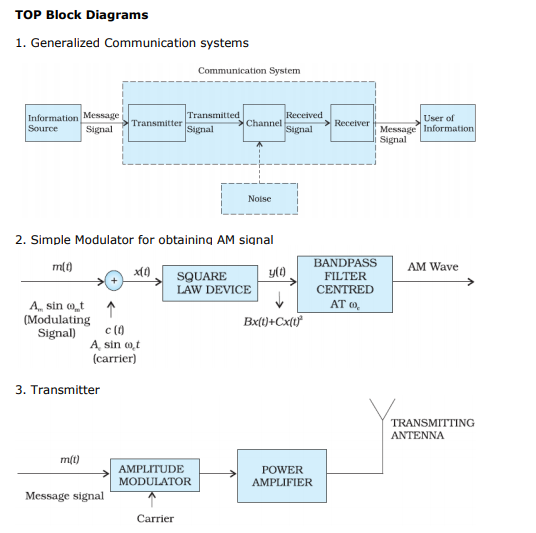
4. Modulation. Process of changing some characteristic e.g. amplitude, frequency or phase of a carrier wave in accordance with the intensity of the signal is known as modulation.
5. Types of Modulation
(i) Amplitude modulation
(ii) Frequency modulation
(iii) Phase modulation.
6. Amplitude Modulation. The amplitude of the carrier wave changes according to the intensity of the signal. The amplitude variation of the carrier wave is at the signal frequency s.
7. Modulation Factor. The ratio of change of amplitude of carrier wave to the amplitude of normal carrier wave is called modulation factor (m).
8. Pulse modulation could be classified as: Pulse Amplitude Modulation (PAM), Pulse Duration Modulation (PDM) or Pulse Width Modulation (PWM) and Pulse Position Modulation (PPM).
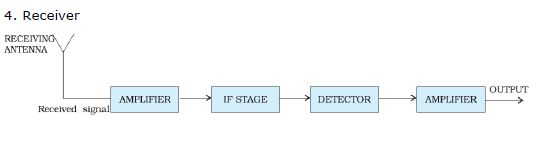
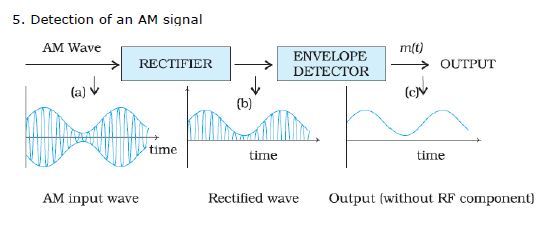
9. Demodulation. Demodulation is the process of recovering the signal intelligence from a modulated carrier wave.
10. FAX. Facsimiles of FAX means exact reproduction of the documents, a picture, letter, map etc. at receiver end.
11. MODEM. The term modem means modulator and demodulator. It converts a series of binary pulses of digital information into an analog signal and transmits across the phone lines.
Please refer to the link below for CBSE Class 12 Physics Notes - Communication Systems
Free study material for Physics
Download CBSE Revision Notes: Class 12 Physics Chapter 15 Communication Systems
Key Concepts and Summary for Class 12 Physics Chapter 15 Communication Systems
Explore reliable chapter overviews for Chapter 15 Communication Systems tailored for Class 12 learners. Use these structured points to grasp difficult themes and ensure solid preparation for upcoming assessments.
NCERT-Aligned Chapter Summary and Notes
Built using the official NCERT book for Class 12 Physics, these notes provide reliable academic guidance. Pair your summary review with our recommended NCERT solutions to master optimal problem-solving approaches.
Next Steps in Your Exam Preparation
Follow up your revision by attempting the interactive online Physics MCQ test and practice worksheets for this chapter to verify your mastery. All platform resources are free to access.
FAQs
You can download the teacher prepared revision notes for CBSE Class 12 Physics Communication Systems Notes Set 02 from StudiesToday.com. These notes are designed as per 2026-27 academic session to help Class 12 students get the best study material for Physics.
Yes, our CBSE Class 12 Physics Communication Systems Notes Set 02 include 50% competency-based questions with focus on core logic, keyword definitions, and the practical application of Physics principles which is important for getting more marks in 2026 CBSE exams.
Yes, our CBSE Class 12 Physics Communication Systems Notes Set 02 provide a detailed, topic wise breakdown of the chapter. Fundamental definitions, complex numerical formulas and all topics of CBSE syllabus in Class 12 is covered.
These notes for Physics are organized into bullet points and easy-to-read charts. By using CBSE Class 12 Physics Communication Systems Notes Set 02, Class 12 students fast revise formulas, key definitions before the exams.
No, all study resources on StudiesToday, including CBSE Class 12 Physics Communication Systems Notes Set 02, are available for immediate free download. Class 12 Physics study material is available in PDF and can be downloaded on mobile.