

Download Class 12 Physics Concept Summaries: CBSE Class 12 Physics Electric Charges And Fields Notes Set 02
Access comprehensive revision notes for Chapter 01 Electric Charges and Fields using the CBSE Class 12 Physics Electric Charges And Fields Notes Set 02. Designed to align with the 2026-27 academic syllabus for Class 12 Physics, these concept summaries help students streamline their exam preparation and review complex topics efficiently.
Access Chapter 01 Electric Charges and Fields Notes and Study Material
Access the complete concept summary PDF for Chapter 01 Electric Charges and Fields below. Regular review of these targeted notes builds familiarity with complex Class 12 Physics themes and helps secure higher marks in final school evaluations.
Physics
Chapter 1: Electric Charges and Fields
Top Concepts
1. Like charges repel and unlike charges attract.
2. Conductors allow movement of electric charge through them, insulators do not.
3. Quantization of electric charge means that total charge (q) of a body is always an integral multiple of a basic quantum of charge (e) i.e.,q = ne, where n = 0, ±1, ±2, ±3, ….
4. Additivity of electric charges : Total charge of a system is the algebraic sum of all individual charges in the system.
5. Conservation of electric charges: Total charge of an isolated system remains uncharged with time.
6. Superposition Principle : Property that the forces with which two charges attract or repel each other are not affected by the presence of a third (or more) additional charge(s).
7. The electric field E at a point due to a charge configuration is the force on a small positive test charges q placed at the point divided by a magnitude
│ q│ / 4 π ε0 r2; it is radially outwards from q, if q is positive and radially inwards if q is negative.
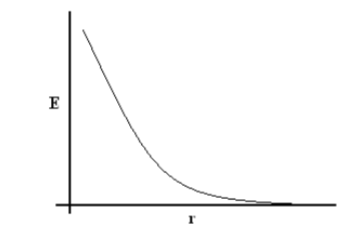
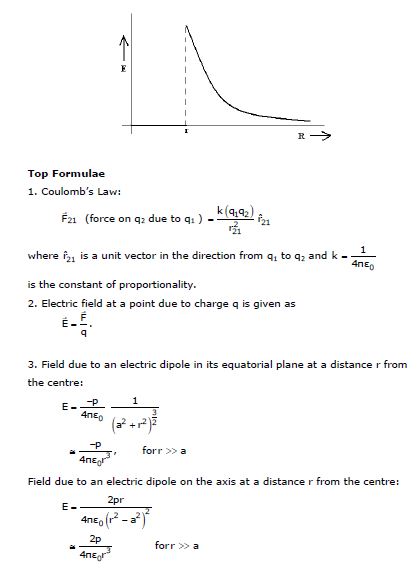
8. E at a point varies inversely as the square of its distance from Q, the plot of E v/s r will look like the figure given below.
8. Coulomb’s Law: The mutual electrostatic force between two point charges q1 and q2 is proportional to the product q1q2 and inversely proportional to the square of the distance r21 separating them.
F21 (force on q2 due to q1 ) k( q1 q2) / r221* i21
where 21 ˆr is a unit vector in the direction from q1 to q2 and k = 1/4πε0 is the constant of proportionality.
9. An electric field line is a curve drawn in such a way that the tangent at each point on the curve gives the direction of electric field at that point.
10. Important properties of field lines are:
(i) Field lines are continuous curves without any breaks.
(ii) Two field lines cannot cross each other.
(iii) Electrostatic field lines start at positive charges and end at negative charges – they cannot form closed loops.
11. The electric flux φ = ∫dφ = ∫E.ds is a ‘dot’ product, hence it is scalar.
Δφ is positive for all values of Θ < π/2
is negative for all values of Θ < π/2.
12. Gauss’s law: The flux of electric field through any closed surface S is 1/ε0 times the total charge enclosed by S.
φ = ∫E.dS = q/ ε0
13. Electric field outside the charged shell is as though the total charge is concentrated at the centre. The same result is true for a solid sphere of uniform volume charge density.
The electric field is zero at all points inside a charged shell.
Graphical plot of E vs R inside the spherical shell.

Please click the link below to download pdf file for CBSE Class 12 Physics Notes - Electric Charges and Fields.
Free study material for Physics
Download CBSE Revision Notes: Class 12 Physics Chapter 01 Electric Charges and Fields
Quick Revision Notes: Chapter 01 Electric Charges and Fields (CBSE)
Access structured revision notes for Chapter 01 Electric Charges and Fields designed in alignment with the latest CBSE curriculum for Class 12 Physics. These summaries help clarify core themes and support effective daily study.
Expert Study Material for Class 12 Physics
Built using the official NCERT book for Class 12 Physics, these notes provide reliable academic guidance. Pair your summary review with our recommended NCERT solutions to master optimal problem-solving approaches.
Complete Your Chapter Revision
Explore our broader library of printable assignments, chapter notes, and mock tests designed to support continuous revision and secure higher marks in CBSE assessments.
FAQs
You can download the teacher prepared revision notes for CBSE Class 12 Physics Electric Charges And Fields Notes Set 02 from StudiesToday.com. These notes are designed as per 2026-27 academic session to help Class 12 students get the best study material for Physics.
Yes, our CBSE Class 12 Physics Electric Charges And Fields Notes Set 02 include 50% competency-based questions with focus on core logic, keyword definitions, and the practical application of Physics principles which is important for getting more marks in 2026 CBSE exams.
Yes, our CBSE Class 12 Physics Electric Charges And Fields Notes Set 02 provide a detailed, topic wise breakdown of the chapter. Fundamental definitions, complex numerical formulas and all topics of CBSE syllabus in Class 12 is covered.
These notes for Physics are organized into bullet points and easy-to-read charts. By using CBSE Class 12 Physics Electric Charges And Fields Notes Set 02, Class 12 students fast revise formulas, key definitions before the exams.
No, all study resources on StudiesToday, including CBSE Class 12 Physics Electric Charges And Fields Notes Set 02, are available for immediate free download. Class 12 Physics study material is available in PDF and can be downloaded on mobile.