

Revision Notes for Class 12 Physics: Chapter 02 Electrostatic Potential and Capacitance
Explore reliable concept summaries and revision materials through the CBSE Class 12 Physics Electrostatic Potential And Capacitance Notes. Tailored for Class 12 learners, utilizing these notes for Physics Chapter 02 Electrostatic Potential and Capacitance ensures thorough preparation and strengthens core academic definitions before final evaluations.
Review Chapter 02 Electrostatic Potential and Capacitance for Class 12 Physics
Navigate directly to the revision notes for Chapter 02 Electrostatic Potential and Capacitance using the digital viewer below. Each summary is structured to highlight high-weightage sections, allowing students to instantly access critical definitions and focus on core exam topics.
CBSE Class 12 Physics Notes - Electrostatic Potential and capacitance. Learning the important concepts is very important for every student to get better marks in examinations. The concepts should be clear which will help in faster learning. The attached concepts made as per NCERT and CBSE pattern will help the student to understand the chapter and score better marks in the examinations.
Class XII Physics Ch 2: Electrostatic Potential and capacitance
Chapter Notes
Top Concepts
1. Potential at a point is the work done by per unit charge by an external agency, in bringing a charge from infinity to that point.
2. Equipotential surface: Definition: An equipotential surface is a surface over which potential has a constant value. Imp:
a. For a point charge, concentric spheres centered at a location of the charge are equipotential surfaces.
b. The electric field E at a point is perpendicular to the equipotential surface through the point.
c. E is in the direction of the steepest decrease of potential.
3. Electric field E along the outward normal to the surface is zero and σ is the surface charge density. Charges in a conductor can reside only at its surface. Potential is constant within and on the surface of a conductor. In a cavity within a conductor (with no charges), the electric field is zero.
4. Capacitance is determined purely geometrically, by the shapes, sizes, and relative positions of the two conductors.
5. Changes observed when the medium between the plates of a capacitor is filled with an insulating substance (dielectric).
i. polarization of the medium gives rise to a field in the opposite direction. The net electric field inside the insulating medium is reduced.
ii. potential difference between the plates is thus reduced.
iii. capacitance C increases from its value C0 when there is no medium
(vacuum). C = KC0
where K is the dielectric constant of the insulating substance.
6. A conductor has a cavity with no charge inside the cavity, then E = 0 inside, no matter what happens outside the conductor.
Therefore, even if there are intense electric fields outside the conductor, the
cavity inside has E= 0 , shielding whatever is inside the cavity from whatever is outside the cavity. This is called electrostatic shielding.
Top Formulae
1.
1. Potential due to a charge at a point is given by V(r)= 2/ 4πεο Q/r
2. The electrostatic potential at a point with position vector r due to a point dipole of dipole moment p place at the origin is
V(r)= 2/ 4πεο pr /r2
The result is true also for a dipole (with charges –q and q separated by 2a) for r >> a.
3. For a charge configuration q1, q2, …… qn with position vectors r1, r2, ….rn, the potential at a point P is given by the superposition principle
V=1 /4πεο(q1 r1p + q1 r2p+..... +qn / rnp )
where r1p is the distance between q1, and P, as and so on.
4. Potential energy stored in a system of charges is the work done (by an external agency) in assembling the charges at their locations. Potential energy of two charges q1, q2, at r1, r2 is given by
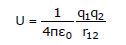 where r12 is distance between q1 and q2
5. PE of a charge q in an external potential, V(r)= qV(r). PE of a dipole of dipole moment p in a uniform electric field E = –p.E.
6. Capacitance C of a system of two conductors separated by an insulator is defined by C = Q/ V
where Q and – Q are the charges on the two conductors V is the potential difference between them.
7. Capacitance C of a parallel plate capacitor (with vacuum between the plates) is given by

where A is the area of each plate and d the separation between them.
8. For capacitors in the series combination, the total capacitance C is given by:
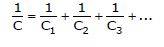
For capacitors in the parallel combination, the total capacitance C is given by:
C = C1 + C2 + C3 + …..
where C1, C2, C3... are individual capacitances
9. The energy U stored in a capacitor of capacitance C, with charge Q and voltage V is
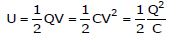
The electric energy density (energy per unit volume) in a region with electric field is (1/2) ε0E2
10. The potential difference between the conductor (radius ro) inside & outside spherical shell (radius R) is

Please click the link below to download pdf file for CBSE Class 12 Physics Notes - Electrostatic Potential and capacitance.
Free study material for Physics
Study Material and Revision Notes for Class 12 Physics Chapter 02 Electrostatic Potential and Capacitance
Quick Revision Notes: Chapter 02 Electrostatic Potential and Capacitance (CBSE)
Explore reliable chapter overviews for Chapter 02 Electrostatic Potential and Capacitance tailored for Class 12 learners. Use these structured points to grasp difficult themes and ensure solid preparation for upcoming assessments.
Expert Study Material for Class 12 Physics
Cross-reference your comprehension with comprehensive NCERT solutions for Class 12 to ensure absolute clarity across all sub-topics in this chapter.
Complete Your Chapter Revision
Explore our broader library of printable assignments, chapter notes, and mock tests designed to support continuous revision and secure higher marks in CBSE assessments.
FAQs
You can download the teacher prepared revision notes for CBSE Class 12 Physics Electrostatic Potential And Capacitance Notes from StudiesToday.com. These notes are designed as per 2026-27 academic session to help Class 12 students get the best study material for Physics.
Yes, our CBSE Class 12 Physics Electrostatic Potential And Capacitance Notes include 50% competency-based questions with focus on core logic, keyword definitions, and the practical application of Physics principles which is important for getting more marks in 2026 CBSE exams.
Yes, our CBSE Class 12 Physics Electrostatic Potential And Capacitance Notes provide a detailed, topic wise breakdown of the chapter. Fundamental definitions, complex numerical formulas and all topics of CBSE syllabus in Class 12 is covered.
These notes for Physics are organized into bullet points and easy-to-read charts. By using CBSE Class 12 Physics Electrostatic Potential And Capacitance Notes, Class 12 students fast revise formulas, key definitions before the exams.
No, all study resources on StudiesToday, including CBSE Class 12 Physics Electrostatic Potential And Capacitance Notes, are available for immediate free download. Class 12 Physics study material is available in PDF and can be downloaded on mobile.