

Revision Notes for Class 12 Physics: Chapter 15 Communication Systems
Access comprehensive revision notes for Chapter 15 Communication Systems using the CBSE Class 12 Physics Communication Systems Notes. Designed to align with the 2026-27 academic syllabus for Class 12 Physics, these concept summaries help students streamline their exam preparation and review complex topics efficiently.
Review Chapter 15 Communication Systems for Class 12 Physics
View or download the dedicated Chapter 15 Communication Systems revision resource below. Engaging with these structured concept notes daily ensures continuous academic progress and mastery of the 2026-27 curriculum for Physics.
CBSE Class 12 Physics Communication Systems. Learning the important concepts is very important for every student to get better marks in examinations. The concepts should be clear which will help in faster learning. The attached concepts made as per NCERT and CBSE pattern will help the student to understand the chapter and score better marks in the examinations.
10. COMMUNICATION SYSTEMS
GIST
1. COMMUNICATION
The sending and receiving of message from one place to another is called communication. Two important forms of communication systems are (i) Analog and (ii) digital. In analog communication the signal is continuous while in digital communication the signal is discrete.
2. THREE BASIC ELEMENTS OF COMMUNICATION
(i) Transmitter (ii) Communication channel (iii) Receiver
3. MODULATION
The superposition of (audio frequency) message signal (20 Hz-20 kHz) over (high frequency) carrier wave (≈ 1MHz) is called modulation.
4. NEED FOR MODULATION:
* Size of antenna h= λ/4 so, for high frequency. Height will be large which is impossible.
* Effective power radiated by an antenna P α 1/λ2
* Mixing up of signals from different transmitters.
5. TYPES OF MODULATION
There are two broad types of modulation: (i) Continuous wave modulation (ii) Pulse modulation.
1. Continuous wave modulation is of three types:
(i) Amplitude modulation (AM): In amplitude modulation, the amplitude of carrier wave varies in accordance with instantaneous voltage of information (or message) signal.
(ii) Frequency modulation (FM): In frequency modulation the frequency of carrier wave is varied in accordance with instantaneous voltage of information signal.
(iii) Phase modulation (PM): In phase modulation, the phase of carrier wave is varied in accordance with the information signal.

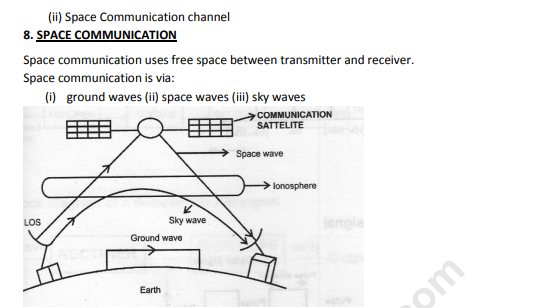
9. GROUND OR SURFACE WAVE PROPAGATION is a mode of wave propagation in which the ground has a strong influence on the propagation of signal wave from the transmitting antenna to receiving antenna .In this propagation ,the signal waves glides over the surface of earth, Ground waves are heavily absorbed by earth and not suitable for long range communication. Ground wave propagation can be sustained only at low frequencies (500 kHz-1500 kHz).
10. SKY WAVE PROPAGATION is a mode of wave propagation in which the radiowave emitted from the transmitter antenna reach the receiving antenna after reflection by ionosphere. Sky wave propagation is possible because of reflection of carrier signals from ionosphere or satellite.
11. SPACE WAVE PROPAGATION higher than 30MHz is that mode of wave propagation in which the radiowaves emitted from the transmitter antenna reach the receiving antenna through space. These radiowaves are called space waves. It is also called line of sight communication. Space wave is suitable for UHF/VHF regions.

14. MAXIMUM USABLE FREQUENCY
It is that highest frequency of radio waves which when sent at some angle towards the ionosphere, gets reflected from that and returns to the earth.
15. SKIP DISTANCE
It is the smallest distance between the transmitting antenna and the point R1, where the sky wave of a fixed frequency, but not more than critical frequency is first received after reflection from ionosphere.
16. SATELLITE COMMUNICATION
The communication satellite is used for reflecting sky waves without any disturbance. Its height is 35800 km above earth’s surface. To cover entire globe of earth simultaneously 3-satellites are employed.
II. IMPORTANT FORMULAE
1. Marconi antenna is grounded, and its length = λ/4, where λ is wavelength of the waves transmitted. It is called quarter wave antenna.
2. Hertz antenna is not grounded, and its length = λ/2. It is called half wave antenna.
3. Side band frequencies in AM wave are υSB = υc ± υm where υm is frequency of modulating (audio) signal.

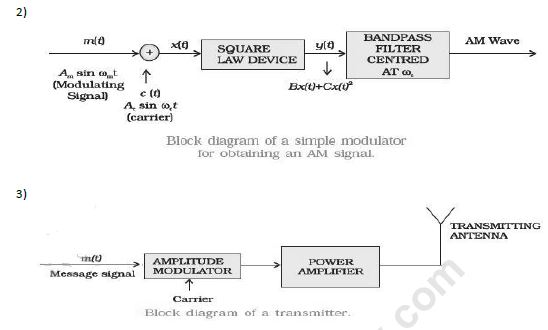
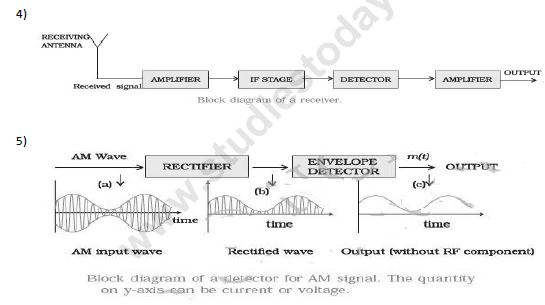
Please click the link below to download pdf file for CBSE Class 12 Physics Communication Systems.
Free study material for Physics
Study Material and Revision Notes for Class 12 Physics Chapter 15 Communication Systems
Quick Revision Notes: Chapter 15 Communication Systems (CBSE)
Review targeted chapter notes for Class 12 Physics Chapter 15 Communication Systems. Built according to official CBSE guidelines, these summaries highlight high-yield topics frequently tested in school evaluations.
Expert Study Material for Class 12 Physics
Built using the official NCERT book for Class 12 Physics, these notes provide reliable academic guidance. Pair your summary review with our recommended NCERT solutions to master optimal problem-solving approaches.
Complete Your Chapter Revision
Wrap up your chapter revision by testing your knowledge against standard question formats. Everything on our platform is provided free of charge.
FAQs
You can download the teacher prepared revision notes for CBSE Class 12 Physics Communication Systems Notes from StudiesToday.com. These notes are designed as per 2026-27 academic session to help Class 12 students get the best study material for Physics.
Yes, our CBSE Class 12 Physics Communication Systems Notes include 50% competency-based questions with focus on core logic, keyword definitions, and the practical application of Physics principles which is important for getting more marks in 2026 CBSE exams.
Yes, our CBSE Class 12 Physics Communication Systems Notes provide a detailed, topic wise breakdown of the chapter. Fundamental definitions, complex numerical formulas and all topics of CBSE syllabus in Class 12 is covered.
These notes for Physics are organized into bullet points and easy-to-read charts. By using CBSE Class 12 Physics Communication Systems Notes, Class 12 students fast revise formulas, key definitions before the exams.
No, all study resources on StudiesToday, including CBSE Class 12 Physics Communication Systems Notes, are available for immediate free download. Class 12 Physics study material is available in PDF and can be downloaded on mobile.