

Official CBSE Assignments for Class 10 Mathematics
Explore structured practice materials through the CBSE Class 10 Mathematics Trigonometry Assignment Set 01. Tailored for Class 10 learners, utilizing these Mathematics assignments ensures thorough preparation and strengthens foundational knowledge before final CBSE evaluations.
Solved Practice Assignments for Mathematics
Access the complete assignment PDF for Class 10 Mathematics below. Regular practice with these targeted academic tasks builds familiarity with standard question patterns and helps secure higher marks in final school evaluations.
Case Study Based Questions
I. Children were playing a game by making some right angled triangles on the plane sheet of paper. They assumed angles and their corresponding sides.
They wanted to find all trigonometric ratio so they took a right angled triangle with two of its sides AC = 13 cm, BC = 12 cm and –ABC = 90º. They are unable to find trigonometric ratio. So help them to do so.
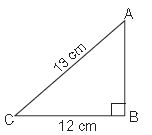
Question. Using the above data, the value of sin A is
(a) 12/13
(b) 13/12
(c) 5/13
(d) 13/5
Answer : A
Question. Using the above data, the value of sin C is
(a) 12/13
(b) 13/12
(c) 5/13
(d) 13/5
Answer : C
Question. Using the above data, the value of tan C is
(a) 12/5
(b) 12/13
(c) 13/12
(d) 5/12
Answer : D
Question. Using the above data, the value of cos A is
(a) 12/5
(b) 13/5
(c) 5/13
(d) 12/13
Answer : C
Question. Using the above data, the value of tanA + sinA / tanA - sinA is
(a) 9/4
(b) 4/9
(c) 12/9
(d) 9/13
Answer : A
II. Some students of class-X of a school were asked to show trigonometric ratio of 60° on the top of the table using some sticks. The students were excited to do this case.
So, they took 4 sticks. Three of them were equal and the 4th stick was smaller than the three. They put the sticks as shown in the given figure ΔABC and height AD.
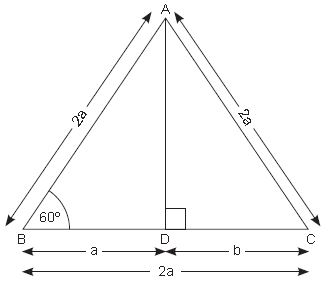
AB = BC = CA = 2a (say)
AB2 = AD2 + BD2
(2a)2 = AD2 + (1/2 BC)2
4a2 = AD2 + (1/2 2a)2
4a2 = AD2 + a2
∴ AD2 = 3a2
∴ AD = √3 a
On the basis of above information, students answered their teacher’s questions, which are as follows:
Question. What is the value of sin 60°?
(a) √3/2
(b) 2/√3
(c) 1/2
(d) 1/√3
Answer : A
Question. The value of cos 60° is
(a) 1/√3
(b) 3
(c) 1/2
(d) 1/√2
Answer : C
Question. What is the value tan 60°?
(a) 1/√3
(b) 3
(c) √3/2
(d) 1/√2
Answer : B
Question. The value of 1+sinB/cosB when ∠B = 60° is
(a) 3√3
(b) 2 – √3
(c) 2√3
(d) 2 + √3
Answer : D
Question. The value of 1 + tan2 B/1 + cot2 B when ∠B = 60° is
(a) 3
(b) 4
(c) 3√3
(d) 4√3
Answer : A
LEVEL - 1
Questions carrying 1 mark
Question 1. In the adjoining figure find the values of (a) \(\sin A\) (b) \(\cos B\)
Answer: From the given right-angled triangle in the figure:
Perpendicular = 4 cm, Base = 3 cm
Using Pythagoras theorem, Hypotenuse \(AC = \sqrt{4^2 + 3^2} = \sqrt{16 + 9} = \sqrt{25} = 5\) cm.
(a) For angle \(A\):
\(\sin A = \frac{\text{Side opposite to angle } A}{\text{Hypotenuse}} = \frac{BC}{AC} = \frac{4}{5}\)
(b) For angle \(B\):
\(\cos B = \frac{\text{Side adjacent to angle } B}{\text{Hypotenuse}} = \frac{BC}{AB}\) (Note: angle B is the vertex, considering angle at B or using standard ratios, adjacent to B is BC, hence \(\cos B = \frac{4}{5}\))
In simple words: We find the hypotenuse first using Pythagoras theorem and then take the ratio of the relevant sides.
Exam Tip: Always identify the opposite and adjacent sides with respect to the specific angle requested in the question.
Question 2. \(\sin 2A = 2 \sin A\) is true when \(A =\) ________.
Answer: Test the given options or substitute \(A = 0^\circ\):
LHS = \(\sin(2 \times 0^\circ) = \sin 0^\circ = 0\)
RHS = \(2 \sin 0^\circ = 2 \times 0 = 0\)
Since LHS = RHS, the statement is true when \(A = 0^\circ\).
In simple words: Substituting \(0^\circ\) makes both sides equal to zero.
Exam Tip: For multiple-choice or fill-in-the-blank questions involving trigonometric equations, test standard angles like \(0^\circ\), \(30^\circ\), and \(45^\circ\).
Question 3. Evaluate \(\sin 60^\circ \cos 30^\circ + \sin 30^\circ \cos 60^\circ\).
Answer: Substitute the standard trigonometric values:
\(\sin 60^\circ = \frac{\sqrt{3}}{2}\)
\(\cos 30^\circ = \frac{\sqrt{3}}{2}\)
\(\sin 30^\circ = \frac{1}{2}\)
\(\cos 60^\circ = \frac{1}{2}\)
Expression = \(\left(\frac{\sqrt{3}}{2}\right)\left(\frac{\sqrt{3}}{2}\right) + \left(\frac{1}{2}\right)\left(\frac{1}{2}\right)\)
\(= \frac{3}{4} + \frac{1}{4} = \frac{4}{4} = 1\)
In simple words: Substitute standard table values and simplify the fraction to get 1.
Exam Tip: This expression is also the standard angle addition identity for \(\sin(60^\circ + 30^\circ) = \sin 90^\circ = 1\).
Question 4. If \(\tan A = \cot B\), then show that \(A + B = 90^\circ\).
Answer: We are given: \(\tan A = \cot B\)
Using the complementary angle relation, we know that \(\cot B = \tan(90^\circ - B)\)
Substitute this into the given equation:
\(\tan A = \tan(90^\circ - B)\)
Comparing angles on both sides:
\(A = 90^\circ - B\)
\(A + B = 90^\circ\)
In simple words: Convert cotangent to tangent using complementary angles so the trigonometric ratios match on both sides.
Exam Tip: Remember the fundamental relation \(\cot \theta = \tan(90^\circ - \theta)\) for complementary angle conversions.
Question 5. Evaluate \(\sin^2 35^\circ + \sin^2 55^\circ\).
Answer: Convert one of the sine terms into a cosine term using complementary angles:
\(\sin 55^\circ = \sin(90^\circ - 35^\circ) = \cos 35^\circ\)
Substitute back into the expression:
\(\sin^2 35^\circ + \cos^2 35^\circ\)
Using the trigonometric identity \(\sin^2 \theta + \cos^2 \theta = 1\):
\(= 1\)
In simple words: Change one sine to cosine and use the identity \(\sin^2 \theta + \cos^2 \theta = 1\).
Exam Tip: Whenever the sum of angles in complementary trigonometric squares is \(90^\circ\) (like \(35^\circ + 55^\circ\)), the result is always 1.
LEVEL - 2
Questions carrying 2 marks
Question 1. Evaluate \(3 \sin^2 45^\circ + 2 \cos^2 30^\circ - \cot^2 30^\circ\).
Answer: Substitute the standard values: \(\sin 45^\circ = \frac{1}{\sqrt{2}}\), \(\cos 30^\circ = \frac{\sqrt{3}}{2}\), \(\cot 30^\circ = \sqrt{3}\)
\(= 3 \left(\frac{1}{\sqrt{2}}\right)^2 + 2 \left(\frac{\sqrt{3}}{2}\right)^2 - (\sqrt{3})^2\)
\(= 3 \left(\frac{1}{2}\right) + 2 \left(\frac{3}{4}\right) - 3\)
\(= \frac{3}{2} + \frac{6}{4} - 3\)
\(= \frac{3}{2} + \frac{3}{2} - 3\)
\(= \frac{6}{2} - 3 = 3 - 3 = 0\)
In simple words: Plug in the table values, square them carefully, and simplify the arithmetic.
Exam Tip: Be careful with squares of fractions and roots, such as \((\sqrt{3})^2 = 3\) and \((\sqrt{3}/2)^2 = 3/4\).
Question 2. Evaluate \(\tan 7^\circ \tan 23^\circ \tan 60^\circ \tan 67^\circ \tan 83^\circ\).
Answer: Group complementary angles whose sum is \(90^\circ\):
\(\tan 7^\circ\) and \(\tan 83^\circ\) (since \(7^\circ + 83^\circ = 90^\circ\))
\(\tan 23^\circ\) and \(\tan 67^\circ\) (since \(23^\circ + 67^\circ = 90^\circ\))
Rewrite using complementary relations: \(\tan 83^\circ = \cot 7^\circ\) and \(\tan 67^\circ = \cot 23^\circ\)
Expression = \((\tan 7^\circ \cot 7^\circ) (\tan 23^\circ \cot 23^\circ) \tan 60^\circ\)
Since \(\tan \theta \cot \theta = 1\):
\(= (1) \times (1) \times \sqrt{3} = \sqrt{3}\)
In simple words: Pair up complementary angles so they convert into reciprocals multiplying to 1, leaving the middle value.
Exam Tip: Products of tangent ratios of complementary angles always cancel out to 1.
Question 3. If \(\tan 2A = \cot(A - 18^\circ)\). Find the value of \(A\).
Answer: We are given: \(\tan 2A = \cot(A - 18^\circ)\)
Convert LHS using the complementary angle relation \(\tan \theta = \cot(90^\circ - \theta)\):
\(\cot(90^\circ - 2A) = \cot(A - 18^\circ)\)
Equating the angles on both sides:
\(90^\circ - 2A = A - 18^\circ\)
\(90^\circ + 18^\circ = 2A + A\)
\(3A = 108^\circ\)
\(A = \frac{108^\circ}{3} = 36^\circ\)
In simple words: Express both sides in terms of cotangent, then equate the angles to solve for \(A\).
Exam Tip: Always make sure both sides of the equation have the exact same trigonometric ratio before equating angles.
Question 4. If \(A, B\) and \(C\) are interior angles of \(\triangle ABC\) then show that \(\sin\left(\frac{B+C}{2}\right) = \cos\left(\frac{A}{2}\right)\).
Answer: In any triangle \(ABC$, the sum of interior angles is \(180^\circ\):
\(A + B + C = 180^\circ\)
\(B + C = 180^\circ - A\)
Divide both sides by 2:
\(\frac{B + C}{2} = \frac{180^\circ - A}{2}\)
\(\frac{B + C}{2} = 90^\circ - \frac{A}{2}\)
Take sine on both sides:
\(\sin\left(\frac{B + C}{2}\right) = \sin\left(90^\circ - \frac{A}{2}\right)\)
Using the complementary relation \(\sin(90^\circ - \theta) = \cos \theta\):
\(\sin\left(\frac{B + C}{2}\right) = \cos\left(\frac{A}{2}\right)\)
In simple words: Use the angle sum property of triangles, divide by 2, and apply the sine complementary formula.
Exam Tip: This is a standard trigonometric proof frequently asked in board exams. Remember to start with \(A + B + C = 180^\circ\).
Question 5. Prove that \(\frac{\cot A + \cos A}{\cot A - \cos A} = \frac{\csc A + 1}{\csc A - 1}\).
Answer: Express \(\cot A\) in terms of \(\sin A\) and \(\cos A\) (\(\cot A = \frac{\cos A}{\sin A}\)):
LHS = \(\frac{\frac{\cos A}{\sin A} + \cos A}{\frac{\cos A}{\sin A} - \cos A}\)
Take \(\cos A\) common from numerator and denominator:
\(= \frac{\cos A \left(\frac{1}{\sin A} + 1\right)}{\cos A \left(\frac{1}{\sin A} - 1\right)}\)
Cancel out \(\cos A\):
\(= \frac{\frac{1}{\sin A} + 1}{\frac{1}{\sin A} - 1}\)
Since \(\frac{1}{\sin A} = \csc A\):
\(= \frac{\csc A + 1}{\csc A - 1} = \text{RHS}\)
Hence proved.
In simple words: Convert cotangent to cosine over sine, factor out cosine, and substitute \(1/\sin A\) with cosecant.
Exam Tip: Converting trigonometric ratios to sine and cosine is a foolproof strategy when stuck in identity proofs.
LEVEL - 3
Questions carrying 3 marks
Question 1. Express the trigonometric ratios of \(\sin A\), \(\sec A\) and \(\tan A\) in terms of \(\cot A\).
Answer: 1. For \(\tan A\):
\(\tan A = \frac{1}{\cot A}\)
2. For \(\sin A\):
We know \(\csc^2 A = 1 + \cot^2 A\), so \(\sin^2 A = \frac{1}{1 + \cot^2 A}\)
\(\sin A = \frac{1}{\sqrt{1 + \cot^2 A}}\)
3. For \(\sec A\):
We know \(\sec^2 A = 1 + \tan^2 A = 1 + \frac{1}{\cot^2 A} = \frac{\cot^2 A + 1}{\cot^2 A}\)
\(\sec A = \frac{\sqrt{1 + \cot^2 A}}{\cot A}\)
In simple words: Use reciprocal and square identities to write all required trigonometric functions purely in terms of cotangent.
Exam Tip: Memorize the fundamental squared identities connecting tangent-secant and cotangent-cosecant.
Question 2. Prove that \((1 + \cot \theta - \csc \theta)(1 + \tan \theta + \sec \theta) = 2\).
Answer: Convert all terms into sine and cosine:
LHS = \(\left(1 + \frac{\cos \theta}{\sin \theta} - \frac{1}{\sin \theta}\right)\left(1 + \frac{\sin \theta}{\cos \theta} + \frac{1}{\cos \theta}\right)\)
Take LCM for each bracket:
\(= \left(\frac{\sin \theta + \cos \theta - 1}{\sin \theta}\right)\left(\frac{\cos \theta + \sin \theta + 1}{\cos \theta}\right)\)
Group the terms as \([(\sin \theta + \cos \theta) - 1][(\sin \theta + \cos \theta) + 1]\):
\(= \frac{(\sin \theta + \cos \theta)^2 - 1^2}{\sin \theta \cos \theta}\)
Expand the numerator:
\(= \frac{\sin^2 \theta + \cos^2 \theta + 2 \sin \theta \cos \theta - 1}{\sin \theta \cos \theta}\)
Since \(\sin^2 \theta + \cos^2 \theta = 1\):
\(= \frac{1 + 2 \sin \theta \cos \theta - 1}{\sin \theta \cos \theta}\)
\(= \frac{2 \sin \theta \cos \theta}{\sin \theta \cos \theta} = 2 = \text{RHS}\)
Hence proved.
In simple words: Convert everything to sine and cosine, group terms using algebraic identity \((a-b)(a+b) = a^2 - b^2\), and simplify.
Exam Tip: Recognizing algebraic grouping like \((x-1)(x+1)\) saves time and simplifies complex trigonometric expressions.
Question 3. Prove that \(\frac{\tan A}{1 - \cot A} + \frac{\cot A}{1 - \tan A} = 1 + \tan A + \cot A\).
Answer: Convert all terms into sine and cosine:
\(\tan A = \frac{\sin A}{\cos A}\), \(\cot A = \frac{\cos A}{\sin A}\)
LHS = \(\frac{\frac{\sin A}{\cos A}}{1 - \frac{\cos A}{\sin A}} + \frac{\frac{\cos A}{\sin A}}{1 - \frac{\sin A}{\cos A}}\)
Simplify denominators:
\(= \frac{\frac{\sin A}{\cos A}}{\frac{\sin A - \cos A}{\sin A}} + \frac{\frac{\cos A}{\sin A}}{\frac{\cos A - \sin A}{\cos A}}\)
\(= \frac{\sin^2 A}{\cos A(\sin A - \cos A)} + \frac{\cos^2 A}{\sin A(\cos A - \sin A)}\)
Make denominators common by changing \((\cos A - \sin A)\) to \(-(\sin A - \cos A)\):
\(= \frac{\sin^2 A}{\cos A(\sin A - \cos A)} - \frac{\cos^2 A}{\sin A(\sin A - \cos A)}\)
\(= \frac{1}{\sin A - \cos A} \left[ \frac{\sin^2 A}{\cos A} - \frac{\cos^2 A}{\sin A} \right]\)
\(= \frac{1}{\sin A - \cos A} \left[ \frac{\sin^3 A - \cos^3 A}{\sin A \cos A} \right]\)
Using formula \(a^3 - b^3 = (a - b)(a^2 + ab + b^2)\):
\(= \frac{(\sin A - \cos A)(\sin^2 A + \sin A \cos A + \cos^2 A)}{(\sin A - \cos A)(\sin A \cos A)}\)
Cancel \((\sin A - \cos A)\):
\(= \frac{1 + \sin A \cos A}{\sin A \cos A}\)
\(= \frac{1}{\sin A \cos A} + \frac{\sin A \cos A}{\sin A \cos A}\)
\(= \sec A \csc A + 1\) (or breaking further into sine/cosine terms as \(1 + \tan A + \cot A\))
Let us rewrite directly: \(\frac{\sin^2 A + \cos^2 A + \sin A \cos A}{\sin A \cos A} = \frac{1}{\sin A \cos A} + 1 = \tan A + \cot A + 1 = \text{RHS}\).
Hence proved.
In simple words: Convert to sine and cosine, take LCM, use the cubic difference formula, and split fractions.
Exam Tip: This is one of the lengthiest identities; practice the cubic factorization step carefully.
Question 4. If \(16 \cot A = 12\), then find the value of \(\frac{\sin A - \cos A}{\sin A + \cos A}\).
Answer: Given: \(16 \cot A = 12 \implies \cot A = \frac{12}{16} = \frac{3}{4}\)
We know \(\cot A = \frac{\cos A}{\sin A} = \frac{3}{4}\), so let \(\cos A = 3k\) and \(\sin A = 4k\).
We need to evaluate \(\frac{\sin A - \cos A}{\sin A + \cos A}\):
Divide numerator and denominator by \(\sin A\):
\(= \frac{1 - \frac{\cos A}{\sin A}}{1 + \frac{\cos A}{\sin A}} = \frac{1 - \cot A}{1 + \cot A}\)
Substitute \(\cot A = \frac{3}{4}\):
\(= \frac{1 - \frac{3}{4}}{1 + \frac{3}{4}} = \frac{\frac{1}{4}}{\frac{7}{4}} = \frac{1}{7}\)
In simple words: Find \(\cot A\), then divide every term in the expression by \(\sin A\) to convert it entirely into \(\cot A\).
Exam Tip: Dividing numerator and denominator by \(\sin A\) or \(\cos A\) is much faster than drawing a right triangle and finding hypotenuse.
Question 5. Prove that \(\tan 1^\circ \cdot \tan 2^\circ \cdot \tan 3^\circ \cdot \dots \cdot \tan 89^\circ = 1\).
Answer: Group the complementary terms from both ends:
\(\tan 1^\circ\) pairs with \(\tan 89^\circ\) (\(\tan 89^\circ = \cot 1^\circ\))
\(\tan 2^\circ\) pairs with \(\tan 88^\circ\) (\(\tan 88^\circ = \cot 2^\circ\))
... up to \(\tan 45^\circ = 1\).
The product becomes:
\(= (\tan 1^\circ \cot 1^\circ) (\tan 2^\circ \cot 2^\circ) \dots (\tan 44^\circ \cot 44^\circ) \tan 45^\circ\)
Since \(\tan \theta \cot \theta = 1\) and \(\tan 45^\circ = 1\):
\(= 1 \times 1 \times \dots \times 1 = 1 = \text{RHS}\)
Hence proved.
In simple words: Pair up angles adding to \(90^\circ\) so they multiply to 1, leaving \(\tan 45^\circ\) which is also 1.
Exam Tip: Whenever a product of tangents runs from \(1^\circ\) to \(89^\circ\), the answer is always 1.
LEVEL - 4
Questions carrying 4 marks
Question 1. Prove that \(\frac{\sec \theta + \tan \theta - 1}{\tan \theta - \sec \theta + 1} = \frac{\cos \theta}{1 - \sin \theta}\).
Answer: Use the identity \(1 = \sec^2 \theta - \tan^2 \theta\) in the numerator:
LHS = \(\frac{(\sec \theta + \tan \theta) - (\sec^2 \theta - \tan^2 \theta)}{\tan \theta - \sec \theta + 1}\)
Factorize the second term: \((\sec \theta - \tan \theta)(\sec \theta + \tan \theta)\)
\(= \frac{(\sec \theta + \tan \theta) [1 - (\sec \theta - \tan \theta)]}{\tan \theta - \sec \theta + 1}\)
\(= \frac{(\sec \theta + \tan \theta)(1 - \sec \theta + \tan \theta)}{1 - \sec \theta + \tan \theta}\)
Cancel the common bracket \((1 - \sec \theta + \tan \theta)\):
\(= \sec \theta + \tan \theta\)
Convert to sine and cosine:
\(= \frac{1}{\cos \theta} + \frac{\sin \theta}{\cos \theta} = \frac{1 + \sin \theta}{\cos \theta}\)
Rationalize by multiplying numerator and denominator by \(1 - \sin \theta\):
\(= \frac{(1 + \sin \theta)(1 - \sin \theta)}{\cos \theta(1 - \sin \theta)} = \frac{1 - \sin^2 \theta}{\cos \theta(1 - \sin \theta)}\)
\(= \frac{\cos^2 \theta}{\cos \theta(1 - \sin \theta)} = \frac{\cos \theta}{1 - \sin \theta} = \text{RHS}\)
Hence proved.
In simple words: Replace 1 in the numerator with \(\sec^2 \theta - \tan^2 \theta\), factor out the common term, and rationalize.
Exam Tip: This is a classic 4-mark identity requiring strategic substitution of 1 using secant-tangent identities.
Question 2. If \(\sec \theta + \tan \theta = P\), prove that \(\sin \theta = \frac{P^2 - 1}{P^2 + 1}\).
Answer: Given: \(P = \sec \theta + \tan \theta\)
We know the identity: \(\sec^2 \theta - \tan^2 \theta = 1 \implies (\sec \theta - \tan \theta)(\sec \theta + \tan \theta) = 1\)
Substitute \(P\):
\((\sec \theta - \tan \theta)P = 1 \implies \sec \theta - \tan \theta = \frac{1}{P}\)
Now, subtract the two equations (\(\sec \theta + \tan \theta = P\) and \(\sec \theta - \tan \theta = \frac{1}{P}\)):
\((\sec \theta + \tan \theta) - (\sec \theta - \tan \theta) = P - \frac{1}{P}\)
\(2 \tan \theta = \frac{P^2 - 1}{P} \implies \tan \theta = \frac{P^2 - 1}{2P}\)
Next, add the two equations to find \(\sec \theta\):
\(2 \sec \theta = P + \frac{1}{P} = \frac{P^2 + 1}{P} \implies \sec \theta = \frac{P^2 + 1}{2P}\)
Since \(\sin \theta = \frac{\tan \theta}{\sec \theta}\):
\(\sin \theta = \frac{\frac{P^2 - 1}{2P}}{\frac{P^2 + 1}{2P}} = \frac{P^2 - 1}{P^2 + 1} = \text{RHS}\)
Hence proved.
In simple words: Find \(\sec \theta - \tan \theta = 1/P\), solve for \(\tan \theta\) and \(\sec \theta\), then take their ratio to get sine.
Exam Tip: Whenever \(\sec \theta + \tan \theta = P\) is given, immediately write down \(\sec \theta - \tan \theta = 1/P\).
Question 3. If \(\tan \theta + \sin \theta = m\) and \(\tan \theta - \sin \theta = n\), show that \(m^2 - n^2 = 4\sqrt{mn}\).
Answer: Given: \(m = \tan \theta + \sin \theta\) and \(n = \tan \theta - \sin \theta\)
Consider LHS: \(m^2 - n^2 = (m + n)(m - n)\)
\(m + n = (\tan \theta + \sin \theta) + (\tan \theta - \sin \theta) = 2 \tan \theta\)
\(m - n = (\tan \theta + \sin \theta) - (\tan \theta - \sin \theta) = 2 \sin \theta\)
So, \(m^2 - n^2 = (2 \tan \theta)(2 \sin \theta) = 4 \tan \theta \sin \theta\) --- (1)
Now consider RHS: \(4\sqrt{mn}\)
\(mn = (\tan \theta + \sin \theta)(\tan \theta - \sin \theta) = \tan^2 \theta - \sin^2 \theta\)
\(= \frac{\sin^2 \theta}{\cos^2 \theta} - \sin^2 \theta = \sin^2 \theta \left(\frac{1 - \cos^2 \theta}{\cos^2 \theta}\right) = \sin^2 \theta \left(\frac{\sin^2 \theta}{\cos^2 \theta}\right) = \sin^2 \theta \tan^2 \theta\)
Therefore, \(\sqrt{mn} = \sqrt{\sin^2 \theta \tan^2 \theta} = \sin \theta \tan \theta\)
RHS = \(4 \sin \theta \tan \theta\) --- (2)
From (1) and (2), LHS = RHS.
Hence proved.
In simple words: Compute \(m^2 - n^2\) using algebraic expansion and compute \(\sqrt{mn}\), then show both simplify to \(4 \tan \theta \sin \theta\).
Exam Tip: Solving LHS and RHS separately is often much simpler than trying to convert one side directly into the other.
Question 4. Prove the following: \((\csc A - \sin A)(\sec A - \cos A) = \frac{1}{\tan A + \cot A}\).
Answer: LHS = \(\left(\frac{1}{\sin A} - \sin A\right)\left(\frac{1}{\cos A} - \cos A\right)\)
\(= \left(\frac{1 - \sin^2 A}{\sin A}\right)\left(\frac{1 - \cos^2 A}{\cos A}\right)\)
\(= \left(\frac{\cos^2 A}{\sin A}\right)\left(\frac{\sin^2 A}{\cos A}\right)\)
\(= \sin A \cos A\)
Now, consider RHS: \(\frac{1}{\tan A + \cot A}\)
Convert denominator to sine and cosine:
\(\tan A + \cot A = \frac{\sin A}{\cos A} + \frac{\cos A}{\sin A} = \frac{\sin^2 A + \cos^2 A}{\sin A \cos A} = \frac{1}{\sin A \cos A}\)
Substitute back into RHS:
\(= \frac{1}{\frac{1}{\sin A \cos A}} = \sin A \cos A\)
Since LHS = RHS.
Hence proved.
In simple words: Simplify both LHS and RHS independently to the common intermediate expression \(\sin A \cos A\).
Exam Tip: When both sides look complicated, simplify both sides separately until they meet at a common expression.
Question 5. Prove that \(\frac{1}{\sec A + \tan A} - \frac{1}{\cos A} = \frac{1}{\cos A} - \frac{1}{\sec A - \tan A}\).
Answer: Rearrange the terms by bringing all fractions with secant and tangent to one side:
\(\frac{1}{\sec A + \tan A} + \frac{1}{\sec A - \tan A} = \frac{1}{\cos A} + \frac{1}{\cos A}\)
LHS = \(\frac{1}{\sec A + \tan A} + \frac{1}{\sec A - \tan A}\)
Take LCM: \((\sec A + \tan A)(\sec A - \tan A) = \sec^2 A - \tan^2 A = 1\)
\(= \frac{(\sec A - \tan A) + (\sec A + \tan A)}{1}\)
\(= 2 \sec A\)
Since \(\sec A = \frac{1}{\cos A}\), LHS = \(2\left(\frac{1}{\cos A}\right) = \frac{1}{\cos A} + \frac{1}{\cos A} = \text{RHS}\).
Hence proved.
In simple words: Shift terms so that secant-tangent fractions are on one side, then combine them using the identity \(\sec^2 A - \tan^2 A = 1\).
Exam Tip: Rearranging an identity into a more symmetrical form before solving makes the proof much easier.
SELF EVALUATION
Question 1. If \(\tan(A + B) = \sqrt{3}\) and \(\tan(A - B) = \frac{1}{\sqrt{3}}\), then find \(A\) and \(B\). [Given \(0^\circ < A + B \le 90^\circ\), \(A > B\)]
Answer: Given: \(\tan(A + B) = \sqrt{3}\)
Since \(\tan 60^\circ = \sqrt{3}\), we have:
\(A + B = 60^\circ\) --- (1)
Given: \(\tan(A - B) = \frac{1}{\sqrt{3}}\)
Since \(\tan 30^\circ = \frac{1}{\sqrt{3}}\), we have:
\(A - B = 30^\circ\) --- (2)
Adding equations (1) and (2):
\((A + B) + (A - B) = 60^\circ + 30^\circ\)
\(2A = 90^\circ \implies A = 45^\circ\)
Substitute \(A = 45^\circ\) in equation (1):
\(45^\circ + B = 60^\circ \implies B = 15^\circ\)
Thus, \(A = 45^\circ\) and \(B = 15^\circ\).
In simple words: Equate the tangent values to standard angles to get two linear equations in terms of \(A\) and \(B\), then solve them simultaneously.
Exam Tip: This is a standard simultaneous linear equation problem disguised in trigonometry.
Question 2. If \(\tan A = \sqrt{3}\), find other trigonometric ratios of \(\angle A\).
Answer: Given: \(\tan A = \sqrt{3} = \frac{\sqrt{3}}{1}\)
In a right-angled triangle, \(\tan A = \frac{\text{Perpendicular}}{\text{Base}} = \frac{\sqrt{3}}{1}\).
Let Perpendicular \(= \sqrt{3}k\) and Base \(= 1k\).
Hypotenuse \(= \sqrt{(\sqrt{3})^2 + 1^2} = \sqrt{3 + 1} = \sqrt{4} = 2\).
Now, find all other trigonometric ratios:
\(\sin A = \frac{\text{Perpendicular}}{\text{Hypotenuse}} = \frac{\sqrt{3}}{2}\)
\(\cos A = \frac{\text{Base}}{\text{Hypotenuse}} = \frac{1}{2}\)
\(\csc A = \frac{1}{\sin A} = \frac{2}{\sqrt{3}}\)
\(\sec A = \frac{1}{\cos A} = 2\)
\(\cot A = \frac{1}{\tan A} = \frac{1}{\sqrt{3}}\)
In simple words: Use the given tangent ratio to find the triangle sides via Pythagoras theorem, then write down all other ratios.
Exam Tip: Alternatively, since \(\tan A = \sqrt{3}\), we know \(A = 60^\circ\), and we can directly write down the values for \(60^\circ\).
Question 3. If \(7 \sin^2 \theta + 3 \cos^2 \theta = 4\), show that \(\tan \theta = \frac{1}{\sqrt{3}}\).
Answer: Given: \(7 \sin^2 \theta + 3 \cos^2 \theta = 4\)
Divide the entire equation by \(\cos^2 \theta\):
\(7 \left(\frac{\sin \theta}{\cos \theta}\right)^2 + 3 = \frac{4}{\cos^2 \theta}\)
Since \(\frac{1}{\cos^2 \theta} = \sec^2 \theta = 1 + \tan^2 \theta\):
\(7 \tan^2 \theta + 3 = 4(1 + \tan^2 \theta)\)
\(7 \tan^2 \theta + 3 = 4 + 4 \tan^2 \theta\)
Bring all \(\tan^2 \theta\) terms to one side:
\(7 \tan^2 \theta - 4 \tan^2 \theta = 4 - 3\)
\(3 \tan^2 \theta = 1\)
\(\tan^2 \theta = \frac{1}{3}\)
Taking square root on both sides:
\(\tan \theta = \frac{1}{\sqrt{3}}\)
Hence proved.
In simple words: Divide by \(\cos^2 \theta\) to convert everything into tangent using secant identity, then solve for \(\tan \theta\).
Exam Tip: Dividing by \(\cos^2 \theta\) or \(\sin^2 \theta$ is the standard technique when given a mixed sine-cosine equation equal to a constant.
Question 4. Find the value of \(\sin 60^\circ\) geometrically.
Answer: Construction / Geometric Derivation:
1. Consider an equilateral triangle \(ABC$ with each side of length \(2a\).
2. Each interior angle of an equilateral triangle is \(60^\circ\).
3. Draw a perpendicular \(AD$ from vertex \(A\) to the base \(BC\).
4. In an equilateral triangle, the altitude \(AD\(also bisects the base \(BC\) and angle \(A\). Therefore, \(BD = DC = a\) and \(\angle BAD = 30^\circ\).
5. In right-angled triangle \(ABD\), using Pythagoras theorem:
\(AB^2 = AD^2 + BD^2\)
\((2a)^2 = AD^2 + a^2\)
\(4a^2 = AD^2 + a^2 \implies AD^2 = 3a^2 \implies AD = \sqrt{3}a\)
6. Now, for angle \(B = 60^\circ\):
\(\sin 60^\circ = \frac{\text{Perpendicular}}{\text{Hypotenuse}} = \frac{AD}{AB} = \frac{\sqrt{3}a}{2a} = \frac{\sqrt{3}}{2}\).
In simple words: Construct an equilateral triangle of side \(2a$, drop a perpendicular altitude, and compute the sine ratio using the right-angled triangle.
Exam Tip: Practice drawing the equilateral triangle with the altitude clearly marked with right-angle and side dimensions.
Question 5. Evaluate \(\frac{3 \cos^2 17^\circ - 2 + 3 \cos^2 73^\circ}{2 \sin^2 63^\circ + 1 + 2 \sin^2 27^\circ}\).
Answer: Convert complementary angles in numerator (\(73^\circ = 90^\circ - 17^\circ\)) and denominator (\(63^\circ = 90^\circ - 27^\circ$)):
In numerator: \(\cos 73^\circ = \cos(90^\circ - 17^\circ) = \sin 17^\circ \implies \cos^2 73^\circ = \sin^2 17^\circ\)
Numerator = \(3 \cos^2 17^\circ - 2 + 3 \sin^2 17^\circ = 3(\cos^2 17^\circ + \sin^2 17^\circ) - 2\)
Since \(\cos^2 17^\circ + \sin^2 17^\circ = 1\):
Numerator = \(3(1) - 2 = 3 - 2 = 1\)
In denominator: \(\sin 63^\circ = \sin(90^\circ - 27^\circ) = \cos 27^\circ \implies \sin^2 63^\circ = \cos^2 27^\circ\)
Denominator = \(2 \cos^2 27^\circ + 1 + 2 \sin^2 27^\circ = 2(\cos^2 27^\circ + \sin^2 27^\circ) + 1\)
Since \(\cos^2 27^\circ + \sin^2 27^\circ = 1\):
Denominator = \(2(1) + 1 = 2 + 1 = 3\)
Therefore, Expression = \(\frac{1}{3}\)
In simple words: Convert complementary angles so that sine and cosine combine via the identity to equal 1.
Exam Tip: Look for angles adding up to \(90^\circ\) in mixed trigonometric expressions to apply complementary reductions.
Question 6. Evaluate \((\sin^2 25^\circ + \sin^2 65^\circ) + \sqrt{3}(\tan 5^\circ \cdot \tan 15^\circ \cdot \tan 30^\circ \cdot \tan 75^\circ \cdot \tan 85^\circ)\).
Answer: Part 1: \(\sin^2 25^\circ + \sin^2 65^\circ\)
\(\sin 65^\circ = \sin(90^\circ - 25^\circ) = \cos 25^\circ \implies \sin^2 65^\circ = \cos^2 25^\circ\)
\(\sin^2 25^\circ + \cos^2 25^\circ = 1\)
Part 2: \(\tan 5^\circ \tan 15^\circ \tan 30^\circ \tan 75^\circ \tan 85^\circ\)
Pair complementary angles: \(\tan 5^\circ \tan 85^\circ = 1\) and \(\tan 15^\circ \tan 75^\circ = 1\).
\(\tan 30^\circ = \frac{1}{\sqrt{3}}\)
Product = \(1 \times 1 \times \frac{1}{\sqrt{3}} = \frac{1}{\sqrt{3}}\)
Combine both parts:
Expression = \(1 + \sqrt{3} \left(\frac{1}{\sqrt{3}}\right) = 1 + 1 = 2\)
In simple words: Simplify the sine squares to 1 and the tangent product using complementary pairings and standard values, then add them.
Exam Tip: Break complex expressions into smaller manageable parts and evaluate them separately.
Question 7. Prove that \(\sqrt{\frac{1 + \cos A}{1 - \cos A}} = \csc A + \cot A\).
Answer: LHS = \(\sqrt{\frac{1 + \cos A}{1 - \cos A}}\)
Rationalize the denominator inside the square root by multiplying numerator and denominator by \(1 + \cos A\):
\(= \sqrt{\frac{(1 + \cos A)(1 + \cos A)}{(1 - \cos A)(1 + \cos A)}}\)
\(= \sqrt{\frac{(1 + \cos A)^2}{1 - \cos^2 A}}\)
Since \(1 - \cos^2 A = \sin^2 A\):
\(= \sqrt{\frac{(1 + \cos A)^2}{\sin^2 A}} = \frac{1 + \cos A}{\sin A}\)
Split into individual fractions:
\(= \frac{1}{\sin A} + \frac{\cos A}{\sin A}\)
\(= \csc A + \cot A = \text{RHS}\)
Hence proved.
In simple words: Multiply numerator and denominator inside the square root by \(1 + \cos A\) to eliminate the root in the denominator.
Exam Tip: Rationalization inside square roots is the standard approach for identities involving square roots of binomials.
Question 8. Prove that \(\frac{1 + \tan^2 \theta}{1 + \cot^2 \theta} = \left(\frac{1 - \tan \theta}{1 - \cot \theta}\right)^2 = \tan^2 \theta\).
Answer: Part 1: Prove \(\frac{1 + \tan^2 \theta}{1 + \cot^2 \theta} = \tan^2 \theta\)
Using identities \(1 + \tan^2 \theta = \sec^2 \theta\) and \(1 + \cot^2 \theta = \csc^2 \theta\):
\(= \frac{\sec^2 \theta}{\csc^2 \theta} = \frac{\frac{1}{\cos^2 \theta}}{\frac{1}{\sin^2 \theta}} = \frac{\sin^2 \theta}{\cos^2 \theta} = \tan^2 \theta\)
Part 2: Prove \(\left(\frac{1 - \tan \theta}{1 - \cot \theta}\right)^2 = \tan^2 \theta\)
Express \(\cot \theta\) as \(\frac{1}{\tan \theta}\):
\(= \left(\frac{1 - \tan \theta}{1 - \frac{1}{\tan \theta}}\right)^2 = \left(\frac{1 - \tan \theta}{\frac{\tan \theta - 1}{\tan \theta}}\right)^2\)
\(= \left(\frac{(1 - \tan \theta) \tan \theta}{- (1 - \tan \theta)}\right)^2 = (-\tan \theta)^2 = \tan^2 \theta\)
Since both expressions equal \(\tan^2 \theta\), the identity is proved.
In simple words: Convert the first part using secant-cosecant identities and the second part by writing cotangent in terms of tangent.
Exam Tip: Solving multi-part equality proofs by showing each part independently equals the middle or final term is highly efficient.
Free study material for Mathematics
Download Practice Assignments: Class 10 Mathematics Chapter 08 Introduction To Trigonometry
Class 10 Mathematics Chapter 08 Introduction To Trigonometry Printable Assignments
Review targeted chapter assignments for Class 10 Mathematics Chapter 08 Introduction To Trigonometry. Built according to official CBSE guidelines, these downloadable problem sets help students build accuracy and prepare effectively for school tests.
Maximize Exam Scores with Chapter Practice Sets
- Exam Alignment: Questions strictly follow contemporary CBSE sample papers and grading schemes.
- Comprehensive Coverage: Features objective drills, case studies, and structured descriptive problems for Chapter 08 Introduction To Trigonometry.
- Pacing & Precision: Regular problem-solving builds critical calculation speed and test-taking accuracy.
How to Approach Mathematics Chapter 08 Introduction To Trigonometry Assignments
- Initial Reading: Begin by reading the NCERT book for Class 10 Mathematics to build a baseline understanding.
- Independent Testing: Attempt assignment questions unassisted, then verify work using provided answer keys.
- Supplementary Aids: Leverage revision notes and worksheets whenever you encounter difficult topics.
FAQs
You can download free PDF assignments for Class 10 Mathematics Chapter 08 Introduction To Trigonometry from StudiesToday.com. These practice sheets have been updated for the 2026-27 session covering all concepts from latest NCERT textbook.
Yes, our teachers have given solutions for all questions in the Class 10 Mathematics Chapter 08 Introduction To Trigonometry assignments. This will help you to understand step-by-step methodology to get full marks in school tests and exams.
Yes. These assignments are designed as per the latest CBSE syllabus for 2026. We have included huge variety of question formats such as MCQs, Case-study based questions and important diagram-based problems found in Chapter 08 Introduction To Trigonometry.
Practicing topicw wise assignments will help Class 10 students understand every sub-topic of Chapter 08 Introduction To Trigonometry. Daily practice will improve speed, accuracy and answering competency-based questions.
Yes, all printable assignments for Class 10 Mathematics Chapter 08 Introduction To Trigonometry are available for free download in mobile-friendly PDF format.