

Download CBSE Class 10 Mathematics Assignments
Review targeted academic assignments with the CBSE Class 10 Mathematics Constructions Assignment Set 01. Built according to official CBSE standards for the 2026-27 term, these downloadable Class 10 Mathematics worksheets support effective daily practice for Chapter 11 Areas Related to Circles.
Access CBSE School Assignments and Answers
View or download the dedicated CBSE Class 10 Mathematics Constructions Assignment Set 01 resource below. Engaging with these assignments under focused study conditions ensures continuous academic progress and mastery of the 2026-27 curriculum.
Question. To divide a line segment AB in ratio m: n (mand n are positive integers), draw a ray AX to that ∠BAX is an acute angle and the mark point on ray AX at equal distances such that the minimum number of these points is
(a) greater of m and n
(b) m + n
(c) m + n −1
(d) mn
Answer : B
Question. To divide a line segment AB in the ratio 4 : 5, first a ray AX is drawn making ∠BAX an acute angle and then points A1 , A2 , A3 , . . at equal distances are marked on the ray AX and the point B is joined to
(a) A4
(b) A 5
(c) A9
(d) A7
Answer : C
Question. To divide a line segment AB in the ratio 3 : 5 first a ray AX is drawn so that ∠BAX is an acute angle and then at equal distances points are marked on the ray AX such that the minimum number of these points is
(a) 8
(b) 9
(c) 10
(d) 11
Answer : A
Question. The ratio of division of the line segment AB by the point P from A in the following figure is
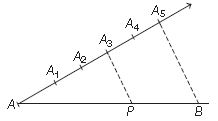
(a) 2 : 3
(b) 3 : 2
(c) 3 : 5
(d) 2 : 5
Answer : B
Question. In the given figure, find the ratio, when P divides AB internally.
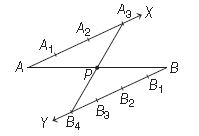
(a) 3 : 2
(b) 2 : 3
(c) 4 : 3
(d) 3 : 4
Answer : D
Question. To divide a line segment AB in the ratio 4 : 7, a ray AX is drawn first such that ∠BAX is an acute angle and then points A1 , A2 , A3 ,. . . are located at equal distances on the ray AX and the point B is joined to
(a) A12
(b) A11
(c) A10
(d) A9
Answer : B
Question. To divide a line segment AB in the ratio 5 : 6, draw a ray AX such that ∠BAX is an acute angle, then draw a ray BY parallel to AX and the points A1 , A2 , A3 ,. . . and B1 ,B2 ,B3 ,. . . are located to equal distances on ray AX and BY, respectively.
Then, the points joined are
(a) A5 and B6
(b) A6 and B5
(c) A4 and B5
(d) A5 and B4
Answer : A
Question. To divide a line segment AB in the ratio 6 : 7, a ray AX is drawn first such that ∠BAX is an acute angle and then points A1 , A2 , A3, … are located equal distances on the ray AX and the point B is joined with
(a) A12
(b) A13
(c) A10
(d) A11
Answer : B
Question. A pair of tangents can be constructed froma point P to a circle of radius 3.5 cm, situated at a distance of 3 cm from the centre.
(a) True
(b) False
(c) Can’t determined
(d) None of the above
Answer : B
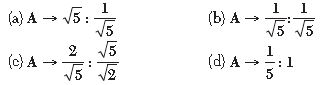
Question. From the following ratios, a line segment cannot be divided into A ratio.
Answer : C
Question. To draw a pair of tangents to a circle, which are inclined to each other at an angle of 60°, it is required to draw tangents at end points of those two radii of the circle, the angle between them should be
(a) 135°
(b) 90°
(c) 60°
(d) 120°
Answer : D
Question. A pair of tangents can be constructed to a circle inclined at an angle of 170°.
(a) True
(b) False
(c) Can’t determined
(d) None of the above
Answer : A
Question. To draw a pair of tangents to a circle which are inclined to each other at an angle of 30°, it is required to draw tangents at end points of those two radii of the circle, the angle between them should be
(a) 150°
(b) 90°
(c) 60°
(d) 120°
Answer : A
Question. If you draw a pair of tangents to a circle C(O, r) from point P such that OP = 2r, then the angle between the two tangents is
(a) 90°
(b) 30°
(c) 60°
(d) 45°
Answer : C
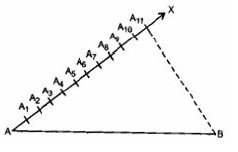
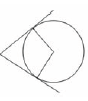
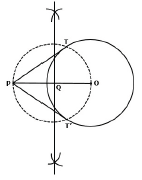
CONSTRUCTIONS
Level 3.
Q1. Draw a pair of tangents to a circle of radius \(4.5\text{ cm}\) which are inclined to each other at an angle of \(45^{\circ}\)
Answer:
STEPS OF CONSTRUCTION:
1. Draw a circle of radius \(4.5\text{ cm}\) with centre \(O\).
2. We know that the sum of angles of a quadrilateral is \(360^{\circ}\):
\(\angle O + \angle A + \angle B + \angle P = 360^{\circ}\)
\(\angle O + 90^{\circ} + 90^{\circ} + 45^{\circ} = 360^{\circ}\)
\(\angle O + 225^{\circ} = 360^{\circ}\)
\(\angle O = 360^{\circ} - 225^{\circ} = 135^{\circ}\)
3. Draw radius \(OA\).
4. At \(O\), draw an angle of \(135^{\circ}\) which meets the circle at \(B\).
5. At \(A\) and \(B\), draw angles of \(90^{\circ}\) with a compass (since radius and tangent are perpendicular to each other at the point of contact).
6. The perpendiculars drawn at \(A\) and \(B\) intersect each other at point \(P\).
7. Verify that \(\angle APB = 45^{\circ}\).
8. \(PA\) and \(PB\) are the required pair of tangents.
In simple words: Find the central angle by subtracting the given inclination and right angles from \(360^{\circ}\), then draw radii and perpendicular tangents.
Exam Tip: Always show the angle sum calculation explicitly in the rough/fair work to secure full marks for the preliminary geometry.
Q2. Draw a circle of radius \(6\text{ cm}\), draw a tangent to this circle making an angle of \(30^{\circ}\) with a line passing through the centre.
Answer:
STEPS OF CONSTRUCTION:
1. Draw a circle of radius \(6\text{ cm}\) with centre \(O\).
2. From the right-angled triangle formed by the centre, point of contact, and external point \(P\):
\(\angle O + \angle B + \angle P = 180^{\circ}\)
\(\angle O + 90^{\circ} + 30^{\circ} = 180^{\circ}\)
\(\angle O + 120^{\circ} = 180^{\circ}\)
\(\angle O = 180^{\circ} - 120^{\circ} = 60^{\circ}\)
3. At \(O\), draw an angle of \(60^{\circ}\) with a compass meeting the circle at \(B\).
4. At \(B\), draw an angle of \(90^{\circ}\) with a compass (since radius and tangent are perpendicular at the point of contact).
5. Extend the tangent to meet the line from the centre at point \(P\), verifying that \(\angle OPB = 30^{\circ}\).
6. \(BP\) is the required tangent.
In simple words: Construct the central angle of \(60^{\circ}\) and draw a perpendicular line at that circumference point to form the required \(30^{\circ}\) angle with the centre line.
Exam Tip: Remember that the angle between the tangent and the radius is always \(90^{\circ}\).
Q3. Two trees are to be planted at two positions \(A\) and \(B\) in the middle of park and third tree is at a position \(C\) in such a way that \(AC:BC = 3:4\). How it can be done?
Answer:
Steps of construction:
1. First, two trees are planted at positions \(A\) and \(B\). Then, a long line segment \(AX\) making an acute angle with \(AB\) is drawn.
2. Calculate the sum of ratio terms: \(3 + 4 = 7\). Mark \(7\) equal parts on \(AX\), namely \(AA_1, A_1A_2, A_2A_3, A_3A_4, A_4A_5, A_5A_6,\) and \(A_6A_7\). Join \(BA_7\).
3. Through the third point \(A_3\), draw a line segment parallel to \(BA_7\) intersecting \(AB\) at point \(C\) such that \(AC:CB = 3:4$.
In simple words: Divide a line segment in a given ratio by drawing a ray, marking equal divisions equal to the sum of the ratio, and drawing parallel lines.
Exam Tip: Ensure the arcs marked on the ray \(AX\) are of equal radii using a compass.
Q4. Draw a circle of radius \(4\text{ cm}\) and construct a pair of tangents to the circle which are inclined to each other at \(30^{\circ}\).
Answer:
Steps of construction:
1. Draw a circle with centre \(O\) and radius \(4\text{ cm}\).
2. Draw a radius \(OA\) and construct an angle \(AOB = 150^{\circ}\) at the centre, since:
\(\angle AOB = 360^{\circ} - (30^{\circ} + 90^{\circ} + 90^{\circ}) = 150^{\circ}\)
3. At points \(A\) and \(B\), draw perpendicular lines (tangents) meeting each other at point \(P\).
4. The angle between the tangents at \(P\) will be \(\angle APB = 30^{\circ}\).
In simple words: Draw a central angle of \(150^{\circ}\) and erect \(90^{\circ}\) perpendiculars at the endpoints of the radii to get an inclination of \(30^{\circ}\).
Exam Tip: Double-check your protractor or compass construction for the \(150^{\circ}\) angle by combining \(90^{\circ}\) and \(60^{\circ}\).
LEVEL 4.
Q1. Draw a triangle \(ABC\) with side \(BC = 6\text{ cm}\), \(AB = 5\text{ cm}\) and \(\angle ABC = 60^{\circ}\). Then construct a triangle whose sides are \(\frac{3}{4}\) of the corresponding sides of the triangle \(ABC\).
Answer:
A triangle \(\Delta A'BC'\) whose sides are \(\frac{3}{4}\) of the corresponding sides of \(\Delta ABC\) can be drawn as follows:
Step 1: Draw a \(\Delta ABC\) with side \(BC = 6\text{ cm}\), \(AB = 5\text{ cm}\) and \(\angle ABC = 60^{\circ}\).
Step 2: Draw a ray \(BX\) making an acute angle with \(BC\) on the opposite side of vertex \(A\).
Step 3: Locate \(4\) points (\(4\) being greater between \(3\) and \(4\)), namely \(B_1, B_2, B_3, B_4\) on the line segment \(BX\) at equal intervals.
Step 4: Join \(B_4C\) and draw a line through \(B_3\) parallel to \(B_4C\) intersecting \(BC\) at \(C'\).
Step 5: Draw a line through \(C'\) parallel to \(AC\) intersecting \(AB\) at \(A'\). Then \(\Delta A'BC'\) is the required triangle.
In simple words: Construct the base triangle first, make a ray with divisions based on the larger numerator/denominator, and use parallel lines to scale the sides.
Exam Tip: When constructing a smaller similar triangle (proper fraction like \(\frac{3}{4}\)), the new triangle lies entirely inside the original triangle.
Q2. Construct an isosceles triangle whose base is \(8\text{ cm}\) and altitude \(4\text{ cm}\) and then another triangle whose sides are \(1\frac{1}{2}\) times the corresponding sides of the isosceles triangle.
Answer:
STEPS OF CONSTRUCTION:
1. Draw a line segment \(BC = 8\text{ cm}\).
2. Draw the perpendicular bisector of \(BC\) intersecting \(BC\) at mid-point \(M\).
3. From \(M\), cut an arc along the bisector of length \(MA = 4\text{ cm}\).
4. Join \(AB\) and \(AC\) to form the isosceles triangle \(\Delta ABC\).
5. Draw a ray \(BX\) making an acute angle with \(BC\).
6. Since the scale factor is \(1\frac{1}{2} = \frac{3}{2}\), mark \(3\) points \(B_1, B_2, B_3\) on \(BX\) such that \(BB_1 = B_1B_2 = B_2B_3\).
7. Join \(B_2\) to \(C\).
8. Through \(B_3\), draw a line parallel to \(B_2C\) intersecting the extended line segment \(BC\) at \(C'\).
9. Through \(C'\), draw a line parallel to \(AC\) intersecting the extended line segment \(BA\) at \(A'\).
10. \(A'BC'\) is the required triangle whose sides are \(\frac{3}{2}\) times of triangle \(ABC\).
In simple words: First draw the base and altitude to form the isosceles triangle, then extend the sides using a scale factor greater than 1 (\(\frac{3}{2}\)).
Exam Tip: For improper fractions (scale factor \(> 1\)), extend the base and side lines outwards because the new triangle will be larger than the original.
Q3. Draw a triangle \(ABC\) with side \(BC = 7\text{ cm}\), \(\angle B = 45^{\circ}\), \(\angle A = 105^{\circ}\). Then construct a triangle whose sides are \(\frac{3}{4}\) times the corresponding sides of triangle \(ABC\).
Answer:
STEPS OF CONSTRUCTION:
1. Draw a line segment \(BC = 7\text{ cm}\).
2. At \(B\), draw an angle of \(45^{\circ}\).
3. Calculate the missing angle \(\angle C\) using the angle sum property of a triangle:
\(\angle A + \angle B + \angle C = 180^{\circ}\)
\(105^{\circ} + 45^{\circ} + \angle C = 180^{\circ}\)
\(150^{\circ} + \angle C = 180^{\circ}\)
\(\angle C = 180^{\circ} - 150^{\circ} = 30^{\circ}\)
4. At \(C\), draw an angle of \(30^{\circ}\).
5. The arms of the angles at \(B\) and \(C\) meet at vertex \(A\) forming an angle of \(105^{\circ}\).
6. Draw a ray \(BX\) making an acute angle with \(BC\).
7. With a convenient radius, mark four arcs \(B_1, B_2, B_3, B_4\) on \(BX\) such that \(BB_1 = B_1B_2 = B_2B_3 = B_3B_4\).
8. Join \(B_3\) to \(C\).
9. Through \(B_4\), draw a line parallel to \(B_3C\) intersecting the extended line segment \(BC\) at \(C_1\).
10. Through \(C_1\), draw a line parallel to \(AC\) intersecting the extended line segment \(BA\) at \(A_1\).
11. Therefore, \(\Delta A_1BC_1\) is the required triangle, where \(\Delta A_1BC_1 = \frac{4}{3}\Delta ABC\) (or scaled accordingly as per standard ratio application).
In simple words: Determine the third angle of the triangle first, construct it accurately, and then apply the scaling ratio.
Exam Tip: Always verify that the sum of angles in your constructed triangle equals \(180^{\circ}\) before proceeding with the parallel line divisions.
Q4. Draw a triangle \(ABC\) with side \(BC = 7\text{ cm}\), \(\angle B = 45^{\circ}\), \(\angle A = 105^{\circ}\). Then, construct a triangle whose sides are \(\frac{4}{3}\) times the corresponding side of \(\Delta ABC\).
Answer:
Step 1: Draw a \(\Delta ABC\) with side \(BC = 7\text{ cm}\), \(\angle B = 45^{\circ}\), and calculated \(\angle C = 30^{\circ}\).
Step 2: Draw a ray \(BX\) making an acute angle with \(BC\) on the opposite side of vertex \(A\).
Step 3: Locate \(4\) points (\(4\) being greater between \(4\) and \(3\)), namely \(B_1, B_2, B_3, B_4\) on \(BX\).
Step 4: Join \(B_3\) to \(C\). Draw a line through \(B_4\) parallel to \(B_3C\) intersecting the extended line segment \(BC\) at \(C'\).
Step 5: Through \(C'\), draw a line parallel to \(AC\) intersecting the extended line segment \(AB\) at \(A'\). Then \(\Delta A'BC'\) is the required triangle.
In simple words: Construct the base triangle, extend the base line, and use a \(4\)-part division ray with parallel lines to construct the enlarged similar triangle.
Exam Inf: Clearly label extended lines using dashed or dotted representations to distinguish them from primary construction lines.
Free study material for Mathematics
Chapter Assignment & Practice Material for Class 10 Mathematics Chapter 11 Areas Related to Circles
Revision Assignment: Chapter 11 Areas Related to Circles (CBSE)
Explore reliable practice questions for Chapter 11 Areas Related to Circles tailored for Class 10 learners. Use these structured worksheets to evaluate preparedness and strengthen core problem-solving skills.
Key Advantages of Solving Chapter 11 Areas Related to Circles Assignments
- Exam Alignment: Questions strictly follow contemporary CBSE sample papers and grading schemes.
- Comprehensive Coverage: Features objective drills, case studies, and structured descriptive problems for Chapter 11 Areas Related to Circles.
- Pacing & Precision: Regular problem-solving builds critical calculation speed and test-taking accuracy.
How to Approach Mathematics Chapter 11 Areas Related to Circles Assignments
- Initial Reading: Begin by reading the NCERT book for Class 10 Mathematics to build a baseline understanding.
- Independent Testing: Attempt assignment questions unassisted, then verify work using provided answer keys.
- Supplementary Aids: Leverage revision notes and worksheets whenever you encounter difficult topics.
FAQs
You can download free PDF assignments for Class 10 Mathematics Chapter 11 Areas Related to Circles from StudiesToday.com. These practice sheets have been updated for the 2026-27 session covering all concepts from latest NCERT textbook.
Yes, our teachers have given solutions for all questions in the Class 10 Mathematics Chapter 11 Areas Related to Circles assignments. This will help you to understand step-by-step methodology to get full marks in school tests and exams.
Yes. These assignments are designed as per the latest CBSE syllabus for 2026. We have included huge variety of question formats such as MCQs, Case-study based questions and important diagram-based problems found in Chapter 11 Areas Related to Circles.
Practicing topicw wise assignments will help Class 10 students understand every sub-topic of Chapter 11 Areas Related to Circles. Daily practice will improve speed, accuracy and answering competency-based questions.
Yes, all printable assignments for Class 10 Mathematics Chapter 11 Areas Related to Circles are available for free download in mobile-friendly PDF format.