

Class 10 Mathematics Practice Assignments: CBSE Class 10 Mathematics Statistics Assignment Set 02
Review targeted academic assignments with the CBSE Class 10 Mathematics Statistics Assignment Set 02. Built according to official CBSE standards for the 2026-27 term, these downloadable Class 10 Mathematics worksheets support effective daily practice for Chapter 13 Statistics.
Download Chapter 13 Statistics Assignment PDF with Solutions
View or download the dedicated CBSE Class 10 Mathematics Statistics Assignment Set 02 resource below. Engaging with these assignments under focused study conditions ensures continuous academic progress and mastery of the 2026-27 curriculum.
Question. For the following grouped frequency distribution
| Class | 3–6 | 6–9 | 9–12 | 12–15 | 15–18 | 18–21 | 21–24 |
| Frequency | 2 | 5 | 1 | 23 | 21 | 12 | 3 |
Consider the following.
(I) Lower limit of model class is 12
(II) Frequency of the class preceding the model class = 10
(III) Mode = 14.6
(IV) Width of the model class is 4
Which of the following is correct?
(a) I and II
(b) II and III
(c) I, II and III
(d) All of these
Answer: C
Question. The marks in science of 80 students of class X are given below. Find the mode of these marks obtained by the students in science.
| Marks | 0–10 | 10–20 | 20–30 | 30–40 | 40–50 |
| Frequency | 3 | 5 | 16 | 12 | 13 |
| Marks | 50–60 | 60–70 | 70–80 | 80–90 | 90–100 |
| Frequency | 20 | 5 | 4 | 1 | 1 |
(a) 53.18
(b) 53.25
(c) 52.25
(d) 53
Answer: A
Question. There are three sections A, B and C in class X with 25, 40 and 35 students respectively. The average marks obtained by section A, B and C are 70%, 65% and 50% respectively. Find the average marks of entire class X.
(a) 59%
(b) 56%
(c) 63%
(d) 61%
Answer: D
Question. The mean weight of a class of 35 students is 45kg. If the weight of a teacher be included, the mean weight increases by 500 grams. Find the weight of the teacher.
(a) 63 kg
(b) 61 kg
(c) 64 kg
(d) 70 kg
Answer: A
Question. In the following distribution
| Monthly income range (in ₹) | Number of families |
| Income more than ₹ 10,000 | 100 |
| Income more than ₹ 13,000 | 85 |
| Income more than ₹ 16,000 | 69 |
| Income more than ₹ 19,000 | 50 |
| Income more than ₹ 22,000 | 33 |
| Income more than ₹ 25,000 | 15 |
the number of families having income range (in ₹) 16000 – 19000 is
(a) 15
(b) 16
(c) 17
(d) 19
Answer: D
Question. Find the mean of the following frequency distribution.
| Class Interval | 0–10 | 10–20 | 20–30 | 30–40 | 40–50 |
| Frequency | 3 | 12 | 10 | 11 | 9 |
(a) 25. 3
(b) 25.2
(c) 24
(d) 25.5
Answer: B
Question. Calculate the mean of the following frequency distribution
| C. I. | 0–80 | 80–160 | 160–240 | 240–320 | 320–400 |
| Frequency | 22 | 35 | 44 | 25 | 24 |
(a) 195.5
(b) 198.8
(c) 196.8
(d) 195
Answer: C
Question. If the mean of first ‘n’ odd natural numbers is ‘n’ itself, what is the value of ‘n’?
(a) 2
(b) 3
(c) 1
(d) Any natural number
Answer: D
Question. What is the arithmetic mean of 20 fours, 40 fives, 30 sixes and 10 tens?
(a) 50
(b) 25
(c) 5.6
(d) 33
Answer: C
Question. If the mean of the numbers 27 + x, 31 + x, 89 + x, 107 + x, 156 + x is 82, then the mean of 130 + x, 126 + x, 68 + x, 50 + x, 1 + x is
(a) 75
(b) 157
(c) 82
(d) 80
Answer: A
Question. If the class-intervals are 10 – 19, 20 – 29, 30 – 39, .............., then the upper limit of the first class-interval is
(a) 19.5
(b) 19
(c) 20
(d) None of these
Answer: A
Question. The numbers 3, 5, 7 and 9 have their respective frequencies x – 2, x + 2 , x – 3 and x + 3. If the arithmetic mean is 6.5, then the value of x is
(a) 3
(b) 4
(c) 5
(d) 6
Answer: C
Question. The median of a set of 9 distinct observations is 20.5. If each of the largest 4 observation of the set is increased by 2, then the median of the new set
(a) is increased by 2
(b) is decreased by 2
(c) is two times the original median
(d) remains the same as that of the original set
Answer: D
Question. A set of numbers consists of three 4’s, five 5’s, six 6’s, eight 8’s and seven 10’s. The mode of this set of numbers is
(a) 6
(b) 7
(c) 8
(d) 10
Answer: C
Question. The mean of a set of 20 observation is 19.3. The mean is reduced by 0.5 when a new observation is added to the set. The new observation is
(a) 19.8
(b) 8.8
(c) 9.5
(d) 30.8
Answer: B
Question. In a frequency distribution, the mid value of a class is 10 and the width of the class is 6. The lower limit of the class is
(a) 6
(b) 7
(c) 8
(d) 12
Answer: B
Question. If the mean of the observations x, x + 3, x + 5, x + 7 and x + 10 is 9, then the mean of the last three observations is
(a) 10(1/3)
(b) 10(2/3)
(c) 11(1/3)
(d) 11(2/3)
Answer: C
Question. The mean of fifteen different natural numbers is 13. The maximum value for the second largest of these numbers is
(a) 46
(b) 51
(c) 52
(d) 53
Answer: B
Question. For the data (2, 9, x + 6, 2x + 3, 5, 10, 5) if mean is 7, then mode is
(a) 3
(b) 5
(c) 9
(d) 10
Answer: C
Question. The mean of three positive numbers is 10 more than the mallest of the numbers and 15 less than the largest of the three. If the median of the three numbers is 5, then the mean of squares of the numbers is
(a) 108(2/3)
(b) 116(2/3)
(c) 208(1/3)
(d) 216(2/3)
Answer: D
Question. Positive integers from 1 to 21 are arranged in 3 groups of 7 integers each, in some particular order. Then the highest possible mean of the medians of these 3 groups is ______
(a) 16
(b) 12.5
(c) 11
(d) 14
Answer: D
Question. The mean of 5 observation is 15. If the mean of first three observations is 14 and last three observations is 17, then the third observation is :
(a) 18
(b) 19
(c) 17
(d) 20
Answer: A
Question. The mean of a group of eleven consecutive natural numbers is m. What will be the percentage change in the mean when next six consecutive natural numbers are included in the group ?
(a) m%
(b) (3/m) %
(c) (300/m) %
(d) (300/m)%
Answer: D
Question. A 100 mark examination was administered to a class of 50 students. Despite only integer marks being given, the average score of the class was 47.5. Then, the maximum number of students who could get marks more than the class average is
(a) 25
(b) 35
(c) 45
(d) 49
Answer: D
Question. Let x1, x2 , ..., x11 be 11 distinct positive integers. If we replace the largest of these integers by the median of the other 10 integers, then
(a) the median remains the same
(b) the mean increases
(c) the median decreases
(d) the mean remains the same
Answer: C
Question. The mean of 15 observations written in some order is 50. If the mean of first eight observations and last eight observations are 48 and 53 respectively, then the eighth observation is
(a) 35
(b) 80
(c) 72
(d) 58
Answer: D
Question. The upper limit of modal class is
(a) 15
(b) 25
(c) 35
(d) 45
Answer: C
Question. The mean of the given data is
(a) 26.2
(b) 32.4
(c) 33.5
(d) 35.4
Answer: D
Question. The mode of the given data is
(a) 41.4
(b) 48.2
(c) 55.3
(d) 64.6
Answer: A
Question. The median of the given data is
(a) 32.7
(b) 40.2
(c) 42.3
(d) 48.6
Answer: B
Fill in the Blanks
DIRECTIONS : Complete the following statements with an appropriate word / term to be filled in the blank space(s).
Question. Median divides the total frequency into .......... equal parts.
Answer: two
Question. The mid-value of 20-30 is .................
Answer: 25
Question. The sum of 12 observations is 600, then their mean is .........
Answer: 50
Question. In the class interval 35-46, the lower limit is ....... and upper limit is .............
Answer: 35, 46
Question. A class interval of a data has 15 as the lower limit and 25 as the size, then the class mark is .............
Answer: 27.5
Question. The algebraic sum of the deviations from arithmetic mean is always ...............
Answer: zero
Question. The class mark of a class is 25 and if the upper limit of that class is 40, then its lower limit is ...................
Answer: 10
Question. 0–10, 10–20, 20–30 ............ so on are the classes, the lower boundary of the class 20–30 is ...............
Answer: 20
Question. The mid-point of a class interval is called its ................
Answer: class-mark
Question. The ................. is the most frequently occurring observation.
Answer: mode
Question. 3 median = mode + ............. mean
Answer: 2
Question. To find the mode of a grouped data, the size of the classes is ..................
Answer: uniform
Question. On an ogive, point A (say), whose Y- co-ordinate is n/2 (half of the total observation), has its X-coordinate equal to .................. of the data.
Answer: Median
Question. Facts or figures, collected with a definite purpose, are called ..................
Answer: data
Question. Value of the middle-most observation (s) is called ............
Answer: median
Question. Two ogives, for the same data intersect at the point P. Then, Y-coordinate of P represents .................. .
Answer: cumulative frequency of the median class.
True / False
DIRECTIONS : Read the following statements and write your answer as true or false.
Question. Class mark = Upper class limit + Lower class limit/2
Answer: True
Question. The median of grouped data with unequal class sizes cannot be calculated.
Answer: False
Question. Median of 15, 28, 72, 56, 44, 32, 31, 43 and 51 is 43.
Answer: True
Question. Mode of 2, 3, 4, 5, 0, 1, 3, 3, 4, 3 is 3.
Answer: True
Question. The modal value is the value of the variate which divides the total frequency into two equal parts.
Answer: False
Question. The mean of x, y, z is y, then x + z = 2y
Answer: True
Question. 2(Median – Mean) = Mode – Mean.
Answer: False
Question. Mean may or may not be the appropriate measure of central tendency.
Answer: True
Question. If 16 observations are arranged in ascending order, then median is (8th observation + 9th observation)/2
Answer: True
Question. Mean of 41, 39, 48, 52, 46, 62, 54, 40, 96, 52, 98, 49, 42, 52, 60 is 55.4
Answer: True
Level-1
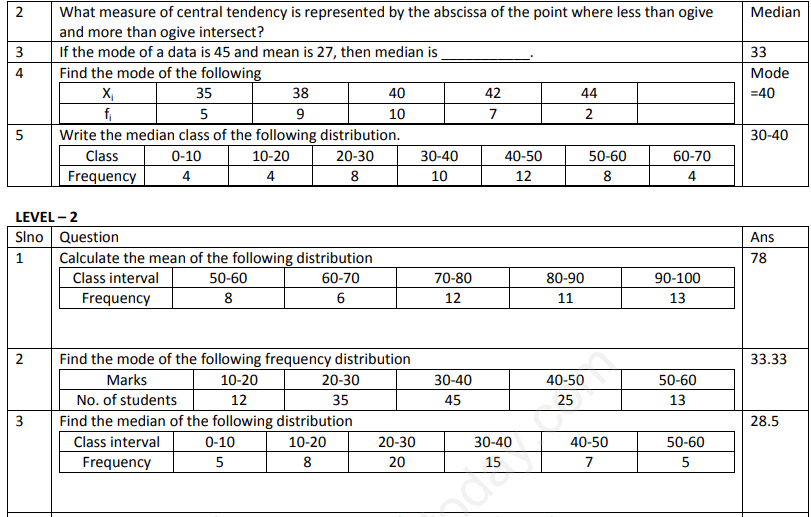
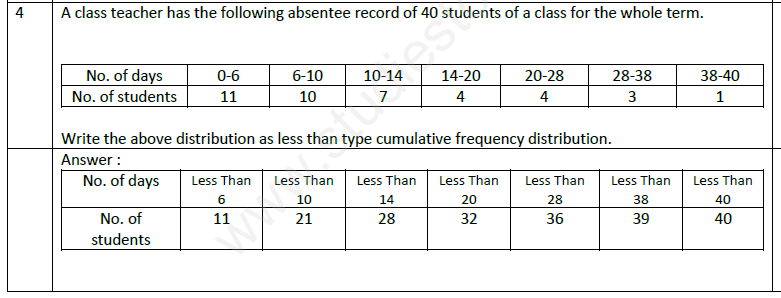
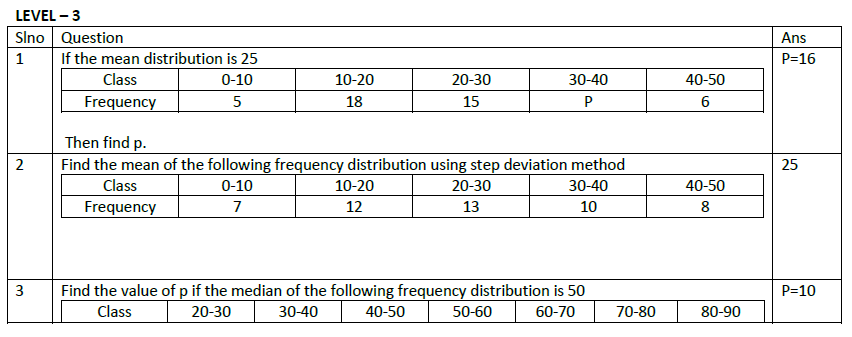
Please refer to attached file for CBSE Class 10 Mathematics Statistics Assignment Set B
Free study material for Mathematics
Download Practice Assignments: Class 10 Mathematics Chapter 13 Statistics
Chapter Practice Questions for Class 10 Mathematics
Access structured practice assignments for Chapter 13 Statistics designed in alignment with the latest CBSE curriculum for Class 10 Mathematics. These printable sets cover objective and descriptive problem types to support thorough revision.
Maximize Exam Scores with Chapter Practice Sets
- Exam Alignment: Questions strictly follow contemporary CBSE sample papers and grading schemes.
- Comprehensive Coverage: Features objective drills, case studies, and structured descriptive problems for Chapter 13 Statistics.
- Pacing & Precision: Regular problem-solving builds critical calculation speed and test-taking accuracy.
How to Approach Mathematics Chapter 13 Statistics Assignments
- Textbook Review: Always study the core NCERT book for Class 10 Mathematics prior to beginning the assignment.
- Independent Attempt: Solve Chapter 13 Statistics questions on your own initially before cross-checking with expert solutions.
- Error Tracking: Record challenging concepts in a dedicated notebook and practice online MCQ tests for revision.
FAQs
You can download free PDF assignments for Class 10 Mathematics Chapter 13 Statistics from StudiesToday.com. These practice sheets have been updated for the 2026-27 session covering all concepts from latest NCERT textbook.
Yes, our teachers have given solutions for all questions in the Class 10 Mathematics Chapter 13 Statistics assignments. This will help you to understand step-by-step methodology to get full marks in school tests and exams.
Yes. These assignments are designed as per the latest CBSE syllabus for 2026. We have included huge variety of question formats such as MCQs, Case-study based questions and important diagram-based problems found in Chapter 13 Statistics.
Practicing topicw wise assignments will help Class 10 students understand every sub-topic of Chapter 13 Statistics. Daily practice will improve speed, accuracy and answering competency-based questions.
Yes, all printable assignments for Class 10 Mathematics Chapter 13 Statistics are available for free download in mobile-friendly PDF format.