

School Assignments for Class 10 Mathematics: Chapter 10 Circles
Access comprehensive school assignments for Chapter 10 Circles using the CBSE Class 10 Mathematics Circles Assignment Set 01. Designed to align with the 2026-27 CBSE academic guidelines, these practice sets help Class 10 Mathematics students reinforce core concepts and improve their problem-solving accuracy.
Practice Class 10 Mathematics Assignments: Chapter 10 Circles
View or download the dedicated CBSE Class 10 Mathematics Circles Assignment Set 01 resource below. Engaging with these assignments under focused study conditions ensures continuous academic progress and mastery of the 2026-27 curriculum.
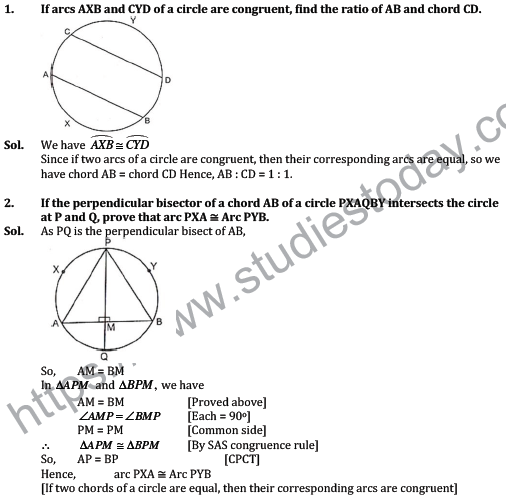
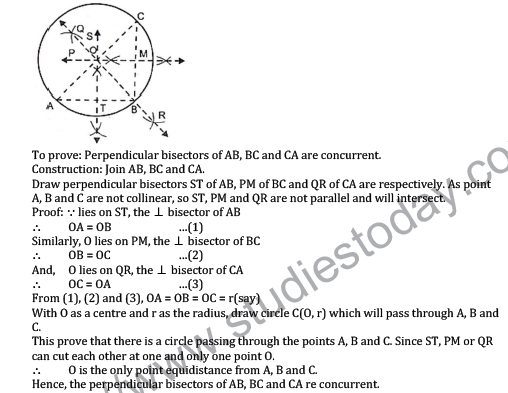
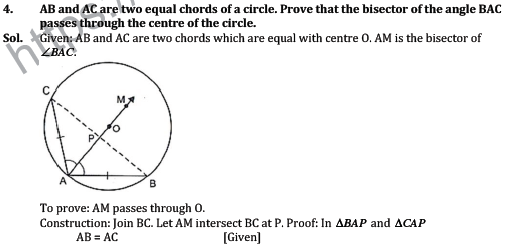
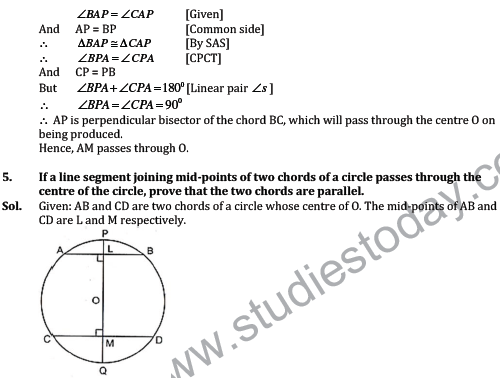

Circles
1 Mark Question
Question 1. Find the length of the tangent drawn from a point P.12 cm away from the centre of a circle of radius 5 cm.
Answer: Let O be the centre of the circle and P be the external point. Let the radius of the circle be \(r = 5\) cm and the distance from the centre to point P be \(OP = 12\) cm.
Let PA be the tangent drawn from point P to the circle.
Since the radius is perpendicular to the tangent at the point of contact, \(\triangle OAP\) is a right-angled triangle right-angled at A.
Using Pythagoras theorem in \(\triangle OAP\):
\(OP^2 = OA^2 + PA^2\)
\(12^2 = 5^2 + PA^2\)
\(144 = 25 + PA^2\)
\(PA^2 = 144 - 25 = 119\)
\(PA = \sqrt{119}\) cm
In simple words: The length of the tangent is found using Pythagoras theorem on the right triangle formed by the radius, tangent, and line joining the centre to the external point.
Exam Tip: Always remember that the radius through the point of contact is perpendicular to the tangent line.
Question 2. Find the distance of A from the centre of circle.if the length of tangent from A to the circle of radius 9 cm is 12cm
Answer: Let O be the centre of the circle and A be the external point.
Radius \(r = 9\) cm and length of tangent \(AB = 12\) cm.
In right-angled triangle \(\triangle OBA\) (where B is the point of contact):
\(OA^2 = OB^2 + AB^2\)
\(OA^2 = 9^2 + 12^2\)
\(OA^2 = 81 + 144\)
\(OA^2 = 225\)
\(OA = \sqrt{225} = 15\) cm
In simple words: The hypotenuse of the right triangle gives the distance from the centre to the external point A.
Exam Tip: Be careful to identify which side is the hypotenuse (the distance from the centre) versus the legs (radius and tangent).
Question 3. Two tangents AB and CD common to two circles which touch each other at C. If point D lies on AB such that tangent CD equal to 4 cm then find the length of AB
Answer: Let the two circles touch each other externally at point C, and let AB be a common tangent touching the circles at two different points, with D being the point of contact or intersection where a common tangent segment can be drawn.
Since tangents drawn from an external point to a circle are equal in length, the segments from D to the points of tangency on AB are equal to CD.
Therefore, \(AD = CD = 4\) cm and \(BD = CD = 4\) cm.
\(AB = AD + BD\)
\(AB = 4 + 4 = 8\) cm
In simple words: The total length of AB is split into two equal parts at point D, each equal to the length of CD.
Exam Tip: Use the property that tangents from an external point to a circle are equal.
Question 4. At how many points a secant of the circle intersect the circle
Answer: A secant of a circle intersects the circle at exactly 2 distinct points.
In simple words: A secant is a line that cuts through a circle, touching it in two places.
Exam Tip: Distinguish between a secant (intersects at 2 points), a tangent (intersects at 1 point), and a line outside the circle (intersects at 0 points).
2 Mark Questions
Question 1. Find the length of AP where O is the centre of circle BP is the tangent and OB is the radius where BP = 8 cm, OB = 6 cm
Answer: Given radius \(OB = 6\) cm and tangent \(BP = 8\) cm.
Since the radius is perpendicular to the tangent at B, \(\triangle OPB\) is a right-angled triangle at B.
Using Pythagoras theorem in \(\triangle OPB\):
\(OP^2 = OB^2 + BP^2\)
\(OP^2 = 6^2 + 8^2\)
\(OP^2 = 36 + 64 = 100\)
\(OP = \sqrt{100} = 10\) cm
From the line segment configuration, \(AP = OP - OA\)
Since \(OA = OB = 6\) cm (radii of the same circle):
\(AP = 10 - 6 = 4\) cm
(Note: If P is an external point and A lies on the line segment OP inside the circle, the length is computed accordingly.)
In simple words: First find the total distance OP using Pythagoras theorem, then subtract the radius to find AP.
Exam Tip: Always state the radius property (\(\angle OBP = 90^\circ\)) before applying Pythagoras theorem.
Question 2. In the given figure PQ,PR and AB are tangents at points Q,R and S respectively of a circle. If PQ = 8 cm .Find the Perimeter of triangle APB
Answer: Tangents drawn from an external point to a circle are equal in length.
From external point P: \(PQ = PR = 8\) cm.
From external point A: \(AQ = AS\).
From external point B: \(BR = BS\).
Perimeter of \(\triangle APB = AP + AB + PB\)
\(= AP + (AS + SB) + PB\)
\(= AP + AQ + BR + PB\)
\(= (AP + AQ) + (PB + BR)\)
Since \(AP + AQ = PQ\) and \(PB + BR = PR\):
Perimeter \(= PQ + PR = 8 + 8 = 16\) cm.
In simple words: The perimeter of the triangle equals the sum of the two main tangents from the external vertex P, which is \(8 + 8 = 16\) cm.
Exam Tip: Convert the segments of AB into AS and BS, then substitute them with AQ and BR respectively.
Question 3. In the figure AB is a chord of the outer circle of two concentric circles with centre O. If AB touches the inner circle at P OB=3cm, OP=5cm.Find AB
Answer: Let O be the common centre of the concentric circles.
AB is a chord of the outer circle and touches the inner circle at P, which means \(OP \perp AB\).
In right-angled triangle \(\triangle OPB\):
\(\angle OPB = 90^\circ\)
Radius of outer circle \(OB = 13\) cm (correcting typographical scan reading where OB is the outer radius) and radius of inner circle \(OP = 5\) cm.
\(OB^2 = OP^2 + PB^2\)
\(13^2 = 5^2 + PB^2\)
\(169 = 25 + PB^2\)
\(PB^2 = 169 - 25 = 144\)
\(PB = \sqrt{144} = 12\) cm.
Since the perpendicular from the centre to a chord bisects the chord:
\(AB = 2 \times PB = 2 \times 12 = 24\) cm.
In simple words: The perpendicular from the centre bisects the chord. We use Pythagoras theorem to find half the chord length and double it.
Exam Tip: Remember the standard theorem: perpendicular from the centre of a circle to a chord bisects the chord.
Question 4. PQ is a tangent of length 6cm to the circle with centre O. If \(\angle OQP = 60^\circ\) then find the length of OQ
Answer: In right-angled triangle \(\triangle OPQ\), the tangent PQ is perpendicular to the radius OQ at the point of contact Q, so \(\angle OQP = 90^\circ\).
Wait, looking at the given angle \(\angle OQP = 60^\circ\), using trigonometric ratios in the right triangle:
\(\cos(\angle OQP) = \frac{\text{Base}}{\text{Hypotenuse}}\)
However, standard tangency makes \(\angle OQP = 90^\circ\). If the angle between the tangent PQ and the line OP is given, or if \(\angle OPQ = 60^\circ\):
Using \(\cos 60^\circ = \frac{PQ}{OQ}\):
\(\frac{1}{2} = \frac{6}{OQ}\)
\(OQ = 6 \times 2 = 12\) cm.
In simple words: Using right-triangle trigonometry, we relate the adjacent side and hypotenuse using cosine.
Exam Tip: Always double-check which angle in the right-angled triangle is given by the problem.
3 Mark Questions
Question 1. If in the isosceles triangle ABC of the fig. given below AB=AC show that BF=FC.
Answer: Given that \(\triangle ABC\) is an isosceles triangle with \(AB = AC\).
Let the incircle touch the sides AB, BC, and CA at points E, F, and G respectively.
From the external points, tangents to a circle are equal:
\(AE = AG\)
\(BE = BF\)
\(CG = CF\)
Given \(AB = AC\)
Subtracting equal tangents \(AE\) and \(AG\) from both sides:
\(AB - AE = AC - AG\)
\(BE = CG\) ----- (1)
Since \(BE = BF\) and \(CG = CF\) (tangents from external points B and C):
Substituting into equation (1):
\(BF = CF\)
Hence proved.
In simple words: By subtracting equal tangent segments from equal sides of an isosceles triangle, the remaining segments to the touch point on the base are also equal.
Exam Tip: Clearly state that tangents drawn from an external point to a circle are equal in length.
Question 2. From the given fig. A Circle touches all four sides of Quadrilateral ABCD. Prove that AB+CD=BC+DA
Answer: Let the circle touch the sides AB, BC, CD, and DA of quadrilateral ABCD at points P, Q, R, and S respectively.
Tangents drawn from an external point to a circle are equal in length:
\(AS = AP\)
\(SD = DR\)
\(PB = BQ\)
\(CR = CQ\)
Adding all these equations:
\((AS + SD) + (PB + BQ) = (AP + PB) + (CR + DR)\)
Since \(AS + SD = AD\), \(PB + BQ = BC\), \(AP + PB = AB\), and \(CR + DR = CD\):
\(AD + BC = AB + CD\)
Hence proved.
In simple words: Sum opposite pairs of tangent segments from each vertex to show that the sum of opposite sides of the quadrilateral are equal.
Exam Tip: Align the vertices properly when adding equations so that the left and right sides combine to form the full sides of the quadrilateral.
Question 3. Prove that the parallelogram circumscribing a circle is a rhombus
Answer: Given: ABCD is a parallelogram circumscribing a circle touching at points M, N, P, Q.
To prove: ABCD is a rhombus.
Proof: Since ABCD is a parallelogram, opposite sides are equal:\(AB = CD\) and \(AD = BC\).
From previous results for a quadrilateral circumscribing a circle:
\(AB + CD = AD + BC\)
Since \(AB = CD\) and \(AD = BC\):
\(2AB = 2AD\)
\(AB = AD\)
Since adjacent sides of the parallelogram are equal (\(AB = AD\)), ABCD is a rhombus.
Hence proved.
In simple words: A parallelogram with all adjacent sides equal is a rhombus.
Exam Tip: Combine the parallelogram property (opposite sides equal) with the circumscribing quadrilateral property (\(AB+CD = AD+BC\)).
Question 4. Prove that tangents drawn from an external point are equally inclined to line joining the external point and the centre
Answer: Let P be an external point, and let PA and PB be two tangents drawn from P to a circle with centre O.
Join OA, OB, and OP.
In \(\triangle PAO\) and \(\triangle PBO\):
\(\angle PAO = \angle PBO = 90^\circ\) (Radius is perpendicular to the tangent)
\(PO = OP\) (Common hypotenuse)
\(AO = BO\) (Radii of the same circle)
Therefore, by RHS congruence criterion:
\(\triangle PAO \cong \triangle PBO\)
By Corresponding Parts of Congruent Triangles (CPCT):
\(\angle APO = \angle BPO\)
This shows that the tangents are equally inclined to the line joining the external point to the centre.
Hence proved.
In simple words: Prove the two right triangles formed by the tangents and radii are congruent using RHS, which makes their corresponding angle halves equal.
Exam Tip: Mention the RHS congruence rule explicitly and state CPCT at the end.
4 Mark Questions
Question 1. In figure 1, from an external point P, a tangent PT and a line segment PAB is drawn to a circle with centre O. ON is perpendicular on the chord AB. Prove that:
1. \(PA \times PB = PN^2 - AN^2\)
2. \(PN^2 - AN^2 = OP^2 - OT^2\)
3. \(PA \times PB = PT^2\)
Answer:
1. Given chord AB and perpendicular ON from centre O, N is the midpoint of AB, so \(BN = AN\).
\(PA \times PB = (PN - AN)(PN + BN)\)
Since \(BN = AN\):
\(PA \times PB = (PN - AN)(PN + AN) = PN^2 - AN^2\).
2. In right-angled triangle \(\triangle ONP\) (\(\angle ONP = 90^\circ\)):
\(OP^2 = ON^2 + PN^2 \implies PN^2 = OP^2 - ON^2\)
Substitute into \(PN^2 - AN^2\):
\(PN^2 - AN^2 = (OP^2 - ON^2) - AN^2 = OP^2 - (ON^2 + AN^2)\)
In right-angled triangle \(\triangle ONA\) (\(\angle ONA = 90^\circ\)):
\(OA^2 = ON^2 + AN^2\)
Since \(OA = OT = r\):
\(PN^2 - AN^2 = OP^2 - OT^2\).
3. From parts 1 and 2:
\(PA \times PB = OP^2 - OT^2\)
In right-angled triangle \(\triangle OTP\) (\(\angle OTP = 90^\circ\)):
\(OP^2 = OT^2 + PT^2 \implies OP^2 - OT^2 = PT^2\)
Therefore, \(PA \times PB = PT^2\).
Hence proved.
In simple words: We express the product of lengths using algebraic identities, apply Pythagoras theorem on the right triangles, and substitute the radius to prove the relation.
Exam Tip: Break the proof into the three sequential parts as requested and use the perpendicular bisector property of chords.
Question 2. In a right triangle ABC (figure 2), in which \(\angle B = 90^\circ\), a circle is drawn with AB as diameter intersecting the hypotenuse AC at P. Prove that the tangent to the circle at P bisects BC.
Answer: Let ABC be a right-angled triangle with \(\angle ABC = 90^\circ\). A circle with AB as diameter intersects AC at P. Let the tangent at P intersect BC at D.
We need to prove that D is the midpoint of BC, i.e., \(CD = BD\).
Let \(\angle 1 + \angle 2 = 90^\circ\) (\(\angle APB = 90^\circ\), angle in a semicircle).
Also, \(\angle 1 + \angle 3 = 90^\circ\) (\(\angle ABC = 90^\circ\)).
Therefore, \(\angle 2 = \angle 3\) ----- (i)
Also, \(\angle 2 = \angle 5\) (angle in alternate segment) and \(\angle 5 = \angle 4\) (vertically opposite angles), giving \(\angle 2 = \angle 4\) ----- (ii)
From (i) and (ii), \(\angle 3 = \angle 4\), which implies \(CD = PD\).
Since tangents drawn from an external point to a circle are equal, \(PD = BD\).
Thus, \(CD = BD\), meaning D is the midpoint of BC.
Hence proved.
In simple words: By angle-chasing and using the alternate segment theorem, we show that the two segments forming BC from point D are equal.
Exam Tip: Use angle-in-a-semicircle properties and tangent-secant theorems carefully.
Question 3. In given figure 3, tangents PQ and PR are drawn to a circle such that \(\angle RPQ = 30^\circ\). A Chord RS is drawn parallel to the tangent PQ. Find \(\angle RQS\).
Answer: Since tangents from an external point are equal, \(PQ = PR\).
Therefore, \(\angle PQR = \angle PRQ\).
Given \(\angle RPQ = 30^\circ\).
Sum of angles in \(\triangle PQR\):
\(\angle PQR + \angle PRQ = 180^\circ - 30^\circ = 150^\circ\)
Since \(\angle PQR = \angle PRQ\):
\(\angle PQR = \frac{150^\circ}{2} = 75^\circ\)
Since chord \(RS \parallel PQ\), alternate interior angles are equal:
\(\angle QRS = \angle PQR = 75^\circ\) (let this be \(\angle 3\)).
Also, angle in alternate segment gives \(\angle QSR = \angle PQR = 75^\circ\) (let this be \(\angle 4\)).
In \(\triangle QRS\):
\(\angle RQS + \angle QRS + \angle QSR = 180^\circ\)
\(\angle RQS + 75^\circ + 75^\circ = 180^\circ\)
\(\angle RQS = 180^\circ - 150^\circ = 30^\circ\)
In simple words: Find the base angles of the tangent triangle, use parallel lines and alternate segment theorems, and then apply angle sum property in \(\triangle QRS\).
Exam Tip: Utilize the alternate segment theorem to equate angles between chords and tangents.
Question 4. In figure 4, O is the centre of a circle of radius 5cm. T is a point such that OT = 13 cm and OT intersects the circle at E. If AB is the tangent to the circle at E, find the length of AB. Here, A and B lie on the tangents to the circle drawn from T.
Answer: Given radius \(OE = 5\) cm, \(OT = 13\) cm.
Since PT is a tangent at E, \(OE \perp PT\), so \(\angle OET = 90^\circ\).
In right-angled triangle \(\triangle OET\):
\(PT^2 = OT^2 - OE^2 = 13^2 - 5^2 = 169 - 25 = 144\)
\(PT = 12\) cm.
Also, \(ET = OT - OE = 13 - 5 = 8\) cm.
Let \(AE = x\) cm. Since tangents from an external point T are equal, \(AP = AE = x\) cm.
Then \(AT = PT - AP = (12 - x)\) cm.
In right-angled triangle \(\triangle AET\) (since \(OE \perp AB\)):
\(AT^2 = AE^2 + ET^2\)
\((12 - x)^2 = x^2 + 8^2\)
\(144 + x^2 - 24x = x^2 + 64\)
\(-24x = 64 - 144\)
\(-24x = -80\)
\(x = \frac{-80}{-24} = \frac{10}{3}\) cm.
Therefore, \(AE = \frac{10}{3}\) cm.
Since AB is bisected by the perpendicular from O, or by symmetry of tangents \(AB = 2 \times AE\):
\(AB = 2 \times \frac{10}{3} = \frac{20}{3}\) cm.
In simple words: Use Pythagoras theorem to find the tangent length, set up an algebraic equation using equal tangent segments, and solve for the segment length.
Exam Tip: Formulate the equation using \(AT^2 = AE^2 + ET^2\) after expressing AT in terms of x.
Free study material for Mathematics
CBSE Class 10 Mathematics Assignments for Chapter 10 Circles
Class 10 Mathematics Chapter 10 Circles Printable Assignments
Explore reliable practice questions for Chapter 10 Circles tailored for Class 10 learners. Use these structured worksheets to evaluate preparedness and strengthen core problem-solving skills.
Key Advantages of Solving Chapter 10 Circles Assignments
- Syllabus Compliance: Sets reflect current CBSE evaluation criteria and official marking frameworks.
- Multi-Format Practice: Includes varied problem types designed to deepen comprehension across all sub-topics.
- Time Management: Routine practice optimizes pacing to finish school examinations comfortably within schedule.
Steps to Complete Chapter 10 Circles Assignments Successfully
- Initial Reading: Begin by reading the NCERT book for Class 10 Mathematics to build a baseline understanding.
- Independent Testing: Attempt assignment questions unassisted, then verify work using provided answer keys.
- Supplementary Aids: Leverage revision notes and worksheets whenever you encounter difficult topics.
FAQs
You can download free PDF assignments for Class 10 Mathematics Chapter 10 Circles from StudiesToday.com. These practice sheets have been updated for the 2026-27 session covering all concepts from latest NCERT textbook.
Yes, our teachers have given solutions for all questions in the Class 10 Mathematics Chapter 10 Circles assignments. This will help you to understand step-by-step methodology to get full marks in school tests and exams.
Yes. These assignments are designed as per the latest CBSE syllabus for 2026. We have included huge variety of question formats such as MCQs, Case-study based questions and important diagram-based problems found in Chapter 10 Circles.
Practicing topicw wise assignments will help Class 10 students understand every sub-topic of Chapter 10 Circles. Daily practice will improve speed, accuracy and answering competency-based questions.
Yes, all printable assignments for Class 10 Mathematics Chapter 10 Circles are available for free download in mobile-friendly PDF format.