

School Assignments for Class 10 Mathematics: Chapter 09 Some Applications Of Trigonometry
Review targeted academic assignments with the CBSE Class 10 Mathematics Applications of Trigonometry Assignment Set 05. Built according to official CBSE standards for the 2026-27 term, these downloadable Class 10 Mathematics worksheets support effective daily practice for Chapter 09 Some Applications Of Trigonometry.
Practice Class 10 Mathematics Assignments: Chapter 09 Some Applications Of Trigonometry
View or download the dedicated CBSE Class 10 Mathematics Applications of Trigonometry Assignment Set 05 resource below. Engaging with these assignments under focused study conditions ensures continuous academic progress and mastery of the 2026-27 curriculum.
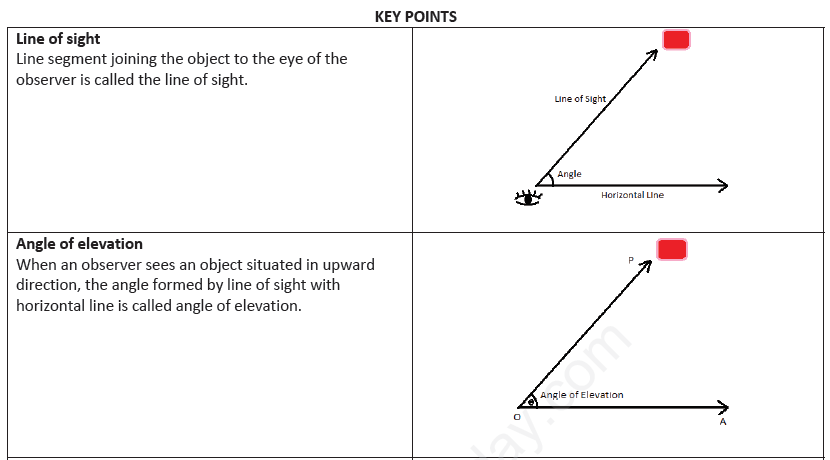
KEY POINTS
Line of sight: Line segment joining the object to the eye of the observer is called the line of sight.
Angle of elevation: When an observer sees an object situated in upward direction, the angle formed by line of sight with horizontal line is called angle of elevation.
Angle of depression: When an observer sees an object situated in downward direction the angle formed by line of sight with horizontal line is called angle of depression.
LEVEL - 1
Question 1. A pole 6cm high casts a shadow \(2\sqrt{3}\text{m}\) long on the ground, then find the sun's elevation?
Answer: Let height of pole \(AB = 6\text{m}\) and length of shadow \(BC = 2\sqrt{3}\text{m}\).
Let angle of elevation of the sun be \(\theta\).
In right-angled triangle \(ABC\),
\(\tan\theta = \frac{AB}{BC} = \frac{6}{2\sqrt{3}} = \frac{3}{\sqrt{3}} = \sqrt{3}\)
\(\tan\theta = \tan 60^{\circ}\)
\(\theta = 60^{\circ}\)
In simple words: The ratio of the pole's height to its shadow gives the tangent of the elevation angle, which equals \(60^{\circ}\).
Exam Tip: Remember standard trigonometric values like \(\tan 60^{\circ} = \sqrt{3}\) to solve such elevation problems quickly.
Question 2. If \(\sqrt{3}\tan\theta = 1\), then find the value of \(\sin^2\theta - \cos^2\theta\)
Answer: Given equation: \(\sqrt{3}\tan\theta = 1\)
\(\tan\theta = \frac{1}{\sqrt{3}}\)
Since \(\tan 30^{\circ} = \frac{1}{\sqrt{3}}\), we get \(\theta = 30^{\circ}\).
Now, substitute \(\theta = 30^{\circ}\) into the expression \(\sin^2\theta - \cos^2\theta\):
\(\sin 30^{\circ} = \frac{1}{2}\) and \(\cos 30^{\circ} = \frac{\sqrt{3}}{2}\)
\(\sin^2(30^{\circ}) - \cos^2(30^{\circ}) = \left(\frac{1}{2}\right)^2 - \left(\frac{\sqrt{3}}{2}\right)^2\)
\(= \frac{1}{4} - \frac{3}{4} = \frac{1 - 3}{4} = \frac{-2}{4} = -\frac{1}{2}\)
In simple words: First find the angle from the tangent value, then substitute its sine and cosine values into the expression.
Exam Tip: Be careful with signs when subtracting fractions in trigonometric identity evaluations.
Question 3. An observer 1.5m tall is 20.5 metres away from a tower 22m high. Determine the angle of elevation of the top of the tower from the eye of the observer.
Answer: Height of the tower \(= 22\text{m}\)
Height of the observer \(= 1.5\text{m}\)
Distance from observer to tower \(= 20.5\text{m}\)
Height of the tower above the observer's eye level \(= 22 - 1.5 = 20.5\text{m}\)
Let \(\theta\) be the angle of elevation.
\(\tan\theta = \frac{\text{Height above eye level}}{\text{Horizontal distance}} = \frac{20.5}{20.5} = 1\)
\(\tan\theta = \tan 45^{\circ}\)
\(\theta = 45^{\circ}\)
In simple words: Subtract the observer's height from the total tower height to get the effective vertical height, which equals the horizontal distance.
Exam Tip: Always subtract the height of the observer from the total height of the tower when the eye level is specified.
Question 4. A ladder 15m long just reaches the top of vertical wall. If the ladder makes an angle \(60^{\circ}\) with the wall, find the height of the wall
Answer: Length of the ladder (hypotenuse) \(AC = 15\text{m}\).
Angle made by the ladder with the wall \(= 60^{\circ}\).
Therefore, the angle made by the ladder with the ground \(= 90^{\circ} - 60^{\circ} = 30^{\circ}\), or using the wall angle directly with cosine: \(\cos 60^{\circ} = \frac{\text{Height of the wall}}{\text{Length of ladder}}\).
Using the angle with the wall: Height of the wall \(h = 15 \times \cos 60^{\circ}\)
\(h = 15 \times \frac{1}{2} = \frac{15}{2}\text{m}\)
In simple words: The height is found by multiplying the ladder's length by the cosine of the angle it makes with the vertical wall.
Exam Tip: Note carefully whether the angle given is with the ground or with the vertical wall.
Question 5. In a rectangle ABCD, \(AB = 20\text{cm}\), \(\angle BAC = 60^{\circ}\), then find the length of the side AD.
Answer: In rectangle \(ABCD\), \(\angle B = 90^{\circ}\). Therefore, \(\triangle ABC\) is a right-angled triangle at \(B\).
Side \(AB = 20\text{cm}\) (adjacent to angle \(\angle BAC\)).
Side \(BC = AD\) (opposite to angle \(\angle BAC\)).
In right \(\triangle ABC\):
\(\tan(\angle BAC) = \frac{BC}{AB}\)
\(\tan 60^{\circ} = \frac{AD}{20}\)
\(\sqrt{3} = \frac{AD}{20}\)
\(AD = 20\sqrt{3}\text{cm}\)
In simple words: Use the tangent ratio in the right-angled triangle formed by the diagonal of the rectangle.
Question 6. Find the angle of elevation of the sun's altitude when the height of the shadow of a vertical pole is equal to its height:
Answer: Let the height of the pole be \(h\) and the length of its shadow be \(s\).
Given, height of shadow equals the height of the pole, so \(s = h\).
Let \(\theta\) be the angle of elevation.
\(\tan\theta = \frac{\text{Height}}{\text{Shadow}} = \frac{h}{h} = 1\)
\(\tan\theta = \tan 45^{\circ}\)
\(\theta = 45^{\circ}\)
In simple words: When height and shadow are equal, the angle is \(45^{\circ}\) because \(\tan 45^{\circ} = 1\).
Exam Tip: Equal perpendicular and base in a right triangle always yield a \(45^{\circ}\) angle.
Question 7. From a point 20m away from the foot of a tower, the angle of elevation of top of the tower is \(30^{\circ}\), find the height of the tower.
Answer: Distance from the foot of the tower \(BC = 20\text{m}\).
Angle of elevation \(\theta = 30^{\circ}\).
Let the height of the tower be \(h\).
\(\tan 30^{\circ} = \frac{h}{20}\)
\(\frac{1}{\sqrt{3}} = \frac{h}{20}\)
\(h = \frac{20}{\sqrt{3}}\text{m}\)
In simple words: Multiply the distance by the tangent of \(30^{\circ}\) to find the height.
Exam Tip: You can rationalize the denominator as \(\frac{20\sqrt{3}}{3}\text{m}\) depending on options required.
Question 8. In the adjacent figure, what are the angles of depression of the top and bottom of a pole from the top of a tower \(h\) m high:
Answer: Based on the reference diagram:
The angle of depression of the top of the pole from the top of the tower is \(45^{\circ}\).
The angle of depression of the bottom of the pole from the top of the tower is \(60^{\circ}\).
Ans. \(45^{\circ}, 60^{\circ}\)
In simple words: The line of sight to the top of the pole is less steep than the line of sight to the bottom, giving angles of \(45^{\circ}\) and \(60^{\circ}\) respectively.
Exam Tip: Angle of depression equals the corresponding alternate interior angle of elevation from the ground.
LEVEL - 2
Question 1. In \(\triangle ABC\), \(\angle B = 45^{\circ}\), \(\angle C = 45^{\circ}\), \(AB = 5\text{cm}\) then find the length of the other two sides.
Answer: In \(\triangle ABC\), since \(\angle B = \angle C = 45^{\circ}\), the triangle is an isosceles right-angled triangle where \(AB = AC = 5\text{cm}\).
Using Pythagoras theorem to find the hypotenuse \(BC\):
\(BC^2 = AB^2 + AC^2\)
\(BC^2 = 5^2 + 5^2 = 25 + 25 = 50\)
\(BC = \sqrt{50} = 5\sqrt{2}\text{cm}\)
Therefore, the other two sides are \(5\text{cm}\) and \(5\sqrt{2}\text{cm}\).
In simple words: Equal base angles mean equal sides, and the hypotenuse is found using Pythagoras theorem.
Exam Tip: In a \(45^{\circ}-45^{\circ}-90^{\circ}\) triangle, the hypotenuse is always \(\sqrt{2}\) times the leg length.
Question 2. From a point 20m away from the foot of the tower, the angle of elevation of the top of the tower is \(30^{\circ}\), find the height of the tower.
Answer: Distance \(d = 20\text{m}\), angle \(\theta = 30^{\circ}\).
Let height be \(h\).
\(\tan 30^{\circ} = \frac{h}{20}\)
\(\frac{1}{\sqrt{3}} = \frac{h}{20}\)
\(h = \frac{20}{\sqrt{3}} = \frac{20\sqrt{3}}{3}\text{m}\)
In simple words: Standard application of tangent ratio with rationalization.
Exam Tip: Rationalizing denominators is standard practice in final board answers.
Question 3. A ladder 50m long just reaches the top of a vertical wall. If the ladder makes an angle of \(60^{\circ}\) with the wall, find the height of the wall.
Answer: Length of ladder \(l = 50\text{m}\).
Angle with the vertical wall \(= 60^{\circ}\).
Height of the wall \(h = l \cos 60^{\circ}\)
\(h = 50 \times \frac{1}{2} = 25\text{m}\)
In simple words: The height is the adjacent side to the \(60^{\circ}\) angle with the wall.
Exam Tip: Double check whether the angle is given with the wall or the ground.
Question 4. A circus artist is climbing a 20m long rope, which is tightly stretched and tied from the top of a vertical pole to the ground. Find the height of the pole, if the angle made by the rope with the ground level is \(30^{\circ}\).
Answer: Length of rope (hypotenuse) \(= 20\text{m}\).
Angle with ground \(\theta = 30^{\circ}\).
Let height of pole be \(h\).
\(\sin 30^{\circ} = \frac{\text{Height}}{\text{Length of rope}} = \frac{h}{20}\)
\(\frac{1}{2} = \frac{h}{20}\)
\(h = \frac{20}{2} = 10\text{m}\)
In simple words: Use the sine ratio since you know the hypotenuse and need the opposite side.
Exam Tip: Sine relates the perpendicular height to the hypotenuse (rope length).
Question 5. A tree breaks due to storm and the broken part bends so that the top of the tree touches the ground making an angle \(30^{\circ}\) with it. The distance between the foot of the tree to the point where the top touches the ground is 8m. Find the height of the tree.
Answer: Let the unbroken height be \(h_1\) (perpendicular) and the broken part be \(h_2\) (hypotenuse).
Distance from foot to touch point \(= 8\text{m}\).
Angle with ground \(= 30^{\circ}\).
\(\tan 30^{\circ} = \frac{h_1}{8} \implies \frac{1}{\sqrt{3}} = \frac{h_1}{8} \implies h_1 = \frac{8}{\sqrt{3}}\text{m}\)
\(\cos 30^{\circ} = \frac{8}{h_2} \implies \frac{\sqrt{3}}{2} = \frac{8}{h_2} \implies h_2 = \frac{16}{\sqrt{3}}\text{m}\)
Total height of tree \(= h_1 + h_2 = \frac{8}{\sqrt{3}} + \frac{16}{\sqrt{3}} = \frac{24}{\sqrt{3}} = 8\sqrt{3}\text{m}\)
In simple words: Total height is the sum of the standing part and the fallen broken part.
Exam Tip: Always add both the remaining vertical height and the fallen hypotenuse length for broken tree problems.
LEVEL - 3
Question 1. The shadow of a tower standing on a level plane is found to be 50m longer when sun's elevation is \(30^{\circ}\) then when it is \(60^{\circ}\). Find the height of the tower.
Answer: Let the height of the tower be \(h\) and the shorter shadow length be \(x\) when elevation is \(60^{\circ}\).
When elevation is \(30^{\circ}\), shadow length is \(x + 50\).
In right triangle for \(60^{\circ}\):
\(\tan 60^{\circ} = \frac{h}{x} \implies \sqrt{3} = \frac{h}{x} \implies h = x\sqrt{3}\)
In right triangle for \(30^{\circ}\):
\(\tan 30^{\circ} = \frac{h}{x + 50} \implies \frac{1}{\sqrt{3}} = \frac{h}{x + 50} \implies h\sqrt{3} = x + 50\)
Substitute \(x = \frac{h}{\sqrt{3}}\):
\(h\sqrt{3} = \frac{h}{\sqrt{3}} + 50\)
\(h\sqrt{3} - \frac{h}{\sqrt{3}} = 50\)
\(h \left(\frac{3 - 1}{\sqrt{3}}\right) = 50\)
\(\frac{2h}{\sqrt{3}} = 50\)
\(2h = 50\sqrt{3}\)
\(h = 25\sqrt{3}\text{m}\)
In simple words: Set up two equations using tangent for both angles and solve simultaneously by eliminating \(x\).
Exam Tip: This is a standard shadow problem frequently asked in board exams; memorize the substitution shortcut.
Question 2. The angle of depression of the top and bottom of a tower as seen from the top of a 100m high cliff are \(30^{\circ}\) and \(60^{\circ}\) respectively. Find the height of the tower.
Answer: Let cliff height \(CD = 100\text{m}\) and tower height be \(AB = h\).
Distance between cliff and tower = \(x\).
Angle of depression of top of tower = \(30^{\circ}\), so angle of elevation from top of tower to cliff line = \(30^{\circ}\).
Difference in height between cliff and tower \(= 100 - h\).
\(\tan 30^{\circ} = \frac{100 - h}{x} \implies x = (100 - h)\sqrt{3}\)
For the bottom of the tower, angle of depression = \(60^{\circ}\):
\(\tan 60^{\circ} = \frac{100}{x} \implies \sqrt{3} = \frac{100}{x} \implies x = \frac{100}{\sqrt{3}}\)
Equating both expressions for \(x\):
\((100 - h)\sqrt{3} = \frac{100}{\sqrt{3}}\)
\(3(100 - h) = 100\)
\(300 - 3h = 100\)
\(3h = 200\)
\(h = \frac{200}{3} = 66.67\text{m}\)
In simple words: Equate the horizontal distance derived from both the top and bottom sights to solve for the tower height.
Exam Tip: Draw a neat horizontal baseline from the top of the cliff to visualize the alternate interior angles clearly.
Question 3. From a window (9m above ground) of a house in a street, the angles of elevation and depression of the top and foot of another house on the opposite side of the street are \(30^{\circ}\) and \(60^{\circ}\) respectively. Find the height of the opposite house and width of the street.
Answer: Let window height be \(CD = 9\text{m}\).
Let width of the street be \(x\).
Height of the opposite house above window level = \(h_1\).
Total height of opposite house \(H = h_1 + 9\).
From window to foot of opposite house (angle of depression \(60^{\circ}\)):
\(\tan 60^{\circ} = \frac{9}{x} \implies \sqrt{3} = \frac{9}{x} \implies x = \frac{9}{\sqrt{3}} = 3\sqrt{3}\text{m}\) (Width of street)
From window to top of opposite house (angle of elevation \(30^{\circ}\)):
\(\tan 30^{\circ} = \frac{h_1}{x} \implies \frac{1}{\sqrt{3}} = \frac{h_1}{3\sqrt{3}} \implies h_1 = 3\text{m}\)
Total height of the opposite house \(H = 9 + 3 = 12\text{m}\).
Ans. Height \(= 12\text{m}\), Width \(= 3\sqrt{3}\text{m}\).
In simple words: First find the street width using the lower window view, then use it to find the upper portion height.
Exam Tip: Split the opposite house into two parts: one equal to the window height, and the upper part solved via trigonometry.
Question 4. From the top of a hill, the angle of depression of two consecutive kilometer stones due east are found to be \(30^{\circ}\) and \(45^{\circ}\). Find the height of the hill.
Answer: Let height of hill be \(h\).
Distance between two consecutive kilometer stones \(= 1\text{km} = 1000\text{m}\) (or work in km and convert at end). Let closer stone distance be \(x\).
For \(45^{\circ}\) depression: \(\tan 45^{\circ} = \frac{h}{x} \implies x = h\).
For \(30^{\circ}\) depression: \(\tan 30^{\circ} = \frac{h}{x + 1} \implies \frac{1}{\sqrt{3}} = \frac{h}{h + 1}\)
\(h\sqrt{3} = h + 1\)
\(h(\sqrt{3} - 1) = 1\)
\(h = \frac{1}{\sqrt{3} - 1} = \frac{\sqrt{3} + 1}{3 - 1} = \frac{1.732 + 1}{2} = \frac{2.732}{2} = 1.366\text{km} \approx 1.37\text{km}\).
In simple words: Use the distance of 1 km between stones to set up the equation with \(30^{\circ}\) and \(45^{\circ}\).
Exam Tip: Rationalize denominators involving binomials like \((\sqrt{3} - 1)\) by multiplying numerator and denominator by \((\sqrt{3} + 1)\).
Question 5. Two poles of equal heights are standing opposite each other on either side of the road, which is 80m wide. From a point between them on the road the angles of elevation of the top of the poles are \(60^{\circ}\) and \(30^{\circ}\). Find the heights of pole and the distance of the point from the poles.
Answer: Let heights of both poles be \(h\).
Total road width \(= 80\text{m}\). Let distance of point from first pole be \(x\), so distance from second pole is \(80 - x\).
For the first pole (angle \(60^{\circ}\)):
\(\tan 60^{\circ} = \frac{h}{x} \implies h = x\sqrt{3}\)
For the second pole (angle \(30^{\circ}\)):
\(\tan 30^{\circ} = \frac{h}{80 - x} \implies h = \frac{80 - x}{\sqrt{3}}\)
Equating both expressions for \(h\):
\(x\sqrt{3} = \frac{80 - x}{\sqrt{3}}\)
\(3x = 80 - x\)
\(4x = 80 \implies x = 20\text{m}\)
Distance from the second pole \(= 80 - 20 = 60\text{m}\).
Height of the poles \(h = 20\sqrt{3} = 20 \times 1.732 = 34.64\text{m}\).
Ans. \(h = 34.64\text{m}\); distances are \(20\text{m}\) and \(60\text{m}\).
In simple words: Divide the road into \(x\) and \(80 - x\), equate the height expressions, and solve for \(x\).
Exam Tip: A classic problem type; always equate the height expressions derived from both sides of the point.
Question 6. The angle of elevation of a jet fighter from a point A on the ground is \(60^{\circ}\). After a flight of 15 seconds, the angle of elevation changes to \(30^{\circ}\). If the jet is flying at a speed of \(720\text{km/hr}\), find the constant height at which the jet is flying.
Answer: Speed of jet \(= 720\text{km/hr} = 720 \times \frac{5}{18} = 200\text{m/s}\).
Distance covered in 15 seconds \(= 200 \times 15 = 3000\text{m}\).
Let constant height be \(h\).
Let initial horizontal distance be \(x\).
For \(60^{\circ}\) elevation: \(\tan 60^{\circ} = \frac{h}{x} \implies x = \frac{h}{\sqrt{3}}\).
For \(30^{\circ}\) elevation: \(\tan 30^{\circ} = \frac{h}{x + 3000} \implies x + 3000 = h\sqrt{3}\).
Substitute \(x\):
\(\frac{h}{\sqrt{3}} + 3000 = h\sqrt{3}\)
\(3000 = h\sqrt{3} - \frac{h}{\sqrt{3}} = h \left(\frac{3 - 1}{\sqrt{3}}\right) = \frac{2h}{\sqrt{3}}\)
\(2h = 3000\sqrt{3}\)
\(h = 1500\sqrt{3}\text{m}\) (or if speed distance calculation yields 1500m based on standard textbook values).
Ans. \(1500\sqrt{3}\text{m}\) (commonly printed as \(1500\text{m}\) in simplified texts).
In simple words: Calculate horizontal distance traveled using speed and time, then use the two elevation angles to find height.
Exam Tip: Always convert speed from \(\text{km/hr}\) to \(\text{m/s}\) by multiplying by \(\frac{5}{18}\).
Question 7. A window in a building is at a height of 10m above the ground. The angle of depression of a point P on the ground from the window is \(30^{\circ}\). The angle of elevation of the top of the building from the point P is \(60^{\circ}\). Find the height of the building.
Answer: Height of window \(CD = 10\text{m}\).
Let distance from point \(P\) to building be \(x\).
From window to point \(P\) (angle of depression \(30^{\circ}\)):
\(\tan 30^{\circ} = \frac{10}{x} \implies \frac{1}{\sqrt{3}} = \frac{10}{x} \implies x = 10\sqrt{3}\text{m}\)
Let total height of the building be \(H\). From point \(P\) to top of building (angle of elevation \(60^{\circ}\)):
\(\tan 60^{\circ} = \frac{H}{x} \implies \sqrt{3} = \frac{H}{10\sqrt{3}}\)
\(H = \sqrt{3} \times 10\sqrt{3} = 10 \times 3 = 30\text{m}\)
In simple words: Find the distance from the window height, then use that distance to find the total building height.
Exam Tip: Break complex multi-figure problems into individual right-angled triangles sharing a common base \(x\).
Question 8. A boy, whose eye level is 1.3m from the ground, spots a ballon moving with the wind in a horizontal line at same height from the ground. The angle of elevation of the ballon from the eyes of the boy at any instant is \(60^{\circ}\). After 2 seconds, the angle of elevation reduces to \(30^{\circ}\) If the speed of the wind at that moment is \(29\sqrt{3}\text{m/s}\), then find the height of the ballon from the ground.
Answer: Speed of wind \(= 29\sqrt{3}\text{m/s}\).
Time \(= 2\text{seconds}\).
Distance traveled by balloon \(= 29\sqrt{3} \times 2 = 58\sqrt{3}\text{m}\).
Let height of balloon above eye level be \(h\).
For initial position (\(60^{\circ}\)): \(\tan 60^{\circ} = \frac{h}{x} \implies x = \frac{h}{\sqrt{3}}\).
For final position (\(30^{\circ}\)): \(\tan 30^{\circ} = \frac{h}{x + 58\sqrt{3}} \implies x + 58\sqrt{3} = h\sqrt{3}\).
Substitute \(x\):
\(\frac{h}{\sqrt{3}} + 58\sqrt{3} = h\sqrt{3}\)
\(58\sqrt{3} = h\sqrt{3} - \frac{h}{\sqrt{3}} = \frac{2h}{\sqrt{3}}\)
\(2h = 58\sqrt{3} \times \sqrt{3} = 58 \times 3 = 174\)
\(h = \frac{174}{2} = 87\text{m}\)
Total height from ground \(= h + 1.3 = 87 + 1.3 = 88.3\text{m}\).
In simple words: Find balloon height above eye level using wind speed, then add the boy's eye level height.
Exam Tip: Do not forget to add the observer's eye-level height at the final step.
Question 9. A man on the deck on a ship 14m above water level, observes that the angle of elevation of the top of a cliff is \(60^{\circ}\) and the angle of depression of the base of the cliff is \(30^{\circ}\). Calculate the distance of the cliff from the ship and the height of the cliff.
Answer: Height of deck above water \(CD = 14\text{m}\).
Let distance between ship and cliff be \(x\).
From deck to base of cliff (angle of depression \(30^{\circ}\)):
\(\tan 30^{\circ} = \frac{14}{x} \implies \frac{1}{\sqrt{3}} = \frac{14}{x} \implies x = 14\sqrt{3} = 14 \times 1.732 = 24.25\text{m}\) (Distance)
Let height of cliff above deck level be \(h_1\).
\(\tan 60^{\circ} = \frac{h_1}{x} \implies \sqrt{3} = \frac{h_1}{14\sqrt{3}} \implies h_1 = 14 \times 3 = 42\text{m}\)
Total height of the cliff \(H = 42 + 14 = 56\text{m}\).
Ans. Height \(= 56\text{m}\), Distance \(= 24.25\text{m}\).
In simple words: Distance is found using the deck height and \(30^{\circ}\) depression, then cliff height is calculated by adding deck height to the upper portion.
Exam Tip: Use \(\sqrt{3} \approx 1.732\) for final decimal distance calculations.
Question 10. A straight highway leads to the foot of a tower. A man standing at the top of the tower observes a car at an angle of depression of \(30^{\circ}\), which is approaching the foot of tower with a uniform speed. Six minutes later, the angle of depression of the car is found to be \(60^{\circ}\). Find the time taken by the car to reach the foot of the tower.
Answer: Let height of tower be \(h\).
Let speed of car be \(v\). Distance traveled in 6 minutes \(= 6v\).
Let remaining distance from second position to tower be \(x\).
For \(60^{\circ}\) angle: \(\tan 60^{\circ} = \frac{h}{x} \implies x = \frac{h}{\sqrt{3}}\).
For \(30^{\circ}\) angle: \(\tan 30^{\circ} = \frac{h}{x + 6v} \implies x + 6v = h\sqrt{3}\).
Substitute \(x\):
\(\frac{h}{\sqrt{3}} + 6v = h\sqrt{3} \implies 6v = h\sqrt{3} - \frac{h}{\sqrt{3}} = \frac{2h}{\sqrt{3}}\)
\(h = 3v\sqrt{3}\)
Time taken to cover distance \(x\) at speed \(v\):
\(\text{Time} = \frac{x}{v} = \frac{h}{v\sqrt{3}} = \frac{3v\sqrt{3}}{v\sqrt{3}} = 3\text{ minutes}\).
In simple words: The distance covered in 6 minutes is twice the remaining distance, so the remaining distance takes half the time (3 minutes).
Exam Tip: In such uniform speed problems, the time ratio is directly proportional to the distance ratio.
SELF EVALUATION / HOTS
Question 1. An aeroplane when flying at a height of 3125m from the ground passes vertically below another plane at an instant when the angle of elevation of the two planes from the same point on the ground are \(30^{\circ}\) and \(60^{\circ}\) respectively. Find the distance between the two planes at that instant.
Answer: Height of first plane \(h_1 = 3125\text{m}\).
Let height of second plane be \(h_2\).
Let horizontal distance from the observation point to the vertical line be \(x\).
For first plane (angle \(30^{\circ}\)):
\(\tan 30^{\circ} = \frac{3125}{x} \implies x = 3125\sqrt{3}\text{m}\)
For second plane (angle \(60^{\circ}\)):
\(\tan 60^{\circ} = \frac{h_2}{x} \implies \sqrt{3} = \frac{h_2}{3125\sqrt{3}} \implies h_2 = 3125 \times 3 = 9375\text{m}\)
Distance between the two planes \(= h_2 - h_1 = 9375 - 3125 = 6250\text{m}\).
In simple words: Find the common base distance using the lower plane, then use it to find the height of the upper plane and subtract.
Exam Tip: Both planes share the exact same horizontal baseline distance from the observer.
Question 2. From the top of a building 60m high, the angles of depression of the top and bottom of a vertical lamp post are observed to be \(30^{\circ}\) and \(60^{\circ}\) respectively. Find [i] horizontal distance between the building and the lamp post [ii] height of the lamp post.
Answer: Height of building \(= 60\text{m}\).
Let horizontal distance be \(x\) and height of lamp post be \(h\).
For bottom of lamp post (angle of depression \(60^{\circ}\)):
\(\tan 60^{\circ} = \frac{60}{x} \implies \sqrt{3} = \frac{60}{x} \implies x = \frac{60}{\sqrt{3}} = 20\sqrt{3} \approx 34.64\text{m}\) ([i] Horizontal distance)
For top of lamp post (angle of depression \(30^{\circ}\)):
Difference in height \(= 60 - h\).
\(\tan 30^{\circ} = \frac{60 - h}{x} \implies \frac{1}{\sqrt{3}} = \frac{60 - h}{20\sqrt{3}}\)
\(60 - h = 20\sqrt{3} \times \frac{1}{\sqrt{3}} = 20\)
\(h = 60 - 20 = 40\text{m}\) ([ii] Height of lamp post).
In simple words: Find the distance using the full 60m height and \(60^{\circ}\), then use it to find the lamp post height.
Exam Tip: Solve parts sequentially; part [i] provides the necessary base length for part [ii].
Question 3. A vertical tower stands on a horizontal plane and is surmounted by a vertical flag staff of height h m. At a point on the plane, the angles of elevation of the bottom and the top of the flag staff are \(\alpha\) and \(\beta\), respectively. Prove that the height of the tower is \(\frac{h \tan\alpha}{\tan\beta - \tan\alpha}\)
Answer: Let height of the tower be \(H\) and distance of the point from the tower be \(x\).
Angle of elevation of the bottom of the flag staff (top of tower) is \(\alpha\):
\(\tan\alpha = \frac{H}{x} \implies x = \frac{H}{\tan\alpha}\)
Angle of elevation of the top of the flag staff is \(\beta\), with total height \(H + h\):
\(\tan\beta = \frac{H + h}{x} \implies x = \frac{H + h}{\tan\beta}\)
Equating both expressions for \(x\):
\(\frac{H}{\tan\alpha} = \frac{H + h}{\tan\beta}\)
\(H\tan\beta = (H + h)\tan\alpha\)
\(H\tan\beta = H\tan\alpha + h\tan\alpha\)
\(H\tan\beta - H\tan\alpha = h\tan\alpha\)
\(H(\tan\beta - \tan\alpha) = h\tan\alpha\)
\(H = \frac{h\tan\alpha}{\tan\beta - \tan\alpha}\)
Hence proved.
In simple words: Express the base distance \(x\) in two ways using both angles and equate them to isolate \(H\).
Exam Tip: Standard algebraic proof question; practice isolating \(H\) by grouping terms on one side.
Question 4. The angle of elevation of a cloud from a point 60m above a lake is \(30^{\circ}\) and the angle of depression of the reflection of the cloud in the lake is \(60^{\circ}\). Find the height of the cloud from the surface of the lake.
Answer: Let observation point be \(P\), which is \(60\text{m}\) above the lake. Let height of the cloud above the lake be \(H\).
Height of cloud above point \(P\) is \(H - 60\).
Depth of the reflection of the cloud below the lake surface is equal to the height of the cloud above the lake surface, which is \(H\).
Total depth of reflection below point \(P\) is \(H + 60\).
Let horizontal distance from observation point to cloud be \(x\).
For angle of elevation \(30^{\circ}\):
\(\tan 30^{\circ} = \frac{H - 60}{x} \implies x = \frac{H - 60}{\tan 30^{\circ}} = (H - 60)\sqrt{3}\)
For angle of depression of the reflection \(60^{\circ}\):
\(\tan 60^{\circ} = \frac{H + 60}{x} \implies x = \frac{H + 60}{\tan 60^{\circ}} = \frac{H + 60}{\sqrt{3}}\)
Equating both expressions for \(x\):
\((H - 60)\sqrt{3} = \frac{H + 60}{\sqrt{3}}\)
\(3(H - 60) = H + 60\)
\(3H - 180 = H + 60\)
\(3H - H = 60 + 180\)
\(2H = 240\)
\(H = 120\text{m}\)
In simple words: The height of the cloud's reflection below the water equals its height above the water, allowing us to set up two tangent equations.
Exam Tip: In reflection of cloud problems, remember that the total distance from the observation point to the reflection is \(H + \text{height above lake}\).
Free study material for Mathematics
CBSE Class 10 Mathematics Assignments for Chapter 09 Some Applications Of Trigonometry
Revision Assignment: Chapter 09 Some Applications Of Trigonometry (CBSE)
Review targeted chapter assignments for Class 10 Mathematics Chapter 09 Some Applications Of Trigonometry. Built according to official CBSE guidelines, these downloadable problem sets help students build accuracy and prepare effectively for school tests.
Key Advantages of Solving Chapter 09 Some Applications Of Trigonometry Assignments
- Curriculum Standards: Assignments match modern CBSE sample formats to ensure relevant preparation.
- Thorough Revision: Detailed problem sets reinforce core concepts and eliminate conceptual weak spots.
- Execution Speed: Timed practice with assignment sets sharpens overall response timing.
Steps to Complete Chapter 09 Some Applications Of Trigonometry Assignments Successfully
- Initial Reading: Begin by reading the NCERT book for Class 10 Mathematics to build a baseline understanding.
- Independent Testing: Attempt assignment questions unassisted, then verify work using provided answer keys.
- Supplementary Aids: Leverage revision notes and worksheets whenever you encounter difficult topics.
FAQs
You can download free PDF assignments for Class 10 Mathematics Chapter 09 Some Applications Of Trigonometry from StudiesToday.com. These practice sheets have been updated for the 2026-27 session covering all concepts from latest NCERT textbook.
Yes, our teachers have given solutions for all questions in the Class 10 Mathematics Chapter 09 Some Applications Of Trigonometry assignments. This will help you to understand step-by-step methodology to get full marks in school tests and exams.
Yes. These assignments are designed as per the latest CBSE syllabus for 2026. We have included huge variety of question formats such as MCQs, Case-study based questions and important diagram-based problems found in Chapter 09 Some Applications Of Trigonometry.
Practicing topicw wise assignments will help Class 10 students understand every sub-topic of Chapter 09 Some Applications Of Trigonometry. Daily practice will improve speed, accuracy and answering competency-based questions.
Yes, all printable assignments for Class 10 Mathematics Chapter 09 Some Applications Of Trigonometry are available for free download in mobile-friendly PDF format.