

Official CBSE Assignments for Class 10 Mathematics
Review targeted academic assignments with the CBSE Class 10 Mathematics Area Relates to Circles Assignment Set 01. Built according to official CBSE standards for the 2026-27 term, these downloadable Class 10 Mathematics worksheets support effective daily practice for Chapter 11 Areas Related to Circles.
Solved Practice Assignments for Mathematics
Navigate directly to the solved Mathematics assignments using the digital viewer below. Each practice set includes detailed step-by-step solutions, allowing students to instantly cross-check their work and identify areas requiring further revision.
Level Based Questions
Level 1
CASE STUDY 1
Q1. A brooch is a small piece of jewellery which has a pin at the back so it can be fastened on a dress, blouse or coat. Designs of some brooch are shown below. Ob serve them carefully.
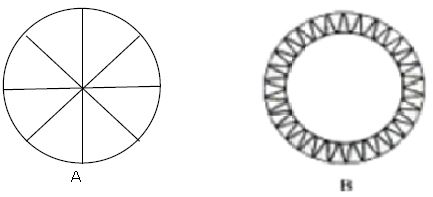
Design A; Brooch A is made with silver wire in the form of a circle with diameter 28 mm.The wire is used for making 4 diameters which divide the circle into 8 equal parts.
Design B; Brooch B is made up of 2 colours.Gold and Silver.Outer part is made with gold.The circumference of silver part is 44 mm and the gold part is 3 mm wide everwhere.
Refer to Design A
Question. Find the total length of silver wire required
Answer : 200M
Question. Find the area of each sector of the brooch
Answer : 77𝑚𝑚2
Question. REFER TO DESGN B; Find the circumference of the outer part (golden)
Answer : 82.2 mm
Question. A boy is playing with Brooch B; He makes revolutions with it along its edge. How many complete revolutions must it take to cover 80π mm?
Answer : 2
Very Short Answer type Questions
Question. What is area of the quadrant of a circle with radius 7cm?
Answer : 38.5cm2.
Question. If radius of a circle is 14cm. What is the circumference of the circle?
Answer : 88cm.
Question. What is the angle described by the minute hand in 25minutes?
Answer : 1500.
Question. A chord of a circle of radius 10 cm. subtends a right angle at the centre. Find the area of the minor sector.
Answer : 78.5 cm2.
Level 2
1. Find the radius of a circle whose area is 301.84 cm2.
Answer : Area of a circle = Πr2
Πr2 = 301.84
r2 = 301.84x7/22
r = 61.6 cm.
2. The minute hand of a clock is 10 cm. long. Find the area of the face of a clock described by the minute hand between 9 am to 9:35 am.
Answer : Angle described by minute hand in 1 minute = 60
Angle described by minute hand in 35 minute = 2100
Area swept = Area of sector with angle 2100
=210/360 xΠ(10)2
= 183.3 cm2
3. Find the area of a quadrant of a circle whose circumference is 22cm.
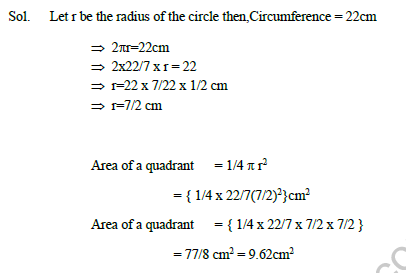
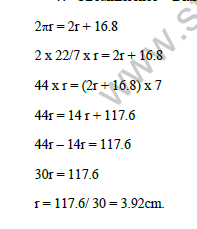
4. The circumference of circle exceeds the diameter by 16.8 cm . Find the radius of the circle?
Answer : Let the radius of the circle by r cm , then ,
Diameter = 2r and circumference = 2pr
It is given that the circumference exceeds the diameter by 16.8 cm.
\ Circumference = Diameter + 16.8
Level Based Questions
Level 1
Question 1. What is area of the quadrant of a circle with radius 7cm?
Answer: Radius of the circle (\(r\)) = 7 cm
Area of a quadrant = \(\frac{1}{4} \pi r^2\)
Area = \(\frac{1}{4} \times \frac{22}{7} \times 7^2\)
Area = \(\frac{1}{4} \times \frac{22}{7} \times 49 = \frac{385}{2} = 38.5 \, \text{cm}^2\)
In simple words: A quadrant is one-fourth of a full circle, so its area is calculated by taking one-fourth of the circle's total area.
Exam Tip: Always include proper square units for area measurements (e.g., cm²).
Question 2. If radius of a circle is 14cm. What is the circumference of the circle?
Answer: Radius of the circle (\(r\)) = 14 cm
Circumference of a circle = \(2\pi r\)
Circumference = \(2 \times \frac{22}{7} \times 14\)
Circumference = \(2 \times 22 \times 2 = 88 \, \text{cm}\)
In simple words: Circumference is the total distance around the edge of a circle, found using the formula \(2\pi r\).
Exam Tip: Use \(\pi = \frac{22}{7}\) when the radius is a multiple of 7 for easy calculation.
Question 3. What is the angle described by the minute hand in 25 minutes?
Answer: Angle described by the minute hand in 60 minutes = \(360^\circ\)
Angle described in 1 minute = \(\frac{360^\circ}{60} = 6^\circ\)
Angle described in 25 minutes = \(25 \times 6^\circ = 150^\circ\)
In simple words: Since a clock makes a full \(360^\circ\) turn in 60 minutes, each minute covers \(6^\circ\). Multiply this by 25 to get the total angle.
Question 4. A chord of a circle of radius 10 cm. subtends a right angle at the centre. Find the area of the minor sector.
Answer: Radius of the circle (\(r\)) = 10 cm
Angle of the minor sector (\(\theta\)) = \(90^\circ\) (right angle)
Area of the minor sector = \(\frac{\theta}{360^\circ} \times \pi r^2\)
Area = \(\frac{90^\circ}{360^\circ} \times 3.14 \times 10^2\)
Area = \(\frac{1}{4} \times 3.14 \times 100 = \frac{314}{4} = 78.5 \, \text{cm}^2\)
In simple words: A right angle is \(90^\circ\), which represents one-fourth of a full circle (\(360^\circ\)). The sector area is one-fourth of the total area.
Exam Tip: Use \(\pi = 3.14\) when given decimal values or when instructed, to match standard answers easily.
Level 2
Question 1. Find the radius of a circle whose area is \(301.84 \, \text{cm}^2\).
Answer: Area of the circle = \(301.84 \, \text{cm}^2\)
Area formula = \(\pi r^2\)
\(\frac{22}{7} \times r^2 = 301.84\)
\(r^2 = \frac{301.84 \times 7}{22}\)
\(r^2 = \frac{2112.88}{22} = 96.04\)
\(r = \sqrt{96.04} = 9.8 \, \text{cm}\)
In simple words: Work backwards from the area formula by dividing by \(\pi\) and taking the square root to find the radius.
Exam Tip: Double-check decimal division before taking the square root.
Question 2. The minute hand of a clock is 10 cm. long. Find the area of the face of a clock described by the minute hand between 9 am to 9:35 am.
Answer: Length of the minute hand (\(r\)) = 10 cm
Time elapsed = From 9:00 am to 9:35 am = 35 minutes
Angle described in 1 minute = \(6^\circ$
Angle described in 35 minutes (\(\theta\)) = \(35 \times 6^\circ = 210^\circ$
Area swept = Area of sector with angle \(210^\circ$
Area = \(\frac{210^\circ}{360^\circ} \times \pi r^2\)
Area = \(\frac{7}{12} \times \frac{22}{7} \times 10^2\)
Area = \(\frac{7}{12} \times \frac{22}{7} \times 100 = \frac{2200}{12} = 183.33 \, \text{cm}^2\)
In simple words: Calculate the total degrees swept by the minute hand in 35 minutes, then find the area of that sector.
Exam Tip: Simplify fractions like \(\frac{210}{360}\) to \(\frac{7}{12}\) early to make calculations simpler.
Question 3. Find the area of a quadrant of a circle whose circumference is 22cm.
Answer: Circumference (\(C\)) = 22 cm
\(2\pi r = 22\)
\(2 \times \frac{22}{7} \times r = 22\)
\(r = 22 \times \frac{7}{22} \times \frac{1}{2} = \frac{7}{2} \, \text{cm}\)
Area of a quadrant = \(\frac{1}{4} \pi r^2\)
Area = \(\frac{1}{4} \times \frac{22}{7} \times \left(\frac{7}{2}\right)^2\)
Area = \(\frac{1}{4} \times \frac{22}{7} \times \frac{49}{4} = \frac{77}{8} = 9.625 \, \text{cm}^2\)
In simple words: First find the radius from the circumference, then use it to calculate the area of one-fourth of the circle.
Exam Tip: Keep fractions in fractional form until the final step to avoid rounding errors.
Question 4. The circumference of circle exceeds the diameter by 16.8 cm. Find the radius of the circle?
Answer: Let the radius of the circle be \(r\).
Diameter = \(2r$
Circumference = \(2\pi r$
According to the given condition:
\(2\pi r = 2r + 16.8\)
\(2 \times \frac{22}{7} \times r = 2r + 16.8\)
\(\frac{44}{7}r = 2r + 16.8\)
\(\frac{44}{7}r - 2r = 16.8\)
\(\frac{44r - 14r}{7} = 16.8\)
\(\frac{30r}{7} = 16.8\)
\(30r = 16.8 \times 7\)
\(30r = 117.6\)
\(r = \frac{117.6}{30} = 3.92 \, \text{cm}\)
In simple words: Set up an equation where the circumference equals the diameter plus 16.8, then solve for the radius \(r\).
Exam Tip: Translate word statements directly into algebraic equations before solving.
Level 3
Question 1. A bicycle wheel make 500 revolution in moving 11 km. Find the diameter of the wheel.
Answer: Total distance moved = 11 km = \(11 \times 1000 \times 100 \, \text{cm} = 11,00,000 \, \text{cm}\)
Number of revolutions = 500
Distance covered in 1 revolution = \(\frac{11,00,000}{500} = 2200 \, \text{cm}\)
Distance covered in 1 revolution is equal to the circumference of the wheel.
Circumference (\(2\pi r\)) = 220 cm
\(2 \times \frac{22}{7} \times r = 220\)
\(r = 220 \times \frac{7}{22} \times \frac{1}{2} = 35 \, \text{cm}\)
Diameter = \(2r = 2 \times 35 = 70 \, \text{cm}\)
In simple words: Divide the total distance by the number of revolutions to find the circumference, then solve for the diameter.
Question 2. Find the area of sector of a circle whose radius is 14cm and angle of sector is \(45^\circ\).
Answer: Radius (\(r\)) = 14 cm
Angle (\(\theta\)) = \(45^\circ$
Area of sector = \(\frac{\theta}{360^\circ} \times \pi r^2\)
Area = \(\frac{45^\circ}{360^\circ} \times \frac{22}{7} \times 14^2\)
Area = \(\frac{1}{8} \times \frac{22}{7} \times 14 \times 14\)
Area = \(\frac{1}{8} \times 22 \times 2 \times 14 = \frac{616}{8} = 77 \, \text{cm}^2\)
In simple words: Substitute the radius and angle into the sector area formula and simplify.
Exam Tip: Notice that \(\frac{45}{360}\) simplifies neatly to \(\frac{1}{8}\).
Question 3. On a square handkerchief, nine circular designs, each of radius 7 cm are made. Find the area of the remaining portion of the handkerchief.
Answer: Radius of each circular design = 7 cm
Diameter of each circular design = \(2 \times 7 = 14 \, \text{cm}\)
Since there are 3 circles along each side of the square:
Side of the square = \(3 \times \text{diameter} = 3 \times 14 = 42 \, \text{cm}\)
Area of the square = \(\text{side}^2 = 42 \times 42 = 1764 \, \text{cm}^2\)
Area of one circular design = \(\pi r^2 = \frac{22}{7} \times 7 \times 7 = 154 \, \text{cm}^2\)
Area of 9 circular designs = \(9 \times 154 = 1386 \, \text{cm}^2$
Area of the remaining portion = Area of square - Area of 9 circles
Remaining Area = \(1764 - 1386 = 378 \, \text{cm}^2$
In simple words: Subtract the total area of the 9 circles from the total area of the square handkerchief to get the remaining area.
Exam Tip: Determine the side length of the bounding square by counting how many circle diameters fit along one edge.
Question 4. Four equal circles are described about the four corners of a square so that each touches two of the others as shown in figure. Find the area of the shaded region, each side of the square measuring 14 cm.
Answer: Side of the square (\(a\)) = 14 cm
Since the circles touch each other at the midpoint of each side, the radius of each circle (\(r\)) = \(\frac{14}{2} = 7 \, \text{cm}\).
Area of the square = \(a^2 = 14 \times 14 = 196 \, \text{cm}^2$
Each corner of a square is a right angle (\(90^\circ\)), so each corner region forms a quadrant of a circle.
Area of one quadrant = \(\frac{1}{4} \pi r^2 = \frac{1}{4} \times \frac{22}{7} \times 7^2 = \frac{38.5 \, \text{cm}^2\)
Area of 4 quadrants = \(4 \times 38.5 = 154 \, \text{cm}^2$
Area of the shaded region = Area of square - Area of 4 quadrants
Shaded Area = \(196 - 154 = 42 \, \text{cm}^2$
In simple words: The four corner quadrants combine to form one full circle. Subtract this circle's area from the square's area.
Exam Tip: Four quadrants of equal radius always make one complete circle (\(4 \times \frac{1}{4} = 1\)).
Level 4
Question 1. An elastic belt is placed round the rim of pulley of radius 5 cm. One point on the belt is pulled directly away from the centre O of the pulley until it is at P, 10 cm from O. Find the length of the belt that is in contact with the rim of the pulley. Also find the shaded area.
Answer: Let tangents from point P touch the circle at A and B. Thus, \(\angle OAP = \angle OBP = 90^\circ\).
In right-angled triangle \(\triangle OAP\):
\(\cos\theta = \frac{OA}{OP} = \frac{5}{10} = \frac{1}{2}\), where \(\theta = \angle AOP\).
Therefore, \(\theta = 60^\circ\).
Angle of the major sector / angle subtended by the arc at the centre: \(\angle AOB = 2\theta = 120^\circ\).
Length of the minor arc AB = \(\frac{120^\circ}{360^\circ} \times 2\pi(5) = \frac{1}{3} \times 10\pi = \frac{10\pi}{3} \, \text{cm}\)
Length of the belt in contact with the rim = Circumference of pulley - Length of arc AB
\(= 2\pi(5) - \frac{10\pi}{3} = 10\pi - \frac{10\pi}{3} = \frac{20\pi}{3} \, \text{cm}\)
Area of sector OAQB = \(\frac{120^\circ}{360^\circ} \times \pi(5^2) = \frac{25\pi}{3} \, \text{cm}^2\)
Area of quadrilateral OAPB = \(2 \times (\text{Area of } \triangle OAP) = 2 \times \left(\frac{1}{2} \times OA \times AP\right)\)
By Pythagoras theorem, \(AP = \sqrt{10^2 - 5^2} = \sqrt{75} = 5\sqrt{3} \, \text{cm}\).
Area of quadrilateral OAPB = \(2 \times \left(\frac{1}{2} \times 5 \times 5\sqrt{3}\right) = 25\sqrt{3} \, \text{cm}^2$
Shaded area = Area of quadrilateral OAPB - Area of sector OAQB
Shaded area = \(25\sqrt{3} - \frac{25\pi}{3} = \frac{25}{3}(3\sqrt{3} - \pi) \, \text{cm}^2$
In simple words: Use trigonometry to find the angle of the sector, subtract the arc from the circumference for the belt length, and subtract the sector area from the quadrilateral area for the shaded region.
Exam Tip: Break complex tangent-and-circle problems into right triangles and sectors.
Question 2. The cost of fencing a circular field at the rate of Rs. 24 per metre is Rs. 5280. The field is ploughed to be at the rate of Rs. 0.50 per metre square. Find the cost of ploughing the field.
Answer: Total cost of fencing = Rs. 5280
Rate of fencing = Rs. 24 per metre
Length of fence (Circumference) = \(\frac{\text{Total Cost}}{\text{Rate}} = \frac{5280}{24} = 220 \, \text{m}\)
\(2\pi r = 220\)
\(2 \times \frac{22}{7} \times r = 220\)
\(r = 220 \times \frac{7}{22} \times \frac{1}{2} = 35 \, \text{m}\)
Area of the field = \(\pi r^2 = \frac{22}{7} \times 35 \times 35 = 3850 \, \text{m}^2\)
Cost of ploughing = Area \(\times\) Rate per square metre
Cost = \(3850 \times 0.50 = \text{Rs. } 1925$
In simple words: Find the circumference from total fencing cost, calculate the radius, find the total area, and multiply by the ploughing rate.
Exam Tip: Fencing always relates to circumference (perimeter), while ploughing always relates to area.
Question 3. AB and CD are respectively arcs of two concentric circles of radii 21 cm and 7 cm at centre O. If \(\angle AOB = 30^\circ\), find the area of shaded region.
Answer: Radius of outer circle (\(R\)) = 21 cm
Radius of inner circle (\(r\)) = 7 cm
Angle (\(\theta\)) = \(30^\circ$
Area of shaded region = Area of sector OAB - Area of sector OCD
Area = \(\frac{30^\circ}{360^\circ} \times \pi R^2 - \frac{30^\circ}{360^\circ} \times \pi r^2\)
Area = \(\frac{30}{360} \times \frac{22}{7} \times (21^2 - 7^2)\)
Area = \(\frac{1}{12} \times \frac{22}{7} \times (21 + 7)(21 - 7)\)
Area = \(\frac{1}{12} \times \frac{22}{7} \times 28 \times 14\)
Area = \(\frac{1}{12} \times \frac{22}{7} \times 392 = \frac{8624}{84} = 102.67 \, \text{cm}^2\)
In simple words: Use the difference of two sector areas. Applying the algebraic identity \(R^2 - r^2 = (R+r)(R-r)\) makes calculation much easier.
Exam Tip: Use algebraic factoring for concentric circle problems to avoid large numbers.
Question 4. A horse is placed for grazing inside a rectangular field 70 m by 52 m and is tethered to one corner by a rope 20 m long. On how much area can it graze?
Answer: Length of the rope = Radius of the grazing sector (\(r\)) = 20 m
Since the horse is tethered at a corner of a rectangular field, the grazing area forms a quadrant of a circle with angle \(90^\circ\).
Required area = \(\frac{1}{4} \pi r^2\)
Area = \(\frac{1}{4} \times \frac{22}{7} \times 20^2\)
Area = \(\frac{1}{4} \times \frac{22}{7} \times 400 = \frac{2200}{7} = 314.28 \, \text{m}^2\)
In simple words: The area grazed is one-fourth of a circle because the corner of a rectangle forms a \(90^\circ\) angle.
Exam Tip: The dimensions of the rectangular field are extra information and not needed since the rope length is shorter than the sides.
Free study material for Mathematics
CBSE Class 10 Mathematics Assignments for Chapter 11 Areas Related to Circles
Revision Assignment: Chapter 11 Areas Related to Circles (CBSE)
Access structured practice assignments for Chapter 11 Areas Related to Circles designed in alignment with the latest CBSE curriculum for Class 10 Mathematics. These printable sets cover objective and descriptive problem types to support thorough revision.
Key Advantages of Solving Chapter 11 Areas Related to Circles Assignments
- Syllabus Compliance: Sets reflect current CBSE evaluation criteria and official marking frameworks.
- Multi-Format Practice: Includes varied problem types designed to deepen comprehension across all sub-topics.
- Time Management: Routine practice optimizes pacing to finish school examinations comfortably within schedule.
Effective Strategy for Class 10 Mathematics Assignments
- Textbook Review: Always study the core NCERT book for Class 10 Mathematics prior to beginning the assignment.
- Independent Attempt: Solve Chapter 11 Areas Related to Circles questions on your own initially before cross-checking with expert solutions.
- Error Tracking: Record challenging concepts in a dedicated notebook and practice online MCQ tests for revision.
FAQs
You can download free PDF assignments for Class 10 Mathematics Chapter 11 Areas Related to Circles from StudiesToday.com. These practice sheets have been updated for the 2026-27 session covering all concepts from latest NCERT textbook.
Yes, our teachers have given solutions for all questions in the Class 10 Mathematics Chapter 11 Areas Related to Circles assignments. This will help you to understand step-by-step methodology to get full marks in school tests and exams.
Yes. These assignments are designed as per the latest CBSE syllabus for 2026. We have included huge variety of question formats such as MCQs, Case-study based questions and important diagram-based problems found in Chapter 11 Areas Related to Circles.
Practicing topicw wise assignments will help Class 10 students understand every sub-topic of Chapter 11 Areas Related to Circles. Daily practice will improve speed, accuracy and answering competency-based questions.
Yes, all printable assignments for Class 10 Mathematics Chapter 11 Areas Related to Circles are available for free download in mobile-friendly PDF format.