

Class 10 Mathematics Practice Assignments: CBSE Class 10 Mathematics Arithmetic Progression Assignment Set 02
Access comprehensive school assignments for Chapter 05 Arithmetic Progressions using the CBSE Class 10 Mathematics Arithmetic Progression Assignment Set 02. Designed to align with the 2026-27 CBSE academic guidelines, these practice sets help Class 10 Mathematics students reinforce core concepts and improve their problem-solving accuracy.
Download Chapter 05 Arithmetic Progressions Assignment PDF with Solutions
Access the complete assignment PDF for Class 10 Mathematics below. Regular practice with these targeted academic tasks builds familiarity with standard question patterns and helps secure higher marks in final school evaluations.
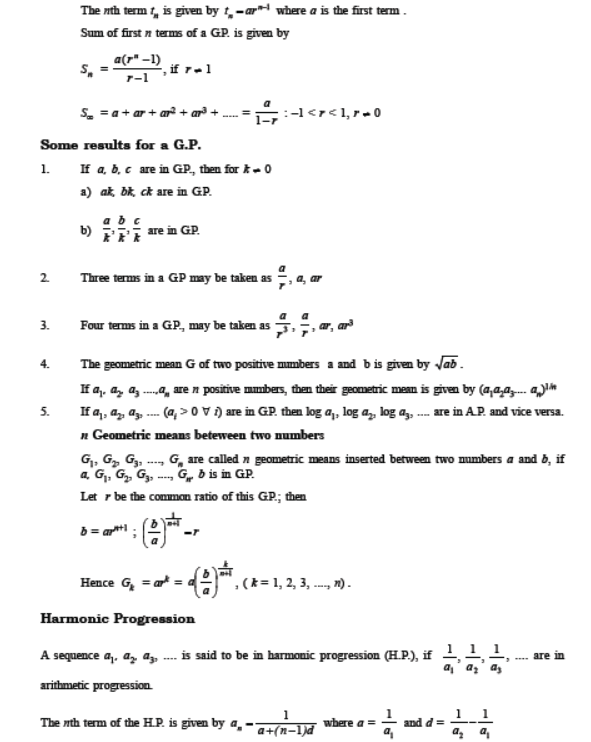
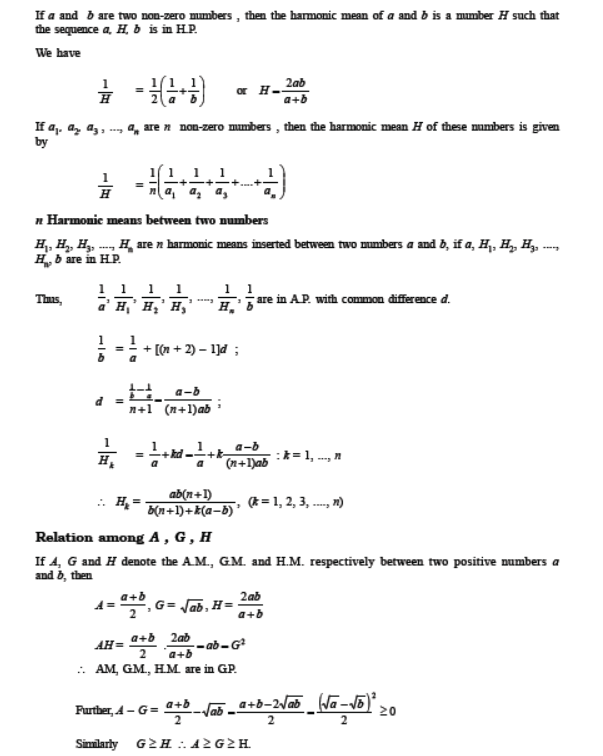
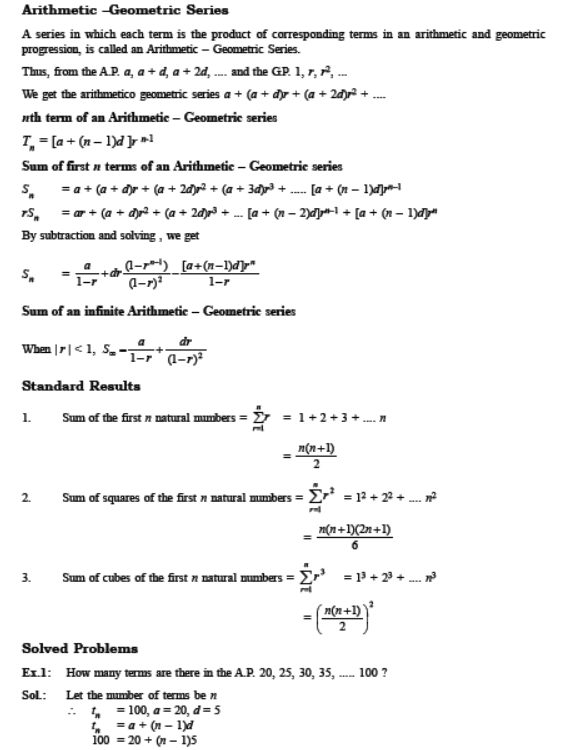
ARITHMETIC PROGRESSIONS
EASY SCORING IMPORTANT QUESTIONS
LEVEL- 1 (1 Marks)
Q1) For the A.P 3, 1, -1, -3...., Write the first term and common difference?
Answer: Here, first term \(a = 3\)
Common difference \(d = 1 - 3 = -2\)
In simple words: The first term is the starting number, and the common difference is found by subtracting any term from the one after it.
Exam Tip: Always subtract the first term from the second term, not the other way around, to get the correct sign for \(d\).
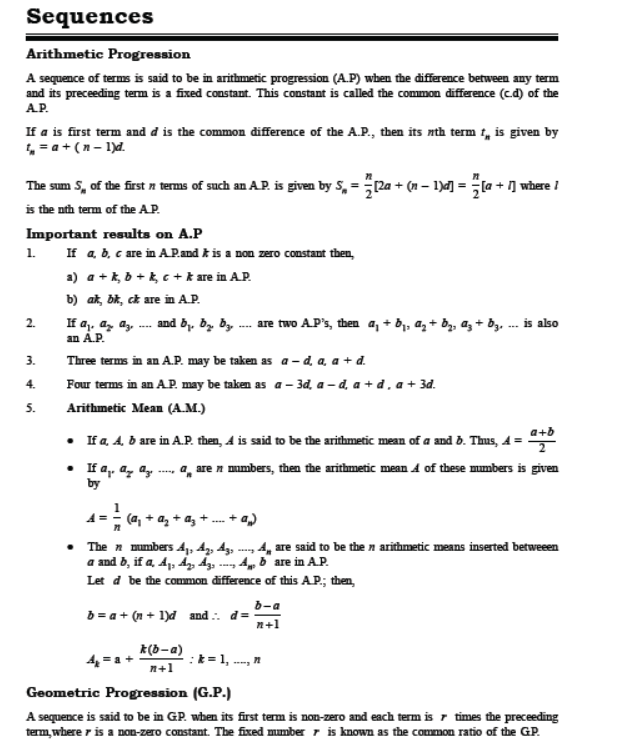
Q2) Find the 10th term of the A.P, whose first term is 2 and common difference is 5.
Answer: Here, first term \(a = 2\) and common difference \(d = 5\)
Formula: \(a_n = a + (n - 1) \times d\)
\(a_{10} = 2 + (10 - 1) \times 5\)
\(a_{10} = 2 + 9 \times 5\)
\(a_{10} = 2 + 45\)
\(a_{10} = 47\)
In simple words: Substitute \(n = 10\), \(a = 2\), and \(d = 5\) into the general term formula.
Exam Tip: Remember that the coefficient of \(d\) is always one less than the term number you want to find (\(n - 1\)).
Q3. Write the formula to find the sum of first \(n\) terms of an AP whose first term is \(a\) and common difference is \(d\).
Answer: \(S_n = \frac{n}{2} \{ 2a + (n - 1)d \}\)
In simple words: This is the standard formula used to find the sum of an arithmetic progression when the first term and common difference are known.
Exam Tip: Memorize this formula thoroughly as it is frequently applied in multi-mark questions.
Q4. Write the sum of first \(n\) terms of an AP whose first term is \(a\) and last term is \(l\).
Answer: \(S_n = \frac{n}{2} (a + l)\)
In simple words: Use this short formula when the last term of the AP is already given.
Exam Tip: This formula saves time when the last term \(l\) (or \(a_n\)) is provided in the problem statement.
LEVEL- 2 (2 Marks)
Q1. Find the 8th term of an A.P. 7, 10, 13, .....?
Answer: Here, first term \(a = 7\)
Common difference \(d = 10 - 7 = 3\)
Using the formula \(a_n = a + (n - 1)d\), for the 8th term:
\(a_8 = a + 7d\)
\(a_8 = 7 + 7 \times 3\)
\(a_8 = 7 + 21\)
\(a_8 = 28\)
In simple words: Find \(a\) and \(d\) from the given sequence, then substitute into the formula for \(a_8\).
Exam Tip: Writing \(a_8 = a + 7d\) directly skips one step and reduces calculation errors.
Q2. Find the sum of first 10 terms of the A.P 2, 5, 8, 11 .......?
Answer: Here, first term \(a = 2\)
Common difference \(d = 5 - 2 = 3\)
Number of terms \(n = 10\)
Using the sum formula \(S_n = \frac{n}{2} [ 2a + (n - 1)d ]\):
\(S_{10} = \frac{10}{2} [ 2 \times 2 + (10 - 1) \times 3 ]\)
\(S_{10} = 5 [ 4 + 9 \times 3 ]\)
\(S_{10} = 5 [ 4 + 27 ]\)
\(S_{10} = 5 \times 31\)
\(S_{10} = 155\)
In simple words: Identify \(a\), \(d\), and \(n\), plug them into the sum formula, and simplify carefully following order of operations.
Exam Tip: Always evaluate the inner bracket expression completely before multiplying by the outer factor.
Q3. For what values of \(n\) the \(n\)th term of AP is 63, 65, 67, .......... and 3, 10, 17, ...... are equal?
Answer: For AP 1: 63, 65, 67, ...
First term \(a = 63\), common difference \(d = 65 - 63 = 2\)
\(n\)th term of AP 1: \(a_n = a + (n - 1)d = 63 + (n - 1)2\)
For AP 2: 3, 10, 17, ...
First term \(A = 3\), common difference \(D = 10 - 3 = 7\)
\(n\)th term of AP 2: \(A_n = A + (n - 1)D = 3 + (n - 1)7\)
Equating the two \(n\)th terms:
\(63 + (n - 1)2 = 3 + (n - 1)7\)
\(63 - 3 = (n - 1)7 - (n - 1)2\)
\(60 = (n - 1)(7 - 2)\)
\(60 = (n - 1)5\)
\(\frac{60}{5} = n - 1\)
\(12 = n - 1\)
\(n = 12 + 1 = 13\)
In simple words: Write expressions for the \(n\)th term of both progressions, set them equal to each other, and solve the linear equation for \(n\).
Exam Tip: Grouping terms containing \((n - 1)\) on one side avoids expanding polynomials and simplifies the algebra.
Q4. Find the 20th term from the last term of an AP 3, 8, 13, ...... 253.
Answer: Given AP: 3, 8, 13, ..., 253
Here, first term \(a = 3\), common difference \(d = 8 - 3 = 5\), and last term \(l = 253\)
To find terms from the end, reverse the AP where the new first term \(A = 253\) and the new common difference \(D = -5\)
Using the formula for the \(n\)th term:
\(A_{20} = A + (20 - 1)D\)
\(A_{20} = 253 + 19 \times (-5)\)
\(A_{20} = 253 - 95\)
\(A_{20} = 158\)
In simple words: Reversing the AP turns the last term into the first term and changes the sign of the common difference.
Exam Tip: Remember to change the sign of \(d\) to its negative when measuring terms from the end of the sequence.
LEVEL- 3 (3 Marks)
Q1) Which term of the A.P : 21, 18, 15, ..... is -81?
Answer: Here, first term \(a = 21\)
Common difference \(d = 18 - 21 = -3\)
Let the \(n\)th term be \(-81\), so \(a_n = -81\)
\(a + (n - 1)d = -81\)
\(21 + (n - 1)(-3) = -81\)
\((n - 1)(-3) = -81 - 21\)
\((n - 1)(-3) = -102\)
\(n - 1 = \frac{-102}{-3}\)
\(n - 1 = 34\)
\(n = 34 + 1 = 35\)
Hence, the 35th term is -81.
In simple words: Equate the \(n\)th term formula to -81 and solve for \(n\) to find the position number.
Exam Tip: Ensure proper handling of negative signs during division to prevent sign errors.
Q2. Determine the A.P whose 3rd term is 5 and 7th term is 9?
Answer: Let the first term of the A.P be \(a\) and the common difference be \(d\).
Given, 3rd term \(a_3 = 5\)
\(a + (3 - 1)d = 5\)
\(a + 2d = 5 \text{ } ........ (1)\)
Also, 7th term \(a_7 = 9\)
\(a + (7 - 1)d = 9\)
\(a + 6d = 9 \text{ } ........ (2)\)
Subtracting equation (1) from equation (2):
\((a + 6d) - (a + 2d) = 9 - 5\)
\(4d = 4\)
\(d = 1\)
Putting \(d = 1\) in equation (1):
\(a + 2(1) = 5\)
\(a + 2 = 5\)
\(a = 5 - 2 = 3\)
Required A.P is \(a, a + d, a + 2d, a + 3d, ...\)
\(3, (3 + 1), (3 + 2 \times 1), (3 + 3 \times 1), ...\)
\(3, 4, 5, 6, ...\)
In simple words: Set up a system of two linear equations in terms of \(a\) and \(d\), solve for both variables, and build the sequence.
Exam Tip: Elimination by subtraction is the fastest way to solve simultaneous linear equations involving \(a\).
Q3. Find the common difference of an A.P. whose first term is \(\frac{1}{2}\) and the 8th term is \(\frac{17}{6}\). Also write its 4th term.
Answer: Here, first term \(a = \frac{1}{2}\)
Eighth term \(a_8 = \frac{17}{6}\)
\(a + 7d = \frac{17}{6}\)
Substitute \(a = \frac{1}{2}\):
\(\frac{1}{2} + 7d = \frac{17}{6}\)
\(7d = \frac{17}{6} - \frac{1}{2}\)
\(7d = \frac{17 - 3}{6} = \frac{14}{6} = \frac{7}{3}\)
\(d = \frac{7}{3 \times 7} = \frac{1}{3}\)
Now, find the 4th term \(a_4\):
\(a_4 = a + 3d = \frac{1}{2} + 3 \times \frac{1}{3}\)
\(a_4 = \frac{1}{2} + 1 = \frac{3}{2}\)
In simple words: Substitute the given first term into the equation for the 8th term to find \(d\), then use \(a\) and \(d\) to find \(a_4\).
Exam Tip: Take common denominators carefully when subtracting fractions.
Q4. Find the sum of integers between 100 and 200 that are divisible by 9.
Answer: Integers divisible by 9 between 100 and 200 are: 108, 117, 126, 135, ..., 198
This forms an AP with \(a = 108\), \(d = 9\), and \(a_n = 198\)
First, find the number of terms \(n\):
\(a_n = a + (n - 1)d\)
\(108 + (n - 1)9 = 198\)
\((n - 1)9 = 198 - 108\)
\((n - 1)9 = 90\)
\(n - 1 = 10\)
\(n = 11\)
Now, find the sum \(S_{11}\):
\(S_n = \frac{n}{2}(a + a_n)\)
\(S_{11} = \frac{11}{2}(108 + 198)\)
\(S_{11} = \frac{11}{2} \times 306\)
\(S_{11} = 11 \times 153 = 1683\)
In simple words: List the first and last numbers divisible by 9 in the given range, find how many such numbers exist, and apply the sum formula.
Exam Tip: Always verify that the first number (108) and last number (198) are exact multiples of 9 before starting.
LEVEL- 4 (4 Marks)
Q1. If the numbers \(x - 2\), \(4x - 1\) and \(5x + 2\) are in A.P. Find the value of \(x\).
Answer: Since the terms are in A.P., the difference between consecutive terms is constant:
\((4x - 1) - (x - 2) = (5x + 2) - (4x - 1)\)
\(4x - 1 - x + 2 = 5x + 2 - 4x + 1\)
\(3x + 1 = x + 3\)
\(3x - x = 3 - 1\)
\(2x = 2\)
\(x = 1\)
In simple words: Use the property that consecutive terms in an AP have an equal common difference to set up an equation and solve for \(x\).
Exam Tip: Pay close attention to parentheses when subtracting algebraic expressions to avoid sign errors.
Q2. Determine the AP whose 3rd term is 16 and when fifth term is subtracted from 7th term, we get 12.
Answer: Given, 3rd term \(a_3 = 16\)
\(a + 2d = 16 \text{ } ........ (1)\)
Also given, \(a_7 - a_5 = 12\)
\((a + 6d) - (a + 4d) = 12\)
\(a + 6d - a - 4d = 12\)
\(2d = 12\)
\(d = 6\)
Put \(d = 6\) in equation (1):
\(a + 2(6) = 16\)
\(a + 12 = 16\)
\(a = 16 - 12 = 4\)
Therefore, the required AP is: 4, 10, 16, 22, ...
In simple words: Translate the given conditions into algebraic equations, solve for \(d\) first, then find \(a\).
Exam Tip: Difference between any two terms \(a_m - a_n\) simplifies directly to \((m - n)d\).
Q3. Find the sum of the first 31 terms of an AP. Whose \(n\)th term is given by \(3 + \frac{2n}{3}\).
Answer: Given \(a_n = 3 + \frac{2n}{3}\)
Substitute \(n = 1, 2, 3\) to find the first few terms:
For \(n = 1\), \(a = 3 + \frac{2(1)}{3} = 3 + \frac{2}{3} = \frac{11}{3}\)
For \(n = 2\), \(a_2 = 3 + \frac{2(2)}{3} = 3 + \frac{4}{3} = \frac{13}{3}\)
For \(n = 3\), \(a_3 = 3 + \frac{2(3)}{3} = 3 + 2 = 5 = \frac{15}{3}\)
Thus, first term \(a = \frac{11}{3}\) and common difference \(d = \frac{13}{3} - \frac{11}{3} = \frac{2}{3}\)
Now, find the sum of the first 31 terms using \(S_n = \frac{n}{2} [ 2a + (n - 1)d ]\):
\(S_{31} = \frac{31}{2} \left[ 2 \left(\frac{11}{3}\right) + (31 - 1)\left(\frac{2}{3}\right) \right]\)
\(S_{31} = \frac{31}{2} \left[ \frac{22}{3} + 30 \times \frac{2}{3} \right]\)
\(S_{31} = \frac{31}{2} \left[ \frac{22}{3} + \frac{60}{3} \right]\)
\(S_{31} = \frac{31}{2} \left[ \frac{82}{3} \right]\)
\(S_{31} = \frac{31}{2} \times \frac{82}{3} = \frac{31 \times 41}{3} = \frac{1271}{3}\)
In simple words: Generate the first few terms from the given \(n\)th term formula to find \(a\) and \(d\), then use the sum formula.
Exam Tip: Generating terms confirms the sequence is indeed an arithmetic progression.
Q4. If the 8th term of an A.P is 31 and 15th term is 16 more than the 11th term, find the A.P.
Answer: Let \(a\) be the first term and \(d\) be the common difference of the A.P.
Given, 8th term \(a_8 = 31\)
\(a + 7d = 31 \text{ } ........ (1)\)
Also given, 15th term is 16 more than the 11th term:
\(a_{15} = 16 + a_{11}\)
\(a + 14d = 16 + (a + 10d)\)
\(a + 14d - a - 10d = 16\)
\(4d = 16\)
\(d = 4\)
Putting the value of \(d\) in equation (1):
\(a + 7(4) = 31\)
\(a + 28 = 31\)
\(a = 31 - 28 = 3\)
Therefore, the A.P is: \(a, a + d, a + 2d, a + 3d, ...\)
\(3, (3 + 4), (3 + 2 \times 4), (3 + 3 \times 4), ...\)
\(3, 7, 11, 15, ...\)
In simple words: Form two equations based on the problem conditions, solve for \(d\) and \(a\), and construct the arithmetic progression.
Exam Tip: Translating word statements into precise algebraic equations is crucial for full marks.
Free study material for Mathematics
Download Practice Assignments: Class 10 Mathematics Chapter 05 Arithmetic Progressions
Revision Assignment: Chapter 05 Arithmetic Progressions (CBSE)
Explore reliable practice questions for Chapter 05 Arithmetic Progressions tailored for Class 10 learners. Use these structured worksheets to evaluate preparedness and strengthen core problem-solving skills.
Why Practice Class 10 Mathematics Assignments?
- Syllabus Compliance: Sets reflect current CBSE evaluation criteria and official marking frameworks.
- Multi-Format Practice: Includes varied problem types designed to deepen comprehension across all sub-topics.
- Time Management: Routine practice optimizes pacing to finish school examinations comfortably within schedule.
How to Approach Mathematics Chapter 05 Arithmetic Progressions Assignments
- Textbook Review: Always study the core NCERT book for Class 10 Mathematics prior to beginning the assignment.
- Independent Attempt: Solve Chapter 05 Arithmetic Progressions questions on your own initially before cross-checking with expert solutions.
- Error Tracking: Record challenging concepts in a dedicated notebook and practice online MCQ tests for revision.
FAQs
You can download free PDF assignments for Class 10 Mathematics Chapter 05 Arithmetic Progressions from StudiesToday.com. These practice sheets have been updated for the 2026-27 session covering all concepts from latest NCERT textbook.
Yes, our teachers have given solutions for all questions in the Class 10 Mathematics Chapter 05 Arithmetic Progressions assignments. This will help you to understand step-by-step methodology to get full marks in school tests and exams.
Yes. These assignments are designed as per the latest CBSE syllabus for 2026. We have included huge variety of question formats such as MCQs, Case-study based questions and important diagram-based problems found in Chapter 05 Arithmetic Progressions.
Practicing topicw wise assignments will help Class 10 students understand every sub-topic of Chapter 05 Arithmetic Progressions. Daily practice will improve speed, accuracy and answering competency-based questions.
Yes, all printable assignments for Class 10 Mathematics Chapter 05 Arithmetic Progressions are available for free download in mobile-friendly PDF format.