

Class 10 Mathematics Practice Assignments: CBSE Class 10 Mathematics Triangles Assignment Set 01
Access comprehensive school assignments for Chapter 06 Triangles using the CBSE Class 10 Mathematics Triangles Assignment Set 01. Designed to align with the 2026-27 CBSE academic guidelines, these practice sets help Class 10 Mathematics students reinforce core concepts and improve their problem-solving accuracy.
Download Chapter 06 Triangles Assignment PDF with Solutions
View or download the dedicated CBSE Class 10 Mathematics Triangles Assignment Set 01 resource below. Engaging with these assignments under focused study conditions ensures continuous academic progress and mastery of the 2026-27 curriculum.
Multiple Choice Questions
Question. If in two triangles ABC and PQR, AB/QR = BC/PR = CA/PQ, then
(a) ∆PQR ~ ∆CAB
(b) ∆PQR ~ ∆ABC
(c) ∆CBA ~ ∆PQR
(d) ∆BCA ~ ∆PQR
Answer : A
Question. The perimeters of two similar triangles ∆ABC and ∆PQR are 35 cm and 45 cm respectively, then the ratio of the areas of the two triangles is
(a) 7 : 9
(b) 28 : 45
(c) 14 : 27
(d) 49 : 81
Answer : D
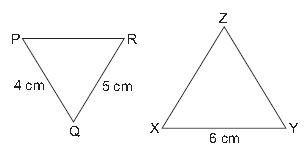
Question. In the given figures, ∆PQR ∼ ∆XYZ. If PQ = 4 cm, QR = 5 cm and XY = 6 cm, then YZ equals.
(a) 4.5 cm
(b) 7.5 cm
(c) 6.4 cm
(d) None of these
Answer : B
Question. Corresponding sides of two similar triangles are in the ratio 9 : 5. Areas of these triangles are in the ratio
(a) 21 : 85
(b) 81 : 25
(c) 9 : 5
(d) 5 : 9
Answer : B
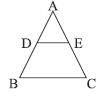
Question. In the given figure, DE || BC, AD = 1 cm and BD = 2 cm. What is the ratio of the ar (∆ABC) to the ar (∆ADE)?
(a) 1 : 9
(b) 1 : 7
(c) 9 : 1
(d) 7 : 1
Answer : C
Question. The sides of two similar triangles are in the ratio 2 : 3, then the areas of these triangles are in the ratio
(a) 2 : 5
(b) 4 : 9
(c) 7 : 16
(d) None of these
Answer : B
Question. If ∆PQR ~ ∆XYZ, ∠Q = 50° and ∠R = 70°, then ∠X + ∠Y is equal to
(a) 70°
(b) 110°
(c) 120°
(d) 50°
Answer : B
Question. Given ∆ABC ~ ∆PQR, if AB/PQ = 1/3, then ar(∆ABC)/ar(∆PQR) =
(a) 1 : 3
(b) 1 : 6
(c) 1 : 9
(d) 1 : 5
Answer : C
Question. ∆ABC is isosceles with AC = BC. If AB2 = 2AC2, then the measure of ∠C is
(a) 30°
(b) 60°
(c) 45°
(d) 90°
Answer : D
Question. The perimeters of two similar triangles are 25 cm and 15 cm respectively. If one side of the first triangle is 9 cm, then the corresponding side of second triangle is
(a) 5.4 cm
(b) 8 cm
(c) 9.5 cm
(d) 10 cm
Answer : A
Question. Let ∆ABC ∼ ∆DEF, ar (∆ABC) = 169 cm2 and ar (∆DEF) = 121 cm2. If AB = 26 cm, then DE equals
(a) 11 cm
(b) 22 cm
(c) 33 cm
(d) 44 cm
Answer : B
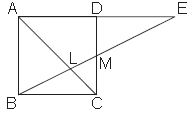
Question. In the given figure, M is mid-point of side CD of a parallelogram ABCD. The line BM is drawn intersecting AC at L and AD produced at E. Then EL =
(a) BL
(b) (1/2) BL
(c) 2BL
(d) None of these
Answer : C
Question. In a trapezium ABCD, AC and BD intersecting at O, AB || DC and AB = 2CD, if area of ∆AOB = 84 cm2, the area of ∆COD is
(a) 12 cm2
(b) 18 cm2
(c) 21 cm2
(d) 27 cm2
Answer : C
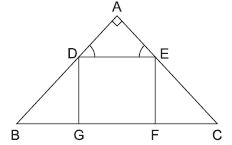
Question. In the given figure, DEFG is a square and ∠BAC = 90°. Then FG2 =
(a) BG × FC
(b) BG + FC
(c) BG/FC
(d) None of these
Answer : A
Assertion-Reason Type Questions
In the following questions, a statement of assertion (A) is followed by a statement of reason (R). Choose the correct choice as:
(a) Both assertion (A) and reason (R) are true and reason (R) is the correct explanation of assertion (A).
(b) Both assertion (A) and reason (R) are true but reason (R) is not the correct explanation of assertion (A).
(c) Assertion (A) is true but reason (R) is false.
(d) Assertion (A) is false but reason (R) is true.
Question. Assertion (A): In the given figures, ∆ABC ~ ∆GHI.
Reason (R): If the corresponding sides of two triangles are proportional, then they are similar.
Answer : A
Question. Assertion (A): The sides of two similar triangles are in the ratio 2 : 5, then the areas of these triangles are in the ratio 4 : 25.
Reason (R): The ratio of the areas of two similar triangles is equal to the square of the ratio of their sides.
Answer : A
Triangles
Level - 1 (1 MARK EACH)
Fill in the blanks:
Question 1. All ................................ triangles are similar.
Answer: Equilateral
In simple words: All equilateral triangles have the same shape regardless of their size, so they are always similar.
Exam Tip: Remember that equiangular triangles are also equilateral, hence similar.
Question 2. If a line divides two sides of a triangle in the same ratio, the line is ................................... to the third side.
Answer: parallel
In simple words: This is the converse of Basic Proportionality Theorem (Thales Theorem).
Exam Tip: Learn both the Thales Theorem and its converse thoroughly for geometry proofs.
Question 3. Sides of two similar triangles are in the ratio 4:9. The ratio of areas of these triangles is ............................
Answer: 16:81
In simple words: The ratio of areas of two similar triangles is equal to the square of the ratio of their corresponding sides, so \(\left(\frac{4}{9}\right)^2 = \frac{16}{81}\).
Exam Tip: Do not confuse side ratio with area ratio; always square the side ratio for areas.
Question 4. Two triangles are said to be similar if ..............................................................
Answer: corresponding sides are in same ratio and corresponding angles are equal
In simple words: Similar figures have the same shape, meaning equal angles and proportional sides.
Exam Tip: Both conditions must be satisfied for general polygons, though for triangles equal angles automatically imply proportional sides.
Question 5. Triangles have .................... diagonals.
Answer: no (or 0)
In simple words: A diagonal connects non-adjacent vertices, and a triangle has no non-adjacent vertices.
Exam Tip: Number of diagonals in an n-sided polygon is given by \(\frac{n(n-3)}{2}\).
Question 6. The six elements of a triangle are its three angles and the ....................................
Answer: three sides
In simple words: Every triangle consists of 3 sides and 3 interior angles.
Exam Training: Knowing all 6 elements helps in congruence and similarity criteria (SSS, SAS, ASA).
Level - 2 (2 MARK EACH)
Question 7. Find the length of x in the following cases:
Answer: In \(\triangle ABC\):
\(BC^2 = AB^2 + AC^2\) (by Pythagoras theorem)
\(x^2 = 5^2 + 12^2\)
\(x^2 = 25 + 144 = 169\)
\(x = \sqrt{169}\)
\(x = 13\)
In simple words: Using the Pythagorean theorem, the square of the hypotenuse is equal to the sum of the squares of the other two sides.
Exam Tip: Memorize common Pythagorean triples like \((5, 12, 13)\) to save time.
Question 8. A ladder 25 m long reaches a window of a building 20 m above the ground. Determine the distance of the foot of the ladder from the building.
Answer: Let \(AB\) be the ladder, \(B\) (or top) be the window, and \(AC\) be the height of the building. Then \(\triangle ABC\) is a right-angled triangle at \(C\).
\(AB^2 = AC^2 + BC^2\)
\(25^2 = AC^2 + 20^2\)
\(AC^2 = 625 - 400 = 225\)
\(AC = \sqrt{225} = 15\text{ m}\)
Hence, the foot of the ladder is at a distance of 15 m from the building.
In simple words: Subtract the square of the height from the square of the ladder's length to find the base distance.
Exam Tip: Clearly define the variables and state the theorem used before substituting values.
Question 9. If \(\triangle ABC \sim \triangle DEF\), such that \(AB = 1.2\text{ cm}\), and \(DE = 1.4\text{ cm}\). Find the ratio of areas of \(\triangle ABC\) and \(\triangle DEF\).
Answer: The ratio of areas of two similar triangles is equal to the ratio of the squares of their corresponding sides.
\(\frac{\text{ar}(\triangle ABC)}{\text{ar}(\triangle DEF)} = \left(\frac{AB}{DE}\right)^2\)
\(\frac{\text{ar}(\triangle ABC)}{\text{ar}(\triangle DEF)} = \left(\frac{1.2}{1.4}\right)^2 = \left(\frac{6}{7}\right)^2 = \frac{36}{49}\)
In simple words: Square the simplified ratio of the given corresponding sides.
Question 10. If the areas of two similar triangles are equal, prove that they are congruent.
Answer: Let us take two similar triangles \(\triangle ABC\) and \(\triangle PQR\) with equal areas.
Then, we have \(\frac{\text{ar}(ABC)}{\text{ar}(PQR)} = \frac{1}{1}\).
Since the triangles are similar, the ratio of their areas is equal to the square of the ratio of their corresponding sides:
\(\frac{AB^2}{PQ^2} = \frac{BC^2}{QR^2} = \frac{AC^2}{PR^2} = \frac{1}{1}\)
Taking square roots, we get:
\(\frac{AB}{PQ} = \frac{BC}{QR} = \frac{AC}{PR} = 1\)
Therefore, \(AB = PQ\), \(BC = QR\), and \(AC = PR\).
Also, corresponding angles are equal: \(\angle A = \angle P\), \(\angle B = \angle Q\), and \(\angle C = \angle R\).
Hence, by SSS or SAS criteria, the triangles are congruent.
In simple words: Equal areas in similar triangles force the side ratios to be 1, making all corresponding sides and angles equal.
Exam Tip: State the similarity theorem relating areas to sides clearly at the start of the proof.
Level - 3 (3 MARK EACH)
Question 11. In \(\triangle ABC\), \(AB = AC = x\), \(BC = 5\text{ cm}\) and the area of the triangle ABC is \(15\text{ cm}^2\). Find \(x\).
Answer: Construction: Draw \(AD \perp BC\). Since \(\triangle ABC\) is an isosceles triangle, \(AD\) bisects \(BC\).
Therefore, \(BD = DC = \frac{5}{2} \text{ cm}\).
Area of \(\triangle ABC = \frac{1}{2} \times BC \times AD\)
\(15 = \frac{1}{2} \times 5 \times AD\)
\(AD = \frac{15 \times 2}{5} = 6\text{ cm}\)
In right-angled \(\triangle ABD\):
\(AB^2 = AD^2 + BD^2\)
\(x^2 = 6^2 + \left(\frac{5}{2}\right)^2\)
\(x^2 = 36 + \frac{25}{4}\)
\(x^2 = \frac{144 + 25}{4} = \frac{169}{4}\)
\(x = \sqrt{\frac{169}{4}} = \frac{13}{2} = 6.5\text{ cm}\)
In simple words: Find the altitude using the area formula, then apply Pythagoras theorem in half the triangle to find the side length.
Exam Tip: In an isosceles triangle, the altitude from the vertex bisects the base.
Question 12. If AD and PM are medians of triangles ABC and PQR, respectively where \(\Delta ABC \sim \Delta PQR\), prove that \(\frac{AB}{PQ} = \frac{AD}{PM}\).
Answer: Given: \(\Delta ABC \sim \Delta PQR\).
Therefore, \(\frac{AB}{PQ} = \frac{BC}{QR}\) and \(\angle B = \angle Q\).
Since \(AD\) and \(PM\) are medians, \(BD = \frac{1}{2}BC\) and \(QM = \frac{1}{2}QR\).
Thus, \(\frac{BC}{QR} = \frac{2BD}{2QM} = \frac{BD}{QM}\).
From above, \(\frac{AB}{PQ} = \frac{BD}{QM}\).
In \(\triangle ABD\) and \(\triangle PQM\):
\(\frac{AB}{PQ} = \frac{BD}{QM}\) and \(\angle B = \angle Q\).
Therefore, by SAS similarity criterion, \(\triangle ABD \sim \triangle PQM\).
Hence, corresponding sides are in the same ratio: \(\frac{AB}{PQ} = \frac{AD}{PM}\). Proved.
In simple words: Use the proportionality of halves of corresponding sides along with the included equal angle to prove smaller triangles similar.
Exam Tip: Clearly state the definition of a median dividing the side into two equal halves.
Question 13. A vertical pole of length 6 m casts a shadow 4 m long on the ground and at the same time a tower casts a shadow 28 m long. Find the height of the tower.
Answer: Let height of pole = \(AB = 6\text{ m}\) and its shadow = \(BC = 4\text{ m}\).
Let height of tower = \(PQ\) and its shadow = \(QR = 28\text{ m}\).
The angle of elevation of the sun is the same at the same time for both objects.
Therefore, \(\triangle ABC \sim \triangle PQR\) by AA similarity.
This means: \(\frac{AB}{PQ} = \frac{BC}{QR}\)
\(\frac{6}{PQ} = \frac{4}{28}\)
\(PQ = \frac{6 \times 28}{4} = 6 \times 7 = 42\text{ m}\)
Height of tower = 42 m.
In simple words: Set up a direct proportion between the heights and shadows of the pole and the tower.
Exam Tip: Mention that light rays from the sun make equal angles with the ground at the same instant.
Question 14. D is a point on the side BC of a triangle ABC such that \(\angle ADC = \angle BAC\). Show that \(CA^2 = CB \cdot CD\).
Answer: In \(\triangle BAC\) and \(\triangle ADC\):
\(\angle BAC = \angle ADC\) (Given)
\(\angle BCA = \angle ACD\) (Common angle)
Therefore, by AA similarity, \(\triangle BAC \sim \triangle ADC\).
Since the triangles are similar, their corresponding sides are proportional:
\(\frac{CA}{CD} = \frac{CB}{CA}\)
Cross-multiplying gives:
\(CA \times CA = CB \times CD\)
\(CA^2 = CB \cdot CD\). Proved.
In simple words: Prove the large triangle similar to the smaller component triangle, then cross-multiply the proportional sides.
Exam Tip: Write the vertices of similar triangles in correct corresponding order to match side ratios easily.
Level - 4 (4 MARK EACH)
Question 15. In the given figure, ABC and DBC are two triangles on the same base BC. If AD intersects BC at O, show that \(\frac{\text{ar}(ABC)}{\text{ar}(DBC)} = \frac{AO}{DO}\).
Answer: Construction: Draw altitudes \(AM\) and \(DN\) to the base \(BC\) from points \(A\) and \(D\) respectively.
Area of \(\triangle ABC = \frac{1}{2} \times BC \times AM\)
Area of \(\triangle DBC = \frac{1}{2} \times BC \times DN\)
Taking the ratio of the two areas:
\(\frac{\text{ar}(ABC)}{\text{ar}(DBC)} = \frac{\frac{1}{2} \times BC \times AM}{\frac{1}{2} \times BC \times DN} = \frac{AM}{DN}\)
Now, in \(\triangle AMO\) and \(\triangle DNO\):
\(\angle AMO = \angle DNO = 90^\circ\)
\(\angle AOM = \angle DON\) (Vertically opposite angles)
Therefore, \(\triangle AMO \sim \triangle DNO\) by AA similarity.
This gives: \(\frac{AM}{DN} = \frac{AO}{DO}\)
Substituting this back, we get:
\(\frac{\text{ar}(ABC)}{\text{ar}(DBC)} = \frac{AO}{DO}\). Proved.
In simple words: Express the area ratio as the ratio of altitudes, then use similar right triangles formed by intersecting lines to equate the altitude ratio to \(\frac{AO}{DO}\).
Exam Tip: Drawing auxiliary perpendiculars is the standard technique for area ratio problems involving heights.
Question 16. D, E and F are respectively the mid-points of sides AB, BC and CA of \(\triangle ABC\). Find the ratio of the areas of \(\triangle DEF\) and \(\triangle ABC\).
Answer: Since \(D, E, F\) are mid-points of sides \(AB, BC, CA\), by Mid-Point Theorem, \(DE \parallel CA\), \(EF \parallel AB\), and \(DF \parallel BC\).
This forms four smaller congruent triangles, and \(\triangle DEF\) is similar to \(\triangle CAB\).
Specifically, side lengths of \(\triangle DEF\) are half of the corresponding sides of \(\triangle ABC\):
\(\frac{DF}{BC} = \frac{EF}{AB} = \frac{DE}{AC} = \frac{1}{2}\)
The ratio of the areas of similar triangles is equal to the square of the ratio of their corresponding sides:
\(\frac{\text{ar}(DEF)}{\text{ar}(ABC)} = \left(\frac{1}{2}\right)^2 = \frac{1}{4}\)
In simple words: The mid-points divide a triangle into 4 smaller triangles of equal area, so \(\triangle DEF\) is one-fourth of \(\triangle ABC\).
Exam Tip: Remember the standard result that joining mid-points creates 4 congruent triangles, each with \(\frac{1}{4}\text{th}\) the area.
Question 17. Prove that the area of an equilateral triangle described on one side of a square is equal to half the area of the equilateral triangle described on one of its diagonals.
Answer: Let the side of the square be \(a\).
Then the diagonal of the square will be \(a\sqrt{2}\).
Area of the equilateral triangle described on the side \(a\) is:
\(\text{Area}_1 = \frac{\sqrt{3}}{4} a^2\)
Area of the equilateral triangle described on the diagonal \(a\sqrt{2}\) is:
\(\text{Area}_2 = \frac{\sqrt{3}}{4} (a\sqrt{2})^2 = \frac{\sqrt{3}}{4} (2a^2) = 2 \times \frac{\sqrt{3}}{4} a^2\)
Taking the ratio of the two areas:
\(\frac{\text{Area}_1}{\text{Area}_2} = \frac{\frac{\sqrt{3}}{4} a^2}{\frac{\sqrt{3}}{4} (2a^2)} = \frac{1}{2}\)
Therefore, \(\text{Area}_1 = \frac{1}{2} \text{ Area}_2\). Proved.
In simple words: Calculate the area using side \(a\) and diagonal \(a\sqrt{2}\), then compare their formulas to get a ratio of 1:2.
Exam Tip: All equilateral triangles are similar, so their areas are proportional to the squares of their side lengths.
Question 18. The perpendicular from A on side BC of \(\triangle ABC\) intersects BC at D such that \(DB = 3CD\). Prove that \(2AB^2 = 2AC^2 + BC^2\).
Answer: Given: \(AD \perp BC\) and \(DB = 3CD\).
We know that \(BC = DB + CD = 3CD + CD = 4CD\).
Therefore, \(CD = \frac{1}{4}BC\) and \(DB = \frac{3}{4}BC\).
In right-angled \(\triangle ABD\):
\(AB^2 = AD^2 + BD^2\)
\(AB^2 = AD^2 + \left(\frac{3}{4}BC\right)^2 = AD^2 + \frac{9}{16}BC^2\) --- (1)
In right-angled \(\triangle ACD\):
\(AC^2 = AD^2 + CD^2\)
\(AC^2 = AD^2 + \left(\frac{1}{4}BC\right)^2 = AD^2 + \frac{1}{16}BC^2\) --- (2)
Subtract equation (2) from equation (1):
\(AB^2 - AC^2 = \frac{9}{16}BC^2 - \frac{1}{16}BC^2\)
\(AB^2 - AC^2 = \frac{8}{16}BC^2 = \frac{1}{2}BC^2\)
Multiply both sides by 2:
\(2AB^2 - 2AC^2 = BC^2\)
\(2AB^2 = 2AC^2 + BC^2\). Proved.
In simple words: Write Pythagoras equations for both smaller right triangles, express segments in terms of \(BC\), and subtract them to eliminate \(AD\).
Exam Tip: This is an important standard theorem in triangles; practice expressing parts of bases as fractions of the total base \(BC\).
Free study material for Mathematics
Download Practice Assignments: Class 10 Mathematics Chapter 06 Triangles
Class 10 Mathematics Chapter 06 Triangles Printable Assignments
Access structured practice assignments for Chapter 06 Triangles designed in alignment with the latest CBSE curriculum for Class 10 Mathematics. These printable sets cover objective and descriptive problem types to support thorough revision.
Maximize Exam Scores with Chapter Practice Sets
- Syllabus Compliance: Sets reflect current CBSE evaluation criteria and official marking frameworks.
- Multi-Format Practice: Includes varied problem types designed to deepen comprehension across all sub-topics.
- Time Management: Routine practice optimizes pacing to finish school examinations comfortably within schedule.
Steps to Complete Chapter 06 Triangles Assignments Successfully
- Initial Reading: Begin by reading the NCERT book for Class 10 Mathematics to build a baseline understanding.
- Independent Testing: Attempt assignment questions unassisted, then verify work using provided answer keys.
- Supplementary Aids: Leverage revision notes and worksheets whenever you encounter difficult topics.
FAQs
You can download free PDF assignments for Class 10 Mathematics Chapter 06 Triangles from StudiesToday.com. These practice sheets have been updated for the 2026-27 session covering all concepts from latest NCERT textbook.
Yes, our teachers have given solutions for all questions in the Class 10 Mathematics Chapter 06 Triangles assignments. This will help you to understand step-by-step methodology to get full marks in school tests and exams.
Yes. These assignments are designed as per the latest CBSE syllabus for 2026. We have included huge variety of question formats such as MCQs, Case-study based questions and important diagram-based problems found in Chapter 06 Triangles.
Practicing topicw wise assignments will help Class 10 students understand every sub-topic of Chapter 06 Triangles. Daily practice will improve speed, accuracy and answering competency-based questions.
Yes, all printable assignments for Class 10 Mathematics Chapter 06 Triangles are available for free download in mobile-friendly PDF format.