

Class 10 Mathematics Practice Assignments: CBSE Class 10 Mathematics Probability Assignment Set 01
Explore structured practice materials through the CBSE Class 10 Mathematics Probability Assignment Set 01. Tailored for Class 10 learners, utilizing these Mathematics assignments ensures thorough preparation and strengthens foundational knowledge before final CBSE evaluations.
Download Chapter 14 Probability Assignment PDF with Solutions
Navigate directly to the solved Mathematics assignments using the digital viewer below. Each practice set includes detailed step-by-step solutions, allowing students to instantly cross-check their work and identify areas requiring further revision.
CBSE Class 10 Mathematics Probability Assignment Set A. Students are advised to refer to the attached assignments and practise them regularly. This will help them to identify their weak areas and will help them to score better in examination. Parents should download and give the assignments to their children for practice.
Question. The Ace, number 10 and jack of clubs are removed from a deck of 52 playing cards and remaining cards are shuffled. A card is drawn from the remaining cards. Find the probability of getting a card of
(a) heart
(b) Ace
(c) clubs
(d) either 10 or jack
Answer : 13/49 , 3/49 , 104/9 , 6/49
Question. All the black Ace cards are removed from a pack of 52 playing cards. The remaining cards are well shuffled and then a card is drawn at random. Find the probability of getting
i) a Ace card ii) a red card iii) a black card iv) a Jack
Answer : 1/25 , 13/25 , 12/25, 2/25
Question. Cards marked with the number 2 to 101 are placed in a box and mixed thoroughly. One card is drawn from the box. Find the probability that the number on the card is:
(i) An even number (ii) A number less than 14 (iii) A number is perfect square (iv) A prime number less than 20
Answer : 1/2 , 3/25 , 9/100 , 2/25
Question. A bag contains white, black and red balls only. A ball is drawn at random from the bag. The probability of getting a white ball is 310 and that of black is 25 . Find the probability of getting a red ball. If the bag contains 20 black balls, then find the total number of balls in the bag.
Answer : 3/10 , 50
Question. A bag contains 8 red balls & some blue balls. If the probability of drawing a blue ball is 3 times of a red ball, find the number of blue balls in the bag.
Answer : 24
Question. Cards, marked with numbers 5 to 50, are placed in a box and mixed thoroughly. A card is drawn from the box at random. Find the probability that the number on the taken card is (i) a prime number less than 10. (ii) a number which is a perfect square.
Answer : Total no. of cards = 46
Total no. of ways to select a card = 46
(i) Prime no. less than 10 in these cards are 5, 7
∴ No. of ways to select a prime no. less than 10 = 2.
∴ Probability that the number on the card is prime = 2/46 = 1/23
(ii) No. which is a perfect square, i.e. 9, 16, 25, 36, 49.
No. of ways to select a card with perfect square = 5.
∴ Probability = 5/46
Question. A card is drawn at random from a well-shuffled deck of playing cards. Find the probability of drawing a (i) face card (ii) card which is neither a king nor a red card.
Answer : Total number of outcomes = 52
(i) Number of face cards = 12
∴ Probability of drawing a face card = 12/52 = 3/13
(ii) Number of cards which are neither king nor red = 24
∴ Probability of drawing a card which is neither a king nor a red card = 24/52 = 6/13
Question. Find the probability of getting 53 Fridays in a leap year.
Answer : Leap year contains 366 days.
52 weeks + 2 days left
Now, 52 weeks contain 52 Fridays. We will get 53 Fridays if one of the remaining two days is a Friday.
Total possibilities for two days are:
(Sunday, Monday), (Monday, Tuesday), (Tuesday, Wednesday), (Wednesday,
Thursday),(Thursday, Friday), (Friday, Saturday), (Saturday, Sunday)
There are 7 possibilities and out of these there are 2 favourable cases.
∴ P (53 Fridays) = 2/7
Question. 15 cards, numbered 1, 2, 3, ..., 15 are put in a box and mixed thoroughly. A card is drawn at random from the box. Find the probability that the card drawn bears (i) an even number (ii) a number divisible by 2 or 3.
Answer : Total number of ways to select one card out of 15 cards = 15
(i) Number of cards bears even numbers i.e. 2, 4, 6, 8, 10, 12 or 14 = 7
∴ Required Probability = 7/15
(ii) Number of Cards bears a number divisible by 2 or 3 i.e. 2, 3, 4, 6, 8, 9, 10, 12, 14 or 15 = 10
∴ Required Probability = 10/15 = 2/3
Question. Cards marked with numbers 3, 4, 5, ...., 50 are placed in a box and mixed thoroughly. One cardis drawn at random from the box. Find the probability that number on the drawn card is (i) divisible by 7 (ii) a number which is a perfect square.
Answer : Total number of cards in the box = 48
(i) Numbers divisible by 7 are = 7, 14, 21, 28, 35, 42, 49 [Total 7 numbers]
Thus the probability of drawing a number divisible by 7 = 7/48
(ii) Perfect squares from 3 to 50 are = 9, 16, 25, 36 and 49 [Total 5 numbers]
∴ Probability of drawing a perfect square = 5/48
Question. A box contains 19 balls bearing numbers 1, 2, 3, ....,19. A ball is drawn at random from the box. What is the probability that the number on the ball is (i) a prime number (ii) divisible by 3 or 5 (iii) neither divisible by 5 nor by 10 (iv) an even number.
Answer : Total number of balls = 19
(i) Prime numbers from 1 to 19 are 2, 3, 5, 7, 11, 13, 17, 19 = Total 8 prime numbers
∴ Probability of drawing a prime number = 8/19
(ii) Numbers divisible by 3 or 5 are 3, 6, 9, 15, 18, 10, 5, 12 = Total 8 numbers
∴ Probability of drawing a number divisible by 3 or 5 = 8/19
(iii) Number divisible by 5 and 10 are 5, 10, 15 = Total 3
∴ Numbers which are neither divisible by 5 nor 10 are 19 – 3 = 16
∴ Probability of drawing a number which is neither divisible by 5 nor by 10 = 16/19
(iv) Even numbers from 1 – 19 are 2, 4, 6, 8, 10, 12, 14, 16, 18 [Total 9 even numbers]
∴ Probability of drawing an even number = 9/19
Question. Three cards of spades are lost from a pack of 52 playing cards. The remaining cards were well shuffled and then a card was drawn at random from them. Find the probability that the drawn cards are of black colour.
Answer : Number of cards left = 52 – 3 = 49
and number of cards of spade left = 13 – 3 = 10
Number of black cards left = 13 + 10 = 23
Total number of ways to draw a card = 49
Number of ways to draw a black card = 23
Required probability = 23/49
Question. A bag contains 5 red, 4 blue and 3 green balls. A ball is taken out of the bag at random. Find the probability that the selected ball is (i) of red colour (ii) not of green colour.
Answer : Total number of balls in the bag = 5 + 4 + 3 = 12
(i) Number of red balls = 5
Probability of drawing a red ball = 5/12
(ii) Number of ball not green in colour = Red + blue = 5 + 4 = 9
∴ Probability of drawing a ball which is not of green colour = 9/12 = 3/4
Question. Two different dice are tossed together. Find the probability (i) that the number on each dice is even (ii) that the sum of numbers appearing on two dice is 5.
Answer : Two different dice are tossed. Therefore, total outcomes are 36.
(i) Favourable outcomes for even number on both dice = 9, (2, 2), (2, 4), (2, 6), (4, 2),
(4,4), (4, 6), (6, 2), (6, 4), (6, 6)
Probability of getting even number on both dice = 9/36 = 1/4
(ii) Favourable outcomes that the sum of the numbers appearing in two dice is 5 are
(1,4), (2, 3), (3, 2), (4, 1), i.e. 4.
Probability of getting sum of numbers appearing on two dice is 5 = 4/36 = 1/9
Question. A card is drawn at random from a well-shuffled deck of playing cards. Find the probability that the card drawn is (i) a king or a jack (ii) a non-ace (iii) a red card (iv) neither a king nor a queen.
Answer : Total number of playing cards = 52
(i) Favourable cases for a king or a jack are 8 (4 kings + 4 jacks)
∴ Probability of drawing a king or a jack = 8/52 = 2/13
(ii) Favourable cases for a non-ace are 48 (52 cards – 4 aces)
∴ Probability of drawing a non-ace = 48/52 = 12/13
(iii) Favourable cases for a red cards are 26 (13 hearts + 13 diamonds)
∴ Probability of drawing a red card = 26/52 = 1/2
(iv) Favourable cases for neither a king nor a queen are 44(52 cards – 4 kings – 4 queen)
∴ Probability of drawing neither a king nor a queen = 44/52 = 11/13
Question. Two dice are rolled once. Find the probability of getting such numbers on the two ice, whose product is 12.
Answer : Total number of elementary events = 36
Favourable events are (4, 3), (3, 4), (6, 2), (2, 6);
Required probability = 4/36 = 1/9
Question. A card is drawn at random from a pack of 52 playing cards. Find the probability that the card drawn is neither an ace nor a king.
Answer : Total number of cards = 52
Number of aces and kings = 4 + 4 = 8
Number of cards which are neither ace nor king = 52 - 8 = 44
Probability that the card drawn is neither an ace nor a king = 44/52 = 11/13
Question. Two dice are thrown simultaneously. What is the probability that (a) 5 will not come up on either of them? (b) 5 will come up on at least one? (c) 5 will come up at both dice?
Answer : Total no. of outcomes = 36
(a) Number of outcomes in which 5 will not come up on either of them = 25.
∴ Required Probability = 25/36
(b) Number of outcomes in which 5 will come up at least one die = 11.
∴ Required Probability = 11/36
(c) Number of outcomes in which 5 will come up at both die = 1.
∴ Required Probability = 1/36
Question. From a pack of 52 playing cards, jacks, queens, kings and aces of red colour are removed. From the remaining a card is drawn at random. Find the probability that the card drawn is (i) a black queen (ii) a red card (iii) a black jack (iv) a face card.
Answer : From the total playing 52 cards, red coloured jacks, queen, kings and aces are removed(i.e., 2 jacks, 2 queens, 2 kings, 2 aces) ∴ Remaining cards = 52 – 8 = 44
(i) Favourable cases for a black queen are 2 (i.e., queen of club or spade)
∴ Probability of drawing a black queen = 2/44 = 1/22
(ii) Favourable cases for red cards are 26 – 8 = 18 (as 8 cards have been removed)
(i.e.9 diamonds + 9 hearts)
∴ Probability of drawing a red card = 18/44 = 9/22
(iii) Favourable cases for a black jack are 2 (i.e. jacks of club or spade)
∴ Probability of drawing a black jack = 2/44 = 1/22
(iv) Favourable cases for a picture card are 6 (i.e. 2 black jacks, queens and kings each)
∴ Probability of drawing a picture card = 6/44 = 3/22
Question. A card is drawn at random from a well-shuffled deck of playing cards. Find the probability that the card drawn is (i) a card of spade or an ace (ii) a red king (iii) neither a king nor a queen (iv) either a king or queen.
Answer : (i) Total number of spade = 13
Number of ace = 3
[There are 4 ace but 1 ace is of spade which has been included in spades]
Total number of ace or spades = 16
Probability of drawing a spade or ace = 16/52 = 4/13
(ii) There are 2 red kings.
Therefore, probability of drawing a red king = 2/52 = 1/26
(iii) Total number of kings and queens = 4 kings + 4 queens = 8
Number of cards which are neither kings nor queens = 52 – 8 = 44
Probability of drawing neither a king nor a queen = 44/52 = 11/13
(iv) Number of kings and queens = 4 kings + 4 queens = 8
Probability of drawing a king or queen = 8/52 = 2/13
Question. Cards bearing numbers 1, 3, 5, ..........., 35 are kept in a bag. A card is drawn at random from the bag. Find the probability of getting a card bearing (a) a prime number less than 15. (b) a number divisible by 3 and 5.
Answer : Total number of cards = 18
(a) Prime numbers less than 15 = 3, 5, 7, 11, 13
P(a prime number less than 15) = 5/18
(b) P(a number divisible by 3 and 5) = 1/18
Question. A bag contains 5 red balls and some blue balls. If the probability of drawing a blue ball from the bag is thrice that of a red ball, find the number of blue balls in the bag.
Answer : Let the number of blue balls be x. Total number of balls in the bag = 5 + x
∴ Probability of drawing a red ball = 5 / 5 + x
and probability of drawing a blue ball = 5/x + x
Given probability of drawing a blue ball = 3 × probability of drawing a red ball
⇒ 3 x 5 + x = 5 + x ⇒ = 15
Number of blue balls = 15
Question. One card is drawn from a well-shuffled deck of 52 cards. Find the probability of drawing: (i) an ace (ii) ‘2’ of spades (iii) ‘10’ of a black suit.
Answer : Total number of cards = 52
(i) Number of ace = 4
∴ Probability of drawing an ace = 4/52 = 1/13
(ii) There is only one ‘2’ of spades
∴ Probability of drawing a ‘2’ of spade = 2/52 = 1/26
(iii) ‘10’ of a black suit there are two cards
∴ Probability of drawing 10 of black suit = 2/52 = 1/26
Question. A bag contains 18 balls out of which x balls are red. (i) If one ball is drawn at random from the bag, what is the probability that it is not red? (ii) If 2 more red balls are put in the bag, the probability of drawing a red ball will be 9/8 times the probability of drawing a red ball in the first case. Find the value of x.
Answer : Number of non red balls = 18 – x
Probability that ball drawn is not red = 18 - x / 18
Probability that ball drawn is red = x/18
When 2 more red balls are put in the bag then number of balls in the bag = 20
Number of red balls = x + 2
Now, Probability that ball drawn is red = x + 2'/20
According to the question, x + 2 / 20 = 9/8 x x/18 ⇒ x + 2 / 20 = x/6
⇒ 16x + 32 = 20x ⇒ 4x = 32 ⇒ x = 8
Question. All the three face cards of spades are removed from a well-shuffled pack of 52 cards. A card is then drawn at random from the remaining pack. Find the probability of getting (i) a black face card, (ii) a queen, (iii) a black card.
Answer : Cards removed = 3 face cards of spade
Number of cards remaining = 52 – 3 = 49
(i) Number of black face cards left = 3
∴ Probability of drawing a black face card = 3/49
(ii) Number of queens = 4 – 1 = 3 [Since a queen of spade has been removed]
∴ Probability of drawing a queen = 3/49
(iii) Total number of black cards = 26 – 3 = 23 [as 3 black cards have been removed]
∴ Probability of drawing a black card = 23/49
Question. A bag contains 12 balls out of which x are white. (i) If one ball is drawn at random, what is the probability that it will be a white ball? (ii) If 6 more white balls are put in the bag, the probability of drawing a white ball will be double than that in (i). Find x.
Answer : Total number of balls = 12
(i) Number of white balls = x
∴ Probability of getting white ball = x/12
(ii) Number of white balls = x + 6
Total number of balls = 12 + 6 = 18.
∴ Probability of getting white ball = x + 6/18
According to the question, x+6/18 = 2 x x/12 ⇒ 6x + 36 = 18x ⇒ 12x = 36 ⇒ x = 3
Question. Two dice are rolled once. Find the probability of getting such numbers on two dice, whose product is a perfect square.
Answer : Total no. of outcomes = 36
Number of outcomes in which product is a perfect square = 8.
i.e. (1,1), (1, 4), (2,2), (3,3)(4,1), (4,4), (5,5) (6,6)
∴ Required Probability = 8/36 = 2/9
Question. A child’s game has 8 triangles of which 3 are blue and rest are red, and 10 squares of which 6are blue and rest are red. One piece is lost at random. Find the probability that it is a (i) triangle (ii) square (iii) square of blue colour (iv) triangle of red colour
Answer : Total number of pieces = 8 + 10 = 18
(i) No. of triangles = 8. Hence, P(triangle is lost) = 8/18 = 4/9
(ii) No. of squares = 10. Hence, P(square is lost) = 10/18 = 5/9
(iii) No. of squares of blue colour = 6. So, P(square of blue colour is lost) = 6/18 = 1/3
(iv) No. of triangles of red colour = 8 – 3 = 5. So, P(triangle of red colour is lost) = 5/18
Question. Cards marked with the numbers 2 to 101 are placed in a box and mixed thoroughly.
One card is drawn from this box. Find the probability that the number on the card is
(i) an even number (ii) a number less than 14 (iii) a number which is a perfect square
(iv) a prime number less than 20.
Answer : Total number of cards = 100
(i) Number of cards bearing even number = 50
∴ Probability of drawing an even number = 50/100 = 1/2
(ii) Total cards with number less than 14 = 12
∴ Probability of drawing a number less than 14 = 12/100 = 3/25
(iii) Total perfect squares {4, 9, 16, 25, 36, 49, 64, 81, 100} = 9
∴ Probability of drawing a perfect square = 9/100
(iv) Prime numbers less than 20 are 2, 3, 5, 7, 11, 13, 17, 19
∴ Probability of drawing a prime number less than 20 is = 8/100 = 2/25
Question. The king, queen and jack of diamonds are removed from a pack of 52 cards and then the pack is well shuffled. A card is drawn from the remaining cards. Find the probability of getting a card of (i)diamonds, (ii) a jack
Answer : Total number of cards in the deck = 52
Number of cards removed = 3 [king, Queen & Jack of diamonds]
Number of cards remaining = 52 – 3 = 49
(i) Number of diamonds left = 13 – 3 = 10 [as 3 diamonds have been removed]
∴ Probability of drawing a diamond = 10/49
(ii) Number of jacks left = 4 – 1 = 3 [as jack of diamond has been removed]
Probability of drawing a jack = 3/49
Question. A bag contains 5 white balls, 7 red balls, 4 black balls and 2 blue balls. One ball is drawn at random from the bag. What is the probability that the ball drawn is (i) white or blue (ii) red or black (iii) not white (iv) neither white nor black.
Answer : Total number of balls = 5 + 7 + 4 + 2 = 18
(i) Number of white or blue balls = 5 + 2 = 7
∴ Probability of drawing a white or blue balls = 7/18
(ii) Number of red or black balls = 7 + 4 = 11
∴ Probability of drawing a red or black ball = 11/18
(iii) Number of balls that are not white = 13
∴ Probability of drawing a ball which is not white = 13/18
(iv) Number of balls that are not white or black = 7 + 2 = 9
∴ Probability of drawing neither white nor black ball = 9/18 = 1/2
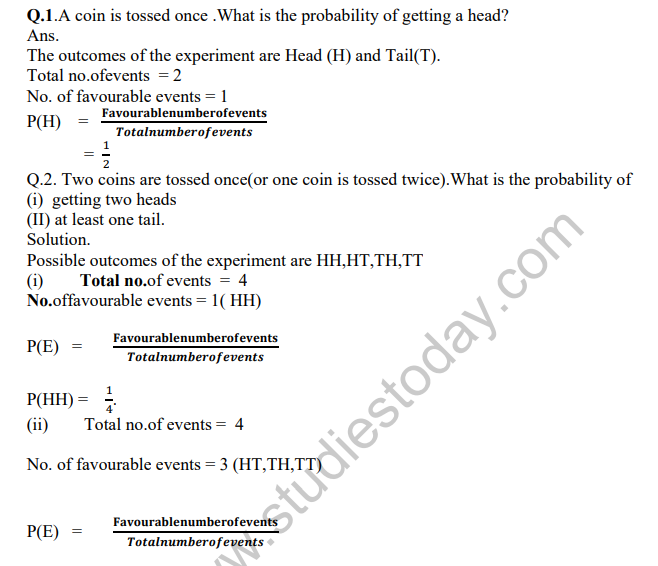
Please click the link below to download CBSE Class 10 Mathematics Probability Assignment Set A.
Free study material for Mathematics
Chapter 14 Probability Printable Assignments & Solutions for Class 10 Mathematics
Chapter Practice Questions for Class 10 Mathematics
Explore reliable practice questions for Chapter 14 Probability tailored for Class 10 learners. Use these structured worksheets to evaluate preparedness and strengthen core problem-solving skills.
Maximize Exam Scores with Chapter Practice Sets
- Syllabus Compliance: Sets reflect current CBSE evaluation criteria and official marking frameworks.
- Multi-Format Practice: Includes varied problem types designed to deepen comprehension across all sub-topics.
- Time Management: Routine practice optimizes pacing to finish school examinations comfortably within schedule.
Effective Strategy for Class 10 Mathematics Assignments
- Concept Foundation: Review the NCERT book for Class 10 Mathematics thoroughly before diving into assignment tasks.
- Self-Evaluation: Solve exercises independently before inspecting professional answer guides.
- Progress Monitoring: Note down complex formulas or concepts, clearing them up using available online practice aids.
FAQs
You can download free PDF assignments for Class 10 Mathematics Chapter 14 Probability from StudiesToday.com. These practice sheets have been updated for the 2026-27 session covering all concepts from latest NCERT textbook.
Yes, our teachers have given solutions for all questions in the Class 10 Mathematics Chapter 14 Probability assignments. This will help you to understand step-by-step methodology to get full marks in school tests and exams.
Yes. These assignments are designed as per the latest CBSE syllabus for 2026. We have included huge variety of question formats such as MCQs, Case-study based questions and important diagram-based problems found in Chapter 14 Probability.
Practicing topicw wise assignments will help Class 10 students understand every sub-topic of Chapter 14 Probability. Daily practice will improve speed, accuracy and answering competency-based questions.
Yes, all printable assignments for Class 10 Mathematics Chapter 14 Probability are available for free download in mobile-friendly PDF format.