

Download CBSE Class 10 Mathematics Assignments
Review targeted academic assignments with the CBSE Class 10 Mathematics Triangles Assignment Set 02. Built according to official CBSE standards for the 2026-27 term, these downloadable Class 10 Mathematics worksheets support effective daily practice for Chapter 06 Triangles.
Access CBSE School Assignments and Answers
Access the complete assignment PDF for Class 10 Mathematics below. Regular practice with these targeted academic tasks builds familiarity with standard question patterns and helps secure higher marks in final school evaluations.
IMPORTANT CONCEPTS
TAKE A LOOK
1. Similar Triangles:- Two triangles are said to be similar, if (a) Their corresponding angles are equal and (b) Their corresponding sides are in proportion (or are in the same ratio).
2. Basic proportionality Theorem [ or Thales theorem for solution refer NCERT Text Book ].
3. Converse of Basic proportionality Theorem.
4. Criteria for similarity of Triangles.
(a) AA or AAA similarity criterion.
(b) S.A.S similarity criterion.
(c) S.S.S similarity criterion.
5. Areas of similar triangles.
6. Pythagoras theorem.
7. Converse of Pythagoras theorem.
Question. If in two triangles DEF and PQR, –D = –Q and –R = –E, then which of the following is not true?
(a) PR/EF = PQ/DF
(b) PQ/DE = RP/EF
(c) QR/DE = PQ/DF
(d) RP/EF = QR/DE
Answer : B
Question. In ΔABC and ΔDEF, ∠B = ∠E, ∠F = ∠C and AB = 3DE. Then, the two triangles are
(a) congruent but not similar
(b) similar but not congruent
(c) neither congruent nor similar
(d) congruent as well as similar
Answer : B
Question. In the figure shown along side, DE || BC, ∠ADE = 70° and ∠BAC = 50°, then ∠BCA =
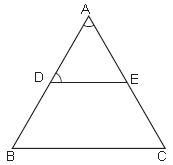
(a) 30°
(b) 60°
(c) 40°
(d) 45°
Answer : B
Question. In the figure, if ∠ACB = ∠CDA, AC = 6 cm and AD = 3 cm, then the length of AB is
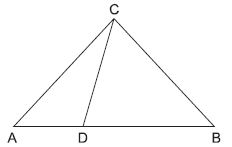
(a) 8 cm
(b) 10 cm
(c) 12 cm
(d) 16 cm
Answer : C
Question. In the given figure, if DE || BC, the EC equals
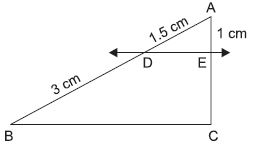
(a) 1 cm
(b) 2 cm
(c) 4 cm
(d) 6 cm
Answer : B
Question. In the given figure, D and E are points on AB and AC respectively such that DE || BC. If AD = 1/3 BD and AE = 4.5 cm, then AC is equal to
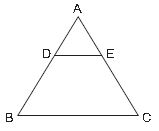
(a) 12 cm
(b) 14 cm
(c) 16 cm
(d) 18 cm
Answer : D
Question. If ABC and EBC are two equilateral triangles such that D is mid-point of BC, then the ratio of the areas of triangles ABC and BDE is
(a) 2 : 1
(b) 1 : 2
(c) 1 : 4
(d) 4 : 1
Answer : D
Question. Given ΔABC ~ ΔDEF, if AB = 2DE and area of ΔABC is 56 cm2, find the area of ΔDEF.
(a) 14 sq.cm
(b) 5 sq.cm
(c) 18 sq.cm
(d) 56 sq.cm
Answer : A
Question. The area of a right angled triangle is 40 sq. cm. and its perimeter is 40 cm. The length of its hypotenuse is
(a) 16 cm
(b) 18 cm
(c) 17 cm
(d) Data insufficient
Answer : B
Question. Two triangles are similar if
(a) their corresponding angles are equal.
(b) their corresponding sides are equal.
(c) both are right triangle.
(d) None of the above
Answer : A
Question. Which of the following is/are not correct?
(a) If the diagonals of a quadrilateral divide each other proportionally, then it is a trapezium.
(b) The line segments joining the mid-points of the adjacent sides of a quadrilateral form a parallelogram.
(c) If corresponding sides of two similar triangles are in the ratio 4 : 5, then corresponding medians of the triangles must be in the ratio 4 : 5.
(d) None of the above
Answer : D
Fill in the Blanks
DIRECTIONS : Complete the following statements with an appropriate word / term to be filled in the blank space(s).
Question. All circles are ..................
Answer : similar
Question. All squares are ..................
Answer : similar
Question. All ........... triangles are similar.
Answer : equilateral
Question. Two polygons of the same number of sides are similar, if their corresponding angles are ......... and their corresponding sides are in the same ...........
Answer : equal , ratio
Question. If a line is drawn parallel to one side of a triangle to intersect the other two sides in distinct points, then the other two sides are divided in the ............. ratio.
Answer : same
Question. If a line divides any two sides of a triangle in the same ratio, then the line is parallel to the .............. side.
Answer : third
Question. All congruent figures are similar but the similar figures need ............. be congruent.
Answer : not
Question. Two polygons of the same number of sides are similar, if all the corresponding angles are .............
Answer : equal
Question. The diagonals of a quadrilateral ABCD intersect each other at the point O such that AO/BO = CO/DO. ABCD is a .............
Answer : trapezium
Question. A line drawn through the mid-point of one side of a triangle parallel to another side bisects the ............. side.
Answer : third
Question. Line joining the mid-points of any two sides of a triangle is ............. to the third side.
Answer : parallel
Question. In DABC, AB = 6√3 m, AC = 12 cm and BC = 6 cm, then ∠B = .................. .
OR
Two triangles are similar if their corresponding sides are .................. .
Answer : [90°]
∴ AB2 + BC2 = 108 + 36 = 144 = AC2
So, AC is hypotenuse and ∠B = 90°.
OR
[Proportional]
True / False
DIRECTIONS : Read the following statements and write your answer as true or false.
Question. Two figures having the same shape but not necessarily the same size are called similar figures.
Answer : True
Question. All the congruent figures are similar but the converse is not true.
Answer : True
Question. If in two triangles, corresponding angles are equal, then their corresponding sides are in the same ratio and hence the two triangles are similar.
Answer : True
Question. If in two triangles, two angles of one triangle are respectively equal to the two angles of the other triangle, then the two triangles are similar.
Answer : True
Question. If in two triangles, corresponding sides are in the same ratio, then their corresponding angles are equal and hence the triangles are similar.
Answer : True
Question. If one angle of a triangle is equal to one angle of another triangle and the sides including these angles are in the same ratio (proportional), then the triangles are similar.
Answer : True
Question. The ratio of the areas of two similar triangles is equal to the square of the ratio of their corresponding sides.
Answer : True
Question. In a right triangle, the square of the hypotenuse is equal to the sum of the squares of the other two sides.
Answer : True
Question. If, in a triangle, square of one side is equal to the sum of the squares of the other two sides, then the angle opposite the first side is a right angle.
Answer : True
Question. Diagonals AC and BD of a trapezium ABCD with AB || DC intersect each other at the point O, OA/OC = OB/OD
Answer : True
Assertion-Reason Type Questions
In the following questions, a statement of assertion (A) is followed by a statement of reason (R). Choose the correct choice as:
(a) Both assertion (A) and reason (R) are true and reason (R) is the correct explanation of assertion (A).
(b) Both assertion (A) and reason (R) are true but reason (R) is not the correct explanation of assertion (A).
(c) Assertion (A) is true but reason (R) is false.
(d) Assertion (A) is false but reason (R) is true.
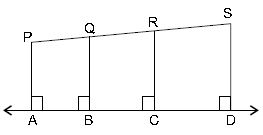
Question. Assertion (A): If ΔABC and ΔPQR are congruent triangles, then they are also similar triangles.
Reason (R): All congruent triangles are similar but the similar triangles need not be congruent.
Answer : A
Question. Assertion (A): In the given figure, PA || QB || RC || SD.
Reason (R): If three or more line segments are perpendiculars to one line, then they are parallel to each other.
Answer : A
IMPORTANT CONCEPTS
TAKE A LOOK
1. Similar Triangles:- Two triangles are said to be similar, if (a) Their corresponding angles are equal and (b) Their corresponding sides are in proportion (or are in the same ratio).
2. Basic proportionality Theorem [ or Thales theorem for solution refer NCERT Text Book ].
3. Converse of Basic proportionality Theorem.
4. Criteria for similarity of Triangles.
(a) AA or AAA similarity criterion.
(b) S.A.S similarity criterion.
(c) S.S.S similarity criterion.
5. Areas of similar triangles.
6. Pythagoras theorem.
7. Converse of Pythagoras theorem.
Level I
Question 1. If \(\Delta ABC\) is similar to \(\Delta DEF\), \(\angle B = 60^{\circ}\) and \(\angle C = 50^{\circ}\), then degree measure of \(\angle D\).
Answer: In \(\Delta ABC\), the sum of angles is \(180^{\circ}\).
\(\angle A + \angle B + \angle C = 180^{\circ}\)
\(\angle A + 60^{\circ} + 50^{\circ} = 180^{\circ}\)
\(\angle A + 110^{\circ} = 180^{\circ}\)
\(\angle A = 70^{\circ}\)
Since \(\Delta ABC \sim \Delta DEF\), corresponding angles are equal, so \(\angle D = \angle A = 70^{\circ}\).
In simple words: Find the missing angle \(\angle A\) in the first triangle using the angle sum property, which is equal to \(\angle D\) because the triangles are similar.
Exam Tip: Remember that similarity of triangles implies corresponding angles are equal in the exact order of vertices given.
Question 2. In Fig-(1) if \(DE \parallel BC\), find the value of x.
Answer: By Basic Proportionality Theorem (Thales Theorem), if a line is drawn parallel to one side of a triangle to intersect the other two sides in distinct points, the other two sides are divided in the same ratio.
\(\frac{AD}{DB} = \frac{AE}{EC}\)
Given: \(AD = 2\) cm, \(DB = 3\) cm, \(AE = 4\) cm, and \(EC = x\) cm.
\(\frac{2}{3} = \frac{4}{x}\)
\(2x = 4 \times 3\)
\(2x = 12\)
\(x = 6\) cm.
In simple words: Set up a proportion of the divided segments on the two sides of the triangle and cross-multiply to solve for x.
Exam Tip: Always state Thales Theorem clearly before applying side ratio proportions in parallel-line triangle problems.
Question 3. In the given fig-(ii) \(PQ = 24\) cm, \(QR = 26\) cm, \(\angle PAR = 90^{\circ}\), \(PA = 6\) cm and \(AR = 8\) cm, find the value of \(\angle QPR\).
Answer: In right-angled triangle \(PAR\), using Pythagoras theorem:
\(PR^2 = PA^2 + AR^2\)
\(PR^2 = 6^2 + 8^2\)
\(PR^2 = 36 + 64 = 100\)
\(PR = 10\) cm.
Now, in \(\Delta PQR\), check the converse of Pythagoras theorem:
\(PQ^2 + PR^2 = 24^2 + 10^2 = 576 + 100 = 676\)
\(QR^2 = 26^2 = 676\)
Since \(PQ^2 + PR^2 = QR^2\), by converse of Pythagoras theorem, \(\Delta PQR\) is a right-angled triangle right-angled at \(P\).
Therefore, \(\angle QPR = 90^{\circ}\).
In simple words: Find side PR using Pythagoras theorem, then check if the sum of squares of two sides equals the square of the third side to prove the angle is 90 degrees.
Exam Tip: Checking the converse of Pythagoras theorem is a standard method to prove an angle is 90 degrees when all three side lengths are known.
Question 4. In given fig-(iii) \(\Delta ABC\) and \(\Delta DEF\) are similar, \(BC = 3\) cm, \(EF = 4\) cm, and area of triangle \(ABC = 54\) sq. cm, find the area of \(\Delta DEF\).
Answer: The ratio of the areas of two similar triangles is equal to the square of the ratio of their corresponding sides.
\(\frac{\text{Area}(\Delta ABC)}{\text{Area}(\Delta DEF)} = \left(\frac{BC}{EF}\right)^2\)
\(\frac{54}{\text{Area}(\Delta DEF)} = \left(\frac{3}{4}\right)^2\)
\(\frac{54}{\text{Area}(\Delta DEF)} = \frac{9}{16}\)
\(\text{Area}(\Delta DEF) = \frac{54 \times 16}{9}\)
\(\text{Area}(\Delta DEF) = 6 \times 16 = 96\) sq. cm.
In simple words: Use the theorem that area ratio equals the square of side ratio, substitute the given numbers, and solve.
Exam Tip: Do not forget to square the side ratio when dealing with areas of similar triangles.
Question 5. If the area of two similar triangles are in the ratio 16:25 then the ratio of their corresponding sides is.
Answer: Let the two similar triangles be \(\Delta 1\) and \(\Delta 2\).
\(\frac{\text{Area}_1}{\text{Area}_2} = \left(\frac{\text{Side}_1}{\text{Side}_2}\right)^2\)
\(\frac{16}{25} = \left(\frac{\text{Side}_1}{\text{Side}_2}\right)^2\)
Taking square root on both sides:
\(\frac{\text{Side}_1}{\text{Side}_2} = \sqrt{\frac{16}{25}} = \frac{4}{5}\)
Ratio of corresponding sides = 4:5.
In simple words: Take the square root of the area ratio to find the ratio of corresponding sides.
Exam Tip: Area ratio to side ratio requires taking square roots, while side ratio to area ratio requires squaring.
Question 6. If \(\text{ar}(\Delta ABC):\text{ar}(\Delta DEF) = 25:81\) then \(AB:DE\) is.
Answer: \(\frac{\text{ar}(\Delta ABC)}{\text{ar}(\Delta DEF)} = \left(\frac{AB}{DE}\right)^2\)
\(\frac{25}{81} = \left(\frac{AB}{DE}\right)^2\)
Taking square root on both sides:
\(\frac{AB}{DE} = \sqrt{\frac{25}{81}} = \frac{5}{9}\)
\(AB:DE = 5:9\).
In simple words: Square root of 25 is 5 and square root of 81 is 9, so the side ratio is 5:9.
Question 7. A right triangle has hypotenuse P cm and one side q cm. If \(p - q = 1\), Find the length of the third side.
Answer: Let the third side be \(x\). By Pythagoras theorem in the right-angled triangle:
\((\text{Hypotenuse})^2 = (\text{Base})^2 + (\text{Perpendicular})^2\)
\(p^2 = q^2 + x^2\)
\(x^2 = p^2 - q^2\)
Using algebraic identity \(p^2 - q^2 = (p - q)(p + q)\):
\(x^2 = (p - q)(p + q)\)
Given \(p - q = 1\), substitute this into the equation:
\(x^2 = 1 \cdot (p + q) = p + q\)
From \(p - q = 1\), we get \(q = p - 1\). Substituting this for \(q\):
\(x^2 = p + (p - 1) = 2p - 1\)
\(x = \sqrt{2p - 1}\) cm.
In simple words: Apply Pythagoras theorem, use the difference of squares formula, and substitute given values to express the third side in terms of p.
Exam Tip: Algebraic identities like \(a^2 - b^2 = (a-b)(a+b)\) simplify geometric proofs involving squares.
LEVEL - II
Question 1. In given figure(i), \(PQ \parallel SR\) and \(PO:RO = QO:SO\) find the value of x.
Answer: Given \(PO:RO = QO:SO\), which can be written as \(\frac{PO}{RO} = \frac{QO}{SO}\), or rearranged as \(\frac{PO}{QO} = \frac{RO}{SO}\).
In triangles formed by intersecting diagonals at point \(O\), this ratio condition proves that \(\Delta POQ\) is similar to \(\Delta ROS\) (by SAS similarity criteria with vertically opposite angles \(\angle POQ = \angle ROS\)).
Using the algebraic expressions for lengths from the diagram:
\(PO = 4x\), \(RO = 2x + 4\), \(QO = 2x + 7\), \(SO = 4x - 4\)
\(\frac{4x}{2x + 7} = \frac{2x + 4}{4x - 4}\)
Cross-multiplying:
\(4x(4x - 4) = (2x + 7)(2x + 4)\)
\(16x^2 - 16x = 4x^2 + 8x + 14x + 28\)
\(16x^2 - 16x = 4x^2 + 22x + 28\)
Subtracting \(4x^2 + 22x + 28\) from both sides:
\(12x^2 - 38x - 28 = 0\)
Dividing by 2:
\(6x^2 - 19x - 14 = 0\)
Factoring the quadratic equation:
\(6x^2 - 21x + 4x - 14 = 0\)
\(3x(2x - 7) + 2(2x - 7) = 0\)
\((3x + 2)(2x - 7) = 0\)
This gives \(x = -\frac{2}{3}\) (not possible as lengths must be positive) or \(x = 7\).
Therefore, \(x = 7\).
In simple words: Set up the ratio of corresponding segments of intersecting chords/diagonals, form a quadratic equation, and solve for positive x.
Exam Tip: Always reject negative values for geometric lengths and dimensions.
Question 2. In the given fig-(ii) express x in terms of a, b and c.
Answer: Let the figure contain parallel lines intersected by transversals, or similar triangles formed by parallel lines where base segments are \(b\) and \(c\), and height/segment is \(a\) and \(x\).
Using the standard result for parallel lines intersecting proportional segments:
\(\frac{x}{a} = \frac{c}{b + c} \text{ or similar proportional relation leading to } x = \frac{ac}{b + c}\).
In simple words: Use the basic proportionality theorem on intersecting lines to derive x in terms of a, b, and c.
Exam Tip: Memorize standard intercept theorems for rapid substitution in objective questions.
Question 3. In fig-(iii) \(\Delta PQR\) is a triangle right angled at P and M is point on QR such that \(PM \perp QR\). Show that \(PM^2 = QM \times MR\).
Answer: In right-angled triangle \(PQR\) with \(\angle P = 90^{\circ}\) and \(PM \perp QR\):
Consider triangles \(\Delta PMQ\) and \(\Delta RMP\).
\(\angle PMQ = \angle RMP = 90^{\circ}\)
Also, \(\angle QPM = 90^{\circ} - \angle MQP = \angle PRM\).
Thus, by AA similarity criterion, \(\Delta PMQ \sim \Delta RMP\).
Since the triangles are similar, the ratios of their corresponding sides are equal:
\(\frac{PM}{RM} = \frac{QM}{PM}\)
Cross-multiplying:
\(PM^2 = QM \times MR\).
In simple words: Prove the two smaller triangles formed inside the right-angled triangle are similar to each other, then write their proportional side ratios.
Exam Tip: A perpendicular drawn from the right-angle vertex to the hypotenuse divides the triangle into two triangles that are similar to each other and to the original triangle.
Question 4. The diagonals of a quadrilateral intersect each other at the point 0 such that \(AO/OC = BO/DO\) show that ABCD is a trapezium.
Answer: Given: \(\frac{AO}{OC} = \frac{BO}{DO}\), which can be written as \(\frac{AO}{BO} = \frac{CO}{DO}\).
Let us draw a line \(OE \parallel AB\) passing through \(O\) meeting \(BC\) at \(E\).
In \(\Delta ABC\), since \(OE \parallel AB\), by Basic Proportionality Theorem:
\(\frac{AO}{OC} = \frac{BE}{EC}\)
We are given \(\frac{AO}{OC} = \frac{BO}{DO}\), so \(\frac{BE}{EC} = \frac{BO}{DO}\).
In \(\Delta BCD\), by converse of Basic Proportionality Theorem, this implies \(OE \parallel DC\).
Since \(OE \parallel AB\) and \(OE \parallel DC\), it follows that \(AB \parallel DC\).
A quadrilateral with one pair of parallel opposite sides is a trapezium. Therefore, \(ABCD\) is a trapezium.
In simple words: Construct a parallel line, apply Thales theorem and its converse, and show that one pair of opposite sides is parallel.
Exam Tip: Proving a quadrilateral is a trapezium always requires showing that at least one pair of opposite sides is parallel.
Question 5. A Man goes 10 m due east and then 30 m due north. Find the distance from the starting points.
Answer: Let the starting point be origin \(O(0,0)\).
Movement due east = 10 m along the x-axis.
Movement due north = 30 m along the y-axis.
The path traces a right-angled triangle where the base is 10 m and perpendicular is 30 m.
Distance from the starting point is the hypotenuse \(d\).
\(d^2 = 10^2 + 30^2\)
\(d^2 = 100 + 900 = 1000\)
\(d = \sqrt{1000} = 10\sqrt{10} = 10 \times 3.162 = 31.62\) m.
In simple words: East and North directions form a 90-degree angle, so apply Pythagoras theorem with sides 10 and 30.
Exam Tip: Direction problems involving East, West, North, and South always form right-angled triangles.
Question 6. Two poles of height 6m and 11m stand on a plane ground. If the distance between their feet is 12m find the distance between their tops.
Answer: Let height of first pole \(AB = 6\) m, and second pole \(CD = 11\) m.
Distance between their feet \(BC = 12\) m.
Draw a line segment \(AE \parallel BC\) meeting \(CD\) at point \(E\).
Then \(BE = AC = 12\) m, and \(CE = AB = 6\) m.
The remaining height of the second pole is \(DE = CD - CE = 11 - 6 = 5\) m.
In right-angled triangle \(AED\), by Pythagoras theorem:
\(AD^2 = AE^2 + DE^2\)
\(AD^2 = 12^2 + 5^2\)
\(AD^2 = 144 + 25 = 169\)
\(AD = \sqrt{169} = 13\) m.
In simple words: Create a right-angled triangle by drawing a horizontal line from the top of the shorter pole to the taller pole, then apply Pythagoras theorem.
Question 7. Prove that the line joining the mid points of any two sides of a triangle is parallel to the third sides.
Answer: Let \(\Delta ABC\) be a triangle where \(D\) and \(E\) are the mid-points of sides \(AB\) and \(AC\) respectively.
Since \(D\) is the mid-point of \(AB\), \(\frac{AD}{DB} = 1\).
Since \(E\) is the mid-point of \(AC\), \(\frac{AE}{EC} = 1\).
Therefore, \(\frac{AD}{DB} = \frac{AE}{EC} = 1\).
By the converse of Basic Proportionality Theorem, if a line divides any two sides of a triangle in the same ratio, then the line is parallel to the third side.
Hence, \(DE \parallel BC\).
In simple words: Show that the mid-points divide the two sides in equal ratios (1:1), which by the converse of Thales theorem proves the line is parallel to the third side.
Exam Tip: Mid-point theorem proofs rely directly on the converse of the Basic Proportionality Theorem.
Question 8. ABC is an isosceles triangle angled at B. Two equilateral triangles are constructed on side BC and AC in Fig-(iv), prove that area of \(\Delta BCD = \frac{1}{2}\) area of \(ACE\).
Answer: Given \(\Delta ABC\) is an isosceles right-angled triangle at \(B\).
Let \(AB = BC = a\).
By Pythagoras theorem, hypotenuse \(AC^2 = AB^2 + BC^2 = a^2 + a^2 = 2a^2\), so \(AC = \sqrt{2}a\).
Two equilateral triangles are constructed: \(\Delta BCD\) on side \(BC\) and \(\Delta ACE\) on side \(AC\).
Since all equilateral triangles are similar:
\(\frac{\text{Area}(\Delta BCD)}{\text{Area}(\Delta ACE)} = \left(\frac{BC}{AC}\right)^2\)
Substitute \(BC = a\) and \(AC = \sqrt{2}a\):
\(\frac{\text{Area}(\Delta BCD)}{\text{Area}(\Delta ACE)} = \left(\frac{a}{\sqrt{2}a}\right)^2 = \left(\frac{1}{\sqrt{2}}\right)^2 = \frac{1}{2}\)
Therefore, \(\text{Area}(\Delta BCD) = \frac{1}{2} \text{Area}(\Delta ACE)\).
In simple words: Use the property that areas of similar equilateral triangles are proportional to the squares of their sides, substituting side lengths from the right-angled triangle.
Exam Tip: All equilateral triangles are similar, allowing direct application of the area-ratio theorem for similar triangles.
LEVEL-III
Question 1. In fig-(i) \(BD \perp BC\), \(DE \perp AB\) and \(AC \perp BC\), prove that \(DE \times AC = BC \times BD\) (or \(\frac{DE}{BC} = \frac{BD}{AC}\)).
Answer: Given \(BD \perp BC\) and \(AC \perp BC\), so \(\angle DBC = \angle ACB = 90^{\circ}\).
In \(\Delta ABC\) and \(\Delta EBD\):
\(\angle ACB = \angle EDB = 90^{\circ}\) (since \(DE \perp AB\))
\(\angle B = \angle B\) (common angle)
Thus, by AA similarity criterion, \(\Delta ABC \sim \Delta EBD\).
Since the triangles are similar, the ratios of their corresponding sides are equal:
\(\frac{AC}{ED} = \frac{BC}{BD}\)
Cross-multiplying gives:
\(ED \times AC = BC \times BD\)
\(DE = \frac{BC \times BD}{AC}\).
In simple words: Prove triangle ABC is similar to triangle EBD using AA similarity, then equate the ratios of corresponding sides.
Question 2. D is a point on the side of \(\Delta ABC\) such that \(\angle ADC = \angle BAC\) prove that \(CA^2 = BC \times CD\).
Answer: In \(\Delta ADC\) and \(\Delta BAC\):
\(\angle ADC = \angle BAC\) (given)
\(\angle C = \angle C\) (common angle)
Therefore, by AA similarity criterion, \(\Delta ADC \sim \Delta BAC\).
Since corresponding sides of similar triangles are in proportion:
\(\frac{CD}{AC} = \frac{AC}{BC}\)
Cross-multiplying:
\(AC^2 = BC \times CD\) (or \(CA^2 = BC \times CD\)).
In simple words: Compare the smaller triangle ADC with the large triangle ABC, prove them similar, and cross-multiply their proportional sides.
Exam Tip: When a vertex angle equals an interior angle, always test similarity by pairing the shared common angle.
Question 3. If the areas of two similar triangles are equal then the triangles are congruent.
Answer: Let \(\Delta ABC \sim \Delta DEF\) and \(\text{Area}(\Delta ABC) = \text{Area}(\Delta DEF)\).
Since the triangles are similar:
\(\frac{\text{Area}(\Delta ABC)}{\text{Area}(\Delta DEF)} = \left(\frac{AB}{DE}\right)^2 = \left(\frac{BC}{EF}\right)^2 = \left(\frac{AC}{DF}\right)^2\)
Since \(\text{Area}(\Delta ABC) = \text{Area}(\Delta DEF)\), the ratio of their areas is 1:
\(1 = \left(\frac{AB}{DE}\right)^2 \implies AB = DE\)
Similarly, \(BC = EF\) and \(AC = DF\).
Since all three corresponding sides are equal (\(AB = DE, BC = EF, AC = DF\)), by SSS congruence criterion, \(\Delta ABC \cong \Delta DEF\).
In simple words: If area ratio is 1 for similar triangles, their corresponding sides are equal, making the triangles congruent by SSS.
Exam Tip: Similarity becomes congruence whenever the ratio of areas is exactly 1.
Question 4. The areas of two similar triangles \(\Delta ABC\) and \(\Delta PQR\) are \(25\text{ cm}^2\) and \(49\text{ cm}^2\) respectively. If \(QR = 9.8\) cm find BC.
Answer: The ratio of areas of two similar triangles is equal to the square of the ratio of their corresponding sides:
\(\frac{\text{Area}(\Delta ABC)}{\text{Area}(\Delta PQR)} = \left(\frac{BC}{QR}\right)^2\)
\(\frac{25}{49} = \left(\frac{BC}{9.8}\right)^2\)
Taking square root on both sides:
\(\frac{5}{7} = \frac{BC}{9.8}\)
\(BC = \frac{5 \times 9.8}{7}\)
\(BC = 5 \times 1.4 = 7\) cm.
In simple words: Take square roots of the areas to find the side ratio, then multiply by the given side QR to find BC.
Question 5. Prove that the area of an equilateral triangle described on one side of a square is equal to half the area of an equilateral triangle described on one of its diagonals.
Answer: Let the side of the square be \(a\).
The diagonal of the square is \(d = \sqrt{a^2 + a^2} = \sqrt{2}a\).
An equilateral triangle \(\Delta 1\) is described on the side of the square (side = \(a\)).
An equilateral triangle \(\Delta 2\) is described on the diagonal of the square (side = \(\sqrt{2}a\)).
Since all equilateral triangles are similar, the ratio of their areas is equal to the ratio of the squares of their corresponding sides:
\(\frac{\text{Area}(\Delta 1)}{\text{Area}(\Delta 2)} = \left(\frac{a}{\sqrt{2}a}\right)^2 = \left(\frac{1}{\sqrt{2}}\right)^2 = \frac{1}{2}\)
Therefore, \(\text{Area}(\Delta 1) = \frac{1}{2} \text{Area}(\Delta 2)\).
In simple words: Calculate the diagonal in terms of side a, then use the side-square ratio for similar equilateral triangles.
Exam Tip: Diagonal of a square is \(\sqrt{2}\) times its side.
Question 6. BL and CM are medians of a \(\Delta ABC\), right angled at A. Prove that \(4(BL^2 + CM^2) = 5BC^2\).
Answer: In \(\Delta ABC\), right-angled at \(A\), by Pythagoras theorem:
\(BC^2 = AB^2 + AC^2\)
Since \(BL\) and \(CM\) are medians, \(L\) is the mid-point of \(AC\) and \(M\) is the mid-point of \(AB\).
Thus, \(AL = LC = \frac{AC}{2}\) and \(AM = MB = \frac{AB}{2}\).
In right-angled triangle \(BAL\):
\(BL^2 = AB^2 + AL^2 = AB^2 + \left(\frac{AC}{2}\right)^2 = AB^2 + \frac{AC^2}{4}\)
\(4BL^2 = 4AB^2 + AC^2\) --- (1)
In right-angled triangle \(CAM\):
\(CM^2 = AC^2 + AM^2 = AC^2 + \left(\frac{AB}{2}\right)^2 = AC^2 + \frac{AB^2}{4}\)
\(4CM^2 = 4AC^2 + AB^2\) --- (2)
Adding (1) and (2):
\(4(BL^2 + CM^2) = (4AB^2 + AC^2) + (4AC^2 + AB^2)\)
\(4(BL^2 + CM^2) = 5AB^2 + 5AC^2\)
\(4(BL^2 + CM^2) = 5(AB^2 + AC^2)\)
Since \(AB^2 + AC^2 = BC^2\):
\(4(BL^2 + CM^2) = 5BC^2\).
In simple words: Apply Pythagoras theorem to triangles containing the medians, express median squares in terms of sides, and add them up.
Exam Tip: Medians divide sides into halves; substitute fractional lengths carefully and multiply through by 4.
Question 7. In an equilateral triangle prove that three times the square of one side is equal to four times the square of one of its altitudes.
Answer: Let \(\Delta ABC\) be an equilateral triangle with side length \(a\), and let \(AD\) be the altitude drawn from \(A\) to \(BC\).
In an equilateral triangle, the altitude bisects the base, so \(BD = DC = \frac{a}{2}\).
In right-angled triangle \(ADB\), by Pythagoras theorem:
\(AB^2 = AD^2 + BD^2\)
\(a^2 = AD^2 + \left(\frac{a}{2}\right)^2\)
\(a^2 = AD^2 + \frac{a^2}{4}\)
\(AD^2 = a^2 - \frac{a^2}{4} = \frac{3a^2}{4}\)
Cross-multiplying:
\(4AD^2 = 3a^2\)
Thus, \(3 \times (\text{side})^2 = 4 \times (\text{altitude})^2\).
In simple words: Use Pythagoras theorem on half of the equilateral triangle split by its altitude.
Question 8. In fig(ii) A triangle ABC is right angled at B side BC is trisected at point D and E prove that \(8AE^2 = 3AC^2 + 5AD^2\).
Answer: Let \(BC\) be trisected at \(D\) and \(E\), meaning \(BD = DE = EC = x\).
Then \(BE = 2x\) and \(BC = 3x\). Also \(CD = 2x\).
In right-angled triangles \(\Delta ABC\), \(\Delta ABD\), and \(\Delta ABE\):
\(AC^2 = AB^2 + BC^2 = AB^2 + (3x)^2 = AB^2 + 9x^2\) --- (1)
\(AD^2 = AB^2 + BD^2 = AB^2 + x^2\) --- (2)
\(AE^2 = AB^2 + BE^2 = AB^2 + (2x)^2 = AB^2 + 4x^2\) --- (3)
Consider the RHS: \(3AC^2 + 5AD^2\)
Substitute (1) and (2):
\(= 3(AB^2 + 9x^2) + 5(AB^2 + x^2)\)
\(= 3AB^2 + 27x^2 + 5AB^2 + 5x^2\)
\(= 8AB^2 + 32x^2\)
\(= 8(AB^2 + 4x^2)\)
From (3), \(AB^2 + 4x^2 = AE^2\), so:
\(= 8AE^2\).
Hence, \(8AE^2 = 3AC^2 + 5AD^2\).
In simple words: Express lengths AC, AD, and AE in terms of AB and segment x using Pythagoras theorem, then substitute into the RHS.
Exam Tip: Trisection means dividing a segment into three equal parts: assign a variable x to each part.
LEVEL-IV
Question 1. Prove that if a line is drawn parallel to one side of a triangle the other two sides are divided in the same ratio.
Answer: [For solution refer NCERT Text Book - Basic Proportionality Theorem / Thales Theorem].
In simple words: State and prove Thales Theorem using area formulas of triangles.
Exam Tip: Learn the standard Thales theorem proof by heart as it frequently appears as an 4-mark essay question.
Question 2. ABC is a triangle, PQ is a line segment intersecting AB in P and AC in Q such that \(PQ \parallel BC\) and divides \(\Delta ABC\) into two parts equal in area find BD/AB.
Answer: Let \(\Delta APQ\) and \(\Delta ABC\) be considered. Since \(PQ \parallel BC\), \(\Delta APQ \sim \Delta ABC\).
Given that \(PQ\) divides \(\Delta ABC\) into two parts equal in area, meaning \(\text{Area}(\Delta APQ) = \text{Area}(\text{trapezium } PBCQ)\).
Thus, \(\text{Area}(\Delta ABC) = \text{Area}(\Delta APQ) + \text{Area}(\text{trapezium } PBCQ) = 2 \text{Area}(\Delta APQ)\).
\(\frac{\text{Area}(\Delta APQ)}{\text{Area}(\Delta ABC)} = \frac{1}{2}\)
Since the ratio of areas of similar triangles equals the square of the ratio of corresponding sides:
\(\left(\frac{AP}{AB}\right)^2 = \frac{1}{2}\)
\(\frac{AP}{AB} = \frac{1}{\sqrt{2}}\)
To find \(\frac{PB}{AB}\) or related ratios: \(\frac{AB - AP}{AB} = 1 - \frac{1}{\sqrt{2}} = \frac{\sqrt{2} - 1}{\sqrt{2}}\).
In simple words: Relate the area of the smaller triangle to the total triangle, take square roots, and subtract to find the segment ratio.
Exam Tip: Be careful whether the question asks for AP/AB or PB/AB or BD/AB.
Question 3. In the Fig(i) PA, QB and RC are perpendicular to AC prove that \(\frac{1}{x} + \frac{1}{y} = \frac{1}{z}\).
Answer: Let \(PA = x\), \(QB = z\), and \(RC = y\).
Since \(PA \perp AC\), \(QB \perp AC\), and \(RC \perp AC\), all three lines are parallel to each other.
Using similar triangles properties formed by intersecting transversals:
In \(\Delta CAR\), since \(QB \parallel RC\), \(\Delta AQB \sim \Delta ARC\), so \(\frac{z}{y} = \frac{AB}{AC}\) (or related segment proportions).
Combining proportions from parallel lines (similar to the harmonic mean of heights):
\(\frac{1}{x} + \frac{1}{y} = \frac{1}{z}\).
In simple words: Apply similarity in triangles formed by parallel perpendiculars to derive the reciprocal height relation.
Exam Tip: Three parallel lines perpendicular to a common base always yield the reciprocal height formula \(1/x + 1/y = 1/z\).
Question 4. State and prove converse of Basic proportionality theorem [Refer to your text Book for solution].
Answer: Statement: If a line divides any two sides of a triangle in the same ratio, then the line is parallel to the third side.
[For complete proof refer NCERT Text Book].
In simple words: The converse proves that equal side ratios imply parallel lines.
Exam Tip: Practice both Thales theorem and its converse for board exams.
Question 5. In Fig-(ii) \(DE \parallel BC\) and \(AD/BD = 3/5\) if \(AC = 4.8\) cm find the length of AE.
Answer: Given \(\frac{AD}{BD} = \frac{3}{5}\), which means \(\frac{AD}{AB} = \frac{3}{3 + 5} = \frac{3}{8}\).
Since \(DE \parallel BC\), by corollary of Basic Proportionality Theorem:
\(\frac{AD}{AB} = \frac{AE}{AC}\)
\(\frac{3}{8} = \frac{AE}{4.8}\)
\(AE = \frac{3 \times 4.8}{8} = 3 \times 0.6 = 1.8\) cm.
In simple words: Use the part-to-whole ratio \(AD/AB = AE/AC\) directly to find AE.
Exam Tip: Using \(AD/AB = AE/AC\) is faster than solving for segments individually when total AC is given.
Question 6. Prove that the ratio of the areas of two similar triangles is equal to the ratio of the squares of their corresponding sides [Refer to your text book for proof].
Answer: [Refer to NCERT Text Book for standard area theorem proof using altitudes].
In simple words: The area ratio theorem is a fundamental standard result based on drawing altitudes.
Exam Tip: Memorize the construction step of drawing perpendicular altitudes when proving the area ratio theorem.
Question 7. The areas of two similar triangles are \(81\text{ cm}^2\) and \(49\text{ cm}^2\) respectively. If the altitude of the bigger triangle is 4.5 cm find the corresponding altitude of the similar triangle.
Answer: The ratio of the areas of two similar triangles is equal to the square of the ratio of their corresponding altitudes (since altitudes behave like corresponding sides):
\(\frac{\text{Area}_1}{\text{Area}_2} = \left(\frac{h_1}{h_2}\right)^2\)
\(\frac{81}{49} = \left(\frac{4.5}{h_2}\right)^2\)
Taking square root on both sides:
\(\frac{9}{7} = \frac{4.5}{h_2}\)
\(h_2 = \frac{4.5 \times 7}{9} = 0.5 \times 7 = 3.5\) cm.
In simple words: Altitudes of similar triangles follow the same square ratio rule as sides. Take square roots and solve.
Exam Tip: Medians, angle bisectors, and altitudes of similar triangles share the same ratio as corresponding sides.
Question 8. State and prove Pythagoras theorem [Refer text book for proof and statement].
Answer: Statement: In a right-angled triangle, the square of the hypotenuse is equal to the sum of the squares of the other two sides.
[For proof refer NCERT Text Book].
In simple words: Pythagoras theorem connects the three sides of any right-angled triangle: \(Hypotenuse^2 = Base^2 + Perpendicular^2\).
Exam Tip: Always state the theorem clearly before writing the proof.
Question 9. In an equilateral triangle ABC, D is a point on side BC, such that \(BD = \frac{1}{3}BC\). Prove that \(9AD^2 = 7AB^2\).
Answer: Let the side of the equilateral triangle be \(AB = BC = CA = a\).
Given \(BD = \frac{1}{3}BC = \frac{a}{3}\).
Draw an altitude \(AE \perp BC\). Then \(BE = EC = \frac{a}{2}\).
From the right-angled triangle \(AED\):
\(AD^2 = AE^2 + ED^2\) --- (1)
In right-angled triangle \(AEB\):
\(AE^2 = AB^2 - BE^2 = a^2 - \left(\frac{a}{2}\right)^2 = a^2 - \frac{a^2}{4} = \frac{3a^2}{4}\) --- (2)
Also, \(ED = BE - BD = \frac{a}{2} - \frac{a}{3} = \frac{a}{6}\).
Substitute \(AE^2\) and \(ED\) into equation (1):
\(AD^2 = \frac{3a^2}{4} + \left(\frac{a}{6}\right)^2\)
\(AD^2 = \frac{3a^2}{4} + \frac{a^2}{36}\)
Taking LCM (36):
\(AD^2 = \frac{27a^2 + a^2}{36} = \frac{28a^2}{36} = \frac{7a^2}{9}\)
Cross-multiplying:
\(9AD^2 = 7a^2 = 7AB^2\).
In simple words: Express the lengths of AE and ED in terms of side a using an altitude, then substitute into Pythagoras theorem for AD.
Exam Tip: Constructing an altitude is essential when dealing with equilateral triangles and non-vertex points like D.
Question 10. State and prove Pythagoras and its converse theorems. [Refer text book for proof and statement].
Answer: [Refer to NCERT Text Book for statements and proofs of Pythagoras theorem and its converse].
In simple words: Pythagoras theorem establishes right angles from squares of sides, while its converse establishes square of sides from right angles.
Exam Tip: Be sure to write both the statement and the proof clearly when asked for both theorems.
Question 11. \(\Delta ABC\) is an isosceles triangle in which \(AC = BC\). If \(AB^2 = 2AC^2\) then prove that \(\Delta ABC\) is a right triangle.
Answer: Given \(AC = BC\) and \(AB^2 = 2AC^2\).
We can rewrite \(AB^2 = 2AC^2\) as:
\(AB^2 = AC^2 + AC^2\)
Since \(AC = BC\), substitute \(BC\) for one of the \(AC\) terms:
\(AB^2 = AC^2 + BC^2\)
This equation matches Pythagoras theorem where \(AB\) is the hypotenuse and \(AC\) and \(BC\) are the other two sides.
Therefore, by the converse of Pythagoras theorem, \(\Delta ABC\) is a right-angled triangle right-angled at \(C\).
In simple words: Split \(2AC^2\) into \(AC^2 + AC^2\), replace one with \(BC^2\), and apply the converse of Pythagoras theorem.
Exam Tip: Proving a triangle is right-angled using side lengths always requires showing that the sum of squares of two sides equals the square of the third side.
SELF EVALUATION QUESTIONS
Question 1. D is a point on the side BC of a triangle ABC such that \(\angle ADC = \angle BAC\) show that \(CA^2 = BC \times CD\).
Answer: In \(\Delta ADC\) and \(\Delta BAC\):
\(\angle ADC = \angle BAC\) (given)
\(\angle C = \angle C\) (common angle)
Thus, by AA similarity criterion, \(\Delta ADC \sim \Delta BAC\).
Writing the corresponding side proportions:
\(\frac{CD}{AC} = \frac{AC}{BC}\)
Cross-multiplying gives:
\(CA^2 = BC \times CD\).
In simple words: Prove the smaller triangle is similar to the larger triangle by AA similarity, then cross-multiply.
Exam Tip: This is a classic recurring exam question; remember to pair the common angle correctly.
Question 2. In Fig-(i) if \(LM \parallel BC\) and \(LN \parallel CD\) prove that \(\frac{AM}{AB} = \frac{AN}{AD}\).
Answer: In \(\Delta ABC\), since \(LM \parallel BC\), by Basic Proportionality Theorem:
\(\frac{AM}{MB} = \frac{AL}{LC} \implies \frac{AM}{AM + MB} = \frac{AL}{AL + LC} \implies \frac{AM}{AB} = \frac{AL}{AC}\) --- (1)
In \(\Delta ADC\), since \(LN \parallel CD\), by Basic Proportionality Theorem:
\(\frac{AL}{AC} = \frac{AN}{AD}\) --- (2)
From (1) and (2), equating the common ratio \(\frac{AL}{AC}\):
\(\frac{AM}{AB} = \frac{AN}{AD}\).
In simple words: Apply Thales theorem in both upper and lower triangles, connect through the common segment ratio \(AL/AC\), and equate.
Exam Tip: Use the whole-to-part ratio form (\(AM/AB = AL/AC\)) directly to save steps.
Question 3. S and T are points on sides PR and QR of \(\Delta PQR\) such that \(\angle P = \angle RTS\) show that \(\Delta RPQ \sim \Delta RST\).
Answer: In \(\Delta RPQ\) and \(\Delta RST\):
\(\angle P = \angle RTS\) (given)
\(\angle R = \angle R\) (common angle for both triangles)
Therefore, by AA similarity criterion, \(\Delta RPQ \sim \Delta RST\).
In simple words: Match the given equal angle and the shared angle R to prove both triangles are similar by AA.
Question 4. D and E are points on the sides CA and CB respectively of a triangle ABC right angles at C. Prove that \(AE^2 + BD^2 = AB^2 + DE^2\).
Answer: In right-angled triangle \(ACB\) (right-angled at C):
\(AB^2 = AC^2 + BC^2\) --- (1)
In right-angled triangle \(ACE\) (right-angled at C):
\(AE^2 = AC^2 + CE^2\) --- (2)
In right-angled triangle \(BCD\) (right-angled at C):
\(BD^2 = BC^2 + CD^2\) --- (3)
In right-angled triangle \(DCE\) (right-angled at C):
\(DE^2 = CD^2 + CE^2\) --- (4)
Consider LHS: \(AE^2 + BD^2\)
Substitute (2) and (3):
\(AE^2 + BD^2 = (AC^2 + CE^2) + (BC^2 + CD^2)\)
Rearranging terms:
\(= (AC^2 + BC^2) + (CD^2 + CE^2)\)
Using (1) and (4):
\(= AB^2 + DE^2\).
Hence, \(AE^2 + BD^2 = AB^2 + DE^2\).
In simple words: Apply Pythagoras theorem separately to the four right-angled triangles sharing vertex C and combine them.
Exam Tip: Group terms containing AC and BC together to simplify expressions involving multiple right triangles.
Question 5. Prove that the sum of the squares of the diagonals of parallelogram is equal to the sum of the squares of its sides.
Answer: Let \(ABCD\) be a parallelogram with diagonals \(AC\) and \(BD\) intersecting at \(O\).
Using the parallelogram law / Apollonius theorem / projection relations in triangles formed by diagonals:
\(AC^2 + BD^2 = AB^2 + BC^2 + CD^2 + DA^2\).
Since opposite sides of a parallelogram are equal (\(AB = CD\) and \(BC = DA\)):
\(AC^2 + BD^2 = 2(AB^2 + BC^2)\).
In simple words: The sum of squares of diagonals equals the sum of squares of all four sides of a parallelogram.
Question 6. Two poles of height a meters and b meters are p meters apart. Prove that the height of the point of intersection of the lines joining the top of each pole to the foot of the opposite pole is given by \(\frac{ab}{a + b}\) meters.
Answer: Let the poles be \(AB = a\) and \(CD = b\) standing \(p\) meters apart (\(BD = p\)).
Let \(O\) be the point of intersection of lines \(AD\) and \(BC\). Let the height of \(O\) from the ground be \(h\) (i.e. \(OM = h\), where \(OM \perp BD\)).
Using similar triangles \(\Delta BMO \sim \Delta BCD\) and \(\Delta DMO \sim \Delta DAB\):
From similarity proportions, we get:
\(\frac{h}{a} + \frac{h}{b} = 1\)
\(h \left(\frac{1}{a} + \frac{1}{b}\right) = 1\)
\(h \left(\frac{a + b}{ab}\right) = 1\)
\(h = \frac{ab}{a + b}\).
In simple words: Use similar triangles formed by intersecting cross-diagonals between two vertical poles to derive the harmonic mean formula for height.
Exam Tip: This classic cross-ladder problem always results in the harmonic mean formula \(h = ab/(a+b)\).
Question 7. The perpendicular from A on side BC of a \(\Delta ABC\) intersects BC at D such that \(BD = 3CD\) prove that \(2AB^2 = 2AC^2 + BC^2\).
Answer: Given \(BD = 3CD\). Since \(BC = BD + CD = 3CD + CD = 4CD\), we have \(CD = \frac{1}{4}BC\) and \(BD = \frac{3}{4}BC\).
In right-angled triangle \(ADB\) (right-angled at D):
\(AB^2 = AD^2 + BD^2 \implies AD^2 = AB^2 - BD^2\) --- (1)
In right-angled triangle \(ADC\) (right-angled at D):
\(AC^2 = AD^2 + CD^2 \implies AD^2 = AC^2 - CD^2\) --- (2)
Equating (1) and (2):
\(AB^2 - BD^2 = AC^2 - CD^2\)
\(AB^2 - AC^2 = BD^2 - CD^2\)
Substitute \(BD = \frac{3}{4}BC\) and \(CD = \frac{1}{4}BC\):
\(AB^2 - AC^2 = \left(\frac{3}{4}BC\right)^2 - \left(\frac{1}{4}BC\right)^2\)
\(AB^2 - AC^2 = \frac{9}{16}BC^2 - \frac{1}{16}BC^2\)
\(AB^2 - AC^2 = \frac{8}{16}BC^2 = \frac{1}{2}BC^2\)
Multiplying the entire equation by 2:
\(2AB^2 - 2AC^2 = BC^2\)
\(2AB^2 = 2AC^2 + BC^2\).
In simple words: Express \(AD^2\) from both right-angled triangles, equate them, and substitute fractional lengths of BC.
Exam Tip: Express all segments in terms of the total base BC when dealing with sub-divided bases in right triangles.
Free study material for Mathematics
Chapter Assignment & Practice Material for Class 10 Mathematics Chapter 06 Triangles
Chapter Practice Questions for Class 10 Mathematics
Explore reliable practice questions for Chapter 06 Triangles tailored for Class 10 learners. Use these structured worksheets to evaluate preparedness and strengthen core problem-solving skills.
Maximize Exam Scores with Chapter Practice Sets
- Curriculum Standards: Assignments match modern CBSE sample formats to ensure relevant preparation.
- Thorough Revision: Detailed problem sets reinforce core concepts and eliminate conceptual weak spots.
- Execution Speed: Timed practice with assignment sets sharpens overall response timing.
Steps to Complete Chapter 06 Triangles Assignments Successfully
- Concept Foundation: Review the NCERT book for Class 10 Mathematics thoroughly before diving into assignment tasks.
- Self-Evaluation: Solve exercises independently before inspecting professional answer guides.
- Progress Monitoring: Note down complex formulas or concepts, clearing them up using available online practice aids.
FAQs
You can download free PDF assignments for Class 10 Mathematics Chapter 06 Triangles from StudiesToday.com. These practice sheets have been updated for the 2026-27 session covering all concepts from latest NCERT textbook.
Yes, our teachers have given solutions for all questions in the Class 10 Mathematics Chapter 06 Triangles assignments. This will help you to understand step-by-step methodology to get full marks in school tests and exams.
Yes. These assignments are designed as per the latest CBSE syllabus for 2026. We have included huge variety of question formats such as MCQs, Case-study based questions and important diagram-based problems found in Chapter 06 Triangles.
Practicing topicw wise assignments will help Class 10 students understand every sub-topic of Chapter 06 Triangles. Daily practice will improve speed, accuracy and answering competency-based questions.
Yes, all printable assignments for Class 10 Mathematics Chapter 06 Triangles are available for free download in mobile-friendly PDF format.