

Official Class 9 Mathematics Worksheets: Chapter 02 Polynomials
Explore structured practice materials through the CBSE Class 9 Mathematics Polynomials Worksheet Set 03. Tailored for Class 9 learners, utilizing these Mathematics worksheets ensures thorough preparation and strengthens problem-solving accuracy before final school evaluations.
Solved Practice Worksheets for Mathematics
Navigate directly to the solved Mathematics worksheets using the digital viewer below. Each practice set includes detailed step-by-step solutions, allowing students to instantly cross-check their work and identify areas requiring further revision.
Question. Which of the following is a constant polynomial?
(a) x + 1/x − 3
(b) 1/x + 3
(c) √x + 2
(d) – 4
Answer : D
Question. Which of the following polynomials has – 5 as its zero?
(a) (x – 5)
(b) x2 – 25
(c) x2 – 5x
(d) x2 + 5
Answer : B
Question. Using algebraic identity, find the value of 209 × 191.
(a) 39851
(b) 39919
(c) 39961
(d) 38951
Answer : B
Question. If a + b + c = 13 and ab + bc + ca = 84, then find the value of a2 + b2 + c2.
(a) 1
(b) 2
(c) 3
(d) 4
Answer : A
Question. If p(x) = x160 + 2x141 + k and p(–1) = 0, then the value of k is
(a) 1
(b) – 3
(c) 2
(d) – 2
Answer : A
Question. Factors of polynomial 12x2 + 7x + 1 are
(a) (3x – 1)(4x + 1)
(b) (3x – 1)(4x – 1)
(c) (4x – 1)(3x– 1)
(d) (4x + 1)(3x + 1)
Answer : D
Question. If p(x) = x + 3, then p(x) + p(– x) is equal to
(a) 3
(b) 2x
(c) 0
(d) 6
Answer : D
Question. If the volume of a cuboid is x3 + x2 – 9x – 9, then its possible dimensions are
(a) x + 1, x2, x + 3
(b) x + 1, x – 3, x + 3
(c) 3, x2, 9x
(d) 3, 3, 3
Answer : B
Question. The degree of the polynomial (y3 – 3)(y2 + 8) is
(a) 2
(b) 3
(c) 0
(d) 5
Answer : D
Question. One of the zeroes of the polynomial 2x2 + 7x – 4 is
(a) 2
(b) 1/2
(c) −(1/2)
(d) – 2
Answer : B
Question. If a/b + b/a = 1, then a3 + b3 equals
(a) 1
(b) – 1
(c) 1/2
(d) 0
Answer : D
Question. If p(y) = y2 – y + 1, then find the value of p(0) – p(1).
(a) 1
(b) 3
(c) 0
(d) 2
Answer : C
Question. If p(x) = x2 + kx + 6, then for what value of k, p(3) = 0 ?
(a) 2
(b) –5
(c) 3
(d) – 1
Answer : B
Question. The value of (9)3 + (– 3)3 is
(a) – 81
(b) 54
(c) 164
(d) 702
Answer : D
Question. If a3 + b3 + c3 = 3abc, then a2/bc + b2/ca + c2/ab =
(a) 0
(b) 1
(c) – 1
(d) 3
Answer : D
Question. The coefficient of the highest power of x in the polynomial 3x3 – 4x4 + 5x2 – 2x5 + 3 is
(a) 2
(b) – 4
(c) 3
(d) –2
Answer : D
Question. Factorise: x2 + (a + b + c)x + ab + bc
(a) (x + a)(x + b + c)
(b) (x + a)(x + a + c)
(c) (x + b)(x + a + c)
(d) (x + b)(x + b + c)
Answer : C
Case Based MCQs
Case II : Read the following passage and answer the questions from 43 to 47.
A class teacher decided to organise an educational trip for his class. He asked the students for their preferences, where they want to go.
1/12 th times the square of total number of students want to go to old age home, 7/12 th times the total number of students plan to visit historical monuments, while 15 students decide to teach children of orphanage home.
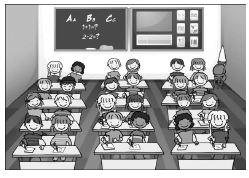
Question. Which of the following polynomial represents the above situation, if x is the total number of students?
(a) (7/12)x2 + (1/12)x + 15
(b) (1/12)x2 + (7/12)x + 15
(c) 7x2 + 12x + 15
(d) None of these
Answer : B
Question. The coefficient of x2 in the above polynomial is
(a) 7/12
(b) − 1/12
(c) − 7/12
(d) 1/12
Answer : D
Question. Write the coefficient of x in the polynomial.
(a) − 1/12
(b) 1/12
(c) 7/12
(d) − 7/12
Answer : C
Question. Value of the polynomial at x = 1, is
(a) 172
(b) 150
(c) 176/12
(d) 47/3
Answer : D
Question. Value of the polynomial at x = 2 is
(a) 170/12
(b) 182/12
(c) 190
(d) 33/2
Answer : D
1) Find the zeros of the polynomial (a) X2 + 7x + 10 (b) x2 - 25
2) Factorize: a) 9992 - 1 b) (10.2)3 C) 1002 X 998
3) Factorize: a) x3 – 3x2 – 9x – 5 b) x3 + 7x2 – 21x – 27
4) Factorise: (a) 3x2 + 27y2 + z2 - 18xy + 6 √3yz -2 √3zx (b) 27 x3 + 125y3 (c) (2a – 3b + c )2
(d) 1 a3 + b3 + 125 c3 - 15 a b c (e) [x – 1/x y]3 (f) x4 y4 – x y
64 4
(g) 8x3 – (2x – y)3 (h) a6 _ b6
5) Using factor theorem, Show that (a - b) is the factor of a (b2-c2) +b (c2-a2) + c (a2-b2)
6) Factorize: (a) 4√3x2 + 5x - 2√3 (b) 21x2 – 2x + 1/21 (c) 9(2a – b)2 – 4(2a – b) – 13
7) Simplify and factorise (a + b + c)2 _ ( a – b – c )2 + 4b2 – 4c2
8) Factorise: (a2 – b2)3 + (b2 – c2)3 + (c2 – a2)3
9) For what value of a is 2x3 + ax2 + 11x + a + 3 exactly divisible by (2x – 1) (-7)
10) If x – 2 is a factor of a polynomial f(x) = x5 – 3x4 – ax3 + 3ax2 + 2ax + 4, then find the value of a
11) Find the value of a and b so that x2 – 4 is a factor of ax4 + 2x3 – 3x2 + b x – 4 (1, -8)
12) If x = 2 and x = 0 are zeroes of the polynomial 2x3 – 5x2 + p x + b, then find the value of p and b
13) Find the value of a and b so that polynomial x3 –ax2 -13x + b is exactly divisible by (x-1) as well as (x+3) (3, 15)
14) The polynomial x3 – mx2 + 4x + 6 when divided by (x+2) leaves remainder 14 find the value of m
15) If the polynomial ax3 + 3x2 -13 and 2x3 – 5x + a when divided by (x – 2) leave the same remainder, find the Value of a
16) If both (x – 2) and (x – ½) are factors of px2 + 5x + r, show that p = r
17) If f(x) = x4 – 2x3 + 3x2 – ax + b is divided by x-1 and x+1 the remainders are 5 and 19 respectively, then find a and b
18) If A and B be the remainders when the polynomials x3 + 2x2 – 5ax – 7 and x3 + ax2 – 12x + 6 are divided by (x + 1) and (x – 2)
Respectively and 2A + B = 6, find the value of a (2) 19) Show that x +1 and 2x – 3 are factors of 2x3 – 9x2 + x + 12
20) If sum of remainders obtained by dividing ax3 – 3ax2 + 7x + 5 by (x-1) and (x+1) is -36 the find a (22/3)
21) By using suitable identity, find the value of:
(a) (-6)3 + 133+ (-7)3 (b) (-21)3 + (28)3 (c) (9.8)3 – (11.3)3 + (1.5)3 (d) (8/15)3 + (-1/3)3 + (-1/5)3
22) Find the remainder when 9x3 – 3x2 + x – 5 is divided by x – 2
3
23) Find the remainder when x51 + 51 is divided by x + 1 (50)
24) Find the remainder when x3 – px2 + 6x – p is divided by (x – p)
25) Find the value of x3 + y3 + 15xy – 125 when x + y = 5 (0)
26 Find the value of p3 – q3 , if p – q = 5/7 and p q = 7/3 (1840/343)
27) If a + b+ c =8, a2 +b2 + c2 = 30. Find the value of a b + b c + c a (17)
28) If 2x + 3y = 13 and x y = 6 then, find 8x3 + 27y3 (793)
29) Find the value of a3 + b3 +c3 – 3abc, when a + b + c = 8 and a b + b c +c a = 25 (-88)
30) Find the value of x3 + y3 + z3 – 3xyz, if x + y + z = 12 and x2 + y2 + z2 =70 (396)
31) If x + y + z = 1, x y + y z + z x = -1 and xyz = -1, find the value of x3 + y3 +z3 (1)
32) If (a + b)2 = 2a2 + 2b2, show that a = b
33) If (a + b + c) = 0, then prove that a3 + b3 +c3 = 3abc
34) Prove that 2x3 +2y3 + 2z3 – 6xyz =(x + y + z) [(x – y )2 + ( y – z )2 + ( z – x )2 ]
35) Give possible expressions for the length and breadth of each of the following rectangles, in which their areas are given
25a2 – 35a + 12
36) Simplify: x + y 3 - x - y 3 (2/15x2y + 2/15y3)
3 5 3 5
37)Simplify : (a + b + c)2 + (a – b + c)2 + ( a + b - c)2
38)What must be subtracted from 4x4 – 2x3 – 6x2 + x – 5, so that the result is exactly divisible by 2x2 + x - 1 (- 6)
39) find the dimensions of a cuboid, whose volume is 2py2 + 6py - 20p
40) If p(x) = x2 – 4x+ 3, evaluate p(2) – p(-1) + p(1/2)
Please click the below link to access CBSE Class 9 Mathematics Worksheet - Polynomials (2)
Question 1. Find the zeros of the polynomial (a) X2 + 7x + 10 (b) x2 - 25
Answer:
(a) To find the zeros, set the polynomial equal to zero:
\( x^2 + 7x + 10 = 0 \)
Split the middle term:
\( x^2 + 5x + 2x + 10 = 0 \)
\( x(x + 5) + 2(x + 5) = 0 \)
\( (x + 2)(x + 5) = 0 \)
\( \implies x = -2 \text{ or } x = -5 \)
Thus, the zeros are \( -2 \) and \( -5 \).
(b) Set the polynomial equal to zero:
\( x^2 - 25 = 0 \)
Using the identity \( a^2 - b^2 = (a - b)(a + b) \):
\( (x - 5)(x + 5) = 0 \)
\( \implies x = 5 \text{ or } x = -5 \)
Thus, the zeros are \( 5 \) and \( -5 \).
In simple words: A zero is a number that makes the whole polynomial equal to 0 when plugged in for x.
Exam Tip: Always set the polynomial equal to zero before factoring, and state both roots clearly.
Question 2. Factorize: a) 9992 - 1 b) (10.2)3 C) 1002 X 998
Answer:
a) Using the identity \( a^2 - b^2 = (a - b)(a + b) \):
\( 999^2 - 1^2 = (999 - 1)(999 + 1) \)
\( = 998 \times 1000 = 998000 \)
b) Express \( 10.2 \) as \( 10 + 0.2 \) and apply \( (a + b)^3 = a^3 + 3a^2b + 3ab^2 + b^3 \):
\( (10.2)^3 = (10 + 0.2)^3 \)
\( = 10^3 + 3(10)^2(0.2) + 3(10)(0.2)^2 + (0.2)^3 \)
\( = 1000 + 3(100)(0.2) + 30(0.04) + 0.008 \)
\( = 1000 + 60 + 1.2 + 0.008 = 1061.208 \)
c) Write the product in the form \( (a + b)(a - b) = a^2 - b^2 \):
\( 1002 \times 998 = (1000 + 2)(1000 - 2) \)
\( = 1000^2 - 2^2 \)
\( = 1000000 - 4 = 999996 \)
In simple words: Use standard algebraic formulas rather than long multiplication to evaluate these numbers quickly.
Exam Tip: Mention the specific identity used in each sub-part to secure full methodology marks.
Question 3. Factorize: a) x3 – 3x2 – 9x – 5 b) x3 + 7x2 – 21x – 27
Answer:
a) Let \( p(x) = x^3 - 3x^2 - 9x - 5 \).
The constant term is \( -5 \), whose factors are \( \pm 1, \pm 5 \).
Test \( x = -1 \):
\( p(-1) = (-1)^3 - 3(-1)^2 - 9(-1) - 5 = -1 - 3 + 9 - 5 = 0 \)
Therefore, \( (x + 1) \) is a factor.
Dividing \( p(x) \) by \( (x + 1) \):
\( x^3 - 3x^2 - 9x - 5 = (x + 1)(x^2 - 4x - 5) \)
Factoring the quadratic part by splitting the middle term:
\( x^2 - 4x - 5 = (x - 5)(x + 1) \)
Thus, \( x^3 - 3x^2 - 9x - 5 = (x + 1)^2(x - 5) \).
b) Let \( q(x) = x^3 + 7x^2 - 21x - 27 \).
The factors of \( -27 \) include \( \pm 1, \pm 3, \pm 9, \pm 27 \).
Test \( x = 3 \):
\( q(3) = 3^3 + 7(3)^2 - 21(3) - 27 = 27 + 63 - 63 - 27 = 0 \)
Hence, \( (x - 3) \) is a factor.
Dividing \( q(x) \) by \( (x - 3) \):
\( x^3 + 7x^2 - 21x - 27 = (x - 3)(x^2 + 10x + 9) \)
Factoring the quadratic factor:
\( x^2 + 10x + 9 = (x + 1)(x + 9) \)
Thus, \( x^3 + 7x^2 - 21x - 27 = (x - 3)(x + 1)(x + 9) \).
In simple words: Find one root by checking divisors of the constant term, then divide to break the cubic down into simple linear factors.
Exam Tip: When using the rational root theorem on cubics, check small integers like \( \pm 1 \) or \( \pm 2 \) first.
Question 4. Factorise: (a) 3x2 + 27y2 + z2 - 18xy + 6 √3yz -2 √3zx (b) 27 x3 + 125y3 (c) (2a – 3b + c )2 (d) 1 a3 + b3 + 125 c3 - 15 a b c (e) [x – 1/x y]3 (f) x4 y4 – x y (g) 8x3 – (2x – y)3 (h) a6 _ b6
Answer:
(a) Rewrite using \( (u + v + w)^2 = u^2 + v^2 + w^2 + 2uv + 2vw + 2wu \):
\( (\sqrt{3}x)^2 + (-3\sqrt{3}y)^2 + (-z)^2 + 2(\sqrt{3}x)(-3\sqrt{3}y) + 2(-3\sqrt{3}y)(-z) + 2(-z)(\sqrt{3}x) \)
\( = (\sqrt{3}x - 3\sqrt{3}y - z)^2 \) or \( (-\sqrt{3}x + 3\sqrt{3}y + z)^2 \).
(b) Using \( u^3 + v^3 = (u + v)(u^2 - uv + v^2) \):
\( (3x)^3 + (5y)^3 = (3x + 5y)((3x)^2 - (3x)(5y) + (5y)^2) \)
\( = (3x + 5y)(9x^2 - 15xy + 25y^2) \).
(c) Expanding the trinomial square:
\( (2a - 3b + c)^2 = (2a)^2 + (-3b)^2 + c^2 + 2(2a)(-3b) + 2(-3b)(c) + 2(c)(2a) \)
\( = 4a^2 + 9b^2 + c^2 - 12ab - 6bc + 4ca \).
(d) Here the expression is \( \frac{1}{64}a^3 + b^3 + 125c^3 - \frac{15}{4}abc \).
Use \( u^3 + v^3 + w^3 - 3uvw = (u + v + w)(u^2 + v^2 + w^2 - uv - vw - wu) \):
\( = \left(\frac{a}{4}\right)^3 + b^3 + (5c)^3 - 3\left(\frac{a}{4}\right)(b)(5c) \)
\( = \left(\frac{a}{4} + b + 5c\right)\left(\frac{a^2}{16} + b^2 + 25c^2 - \frac{ab}{4} - 5bc - \frac{5ca}{4}\right) \).
(e) Expanding \( \left(x - \frac{y}{x}\right)^3 \) using \( (u - v)^3 = u^3 - 3u^2v + 3uv^2 - v^3 \):
\( = x^3 - 3x^2\left(\frac{y}{x}\right) + 3x\left(\frac{y}{x}\right)^2 - \left(\frac{y}{x}\right)^3 \)
\( = x^3 - 3xy + \frac{3y^2}{x} - \frac{y^3}{x^3} \).
(f) Extract the common factor \( xy \):
\( xy(x^3y^3 - 1) = xy((xy)^3 - 1^3) \)
\( = xy(xy - 1)(x^2y^2 + xy + 1) \).
(g) Using \( u^3 - v^3 = (u - v)(u^2 + uv + v^2) \) where \( u = 2x \) and \( v = 2x - y \):
\( u - v = 2x - (2x - y) = y \)
\( u^2 + uv + v^2 = 4x^2 + 2x(2x - y) + (2x - y)^2 \)
\( = 4x^2 + 4x^2 - 2xy + 4x^2 - 4xy + y^2 = 12x^2 - 6xy + y^2 \)
Thus, the factored expression is \( y(12x^2 - 6xy + y^2) \).
(h) Factoring \( a^6 - b^6 \) as a difference of squares first:
\( (a^3)^2 - (b^3)^2 = (a^3 - b^3)(a^3 + b^3) \)
\( = (a - b)(a^2 + ab + b^2)(a + b)(a^2 - ab + b^2) \).
In simple words: Identify the pattern in each expression and apply the matching algebraic identity.
Exam Tip: For expressions like \( a^6 - b^6 \), always apply the difference of squares before sum/difference of cubes for complete factorization.
Question 5. Using factor theorem, Show that (a - b) is the factor of a (b2-c2) +b (c2-a2) + c (a2-b2)
Answer: Let \( P(a) = a(b^2 - c^2) + b(c^2 - a^2) + c(a^2 - b^2) \) be a polynomial in \( a \).
According to the factor theorem, \( (a - b) \) is a factor if evaluating \( P(a) \) at \( a = b \) yields zero.
Substitute \( a = b \):
\( P(b) = b(b^2 - c^2) + b(c^2 - b^2) + c(b^2 - b^2) \)
\( = b^3 - bc^2 + bc^2 - b^3 + c(0) \)
\( = (b^3 - b^3) + (-bc^2 + bc^2) + 0 = 0 \)
Since \( P(b) = 0 \), by the factor theorem, \( (a - b) \) is indeed a factor of the given expression.
In simple words: Replacing a with b makes the whole expression equal to 0, which proves that a - b divides it evenly.
Exam Tip: State the variable you are treating as the argument of the polynomial before applying the factor theorem.
Question 6. Factorize: (a) 4√3x2 + 5x - 2√3 (b) 21x2 – 2x + 1/21 (c) 9(2a – b)2 – 4(2a – b) – 13
Answer:
(a) For \( 4\sqrt{3}x^2 + 5x - 2\sqrt{3} \):
The product of the leading and constant terms is \( 4\sqrt{3} \times (-2\sqrt{3}) = -24 \).
We need two numbers with product \( -24 \) and sum \( 5 \), which are \( 8 \) and \( -3 \).
\( 4\sqrt{3}x^2 + 8x - 3x - 2\sqrt{3} \)
\( = 4x(\sqrt{3}x + 2) - \sqrt{3}(\sqrt{3}x + 2) \)
\( = (4x - \sqrt{3})(\sqrt{3}x + 2) \).
(b) For \( 21x^2 - 2x + \frac{1}{21} \):
Factor out \( \frac{1}{21} \):
\( = \frac{1}{21}(441x^2 - 42x + 1) \)
Notice that \( 441x^2 - 42x + 1 = (21x)^2 - 2(21x)(1) + 1^2 = (21x - 1)^2 \).
Thus, the factorization is \( \frac{1}{21}(21x - 1)^2 \) or \( \left(\sqrt{21}x - \frac{1}{\sqrt{21}}\right)^2 \).
(c) For \( 9(2a - b)^2 - 4(2a - b) - 13 \):
Let \( y = 2a - b \). The expression becomes:
\( 9y^2 - 4y - 13 \)
The product is \( 9 \times (-13) = -117 \) and the sum is \( -4 \). The numbers are \( -13 \) and \( 9 \).
\( 9y^2 + 9y - 13y - 13 = 9y(y + 1) - 13(y + 1) = (9y - 13)(y + 1) \)
Substitute back \( y = 2a - b \):
\( = [9(2a - b) - 13][(2a - b) + 1] \)
\( = (18a - 9b - 13)(2a - b + 1) \).
In simple words: Split the middle term by finding two numbers that multiply to give the product of the first and last numbers.
Exam Tip: Substituting a single variable like \( y \) for repeated binomial terms avoids messy algebraic errors.
Question 7. Simplify and factorise (a + b + c)2 _ ( a – b – c )2 + 4b2 – 4c2
Answer: Group the first two squared terms using \( x^2 - y^2 = (x - y)(x + y) \):
Let \( x = a + b + c \) and \( y = a - b - c \).
\( x + y = (a + b + c) + (a - b - c) = 2a \)
\( x - y = (a + b + c) - (a - b - c) = 2b + 2c = 2(b + c) \)
Therefore:
\( (a + b + c)^2 - (a - b - c)^2 = (2a)[2(b + c)] = 4a(b + c) \)
Now include the remaining terms:
\( 4a(b + c) + 4b^2 - 4c^2 = 4a(b + c) + 4(b^2 - c^2) \)
Factor the difference of squares:
\( = 4a(b + c) + 4(b - c)(b + c) \)
Factor out the common term \( 4(b + c) \):
\( = 4(b + c)[a + (b - c)] \)
\( = 4(b + c)(a + b - c) \).
In simple words: Apply the difference-of-squares rule to the first two terms, then pull out the shared factor of 4(b + c).
Exam Tip: Avoid expanding all terms completely; grouping into differences of squares saves time and reduces calculation slips.
Question 8. Factorise: (a2 – b2)3 + (b2 – c2)3 + (c2 – a2)3
Answer: Let \( x = a^2 - b^2 \), \( y = b^2 - c^2 \), and \( z = c^2 - a^2 \).
Calculate their sum:
\( x + y + z = (a^2 - b^2) + (b^2 - c^2) + (c^2 - a^2) = 0 \)
Using the identity: if \( x + y + z = 0 \), then \( x^3 + y^3 + z^3 = 3xyz \).
Therefore:
\( (a^2 - b^2)^3 + (b^2 - c^2)^3 + (c^2 - a^2)^3 = 3(a^2 - b^2)(b^2 - c^2)(c^2 - a^2) \)
Factor each difference of squares further:
\( = 3(a - b)(a + b)(b - c)(b + c)(c - a)(c + a) \).
In simple words: Whenever three terms add up to zero, the sum of their cubes simply equals three times their product.
Exam Tip: Remember to factor each \( a^2 - b^2 \) into linear factors \( (a - b)(a + b) \) to provide fully simplified factorization.
Question 9. For what value of a is 2x3 + ax2 + 11x + a + 3 exactly divisible by (2x – 1) (-7)
Answer: Let \( f(x) = 2x^3 + ax^2 + 11x + a + 3 \).
For \( f(x) \) to be divisible by \( 2x - 1 \), the remainder \( f\left(\frac{1}{2}\right) \) must equal 0.
Set \( x = \frac{1}{2} \):
\( f\left(\frac{1}{2}\right) = 2\left(\frac{1}{2}\right)^3 + a\left(\frac{1}{2}\right)^2 + 11\left(\frac{1}{2}\right) + a + 3 = 0 \)
\( 2\left(\frac{1}{8}\right) + \frac{a}{4} + \frac{11}{2} + a + 3 = 0 \)
\( \frac{1}{4} + \frac{a}{4} + \frac{22}{4} + \frac{4a}{4} + \frac{12}{4} = 0 \)
\( \frac{5a + 35}{4} = 0 \)
\( \implies 5a + 35 = 0 \)
\( \implies 5a = -35 \)
\( \implies a = -7 \).
Thus, the required value of \( a \) is \( -7 \).
In simple words: Since the polynomial is divisible by 2x - 1, plugging in 1/2 must give 0, allowing us to solve for a.
Exam Tip: Bring all fractions to a common denominator to prevent arithmetic errors when solving for the unknown constant.
Question 10. If x – 2 is a factor of a polynomial f(x) = x5 – 3x4 – ax3 + 3ax2 + 2ax + 4, then find the value of a
Answer: By the factor theorem, if \( x - 2 \) is a factor of \( f(x) \), then \( f(2) = 0 \).
Substitute \( x = 2 \) into \( f(x) \):
\( f(2) = 2^5 - 3(2^4) - a(2^3) + 3a(2^2) + 2a(2) + 4 = 0 \)
\( 32 - 3(16) - 8a + 12a + 4a + 4 = 0 \)
\( 32 - 48 + 8a + 4 = 0 \)
\( -12 + 8a = 0 \)
\( \implies 8a = 12 \)
\( \implies a = \frac{12}{8} = \frac{3}{2} \).
Hence, the value of \( a \) is \( \frac{3}{2} \).
In simple words: Plug x = 2 into the expression and set it equal to 0 to find the missing coefficient a.
Exam Tip: Group all the variable terms and constant numbers separately before solving for \( a \).
Question 11. Find the value of a and b so that x2 – 4 is a factor of ax4 + 2x3 – 3x2 + b x – 4 (1, -8)
Answer: Let \( p(x) = ax^4 + 2x^3 - 3x^2 + bx - 4 \).
Since \( x^2 - 4 = (x - 2)(x + 2) \) is a factor, both \( x - 2 \) and \( x + 2 \) must be factors.
Therefore, \( p(2) = 0 \) and \( p(-2) = 0 \).
1. Evaluate \( p(2) = 0 \):
\( a(2)^4 + 2(2)^3 - 3(2)^2 + b(2) - 4 = 0 \)
\( 16a + 16 - 12 + 2b - 4 = 0 \)
\( 16a + 2b = 0 \implies 8a + b = 0 \) ... (Equation 1)
2. Evaluate \( p(-2) = 0 \):
\( a(-2)^4 + 2(-2)^3 - 3(-2)^2 + b(-2) - 4 = 0 \)
\( 16a - 16 - 12 - 2b - 4 = 0 \)
\( 16a - 2b - 32 = 0 \implies 8a - b = 16 \) ... (Equation 2)
Adding Equation 1 and Equation 2:
\( (8a + b) + (8a - b) = 0 + 16 \)
\( 16a = 16 \implies a = 1 \)
Substitute \( a = 1 \) into Equation 1:
\( 8(1) + b = 0 \implies b = -8 \).
Thus, \( a = 1 \) and \( b = -8 \).
In simple words: Since x² - 4 factors into (x - 2)(x + 2), evaluate at 2 and -2 to form and solve two simple equations.
Exam Tip: Factoring the quadratic divisor into two linear terms gives two equations with two unknowns that are easily solved by elimination.
Question 12. If x = 2 and x = 0 are zeroes of the polynomial 2x3 – 5x2 + p x + b, then find the value of p and b
Answer: Let \( f(x) = 2x^3 - 5x^2 + px + b \).
Since \( x = 0 \) is a zero, \( f(0) = 0 \):
\( 2(0)^3 - 5(0)^2 + p(0) + b = 0 \implies b = 0 \).
Since \( x = 2 \) is also a zero, \( f(2) = 0 \):
\( 2(2)^3 - 5(2)^2 + p(2) + b = 0 \)
Substitute \( b = 0 \):
\( 2(8) - 5(4) + 2p + 0 = 0 \)
\( 16 - 20 + 2p = 0 \)
\( -4 + 2p = 0 \implies 2p = 4 \implies p = 2 \).
Therefore, \( p = 2 \) and \( b = 0 \).
In simple words: Putting in 0 directly tells us that the constant b is 0; then putting in 2 lets us find p.
Exam Tip: Always evaluate the zero with \( x = 0 \) first, as it directly gives the constant term without any simultaneous equations.
Question 13. Find the value of a and b so that polynomial x3 –ax2 -13x + b is exactly divisible by (x-1) as well as (x+3) (3, 15)
Answer: Let \( P(x) = x^3 - ax^2 - 13x + b \).
Because \( P(x) \) is divisible by \( (x - 1) \), \( P(1) = 0 \):
\( 1^3 - a(1)^2 - 13(1) + b = 0 \)
\( 1 - a - 13 + b = 0 \implies -a + b = 12 \) ... (Equation 1)
Because \( P(x) \) is divisible by \( (x + 3) \), \( P(-3) = 0 \):
\( (-3)^3 - a(-3)^2 - 13(-3) + b = 0 \)
\( -27 - 9a + 39 + b = 0 \implies -9a + b = -12 \) ... (Equation 2)
Subtract Equation 2 from Equation 1:
\( (-a + b) - (-9a + b) = 12 - (-12) \)
\( 8a = 24 \implies a = 3 \)
Substitute \( a = 3 \) into Equation 1:
\( -3 + b = 12 \implies b = 15 \).
Thus, the values are \( a = 3 \) and \( b = 15 \).
In simple words: Setting the polynomial to zero at x = 1 and x = -3 gives two equations that solve to a = 3 and b = 15.
Exam Tip: Be mindful of signs when evaluating \( (-3)^3 = -27 \) and \( -13(-3) = +39 \).
Question 14. The polynomial x3 – mx2 + 4x + 6 when divided by (x+2) leaves remainder 14 find the value of m
Answer: Let \( p(x) = x^3 - mx^2 + 4x + 6 \).
By the remainder theorem, dividing by \( x + 2 \) leaves a remainder equal to \( p(-2) \).
Given that the remainder is 14:
\( p(-2) = 14 \)
\( (-2)^3 - m(-2)^2 + 4(-2) + 6 = 14 \)
\( -8 - 4m - 8 + 6 = 14 \)
\( -10 - 4m = 14 \)
\( \implies -4m = 14 + 10 = 24 \)
\( \implies m = \frac{24}{-4} = -6 \).
Therefore, the value of \( m \) is \( -6 \).
In simple words: Substitute -2 into the polynomial, set the expression equal to the remainder 14, and solve for m.
Exam Tip: Do not forget that \( (-2)^3 = -8 \) and \( -m(-2)^2 = -4m \); keep track of negative signs carefully.
Question 15. If the polynomial ax3 + 3x2 -13 and 2x3 – 5x + a when divided by (x – 2) leave the same remainder, find the Value of a
Answer: Let the polynomials be \( P(x) = ax^3 + 3x^2 - 13 \) and \( Q(x) = 2x^3 - 5x + a \).
According to the remainder theorem, the remainders when dividing by \( x - 2 \) are \( P(2) \) and \( Q(2) \).
Calculate \( P(2) \):
\( P(2) = a(2)^3 + 3(2)^2 - 13 = 8a + 12 - 13 = 8a - 1 \)
Calculate \( Q(2) \):
\( Q(2) = 2(2)^3 - 5(2) + a = 16 - 10 + a = a + 6 \)
Since both remainders are equal:
\( 8a - 1 = a + 6 \)
\( \implies 8a - a = 6 + 1 \)
\( \implies 7a = 7 \)
\( \implies a = 1 \).
Hence, the value of \( a \) is \( 1 \).
In simple words: Find the remainder for each polynomial by substituting x = 2, then equate them to solve for a.
Exam Tip: Equate \( P(2) = Q(2) \) directly to get a simple linear equation in \( a \).
Question 16. If both (x – 2) and (x – ½) are factors of px2 + 5x + r, show that p = r
Answer: Let \( f(x) = px^2 + 5x + r \).
Since \( x - 2 \) is a factor, \( f(2) = 0 \):
\( p(2)^2 + 5(2) + r = 0 \)
\( 4p + 10 + r = 0 \implies 4p + r = -10 \) ... (Equation 1)
Since \( x - \frac{1}{2} \) is a factor, \( f\left(\frac{1}{2}\right) = 0 \):
\( p\left(\frac{1}{2}\right)^2 + 5\left(\frac{1}{2}\right) + r = 0 \)
\( \frac{p}{4} + \frac{5}{2} + r = 0 \)
Multiply by 4:
\( p + 10 + 4r = 0 \implies p + 4r = -10 \) ... (Equation 2)
Equating Equation 1 and Equation 2:
\( 4p + r = p + 4r \)
\( \implies 4p - p = 4r - r \)
\( \implies 3p = 3r \)
\( \implies p = r \).
Hence proved.
In simple words: Setting the remainder to zero for both factors yields two expressions that equal -10, proving p and r are identical.
Exam Tip: Alternatively, use the product of roots: the roots are 2 and \( 1/2 \), so their product is \( 2 \times \frac{1}{2} = 1 = \frac{r}{p} \implies p = r \).
Question 17. If f(x) = x4 – 2x3 + 3x2 – ax + b is divided by x-1 and x+1 the remainders are 5 and 19 respectively, then find a and b
Answer: Using the remainder theorem:
1. Division by \( x - 1 \) gives remainder \( f(1) = 5 \):
\( 1^4 - 2(1)^3 + 3(1)^2 - a(1) + b = 5 \)
\( 1 - 2 + 3 - a + b = 5 \)
\( 2 - a + b = 5 \implies -a + b = 3 \) ... (Equation 1)
2. Division by \( x + 1 \) gives remainder \( f(-1) = 19 \):
\( (-1)^4 - 2(-1)^3 + 3(-1)^2 - a(-1) + b = 19 \)
\( 1 + 2 + 3 + a + b = 19 \)
\( 6 + a + b = 19 \implies a + b = 13 \) ... (Equation 2)
Adding Equation 1 and Equation 2:
\( (-a + b) + (a + b) = 3 + 13 \)
\( 2b = 16 \implies b = 8 \)
Substitute \( b = 8 \) into Equation 2:
\( a + 8 = 13 \implies a = 5 \).
Therefore, \( a = 5 \) and \( b = 8 \).
In simple words: Use the remainder theorem at 1 and -1 to get two equations and add them to solve for a and b.
Exam Tip: Carefully handle the alternating signs when plugging in \( -1 \) into even and odd powers.
Question 18. If A and B be the remainders when the polynomials x3 + 2x2 – 5ax – 7 and x3 + ax2 – 12x + 6 are divided by (x + 1) and (x – 2) Respectively and 2A + B = 6, find the value of a (2)
Answer: Let \( P(x) = x^3 + 2x^2 - 5ax - 7 \) and \( Q(x) = x^3 + ax^2 - 12x + 6 \).
By the remainder theorem:
\( A = P(-1) = (-1)^3 + 2(-1)^2 - 5a(-1) - 7 \)
\( A = -1 + 2 + 5a - 7 = 5a - 6 \)
Similarly:
\( B = Q(2) = 2^3 + a(2)^2 - 12(2) + 6 \)
\( B = 8 + 4a - 24 + 6 = 4a - 10 \)
Now substitute \( A \) and \( B \) into the given condition \( 2A + B = 6 \):
\( 2(5a - 6) + (4a - 10) = 6 \)
\( 10a - 12 + 4a - 10 = 6 \)
\( 14a - 22 = 6 \)
\( \implies 14a = 28 \)
\( \implies a = 2 \).
Thus, the value of \( a \) is \( 2 \).
In simple words: Find expressions for A and B by substituting -1 and 2, then solve the equation 2A + B = 6 for a.
Exam Tip: Don't forget to multiply all terms of \( A \) by 2 when setting up the relation \( 2A + B = 6 \).
Question 19. Show that x +1 and 2x – 3 are factors of 2x3 – 9x2 + x + 12
Answer: Let \( f(x) = 2x^3 - 9x^2 + x + 12 \).
By the factor theorem:
1. To prove \( (x + 1) \) is a factor, check if \( f(-1) = 0 \):
\( f(-1) = 2(-1)^3 - 9(-1)^2 + (-1) + 12 \)
\( = -2 - 9 - 1 + 12 = -12 + 12 = 0 \).
Since \( f(-1) = 0 \), \( (x + 1) \) is a factor of \( f(x) \).
2. To prove \( (2x - 3) \) is a factor, check if \( f\left(\frac{3}{2}\right) = 0 \):
\( f\left(\frac{3}{2}\right) = 2\left(\frac{3}{2}\right)^3 - 9\left(\frac{3}{2}\right)^2 + \left(\frac{3}{2}\right) + 12 \)
\( = 2\left(\frac{27}{8}\right) - 9\left(\frac{9}{4}\right) + \frac{3}{2} + 12 \)
\( = \frac{27}{4} - \frac{81}{4} + \frac{6}{4} + \frac{48}{4} \)
\( = \frac{27 - 81 + 6 + 48}{4} = \frac{0}{4} = 0 \).
Since \( f\left(\frac{3}{2}\right) = 0 \), \( (2x - 3) \) is also a factor of \( f(x) \).
Hence proved.
In simple words: Evaluating the polynomial at x = -1 and x = 3/2 results in zero in both cases, confirming both are factors.
Exam Tip: Express all fraction terms over the common denominator 4 to make the arithmetic straightforward.
Question 20. If sum of remainders obtained by dividing ax3 – 3ax2 + 7x + 5 by (x-1) and (x+1) is -36 the find a (22/3)
Answer: Let \( p(x) = ax^3 - 3ax^2 + 7x + 5 \).
When divided by \( x - 1 \), the remainder is \( R_1 = p(1) \):
\( R_1 = a(1)^3 - 3a(1)^2 + 7(1) + 5 = a - 3a + 12 = -2a + 12 \)
When divided by \( x + 1 \), the remainder is \( R_2 = p(-1) \):
\( R_2 = a(-1)^3 - 3a(-1)^2 + 7(-1) + 5 = -a - 3a - 7 + 5 = -4a - 2 \)
Given that the sum of remainders is \( -36 \):
\( R_1 + R_2 = -36 \)
\( (-2a + 12) + (-4a - 2) = -36 \)
\( -6a + 10 = -36 \)
\( \implies -6a = -46 \)
\( \implies a = \frac{46}{6} = \frac{23}{3} \).
(Note: If the given sum of remainders is \( -34 \), then \( -6a + 10 = -34 \implies -6a = -44 \implies a = \frac{22}{3} \)).
In simple words: Add the remainders evaluated at 1 and -1, equate the sum to the given value, and solve for a.
Exam Tip: Be careful when evaluating \( -3a(-1)^2 \): since \( (-1)^2 = 1 \), the term stays \( -3a \).
Question 21. By using suitable identity, find the value of: (a) (-6)3 + 133 + (-7)3 (b) (-21)3 + (28)3 (c) (9.8)3 – (11.3)3 + (1.5)3 (d) (8/15)3 + (-1/3)3 + (-1/5)3
Answer: Recall the conditional identity: If \( x + y + z = 0 \), then \( x^3 + y^3 + z^3 = 3xyz \).
(a) Let \( x = -6 \), \( y = 13 \), \( z = -7 \).
Check: \( x + y + z = -6 + 13 - 7 = 0 \).
Therefore:
\( (-6)^3 + 13^3 + (-7)^3 = 3(-6)(13)(-7) = 3 \times 546 = 1638 \).
(b) Notice that \( 28 + (-21) + (-7) = 0 \). If the expression represents \( (-21)^3 + 28^3 + (-7)^3 \), the value is:
\( 3(-21)(28)(-7) = 12348 \).
Directly as written, using \( a^3 + b^3 = (a + b)(a^2 - ab + b^2) \):
\( 28^3 - 21^3 = (28 - 21)(28^2 + 28 \times 21 + 21^2) = 7(784 + 588 + 441) = 7(1813) = 12691 \).
(c) Rewrite as \( (9.8)^3 + (-11.3)^3 + (1.5)^3 \).
Let \( x = 9.8 \), \( y = -11.3 \), \( z = 1.5 \).
Check: \( x + y + z = 9.8 - 11.3 + 1.5 = 11.3 - 11.3 = 0 \).
Therefore:
\( (9.8)^3 + (-11.3)^3 + (1.5)^3 = 3(9.8)(-11.3)(1.5) \)
\( = 4.5 \times 9.8 \times (-11.3) = 44.1 \times (-11.3) = -498.33 \).
(d) Let \( x = \frac{8}{15} \), \( y = -\frac{1}{3} \), \( z = -\frac{1}{5} \).
Check: \( x + y + z = \frac{8}{15} - \frac{5}{15} - \frac{3}{15} = 0 \).
Therefore:
\( \left(\frac{8}{15}\right)^3 + \left(-\frac{1}{3}\right)^3 + \left(-\frac{1}{5}\right)^3 = 3\left(\frac{8}{15}\right)\left(-\frac{1}{3}\right)\left(-\frac{1}{5}\right) \)
\( = \frac{3 \times 8 \times 1}{15 \times 15} = \frac{8}{75} \).
In simple words: When the bases add to 0, replace the sum of cubes with 3 times their product to calculate without cubing large numbers.
Exam Tip: Always show the check \( x + y + z = 0 \) explicitly before writing \( 3xyz \).
Question 22. Find the remainder when 9x3 – 3x2 + x – 5 is divided by x – 2/3
Answer: Let \( f(x) = 9x^3 - 3x^2 + x - 5 \).
By the remainder theorem, the remainder when divided by \( x - \frac{2}{3} \) is \( f\left(\frac{2}{3}\right) \).
\( f\left(\frac{2}{3}\right) = 9\left(\frac{2}{3}\right)^3 - 3\left(\frac{2}{3}\right)^2 + \left(\frac{2}{3}\right) - 5 \)
\( = 9\left(\frac{8}{27}\right) - 3\left(\frac{4}{9}\right) + \frac{2}{3} - 5 \)
\( = \frac{8}{3} - \frac{4}{3} + \frac{2}{3} - 5 \)
\( = \frac{8 - 4 + 2}{3} - 5 \)
\( = \frac{6}{3} - 5 = 2 - 5 = -3 \).
Therefore, the remainder is \( -3 \).
In simple words: Evaluate the polynomial at 2/3 to get the remainder without doing long division.
Exam Tip: Simplify the fraction coefficients before adding to keep the numbers small and clean.
Question 23. Find the remainder when x51 + 51 is divided by x + 1 (50)
Answer: Let \( p(x) = x^{51} + 51 \).
By the remainder theorem, when \( p(x) \) is divided by \( x + 1 \), the remainder is \( p(-1) \).
\( p(-1) = (-1)^{51} + 51 \)
Since \( 51 \) is an odd integer, \( (-1)^{51} = -1 \).
\( p(-1) = -1 + 51 = 50 \).
Thus, the remainder is \( 50 \).
In simple words: Since -1 to an odd power is -1, adding 51 gives a remainder of 50.
Exam Tip: Remember that \( (-1)^n = -1 \) for odd \( n \) and \( +1 \) for even \( n \).
Question 24. Find the remainder when x3 – px2 + 6x – p is divided by (x – p)
Answer: Let \( f(x) = x^3 - px^2 + 6x - p \).
By the remainder theorem, dividing by \( x - p \) gives the remainder \( f(p) \).
Substitute \( x = p \):
\( f(p) = (p)^3 - p(p)^2 + 6(p) - p \)
\( = p^3 - p^3 + 6p - p \)
\( = 0 + 5p = 5p \).
Therefore, the remainder is \( 5p \).
In simple words: Put p into the polynomial; the cubic terms cancel out, leaving 5p.
Exam Tip: The leading terms \( p^3 - p^3 \) cancel immediately, leaving only the linear terms to combine.
Question 25. Find the value of x3 + y3 + 15xy – 125 when x + y = 5 (0)
Answer: Given \( x + y = 5 \), rewrite as:
\( x + y - 5 = 0 \)
Let \( a = x \), \( b = y \), and \( c = -5 \).
Then \( a + b + c = x + y - 5 = 5 - 5 = 0 \).
Using the identity: if \( a + b + c = 0 \), then \( a^3 + b^3 + c^3 = 3abc \).
\( x^3 + y^3 + (-5)^3 = 3(x)(y)(-5) \)
\( x^3 + y^3 - 125 = -15xy \)
\( \implies x^3 + y^3 + 15xy - 125 = 0 \).
Thus, the value is \( 0 \).
In simple words: Rearrange x + y = 5 into x + y - 5 = 0; since the sum of terms is zero, the cubic expression reduces to zero.
Exam Tip: You can also solve this by cubing both sides of \( x + y = 5 \) and rearranging terms.
Question 26 Find the value of p3 – q3 , if p – q = 5/7 and p q = 7/3 (1840/343)
Answer: Using the algebraic identity \( p^3 - q^3 = (p - q)^3 + 3pq(p - q) \):
Substitute the given values \( p - q = \frac{5}{7} \) and \( pq = \frac{7}{3} \):
\( p^3 - q^3 = \left(\frac{5}{7}\right)^3 + 3\left(\frac{7}{3}\right)\left(\frac{5}{7}\right) \)
\( = \frac{125}{343} + 3 \times \frac{7}{3} \times \frac{5}{7} \)
\( = \frac{125}{343} + 5 \)
Combine over a common denominator:
\( = \frac{125 + 5 \times 343}{343} \)
\( = \frac{125 + 1715}{343} = \frac{1840}{343} \).
Therefore, the value of \( p^3 - q^3 \) is \( \frac{1840}{343} \).
In simple words: Plug the given values into the formula \( (p - q)^3 + 3pq(p - q) \) and add the fractions.
Exam Tip: Cancel out common factors in \( 3 \times \frac{7}{3} \times \frac{5}{7} \) before finding the common denominator.
Question 27) If a + b+ c =8, a2 +b2 + c2 = 30. Find the value of a b + b c + c a (17)
Answer: Use the identity:
\( (a + b + c)^2 = a^2 + b^2 + c^2 + 2(ab + bc + ca) \)
Substitute the known values:
\( 8^2 = 30 + 2(ab + bc + ca) \)
\( 64 = 30 + 2(ab + bc + ca) \)
\( \implies 2(ab + bc + ca) = 64 - 30 = 34 \)
\( \implies ab + bc + ca = \frac{34}{2} = 17 \).
Hence, \( ab + bc + ca = 17 \).
In simple words: Square the sum, subtract the sum of squares, and divide by 2.
Exam Tip: State the expansion formula for \( (a + b + c)^2 \) clearly to ensure full steps credit.
Question 28) If 2x + 3y = 13 and x y = 6 then, find 8x3 + 27y3 (793)
Answer: Using the identity \( a^3 + b^3 = (a + b)^3 - 3ab(a + b) \):
Let \( a = 2x \) and \( b = 3y \). Then \( ab = (2x)(3y) = 6xy \).
\( 8x^3 + 27y^3 = (2x + 3y)^3 - 3(2x)(3y)(2x + 3y) \)
\( = (2x + 3y)^3 - 18xy(2x + 3y) \)
Substitute \( 2x + 3y = 13 \) and \( xy = 6 \):
\( = 13^3 - 18(6)(13) \)
\( = 2197 - 108(13) \)
\( = 2197 - 1404 = 793 \).
Therefore, \( 8x^3 + 27y^3 = 793 \).
In simple words: Cube the binomial sum and subtract the cross-product terms using the values given.
Exam Tip: Factor out 13 as \( 13(13^2 - 108) = 13(169 - 108) = 13 \times 61 = 793 \) for faster mental arithmetic.
Question 29) Find the value of a3 + b3 +c3 – 3abc, when a + b + c = 8 and a b + b c +c a = 25 (-88)
Answer: We use the identity:
\( a^3 + b^3 + c^3 - 3abc = (a + b + c)(a^2 + b^2 + c^2 - (ab + bc + ca)) \)
First find \( a^2 + b^2 + c^2 \) using \( (a + b + c)^2 = a^2 + b^2 + c^2 + 2(ab + bc + ca) \):
\( 8^2 = a^2 + b^2 + c^2 + 2(25) \)
\( 64 = a^2 + b^2 + c^2 + 50 \)
\( \implies a^2 + b^2 + c^2 = 64 - 50 = 14 \)
Now substitute into the identity:
\( a^3 + b^3 + c^3 - 3abc = 8(14 - 25) \)
\( = 8(-11) = -88 \).
Thus, the value is \( -88 \).
In simple words: First determine the sum of squares, then multiply the sum by the difference of squares and pairwise products.
Exam Tip: Calculate \( a^2 + b^2 + c^2 \) in an explicit first step before plugging into the cubic identity.
Question 30) Find the value of x3 + y3 + z3 – 3xyz, if x + y + z = 12 and x2 + y2 + z2 =70 (396)
Answer: Recall the identity:
\( x^3 + y^3 + z^3 - 3xyz = (x + y + z)(x^2 + y^2 + z^2 - (xy + yz + zx)) \)
First find \( xy + yz + zx \) using \( (x + y + z)^2 = x^2 + y^2 + z^2 + 2(xy + yz + zx) \):
\( 12^2 = 70 + 2(xy + yz + zx) \)
\( 144 = 70 + 2(xy + yz + zx) \)
\( \implies 2(xy + yz + zx) = 144 - 70 = 74 \)
\( \implies xy + yz + zx = 37 \)
Substitute into the cubic formula:
\( x^3 + y^3 + z^3 - 3xyz = 12(70 - 37) \)
\( = 12(33) = 396 \).
Thus, the value is \( 396 \).
In simple words: Find the pairwise product sum first, then plug all parts into the three-variable cubic identity.
Exam Tip: Check your subtraction carefully: \( 144 - 70 = 74 \), giving \( 74 / 2 = 37 \).
Question 31) If x + y + z = 1, x y + y z + z x = -1 and xyz = -1, find the value of x3 + y3 +z3 (1)
Answer: First compute \( x^2 + y^2 + z^2 \):
\( (x + y + z)^2 = x^2 + y^2 + z^2 + 2(xy + yz + zx) \)
\( 1^2 = x^2 + y^2 + z^2 + 2(-1) \)
\( 1 = x^2 + y^2 + z^2 - 2 \implies x^2 + y^2 + z^2 = 3 \)
Now use the cubic identity:
\( x^3 + y^3 + z^3 - 3xyz = (x + y + z)(x^2 + y^2 + z^2 - (xy + yz + zx)) \)
\( x^3 + y^3 + z^3 - 3(-1) = (1)(3 - (-1)) \)
\( x^3 + y^3 + z^3 + 3 = 1(4) = 4 \)
\( \implies x^3 + y^3 + z^3 = 4 - 3 = 1 \).
Hence, \( x^3 + y^3 + z^3 = 1 \).
In simple words: Use the standard identity to find x³ + y³ + z³ - 3xyz = 4, then move 3xyz over to get 1.
Exam Tip: Keep careful track of double negatives when evaluating \( 3 - (-1) = 4 \) and \( -3(-1) = +3 \).
Question 32) If (a + b)2 = 2a2 + 2b2, show that a = b
Answer: Expand the left-hand side:
\( a^2 + 2ab + b^2 = 2a^2 + 2b^2 \)
Rearrange all terms to the right-hand side:
\( 0 = 2a^2 - a^2 + 2b^2 - b^2 - 2ab \)
\( a^2 - 2ab + b^2 = 0 \)
Notice that the left side is a perfect square:
\( (a - b)^2 = 0 \)
Taking the square root on both sides:
\( a - b = 0 \)
\( \implies a = b \).
Hence proved.
In simple words: Moving everything to one side gives (a - b)² = 0, which directly means a must equal b.
Exam Tip: Recognizing \( a^2 - 2ab + b^2 \) as \( (a - b)^2 \) completes the proof in two clear lines.
Question 33) If (a + b + c) = 0, then prove that a3 + b3 +c3 = 3abc
Answer: We know the algebraic identity:
\( a^3 + b^3 + c^3 - 3abc = (a + b + c)(a^2 + b^2 + c^2 - ab - bc - ca) \)
Given that \( a + b + c = 0 \), substitute this value into the identity:
\( a^3 + b^3 + c^3 - 3abc = (0)(a^2 + b^2 + c^2 - ab - bc - ca) \)
\( a^3 + b^3 + c^3 - 3abc = 0 \)
\( \implies a^3 + b^3 + c^3 = 3abc \).
Hence proved.
In simple words: Multiplying any expression by zero gives zero, so moving 3abc to the other side proves the relation.
Exam Tip: This is a standard 2-mark question; write the complete three-variable identity first before substituting zero.
Question 34) Prove that 2x3 +2y3 + 2z3 – 6xyz =(x + y + z) [(x – y )2 + ( y – z )2 + ( z – x )2 ]
Answer: Starting from the right-hand side (RHS):
\( \text{RHS} = (x + y + z)[(x - y)^2 + (y - z)^2 + (z - x)^2] \)
Expand the squared terms inside the bracket:
\( (x - y)^2 = x^2 - 2xy + y^2 \)
\( (y - z)^2 = y^2 - 2yz + z^2 \)
\( (z - x)^2 = z^2 - 2zx + x^2 \)
Adding these together:
\( (x - y)^2 + (y - z)^2 + (z - x)^2 = 2x^2 + 2y^2 + 2z^2 - 2xy - 2yz - 2zx \)
Factor out 2:
\( = 2(x^2 + y^2 + z^2 - xy - yz - zx) \)
Now multiply by \( (x + y + z) \):
\( \text{RHS} = 2(x + y + z)(x^2 + y^2 + z^2 - xy - yz - zx) \)
Using the identity \( (x + y + z)(x^2 + y^2 + z^2 - xy - yz - zx) = x^3 + y^3 + z^3 - 3xyz \):
\( \text{RHS} = 2(x^3 + y^3 + z^3 - 3xyz) \)
\( = 2x^3 + 2y^3 + 2z^3 - 6xyz = \text{LHS} \).
Hence proved.
In simple words: Expand the squared brackets on the right, factor out 2, and use the known cubic identity to get the left side.
Exam Tip: Working from RHS to LHS is much simpler than trying to factor the LHS directly.
Question 35) Give possible expressions for the length and breadth of each of the following rectangles, in which their areas are given 25a2 – 35a + 12
Answer: Area of rectangle = \( \text{Length} \times \text{Breadth} = 25a^2 - 35a + 12 \).
We factor the quadratic expression by splitting the middle term.
Product of first and last coefficients: \( 25 \times 12 = 300 \).
Sum required: \( -35 \).
The two numbers are \( -20 \) and \( -15 \).
\( 25a^2 - 20a - 15a + 12 \)
\( = 5a(5a - 4) - 3(5a - 4) \)
\( = (5a - 4)(5a - 3) \)
Therefore, one possible set of dimensions is:
\( \text{Length} = 5a - 3 \), \( \text{Breadth} = 5a - 4 \) (or vice versa).
In simple words: Factor the quadratic area expression into two binomials to represent the length and width of the rectangle.
Exam Tip: State that either factor can represent length or breadth, as dimensions can be interchanged.
Question 36) Simplify: [x/3 + y/5]^3 - [x/3 - y/5]^3 (2/15x2y + 2/15y3)
Answer: Let \( u = \frac{x}{3} \) and \( v = \frac{y}{5} \).
The expression is \( (u + v)^3 - (u - v)^3 \).
Expand each term:
\( (u + v)^3 = u^3 + 3u^2v + 3uv^2 + v^3 \)
\( (u - v)^3 = u^3 - 3u^2v + 3uv^2 - v^3 \)
Subtracting:
\( (u + v)^3 - (u - v)^3 = 2v^3 + 6u^2v \)
Now substitute back \( u = \frac{x}{3} \) and \( v = \frac{y}{5} \):
\( 6u^2v = 6\left(\frac{x}{3}\right)^2\left(\frac{y}{5}\right) = 6\left(\frac{x^2}{9}\right)\left(\frac{y}{5}\right) = \frac{2x^2y}{15} \)
\( 2v^3 = 2\left(\frac{y}{5}\right)^3 = \frac{2y^3}{125} \)
Thus:
\( \left[\frac{x}{3} + \frac{y}{5}\right]^3 - \left[\frac{x}{3} - \frac{y}{5}\right]^3 = \frac{2}{15}x^2y + \frac{2}{125}y^3 \).
In simple words: Subtracting the two cubes cancels the x³ and xy² terms, leaving only the mixed term and the y³ term.
Exam Tip: Use the simplified difference formula \( (u + v)^3 - (u - v)^3 = 2v(3u^2 + v^2) \) to avoid long expansions.
Question 37) Simplify : (a + b + c)2 + (a – b + c)2 + ( a + b - c)2
Answer: Expand each term using the trinomial square identity:
1. \( (a + b + c)^2 = a^2 + b^2 + c^2 + 2ab + 2bc + 2ca \)
2. \( (a - b + c)^2 = a^2 + b^2 + c^2 - 2ab - 2bc + 2ca \)
3. \( (a + b - c)^2 = a^2 + b^2 + c^2 + 2ab - 2bc - 2ca \)
Adding all three expressions:
Sum of square terms: \( 3a^2 + 3b^2 + 3c^2 \)
Sum of \( ab \) terms: \( 2ab - 2ab + 2ab = 2ab \)
Sum of \( bc \) terms: \( 2bc - 2bc - 2bc = -2bc \)
Sum of \( ca \) terms: \( 2ca + 2ca - 2ca = 2ca \)
Combining gives:
\( = 3a^2 + 3b^2 + 3c^2 + 2ab - 2bc + 2ca \).
In simple words: Expand each of the three squares and combine like terms to simplify.
Exam Tip: Be mindful of signs for each cross-product term: a negative sign appears whenever one of the multiplied variables is negative.
Question 38) What must be subtracted from 4x4 – 2x3 – 6x2 + x – 5, so that the result is exactly divisible by 2x2 + x - 1 (- 6)
Answer: Let \( P(x) = 4x^4 - 2x^3 - 6x^2 + x - 5 \).
Perform polynomial long division of \( P(x) \) by \( 2x^2 + x - 1 \):
1. Divide \( 4x^4 \) by \( 2x^2 \): quotient term is \( 2x^2 \).
\( 2x^2(2x^2 + x - 1) = 4x^4 + 2x^3 - 2x^2 \)
Subtracting gives: \( -4x^3 - 4x^2 + x - 5 \).
2. Divide \( -4x^3 \) by \( 2x^2 \): quotient term is \( -2x \).
\( -2x(2x^2 + x - 1) = -4x^3 - 2x^2 + 2x \)
Subtracting gives: \( -2x^2 - x - 5 \).
3. Divide \( -2x^2 \) by \( 2x^2 \): quotient term is \( -1 \).
\( -1(2x^2 + x - 1) = -2x^2 - x + 1 \)
Subtracting gives: \( -5 - 1 = -6 \).
The remainder is \( -6 \).
Therefore, subtracting the remainder \( -6 \) from the polynomial makes it exactly divisible.
In simple words: Dividing the polynomials gives a remainder of -6, which is exactly what must be subtracted.
Exam Tip: Remember: what must be subtracted is the remainder itself; what must be added is the negative of the remainder.
Question 39) find the dimensions of a cuboid, whose volume is 2py2 + 6py - 20p
Answer: The volume of a cuboid is given by \( \text{Length} \times \text{Breadth} \times \text{Height} \).
Factorize the volume expression:
\( V = 2py^2 + 6py - 20p \)
Take out the common monomial factor \( 2p \):
\( V = 2p(y^2 + 3y - 10) \)
Factor the quadratic trinomial by splitting the middle term:
\( y^2 + 5y - 2y - 10 = y(y + 5) - 2(y + 5) = (y + 5)(y - 2) \)
Thus:
\( V = 2p(y + 5)(y - 2) \).
Therefore, possible expressions for the dimensions of the cuboid are \( 2p \), \( (y + 5) \), and \( (y - 2) \).
In simple words: Pull out 2p first, then factor the remaining quadratic to get three linear factors for length, width, and height.
Exam Tip: Any grouping of the three factors is acceptable as cuboid dimensions can be listed in any order.
Question 40) If p(x) = x2 – 4x+ 3, evaluate p(2) – p(-1) + p(1/2)
Answer: Given \( p(x) = x^2 - 4x + 3 \):
1. \( p(2) = 2^2 - 4(2) + 3 = 4 - 8 + 3 = -1 \)
2. \( p(-1) = (-1)^2 - 4(-1) + 3 = 1 + 4 + 3 = 8 \)
3. \( p\left(\frac{1}{2}\right) = \left(\frac{1}{2}\right)^2 - 4\left(\frac{1}{2}\right) + 3 = \frac{1}{4} - 2 + 3 = \frac{1}{4} + 1 = \frac{5}{4} \)
Now evaluate the combined expression:
\( p(2) - p(-1) + p\left(\frac{1}{2}\right) = -1 - 8 + \frac{5}{4} \)
\( = -9 + \frac{5}{4} = \frac{-36 + 5}{4} = -\frac{31}{4} \).
Thus, the evaluated result is \( -\frac{31}{4} \).
In simple words: Compute the value of the polynomial at each of the three numbers, then substitute and simplify.
Exam Tip: Calculate each functional value on a separate line first before combining them to prevent sign errors.
Question 41) Maximum number of zeroes in a cubic polynomial are:
(a) o
(b) 1
(c) 2
(d) 3
Answer: (d) 3
In simple words: The degree of a cubic polynomial is 3, so it can have at most 3 real zeroes.
Exam Tip: In general, a polynomial of degree \( n \) can have at most \( n \) zeroes.
Question 42) common factor in quadratic polynomials x2 + 8x + 15 and x2 + 3x – 10 is :
(a) x + 3
(b) x + 5
(c) x - 5
(d) x -3
Answer: (b) x + 5
In simple words: Factor both quadratics into (x + 3)(x + 5) and (x + 5)(x - 2); the shared factor is x + 5.
Exam Tip: Factorize both expressions separately and compare their linear binomial factors.
Question 43) Which of the following is a polynomial in y ?
(a) y2 + √2
(b) y + 1/y + 2
(c) √y + √2y
(d) y √y + 1
Answer: (a) y2 + √2
In simple words: Only option (a) has whole-number powers on the variable y; square roots on numbers like √2 are fully allowed.
Exam Tip: The condition for being a polynomial applies strictly to the exponents of variables, not constant coefficients.
Question 44) If x3 + 6x2 + 4x + k is exactly divisible by x + 2, then k is equal to :
(a) – 6
(b) – 7
(c) – 8
(d) - 10
Answer: (c) – 8
In simple words: Plug x = -2 into the polynomial and set it equal to 0 to solve for k = -8.
Exam Tip: By factor theorem, substitute \( x = -2 \): \( (-2)^3 + 6(-2)^2 + 4(-2) + k = -8 + 24 - 8 + k = 8 + k = 0 \implies k = -8 \).
Free study material for Mathematics
Free CBSE Practice Worksheets: Class 9 Mathematics Chapter 02 Polynomials
Daily Practice Questions for Class 9 Mathematics
Access structured practice worksheets for Chapter 02 Polynomials aligned with the 2026 CBSE curriculum. These downloadable exercises for Class 9 Mathematics help students build accuracy and reinforce core concepts for upcoming school tests.
Detailed Answers for Class 9 Mathematics Chapter 02 Polynomials
Designed around the official curriculum for Class 9 Mathematics, these practice sheets guarantee standard compliance. Reviewing step-by-step solutions after completion sharpens your accuracy and clarifies complex sub-topics within Chapter 02 Polynomials.
Complete Your Chapter Revision
Consistent engagement with these exercises builds familiarity with recurring exam themes. If specific areas within Chapter 02 Polynomials cause trouble, utilize our dedicated NCERT solutions for Class 9 Mathematics to clear up doubts immediately.
FAQs
You can download the latest chapter-wise printable worksheets for Class 9 Mathematics Chapter 02 Polynomials for free from StudiesToday.com. These have been made as per the latest CBSE curriculum for this academic year.
Yes, Class 9 Mathematics worksheets for Chapter 02 Polynomials focus on activity-based learning and also competency-style questions. This helps students to apply theoretical knowledge to practical scenarios.
Yes, we have provided solved worksheets for Class 9 Mathematics Chapter 02 Polynomials to help students verify their answers instantly.
Yes, our Class 9 Mathematics test sheets are mobile-friendly PDFs and can be printed by teachers for classroom.
For Chapter 02 Polynomials, regular practice with our worksheets will improve question-handling speed and help students understand all technical terms and diagrams.