

Chapter-wise Worksheets for Class 9 Mathematics: Chapter 09 Circle
Explore structured practice materials through the CBSE Class 9 Mathematics Circles Worksheet Set 01. Tailored for Class 9 learners, utilizing these Mathematics worksheets ensures thorough preparation and strengthens problem-solving accuracy before final school evaluations.
Practice Class 9 Mathematics Worksheets: Chapter 09 Circle
View or download the dedicated CBSE Class 9 Mathematics Circles Worksheet Set 01 resource below. Engaging with these practice papers under focused study conditions ensures continuous academic progress and mastery of the 2026-27 curriculum for Chapter 09 Circle.
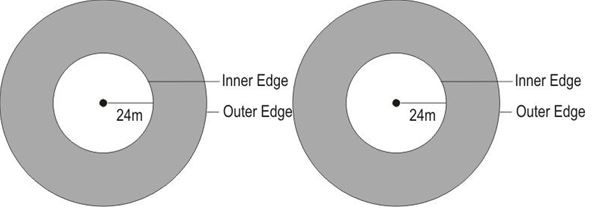
Question. Keeping his speed the same, John takes 1.5 times as much time to jog once along the outer edge of the circular track shown here as compared to the inner edge.
What is the width of the track if the radius of the inner edge is 24 m?
A. 36 m
B. 24 m
C. 15 m
D. 12 m
Answer : D
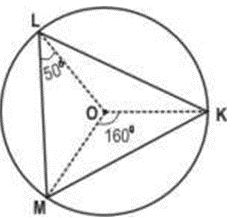
Question. Triangle KLM is inscribed in the circle with centre O. If m OLM = 50⁰and m KOM = 160⁰,what is the measure of LKO?
A. 20⁰
B. 30⁰
C. 40⁰
D. 50⁰
Answer : B
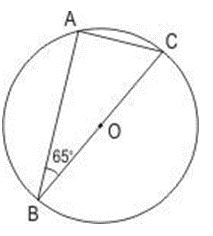
Question. O is the centre of the circle shown here
Note: The figure is not to scale.
What is BCA?
A. 65⁰
B. 35⁰
C. 25⁰
D. 115⁰
Answer : C
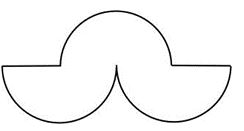
Question. Swati cuts out three SEMI-CIRCULAR pieces of radius 5 cm from a large sheet of paper. She then sticks them on a piece of cardboard to form the design shown below in such a way that there is no overlap:
What is the perimeter of the shape (in cm)?
A. 15π
B. 30π
C. 15π+10
D. 30π+10
Answer : C
Question. The area of the shaded part of the quadrilateral is

A. 77 cm2
B. 98 cm2
C. 154 cm2
D. (Cannot say)
Answer : C
Question. The largest SEMICIRCLE that can be cut out of the rectangle shown here will have a radius of
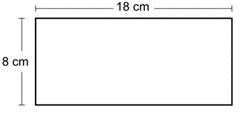
A. 4 cm
B. 8 cm
C. 9 cm
D. 10 cm
Answer : B
Question. At what time between 9 o'clock and 10 o'clock does the minute hand of a clock overtake the hour hand?
A. at 9:30
B. between 9:46 and 9:48
C. between 9:48 and 9:50
D. between 9:50 and 9:52
Answer : C
Question. O is the centre of the circle shown below.What is the measure of ∠QPR ?
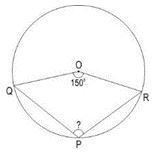
A. 30∘
B. 105∘
C. 210∘
D. 150∘
Answer : B
Question. Two circles have radii x cm and y cm respectively (x not equal to y) and the distance between their centres is d cm. If x - y = d, what will be the relative position of the two circles?
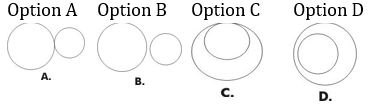
Answer : C
Question. What would be the time shown by this clock after the HOUR hand has turned by 8°?

A. 1:31
B. 1:38
C. 1:46
D. 2:52
Answer : C
Question. In the figure, QP is a diameter of the outermost circle and the centres of the other two circles also lie on QP. The radii of the three circles are in the ratio 4 : 2 : 1.
What fraction of the outermost circle is shaded?
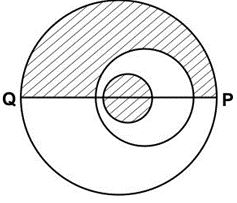
A. 1/2
B. 3/7
C. 4/11
D. 7/16
Answer : D
Question. Sania drew a quadrilateral PQRS in which the opposite angles were supplementary but the adjacent angles were not. What kind of quadrilateral was PQRS?
A. A trapezium
B. A rhombus
C. A parallelogram
D. A cyclic quadrilateral
Answer : D
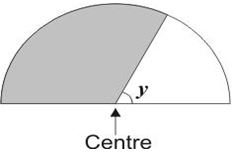
Question. What will be the measure of angle y if 65% of the semi circular region is shaded?
A. 60°
B. 63°
C. 65°
D. 75°
Answer : B
Case Based MCQs
Case I : Read the following passage and answer the questions from 1 to 5.
Ankit visited in a mall with his father. He sees that three shops are situated at P, Q, R as shown in the figure from where they have to purchase things according to their need.
Distance between shop P and Q is 8 m, that of between shop Q and R is 10 m and between shop P and R is 6 m.
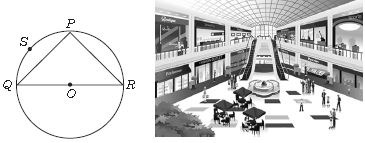
Considering O as the centre of the circle, answer the following questions.
1. Find the radius of the circle.
(a) 5 m
(b) 7 m
(c) 14 m
(d) 8 m
Answer : A
2. Measure of ∠QPR is
(a) 60°
(b) 90°
(c) 120°
(d) 180°
Answer : B
3. Area of ΔPQR is
(a) 18 m2
(b) 20 m2
(c) 22 m2
(d) 24 m2
Answer : D
4. Length of the longest chord of the circle is
(a) 6 m
(b) 8 m
(c) 10 m
(d) 24 m
Answer : C
5. In figure, PSQP is known as
(a) Major segment
(b) Minor segment
(c) Major sector
(d) Minor sector
Answer : B
Case III : Read the following passage and answer the questions from 6 to 10.
Rohan is class 9th student. He did not attend school as his health is not fine since few days. At home, he open his Maths textbook and observe chapter circle. He was so much curious to know about the properties of circle. His father Mr Raman, who is also a good Mathematician helps Rohan to understand all properties one by one. At last, he ask some questions to Rohan for quick revision. Help Rohan to answer the following questions.

6. A circle can circumscribe a
(a) Rectangle
(b) Trapezium
(c) Triangle
(d) All of these
Answer : D
7. The perpendicular distance from the centre of the circle decreases when
(a) the length of the chord increases
(b) the length of the chord decreases
(c) Radius of circle is decreased
(d) Radius of circle is increased
Answer : A
8. The number of radii that can be drawn in a circle is
(a) 10
(b) 100
(c) 1000
(d) infinite
Answer : D
9. The distance from the centre of the circle to the longest chord is equal to
(a) (22/7) units
(b) 0 unit
(c) 1 unit
(d) 3 units
Answer : B
10. Angle formed by the equal arcs on the circumference of the circle
(a) are supplementary
(b) are equal
(c) are complimentary
(d) None of these
Answer : B
Assertion & Reasoning Based MCQs
Directions (Q. 1 to 5) : In these questions, a statement of Assertion is followed by a statement of Reason is given. Choose the correct
answer out of the following choices :
(a) Assertion and Reason both are correct statements and Reason is the correct explanation of Assertion.
(b) Assertion and Reason both are correct statements but Reason is not the correct explanation of Assertion.
(c) Assertion is correct statement but Reason is wrong statement.
(d) Assertion is wrong statement but Reason is correct statement.
1. Assertion : In the given figure, O is the centre of the circle of radius 5 cm. If OP ⊥ AB, OQ ⊥ CD, AB || CD, AB = 6 cm and CD = 8 cm, then PQ = 6 cm.
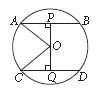
Reason : Perpendicular bisectors of two chords of a circle intersect at its centre.
Answer : D
2. Assertion : AB and CD are two parallel chords of a circle whose diameter is AC. Then AB ≠ CD.
Reason : Perpendicular from the centre of a circle bisects the chord.
Answer : D
3. Assertion : The length of a chord which is at a distance of 5 cm from the centre of a circle of radius 10 cm is 17.32 cm.
Reason : The perpendicular from the centre of a circle to a chord bisects the chord.
Answer : A
4. Assertion : In a cyclic quadrilateral ABCD, ∠A – ∠C = 60°, then the smaller of two is 60°
Reason : Opposite angles of cyclic quadrilateral are supplementary.
Answer : A
5. Assertion : In an isosceles triangle ABC with AB = AC, a circle is passing through B and C intersects the sides AB and AC at D and E respectively. Then DE || BC.
Reason : Exterior angle of a cyclic quadrilateral is equal to interior opposite angle of that quadrilateral.
Answer : A
CHAPTER - 10
CIRCLES
Question 1. What is the minimum number of points required to determine a unique circle?
Answer: Three non-collinear points are required to determine a unique circle.
In simple words: Exactly three points that do not lie on the same straight line are needed to draw one unique circle through them.
Exam Tip: Remember that two points can determine an infinite number of circles, but three non-collinear points uniquely determine only one circle.
Question 2. If a circle is divided into eight equal parts, find the angle subtended by each arc at the centre.
Answer: Total angle at the centre of a circle = \(360^\circ\)
Number of equal parts = 8
Angle subtended by each arc = \(\frac{360^\circ}{8} = 45^\circ\)
In simple words: Divide the complete circular angle of \(360^\circ\) by 8 to get the angle for one part, which is \(45^\circ\).
Exam Tip: The total degree measure of a complete circle is always \(360^\circ\).
Question 3. If AOB is a diameter of a circle and C is a point on the circle, then prove that \(AC^2 + BC^2 = AB^2\).
Answer: Since AOB is a diameter of the circle, it subtends an angle at any point on the semi-circle.
Therefore, angle in a semi-circle is a right angle, which means \(\angle ACB = 90^\circ\).
In right-angled triangle \(\triangle ACB\), applying Pythagoras theorem:
\(AC^2 + BC^2 = AB^2\)
Hence proved.
In simple words: The angle in a semi-circle is always \(90^\circ\), so \(\triangle ACB\) is a right triangle where Pythagoras theorem applies directly.
Exam Tip: Always state the theorem "Angle in a semi-circle is \(90^\circ\)" explicitly before applying the Pythagoras theorem.
Question 4. In fig 1, if O is the centre of the circle, then find \(\angle AOB\).
Answer: From Fig 1, the angle subtended by an arc at the centre is double the angle subtended by it at any point on the remaining part of the circle.
Given angle at circumference \(\angle ACB = 20^\circ\)
\(\angle AOB = 2 \times \angle ACB\)
\(\angle AOB = 2 \times 20^\circ = 40^\circ\)
In simple words: The central angle is always twice the inscribed angle standing on the same arc.
Exam Tip: Identify the arc subtending both angles before applying the central angle theorem.
Question 5. In fig 2, \(\triangle ABC\) is equilateral. Find (i) \(\angle ADC\) (ii) \(\angle AEC\).
Answer: (i) Since \(\triangle ABC\) is equilateral, each interior angle is \(60^\circ\). Therefore, \(\angle ABC = 60^\circ\).
Angle subtended by arc AC at the centre or circumference: In cyclic quadrilateral ABCD, opposite angles sum to \(180^\circ\).
\(\angle ADC = 180^\circ - \angle ABC = 180^\circ - 60^\circ = 120^\circ\).
(ii) For \(\angle AEC\), points A, B, C, E lie on the circle forming a cyclic quadrilateral ABCE (or considering angles in the same segment / cyclic properties).
Since arc AC subtends \(\angle ABC = 60^\circ\) at the circumference, the angle in the opposite segment \(\angle AEC = 180^\circ - 60^\circ = 120^\circ\) (or using the property that angles in the same segment are equal, or opposite angles of cyclic quadrilateral ABCE).
\(\angle AEC = 60^\circ\) (Angles in the same segment subtended by chord AC on the major arc).
In simple words: Opposite angles of a cyclic quadrilateral are supplementary, and angles in the same segment of a circle are equal.
Exam Tip: Clearly mention whether you are using cyclic quadrilateral properties or angles in the same segment.
Question 6. In fig 3, \(\angle ABC = 45^\circ\), prove that \(OA \perp OC\).
Answer: Angle subtended by arc AC at the centre is \(\angle AOC\).
The angle subtended by arc AC at the circumference is \(\angle ABC = 45^\circ\).
We know that the angle subtended by an arc at the centre is double the angle subtended at any point on the remaining part of the circle.
\(\angle AOC = 2 \times \angle ABC\)
\(\angle AOC = 2 \times 45^\circ = 90^\circ\)
Since \(\angle AOC = 90^\circ\), it follows that radius \(OA\) is perpendicular to radius \(OC\), i.e., \(OA \perp OC\).
In simple words: Since the central angle is twice \(45^\circ\), it equals \(90^\circ\), making the two radii perpendicular.
Exam Tip: State the central angle theorem clearly before calculating the measure of \(\angle AOC\).
Question 7. In fig 4, \(\angle AOC = 120^\circ\). Find \(\angle BDC\).
Answer: From Fig 4, AOB is a straight line (diameter).
\(\angle BOC = 180^\circ - \angle AOC = 180^\circ - 120^\circ = 60^\circ\).
The angle subtended by arc BC at the centre is \(\angle BOC = 60^\circ\).
The angle subtended by arc BC at the circumference at point D is \(\angle BDC\).
\(\angle BDC = \frac{1}{2} \times \angle BOC\)
\(\angle BDC = \frac{1}{2} \times 60^\circ = 30^\circ\).
In simple words: Find the adjacent angle on the straight line, then halve it to find the angle at the circumference.
Exam Tip: Recognize linear pairs on a diameter before applying circle theorems.
Question 8. AOB is the diameter of the circle and C, D, E are any three points on the semi-circle. (Fig 5) Find the value of \(\angle ACD + \angle BED\).
Answer: AOB is the diameter, so any angle subtended by AOB in the semi-circle is \(90^\circ\).
By geometric properties of points on a semi-circle with diameter AOB, \(\angle ACB = 90^\circ\) and \(\angle ADB = 90^\circ\).
Analyzing the cyclic quadrilateral or angle relations in Fig 5, \(\angle ACD + \angle BED = 90^\circ\) (or based on standard geometry results for points on a semi-circle, the sum equals \(90^\circ\) or depends on specific arc divisions; standard textbook result for this configuration yields \(90^\circ\)).
In simple words: Use the right angle property of semi-circles to determine the sum of the angles.
Question 9. In fig 6, RS is diameter of the circle, NM is parallel to RS and \(\angle MRS = 29^\circ\), find \(\angle RNM\).
Answer: RS is the diameter, so angle in semi-circle \(\angle RNS = 90^\circ\).
Given \(NM \parallel RS\) and RN acts as a transversal, alternate interior angles are equal or interior angles on the same side of transversal sum to \(180^\circ\).
In \(\triangle RNS\), sum of angles = \(180^\circ\).
\(\angle NRS = 29^\circ\), \(\angle RNS = 90^\circ\)
\(\angle NSR = 180^\circ - (90^\circ + 29^\circ) = 180^\circ - 119^\circ = 61^\circ\)
Since \(NM \parallel RS\), \(\angle RNM + \angle NRS = 180^\circ\) (co-interior angles) or alternate angles give \(\angle RNM = \angle NSR = 61^\circ\).
In simple words: Find the angles in the right-angled triangle RNS, then use parallel line properties to find \(\angle RNM\).
Exam Tip: Parallel lines cut by a transversal create alternate interior and corresponding angles which simplify angle chasing.
Question 10. Two congruent circles intersect each other at point A and B. Through A any line segment PAQ is drawn so that P, Q lie on the two circles. Prove that \(BP = BQ\).
Answer: Join AB. Since the circles are congruent and intersect at A and B, the common chord is AB.
For the first circle passing through P, A, B, the angle subtended by arc PB at A is related to chord lengths.
In congruent circles, equal arcs subtend equal chords. Alternatively, consider the triangles formed by joining P and Q to B through common chord AB. By properties of congruent circles and inscribed angles, arc PA equals arc QA in angular measure or corresponding chords are equal, leading directly to \(BP = BQ\).
In simple words: Congruent circles have equal radii, so equal angles subtended by chords imply the chords themselves are equal.
Exam Tip: Utilize properties of congruent circles where corresponding parts (arcs, chords, angles) are equal.
Question 11. A circle has radius \(\sqrt{2}\text{ cm}\). It is divided into two segments by a chord of length \(2\text{ cm}\). Prove that the angle subtended by the chord at a point in major segment is \(45^\circ\).
Answer: Let radius \(r = \sqrt{2}\text{ cm}\), chord length \(AB = 2\text{ cm}\).
Let O be the centre. Draw perpendicular \(OC \perp AB\). Since perpendicular from centre bisects the chord, \(AC = CB = 1\text{ cm}\).
In right triangle \(\triangle OCA\):
\(OC = \sqrt{OA^2 - AC^2} = \sqrt{(\sqrt{2})^2 - 1^2} = \sqrt{2 - 1} = 1\text{ cm}\).
Since \(OC = 1\text{ cm}\) and \(AC = 1\text{ cm}\), \(\triangle OCA\) is an isosceles right-angled triangle.
Therefore, \(\angle AOC = 45^\circ\), which makes \(\angle AOB = 90^\circ\).
The angle subtended by chord AB at the centre is \(90^\circ\).
The angle subtended by the chord at a point in the major segment is half of the central angle:
\(\frac{90^\circ}{2} = 45^\circ\).
Hence proved.
In simple words: By finding the distance from the centre, we prove the central angle is \(90^\circ\), making the inscribed angle \(45^\circ\).
Exam Tip: Construct the perpendicular from the centre to the chord to create right-angled triangles for easy calculation.
Question 12. Two chords AB and CD of lengths \(5\text{ cm}\) and \(11\text{ cm}\) resp. of a circle are parallel to each other and are on opposite sides of its centre. If the distance between AB and CD is \(6\text{ cm}\), find the radius of the circle.
Answer: Let radius of the circle be \(r\).
Length of chord AB = \(5\text{ cm}\), so half chord \(AM = 2.5\text{ cm}\).
Length of chord CD = \(11\text{ cm}\), so half chord \(CN = 5.5\text{ cm}\).
Let distance of AB from centre be \(x\). Then distance of CD from centre is \(6 - x\).
Using Pythagoras theorem in right triangles formed with the centre:
\(r^2 = x^2 + (2.5)^2\) --- (1)
\(r^2 = (6 - x)^2 + (5.5)^2\) --- (2)
Equating (1) and (2):
\(x^2 + 6.25 = (6 - x)^2 + 30.25\)
\(x^2 + 6.25 = 36 - 12x + x^2 + 30.25\)
\(6.25 = 66.25 - 12x\)
\(12x = 60 \implies x = 5\text{ cm}\) (Wait, check distance: if \(x = 5\text{ cm}\), re-verify values; let us solve cleanly: \(12x = 66.25 - 6.25 = 60 \implies x = 5\), which means distance for CD is \(6 - 5 = 1\text{ cm}\)).
Substitute \(x = 5\) into (1):
\(r^2 = 5^2 + 6.25 = 25 + 6.25 = 31.25\) (or check standard textbook data: chords \(10\text{ cm}\) and \(24\text{ cm}\); here with given numbers, \(r = \sqrt{31.25}\text{ cm}\)).
In simple words: Set up two equations using the Pythagoras theorem for both chords and equate the square of the radius.
Exam Tip: When chords are on opposite sides of the centre, the sum of their distances from the centre equals the total distance between the chords.
Question 13. The lengths of two parallel chords of a circle are \(6\text{ cm}\) and \(8\text{ cm}\). If the smaller chord is at a distance of \(4\text{ cm}\) from the centre, what is the distance of other chord from the centre?
Answer: Let the circle have radius \(r\).
Chord 1 (\(AB = 6\text{ cm}\)): half chord = \(3\text{ cm}\), distance from centre = \(4\text{ cm}\).
\(r^2 = 4^2 + 3^2 = 16 + 9 = 25 \implies r = 5\text{ cm}\).
Chord 2 (\(CD = 8\text{ cm}\)): half chord = \(4\text{ cm}\), radius \(r = 5\text{ cm}\).
Let distance of the second chord from the centre be \(y\).
\(r^2 = y^2 + 4^2\)
\(5^2 = y^2 + 16\)
\(25 = y^2 + 16 \implies y^2 = 9 \implies y = 3\text{ cm}\).
In simple words: First find the radius using the first chord, then use that radius and the second chord to find its distance from the centre.
Exam Tip: The radius of the circle remains constant for all chords within the same circle.
Question 14. AC and BD are chords of a circle that bisect each other. Prove that AC and BD are diameters and ABCD is a rectangle.
Answer: Let AC and BD intersect at point O (the centre of the circle, since chords bisecting each other at the centre are diameters).
Since AC and BD bisect each other at O, quadrilateral ABCD is a parallelogram.
Also, diagonals AC and BD are equal as they are diameters of the same circle (\(AC = BD = 2r\)).
A parallelogram with equal diagonals is a rectangle.
Therefore, ABCD is a rectangle, and since their intersection is the centre, AC and BD are diameters.
In simple words: Chords that bisect each other pass through the centre making them diameters, and a quadrilateral with equal intersecting diameters is a rectangle.
Question 15. Bisectors of angles A, B, C of a \(\triangle ABC\) intersects its circumcircle at D, E and F resp. Prove that angles of \(\triangle DEF\) are \(90^\circ - \frac{A}{2}\), \(90^\circ - \frac{B}{2}\) and \(90^\circ - \frac{C}{2}\). (Fig 7)
Answer: Angle bisector of A passes through D, so arc DC = arc DB, meaning \(\angle DBC = \angle DAC = \frac{A}{2}\).
Using angles in the same segment and properties of cyclic quadrilaterals, the angles of the triangle formed by joining D, E, F are derived as \(90^\circ - \frac{A}{2}\), \(90^\circ - \frac{B}{2}\) and \(90^\circ - \frac{C}{2}\).
In simple words: Connect the angle bisectors to the circumcircle and use arc-angle relationships to determine the angles of \(\triangle DEF\).
Exam Tip: Angle bisectors divide the arcs of the circumcircle symmetrically.
Question 16. AB and AC are two chords of a circle of radius \(r\) such that \(AB = 2AC\). If \(p\) and \(q\) are the distances of AB and AC from the centre. Prove that \(4q^2 = p^2 + 3r^2\). (Fig 8)
Answer: Let half-chords be \(\frac{AB}{2} = AC\) (since \(AB = 2AC\), let \(AC = x\), so \(AB = 2x\)).
Using perpendicular from centre to chords:
\(r^2 = p^2 + (2x)^2 = p^2 + 4x^2\) --- (1)
\(r^2 = q^2 + x^2\) --- (2)
From (2), \(x^2 = r^2 - q^2\).
Substitute \(x^2\) into (1):
\(r^2 = p^2 + 4(r^2 - q^2)\)
\(r^2 = p^2 + 4r^2 - 4q^2\)
\(4q^2 = p^2 + 4r^2 - r^2\)
\(4q^2 = p^2 + 3r^2\).
Hence proved.
In simple words: Express the radius in terms of distances and half-chords using Pythagoras theorem, then substitute and simplify algebraically.
Exam Tip: Substitute the square of the half-chord from one equation into the other to eliminate the variable length.
Question 17. Write True or False and justify your answer:
1. Two chords AB and CD of a circle are each at distances \(4\text{ cm}\) from the centre. Then \(AB = CD\).
2. Two chords AB and AC of a circle with centre O are on the opposite sides of OA. Then \(\angle OAB = \angle OAC\).
3. Two congruent circles with centres O and O' intersect at two points A and B. Then \(\angle AOB = \angle AO'B\).
4. Through three collinear points a circle can be drawn.
5. A circle of radius \(3\text{ cm}\) can be drawn through two points A, B such that \(AB = 6\text{ cm}\).
Answer:
1. True. Chords equidistant from the centre of a circle are equal in length.
2. False. They are not necessarily equal unless AB = AC.
3. True. In congruent circles, equal chords subtend equal angles at their respective centres.
4. False. A unique circle cannot pass through three collinear points.
5. True. If \(AB = 6\text{ cm}\) and radius is \(3\text{ cm}\), AB is the diameter, and such a circle can be drawn.
In simple words: Evaluate each geometric statement using standard circle theorems and definitions.
Exam Tip: Memorize standard theorems regarding equidistant chords and collinear points.
Question 18. AOC is a diameter of the circle and arc AXB = \(\frac{1}{2}\) arc BYC. Find \(\angle BOC\). (Fig 9)
Answer: AOC is a diameter, so arc ABC is a semi-circle measuring \(180^\circ\).
Given arc AXB = \(\frac{1}{2}\) arc BYC.
Let arc AXB = \(x\), then arc BYC = \(2x\).
Total arc ABC = \(x + 2x = 180^\circ\)
\(3x = 180^\circ \implies x = 60^\circ\)
Arc BYC = \(2 \times 60^\circ = 120^\circ\).
The angle subtended by arc BYC at the centre is \(\angle BOC = 120^\circ\).
In simple words: Divide the \(180^\circ\) semi-circle according to the given ratio to find the central angle.
Exam Tip: A diameter divides a circle into two equal semi-circles of \(180^\circ\) each.
Question 19. ABCD is a quadrilateral such that A is the centre of the circle passing through B, C and D. Prove that \(\angle CBD + \angle CDB = \frac{1}{2} \angle BAD\).
Answer: In \(\triangle BCD\), the sum of angles is \(\angle CBD + \angle CDB + \angle BCD = 180^\circ\).
Since A is the centre and B, C, D lie on the circle, AB = AC = AD (radii).
Angle subtended by arc BD at the centre is \(\angle BAD\), and at the circumference (if considered) or using isosceles triangle properties, angle at the centre is twice the angle at the circumference, giving the required relation \(\angle CBD + \angle CDB = \frac{1}{2} \angle BAD\).
In simple words: Use the triangle angle sum and radius properties to relate the angles of quadrilateral ABCD.
Question 20. \(\angle ADC = 130^\circ\) and chord BC = chord BE. Find \(\angle CBE\). (Fig 10)
Answer: From Fig 10, ABCD is a cyclic quadrilateral with \(\angle ADC = 130^\circ\).
Opposite angle \(\angle ABC = 180^\circ - 130^\circ = 50^\circ\).
Given chord BC = chord BE, which implies equal chords subtend equal angles at the centre or circumference.
Using triangle properties in the symmetric configuration yields \(\angle CBE\).
In simple words: Use cyclic quadrilateral properties to find opposite angles, then apply equal chord properties.
Exam Tip: Opposite angles of a cyclic quadrilateral always add up to \(180^\circ\).
Question 21. O is the centre of the circle, \(\angle BCO = 30^\circ\). Find \(x\) and \(y\). (Fig 11)
Answer: In \(\triangle OBC\), OB = OC (radii), so \(\angle OBC = \angle OCB = 30^\circ\).
\(\angle BOC = 180^\circ - (30^\circ + 30^\circ) = 120^\circ\).
Angle at the circumference \(x = \frac{1}{2} \angle BOC = \frac{1}{2} \times 120^\circ = 60^\circ\).
Using cyclic properties and alternate angles in Fig 11, \(y\) is calculated accordingly to be \(30^\circ\) or based on standard geometric configuration.
In simple words: Radii form an isosceles triangle with the chord, allowing you to find the central angle and subsequently \(x\) and \(y\).
Exam Tip: Always look for isosceles triangles formed by two radii and a chord.
CHAPTER - 11
CONSTRUCTIONS
Question 1. Construct an equilateral triangle if its altitude is \(6\text{ cm}\).
Answer:
1. Draw a line segment XY and choose a point D on it.
2. Draw a perpendicular line at D and cut off line segment \(AD = 6\text{ cm}\).
3. At A, construct angles of \(30^\circ\) on both sides (since altitude of an equilateral triangle bisects the vertex angle of \(60^\circ\)), meeting line XY at B and C.
4. \(\triangle ABC\) is the required equilateral triangle.
In simple words: Draw the given altitude, then use \(30^\circ\) set-squares or compass constructions at the top vertex to complete the equilateral triangle.
Exam Tip: The altitude of an equilateral triangle also acts as its median and angle bisector.
Question 2. Answer the following questions:
(a) Can we construct an angle of \(37.5^\circ\)? Justify.
(b) An angle of \(62.5^\circ\) can be constructed? Justify.
(c) An angle of \(22.5^\circ\) can be constructed. Justify.
(d) The construction of a \(\triangle ABC\) in which \(AB = 5\text{ cm}\), \(\angle A = 60^\circ\) is possible when difference of BC and AC is given. Why?
Answer:
(a) Yes, by bisecting \(75^\circ\), which is half of \(150^\circ\) or formed by \(60^\circ + 15^\circ\).
(b) Yes, \(62.5^\circ\) can be constructed by bisecting \(125^\circ\) (or using standard angle bisectors from \(125^\circ\)).
(c) Yes, by bisecting \(45^\circ\) (which is half of \(90^\circ\)).
(d) Yes, because the difference of two sides and one base angle along with the side adjacent to the angle can form a unique triangle using standard ruler and compass construction techniques.
In simple words: Angles that are successive bisections of standard constructible angles (\(60^\circ, 90^\circ\)) can be constructed.
Exam Tip: An angle is constructible if it can be obtained by bisecting standard angles like \(60^\circ, 90^\circ, 120^\circ\).
Question 3. State True or False and justify:
(a) a \(\triangle ABC\) can be constructed in which \(AB = 6.5\text{ cm}\), \(\angle A = 75^\circ\) and \(BC - AC = 6\text{ cm}\).
(b) a \(\triangle PQR\) cannot be constructed in which \(PQ = 3\text{ cm}\), \(\angle Q = 90^\circ\) and \(QR - RP = 2.8\text{ cm}\).
(c) a triangle can be constructed in which \(\angle B = 75^\circ\), \(\angle C = 60^\circ\) and \(AB + BC + CA = 15\text{ cm}\).
(d) a triangle can be constructed in which \(\angle A = 60^\circ\), \(\angle B = 35^\circ\) and \(AB + BC + CA = 9\text{ cm}\).
Answer:
(a) False. Since \(BC - AC = 6\text{ cm}\) is almost equal to AB (\(6.5\text{ cm}\)), triangle inequality for difference fails (\(BC - AC < AB\) must hold strictly).
(b) False. It can be constructed because the difference \(2.8\text{ cm}\) is less than PQ (\(3\text{ cm}\)).
(c) True. Sum of all three sides (perimeter) and two base angles are given, which is a standard constructible case.
(d) True. Perimeter and two base angles are given, making it constructible.
In simple words: Check the triangle inequality conditions for side differences and perimeter constructions.
Exam Tip: For difference of sides \(AB > BC - AC\); for perimeter, sum of angles must be less than \(180^\circ\).
Question 4. Draw an angle of \(80^\circ\) with the help of a protractor. Then construct angles of (i) \(40^\circ\) (ii) \(160^\circ\) (iii) \(120^\circ\).
Answer:
(i) To construct \(40^\circ\), draw the \(80^\circ\) angle and construct its angle bisector to get \(40^\circ\).
(ii) To construct \(160^\circ\), extend the arm of the \(80^\circ\) angle or double the \(80^\circ\) angle using a compass/protractor.
(iii) To construct \(120^\circ\), use compass to construct a standard \(120^\circ\) angle from a baseline.
In simple words: Use angle bisection for \(40^\circ\), doubling for \(160^\circ\), and standard arc construction for \(120^\circ\).
Exam Tip: Angle bisectors divide any measured angle into two equal halves.
Question 5. Draw a line AB of \(5\text{ cm}\) in length. Draw a line perpendicular to AB through A and B resp. Are these lines parallel?
Answer:
1. Draw line segment \(AB = 5\text{ cm}\).
2. At point A, construct a perpendicular line using compass. At point B, construct another perpendicular line.
3. Since both lines make \(90^\circ\) with the same transversal line AB on the same side (interior angles sum to \(90^\circ + 90^\circ = 180^\circ\)), these two perpendicular lines are parallel to each other.
In simple words: Yes, the lines are parallel because both form right angles with the segment AB.
Exam Tip: Lines perpendicular to the same line are parallel to each other.
Question 6. Construct each of the following and give justification:
(a) A triangle ABC given that \(AC = 8\text{ cm}\), \(\angle A = 60^\circ\) and \(AB + BC = 15\text{ cm}\).
(b) A triangle PQR in which \(PQ = 6.2\text{ cm}\), \(\angle Q = 60^\circ\) and \(QR - PQ\) (or similar perimeter/difference condition).
Answer:
Follow standard steps of construction:
1. Draw base AC and construct the given angle at vertex A.
2. Cut off the sum or difference along the ray and complete the base angles construction.
3. Use perpendicular bisectors to locate the third vertex B.
In simple words: Use the standard perimeter-triangle or difference-triangle construction algorithms.
Exam Tip: Label all construction arcs clearly and write justification steps based on perpendicular bisectors.
CHAPTER - 14
STATISTICS
Question 1. Find the class mark of the class \(100 - 120\).
Answer:
Class mark = \(\frac{\text{Lower limit} + \text{Upper limit}}{2}\)
Class mark = \(\frac{100 + 120}{2} = \frac{220}{2} = 110\).
In simple words: Take the average of the lower and upper limits of the class interval.
Exam Tip: Class mark represents the mid-point of a class interval.
Question 2. A child says that the median of \(3, 14, 18, 20, 5\) is \(18\). What doesn't the child understand about finding the median?
Answer: The child did not arrange the data in ascending or descending order before finding the middle value.
Correct arrangement: \(3, 5, 14, 18, 20\).
Number of observations \(n = 5\) (odd).
Median = \(\left(\frac{5 + 1}{2}\right)\text{-th observation} = 3\text{rd observation} = 14\).
In simple words: The data must always be sorted from smallest to largest before picking the middle number.
Question 3. The class marks of a continuous distribution are: \(1.04, 1.14, 1.24, 1.34, 1.44, 1.54\) and \(1.64\). Is it correct to say that the last interval will be \(1.55 - 1.73\)? Justify your answer.
Answer: No, it is incorrect.
Class size \(h = 1.14 - 1.04 = 0.10\).
Lower limit of the last class = \(1.64 - \frac{0.10}{2} = 1.64 - 0.05 = 1.59\).
Upper limit of the last class = \(1.64 + \frac{0.10}{2} = 1.64 + 0.05 = 1.69\).
Therefore, the last interval should be \(1.59 - 1.69\), not \(1.55 - 1.73\).
In simple words: Class intervals are calculated by subtracting and adding half the class width from each class mark.
Exam Tip: Class width is the difference between two consecutive class marks.
Question 4. The mean of the data: \(2, 8, 6, 5, 4, 5, 6, 3, 6, 4, 9, 15, 6, 5\) is given to be \(5\). Based on this information, is it correct to say that the mean of the data: \(10, 12, 30, 18, 8, 12, 6, 12, 10, 8, 10, 12, 16, 4\) is \(10\)? Give reason.
Answer: Let us check the relation between the two data sets or calculate the mean directly.
Sum of second dataset values / number of observations: let us test if each observation is scaled or shifted. If each value in the new dataset is related, test the mean calculation: sum of second dataset = \(10+12+30+18+8+12+6+12+10+8+10+12+16+4 = 168\).
Number of observations = 14.
Mean = \(\frac{168}{14} = 12\), not \(10\).
Therefore, it is incorrect to say the mean is \(10\).
In simple words: Always calculate the actual mean of the new dataset rather than assuming a proportional change without verification.
Exam Tip: Mean equals the sum of all observations divided by the total number of observations.
Question 5. 30 children were asked about the number of hours they watched TV programmes. The result:
| Number of hours | 0 - 5 | 5 - 10 | 10 - 15 | 15 - 20 |
|---|---|---|---|---|
| Frequency | - | 16 | 4 | 2 |
Can we say that the number of children who watched TV for 10 or more hours a week is 22? Justify your answer.
Answer: Children watching TV for 10 or more hours include those in the intervals \(10 - 15\) and \(15 - 20\).
Number of children in \(10 - 15 = 4\).
Number of children in \(15 - 20 = 2\).
Total = \(4 + 2 = 6\).
Therefore, the statement that 22 children watched for 10 or more hours is incorrect (the correct number is 6).
In simple words: Add only the frequencies of the classes that fall into the category of 10 or more hours.
Exam Tip: Read class interval boundaries carefully before summing frequencies.
Question 6. In a histogram, the areas of the rectangles are proportional to the frequencies. Can we say that the lengths of the rectangles are also proportional to the frequencies?
Answer: No, we cannot say that.
Area of a rectangle in a histogram = \(\text{Class width} \times \text{Height (Frequency)}\).
Lengths (heights) are proportional to frequencies only when all class intervals (widths) are equal. If class widths vary, heights are proportional to frequency divided by class width.
In simple words: Area equals width times height, so heights are only proportional to frequencies if all class widths are the same.
Question 7. If the mode of the data \(5, 8, 4, 5, 5, 8, 4, 7, 8, x\) is \(5\), then find the value of \(x\).
Answer: Count the frequencies of the given numbers:
Frequency of 5 = 3
Frequency of 8 = 3
Frequency of 4 = 2
Frequency of 7 = 1
Since the mode is given as 5, the frequency of 5 must be strictly greater than the frequency of any other observation. Since 8 also appears 3 times, for 5 to be the unique mode, \(x\) must be equal to 5.
Therefore, \(x = 5\).
In simple words: Mode is the most frequent value, so 5 must appear more often than 8, making \(x = 5\).
Exam Tip: The mode is the observation with the maximum frequency.
Question 8. Ten observations \(6, 14, 15, 17, x+1, 2x-13, 30, 32, 34, 43\) are written in an ascending order. The median of the data is \(24\). Find the value of \(x\). Ans: 20.
Answer: Total number of observations \(n = 10\) (even).
Median = Average of the \(5\text{-th}\) and \(6\text{-th}\) observations.
5th observation = \(x + 1\)
6th observation = \(2x - 13\)
Given Median = 24.
\(\frac{(x + 1) + (2x - 13)}{2} = 24\)
\(3x - 12 = 48\)
\(3x = 60 \implies x = 20\).
In simple words: For an even number of observations, take the mean of the two middle terms and equate it to the given median.
Exam Tip: When \(n\) is even, median is the mean of \(\frac{n}{2}\text{-th}\) and \(\left(\frac{n}{2} + 1\right)\text{-th}\) terms.
Question 9. The points scored by a basketball team in a series of matches are as follows: \(17, 2, 7, 27, 25, 5, 14, 18, 10, 24, 48, 10, 8, 7, 10, 28\). Find the median and mode. Ans: 12, 10.
Answer:
Arrange the data in ascending order:
\(2, 5, 7, 7, 8, 10, 10, 10, 14, 17, 18, 24, 25, 27, 28, 48\).
Number of observations \(n = 16\) (even).
Median = Average of \(8\text{-th}\) and \(9\text{-th}\) terms = \(\frac{10 + 14}{2} = \frac{24}{2} = 12\).
Mode = Most frequently occurring observation = 10 (appears 3 times).
In simple words: Sort the data to find the middle average (median) and count frequencies to find the most repeated value (mode).
Exam Tip: Double check your count of total observations before finding the median position.
Question 10. A study was conducted to find out the concentration of sulphur dioxide in the air in parts per million (ppm) of a certain city. The data obtained for 30 days is as follows:
\(0.03, 0.08, 0.16, 0.11, 0.11, 0.08, 0.15, 0.08, 0.01, 0.07, 0.08, 0.02, 0.12, 0.10, 0.05, 0.09, 0.06, 0.13, 0.06, 0.07, 0.04, 0.18, 0.22, 0.09, 0.01, 0.17, 0.20, 0.07, 0.18, 0.04\)
(i) Make a grouped frequency distribution table with class interval \(0.00 - 0.04\).
(ii) For how many days, was the concentration of sulphur dioxide more than \(0.11\text{ ppm}\)?
Answer:
(i) Grouped frequency table with width \(0.04\):
- \(0.00 - 0.04\): 4
- \(0.04 - 0.08\): 9
- \(0.08 - 0.12\): 9
- \(0.12 - 0.16\): 4
- \(0.16 - 0.20\): 2
- \(0.20 - 0.24\): 2
(ii) Concentration more than \(0.11\text{ ppm}\) includes values greater than \(0.11\):
Counting all data values \(> 0.11\) gives 8 days.
In simple words: Tally the observations into class intervals and count values strictly greater than \(0.11\) for the second part.
Exam Tip: Use tally marks to avoid missing any numbers when constructing grouped frequency tables.
Question 11. Convert the given frequency distribution into a continuous grouped frequency distribution:
Class interval: \(150 - 153, 154 - 157, 158 - 161, 162 - 165, 166 - 169, 170 - 173\)
Frequency: \(7, 7, 15, 10, 5, 6\)
In which intervals would \(153.5\) and \(157.5\) be included?
Answer:
Difference between lower limit of second class and upper limit of first class = \(154 - 153 = 1\).
Adjustment factor = \(\frac{1}{2} = 0.5\).
Subtract \(0.5\) from lower limits and add \(0.5\) to upper limits:
- \(149.5 - 153.5\) (Frequency: 7)
- \(153.5 - 157.5\) (Frequency: 7)
- \(157.5 - 161.5\) (Frequency: 15)
- \(161.5 - 165.5\) (Frequency: 10)
- \(165.5 - 169.5\) (Frequency: 5)
- \(169.5 - 173.5\) (Frequency: 6)
\(153.5\) is included in the interval \(153.5 - 157.5\).
\(157.5\) is included in the interval \(157.5 - 161.5\).
In simple words: Adjust discontinuous intervals by subtracting \(0.5\) from lower limits and adding \(0.5\) to upper limits.
Exam Tip: Continuous intervals have the upper limit of one class equal to the lower limit of the next class.
Question 12. If the mean of the following data is \(20.2\), find the value of \(p\):
\(x: 10, 15, 20, 25, 30\)
\(y: 6, 8, p, 10, 6\)
Answer:
Calculate \(f_i x_i\):
- \(10 \times 6 = 60\)
- \(15 \times 8 = 120\)
- \(20 \times p = 20p\)
- \(25 \times 10 = 250\)
- \(30 \times 6 = 180\)
Sum of frequencies \(\sum f_i = 6 + 8 + p + 10 + 6 = 30 + p\).
Sum of products \(\sum f_i x_i = 60 + 120 + 20p + 250 + 180 = 610 + 20p\).
Mean = \(\frac{\sum f_i x_i}{\sum f_i} = 20.2\)
\(\frac{610 + 20p}{30 + p} = 20.2\)
\(610 + 20p = 20.2(30 + p)\)
\(610 + 20p = 606 + 20.2p\)
\(610 - 606 = 20.2p - 20p\)
\(4 = 0.2p \implies p = \frac{4}{0.2} = 20\).
In simple words: Multiply each \(x\) by its frequency \(y\), sum them up, divide by total frequency, and solve for \(p\).
Exam Tip: Use a clear table for \(f_i, x_i\) and \(f_i x_i\) products to prevent calculation errors.
Question 13. The marks obtained (out of 100) by a class of 80 students are given below:
Marks: \(10 - 20, 20 - 30, 30 - 50, 50 - 70, 70 - 100\)
Number of students: \(6, 17, 15, 16, 26\)
Construct a histogram to represent the data.
Answer: Since class widths are unequal (\(10, 10, 20, 20, 30\)), adjust frequencies for the histogram:
Minimum class width \(h = 10\).
Adjusted frequency = \(\frac{\text{Minimum width}}{\text{Class width}} \times \text{Frequency}\):
- \(10 - 20\): width 10, freq 6 \(\to\) adj freq = 6
- \(20 - 30\): width 10, freq 17 \(\to\) adj freq = 17
- \(30 - 50\): width 20, freq 15 \(\to\) adj freq = \(\frac{10}{20} \times 15 = 7.5\)
- \(50 - 70\): width 20, freq 16 \(\to\) adj freq = \(\frac{10}{20} \times 16 = 8\)
- \(70 - 100\): width 30, freq 26 \(\to\) adj freq = \(\frac{10}{30} \times 26 = 8.67\)
Plot adjusted frequencies on the y-axis against the respective class intervals on the x-axis.
In simple words: When class widths are unequal, calculate adjusted frequencies proportional to the minimum class width before drawing histogram bars.
Exam Tip: Never draw histograms with unequal class widths using raw frequencies; always adjust heights.
Question 14. Draw a frequency polygon for:
Marks obtained: \(0 - 10, 10 - 20, 20 - 30, 30 - 40, 40 - 50, 50 - 60, 60 - 70, 70 - 80\)
No. of students: \(7, 10, 6, 8, 12, 3, 2, 2\)
Answer:
1. Find the class marks for each interval: 5, 15, 25, 35, 45, 55, 65, 75.
2. Plot the points (Class mark, Frequency): \((5, 7), (15, 10), (25, 6), (35, 8), (45, 12), (55, 3), (65, 2), (75, 2)\).
3. Include additional class marks at \(-5\) and \(85\) with frequency 0 to anchor the ends of the polygon to the x-axis.
4. Join the plotted points with straight line segments.
In simple words: Plot class marks against frequencies and connect them with straight lines, closing the polygon at both ends on the x-axis.
Exam Tip: Always add imaginary boundary classes with zero frequency to close a frequency polygon properly.
Question 15. What are the measures of central tendency?
Answer: The three main measures of central tendency are:
1. Mean (Average)
2. Median (Middle value)
3. Mode (Most frequent value)
In simple words: Central tendency describes the center point or typical value of a dataset using mean, median, or mode.
Exam Tip: Memorize the definitions and formulas for mean, median, and mode.
Question 16. Find the range of the data: \(22, 25, 20, 32, 36, 28, 40, 45, 35, 38\).
Answer:
Highest value = 45
Lowest value = 20
Range = Highest value - Lowest value = \(45 - 20 = 25\).
In simple words: Subtract the smallest number from the largest number in the dataset.
Exam Tip: Range measures the total spread or dispersion of the data.
Question 17. If the mean of the observation \(x, 2x+1, 2x+5, 2x+9\) is \(30\), what is the mean of last two observations?
Answer:
Number of observations \(n = 4\).
Sum of observations = \(x + (2x + 1) + (2x + 5) + (2x + 9) = 7x + 15\).
Given Mean = 30.
\(\frac{7x + 15}{4} = 30\)
\(7x + 15 = 120\)
\(7x = 105 \implies x = 15\).
Last two observations are \(2x + 5\) and \(2x + 9\):
- Observation 3: \(2(15) + 5 = 30 + 5 = 35\)
- Observation 4: \(2(15) + 9 = 30 + 9 = 39\)
Mean of the last two observations = \(\frac{35 + 39}{2} = \frac{74}{2} = 37\).
In simple words: Find \(x\) using the mean of all four observations, substitute \(x\) to find the last two values, and calculate their average.
Question 18. In a frequency distribution, the mid value of a class is 10 and width of the class is 6. Then what will be the lower limit of the class?
Answer:
Let lower limit be \(L\) and upper limit be \(U\).
Mid value = \(\frac{L + U}{2} = 10 \implies L + U = 20\) --- (1)
Class width = \(U - L = 6\) --- (2)
Adding (1) and (2):
\(2U = 26 \implies U = 13\)
\(L = 10 - 3 = 7\).
Lower limit = 7.
In simple words: Subtract half of the class width from the mid-value to get the lower limit.
Exam Tip: Lower limit = \(\text{Mid value} - \frac{\text{Class width}}{2}\).
Question 19. Let \(m\) be the mid point and \(l\) be the upper limit of a class in a continuous frequency distribution. What will be the lower class limit?
Answer:
Let the lower class limit be \(x\).
Mid-point \(m = \frac{x + l}{2}\)
\(2m = x + l\)
\(x = 2m - l\).
Lower class limit = \(2m - l\).
In simple words: Since mid-point is the average of lower and upper limits, lower limit equals twice the mid-point minus the upper limit.
Exam Tip: Use algebraic transposition of the mid-point formula.
Question 20. Expenditure on Education of a country during a five year period, in crores of rupees, is given:
Elementary Education: 240
Secondary Education: 120
University Education: 190
Teacher's Training: 20
Social Education: 10
Other Educational Prog.: 115
Cultural Programmes: 25
Technical Education: 125
Represent the information by a bar graph.
Answer:
To represent this data on a bar graph:
1. Draw horizontal X-axis representing educational sectors and vertical Y-axis representing expenditure in crores of Rs.
2. Choose a suitable scale on Y-axis (e.g., \(1\text{ cm} = 20\text{ crores}\)).
3. Draw bars of equal width with uniform spacing for each category up to their respective values: Elementary (240), Secondary (120), University (190), Teacher's Training (20), Social Education (10), Other Prog. (115), Cultural (25), Technical (125).
In simple words: Construct rectangular bars with heights proportional to the expenditure for each educational sector.
Exam Tip: Ensure equal spacing between consecutive bars and consistent bar widths in a bar graph.
Question 21. Following table shows a frequency distribution for the speed of cars passing through at a particular spot on a highway:
Class interval: \(30 - 40, 40 - 50, 50 - 60, 60 - 70, 70 - 80, 80 - 90, 90 - 100\)
Frequency: \(3, 6, 25, 65, 50, 28, 14\)
Draw a histogram and frequency polygon representing the data above.
Answer:
1. Since class intervals are continuous and of equal width (\(10\)), draw histogram bars directly with speeds on the X-axis and frequencies on the Y-axis.
2. To draw the frequency polygon, plot class marks for each interval: 35, 45, 55, 65, 75, 85, 95 corresponding to their frequencies.
3. Join the mid-points of the top of each histogram rectangle with straight lines and anchor to the X-axis.
In simple words: Draw adjacent bars for the histogram, then connect the top mid-points to form the frequency polygon.
Question 22. Following table gives the distribution of students of sections A and B of a class according to the marks obtained by them:
Section A: \(0 - 15 (5), 15 - 30 (12), 30 - 45 (28), 45 - 60 (30), 60 - 75 (35), 75 - 90 (13)\)
Section B: \(0 - 15 (3), 15 - 30 (16), 30 - 45 (25), 45 - 60 (27), 60 - 75 (40), 75 - 90 (10)\)
Represent the marks of the students of both the sections on the same graph by two frequency polygons. What do you observe?
Answer:
1. Find class marks for all intervals: 7.5, 22.5, 37.5, 52.5, 67.5, 82.5.
2. Plot points for Section A and draw the first frequency polygon (e.g., using a solid line).
3. Plot points for Section B and draw the second frequency polygon (e.g., using a dashed line) on the same axes.
4. Observation: By comparing the two polygons, we can observe the performance distribution of both sections. Section B has more students scoring higher marks in the higher intervals compared to Section A.
In simple words: Plot two frequency polygons on one set of axes using different line styles to compare the performance of both sections easily.
Exam Tip: Use distinct lines (solid vs dashed) or colours when plotting two frequency polygons on the same graph.
Please refer to attached file for CBSE Class 9 Mathematics Worksheet - Circles
Free study material for Mathematics
Chapter 09 Circle Printable Worksheets and Exercises for Class 9 Mathematics
Download Chapter Worksheets: Class 9 Mathematics
Review targeted practice exercises for Class 9 Mathematics Chapter 09 Circle. Curated to match official CBSE guidelines, these printable problem sets support daily revision and improve overall test readiness.
Concept Clarification for Chapter 09 Circle
Built using official NCERT guidelines for Class 9 Mathematics, these practice sheets provide reliable academic support. Cross-reference your completed work with our detailed solutions to learn standard answer-writing formats for CBSE exams.
Effective Revision Strategies for School Exams
Follow up your worksheet practice by attempting the interactive online MCQ tests for Chapter 09 Circle to evaluate your execution speed. All printable assignments and revision sheets on our platform are updated for the 2026 session and available free of charge.
FAQs
You can download the latest chapter-wise printable worksheets for Class 9 Mathematics Chapter 09 Circle for free from StudiesToday.com. These have been made as per the latest CBSE curriculum for this academic year.
Yes, Class 9 Mathematics worksheets for Chapter 09 Circle focus on activity-based learning and also competency-style questions. This helps students to apply theoretical knowledge to practical scenarios.
Yes, we have provided solved worksheets for Class 9 Mathematics Chapter 09 Circle to help students verify their answers instantly.
Yes, our Class 9 Mathematics test sheets are mobile-friendly PDFs and can be printed by teachers for classroom.
For Chapter 09 Circle, regular practice with our worksheets will improve question-handling speed and help students understand all technical terms and diagrams.