

Chapter-wise Worksheets for Class 9 Mathematics: Chapter 03 Coordinate Geometry
Review targeted academic worksheets with the CBSE Class 9 Mathematics Coordinate Geometry Worksheet. Built according to official educational standards for the 2026-27 term, these downloadable Class 9 Mathematics resources support effective daily practice and detailed self-evaluation for Chapter 03 Coordinate Geometry.
Practice Class 9 Mathematics Worksheets: Chapter 03 Coordinate Geometry
View or download the dedicated CBSE Class 9 Mathematics Coordinate Geometry Worksheet resource below. Engaging with these practice papers under focused study conditions ensures continuous academic progress and mastery of the 2026-27 curriculum for Chapter 03 Coordinate Geometry.
Key concepts
Coordinate Geometry : The branch of mathematics in which geometric problems are solved through algebra by using the coordinate system is known as coordinate geometry.
Coordinate System
Coordinate axes: The position of a point in a plane is determined with reference to two fixed mutually perpendicular lines, called the coordinate axes. In this system, position of a point is described by ordered pair of two numbers.
Ordered pair : A pair of numbers a and b listed in a specific order with 'a' at the first place and 'b' at the second place is called an ordered pair (a,b)
1. In which quadrant or on which axes do each point lies
a) The ordinate is 3 and abscissa is – 4
b) The abscissa is – 2 and ordinate is – 3
c) (- 3, 2)
d) (0, - 4)
e) (5, 0)
2. Given point P (3, 4). What is the distance of point P from (a) x axis (b) y axis?
3. Plot the points A (4, 0), B (4, 4) and C (0, 4) on the graph. Join OA, AB, BC, and CO. Name the figure so formed and measure its sides
4. How many axis and quadrants are there in a Cartesian plane?
5. Plot the points on a graph paper:
(a) (3, 4) (b) (-2, 3) (c) (-1,-2) (d) (5,-1)
6. Check wheat her the points (1, 5), (0, 3) lie on the line y = 3 + 2x or not
7. Find the area of the triangle whose vertices are (0, 4), (0, 0) and (2, 0) by plotting them on graph
8. Find the equation of a line parallel to x – axis at a distance of 2 units below x - axis
9. Find the coordinates of the point
(a) Which lies on x and y axis both
(b) Whose ordinate is – 4 and which lies on y axis
(c) Whose abscissa is 5 and which lies on x – axis
10. Write the coordinates of a point left of y – axis and on y – axis at a distance of 6 units
11. Draw the graph of the equation y = 3x
ASSERTION REASONING QUESTIONS
DIRECTION : In the following questions, a statement of assertion (A) is followed by a statement of reason (R).
Mark the correct choice as:
(a) Both assertion (A) and reason (R) are true and reason (R) is the correct explanation of assertion (A) .
(b) Both assertion (A) and reason (R) are true but reason (R) is not the correct explanation of assertion (A) .
(c) Assertion (A) is true but reason (R) is false.
(d) Assertion (A) is false but reason (R) is true.
Question. Assertion: The abscissa of a point (5, 2) is 5.
Reason: The perpendicular distance of a point from y-axis is called its abscissa.
(a) Both assertion (A) and reason (R) are true and reason (R) is the correct explanation of assertion (A) .
(b) Both assertion (A) and reason (R) are true but reason (R) is not the correct explanation of assertion (A) .
(c) Assertion (A) is true but reason (R) is false.
(d) Assertion (A) is false but reason (R) is true
Answer : We know that the perpendicular distance of a point from y-axis is called its x-coordinate or abscissa.
So, Reason is correct.
The x co-ordinate of the point (5, 2) is 5.
So, Assertion is also correct
Correct option is (a) Both assertion (A) and reason (R) are true and reason (R) is the correct explanation of assertion (A) .
Question. Assertion : The point (0, 4) lies on y -axis.
Reason : The x co-ordinate on the point on y -axis is zero.
(a) Both assertion (A) and reason (R) are true and reason (R) is the correct explanation of assertion (A) .
(b) Both assertion (A) and reason (R) are true but reason (R) is not the correct explanation of assertion (A) .
(c) Assertion (A) is true but reason (R) is false.
(d) Assertion (A) is false but reason (R) is true.
Answer : We know that the if the point lies on y-axis, its x-coordinate is 0.
So, Reason is correct.
The x co-ordinate of the point (0, 4) is zero.
So, Point (0, 4) lies on y -axis.
So, Assertion is also correct
Correct option is (a) Both assertion (A) and reason (R) are true and reason (R) is the correct explanation of assertion (A) .
Question. Assertion : The point (-2, 0) lies on y -axis and (0, 4) on x -axis.
Reason : Every point on the x -axis has zero distance from x -axis and every point on the y -axis has zero distance from y -axis.
(a) Both assertion (A) and reason (R) are true and reason
(R) is the correct explanation of assertion (A) .
(b) Both assertion (A) and reason (R) are true but reason
(R) is not the correct explanation of assertion (A) .
(c) Assertion (A) is true but reason (R) is false.
(d) Assertion (A) is false but reason (R) is true.
Answer : We know that Every point on the x -axis has zero distance from x -axis and every point on the y -axis has zero distance from y -axis.
So, Reason is correct.
Now, point (-2, 0) lies on x-axis and (0, 4) on y-axis
So, Assertion is not correct
Correct option is (d) Assertion (A) is false but reason (R) is true.
Question. Assertion: Point (4, -2) lies in IV quadrant.
Reason: The perpendicular distance of a point from y-axis is called its abscissa.
(a) Both assertion (A) and reason (R) are true and reason (R) is the correct explanation of assertion (A) .
(b) Both assertion (A) and reason (R) are true but reason (R) is not the correct explanation of assertion (A) .
(c) Assertion (A) is true but reason (R) is false.
(d) Assertion (A) is false but reason (R) is true.
Answer : We know that the perpendicular distance of a point from y-axis is called its x-coordinate or abscissa.
So, Reason is correct.
Point (4, -2) lies in IV quadrant.
So, Assertion is also correct but Reason is not the correct explanation of Assertion.
Correct option is (b) Both assertion (A) and reason
(R) are true and reason (R) is not the correct explanation of assertion (A) .
Question. Assertion : The points (-1, 2) and (2,- 1) are at different positions in the coordinate plane.
Reason : Point (-1, 2) lies in II-quadrant and (2,- 1) lies in IV quadrant
(a) Both assertion (A) and reason (R) are true and reason (R) is the correct explanation of assertion (A) .
(b) Both assertion (A) and reason (R) are true but reason (R) is not the correct explanation of assertion (A) .
(c) Assertion (A) is true but reason (R) is false.
(d) Assertion (A) is false but reason (R) is true.
Answer : We know that Point (-1, 2) lies in II-quadrant and (2,- 1) lies in IV quadrant
So, Reason is correct.
Hence the points (-1, 2) and (2,- 1) are at different positions in the coordinate plane.
So, Assertion is also correct
Correct option is (a) Both assertion (A) and reason
(R) are true and reason (R) is the correct explanation of assertion (A) .
Question. Assertion : If the ordinate of a point is equal to its abscissa, then the point lies either in the first quadrant or in the second quadrant.
Reason : A point both of whose coordinates are negative will lie in third quadrants.
(a) Both assertion (A) and reason (R) are true and reason (R) is the correct explanation of assertion (A) .
(b) Both assertion (A) and reason (R) are true but reason (R) is not the correct explanation of assertion (A) .
(c) Assertion (A) is true but reason (R) is false.
(d) Assertion (A) is false but reason (R) is true.
Answer : We know that A point both of whose coordinates are negative will lie in third quadrants.
So, Reason is correct.
Also we know that If the ordinate of a point is equal to its abscissa, then the point lies either in the first quadrant or in the third quadrant.
So, Assertion is not correct
Correct option is (d) Assertion (A) is false but reason (R) is true.
Question. Assertion: The perpendicular distance of the point A(3, 4) from the y-axis is 4
Reason: The perpendicular distance of a point from y-axis is called its x-coordinate.
(a) Both assertion (A) and reason (R) are true and reason (R) is the correct explanation of assertion (A) .
(b) Both assertion (A) and reason (R) are true but reason (R) is not the correct explanation of assertion (A) .
(c) Assertion (A) is true but reason (R) is false.
(d) Assertion (A) is false but reason (R) is true.
Answer : We know that the perpendicular distance of a point from y-axis is called its x-coordinate or abscissa.
So, Reason is correct.
The x co-ordinate of the point (3, 4) is 3.
So, Assertion is not correct
Correct option is (d) Assertion (A) is false but reason (R) is true.
Question. Assertion: Point A(-2, -4) lies on III quadrant
Reason: A point both of whose coordinates are negative lies in III quadrant
(a) Both assertion (A) and reason (R) are true and reason (R) is the correct explanation of assertion (A) .
(b) Both assertion (A) and reason (R) are true but reason (R) is not the correct explanation of assertion (A) .
(c) Assertion (A) is true but reason (R) is false.
(d) Assertion (A) is false but reason (R) is true.
Answer : We know that a point both of whose coordinates are negative lies in III quadrant
So, Reason is correct.
Hence, Point A(-2, -4) lies on III quadrant
So, Assertion is also correct and Reason explains Assertion
Correct option is (a) Both assertion (A) and reason (R) are true and reason
(R) is the correct explanation of assertion (A) .
Question. Assertion: A point whose abscissa is -3 and ordinate is 2 lies in second quadrant
Reason: Points of the type (–, +) lie in the second quadrant.
(a) Both assertion (A) and reason (R) are true and reason (R) is the correct explanation of assertion (A) .
(b) Both assertion (A) and reason (R) are true but reason (R) is not the correct explanation of assertion (A) .
(c) Assertion (A) is true but reason (R) is false.
(d) Assertion (A) is false but reason (R) is true.
Answer : We know that Points of the type (–, +) lie in the second quadrant.
So, Reason is correct.
Hence, point whose abscissa is -3 and ordinate is 2 lies in second quadrant
So, Assertion is also correct and Reason explains Assertion
Correct option is (a) Both assertion (A) and reason (R) are true and reason
(R) is the correct explanation of assertion (A) .
Question. Assertion: A point whose abscissa is 2 and ordinate is -3 lies in fourth quadrant
Reason: Points of the type (–, +) lie in the second quadrant.
(a) Both assertion (A) and reason (R) are true and reason (R) is the correct explanation of assertion (A) .
(b) Both assertion (A) and reason (R) are true but reason (R) is not the correct explanation of assertion (A) .
(c) Assertion (A) is true but reason (R) is false.
(d) Assertion (A) is false but reason (R) is true.
Answer : We know that Points of the type (–, +) lie in the second quadrant.
So, Reason is correct.
Also, we know that Points of the type (+, –) lie in the fourth quadrant.
Hence, point whose abscissa is 2 and ordinate is -3 lies in fourth quadrant
So, Assertion is also correct but Reason is the not the correct explanation of Assertion.
Correct option is (b) Both assertion (A) and reason (R) are true but reason
(R) is not the correct explanation of assertion (A) .
1. Write the coordinates of a point which:-
(a) Lies on the x-axis and is at a distance of 4 units to the right of the origin.
(b) Lies on the y-axis and is at a distance of y units below the x-axis.
(c) Is at a distance of 3 units from the x-axis and 7 units from the y-axis. [there would be four such points]
2. Draw the graphs of the eqs:-
(a) 3x – 2y = 7 (b) y = - 2
on the same pair of axes. Read the coordinates of their point of intersection.
3. Find the point where the line represented by the equation 5y – 3x – 10 = 0 cuts the y-axis.
4. Draw the graph of the line 3x + 4y = 18. With the help of graph find value of y when x = 2. (show this point on the graph)
5. On a graph draw a quadrilateral whose vertices are (1,1), (2,4), (8,4) and (10,1). Justify the quadrilateral.
6. How will you describe the position of the table lamp on your study table to another person?
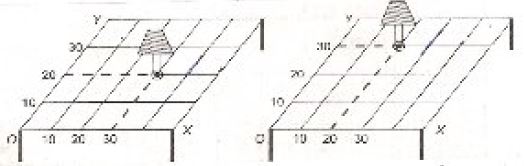
7. Draw the graph of y = 2x + 4. Use the graph to find the area between the line and the axes.
8. in which quadrant will the point lie, if:-
(a) ordinate is 3 and abscissa is – 7
(b) abscissa is – 10 and ordinate is – 4
(c) Ordinate is 4 and abscissa is – 6.
9. Fill in the blanks:-
(a) The coordinates of the origin 0 are ………………………
(b) The y coordinate of every point on the x-axis is ……………
(c) Distance along the x-axis is called ………………………
(d) Distance along the y-axis is called ………………………
(e) The point (x,y) = (y,x) only if ………………………
Key Concepts
Coordinate geometry is the area of mathematics that links algebra and geometry together, allowing geometric figures and problems to be analyzed using algebraic equations and numerical coordinates.
Coordinate System and Axes
- Coordinate axes: Two mutually perpendicular reference lines drawn in a plane to identify the location of any point. The horizontal reference line is called the x-axis (\( X'OX \)), and the vertical reference line is called the y-axis (\( YOY' \)).
- Origin: The intersection point of the coordinate axes, designated as \( O \), having coordinates \( (0, 0) \).
- Ordered pair: A pair of numbers \( (a, b) \) listed in a fixed sequence, where the first value \( a \) represents the x-coordinate (abscissa) and the second value \( b \) represents the y-coordinate (ordinate). Notice that \( (a, b) \neq (b, a) \) unless \( a = b \).
- Abscissa and Ordinate: For a given point \( P(a, b) \), the abscissa \( a \) is its perpendicular distance from the y-axis, and the ordinate \( b \) is its perpendicular distance from the x-axis.
- Points on axes: Any point located on the x-axis has a y-coordinate of 0 and takes the form \( (x, 0) \). Any point located on the y-axis has an x-coordinate of 0 and takes the form \( (0, y) \). Points lying on the axes do not belong to any quadrant.
Quadrants and Sign Conventions
The coordinate axes partition the plane into four distinct regions called quadrants:
- Quadrant I: Both coordinates are positive: \( (+, +) \)
- Quadrant II: Abscissa is negative and ordinate is positive: \( (-, +) \)
- Quadrant III: Both coordinates are negative: \( (-, -) \)
- Quadrant IV: Abscissa is positive and ordinate is negative: \( (+, -) \)
Section - A
Question 1. On which axes do the given points lie?
(i) (7, 0)
(ii) (0, -3)
(iii) (0, 6)
(iv) (-5, 0)
Answer:
(i) Point \( (7, 0) \) has an ordinate of 0, so it lies on the X-axis (specifically on the positive X-axis).
(ii) Point \( (0, -3) \) has an abscissa of 0, so it lies on the Y-axis (specifically on the negative Y-axis).
(iii) Point \( (0, 6) \) has an abscissa of 0, so it lies on the Y-axis (specifically on the positive Y-axis).
(iv) Point \( (-5, 0) \) has an ordinate of 0, so it lies on the X-axis (specifically on the negative X-axis).
In simple words: When the second number is zero, the point sits on the horizontal X-axis. When the first number is zero, the point sits on the vertical Y-axis.
Exam Tip: Always remember: \( y = 0 \) marks the X-axis, whereas \( x = 0 \) marks the Y-axis.
Question 2. In which quadrants do the given points lie?
(i) (4, -2)
(ii) (-3, 7)
(iii) (-1, -2)
(iv) (3, 6)
Answer:
(i) Point \( (4, -2) \) has \( x > 0 \) and \( y < 0 \), which matches the sign pattern \( (+, -) \). Hence, it lies in Quadrant IV.
(ii) Point \( (-3, 7) \) has \( x < 0 \) and \( y > 0 \), which matches the sign pattern \( (-, +) \). Hence, it lies in Quadrant II.
(iii) Point \( (-1, -2) \) has \( x < 0 \) and \( y < 0 \), which matches the sign pattern \( (-, -) \). Hence, it lies in Quadrant III.
(iv) Point \( (3, 6) \) has \( x > 0 \) and \( y > 0 \), which matches the sign pattern \( (+, +) \). Hence, it lies in Quadrant I.
In simple words: Look at the plus and minus signs: (+, +) is first, (-, +) is second, (-, -) is third, and (+, -) is fourth quadrant.
Exam Tip: Double-check the signs of both coordinates before identifying the quadrant to prevent simple sign errors.
Question 3. Is P (3, 2) & Q(2, 3) represent the same point?
Answer: No, \( P(3, 2) \) and \( Q(2, 3) \) do not represent the same point. In coordinate geometry, the position is given by an ordered pair where order is significant. For point \( P(3, 2) \), the abscissa is 3 and the ordinate is 2. For point \( Q(2, 3) \), the abscissa is 2 and the ordinate is 3. Since \( (a, b) \neq (b, a) \) when \( a \neq b \), the two ordered pairs locate two entirely different points in the plane.
In simple words: Order matters in coordinates: (3, 2) is 3 steps right and 2 steps up, while (2, 3) is 2 steps right and 3 steps up, so they are at different spots.
Exam Tip: Mention the mathematical property \( (a, b) \neq (b, a) \) whenever \( a \neq b \) to justify your conclusion formally.
Question 4. In which quadrant points P(3,0), Q(6,0) , R (-7.0), S (0,-6), lie?
Answer: None of these points lie in any quadrant. A point lies in a quadrant only when both of its coordinates are non-zero. When either coordinate equals zero, the point lies directly on one of the coordinate axes:
- Points \( P(3, 0) \), \( Q(6, 0) \), and \( R(-7, 0) \) have their y-coordinate equal to 0, so they lie on the X-axis.
- Point \( S(0, -6) \) has its x-coordinate equal to 0, so it lies on the Y-axis.
Therefore, none of the points belong to any quadrant.
In simple words: Any point that has a zero in its coordinates lies right on the grid lines (axes), not inside any of the four quadrants.
Exam Tip: A classic trick question in exams: remember that the axes themselves form the boundaries and do not belong to any quadrant.
Question 5. If a<0 and b<0, then the point P(a,b) lies in
(a) quadrant IV
(b) quadrant II
(c) quadrant III
(d) quadrant I
Answer: (c) quadrant III
When \( a < 0 \), the x-coordinate is negative, and when \( b < 0 \), the y-coordinate is negative. The quadrant where both coordinates are negative, having the sign pattern \( (-, -) \), is Quadrant III.
In simple words: When both coordinates are less than zero, the point is in the bottom-left area, which is Quadrant III.
Exam Tip: Quickly sketch the sign diagram in the margin during the exam to confirm the quadrant choice.
Question 6. The points (other than the origin) for which the abscissa is equal to the ordinate lie in
(a) Quadrant I only
(b) Quadrant I and II
(c) Quadrant I & III
(d) Quadrant II only.
Answer: (c) Quadrant I & III
If the abscissa equals the ordinate (\( x = y \)), then both coordinates must share the same sign. Both \( x \) and \( y \) can be positive (\( +, + \)), which places the point in Quadrant I, or both can be negative (\( -, - \)), which places the point in Quadrant III. In Quadrants II and IV, the coordinates have opposite signs, so they cannot be equal. Thus, these points lie in Quadrants I and III.
In simple words: For x and y to be completely equal, they must have the same sign - either both positive (Quadrant I) or both negative (Quadrant III).
Exam Tip: Remember that points with equal coordinates lie along the line \( y = x \), which passes through the first and third quadrants.
Question 7. The perpendicular distance of the point P(4,3) from the y axis is
(a) 3 Units
(b) 4 Units
(c) 5 Units
(d) 7 Units
Answer: (b) 4 Units
The perpendicular distance of any point \( P(x, y) \) from the y-axis is given by the absolute value of its x-coordinate (abscissa). For the point \( P(4, 3) \), the abscissa is 4. Therefore, its perpendicular distance from the y-axis is \( |4| = 4 \) units.
In simple words: The distance of a point from the vertical line (y-axis) is just its first coordinate value, which is 4 units.
Exam Tip: Do not swap the axes: the distance from the y-axis is the x-value (abscissa), while the distance from the x-axis is the y-value (ordinate).
Question 8. The area of triangle OAB with 0(0,0), A(4,0) & B(0,6) is
(a) 8 sq. unit
(b) 12 sq. units
(c) 16 sq. units
(d) 24 sq. units
Answer: (b) 12 sq. units
The vertices are \( O(0, 0) \), \( A(4, 0) \), and \( B(0, 6) \). Point \( A \) lies on the x-axis at a distance of 4 units from \( O \), and point \( B \) lies on the y-axis at a distance of 6 units from \( O \). Since the coordinate axes are perpendicular, \( \triangle OAB \) is a right-angled triangle with base \( OA = 4 \) units and altitude \( OB = 6 \) units:
\( \text{Area of } \triangle OAB = \frac{1}{2} \times \text{base} \times \text{height} = \frac{1}{2} \times 4 \times 6 = 12\text{ sq. units} \)
In simple words: Because the triangle sits along the axes, its base is 4 and height is 6. Taking half of 4 times 6 gives 12 square units.
Exam Tip: When vertices lie on both axes with the third at the origin, use the standard formula \( \frac{1}{2} \times |x| \times |y| \).
Section - B
Question 9. Write down the coordinates of each of the points P,Q, R, S and T as shown in the following figure?
Answer: By reading the horizontal distance (abscissa) and vertical distance (ordinate) of each point from the coordinate axes in the grid:
- Point P: Lies 2 units along the positive x-axis and 4 units along the positive y-axis: \( P(2, 4) \)
- Point Q: Lies 2 units along the negative x-axis and 2 units along the positive y-axis: \( Q(-2, 2) \)
- Point R: Lies 4 units along the negative x-axis and 0 units along the y-axis: \( R(-4, 0) \)
- Point S: Lies 0 units along the x-axis and 4 units along the negative y-axis: \( S(0, -4) \)
- Point T: Lies 5 units along the positive x-axis and 3 units along the negative y-axis: \( T(5, -3) \)
In simple words: Count grid units from the center: move left or right first for x, then up or down for y.
Exam Tip: Always state the x-value before the y-value in ordered pairs: \( (x, y) \).
Question 10. Draw the lines X'OX and YOY1 as the axes on the plane of a paper and plot the given points.
(i) A(5,3)
(ii) B (-3, 2)
(iii) C(-5, -4)
(iv) D(2,-6)
Answer: To plot the points, construct two perpendicular lines \( X'OX \) (horizontal) and \( YOY' \) (vertical) intersecting at origin \( O(0, 0) \):
(i) A(5, 3): Move 5 units along the positive X-axis to the right, then 3 units upwards parallel to the Y-axis. This point lies in Quadrant I.
(ii) B(-3, 2): Move 3 units along the negative X-axis to the left, then 2 units upwards parallel to the Y-axis. This point lies in Quadrant II.
(iii) C(-5, -4): Move 5 units along the negative X-axis to the left, then 4 units downwards parallel to the Y-axis. This point lies in Quadrant III.
(iv) D(2, -6): Move 2 units along the positive X-axis to the right, then 6 units downwards parallel to the Y-axis. This point lies in Quadrant IV.
In simple words: Draw a cross with X and Y axes, pick an equal unit spacing, and plot each point by measuring along horizontal and vertical lines.
Exam Tip: Draw dashed projection lines to both axes to show examiners precisely how you located each point.
Section - C
Question 11. Find the mirror images of the following point using x-axis & y-axis as mirror.
(i) A(2,3)
(ii) B(2,-3)
(iii) C(-2,3)
(iv) D(-2,-3)
Answer: Reflection rules for coordinate axes:
- Reflection across the X-axis changes the sign of the y-coordinate: \( (x, y) \to (x, -y) \).
- Reflection across the Y-axis changes the sign of the x-coordinate: \( (x, y) \to (-x, y) \).
(i) For point \( A(2, 3) \):
- In X-axis: \( A_x(2, -3) \)
- In Y-axis: \( A_y(-2, 3) \)
(ii) For point \( B(2, -3) \):
- In X-axis: \( B_x(2, 3) \)
- In Y-axis: \( B_y(-2, -3) \)
(iii) For point \( C(-2, 3) \):
- In X-axis: \( C_x(-2, -3) \)
- In Y-axis: \( C_y(2, 3) \)
(iv) For point \( D(-2, -3) \):
- In X-axis: \( D_x(-2, 3) \)
- In Y-axis: \( D_y(2, -3) \)
In simple words: Reflecting across the horizontal axis flips the sign of y. Reflecting across the vertical axis flips the sign of x.
Exam Tip: Remember: when reflecting across an axis, that axis's coordinate remains unchanged while the other coordinate flips its sign.
Question 12. Draw the graph of the following equations
(i) \( y = 3x + 2 \)
(ii) \( y = x \)
Answer:
(i) For the linear equation \( y = 3x + 2 \):
Determine three points by selecting values of \( x \):
- If \( x = 0 \implies y = 3(0) + 2 = 2 \implies (0, 2) \)
- If \( x = 1 \implies y = 3(1) + 2 = 5 \implies (1, 5) \)
- If \( x = -1 \implies y = 3(-1) + 2 = -1 \implies (-1, -1) \)
Plot the points \( (0, 2) \), \( (1, 5) \), and \( (-1, -1) \) on a Cartesian plane and draw a straight line through them.
(ii) For the linear equation \( y = x \):
Determine three points:
- If \( x = 0 \implies y = 0 \implies (0, 0) \)
- If \( x = 2 \implies y = 2 \implies (2, 2) \)
- If \( x = -2 \implies y = -2 \implies (-2, -2) \)
Plot the points \( (0, 0) \), \( (2, 2) \), and \( (-2, -2) \) and connect them with a straight line passing through the origin at a \( 45^\circ \) angle.
In simple words: Find three pairs of (x, y) coordinates for each equation, plot them on the axes, and draw a straight ruler line through them.
Exam Tip: Always find at least three points for any linear graph: if all three do not align along a straight line, you have caught an arithmetic mistake.
Question 13. Draw a triangle with vertices 0(0,0) A(3,0) B(3,4). Classify the triangle and also find its area.
Answer: Let the vertices be \( O(0, 0) \), \( A(3, 0) \), and \( B(3, 4) \):
1. Side lengths:
- Distance \( OA = 3 - 0 = 3 \) units (horizontal along the X-axis).
- Distance \( AB = 4 - 0 = 4 \) units (vertical along the line \( x = 3 \)).
- Distance \( OB = \sqrt{(3 - 0)^2 + (4 - 0)^2} = \sqrt{9 + 16} = \sqrt{25} = 5 \) units.
2. Classification:
Since line segment \( OA \) lies on the X-axis and segment \( AB \) is parallel to the Y-axis, \( OA \perp AB \), so \( \angle OAB = 90^\circ \). Since all three sides have different lengths (3, 4, 5) and one angle is \( 90^\circ \), \( \triangle OAB \) is a right-angled scalene triangle.
3. Area:
\( \text{Area} = \frac{1}{2} \times \text{base} \times \text{height} = \frac{1}{2} \times OA \times AB = \frac{1}{2} \times 3 \times 4 = 6\text{ square units} \).
In simple words: The base is 3 units along the ground, the height is 4 units straight up, and the longest side is 5 units. It is a right-angled triangle with an area of 6 square units.
Exam Tip: State both the angle classification (right-angled) and side classification (scalene) for full marks under triangle classification.
Question 14. Draw a quadrilateral with vertices A(2,2) B(2,-2) C(-2,-2), D(-2,2). Classify the quadrilateral and also find its area.
Answer: Let the given points be \( A(2, 2) \), \( B(2, -2) \), \( C(-2, -2) \), and \( D(-2, 2) \):
1. Side lengths:
- Distance \( AB = \sqrt{(2 - 2)^2 + (-2 - 2)^2} = \sqrt{0 + 16} = 4 \) units.
- Distance \( BC = \sqrt{(-2 - 2)^2 + (-2 - (-2))^2} = \sqrt{16 + 0} = 4 \) units.
- Distance \( CD = \sqrt{(-2 - (-2))^2 + (2 - (-2))^2} = \sqrt{0 + 16} = 4 \) units.
- Distance \( DA = \sqrt{(2 - (-2))^2 + (2 - 2)^2} = \sqrt{16 + 0} = 4 \) units.
2. Diagonals:
- \( AC = \sqrt{(-2 - 2)^2 + (-2 - 2)^2} = \sqrt{16 + 16} = \sqrt{32} = 4\sqrt{2} \) units.
- \( BD = \sqrt{(-2 - 2)^2 + (2 - (-2))^2} = \sqrt{16 + 16} = \sqrt{32} = 4\sqrt{2} \) units.
3. Classification:
Since all four sides are equal in length (\( AB = BC = CD = DA = 4 \) units) and both diagonals are equal (\( AC = BD = 4\sqrt{2} \) units), quadrilateral \( ABCD \) is a square.
4. Area:
\( \text{Area} = \text{side}^2 = 4^2 = 16\text{ square units} \).
In simple words: Every side has a length of 4 units and all corners form 90-degree angles. This makes the shape a square, and its area is 4 times 4 = 16 square units.
Exam Tip: Showing that all four sides are equal only proves a rhombus; you must also show that the diagonals are equal to confirm it is a square.
Question 15. Find the coordinates of point which are equidistant from these two points P(3,0) and Q(-3,0). How many points are possible satisfying this condition?
Answer: Let \( M(x, y) \) be any point in the plane equidistant from \( P(3, 0) \) and \( Q(-3, 0) \).
By the distance condition:
\( MP = MQ \implies MP^2 = MQ^2 \)
Using the coordinate distance formula:
\( (x - 3)^2 + (y - 0)^2 = (x - (-3))^2 + (y - 0)^2 \)
\( \implies (x - 3)^2 + y^2 = (x + 3)^2 + y^2 \)
Expand the squared terms:
\( x^2 - 6x + 9 + y^2 = x^2 + 6x + 9 + y^2 \)
Subtract \( x^2 + y^2 + 9 \) from both sides:
\( -6x = 6x \)
\( \implies 12x = 0 \implies x = 0 \)
Since \( x = 0 \), the point must lie anywhere along the Y-axis.
Therefore, any point with coordinates of the form \( (0, y) \), where \( y \) is any real number, is equidistant from \( P \) and \( Q \).
Because \( y \) can take any value along the continuous vertical axis, there are infinitely many points that satisfy this condition.
In simple words: The Y-axis acts as the exact perpendicular line down the middle between P and Q. Every single point on the Y-axis has coordinates (0, y), giving infinitely many possible solutions.
Exam Tip: Clearly write the locus equation \( x = 0 \) and state both the coordinate form \( (0, y) \) and that "infinitely many points" exist.
Free study material for Mathematics
Download Class 9 Mathematics Chapter 03 Coordinate Geometry Practice Worksheets
Practice Exercises for Class 9 Mathematics Chapter 03 Coordinate Geometry
Access structured practice worksheets for Chapter 03 Coordinate Geometry aligned with the 2026 CBSE curriculum. These downloadable exercises for Class 9 Mathematics help students build accuracy and reinforce core concepts for upcoming school tests.
Step-by-Step Solutions and Practice Guidelines
Built using official NCERT guidelines for Class 9 Mathematics, these practice sheets provide reliable academic support. Cross-reference your completed work with our detailed solutions to learn standard answer-writing formats for CBSE exams.
Enhance Speed with Online Practice
Follow up your worksheet practice by attempting the interactive online MCQ tests for Chapter 03 Coordinate Geometry to evaluate your execution speed. All printable assignments and revision sheets on our platform are updated for the 2026 session and available free of charge.
FAQs
You can download the latest chapter-wise printable worksheets for Class 9 Mathematics Chapter 03 Coordinate Geometry for free from StudiesToday.com. These have been made as per the latest CBSE curriculum for this academic year.
Yes, Class 9 Mathematics worksheets for Chapter 03 Coordinate Geometry focus on activity-based learning and also competency-style questions. This helps students to apply theoretical knowledge to practical scenarios.
Yes, we have provided solved worksheets for Class 9 Mathematics Chapter 03 Coordinate Geometry to help students verify their answers instantly.
Yes, our Class 9 Mathematics test sheets are mobile-friendly PDFs and can be printed by teachers for classroom.
For Chapter 03 Coordinate Geometry, regular practice with our worksheets will improve question-handling speed and help students understand all technical terms and diagrams.