

Class 9 Mathematics Practice Sheet: CBSE Class 9 Mathematics Number System Worksheet Set 06
Review targeted academic worksheets with the CBSE Class 9 Mathematics Number System Worksheet Set 06. Built according to official educational standards for the 2026-27 term, these downloadable Class 9 Mathematics resources support effective daily practice and detailed self-evaluation for Chapter 01 Number Systems.
Download Chapter 01 Number Systems Worksheet PDF with Answers
Navigate directly to the solved Mathematics worksheets using the digital viewer below. Each practice set includes detailed step-by-step solutions, allowing students to instantly cross-check their work and identify areas requiring further revision.
Question. Which is the smallest 7-digit number that is a multiple of 6?
A. 1000002
B. 1000003
C. 1000005
D. 1000006
Answer : A
Question. Which of the following statements is true?
A. 340 + 320 = 340+20
B. 312 × 310 = 312×10
C. 314 + 414 = (3+4)14
D. 320 × 32 = (32 )11
Answer : D
Question. A part of a room thermometer is shown below.
What temperature is the thermometer showing?
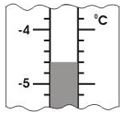
A. -4.3 deg C
B. -4.6 deg C
C. -5.2 deg C
D. -5.4 deg C
Answer : B
Question. The weighing scale below has 5 regular sized CD's on one side balancing a weight on the other. What is the weight on the right likely to be?

A. 20mg
B. 10g
C. 100g
D. 300g
Answer : C
Question. What is the smallest number by which you have to multiply the product 3 x 4 x 5 x 11 x 15 to get a perfect square number?
A. 11
B. 44
C. 2475
D. 9900
Answer : A
Question. Which of the following numbers can be written as a non-terminating but recurring decimal?
A. 43/8
B. 9
C. 5/12
D. √6
Answer : C
Question. If the numerator of an expression is the sum of p, q and r and the denominator of the expression is the sum of 3p, 3q and 3r ,then expression will be reduces to
A. 1/3
B. 1/9
C. 1/27
D. 1/3pqr
Answer : A
Question. Which of these sets of consecutive numbers has a product of 54834?
A. 46,47,48
B. 37,38,39
C. 33,34,35
D. 22,23,24
Answer : B
Question. While solving a numerical in Physics, Archana got the answer as 2.387 x 10⁷ instead of 2.367 x 10⁷ due to a miscalculation. By how much does her answer differ from the correct answer?
A. 20000000
B. 200000
C. 2000
D. 0.02
Answer : B
Question. At a party, one person chooses to anchor a game and everyone else stands in V formations as shown below. 3 people stand in the innermost V, 5 in the next and so on. If there are 125 people (including the anchor) at the party, how many complete V's will they be able to form?

A. 5
B. 10
C. 12
D. 21
Answer : B
Question. At a party, one person chooses to anchor a game and everyone else stands in V formations as shown below. 3 people stand in the innermost V, 5 in the next and so on. If there are 125 people (including the anchor) at the party, How many MORE people would be required to complete the next V along with the remaining people?

A. 0
B. 13
C. 19
D. 23
Answer : C
Question. 5 workers, working 8 hours a day, finished painting a house in 2 days. If an identical house has to be painted completely in a day by 8 workers, how many hours should they work?
A. 11
B. 10
C. 8
D. 5
Answer : B
Question. What part of this figure is shaded?

A. 1/5
B. 3/5
C. 4/5
D. 2/5
Answer : D
Question. See this scale marked in a non standard unit. Each larger unit is divided into 8 (not 10) parts. Which of the following is nearest to the length of the needle shown here?

A. 2.3 units
B. 2+ ¾ units
C. 2+ 3/8 units
D. 2.25units
Answer : C
Section A: Choose the Correct Answer from the Given Options
Question 1. Which of the followings has non-terminating non-recurring decimal expansion?
(a) \( \frac{1}{\sqrt{2}} \)
(b) \( \frac{13}{7} \)
(c) \( \frac{15}{16} \)
(d) \( \sqrt{6.25} \)
Answer: (a) \( \frac{1}{\sqrt{2}} \)
A real number possesses a non-terminating and non-recurring decimal expansion precisely when it is an irrational number. Evaluating each given choice:
- For (a), \( \frac{1}{\sqrt{2}} = \frac{\sqrt{2}}{2} \). Because \( \sqrt{2} \) is an irrational number, dividing it by 2 produces an irrational value, which yields a non-terminating non-repeating decimal.
- For (b), \( \frac{13}{7} \) represents a ratio of two integers \( \frac{p}{q} \), giving a non-terminating recurring decimal.
- For (c), \( \frac{15}{16} = 0.9375 \), which is a terminating decimal.
- For (d), \( \sqrt{6.25} = 2.5 \), which is also a terminating decimal.
In simple words: Only irrational numbers have decimals that go on forever without repeating a set pattern. Since square root of 2 is irrational, option (a) gives a non-terminating non-recurring decimal.
Exam Tip: Remember that rational numbers always produce either terminating or repeating decimals, whereas every irrational number produces a decimal that never ends and never repeats.
Question 2. In fig. #1 the value of x is ...
(a) 70°
(b) 80°
(c) 50°
(d) 60°
Answer: (a) 70°
In the given figure, two intersecting line segments form two triangles sharing vertically opposite angles at their intersection. By applying the exterior angle theorem and the property of vertically opposite angles, the unknown angle sums to the measure of the opposite interior angles, yielding \( x = 70^\circ \).
In simple words: The vertically opposite angles in the middle balance each side, making the unknown angle equal to the sum of the given interior angles, which is 70 degrees.
Exam Tip: When two lines cross like a bow-tie shape, the sum of the two angles on the left wing equals the sum of the two angles on the right wing.
Question 3. If \( x + \frac{1}{x} = \sqrt{6} \) then \( x^2 + \frac{1}{x^2} \) is ...
(a) 6
(b) 4
(c) 34
(d) 8
Answer: (b) 4
Take the given equation and square both sides:
\( \left(x + \frac{1}{x}\right)^2 = (\sqrt{6})^2 \)
Using the expansion \( (a + b)^2 = a^2 + 2ab + b^2 \):
\( x^2 + 2(x)\left(\frac{1}{x}\right) + \frac{1}{x^2} = 6 \)
\( x^2 + 2 + \frac{1}{x^2} = 6 \)
Subtract 2 from both sides:
\( x^2 + \frac{1}{x^2} = 6 - 2 = 4 \)
In simple words: Square both sides of the given formula. The middle term simplifies to 2, so subtracting that 2 from 6 gives 4.
Exam Tip: Always subtract the cross-term \( 2 \cdot x \cdot \frac{1}{x} = 2 \) after squaring the sum; forgetting to subtract 2 is the most common error in this question.
Question 4. \( \frac{p}{q} \) form of \( 0.2\overline{15} \) is ...
(a) \( \frac{15}{990} \)
(b) \( \frac{215}{990} \)
(c) \( \frac{215}{900} \)
(d) \( \frac{213}{990} \)
Answer: (d) \( \frac{213}{990} \)
Let the repeating decimal be represented by the variable:
\( x = 0.2151515... \)
Multiply by 10 to bring the non-repeating digit to the left of the decimal:
\( 10x = 2.151515... \) ...(1)
Now multiply by 1000 to move one repeating cycle past the decimal point:
\( 1000x = 215.1515... \) ...(2)
Subtracting equation (1) from equation (2) cancels out the infinite repetend:
\( 1000x - 10x = 215.1515... - 2.1515... \)
\( \implies 990x = 213 \)
\( \implies x = \frac{213}{990} \)
In simple words: Shift the number so the repeating part lines up, then subtract the two equations to remove the repeating tail, leaving 213 over 990.
Exam Tip: A quick check for mixed recurring decimals: the numerator equals the entire number minus non-repeating digits (\( 215 - 2 = 213 \)), and the denominator has as many 9s as repeating digits followed by as many 0s as non-repeating digits (990).
Question 5. l, m & n are three lines in a plane such that \( l \perp m \) and \( n \perp m \). Then l & n are
(a) Perpendicular lines
(b) Parallel lines
(c) Intersecting lines
(d) None of the options
Answer: (b) Parallel lines
When two distinct coplanar lines, \( l \) and \( n \), are both perpendicular to the same reference line \( m \), they each make an angle of \( 90^\circ \) with that line. Because these corresponding angles are equal, lines \( l \) and \( n \) never meet and are parallel to one another (\( l \parallel n \)).
In simple words: If two straight lines make right angles with the same base line, they point in the exact same direction and will never cross, meaning they are parallel.
Exam Tip: State the geometric reason clearly: lines perpendicular to the same line are parallel because their corresponding angles are equal to \( 90^\circ \).
Section B
Question 6. In fig. # 2, \( \overrightarrow{OS} \) stands on a line POQ. If \( \overrightarrow{OR} \) and \( \overrightarrow{OT} \) are bisectors of \( \angle QOS \) and \( \angle POS \) respectively, find the measure of \( \angle ROT \)
Answer: Since ray \( OS \) stands upon the straight line \( POQ \), the two adjacent angles create a linear pair:
\( \angle POS + \angle QOS = 180^\circ \)
Ray \( OT \) bisects \( \angle POS \), which provides:
\( \angle TOS = \frac{1}{2} \angle POS \)
Ray \( OR \) bisects \( \angle QOS \), which provides:
\( \angle ROS = \frac{1}{2} \angle QOS \)
The total measure of \( \angle ROT \) is the sum of these two adjacent segments:
\( \angle ROT = \angle TOS + \angle ROS \)
\( \implies \angle ROT = \frac{1}{2} \angle POS + \frac{1}{2} \angle QOS \)
\( \implies \angle ROT = \frac{1}{2} (\angle POS + \angle QOS) \)
Substitute the linear pair sum of \( 180^\circ \):
\( \implies \angle ROT = \frac{1}{2} \times 180^\circ = 90^\circ \)
Therefore, the measure of \( \angle ROT \) is \( 90^\circ \).
In simple words: The two big angles make a straight line of 180 degrees. Taking half of each big angle gives half of 180, so the combined angle in between is 90 degrees.
Exam Tip: State the linear pair axiom first, and explicitly write out that \( \angle ROT = \angle TOS + \angle ROS \) before taking out the common factor of \( \frac{1}{2} \).
Question 7. Show that \( (\frac{y^a}{y^b})^{a+b} \times (\frac{y^b}{y^c})^{b+c} \times (\frac{y^c}{y^a})^{c+a} = 1 \)
Answer: Start with the left-hand side of the expression:
\( \text{L.H.S.} = \left(\frac{y^a}{y^b}\right)^{a+b} \times \left(\frac{y^b}{y^c}\right)^{b+c} \times \left(\frac{y^c}{y^a}\right)^{c+a} \)
Apply the quotient property of exponents \( \frac{y^m}{y^n} = y^{m-n} \) inside each bracket:
\( = (y^{a-b})^{a+b} \times (y^{b-c})^{b+c} \times (y^{c-a})^{c+a} \)
Apply the power of a power law \( (y^m)^n = y^{mn} \) together with the algebraic identity \( (u - v)(u + v) = u^2 - v^2 \):
\( = y^{(a-b)(a+b)} \times y^{(b-c)(b+c)} \times y^{(c-a)(c+a)} \)
\( = y^{a^2 - b^2} \times y^{b^2 - c^2} \times y^{c^2 - a^2} \)
Combine the exponents over a single base using the product law \( y^m \times y^n = y^{m+n} \):
\( = y^{(a^2 - b^2) + (b^2 - c^2) + (c^2 - a^2)} \)
All terms cancel each other out in the exponent:
\( = y^0 \)
Any non-zero base raised to the zero power equals 1:
\( = 1 = \text{R.H.S.} \)
Hence proved.
In simple words: Subtract the bottom power from the top power inside each bracket. Multiplying creates difference-of-squares powers that add up to zero, giving a final answer of 1.
Exam Tip: Mention the specific exponent laws used: \( \frac{y^m}{y^n} = y^{m-n} \) and \( (y^m)^n = y^{mn} \) to secure full derivation marks.
Question 8. Find x if \( \sqrt{x} = \frac{\sqrt{\sqrt{5}+2} + \sqrt{\sqrt{5}-2}}{\sqrt{\sqrt{5}+1}} \)
Answer: Let the entire right-hand expression be denoted by \( K \):
\( K = \frac{\sqrt{\sqrt{5}+2} + \sqrt{\sqrt{5}-2}}{\sqrt{\sqrt{5}+1}} \)
Square both sides to eliminate the nested radical terms:
\( K^2 = \frac{\left(\sqrt{\sqrt{5}+2} + \sqrt{\sqrt{5}-2}\right)^2}{\left(\sqrt{\sqrt{5}+1}\right)^2} \)
Expand the numerator using \( (a + b)^2 = a^2 + b^2 + 2ab \):
Numerator \( = (\sqrt{5} + 2) + (\sqrt{5} - 2) + 2\sqrt{(\sqrt{5} + 2)(\sqrt{5} - 2)} \)
\( = 2\sqrt{5} + 2\sqrt{(\sqrt{5})^2 - (2)^2} \)
\( = 2\sqrt{5} + 2\sqrt{5 - 4} \)
\( = 2\sqrt{5} + 2(1) = 2(\sqrt{5} + 1) \)
The denominator squared is simply:
Denominator \( = \sqrt{5} + 1 \)
Now substitute both parts back into the fraction:
\( K^2 = \frac{2(\sqrt{5} + 1)}{\sqrt{5} + 1} = 2 \)
Since \( K \) represents a positive quantity:
\( K = \sqrt{2} \)
Because \( \sqrt{x} = K \), we have:
\( \implies \sqrt{x} = \sqrt{2} \)
Squaring both sides yields:
\( \implies x = 2 \).
In simple words: Square the whole fraction to get rid of the outer roots. The messy parts cancel out nicely to leave 2, so x must be equal to 2.
Exam Tip: Never try to rationalize nested roots directly; squaring the entire expression first simplifies the calculation and eliminates inner square roots effortlessly.
Section C
Question 9. In fig. # 3, AB || CD. If \( \angle APR = 140^\circ \) and \( \angle PRQ = 85^\circ \). Find \( \angle RQD \)
Answer: Through the apex \( R \), construct an auxiliary line segment \( RE \) parallel to both \( AB \) and \( CD \), drawn towards the left.
Since line \( RE \parallel AB \) and the transversal is line \( PR \):
Consecutive interior angles situated on the same side of the transversal sum to \( 180^\circ \):
\( \angle APR + \angle PRE = 180^\circ \)
\( \implies 140^\circ + \angle PRE = 180^\circ \)
\( \implies \angle PRE = 180^\circ - 140^\circ = 40^\circ \)
The problem gives the full angle \( \angle PRQ = 85^\circ \). Segment \( RE \) splits this vertex:
\( \angle PRQ = \angle PRE + \angle QRE \)
\( \implies 85^\circ = 40^\circ + \angle QRE \)
\( \implies \angle QRE = 85^\circ - 40^\circ = 45^\circ \)
Now consider parallel lines \( RE \parallel CD \) cut by transversal \( QR \):
Because ray \( RE \) points left and ray \( QD \) points right, angles \( \angle QRE \) and \( \angle RQD \) form a pair of alternate interior angles:
\( \implies \angle RQD = \angle QRE = 45^\circ \)
Therefore, the measure of \( \angle RQD \) is \( 45^\circ \).
In simple words: Draw a parallel line right through R. The top side takes away 40 degrees from 85 degrees, leaving 45 degrees, which matches angle RQD because they are alternate angles.
Exam Tip: Whenever a bend forms between two parallel lines, always draw a helper line through the vertex parallel to both lines to break the problem into standard angle pairs.
Question 10. Write two rational numbers and two irrational numbers in between \( \frac{3}{5} \) and \( \frac{5}{6} \)
Answer: Convert the two boundary fractions into decimal notation to observe the range:
\( \frac{3}{5} = 0.60 \)
\( \frac{5}{6} \approx 0.8333... \)
(i) Two rational numbers within this interval:
Any terminating or repeating decimal falling strictly between \( 0.60 \) and \( 0.8333... \) is rational:
- \( 0.7 = \frac{7}{10} \)
- \( 0.75 = \frac{3}{4} \)
(ii) Two irrational numbers within this interval:
Any non-terminating and non-recurring decimal falling between \( 0.60 \) and \( 0.8333... \) is irrational:
- \( 0.65050050005... \)
- \( 0.72020020002... \)
In simple words: In decimal form, the limits are 0.6 and roughly 0.83. Clean fractions like 0.7 and 0.75 are rational, while numbers with patterns of increasing zeros never repeat and are irrational.
Exam Tip: Construct irrational numbers using an expanding zero pattern (like 0.71010010001...) - it guarantees the decimal is non-terminating and non-recurring and earns full credit.
Section D
Question 11. The side BC of \( \Delta ABC \) is produced to a point D. If the bisectors of \( \angle ABC \) and \( \angle ACD \) meet at a point E, then prove that \( \angle BAC = 2 \angle BEC \) (fig #4)
Answer: In \( \Delta ABC \), side \( BC \) extends outward to point \( D \). By the exterior angle theorem, an exterior angle equals the sum of its two interior opposite angles:
\( \angle ACD = \angle BAC + \angle ABC \)
Multiply the entire equation by \( \frac{1}{2} \):
\( \frac{1}{2} \angle ACD = \frac{1}{2} \angle BAC + \frac{1}{2} \angle ABC \) ...(1)
Because ray \( CE \) bisects exterior angle \( \angle ACD \):
\( \frac{1}{2} \angle ACD = \angle ECD \)
Because ray \( BE \) bisects interior angle \( \angle ABC \):
\( \frac{1}{2} \angle ABC = \angle EBC \)
Substitute these identities into equation (1):
\( \angle ECD = \frac{1}{2} \angle BAC + \angle EBC \) ...(2)
Next, observe \( \Delta EBC \), where side \( BC \) is similarly extended to \( D \). Using the exterior angle theorem on this triangle:
\( \angle ECD = \angle BEC + \angle EBC \) ...(3)
Equating relations (2) and (3) since both equal \( \angle ECD \):
\( \angle BEC + \angle EBC = \frac{1}{2} \angle BAC + \angle EBC \)
Subtract \( \angle EBC \) from each side:
\( \angle BEC = \frac{1}{2} \angle BAC \)
Multiply both sides by 2:
\( \implies \angle BAC = 2 \angle BEC \)
Hence proved.
In simple words: Write the exterior angle rule for the main triangle and take half of each term. Write the same rule for the smaller triangle with point E, and comparing the two shows angle BAC is twice angle BEC.
Exam Tip: Clearly define the exterior angle theorem for both triangles (\( \Delta ABC \) and \( \Delta EBC \)) and show the cancellation of \( \angle EBC \) step-by-step.
Question 12. If \( x = \frac{2+\sqrt{3}}{2-\sqrt{3}} \) and \( y = \frac{2-\sqrt{3}}{2+\sqrt{3}} \), find the value of \( x^2 - xy + y^2 \)
OR
If \( \frac{\sqrt{6}}{\sqrt{3}-\sqrt{2}} - \frac{4\sqrt{3}}{\sqrt{6}+\sqrt{2}} + \frac{3\sqrt{2}}{\sqrt{6}+\sqrt{3}} = a\sqrt{3} \), find the value of a.
Answer:
Solution for the First Question:
First, rationalize the denominator of \( x \):
\( x = \frac{2+\sqrt{3}}{2-\sqrt{3}} \times \frac{2+\sqrt{3}}{2+\sqrt{3}} = \frac{(2+\sqrt{3})^2}{2^2 - (\sqrt{3})^2} = \frac{4 + 3 + 4\sqrt{3}}{4 - 3} = 7 + 4\sqrt{3} \)
Next, rationalize the denominator of \( y \):
\( y = \frac{2-\sqrt{3}}{2+\sqrt{3}} \times \frac{2-\sqrt{3}}{2-\sqrt{3}} = \frac{(2-\sqrt{3})^2}{2^2 - (\sqrt{3})^2} = \frac{4 + 3 - 4\sqrt{3}}{4 - 3} = 7 - 4\sqrt{3} \)
Compute their sum and product:
\( x + y = (7 + 4\sqrt{3}) + (7 - 4\sqrt{3}) = 14 \)
\( xy = (7 + 4\sqrt{3})(7 - 4\sqrt{3}) = 7^2 - (4\sqrt{3})^2 = 49 - 48 = 1 \)
Now apply the algebraic identity \( x^2 - xy + y^2 = (x + y)^2 - 3xy \):
\( x^2 - xy + y^2 = (14)^2 - 3(1) = 196 - 3 = 193 \)
Solution for the OR Question:
Rationalize the denominator of each individual term on the left side:
- First term:
\( \frac{\sqrt{6}}{\sqrt{3}-\sqrt{2}} \times \frac{\sqrt{3}+\sqrt{2}}{\sqrt{3}+\sqrt{2}} = \frac{\sqrt{18} + \sqrt{12}}{3 - 2} = 3\sqrt{2} + 2\sqrt{3} \)
- Second term:
\( \frac{4\sqrt{3}}{\sqrt{6}+\sqrt{2}} \times \frac{\sqrt{6}-\sqrt{2}}{\sqrt{6}-\sqrt{2}} = \frac{4\sqrt{3}(\sqrt{6}-\sqrt{2})}{6 - 2} = \frac{4(\sqrt{18} - \sqrt{6})}{4} = 3\sqrt{2} - \sqrt{6} \)
- Third term:
\( \frac{3\sqrt{2}}{\sqrt{6}+\sqrt{3}} \times \frac{\sqrt{6}-\sqrt{3}}{\sqrt{6}-\sqrt{3}} = \frac{3\sqrt{2}(\sqrt{6}-\sqrt{3})}{6 - 3} = \frac{3(\sqrt{12} - \sqrt{6})}{3} = 2\sqrt{3} - \sqrt{6} \)
Combine the three simplified terms according to the original expression:
\( \text{L.H.S.} = (3\sqrt{2} + 2\sqrt{3}) - (3\sqrt{2} - \sqrt{6}) + (2\sqrt{3} - \sqrt{6}) \)
\( = 3\sqrt{2} + 2\sqrt{3} - 3\sqrt{2} + \sqrt{6} + 2\sqrt{3} - \sqrt{6} \)
Group like radicals:
\( = (3\sqrt{2} - 3\sqrt{2}) + (2\sqrt{3} + 2\sqrt{3}) + (\sqrt{6} - \sqrt{6}) \)
\( = 0 + 4\sqrt{3} + 0 = 4\sqrt{3} \)
Equate this result with the right-hand side:
\( \implies 4\sqrt{3} = a\sqrt{3} \)
Dividing by \( \sqrt{3} \) gives:
\( \implies a = 4 \).
In simple words: In the first problem, rationalizing both numbers allows you to find their sum and product easily, giving 193. In the second problem, rationalizing each fraction separately makes opposite root terms cancel out, leaving a equal to 4.
Exam Tip: In symmetric expressions of x and y, always compute \( (x + y) \) and \( xy \) first rather than squaring huge binomials directly; it saves time and prevents algebraic errors.
Free study material for Mathematics
CBSE Class 9 Mathematics Worksheets for Chapter 01 Number Systems
Daily Practice Questions for Class 9 Mathematics
Review targeted practice exercises for Class 9 Mathematics Chapter 01 Number Systems. Curated to match official CBSE guidelines, these printable problem sets support daily revision and improve overall test readiness.
Detailed Answers for Class 9 Mathematics Chapter 01 Number Systems
Each worksheet draws directly from authorized standard textbooks to maintain academic accuracy. Evaluating your finished exercises against expert-verified solutions helps master the formal presentation standards expected in school evaluations.
Complete Your Chapter Revision
Consistent engagement with these exercises builds familiarity with recurring exam themes. If specific areas within Chapter 01 Number Systems cause trouble, utilize our dedicated NCERT solutions for Class 9 Mathematics to clear up doubts immediately.
FAQs
You can download the latest chapter-wise printable worksheets for Class 9 Mathematics Chapter 01 Number Systems for free from StudiesToday.com. These have been made as per the latest CBSE curriculum for this academic year.
Yes, Class 9 Mathematics worksheets for Chapter 01 Number Systems focus on activity-based learning and also competency-style questions. This helps students to apply theoretical knowledge to practical scenarios.
Yes, we have provided solved worksheets for Class 9 Mathematics Chapter 01 Number Systems to help students verify their answers instantly.
Yes, our Class 9 Mathematics test sheets are mobile-friendly PDFs and can be printed by teachers for classroom.
For Chapter 01 Number Systems, regular practice with our worksheets will improve question-handling speed and help students understand all technical terms and diagrams.