

Chapter-wise Worksheets for Class 9 Mathematics: Chapter 01 Number Systems
Access comprehensive chapter-wise worksheets for Chapter 01 Number Systems using the CBSE Class 9 Mathematics Number System Worksheet Set 05. Designed to align with the 2026-27 academic syllabus for Class 9 Mathematics, these printable practice sets help students reinforce key concepts and improve their overall exam readiness.
Practice Class 9 Mathematics Worksheets: Chapter 01 Number Systems
Access the complete worksheet PDF for Class 9 Mathematics below. Regular practice with these targeted academic tasks builds familiarity with standard question patterns and helps secure higher marks in final school examinations.
Question. For which of these values of y will 2y be an irrational number?
A. y = √49
B. y = -213
C. y = 22/7
D. y = √8
Answer : D
Question. Which of the following diagrams is the correct diagrammatic representation of the sets of Integers (Z), Rational numbers (R) and Irrational numbers (I)?
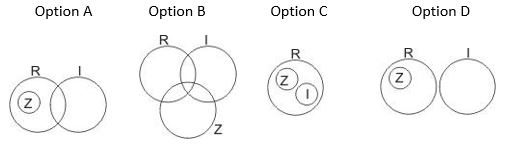
Answer : D
Question. If x times 0.1 = 90, what is x divided by 0.1?
A.9
B. 90
C. 900
D. 9000
Answer : D
Question. 87/ -8-7
A. 0
B. 814
C. 8-49
D. none of these
Answer : D
Question. Naren made a list of whole numbers in ascending order such that the 2nd number is 1 more than the 1st , the 3rd is 2 more than the 2nd, the 4th is 3 more than the 3rd and so on. If this pattern is continued, what would be the difference between the 102nd number and the 100th in the list?
A. 101
B. 200
C. 201
D. 202
Answer : C
Question. A certain comet is visible on earth once in every x years - that is, it has a periodicity of exactly x years. Three of the years in which it was seen are 1780, 1861 and 1987. Which of these could be the value of x?
A. 2
B. 5
C. 6
D. 9
Answer : D
Question. Which of the following shows the distance ∛60 units (from 0) MOST accurately on the number line? 3√60
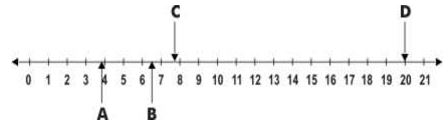
A. a
B. b
C. c
D. d
Answer : A
Question. According to the 2001 census, the population of West Bengal was nearly 8.02 crores. That is equal to
A. 8.02 million
B. 80.2 million
C. 802 million
D. 8.02 billion
Answer : B
Question. Which of the following will be an odd number?
A. (odd number + odd number) times; odd number
B. (odd number+even number) + (odd number) times odd number
C.(odd number times; odd number) + odd number
D.(even number times; odd number) + odd number
Answer : D
Question. Assume 35.1258 x 0.4111 = 14.4402. Now if 0.0351258 x 4111 x a = 0.144402, what is the value of 'a'?
A. 103
B. 102
C.10-2
D.10-3
Answer : D
Question. How many times will P be squared in the flowchart below before printing P for the 1st time? (P🡨 1 means that the value of P is set to 1)
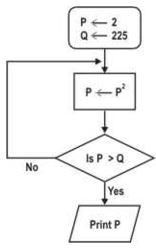
A. 1
B. 3
C.15
D.225
Answer : B
Question 1. Find two rational numbers and two irrational numbers between \( \sqrt[3]{8} \) and \( \sqrt{9} \)
Answer: First, let us simplify the given radical values:
\( \sqrt[3]{8} = 2 \)
\( \sqrt{9} = 3 \)
Now, we select numbers located between 2 and 3.
Two rational numbers:
\( 2.1 = \frac{21}{10} \) and \( 2.5 = \frac{5}{2} \)
Two irrational numbers (non-terminating and non-recurring decimals):
\( 2.1010010001\ldots \) and \( 2.2020020002\ldots \) (or roots such as \( \sqrt{5} \) and \( \sqrt{6} \)).
In simple words: The cube root of 8 equals 2 and the square root of 9 equals 3. We pick regular fractions or simple decimals like 2.1 and 2.5 for rational numbers, and unending, non-repeating decimals for irrational numbers.
Exam Tip: When writing irrational numbers between two integers, creating a pattern with increasing zeros (like 0.1010010001...) is an easy, mistake-proof way to guarantee non-terminating, non-repeating decimals.
Question 2. Show that the following numbers are rational: \( \sqrt[3]{343} \) , \( 0.\overline{325} \) , \( \sqrt{3} \times \sqrt{12} \) , \( 0.75 \) , \( (\sqrt{3}+\sqrt{2})(\sqrt{3}-\sqrt{2}) \)
Answer: A number is rational if it can be written as \( \frac{p}{q} \), where \( p \) and \( q \) are integers and \( q \neq 0 \).
1. \( \sqrt[3]{343} = \sqrt[3]{7^3} = 7 = \frac{7}{1} \), which is a fraction of integers. Hence, it is rational.
2. \( 0.\overline{325} \): Let \( x = 0.325325\ldots \)
\( \implies 1000x = 325.325325\ldots \)
\( \implies 1000x - x = 325 \)
\( \implies 999x = 325 \)
\( \implies x = \frac{325}{999} \), which is in \( \frac{p}{q} \) form. Hence, it is rational.
3. \( \sqrt{3} \times \sqrt{12} = \sqrt{3 \times 12} = \sqrt{36} = 6 = \frac{6}{1} \). Hence, it is rational.
4. \( 0.75 = \frac{75}{100} = \frac{3}{4} \), which is an integer ratio. Hence, it is rational.
5. \( (\sqrt{3}+\sqrt{2})(\sqrt{3}-\sqrt{2}) = (\sqrt{3})^2 - (\sqrt{2})^2 = 3 - 2 = 1 = \frac{1}{1} \). Hence, it is rational.
In simple words: Every number here simplifies either to a whole number or a fraction with integers on top and bottom, which makes all of them rational numbers.
Exam Tip: For repeating decimals, always show the multiplication step by 10, 100, or 1000 to clearly demonstrate conversion into the p/q form.
Question 3. Give examples to show that
i) The sum of two irrational numbers need not be irrational
ii) The product of two irrational numbers need not be irrational
iii) The square roots of all positive integers are not necessarily irrational
Answer:
(i) Take the two irrational values \( (3 + \sqrt{5}) \) and \( (3 - \sqrt{5}) \).
Their sum is \( (3 + \sqrt{5}) + (3 - \sqrt{5}) = 6 \), which is a rational number.
(ii) Take the two irrational values \( \sqrt{8} \) and \( \sqrt{2} \).
Their product is \( \sqrt{8} \times \sqrt{2} = \sqrt{16} = 4 \), which is a rational number.
(iii) Consider perfect squares like 4, 9, or 16.
Their square roots are \( \sqrt{4} = 2 \), \( \sqrt{9} = 3 \), and \( \sqrt{16} = 4 \), all of which are whole numbers and therefore rational.
In simple words: Adding or multiplying two roots can cancel out the root parts to leave an ordinary whole number, and square roots of square numbers like 4 and 9 are simple integers.
Exam Tip: Using conjugate pairs like (a + √b) and (a - √b) is the cleanest way to produce rational sums and products when constructing counterexamples.
Question 4. Without actually dividing, find whether the decimal representation of the following rational numbers will be terminating or non-terminating :
\( \frac{23}{8} \) , \( \frac{35}{50} \) , \( \frac{77}{210} \) , \( \frac{189}{125} \) , \( \frac{51}{300} \) , \( \frac{343}{700} \)
Answer: A rational number in its lowest terms \( \frac{p}{q} \) gives a terminating decimal if and only if the denominator has prime factors consisting solely of 2 and 5 (that is, \( q = 2^m \times 5^n \)). Otherwise, its decimal expansion is non-terminating repeating.
1. \( \frac{23}{8} \): The fraction is in lowest terms. Denominator \( 8 = 2^3 = 2^3 \times 5^0 \). Since the only prime factor is 2, it is terminating.
2. \( \frac{35}{50} = \frac{7}{10} \): Denominator \( 10 = 2^1 \times 5^1 \). Since the prime factors are only 2 and 5, it is terminating.
3. \( \frac{77}{210} = \frac{11}{30} \): Denominator \( 30 = 2 \times 3 \times 5 \). Because 3 is present as a prime factor, it is non-terminating repeating.
4. \( \frac{189}{125} \): The fraction is in lowest terms. Denominator \( 125 = 5^3 = 2^0 \times 5^3 \). Since the only prime factor is 5, it is terminating.
5. \( \frac{51}{300} = \frac{17}{100} \): Denominator \( 100 = 2^2 \times 5^2 \). Since the prime factors are only 2 and 5, it is terminating.
6. \( \frac{343}{700} = \frac{7^3}{7 \times 100} = \frac{49}{100} \): Denominator \( 100 = 2^2 \times 5^2 \). Since the prime factors are only 2 and 5, it is terminating.
In simple words: First cancel out any common factors between the numerator and denominator. If the bottom number breaks down into only 2s and 5s, the decimal ends; if another prime like 3 or 7 remains, it goes on forever repeating.
Exam Tip: Never factorize the denominator before simplifying the fraction to its lowest terms; failing to cancel common factors first is the most common student error here.
Question 5. Simplify :
i) \( \sqrt{8} + 3\sqrt{32} - \sqrt{50} \)
ii) \( \sqrt{12} + \sqrt{192} - \sqrt{147} \)
iii) \( \sqrt{8} \times \sqrt{50} \)
iv) \( \sqrt{63} + \sqrt{28} - \sqrt{112} \)
v) \( \sqrt{45} + \sqrt{80} - 3\sqrt{20} \)
vi) \( 4\sqrt{3} + 2\sqrt{75} - 3\sqrt{12} \)
Answer:
(i) \( \sqrt{8} + 3\sqrt{32} - \sqrt{50} = \sqrt{4 \times 2} + 3\sqrt{16 \times 2} - \sqrt{25 \times 2} \)
\( = 2\sqrt{2} + 3(4\sqrt{2}) - 5\sqrt{2} = 2\sqrt{2} + 12\sqrt{2} - 5\sqrt{2} = (2 + 12 - 5)\sqrt{2} = 9\sqrt{2} \)
(ii) \( \sqrt{12} + \sqrt{192} - \sqrt{147} = \sqrt{4 \times 3} + \sqrt{64 \times 3} - \sqrt{49 \times 3} \)
\( = 2\sqrt{3} + 8\sqrt{3} - 7\sqrt{3} = (2 + 8 - 7)\sqrt{3} = 3\sqrt{3} \)
(iii) \( \sqrt{8} \times \sqrt{50} = \sqrt{8 \times 50} = \sqrt{400} = 20 \)
(iv) \( \sqrt{63} + \sqrt{28} - \sqrt{112} = \sqrt{9 \times 7} + \sqrt{4 \times 7} - \sqrt{16 \times 7} \)
\( = 3\sqrt{7} + 2\sqrt{7} - 4\sqrt{7} = (3 + 2 - 4)\sqrt{7} = \sqrt{7} \)
(v) \( \sqrt{45} + \sqrt{80} - 3\sqrt{20} = \sqrt{9 \times 5} + \sqrt{16 \times 5} - 3\sqrt{4 \times 5} \)
\( = 3\sqrt{5} + 4\sqrt{5} - 3(2\sqrt{5}) = 7\sqrt{5} - 6\sqrt{5} = \sqrt{5} \)
(vi) \( 4\sqrt{3} + 2\sqrt{75} - 3\sqrt{12} = 4\sqrt{3} + 2\sqrt{25 \times 3} - 3\sqrt{4 \times 3} \)
\( = 4\sqrt{3} + 2(5\sqrt{3}) - 3(2\sqrt{3}) = 4\sqrt{3} + 10\sqrt{3} - 6\sqrt{3} = 8\sqrt{3} \)
In simple words: Pull perfect square factors out from under each radical sign so like surds match, then add or subtract their outer numbers together.
Exam Tip: Factor numbers into a perfect square times another integer (e.g., 192 = 64 × 3) to reduce roots in one clean step.
Question 6. Show that \( 2 + \sqrt{7} \) is an irrational number.
Answer: Let us assume, to the contrary, that \( 2 + \sqrt{7} \) is a rational number.
Then there exist co-prime integers \( a \) and \( b \) (with \( b \neq 0 \)) such that:
\( 2 + \sqrt{7} = \frac{a}{b} \)
\( \implies \sqrt{7} = \frac{a}{b} - 2 \)
\( \implies \sqrt{7} = \frac{a - 2b}{b} \)
Since \( a \) and \( b \) are integers, \( a - 2b \) is also an integer. Thus, \( \frac{a - 2b}{b} \) represents a rational number.
This leads to the deduction that \( \sqrt{7} \) is rational.
However, this contradicts the established fact that \( \sqrt{7} \) is an irrational number.
Our initial assumption must therefore be false.
Consequently, \( 2 + \sqrt{7} \) is an irrational number.
In simple words: If the whole expression were rational, subtracting 2 from it would leave the square root of 7 as a fraction, which cannot be true because 7 is not a perfect square.
Exam Tip: In contradiction proofs, always explicitly state that a and b are integers with b ≠ 0, and finish with the formal contradiction statement.
Question 7. Find points on the real-number line, corresponding to: \( \sqrt{3} \) , \( \sqrt{5} \) , \( \sqrt{10} \) , \( \sqrt{17} \) , \( \sqrt{9.8} \) , \( 2.\overline{123} \)
Answer: Each value is located using appropriate geometric and magnification techniques:
1. For \( \sqrt{3} \): First construct a right triangle with base 1 unit and perpendicular 1 unit to obtain hypotenuse \( \sqrt{1^2 + 1^2} = \sqrt{2} \). At the end of this segment, build a perpendicular of 1 unit. The new hypotenuse is \( \sqrt{(\sqrt{2})^2 + 1^2} = \sqrt{3} \). Using a compass centered at the origin, draw an arc of this length onto the number line.
2. For \( \sqrt{5} \): Since \( 5 = 2^2 + 1^2 \), draw a base of 2 units on the line and raise a perpendicular of 1 unit. The hypotenuse is \( \sqrt{2^2 + 1^2} = \sqrt{5} \). Swing an arc to cut the number line at \( \sqrt{5} \).
3. For \( \sqrt{10} \): Since \( 10 = 3^2 + 1^2 \), construct a right triangle with legs of length 3 units and 1 unit. The hypotenuse equals \( \sqrt{3^2 + 1^2} = \sqrt{10} \). Transfer this distance with a compass to the number line.
4. For \( \sqrt{17} \): Since \( 17 = 4^2 + 1^2 \), build a right triangle having legs 4 units and 1 unit. The hypotenuse gives \( \sqrt{4^2 + 1^2} = \sqrt{17} \). Mark this length onto the line.
5. For \( \sqrt{9.8} \): Mark a straight segment \( AB = 9.8 \) units and extend it by 1 unit to point \( C \) so that \( AC = 10.8 \) units. Find the midpoint \( O \) of \( AC \) and draw a semi-circle with radius \( OA \). Erect a perpendicular to \( AC \) at point \( B \) meeting the semi-circle at \( D \). The length of segment \( BD \) equals \( \sqrt{9.8} \). Swing an arc of radius \( BD \) centered at \( B \) (taken as 0) to locate the point on the number line.
6. For \( 2.\overline{123} = 2.123123\ldots \): Use the method of successive magnification:
- Step 1: Locate between 2 and 3; divide the segment into 10 equal parts.
- Step 2: Magnify the interval between 2.1 and 2.2.
- Step 3: Magnify the interval between 2.12 and 2.13.
- Step 4: Magnify the interval between 2.123 and 2.124 to locate the required point.
In simple words: For square roots of whole numbers, build right-angled triangles using Pythagoras' theorem; for decimal square roots like 9.8, construct a semicircle; and for repeating decimals, zoom in step-by-step between decimal places.
Exam Tip: For expressions like √(x), clearly mention the semi-circle construction steps: AB = x, BC = 1, find the midpoint of AC, and draw the perpendicular at B.
Question 8. Simplify by rationalising the denominator:
i) \( \frac{3}{\sqrt{2}-1} \)
ii) \( \frac{1}{7-4\sqrt{3}} \)
iii) \( \frac{1}{5+2\sqrt{6}} \)
iv) \( \frac{2\sqrt{5}}{\sqrt{6}+\sqrt{5}} \)
v) \( \frac{3\sqrt{2}}{3\sqrt{2}-\sqrt{15}} \)
vi) \( \frac{7\sqrt{3}}{\sqrt{10}+\sqrt{3}} \)
vii) \( \frac{\sqrt{3}+\sqrt{2}}{\sqrt{3}-\sqrt{2}} \)
viii) \( \frac{\sqrt{2}+1}{\sqrt{5}+\sqrt{3}} \)
Answer:
(i) Multiply top and bottom by \( (\sqrt{2}+1) \):
\( \frac{3(\sqrt{2}+1)}{(\sqrt{2}-1)(\sqrt{2}+1)} = \frac{3\sqrt{2}+3}{(\sqrt{2})^2 - 1^2} = \frac{3\sqrt{2}+3}{2-1} = 3\sqrt{2}+3 \)
(ii) Multiply top and bottom by \( (7+4\sqrt{3}) \):
\( \frac{1(7+4\sqrt{3})}{(7-4\sqrt{3})(7+4\sqrt{3})} = \frac{7+4\sqrt{3}}{7^2 - (4\sqrt{3})^2} = \frac{7+4\sqrt{3}}{49-48} = 7+4\sqrt{3} \)
(iii) Multiply top and bottom by \( (5-2\sqrt{6}) \):
\( \frac{1(5-2\sqrt{6})}{(5+2\sqrt{6})(5-2\sqrt{6})} = \frac{5-2\sqrt{6}}{5^2 - (2\sqrt{6})^2} = \frac{5-2\sqrt{6}}{25-24} = 5-2\sqrt{6} \)
(iv) Multiply top and bottom by \( (\sqrt{6}-\sqrt{5}) \):
\( \frac{2\sqrt{5}(\sqrt{6}-\sqrt{5})}{(\sqrt{6}+\sqrt{5})(\sqrt{6}-\sqrt{5})} = \frac{2\sqrt{30} - 2(5)}{(\sqrt{6})^2 - (\sqrt{5})^2} = \frac{2\sqrt{30}-10}{6-5} = 2\sqrt{30}-10 \)
(v) Multiply top and bottom by \( (3\sqrt{2}+\sqrt{15}) \):
\( \frac{3\sqrt{2}(3\sqrt{2}+\sqrt{15})}{(3\sqrt{2}-\sqrt{15})(3\sqrt{2}+\sqrt{15})} = \frac{9(2) + 3\sqrt{30}}{(3\sqrt{2})^2 - (\sqrt{15})^2} = \frac{18+3\sqrt{30}}{18-15} = \frac{3(6+\sqrt{30})}{3} = 6+\sqrt{30} \)
(vi) Multiply top and bottom by \( (\sqrt{10}-\sqrt{3}) \):
\( \frac{7\sqrt{3}(\sqrt{10}-\sqrt{3})}{(\sqrt{10}+\sqrt{3})(\sqrt{10}-\sqrt{3})} = \frac{7\sqrt{30} - 7(3)}{(\sqrt{10})^2 - (\sqrt{3})^2} = \frac{7(\sqrt{30}-3)}{10-3} = \frac{7(\sqrt{30}-3)}{7} = \sqrt{30}-3 \)
(vii) Multiply top and bottom by \( (\sqrt{3}+\sqrt{2}) \):
\( \frac{(\sqrt{3}+\sqrt{2})(\sqrt{3}+\sqrt{2})}{(\sqrt{3}-\sqrt{2})(\sqrt{3}+\sqrt{2})} = \frac{(\sqrt{3})^2 + (\sqrt{2})^2 + 2\sqrt{6}}{(\sqrt{3})^2 - (\sqrt{2})^2} = \frac{3+2+2\sqrt{6}}{3-2} = 5+2\sqrt{6} \)
(viii) Multiply top and bottom by \( (\sqrt{5}-\sqrt{3}) \):
\( \frac{(\sqrt{2}+1)(\sqrt{5}-\sqrt{3})}{(\sqrt{5}+\sqrt{3})(\sqrt{5}-\sqrt{3})} = \frac{\sqrt{10} - \sqrt{6} + \sqrt{5} - \sqrt{3}}{(\sqrt{5})^2 - (\sqrt{3})^2} = \frac{\sqrt{10} - \sqrt{6} + \sqrt{5} - \sqrt{3}}{5-3} = \frac{\sqrt{10} - \sqrt{6} + \sqrt{5} - \sqrt{3}}{2} \)
In simple words: Multiply both numerator and denominator by the conjugate of the bottom expression to eliminate all square roots from the denominator using (a + b)(a - b) = a² - b².
Exam Tip: Be careful when squaring terms like (4√3)² = 16 × 3 = 48 or (3√2)² = 9 × 2 = 18; squaring both parts correctly prevents sign errors in the denominator.
Question 9. If \( a = 9 + 4\sqrt{5} \) find i) \( a + \frac{1}{a} \) ii) \( a - \frac{1}{a} \)
Answer: Given \( a = 9 + 4\sqrt{5} \).
First, determine \( \frac{1}{a} \) by rationalising:
\( \frac{1}{a} = \frac{1}{9+4\sqrt{5}} = \frac{9-4\sqrt{5}}{(9+4\sqrt{5})(9-4\sqrt{5})} = \frac{9-4\sqrt{5}}{9^2 - (4\sqrt{5})^2} = \frac{9-4\sqrt{5}}{81-80} = 9-4\sqrt{5} \)
(i) \( a + \frac{1}{a} = (9+4\sqrt{5}) + (9-4\sqrt{5}) = 9 + 9 + 4\sqrt{5} - 4\sqrt{5} = 18 \)
(ii) \( a - \frac{1}{a} = (9+4\sqrt{5}) - (9-4\sqrt{5}) = 9 + 4\sqrt{5} - 9 + 4\sqrt{5} = 8\sqrt{5} \)
In simple words: Find 1/a by flipping the middle plus sign to a minus. Adding them doubles the first number, and subtracting them doubles the square root term.
Exam Tip: Whenever the difference of squares in the denominator is 1 (here 81 - 80 = 1), 1/a is simply the conjugate of a.
Question 10. If \( x = 3 + 2\sqrt{2} \), evaluate \( x + \frac{1}{x} \) and \( x^2 + \frac{1}{x^2} \)
Answer: Given \( x = 3 + 2\sqrt{2} \).
First, find the reciprocal \( \frac{1}{x} \):
\( \frac{1}{x} = \frac{1}{3+2\sqrt{2}} = \frac{3-2\sqrt{2}}{(3+2\sqrt{2})(3-2\sqrt{2})} = \frac{3-2\sqrt{2}}{3^2 - (2\sqrt{2})^2} = \frac{3-2\sqrt{2}}{9-8} = 3-2\sqrt{2} \)
Now, calculate \( x + \frac{1}{x} \):
\( x + \frac{1}{x} = (3+2\sqrt{2}) + (3-2\sqrt{2}) = 6 \)
Next, evaluate \( x^2 + \frac{1}{x^2} \) using the algebraic identity \( x^2 + \frac{1}{x^2} = \left(x + \frac{1}{x}\right)^2 - 2 \):
\( x^2 + \frac{1}{x^2} = (6)^2 - 2 = 36 - 2 = 34 \)
In simple words: Find 1/x first to get 6 for their sum, then square 6 and subtract 2 to find the sum of their squares.
Exam Tip: Never square x and 1/x separately; using the identity (x + 1/x)² - 2 saves substantial time and avoids arithmetic slips.
Question 11. If \( x = 7 + 4\sqrt{3} \), find i) \( x + \frac{1}{x} \) ii) \( x^2 + \frac{1}{x^2} \)
Answer: Given \( x = 7 + 4\sqrt{3} \).
Find the reciprocal \( \frac{1}{x} \) by rationalisation:
\( \frac{1}{x} = \frac{1}{7+4\sqrt{3}} = \frac{7-4\sqrt{3}}{(7+4\sqrt{3})(7-4\sqrt{3})} = \frac{7-4\sqrt{3}}{7^2 - (4\sqrt{3})^2} = \frac{7-4\sqrt{3}}{49-48} = 7-4\sqrt{3} \)
(i) \( x + \frac{1}{x} = (7+4\sqrt{3}) + (7-4\sqrt{3}) = 7 + 7 = 14 \)
(ii) Using the identity \( x^2 + \frac{1}{x^2} = \left(x + \frac{1}{x}\right)^2 - 2 \):
\( x^2 + \frac{1}{x^2} = (14)^2 - 2 = 196 - 2 = 194 \)
In simple words: The reciprocal is 7 - 4√3. Adding them gives 14, and squaring 14 minus 2 gives 194.
Exam Tip: Remember to subtract 2 from (x + 1/x)² because the 2ab term simplifies to 2(x)(1/x) = 2.
Question 12. Find rational numbers \( a \) and \( b \) such that
i) \( \frac{\sqrt{3}-1}{\sqrt{3}+1} = a + b\sqrt{3} \)
ii) \( \frac{\sqrt{5}+\sqrt{3}}{\sqrt{5}-\sqrt{3}} = a + b\sqrt{15} \)
Answer:
(i) Rationalise the left-hand side:
\( \frac{\sqrt{3}-1}{\sqrt{3}+1} = \frac{(\sqrt{3}-1)(\sqrt{3}-1)}{(\sqrt{3}+1)(\sqrt{3}-1)} = \frac{(\sqrt{3}-1)^2}{(\sqrt{3})^2 - 1^2} = \frac{3 + 1 - 2\sqrt{3}}{3 - 1} = \frac{4 - 2\sqrt{3}}{2} = 2 - \sqrt{3} \)
Now, compare \( 2 - \sqrt{3} \) with \( a + b\sqrt{3} \):
\( a = 2 \), \( b = -1 \)
(ii) Rationalise the left-hand side:
\( \frac{\sqrt{5}+\sqrt{3}}{\sqrt{5}-\sqrt{3}} = \frac{(\sqrt{5}+\sqrt{3})(\sqrt{5}+\sqrt{3})}{(\sqrt{5}-\sqrt{3})(\sqrt{5}+\sqrt{3})} = \frac{(\sqrt{5}+\sqrt{3})^2}{(\sqrt{5})^2 - (\sqrt{3})^2} = \frac{5 + 3 + 2\sqrt{15}}{5 - 3} = \frac{8 + 2\sqrt{15}}{2} = 4 + \sqrt{15} \)
Now, compare \( 4 + \sqrt{15} \) with \( a + b\sqrt{15} \):
\( a = 4 \), \( b = 1 \)
In simple words: Simplify the fraction so no roots remain in the bottom, then match the pure number part to a and the root's multiplier to b.
Exam Tip: Watch the minus sign in part (i): since the term is -√3, the value of b must be -1, not 1.
Question 13. Simplify: i) \( 16^{-\frac{3}{4}} \) ii) \( (64^{\frac{1}{2}})^{\frac{1}{3}} \) iii) \( (343)^{\frac{2}{3}} \) iv) \( 216^{-\frac{2}{3}} \) v) \( 12^{\frac{1}{3}} \times 18^{\frac{1}{3}} \) vi) \( 3 \times 9^{\frac{5}{2}} \times 9^{-\frac{1}{2}} \) vii) \( [(512)^{\frac{1}{3}}]^{\frac{1}{3}} \) viii) \( (17^2 - 15^2)^{\frac{1}{2}} \) ix) \( \frac{1}{4} \times 25^{-\frac{1}{2}} (25^{\frac{3}{2}} - 25^{\frac{1}{2}}) \) x) \( (1^3 + 2^3 + 3^3)^{\frac{1}{2}} \)
Answer:
(i) \( 16^{-\frac{3}{4}} = (2^4)^{-\frac{3}{4}} = 2^{4 \times \left(-\frac{3}{4}\right)} = 2^{-3} = \frac{1}{2^3} = \frac{1}{8} \)
(ii) \( (64^{\frac{1}{2}})^{\frac{1}{3}} = (8)^{\frac{1}{3}} = (2^3)^{\frac{1}{3}} = 2 \)
(iii) \( (343)^{\frac{2}{3}} = (7^3)^{\frac{2}{3}} = 7^{3 \times \frac{2}{3}} = 7^2 = 49 \)
(iv) \( 216^{-\frac{2}{3}} = (6^3)^{-\frac{2}{3}} = 6^{3 \times \left(-\frac{2}{3}\right)} = 6^{-2} = \frac{1}{6^2} = \frac{1}{36} \)
(v) \( 12^{\frac{1}{3}} \times 18^{\frac{1}{3}} = (12 \times 18)^{\frac{1}{3}} = (216)^{\frac{1}{3}} = (6^3)^{\frac{1}{3}} = 6 \)
(vi) \( 3 \times 9^{\frac{5}{2}} \times 9^{-\frac{1}{2}} = 3 \times 9^{\frac{5}{2} - \frac{1}{2}} = 3 \times 9^{\frac{4}{2}} = 3 \times 9^2 = 3 \times 81 = 243 \)
(vii) \( [(512)^{\frac{1}{3}}]^{\frac{1}{3}} = 512^{\frac{1}{3} \times \frac{1}{3}} = (2^9)^{\frac{1}{9}} = 2 \)
(viii) \( (17^2 - 15^2)^{\frac{1}{2}} = ((17 - 15)(17 + 15))^{\frac{1}{2}} = (2 \times 32)^{\frac{1}{2}} = (64)^{\frac{1}{2}} = 8 \)
(ix) \( \frac{1}{4} \times 25^{-\frac{1}{2}} (25^{\frac{3}{2}} - 25^{\frac{1}{2}}) = \frac{1}{4} \times (5^2)^{-\frac{1}{2}} ((5^2)^{\frac{3}{2}} - (5^2)^{\frac{1}{2}}) \)
\( = \frac{1}{4} \times 5^{-1} (5^3 - 5^1) = \frac{1}{4} \times \frac{1}{5} \times (125 - 5) = \frac{1}{20} \times 120 = 6 \)
(x) \( (1^3 + 2^3 + 3^3)^{\frac{1}{2}} = (1 + 8 + 27)^{\frac{1}{2}} = (36)^{\frac{1}{2}} = 6 \)
In simple words: Express the base numbers as powers of small prime numbers like 2, 3, 5, or 7, then use exponent rules to simplify the powers step-by-step.
Exam Tip: A negative exponent a^(-n) always converts to 1/(a^n); remember that (a^m)^n = a^(mn) by multiplying exponents together.
Question 14. In which right-angled triangle, the length of the hypotenuse is irrational number ?
i)
ii)
iii)
Answer: By Pythagoras' theorem, the hypotenuse is \( \sqrt{\text{base}^2 + \text{height}^2} \):
In triangle (i):
\( \text{Hypotenuse } AC = \sqrt{3^2 + 4^2} = \sqrt{9 + 16} = \sqrt{25} = 5 \) (which is a rational number).
In triangle (ii):
\( \text{Hypotenuse } PR = \sqrt{8^2 + 15^2} = \sqrt{64 + 225} = \sqrt{289} = 17 \) (which is a rational number).
In triangle (iii):
\( \text{Hypotenuse } XZ = \sqrt{2^2 + 3^2} = \sqrt{4 + 9} = \sqrt{13} \).
Because 13 is not a perfect square, \( \sqrt{13} \) is an irrational number.
Therefore, in triangle (iii), the length of the hypotenuse is an irrational number.
In simple words: Work out the hypotenuse for each triangle using Pythagoras' theorem. Triangles (i) and (ii) give clean whole numbers 5 and 17, while triangle (iii) gives the square root of 13, which cannot be simplified and is irrational.
Exam Tip: Clearly calculate the hypotenuse for all three triangles to show complete working before writing down the final conclusion.
Question 15. Simplify: \( a^{p-q} \times a^{q-r} \times a^{r-p} \)
Answer: Using the product law of exponents, \( a^m \times a^n \times a^k = a^{m+n+k} \):
\( a^{p-q} \times a^{q-r} \times a^{r-p} = a^{(p-q) + (q-r) + (r-p)} \)
\( = a^{p - p + q - q + r - r} \)
\( = a^0 = 1 \)
In simple words: When multiplying powers that share the same base, add their powers together. All the positive and negative terms cancel each other out, leaving a to the power of 0, which equals 1.
Exam Tip: Always state that any non-zero number raised to the zero power equals 1 (a⁰ = 1).
Free study material for Mathematics
CBSE Class 9 Mathematics Worksheets for Chapter 01 Number Systems
Daily Practice Questions for Class 9 Mathematics
Review targeted practice exercises for Class 9 Mathematics Chapter 01 Number Systems. Curated to match official CBSE guidelines, these printable problem sets support daily revision and improve overall test readiness.
Detailed Answers for Class 9 Mathematics Chapter 01 Number Systems
Each worksheet draws directly from authorized standard textbooks to maintain academic accuracy. Evaluating your finished exercises against expert-verified solutions helps master the formal presentation standards expected in school evaluations.
Complete Your Chapter Revision
Wrap up your chapter revision by testing your knowledge against standard objective question formats. Explore our full library of free, up-to-date printable assignments to maximize your academic results in upcoming CBSE evaluations.
FAQs
You can download the latest chapter-wise printable worksheets for Class 9 Mathematics Chapter 01 Number Systems for free from StudiesToday.com. These have been made as per the latest CBSE curriculum for this academic year.
Yes, Class 9 Mathematics worksheets for Chapter 01 Number Systems focus on activity-based learning and also competency-style questions. This helps students to apply theoretical knowledge to practical scenarios.
Yes, we have provided solved worksheets for Class 9 Mathematics Chapter 01 Number Systems to help students verify their answers instantly.
Yes, our Class 9 Mathematics test sheets are mobile-friendly PDFs and can be printed by teachers for classroom.
For Chapter 01 Number Systems, regular practice with our worksheets will improve question-handling speed and help students understand all technical terms and diagrams.