

Download Class 9 Mathematics Practice Worksheets
Access comprehensive chapter-wise worksheets for Chapter 01 Number Systems using the CBSE Class 9 Mathematics Number System Worksheet Set 07. Designed to align with the 2026-27 academic syllabus for Class 9 Mathematics, these printable practice sets help students reinforce key concepts and improve their overall exam readiness.
Access Chapter 01 Number Systems Practice Papers and Solutions
Navigate directly to the solved Mathematics worksheets using the digital viewer below. Each practice set includes detailed step-by-step solutions, allowing students to instantly cross-check their work and identify areas requiring further revision.
Question. If 20% of your Maths score is equal to 30% of my Maths score on a test, which of the following best describes the relation between our scores?
A. Your score is 1(1/2) times mine.
B. My score is 1/2 times yours
C. You scored 10 marks more than me.
D. I scored 10% more than you.
Answer : A
Question. Which of the following statements can be true for a natural number N?
A. When N is divided by 3, the remainder is 3 and when N is divided by 6, the remainder is 0.
B. When N is divided by 3, the remainder is 0 and when N is divided by 6, the remainder is 3.
C. When N is divided by 3, the remainder is 1 and when N is divided by 6, the remainder is 0.
D. All the three statements can be true.
Answer : B
Question. The numbers in the (n + 1)th row of the Pascal's triangle also represent the coefficients of the terms in the expansion of (x + y)n. For instance: (x + y)2 = 1x2 + 2xy + 1y2, (x+y)3 = 1x3 + 3x2y + 3xy2 + 1y3 .The 6th row of the triangle would represent the coefficients of which of these expressions?
A. (x + y)5
B. (x + 5y)6
C. (x + y)6
D. (x + y)4
Answer : A
Question. Which of the following is closest to 8.413/0.19 ?
A. 0.44
B. 4.4
C. 44
D. 440
Answer : C
Question. What decimal fraction of the figure below is shaded
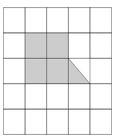
A. 0.45
B. 0.045
C. 0.09
D. 0.18
Answer : D
Question. Scientific Notation is a concise way of writing any number in the form a x 10b where a is a number between 1 and 10 and b is an integer. For example, 652 would be written as 6.52 x 10² in this notation. Which of the following is most likely to contain a negative exponent of 10 when represented in scientific notation?
A. Number of cells in a honeycomb
B. Speed of light in kilometres per second
C. Diameter of a blood cell in centimetres
D. Mass of an airplane in kilograms
Answer : D
Question. In which of the following lists are ALL three numbers irrational?
A. 0, -3, 3.14
B. 22/7 , 0.0141414....., √3
C. √2,√3,√4
D. 3.919119111911119....,√5 ,
Answer : D
Question. If x is such that it satisfies BOTH the inequalities: -2 <x and x≤ 2 which of the following number lines correctly depicts the values of x?

Answer : A
Question. Which of the following numbers will have a '6' in the unit's place?
A. 26
B. 216
C. 226
D. 246
Answer : B
Question. The set of Natural numbers is said to be 'CLOSED' under the operation '+' because for any Natural numbers m and n, the number m + n is also a Natural number. Under which operations is the set of Integers 'CLOSED'?
A. +, -, x and ÷
B. +, - and x
C. only + and x
D. only + and -
Answer : B
Question. If p is a non-zero Rational number, which of the following might NOT be Rational?
A. √3p
B. p-3
C. -p3
D. 3/p
Answer : A
Question. Which of the following is equal to 1?
A. 17-2 + 172
B. 172 - 17-2
C. 17-2 x 172
D. 172/17-2
Answer : C
Question. Which of these numbers can be written as a non-terminating, repeating decimal?
A. √3p
B. √3
C. 3/24
D. 1/12
Answer : A
Question. If the square of ‘x’ is 5, then square of ‘4x’ will be
A. 400
B. 80
C. 60
D. 20
Answer : B
Work Sheet - Number System
Question 1. Find 2 rational nos. and 2 irrational nos. between
a) 1/3 & 1/4
b) 1.3 & 1.4
c) 0.2 & 0.2̄
d) 1 & √2
Answer:
a) Between \( \frac{1}{4} = 0.25 \) and \( \frac{1}{3} = 0.3333\dots \):
Two rational numbers: \( 0.26 = \frac{13}{50} \) and \( 0.30 = \frac{3}{10} \).
Two irrational numbers: \( 0.26010010001\dots \) and \( 0.27010010001\dots \)
b) Between \( 1.3 \) and \( 1.4 \):
Two rational numbers: \( 1.31 = \frac{131}{100} \) and \( 1.35 = \frac{27}{20} \).
Two irrational numbers: \( 1.31010010001\dots \) and \( 1.32010010001\dots \)
c) Between \( 0.2 = 0.2000\dots \) and \( 0.\overline{2} = 0.2222\dots \):
Two rational numbers: \( 0.21 = \frac{21}{100} \) and \( 0.215 = \frac{43}{200} \).
Two irrational numbers: \( 0.21010010001\dots \) and \( 0.215010010001\dots \)
d) Between \( 1 \) and \( \sqrt{2} \approx 1.4142\dots \):
Two rational numbers: \( 1.1 = \frac{11}{10} \) and \( 1.2 = \frac{6}{5} \).
Two irrational numbers: \( 1.2010010001\dots \) and \( 1.3010010001\dots \)
In simple words: Rational numbers have decimals that terminate or repeat, while irrational numbers have non-terminating and non-repeating decimal expansions.
Exam Tip: To create an irrational number easily, write a non-repeating pattern of zeros such as \( 0.1010010001\dots \)
Question 2. Express the following nos. in the form p/q where p & q are integers and q ≠ 0.
a) 0.6̄
b) 1.307̄
c) 0.023̄
d) 3.37̄9̄
Answer:
a) Let \( x = 0.\overline{6} = 0.666\dots \)
Multiplying by 10:
\( 10x = 6.666\dots \)
Subtracting the first equation from the second:
\( 9x = 6 \)
\( \implies x = \frac{6}{9} = \frac{2}{3} \).
b) Let \( x = 1.\overline{307} = 1.307307\dots \)
Multiplying by 1000:
\( 1000x = 1307.307\dots \)
Subtracting:
\( 999x = 1306 \)
\( \implies x = \frac{1306}{999} \).
c) Let \( x = 0.02\overline{3} = 0.02333\dots \)
Multiply by 100 to shift non-repeating digits:
\( 100x = 2.\overline{3} \)
Multiply by 1000:
\( 1000x = 23.\overline{3} \)
Subtracting gives:
\( 900x = 21 \)
\( \implies x = \frac{21}{900} = \frac{7}{300} \).
d) Let \( x = 3.3\overline{79} = 3.37979\dots \)
Multiply by 10:
\( 10x = 33.\overline{79} \)
Multiply by 1000:
\( 1000x = 3379.\overline{79} \)
Subtracting gives:
\( 990x = 3346 \)
\( \implies x = \frac{3346}{990} = \frac{1673}{495} \).
In simple words: Multiply by powers of 10 to line up the repeating parts, subtract to cancel the infinite decimal, and simplify the fraction.
Exam Tip: Always reduce the final fraction \( \frac{p}{q} \) to its lowest terms to ensure full credit.
Question 3. Represent on the number line geometrically.
a) √7
b) √17
c) √6.5
Answer:
a) Representation of \( \sqrt{7} \):
By Pythagoras theorem, \( \sqrt{7} = \sqrt{(\sqrt{6})^2 + 1^2} \).
First, construct \( \sqrt{4} = 2 \) units along the line, erect a perpendicular of 1 unit to get \( \sqrt{5} \). Repeat successively to obtain \( \sqrt{6} \) and then \( \sqrt{7} \).
b) Representation of \( \sqrt{17} \):
Express 17 as the sum of two squares: \( 17 = 4^2 + 1^2 \).
Take 4 units along the baseline from 0 to point A. Draw a perpendicular line segment AB of length 1 unit at A. By Pythagoras theorem:
\( \text{OB} = \sqrt{4^2 + 1^2} = \sqrt{17} \).
With O as centre and radius OB, sweep an arc down to meet the number line at \( \sqrt{17} \approx 4.12 \).
c) Representation of \( \sqrt{6.5} \):
1. Mark segment AB = 6.5 units on a straight line.
2. Extend AB by 1 unit to point C such that BC = 1 unit.
3. Find the midpoint M of AC, where \( \text{AC} = 7.5 \) units and \( \text{MC} = 3.75 \) units.
4. Draw a semicircle with centre M and radius MA.
5. Erect a perpendicular at B intersecting the semicircle at D. The length \( \text{BD} = \sqrt{6.5} \).
6. With B as origin (0) and radius BD, draw an arc cutting the number line at point E, which represents \( \sqrt{6.5} \). In simple words: Mark the length plus 1 unit, draw a semicircle over it, and raise a perpendicular at the join to get the square root.
Exam Tip: For decimals like \( \sqrt{x} \), always use the geometric semicircle method where diameter is \( x + 1 \).
Question 4. Evaluate
a) (1³ + 2³ + 3³)^{-1/2}
b) \frac{(25)^{5/2} \times (729)^{1/2} \times (8)^{-2/3}}{(125)^{2/3} \times (27)^{2/3} \times (225)^{3/2}}
c) \frac{1}{1+\sqrt{2}} + \frac{1}{\sqrt{2}+\sqrt{3}} + \frac{1}{\sqrt{3}+\sqrt{4}} + \dots + \frac{1}{\sqrt{8}+\sqrt{9}}
Answer:
a) Evaluate the sum of cubes inside the parentheses:
\( 1^3 + 2^3 + 3^3 = 1 + 8 + 27 = 36 \)
\( (36)^{-1/2} = \frac{1}{\sqrt{36}} = \frac{1}{6} \).
b) Express all bases in prime factor form:
\( (25)^{5/2} = (5^2)^{5/2} = 5^5 \)
\( (729)^{1/2} = (3^6)^{1/2} = 3^3 \)
\( (8)^{-2/3} = (2^3)^{-2/3} = 2^{-2} = \frac{1}{2^2} \)
Denominator:
\( (125)^{2/3} = (5^3)^{2/3} = 5^2 \)
\( (27)^{2/3} = (3^3)^{2/3} = 3^2 \)
\( (225)^{3/2} = (15^2)^{3/2} = 15^3 = (3 \times 5)^3 = 3^3 \times 5^3 \)
Combine powers:
Numerator = \( \frac{5^5 \times 3^3}{4} \)
Denominator = \( 5^2 \times 3^2 \times 3^3 \times 5^3 = 5^5 \times 3^5 \)
Dividing numerator by denominator:
\( = \frac{5^5 \times 3^3}{4 \times 5^5 \times 3^5} = \frac{1}{4 \times 3^2} = \frac{1}{36} \).
c) Rationalize each term using \( \frac{1}{\sqrt{n} + \sqrt{n+1}} = \sqrt{n+1} - \sqrt{n} \):
\( \frac{1}{1+\sqrt{2}} = \sqrt{2} - 1 \)
\( \frac{1}{\sqrt{2}+\sqrt{3}} = \sqrt{3} - \sqrt{2} \)
\( \dots \)
\( \frac{1}{\sqrt{8}+\sqrt{9}} = \sqrt{9} - \sqrt{8} \)
Adding all rationalized terms, intermediate terms cancel out in a telescoping sum:
\( = (\sqrt{2} - 1) + (\sqrt{3} - \sqrt{2}) + \dots + (\sqrt{9} - \sqrt{8}) \)
\( = \sqrt{9} - 1 = 3 - 1 = 2 \).
In simple words: Change bases to prime powers to cancel common factors, and rationalize terms in long sums to watch intermediate values cancel.
Exam Tip: In telescoping radical sums, only the very first and very last terms survive after cancellation.
Question 5. Simplify by rationalising the denominator.
a) \frac{30}{5\sqrt{3} - 3\sqrt{5}}
b) \frac{1}{\sqrt{3} - \sqrt{2} - 1}
c) \frac{3\sqrt{2}}{\sqrt{6} - \sqrt{3}} - \frac{4\sqrt{3}}{\sqrt{6} - \sqrt{2}} + \frac{2\sqrt{3}}{2 + \sqrt{6}}
d) \frac{3\sqrt{6}}{5\sqrt{3} - \sqrt{32} + 2\sqrt{12} - \sqrt{50}}
Answer:
a) Multiply numerator and denominator by the conjugate \( 5\sqrt{3} + 3\sqrt{5} \):
\( \frac{30(5\sqrt{3} + 3\sqrt{5})}{(5\sqrt{3})^2 - (3\sqrt{5})^2} = \frac{30(5\sqrt{3} + 3\sqrt{5})}{75 - 45} = \frac{30(5\sqrt{3} + 3\sqrt{5})}{30} = 5\sqrt{3} + 3\sqrt{5} \).
b) Group as \( (\sqrt{3} - 1) - \sqrt{2} \) and multiply by \( (\sqrt{3} - 1) + \sqrt{2} \):
\( \frac{(\sqrt{3} - 1) + \sqrt{2}}{[(\sqrt{3} - 1) - \sqrt{2}][(\sqrt{3} - 1) + \sqrt{2}]} = \frac{\sqrt{3} - 1 + \sqrt{2}}{(\sqrt{3} - 1)^2 - 2} = \frac{\sqrt{3} + \sqrt{2} - 1}{4 - 2\sqrt{3} - 2} = \frac{\sqrt{3} + \sqrt{2} - 1}{2 - 2\sqrt{3}} \)
Alternatively, grouping as \( \sqrt{3} - (\sqrt{2} + 1) \):
Multiply numerator and denominator by \( \sqrt{3} + (\sqrt{2} + 1) \):
Denominator: \( 3 - (\sqrt{2} + 1)^2 = 3 - (3 + 2\sqrt{2}) = -2\sqrt{2} \).
Multiplying numerator and denominator by \( \sqrt{2} \):
\( = \frac{(\sqrt{3} + \sqrt{2} + 1)\sqrt{2}}{-2\sqrt{2} \times \sqrt{2}} = -\frac{1}{4}(\sqrt{6} + 2 + \sqrt{2}) \).
c) Rationalize each term individually:
Term 1: \( \frac{3\sqrt{2}(\sqrt{6} + \sqrt{3})}{6 - 3} = \frac{3\sqrt{2}(\sqrt{6} + \sqrt{3})}{3} = \sqrt{12} + \sqrt{6} = 2\sqrt{3} + \sqrt{6} \)
Term 2: \( \frac{4\sqrt{3}(\sqrt{6} + \sqrt{2})}{6 - 2} = \frac{4\sqrt{3}(\sqrt{6} + \sqrt{2})}{4} = \sqrt{18} + \sqrt{6} = 3\sqrt{2} + \sqrt{6} \)
Term 3: \( \frac{2\sqrt{3}(\sqrt{6} - 2)}{6 - 4} = \frac{2\sqrt{3}(\sqrt{6} - 2)}{2} = \sqrt{18} - 2\sqrt{3} = 3\sqrt{2} - 2\sqrt{3} \)
Combining:
\( (2\sqrt{3} + \sqrt{6}) - (3\sqrt{2} + \sqrt{6}) + (3\sqrt{2} - 2\sqrt{3}) = 0 \).
d) Simplify the terms in the denominator first:
\( \sqrt{32} = 4\sqrt{2} \), \( 2\sqrt{12} = 4\sqrt{3} \), \( \sqrt{50} = 5\sqrt{2} \)
Denominator = \( 5\sqrt{3} - 4\sqrt{2} + 4\sqrt{3} - 5\sqrt{2} = 9\sqrt{3} - 9\sqrt{2} = 9(\sqrt{3} - \sqrt{2}) \).
Expression = \( \frac{3\sqrt{6}}{9(\sqrt{3} - \sqrt{2})} = \frac{\sqrt{6}}{3(\sqrt{3} - \sqrt{2})} \)
Multiply numerator and denominator by \( \sqrt{3} + \sqrt{2} \):
\( = \frac{\sqrt{6}(\sqrt{3} + \sqrt{2})}{3(3 - 2)} = \frac{\sqrt{18} + \sqrt{12}}{3} = \frac{3\sqrt{2} + 2\sqrt{3}}{3} = \sqrt{2} + \frac{2\sqrt{3}}{3} \).
In simple words: Multiply top and bottom by the conjugate expression to eliminate square roots from denominators.
Exam Tip: Simplify individual surds such as \( \sqrt{32} = 4\sqrt{2} \) and \( \sqrt{50} = 5\sqrt{2} \) before attempting to rationalize a multi-term denominator.
Question 6. If x = 3+√8 find the value of x² + 1/x² and x³ - 1/x³
Answer: Given \( x = 3 + \sqrt{8} \).
Calculate \( \frac{1}{x} \):
\( \frac{1}{x} = \frac{1}{3 + \sqrt{8}} = \frac{3 - \sqrt{8}}{3^2 - (\sqrt{8})^2} = \frac{3 - \sqrt{8}}{9 - 8} = 3 - \sqrt{8} \).
Then:
\( x + \frac{1}{x} = (3 + \sqrt{8}) + (3 - \sqrt{8}) = 6 \)
\( x - \frac{1}{x} = (3 + \sqrt{8}) - (3 - \sqrt{8}) = 2\sqrt{8} = 4\sqrt{2} \).
Now, calculate \( x^2 + \frac{1}{x^2} \):
\( x^2 + \frac{1}{x^2} = \left(x + \frac{1}{x}\right)^2 - 2 = 6^2 - 2 = 36 - 2 = 34 \).
Next, calculate \( x^3 - \frac{1}{x^3} \):
\( x^3 - \frac{1}{x^3} = \left(x - \frac{1}{x}\right)^3 + 3\left(x - \frac{1}{x}\right) \)
\( = (2\sqrt{8})^3 + 3(2\sqrt{8}) = 8(8\sqrt{8}) + 6\sqrt{8} = 70\sqrt{8} = 70(2\sqrt{2}) = 140\sqrt{2} \).
In simple words: Find \( 1/x \) by rationalizing, then use standard algebraic identities with \( (x + 1/x) \) and \( (x - 1/x) \).
Exam Tip: Notice that \( 3^2 - (\sqrt{8})^2 = 1 \), so \( \frac{1}{x} \) is simply the conjugate \( 3 - \sqrt{8} \).
Question 7. If x = \frac{\sqrt{3} - \sqrt{2}}{\sqrt{3} + \sqrt{2}} and y = \frac{\sqrt{3} + \sqrt{2}}{\sqrt{3} - \sqrt{2}} find x³ + y³
Answer: Rationalize \( x \) and \( y \):
\( x = \frac{(\sqrt{3} - \sqrt{2})^2}{3 - 2} = 3 + 2 - 2\sqrt{6} = 5 - 2\sqrt{6} \)
\( y = \frac{(\sqrt{3} + \sqrt{2})^2}{3 - 2} = 3 + 2 + 2\sqrt{6} = 5 + 2\sqrt{6} \)
Now find the sum and product:
\( x + y = (5 - 2\sqrt{6}) + (5 + 2\sqrt{6}) = 10 \)
\( xy = (5 - 2\sqrt{6})(5 + 2\sqrt{6}) = 25 - 24 = 1 \)
Using the identity \( x^3 + y^3 = (x + y)^3 - 3xy(x + y) \):
\( x^3 + y^3 = (10)^3 - 3(1)(10) = 1000 - 30 = 970 \).
In simple words: Simplify both fractions first to find their sum and product, then evaluate using the sum of cubes formula.
Exam Tip: Do not cube the radical expressions directly; always use the identity \( (x+y)^3 - 3xy(x+y) \).
Question 8. If a^x = b^y = c^z and b² = ac, then S.T. y = \frac{2xz}{x+z}
Answer: Let \( a^x = b^y = c^z = k \).
Express \( a, b, c \) in terms of \( k \):
\( a = k^{1/x}, \quad b = k^{1/y}, \quad c = k^{1/z} \).
Substitute into the given equation \( b^2 = ac \):
\( (k^{1/y})^2 = (k^{1/x})(k^{1/z}) \)
\( k^{2/y} = k^{1/x + 1/z} \)
Equating the exponents since bases are equal:
\( \frac{2}{y} = \frac{1}{x} + \frac{1}{z} \)
\( \frac{2}{y} = \frac{x + z}{xz} \)
Taking the reciprocal on both sides:
\( \implies y = \frac{2xz}{x + z} \).
Hence proved.
In simple words: Equate all powers to a single constant k, express the bases as fractional powers, and equate exponents.
Exam Tip: State clearly that since the base \( k \neq 0, 1 \), the exponents on both sides must be equal.
Question 9. S.T. (x^{a-b})^{a+b} × (x^{b-c})^{b+c} × (x^{c-a})^{c+a} = 1
Answer: Applying the law of exponents \( (x^m)^n = x^{mn} \):
\( \text{LHS} = x^{(a-b)(a+b)} \times x^{(b-c)(b+c)} \times x^{(c-a)(c+a)} \)
Using the identity \( (u - v)(u + v) = u^2 - v^2 \):
\( = x^{a^2 - b^2} \times x^{b^2 - c^2} \times x^{c^2 - a^2} \)
Using the product rule \( x^p \times x^q \times x^r = x^{p+q+r} \):
\( = x^{(a^2 - b^2) + (b^2 - c^2) + (c^2 - a^2)} \)
\( = x^0 = 1 = \text{RHS} \).
Hence proved.
In simple words: Multiply powers using the difference of squares, then add exponents together to get power zero, which equals 1.
Exam Tip: Recall that any non-zero base raised to the power zero equals 1: \( x^0 = 1 \).
Question 10. S.T. \frac{a^{-1}}{a^{-1} + b^{-1}} - \frac{a^{-1}}{a^{-1} - b^{-1}} = \frac{2ab}{a^2 - b^2}
Answer: Rewrite negative exponents as reciprocals:
\( a^{-1} = \frac{1}{a} \) and \( b^{-1} = \frac{1}{b} \).
Then:
\( \frac{a^{-1}}{a^{-1} + b^{-1}} = \frac{\frac{1}{a}}{\frac{1}{a} + \frac{1}{b}} = \frac{\frac{1}{a}}{\frac{b + a}{ab}} = \frac{b}{a + b} \)
Similarly:
\( \frac{a^{-1}}{a^{-1} - b^{-1}} = \frac{\frac{1}{a}}{\frac{1}{a} - \frac{1}{b}} = \frac{\frac{1}{a}}{\frac{b - a}{ab}} = \frac{b}{b - a} = -\frac{b}{a - b} \)
Substitute into LHS:
\( \text{LHS} = \frac{b}{a + b} - \left(-\frac{b}{a - b}\right) = \frac{b}{a + b} + \frac{b}{a - b} \)
Find a common denominator:
\( = \frac{b(a - b) + b(a + b)}{(a + b)(a - b)} = \frac{ab - b^2 + ab + b^2}{a^2 - b^2} = \frac{2ab}{a^2 - b^2} = \text{RHS} \).
Hence proved.
In simple words: Replace negative powers with fractions, simplify the compound fractions, and add them with a common denominator.
Exam Tip: Watch the minus sign in the denominator: \( \frac{b}{b - a} = -\frac{b}{a - b} \).
Question 11. If \frac{7+\sqrt{5}}{7-\sqrt{5}} - \frac{7-\sqrt{5}}{7+\sqrt{5}} = a + b\sqrt{5} find the value of a & b.
Answer: Simplify the left-hand side by taking a common denominator:
\( \text{LHS} = \frac{(7 + \sqrt{5})^2 - (7 - \sqrt{5})^2}{(7 - \sqrt{5})(7 + \sqrt{5})} \)
Using the identity \( (x + y)^2 - (x - y)^2 = 4xy \):
Numerator = \( 4(7)(\sqrt{5}) = 28\sqrt{5} \)
Denominator = \( 7^2 - (\sqrt{5})^2 = 49 - 5 = 44 \)
\( \text{LHS} = \frac{28\sqrt{5}}{44} = \frac{7\sqrt{5}}{11} = 0 + \frac{7}{11}\sqrt{5} \)
Comparing with \( a + b\sqrt{5} \):
\( a = 0 \) and \( b = \frac{7}{11} \).
In simple words: Combine fractions over a common denominator, simplify the numerator, and equate corresponding rational and irrational parts.
Exam Tip: When there is no rational term on the simplified left side, \( a \) is simply 0.
Question 12. Solve for x. 2^{3x-6} × 3^{2x-3} = 216
Answer: Express 216 as a product of its prime factors:
\( 216 = 2^3 \times 3^3 \)
The given equation becomes:
\( 2^{3x-6} \times 3^{2x-3} = 2^3 \times 3^3 \)
Equating the exponents of corresponding prime bases:
For base 2:
\( 3x - 6 = 3 \)
\( \implies 3x = 9 \)
\( \implies x = 3 \)
For base 3:
\( 2x - 3 = 3 \)
\( \implies 2x = 6 \)
\( \implies x = 3 \)
Both give the consistent solution \( x = 3 \).
In simple words: Factor 216 into prime powers of 2 and 3, then set the matching powers equal to each other.
Exam Tip: Check that the value of \( x \) satisfies the exponent equations for both prime bases.
Question 13. If x = 9 + 4√5 find the value of √x + 1/√x
Answer: Express \( x \) as a perfect square:
\( x = 9 + 4\sqrt{5} = 5 + 4 + 2(2)(\sqrt{5}) = (\sqrt{5})^2 + 2^2 + 2(2)(\sqrt{5}) = (\sqrt{5} + 2)^2 \)
Taking the positive square root:
\( \sqrt{x} = \sqrt{5} + 2 \)
Now find \( \frac{1}{\sqrt{x}} \):
\( \frac{1}{\sqrt{x}} = \frac{1}{\sqrt{5} + 2} = \frac{\sqrt{5} - 2}{(\sqrt{5})^2 - 2^2} = \frac{\sqrt{5} - 2}{5 - 4} = \sqrt{5} - 2 \)
Adding both:
\( \sqrt{x} + \frac{1}{\sqrt{x}} = (\sqrt{5} + 2) + (\sqrt{5} - 2) = 2\sqrt{5} \).
In simple words: Rewrite x as the square of \( (\sqrt{5} + 2) \), take its square root, and add it to its rationalized reciprocal.
Exam Tip: Decompose the constant term 9 into \( a^2 + b^2 = 5 + 4 \) to spot the square pattern \( (a+b)^2 \) easily.
Question 14. Choose the most suitable option from the bracket and give eg. to support your answer. "Product of a rational number and an irrational number is _______" [rational / irrational / not a real number / rational or irrational]
Answer: The most suitable option is rational or irrational.
Supporting Examples:
1. If the rational number is zero:
\( 0 \times \sqrt{3} = 0 \), which is a rational number.
2. If the rational number is non-zero (e.g., 2):
\( 2 \times \sqrt{3} = 2\sqrt{3} \), which is an irrational number.
Because zero makes the product rational while any non-zero rational keeps it irrational, the product can be rational or irrational.
In simple words: The result is usually irrational, but multiplying by zero produces a rational number, so both outcomes are possible.
Exam Tip: Always remember that zero is a rational number that acts as an exception in multiplication.
Question 15. Find the value of 0.6 + 0.7̄ + 0.47̄ in the p/q form where p & q are integers and q ≠ 0
Answer: Convert each decimal to fractional form:
1. \( 0.6 = \frac{6}{10} = \frac{3}{5} \)
2. Let \( x = 0.\overline{7} \implies 10x = 7.\overline{7} \implies 9x = 7 \implies x = \frac{7}{9} \)
3. Let \( y = 0.4\overline{7} \implies 10y = 4.\overline{7} \) and \( 100y = 47.\overline{7} \)
\( 90y = 43 \implies y = \frac{43}{90} \)
Now add the three fractions:
\( \frac{6}{10} + \frac{7}{9} + \frac{43}{90} = \frac{6 \times 9 + 7 \times 10 + 43}{90} \)
\( = \frac{54 + 70 + 43}{90} = \frac{167}{90} \).
In simple words: Convert the terminating and repeating decimals into fractions with common denominator 90, then add them up.
Exam Tip: Notice carefully whether a digit has a bar: 0.6 has no bar, while 0.7 and the 7 in 0.47 have bars.
Question 16(i). 0.123̄ =
(a) 111/990
(b) 123/990
(c) 120/900
(d) 111/900
Answer: (d) 111/900
In simple words: Subtract the non-repeating part 12 from 123 to get 111, placed over 900 for one repeating digit and two non-repeating digits.
Exam Tip: The shortcut formula is: \( \frac{\text{Complete Number} - \text{Non-repeating part}}{900} = \frac{123 - 12}{900} = \frac{111}{900} \).
Question 16(ii). which of the following is irrational?
(a) √4/9
(b) √12/√3
(c) √7 × √2
(d) √2025
Answer: (c) √7 × √2
In simple words: \( \sqrt{7} \times \sqrt{2} = \sqrt{14} \), which cannot be simplified to a whole number or simple fraction.
Exam Tip: Evaluate options fully: \( \sqrt{4/9} = 2/3 \), \( \sqrt{12}/\sqrt{3} = 2 \), and \( \sqrt{2025} = 45 \) are all rational.
Question 16(iii). When you represent √3 on the number line, it lies in between
(a) 0 & 1
(b) 1 & 2
(c) 2 & 3
(d) 3 & 4
Answer: (b) 1 & 2
In simple words: Since 3 is between 1 and 4, its square root lies between 1 and 2 (approximately 1.732).
Exam Tip: Use perfect squares: \( 1 < 3 < 4 \implies \sqrt{1} < \sqrt{3} < \sqrt{4} \implies 1 < \sqrt{3} < 2 \).
Question 16(iv). If (27)^x = 9 / 3^x then x =
(a) 3
(b) 1/2
(c) 2
(d) 1
Answer: (b) 1/2
In simple words: Write in base 3 to get \( 3^{3x} = 3^{2-x} \), leading to \( 4x = 2 \), so \( x = 1/2 \).
Exam Tip: Convert all powers to the common base 3: \( (3^3)^x = 3^2 / 3^x \implies 3^{3x} = 3^{2-x} \).
Question 16(v). Which of the following is equal to x?
(a) x^{12/7 + 5/7}
(b) x^{12/7} × x^{7/12}
(c) (√(x^3))^{3/2}
(d) \sqrt[12]{(x^4)^3}
Answer: (d) \sqrt[12]{(x^4)^3}
In simple words: In option (d), the power is \( 4 \times 3 = 12 \), and the 12th root of \( x^{12} \) is simply x.
Exam Tip: Multiply powers using the law \( (x^a)^b = x^{ab} \): \( \sqrt[12]{x^{12}} = x^{12/12} = x^1 \).
Question 16(vi). If 4^{2y} = 256 then 4^{-y} =
(a) 1/16
(b) -1/16
(c) 1/4
(d) 16
Answer: (a) 1/16
In simple words: Since \( 256 = 4^4 \), \( 2y = 4 \) giving \( y = 2 \). Then \( 4^{-2} = 1/16 \).
Exam Tip: A negative exponent means reciprocal: \( 4^{-y} = \frac{1}{4^y} = \frac{1}{4^2} = \frac{1}{16} \).
Question 16(vii). \sqrt[4]{\sqrt[3]{2^2}} = _______
(a) 2^{1/6}
(b) 2^{-6}
(c) 2^{2/3}
(d) 2^6
Answer: (a) 2^{1/6}
In simple words: Multiply the radical indices: \( \sqrt[4]{\sqrt[3]{2^2}} = (2^2)^{1/12} = 2^{2/12} = 2^{1/6} \).
Exam Tip: Combine radical roots: \( \sqrt[m]{\sqrt[n]{a}} = \sqrt[mn]{a} \).
Question 16(viii). (√7 - √5)² ÷ (6 - √35) = _______
(a) 1
(b) -1
(c) 2
(d) -2
Answer: (c) 2
In simple words: Expanding the numerator gives \( 12 - 2\sqrt{35} \), which is exactly twice \( 6 - \sqrt{35} \).
Exam Tip: Factor out 2 from \( 12 - 2\sqrt{35} = 2(6 - \sqrt{35}) \) to cancel the entire denominator cleanly.
Question 16(ix). An irrational no. between √2 & √3 is
(a) (√2+√3)/2
(b) (√3-√2)/2
(c) (√2×√3)/2
(d) √3/√2
Answer: (a) (√2+√3)/2
In simple words: The average of two distinct irrational numbers lies strictly between them and is itself irrational here.
Exam Tip: Check decimal estimates: \( \frac{1.414 + 1.732}{2} \approx 1.573 \), which falls right between \( 1.414 \) and \( 1.732 \).
Question 16(x). A rational no. equivalent to 7/19 is
(a) 17/119
(b) 14/57
(c) 21/57
(d) 49/361
Answer: (c) 21/57
In simple words: Multiply numerator and denominator by 3 to get \( \frac{21}{57} \).
Exam Tip: Equivalent rational numbers must maintain the exact same ratio: \( \frac{7 \times 3}{19 \times 3} = \frac{21}{57} \).
Free study material for Mathematics
Chapter 01 Number Systems Printable Worksheets and Exercises for Class 9 Mathematics
Daily Practice Questions for Class 9 Mathematics
Access structured practice worksheets for Chapter 01 Number Systems aligned with the 2026 CBSE curriculum. These downloadable exercises for Class 9 Mathematics help students build accuracy and reinforce core concepts for upcoming school tests.
Detailed Answers for Class 9 Mathematics Chapter 01 Number Systems
Built using official NCERT guidelines for Class 9 Mathematics, these practice sheets provide reliable academic support. Cross-reference your completed work with our detailed solutions to learn standard answer-writing formats for CBSE exams.
Complete Your Chapter Revision
Consistent engagement with these exercises builds familiarity with recurring exam themes. If specific areas within Chapter 01 Number Systems cause trouble, utilize our dedicated NCERT solutions for Class 9 Mathematics to clear up doubts immediately.
FAQs
You can download the latest chapter-wise printable worksheets for Class 9 Mathematics Chapter 01 Number Systems for free from StudiesToday.com. These have been made as per the latest CBSE curriculum for this academic year.
Yes, Class 9 Mathematics worksheets for Chapter 01 Number Systems focus on activity-based learning and also competency-style questions. This helps students to apply theoretical knowledge to practical scenarios.
Yes, we have provided solved worksheets for Class 9 Mathematics Chapter 01 Number Systems to help students verify their answers instantly.
Yes, our Class 9 Mathematics test sheets are mobile-friendly PDFs and can be printed by teachers for classroom.
For Chapter 01 Number Systems, regular practice with our worksheets will improve question-handling speed and help students understand all technical terms and diagrams.