

Class 9 Mathematics Practice Sheet: CBSE Class 9 Mathematics Circles Worksheet Set 03
Explore structured practice materials through the CBSE Class 9 Mathematics Circles Worksheet Set 03. Tailored for Class 9 learners, utilizing these Mathematics worksheets ensures thorough preparation and strengthens problem-solving accuracy before final school evaluations.
Download Chapter 09 Circle Worksheet PDF with Answers
Navigate directly to the solved Mathematics worksheets using the digital viewer below. Each practice set includes detailed step-by-step solutions, allowing students to instantly cross-check their work and identify areas requiring further revision.
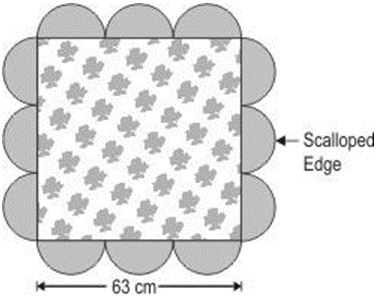
Question. Sunidhi's mother made a square table cloth with scalloped edges made of equal semi-circles as shown:
If she wants to fix lace all along the scalloped edges, about how many metres of lace would she need?
(a) 4
(b) 6
(c) 8
(d) 12
Answer : A
Question. Sania drew a quadrilateral PQRS in which the opposite angles were supplementary but the adjacent angles were not. What kind of quadrilateral was PQRS?
(a) A trapezium
(b) A rhombus
(c) A parallelogram
(d) A cyclic quadrilateral
Answer : D
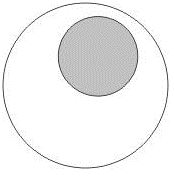
Question. Two circular sheets have diameters in the ratio 1:2. If the smaller circular sheet is put on top of the larger one as shown, what part of the larger circular sheet remains uncovered?
(a) 1/4
(b) 3/4
(c) 2/4
(d) 4/4
Answer : B
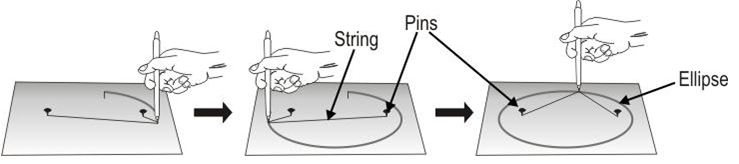
Question. An 'ellipse' is a closed curve drawn in this way: Fix two points (focuses or foci) and move a pencil along the end of a closed string as shown in the figure:From this, we can say that an ellipse is the curve traced by a point moving in such a way that
(a) its distance from a fixed point remains the same.
(b) its distance from 2 fixed points remains the same.
(c) the sum of its distances from 2 fixed points remains the same.
(d) the difference of its distances from 2 fixed points remains the same.
Answer : C
Question. A gardener can trim a square lawn of side 50 metres in 4 hours. At the same rate, how long will it take him to trim a square lawn of side 25 metres?
(a) 1 hour
(b) 2 hours
(c) 2 hours 30 minutes
(d) 3 hours
Answer : A
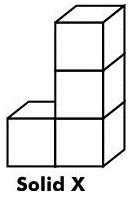
Question. Solid X is made by putting together 4 unit cubes.If the total surface area of solid X is 36 cm2, what is the total surface area of each unit cube?
(a) 12 cm2
(b) 10 cm2
(c) 9 cm2
(d) 6 cm2
Answer : A
Question. A rectangular metal sheet 16 dm x 20 dm has to be rolled to form a cylinder. What is the maximum volume (in cubic decimetres) that it can enclose when the base is attached?
(a) 1280/π
(b) 1600/π
(c) 5120/π
(d) 6400/π
Answer : B
Question. Look at this chocolate wrapper shown in the Image .Normally, how many grams of this chocolate would you have got for Rs. 16?
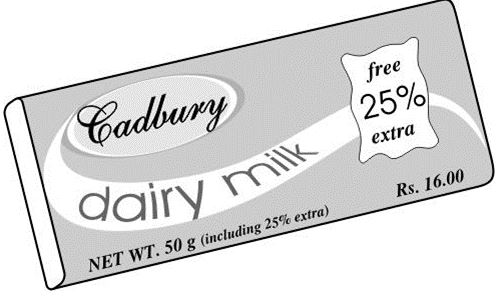
(a) 62.5
(b) 37.5
(c) 37.5
(d) 35
Answer : B
Question. Sarthak gave the description of a three-dimensional figure as follows: It has 6 vertices.
It has 12 edges.
It has 8 faces.
Which of the following figures is it?
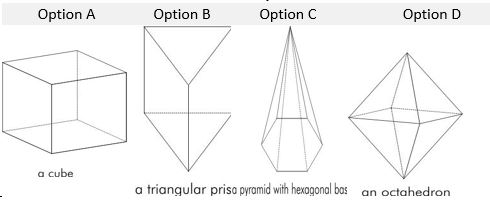
Answer : D
Question. In the following figures, identical shapes represent the same weight.
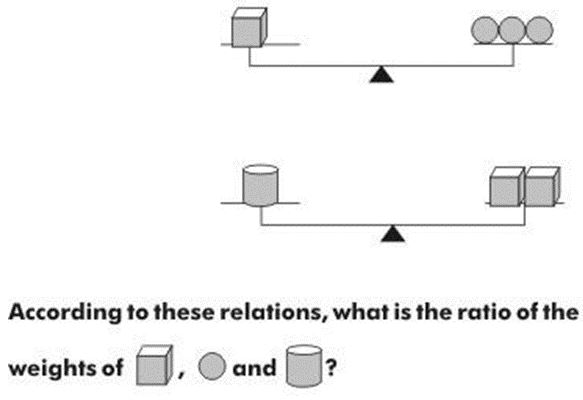
(a) 3:1:6
(b) 2:6:1
(c) 3:1:2
(d) 1:6:1
Answer : A
Question. 11 small unit cubes are joined together as shown below to form the solid shown in Figure At least how many more unit cubes will be needed to turn the structure into a solid CUBE (not cuboid) with no gaps?
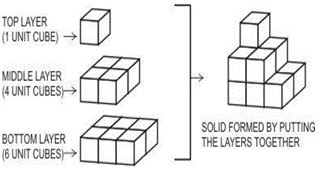
(a) 3
(b) 8
(c) 11
(d) 16
Answer : D
Question 1. Find x and y
Answer: In the first circle, all four vertices of quadrilateral \( ABCD \) lie on the circumference, making it a cyclic quadrilateral.
Side \( BC \) is produced to point \( F \). By the exterior angle property of a cyclic quadrilateral, the exterior angle equals the interior opposite angle:
\( \angle DCF = \angle BAD \)
\( \implies x = 78^\circ \)
In the second circle, vertices \( C \), \( D \), \( E \), and \( F \) lie on the circumference, which makes quadrilateral \( CDEF \) cyclic as well.
The opposite angles of a cyclic quadrilateral are supplementary:
\( \angle DCF + \angle DEF = 180^\circ \)
\( x + y = 180^\circ \)
\( 78^\circ + y = 180^\circ \)
\( \implies y = 180^\circ - 78^\circ = 102^\circ \)
Therefore, \( x = 78^\circ \) and \( y = 102^\circ \).
In simple words: The outer angle of the first four-sided shape matches the opposite inside corner, giving x = 78°. In the second shape, opposite corners sum to 180°, so subtracting 78° from 180° gives y = 102°.
Exam Tip: State the exterior angle property of cyclic quadrilaterals directly: "Exterior angle of a cyclic quadrilateral = interior opposite angle" to save time and secure full marks.
Question 2. Find x and y.
Answer: In the circle with centre \( O \), line segment \( AD \) passes through the centre, making \( AOD \) a diameter.
In \( \Delta OAB \), sides \( OA \) and \( OB \) are radii of the circle:
\( OA = OB \)
\( \implies \angle OBA = \angle OAB = 50^\circ \)
In \( \Delta OAB \), the exterior angle at vertex \( O \) is \( \angle BOD \):
\( \angle BOD = \angle OAB + \angle OBA \)
\( \implies x = 50^\circ + 50^\circ = 100^\circ \)
(Alternatively, arc \( BD \) subtends \( \angle BOD \) at the centre and \( \angle DAB \) at the remaining circumference, giving \( x = 2 \times 50^\circ = 100^\circ \)).
Quadrilateral \( ABCD \) is inscribed in the circle, so it is a cyclic quadrilateral.
The opposite angles of a cyclic quadrilateral sum to \( 180^\circ \):
\( \angle DAB + \angle DCB = 180^\circ \)
\( 50^\circ + y = 180^\circ \)
\( \implies y = 180^\circ - 50^\circ = 130^\circ \)
Therefore, \( x = 100^\circ \) and \( y = 130^\circ \).
In simple words: The central angle x is twice the angle at the circumference (50°), giving x = 100°. The opposite angle y in the four-sided cyclic ring supplements 50°, giving y = 130°.
Exam Tip: Quote Theorem 10.8: "The angle subtended by an arc at the centre is double the angle subtended by it at any point on the remaining part of the circle."
Question 3. PQ is a diameter of a circle with centre O. If PL and QM are perpendiculars on a line l and QM intersects the circle at A, Prove that PL = AM.
Answer: Join point \( P \) to point \( A \).
Because \( PQ \) is a diameter of the circle, the angle inscribed in the semicircle is a right angle:
\( \angle PAQ = 90^\circ \)
Line segment \( QM \) is a straight line containing point \( A \). Therefore, the adjacent angle is:
\( \angle PAM = 180^\circ - \angle PAQ = 180^\circ - 90^\circ = 90^\circ \)
We are given that \( PL \perp l \) and \( QM \perp l \):
\( \angle PLM = 90^\circ \quad \text{and} \quad \angle LMA = 90^\circ \)
Now examine quadrilateral \( PLMA \):
- \( \angle PLM = 90^\circ \)
- \( \angle LMA = 90^\circ \)
- \( \angle PAM = 90^\circ \)
Since three interior angles of quadrilateral \( PLMA \) are right angles, the fourth interior angle must also be:
\( \angle LPA = 360^\circ - (90^\circ + 90^\circ + 90^\circ) = 90^\circ \)
A quadrilateral with four right angles is a rectangle.
Because opposite sides of a rectangle are equal in length:
\( PL = AM \)
Hence proved.
In simple words: The diameter forms a 90° angle at A, making all four corners of the box PLMA equal to 90°. Since PLMA is a rectangle, its opposite vertical sides PL and AM are equal.
Exam Tip: Remember to cite the semicircle theorem: "Angle in a semicircle is a right angle" before deducing that \( \angle PAM = 90^\circ \).
Question 4. AB is a chord of a circle with centre O and AB is produced to C such that BC = OB. Also, CO is joined and produced to meet the circle in D. If ∠ACD = y and ∠AOD = x Prove that x = 3y
Answer: Join the radius \( OB \) and radius \( OA \).
In \( \Delta OBC \), we are given that \( BC = OB \):
The angles opposite to equal sides are equal:
\( \angle BOC = \angle BCO = y \)
For \( \Delta OBC \), \( \angle ABO \) is an exterior angle at vertex \( B \):
\( \angle ABO = \angle BOC + \angle BCO = y + y = 2y \)
In \( \Delta OAB \), segments \( OA \) and \( OB \) are radii of the same circle, so \( OA = OB \):
\( \implies \angle OAB = \angle ABO = 2y \)
Now consider \( \Delta OAC \). Side \( CO \) is produced to point \( D \), making \( \angle AOD \) an exterior angle at vertex \( O \):
The exterior angle equals the sum of the non-adjacent interior angles:
\( \angle AOD = \angle OAC + \angle ACO \)
\( x = 2y + y \)
\( \implies x = 3y \)
Hence proved.
In simple words: Equal sides in the small triangle give base angles of y, so its outer angle is 2y. The radius triangle is also isosceles with angle 2y, and adding y to 2y gives the total central angle x = 3y.
Exam Tip: Apply the exterior angle theorem twice: first to \( \Delta OBC \) to find \( \angle ABO = 2y \), then to \( \Delta OAC \) to reach \( x = 3y \).
Question 5. ΔABC is an isosceles triangle in which BA = BC. Prove that the line segment joining the centre O of the circumcircle of ΔABC to the vertex B bisects ∠ABC.
Answer: Let \( O \) be the centre of the circumcircle of \( \Delta ABC \).
Join line segments \( OA \) and \( OC \).
In \( \Delta OAB \) and \( \Delta OCB \):
- \( BA = BC \) (given, as \( \Delta ABC \) is isosceles)
- \( OA = OC \) (radii of the circumcircle)
- \( OB = OB \) (common side to both triangles)
By the SSS congruence criterion:
\( \Delta OAB \cong \Delta OCB \)
Corresponding parts of congruent triangles are equal (CPCT):
\( \angle ABO = \angle CBO \)
This demonstrates that the line segment \( BO \) bisects \( \angle ABC \).
Hence proved.
In simple words: Connect the centre to points A and C. Triangles OAB and OCB have all three sides equal (SSS), making the two split angles at corner B equal.
Exam Tip: Mention the construction "Join OA and OC" explicitly to earn the designated mark for auxiliary steps.
Question 6. AC is a diameter of a circle with centre O. If AB and CD are two chords such that AB || CD Prove that AB = CD.
Answer: From centre \( O \), draw perpendiculars \( OL \perp AB \) and \( OM \perp CD \).
Because \( AC \) is a diameter, \( A \), \( O \), and \( C \) are collinear.
Given that \( AB \parallel CD \) cut by transversal \( AC \), alternate interior angles are equal:
\( \angle OAL = \angle OCM \)
Now compare right triangles \( \Delta OAL \) and \( \Delta OCM \):
- \( \angle OLA = \angle OMC = 90^\circ \) (by construction)
- \( \angle OAL = \angle OCM \) (alternate interior angles)
- \( OA = OC \) (radii of the circle)
By the AAS congruence criterion:
\( \Delta OAL \cong \Delta OCM \)
By CPCT:
\( OL = OM \)
The perpendicular distances from the centre to both chords are equal. Chords that are equidistant from the centre of a circle are equal in length:
\( AB = CD \)
Hence proved.
In simple words: The parallel chords create matching alternate angles with the diameter. Using AAS congruence shows the chords are the same distance from the centre, which means the chords must be equal in length.
Exam Tip: State the geometric theorem: "Chords equidistant from the centre of a circle are equal in length" to conclude the proof.
Question 7. O is the centre of a circle. In ΔOAB, OA = OB. Prove that AC = BD.
Answer: From centre \( O \), draw \( OM \perp AB \), meeting segment \( AB \) at point \( M \).
In right triangles \( \Delta OMA \) and \( \Delta OMB \):
- \( \angle OMA = \angle OMB = 90^\circ \) (by construction)
- \( OA = OB \) (given)
- \( OM = OM \) (common side)
By the RHS congruence criterion:
\( \Delta OMA \cong \Delta OMB \)
By CPCT:
\( AM = BM \) ...(1)
Now observe chord \( CD \) of the circle:
The line segment \( OM \) is perpendicular to chord \( CD \) from the centre \( O \).
Because the perpendicular from the centre of a circle to a chord bisects the chord:
\( CM = DM \) ...(2)
Subtracting equation (2) from equation (1):
\( AM - CM = BM - DM \)
\( \implies AC = BD \)
Hence proved.
In simple words: Drop a perpendicular from O to the line. It cuts both the outer segment AB and the inner circle chord CD exactly in half. Subtracting the two equal halves leaves AC = BD.
Exam Tip: Quote the chord bisector theorem clearly: "The perpendicular from the centre of a circle to a chord bisects the chord."
Question 8. If a diameter of a circle bisects each of the two chords of a circle, prove that the chords are parallel.
Answer: Let \( AB \) and \( CD \) be two chords of a circle with centre \( O \).
Let a diameter pass through the centre \( O \) and bisect chord \( AB \) at point \( P \), and chord \( CD \) at point \( Q \).
According to Theorem 10.4: "The line drawn through the centre of a circle to bisect a chord is perpendicular to the chord."
Since \( P \) is the midpoint of chord \( AB \) and \( OP \) passes through the centre:
\( OP \perp AB \implies \angle OPA = 90^\circ \)
Similarly, since \( Q \) is the midpoint of chord \( CD \) and \( OQ \) passes through the centre:
\( OQ \perp CD \implies \angle OQD = 90^\circ \)
Since \( P \), \( O \), and \( Q \) lie on the same straight diameter line:
\( \angle OPA = \angle OQD = 90^\circ \)
These two angles form a pair of alternate interior angles for lines \( AB \) and \( CD \) cut by the transversal diameter \( PQ \).
Because the alternate interior angles are equal:
\( AB \parallel CD \)
Hence proved.
In simple words: The diameter cuts both chords at right angles (90°). Because both chords make 90° angles with the same straight line, they are parallel to each other.
Exam Tip: State Theorem 10.4 by name or full statement: "The line drawn through the centre of a circle to bisect a chord is perpendicular to the chord."
Question 9. Two chords AB and AC of a circle are equal. Prove that the centre of the circle lies on the angle bisector of ∠BAC.
Answer: Let \( O \) be the centre of the circle.
Join segments \( OA \), \( OB \), and \( OC \).
In \( \Delta OAB \) and \( \Delta OAC \):
- \( AB = AC \) (given, as the chords are equal)
- \( OA = OA \) (common side)
- \( OB = OC \) (radii of the same circle)
By the SSS congruence criterion:
\( \Delta OAB \cong \Delta OAC \)
By CPCT:
\( \angle OAB = \angle OAC \)
This equality shows that the line segment \( OA \) bisects \( \angle BAC \).
Because ray \( OA \) represents the bisector of \( \angle BAC \), the centre \( O \) lies directly on the angle bisector of \( \angle BAC \).
Hence proved.
In simple words: Joining the centre to corners A, B, and C creates two congruent triangles by SSS. That makes the two halves of angle A equal, meaning the centre sits on the bisector line.
Exam Tip: Showing that \( OA \) divides \( \angle BAC \) into two equal halves by CPCT is sufficient to prove that \( O \) lies on the bisector.
Question 10. AB and CD are two equal chords of a circle whose centre is O. When produced these chords meet at E. Prove that EB = ED.
Answer: From centre \( O \), draw \( OL \perp AB \) and \( OM \perp CD \). Join segment \( OE \).
Equal chords are equidistant from the centre of the circle. Since \( AB = CD \):
\( OL = OM \)
In right triangles \( \Delta OLE \) and \( \Delta OME \):
- \( \angle OLE = \angle OME = 90^\circ \) (by construction)
- \( OE = OE \) (common hypotenuse)
- \( OL = OM \) (equal chords are equidistant from centre)
By the RHS congruence criterion:
\( \Delta OLE \cong \Delta OME \)
By CPCT:
\( LE = ME \) ...(1)
Because the perpendicular from the centre to a chord bisects the chord:
\( BL = \frac{1}{2}AB \quad \text{and} \quad DM = \frac{1}{2}CD \)
Since \( AB = CD \), their halves are equal:
\( BL = DM \) ...(2)
Subtracting equation (2) from equation (1):
\( LE - BL = ME - DM \)
\( \implies EB = ED \)
Hence proved.
In simple words: Draw perpendiculars from the centre to both chords and connect to E. Right triangles OLE and OME are congruent by RHS, so LE = ME. Subtracting the equal half-chords leaves EB = ED.
Exam Tip: This is NCERT Exercise 10.4 Question 2; remember to subtract the half-chords \( BL = DM \) from the full lengths \( LE = ME \).
Question 11. The bisector of ∠B of an isos ΔABC with AB = AC meets the circumcircle of ΔABC at P. If AP and BC produced meet at Q, Prove that CQ = CA.
Answer: In \( \Delta ABC \), we are given \( AB = AC \).
Angles opposite to equal sides are equal:
\( \angle ABC = \angle ACB \)
Let \( \angle ABC = \angle ACB = 2x \).
Because ray \( BP \) is the angle bisector of \( \angle ABC \):
\( \angle ABP = \angle PBC = x \)
Angles subtended by the same arc \( PC \) in the circumcircle are equal:
\( \angle PAC = \angle PBC = x \)
Since \( A \), \( P \), and \( Q \) are collinear, \( \angle CAQ = \angle PAC = x \).
Now examine \( \Delta ABQ \):
The sum of interior angles in \( \Delta ABQ \) is:
\( \angle B + \angle BAQ + \angle BQA = 180^\circ \)
Notice that \( \angle BAQ = \angle BAC + \angle CAQ = \angle BAC + x \), and \( \angle B = 2x \):
\( 2x + (\angle BAC + x) + \angle BQA = 180^\circ \)
\( \implies \angle BAC + 3x + \angle BQA = 180^\circ \) ...(1)
In \( \Delta ABC \), the sum of angles is:
\( \angle BAC + \angle B + \angle C = 180^\circ \)
\( \angle BAC + 2x + 2x = 180^\circ \)
\( \implies \angle BAC + 4x = 180^\circ \) ...(2)
Equating (1) and (2):
\( \angle BAC + 3x + \angle BQA = \angle BAC + 4x \)
Subtracting \( \angle BAC + 3x \) from both sides:
\( \angle BQA = x \)
Since \( \angle CQA \) is the same angle as \( \angle BQA \):
\( \angle CQA = x \)
In \( \Delta ACQ \):
\( \angle CAQ = x \quad \text{and} \quad \angle CQA = x \)
\( \implies \angle CAQ = \angle CQA \)
Sides opposite to equal angles in a triangle are equal:
\( CQ = CA \)
Hence proved.
In simple words: The angle bisector gives an angle of x that moves to corner A through the same arc. Calculating the angle sum in both triangles reveals that corner Q also equals x. Since two angles are equal, sides CQ and CA must be equal.
Exam Tip: State the angle-in-same-segment theorem: \( \angle PAC = \angle PBC = x \) to establish the base angle of \( \Delta ACQ \) early in your solution.
Question 12. ABCD is a cyclic Quad. Find x and y, and thus find angles of Quad.
Answer: In cyclic quadrilateral \( ABCD \), opposite angles are supplementary:
1. \( \angle A + \angle C = 180^\circ \)
\( (2x + 4) + (4y - 4) = 180^\circ \)
\( \implies 2x + 4y = 180^\circ \)
Dividing by 2:
\( \implies x + 2y = 90^\circ \) ...(1)
2. \( \angle B + \angle D = 180^\circ \)
\( (x + 10) + (5y + 5) = 180^\circ \)
\( \implies x + 5y + 15 = 180^\circ \)
\( \implies x + 5y = 165^\circ \) ...(2)
Subtracting equation (1) from equation (2):
\( (x + 5y) - (x + 2y) = 165^\circ - 90^\circ \)
\( \implies 3y = 75^\circ \)
\( \implies y = 25 \)
Substituting \( y = 25 \) into equation (1):
\( x + 2(25) = 90^\circ \)
\( \implies x + 50 = 90^\circ \)
\( \implies x = 40 \)
Now calculate each angle of the cyclic quadrilateral:
- \( \angle A = 2x + 4 = 2(40) + 4 = 84^\circ \)
- \( \angle B = x + 10 = 40 + 10 = 50^\circ \)
- \( \angle C = 4y - 4 = 4(25) - 4 = 96^\circ \)
- \( \angle D = 5y + 5 = 5(25) + 5 = 130^\circ \)
Therefore, \( x = 40 \), \( y = 25 \), and the angles are \( \angle A = 84^\circ \), \( \angle B = 50^\circ \), \( \angle C = 96^\circ \), and \( \angle D = 130^\circ \).
In simple words: Opposite corners add up to 180°, giving two equations with x and y. Solving them yields x = 40 and y = 25, giving angles 84°, 50°, 96°, and 130°.
Exam Tip: Always double check that \( \angle A + \angle C = 180^\circ \) (\( 84^\circ + 96^\circ = 180^\circ \)) and \( \angle B + \angle D = 180^\circ \) (\( 50^\circ + 130^\circ = 180^\circ \)) to verify your answers.
Question 13. BC is a chord of a circle with centre O. A is a point on the arc CB. Prove that ∠BAC - ∠OBC = 90°.
Answer: In the figure, point \( A \) lies on the minor arc \( BC \), and centre \( O \) lies on the opposite side of chord \( BC \).
In \( \Delta OBC \), \( OB \) and \( OC \) are radii of the circle:
\( OB = OC \)
\( \implies \angle OCB = \angle OBC \)
By the angle sum property of \( \Delta OBC \):
\( \angle BOC + \angle OBC + \angle OCB = 180^\circ \)
\( \angle BOC + 2\angle OBC = 180^\circ \)
\( \implies \angle BOC = 180^\circ - 2\angle OBC \) ...(1)
The reflex angle at the centre subtended by major arc \( BC \) is:
\( \text{Reflex } \angle BOC = 360^\circ - \angle BOC \)
Substituting equation (1):
\( \text{Reflex } \angle BOC = 360^\circ - (180^\circ - 2\angle OBC) = 180^\circ + 2\angle OBC \)
By Theorem 10.8, the angle subtended by major arc \( BC \) at point \( A \) on the remaining circumference is half of the reflex angle at the centre:
\( \angle BAC = \frac{1}{2}(\text{Reflex } \angle BOC) \)
\( \angle BAC = \frac{1}{2}(180^\circ + 2\angle OBC) \)
\( \angle BAC = 90^\circ + \angle OBC \)
Subtracting \( \angle OBC \) from both sides:
\( \implies \angle BAC - \angle OBC = 90^\circ \)
Hence proved.
In simple words: The central angle equals 180° minus 2 times angle OBC. The reflex angle at the back is 180° plus 2 times angle OBC, and halving that gives angle BAC = 90° + angle OBC.
Exam Tip: When \( A \) lies on the minor arc, use \( \text{reflex } \angle BOC = 2\angle BAC \) rather than the interior \( \angle BOC \).
Question 14. O is the circumcentre of ΔABC and OD ⊥ BC. Prove that ∠BOD = ∠A
Answer: Join line segment \( OC \).
In right triangles \( \Delta OBD \) and \( \Delta OCD \):
- \( \angle ODB = \angle ODC = 90^\circ \) (given, as \( OD \perp BC \))
- \( OB = OC \) (radii of the circumcircle)
- \( OD = OD \) (common side)
By the RHS congruence criterion:
\( \Delta OBD \cong \Delta OCD \)
By CPCT:
\( \angle BOD = \angle COD \)
Consequently:
\( \angle BOC = \angle BOD + \angle COD = 2\angle BOD \)
\( \implies \angle BOD = \frac{1}{2}\angle BOC \) ...(1)
According to the degree measure theorem, the angle subtended by arc \( BC \) at the centre is double the angle subtended by it at vertex \( A \) on the remaining circle:
\( \angle BOC = 2\angle BAC = 2\angle A \) ...(2)
Substituting equation (2) into equation (1):
\( \angle BOD = \frac{1}{2}(2\angle A) \)
\( \implies \angle BOD = \angle A \)
Hence proved.
In simple words: The perpendicular OD splits the central angle BOC into two equal halves by RHS congruence. Since the full angle BOC is twice angle A, each half angle BOD equals angle A.
Exam Tip: Combine the RHS triangle congruence with the central angle theorem (\( \angle BOC = 2\angle A \)) in two clear steps to earn full marks.
Question 15. ABCD is a cyclic Quad. If AC bisects both the angles A and C, then P.T ∠ABC = 90°
Answer: Diagonal \( AC \) bisects both \( \angle A \) and \( \angle C \).
Therefore:
\( \angle BAC = \angle DAC \)
\( \angle BCA = \angle DCA \)
In \( \Delta ABC \) and \( \Delta ADC \):
- \( \angle BAC = \angle DAC \) (given)
- \( AC = AC \) (common side)
- \( \angle BCA = \angle DCA \) (given)
By the ASA congruence criterion:
\( \Delta ABC \cong \Delta ADC \)
By CPCT:
\( \angle ABC = \angle ADC \)
Because \( ABCD \) is a cyclic quadrilateral, its opposite angles are supplementary:
\( \angle ABC + \angle ADC = 180^\circ \)
Since \( \angle ADC = \angle ABC \):
\( \angle ABC + \angle ABC = 180^\circ \)
\( \implies 2\angle ABC = 180^\circ \)
\( \implies \angle ABC = 90^\circ \)
Hence proved.
In simple words: Diagonal AC splits the quadrilateral into two congruent triangles by ASA, making corners B and D equal. Since opposite corners of a cyclic shape sum to 180°, corner ABC must be 90°.
Exam Tip: Conclude by stating that because \( \angle ABC = 90^\circ \), diagonal \( AC \) also acts as a diameter of the circumscribing circle.
Free study material for Mathematics
CBSE Class 9 Mathematics Worksheets for Chapter 09 Circle
Download Chapter Worksheets: Class 9 Mathematics
Review targeted practice exercises for Class 9 Mathematics Chapter 09 Circle. Curated to match official CBSE guidelines, these printable problem sets support daily revision and improve overall test readiness.
Concept Clarification for Chapter 09 Circle
Designed around the official curriculum for Class 9 Mathematics, these practice sheets guarantee standard compliance. Reviewing step-by-step solutions after completion sharpens your accuracy and clarifies complex sub-topics within Chapter 09 Circle.
Effective Revision Strategies for School Exams
Wrap up your chapter revision by testing your knowledge against standard objective question formats. Explore our full library of free, up-to-date printable assignments to maximize your academic results in upcoming CBSE evaluations.
FAQs
You can download the latest chapter-wise printable worksheets for Class 9 Mathematics Chapter 09 Circle for free from StudiesToday.com. These have been made as per the latest CBSE curriculum for this academic year.
Yes, Class 9 Mathematics worksheets for Chapter 09 Circle focus on activity-based learning and also competency-style questions. This helps students to apply theoretical knowledge to practical scenarios.
Yes, we have provided solved worksheets for Class 9 Mathematics Chapter 09 Circle to help students verify their answers instantly.
Yes, our Class 9 Mathematics test sheets are mobile-friendly PDFs and can be printed by teachers for classroom.
For Chapter 09 Circle, regular practice with our worksheets will improve question-handling speed and help students understand all technical terms and diagrams.