

Official Class 9 Mathematics Worksheets: Chapter 11 Constructions
Explore structured practice materials through the CBSE Class 9 Mathematics Constructions Worksheet Set 01. Tailored for Class 9 learners, utilizing these Mathematics worksheets ensures thorough preparation and strengthens problem-solving accuracy before final school evaluations.
Solved Practice Worksheets for Mathematics
View or download the dedicated CBSE Class 9 Mathematics Constructions Worksheet Set 01 resource below. Engaging with these practice papers under focused study conditions ensures continuous academic progress and mastery of the 2026-27 curriculum for Chapter 11 Constructions.
Question. If we bisect a line segment of length 3.5 cm, then the measure of each of equal parts will be
(a) 7 cm
(b) 1.75 cm
(c) 1.25 cm
(d) 5.5 cm
Answer : B
Question. Perpendicular bisector of a line segment divides it into
(a) infinite equal parts
(b) two equal parts
(c) three equal parts
(d) four equal parts
Answer : B
Question. Bisector of an angle divides the angle into
(a) two equal parts
(b) three equal parts
(c) infinite equal parts
(d) ten equal parts
Answer : A
Question. An angle can be constructed with the help of ruler and compasses only, if
(a) It is divisible by 15
(b) It can be written in terms of 30°, 45°, 60°, 90° or in some combination that involve these
(c) Both (a) and (b)
(d) None of these
Answer : C
Question. Which of the following angles can be constructed using ruler and compasses only?
(a) 25°
(b) 50°
(c) 52.5°
(d) 42.5°
Answer : C
Question. When we bisect an angle of 65°, the measure of each equal part is
(a) 30.5°
(b) 32.5°
(c) 130°
(d) 43.5°
Answer : B
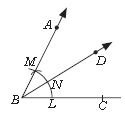
Question. In figure, L M is an arc of a circle having radius a and centre B. If LN = NM and BL = BM = LM = a and L M = 2 M N , then ∠CBD equals
(a) 15°
(b) 25°
(c) 30°
(d) 45°
Answer : C
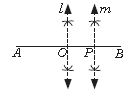
Question. In the given figure, line l is the perpendicular bisector of AB and m is the perpendicular bisector of OB. If OP = 3.2 cm, then the length of AP is
(a) 7 cm
(b) 6.4 cm
(c) 8.65 cm
(d) 9.6 cm
Answer : D
Question. For which of the following conditions the construction of a triangle is not possible?
(a) If two sides and one angle is given.
(b) If two sides and included angle between them is given.
(c) If three sides are given.
(d) If two angles and side between them is given.
Answer : A
Question. While constructing a triangle, sum of angles of the triangle must be
(a) equal to 180°
(b) less than 180°
(c) greater than 180°
(d) equal to 360°
Answer : A
Question. The construction of a ΔABC, in which AB = 6 cm, ∠B = 60°, is not possible when BC + CA is
(a) 10 cm
(b) 9 cm
(c) 10.5 cm
(d) 5.9 cm
Answer : D
Question. The construction of a ΔABC in which AB = 7 cm and ∠A = 75°, is possible when (BC – AC) is equal to
(a) 6 cm
(b) 7 cm
(c) 8 cm
(d) 8.5 cm
Answer : A
Question. In which of the following conditions, it is possible to construct the triangle?
(a) ΔABC, BC = 8 cm, ∠B = 90°, ∠C = 90°
(b) ΔABC, BC = 6 cm, ∠B = 60°, AC – AB = 7 cm
(c) ΔLMN, LN = 8 cm, ∠L = 55°, LM + MN = 10 cm
(d) ΔPQR, QR = 10 cm, ∠R = 80°, PQ – PR = 12 cm
Answer : C
Question. Which of the following steps is incorrect while constructing an equilateral triangle one of whose altitudes measures 6 cm?
Step I : Draw a line XY.
Step II : Mark any point P on it.
Step III : From P, draw PQ ⊥ XY.
Step IV : From P, set off PA = 6 cm, cutting PQ at A.
Step V : Construct ∠PAB = 30° and ∠PAC = 30°, meeting XY at B and C respectively.
Then, ΔABC is the required equilateral triangle.
(a) Step IV
(b) Step V
(c) Step III
(d) None of these
Answer : D
Question. Let ABC be a triangle in which BC = 5 cm, ∠B = 60º and AC + AB = 7.5 cm. Given below are the steps of constructing the triangle ABC.
Which of the following steps is incorrect?
Step I : Draw a line segment BC of length 5 cm.
Step II : Draw an ∠XBC = 60° at point B of line segment BC.
Step III : Cut off PB = 3.5 cm on the ray BX.
Step IV : Join PC.
Step V : Draw perpendicular bisector of BC which intersect ray BX at A. Join AC.
Step VI : ABC is the required triangle.
(a) Step II only
(b) Step III only
(c) Step II and V
(d) Step III and V
Answer : D
Question. Which of the following angles cannot be constructed by using ruler and compass only?
(a) 30°
(b) 45°
(c) 70°
(d) 90°
Answer : C
Question. Arrange the following steps of construction of a ΔABC, in which BC = 3.8 cm, ∠B = 45° and AB + AC = 6.8 cm in correct sequence.
Step I : Draw the perpendicular bisector of CD meeting BD at A.
Step II : Draw BC = 3.8 cm.
Step III : Join CD.
Step IV : From ray BX, cut-off line segment BD equal to AB + AC i.e., 6.8 cm.
Step V : Draw ∠CBX = 45°
Step VI : Join CA to obtain the required DABC.
(a) II, IV, V, III, I, VI
(b) II, V, III, I, IV, VI
(c) II, V, IV, I, III, VI
(d) II, V, IV, III, I, VI
Answer : D
Question. Arrange the following steps of construction of a ΔABC in which BC = 8 cm, ∠B = 60° and the difference between the other two sides is 3 cm in correct sequence.
Step I : Cut off BP = 3 cm.
Step II : Draw BC = 8 cm.
Step III : Construct ∠CBX = 60°.
Step IV : Join AC.
Step V : Draw the right bisector of PC, meeting PB produced at A.
Step VI : Join PC.
Then, ∆ABC is the required triangle.
(a) II, III, I, VI, V, IV
(b) II, III, VI, V, IV, I
(c) II, IV, V, VI, I, III
(d) I, IV, V, VI, III, II
Answer : A
Question. Arrange the following steps of construction of ΔABC in which AB = 5.8 cm, BC + CA = 8.4 cm and ∠B = 60° in correct sequence.
Step I : Join AD.
Step II : From ray BX, cut off line segment BD = BC + CA = 8.4 cm.
Step III : Draw a line segment AB of length 5.8 cm.
Step IV : Draw a perpendicular bisector of AD meeting BD at point C. Join AC to obtain DABC.
Step V : Draw ∠ABX = 60° at point B of line segment AB.
(a) V, III, I, II, IV
(b) III, I, II, V, IV
(c) III, V, II, I, IV
(d) III, II, I, V, IV
Answer : C
Question. To construct an angle of 67.5°, we bisect angle between
(a) 0° and 90°
(b) 60° and 120°
(c) 0° and 135°
(d) 60° and 135°
Answer : C
Short Answer Type Questions
Question. If we draw a perpendicular bisector of a line segment AB = 9 cm which bisects AB at M, then find AM and BM.
Answer : Since, perpendicular bisector of a line segment divides it into two equal parts.
∴ AM = BM = 9/2 cm = 4.5 cm
Question. Find the measure of each of the two angles formed by bisecting an angle of measure 135°.
Answer : The measure of each of the two angles formed by bisecting an angle of measure 135° = 1/2 × 135° = 67.5°.
Question. Can a ΔXYZ be constructed, in which XY = 5 cm, ∠X = 50° and YZ + XZ = 5 cm?
Answer : No, ΔXYZ can’t be constructed.
Since, sum of two sides of triangle must be greater than third side, but here, XY = YZ + XZ.
Question. What is the length of bisected part of a line segment 7.8 cm?
Answer : We know that bisector of the line, divides it into two equal parts.
∴ Length of bisected part of a line segment measuring 7.8 cm = 1/2 (7.8) cm = 3.9 cm.
Question. If we bisect a line segment AB, then each of the equal part we get measures 3.8 cm. Find the length of AB.
Answer : If we bisect line segment AB, then we get each part equal to 3.8 cm.
∴ Length of AB = 2 × 3.8 cm = 7.6 cm
Question. In order to construct a triangle uniquely,
how many minimum parts of triangle are required to be given?
Answer : To construct a triangle uniquely, we are required at least three values like, 2 sides and 1 included angle or 2 angles and 1 included side or all three sides.
Question. Can a DABC be constructed in which ∠B = 110°, ∠C = 95° and AB = 10 cm? Justify your answer
Answer : No, as we know that sum of all three angles of a triangle is 180°.
But, here ∠B + ∠C = 110° + 95° = 205° > 180°
∴ ΔABC cannot be constructed with given conditions
Question. Give reason:
(i) Construction of an angle of 22.5° is possible with the help of ruler and compass.
(ii) It is not possible to construct a DABC given that BC = 7 cm, ∠B = 45° and AB – AC = 10 cm.
(iii) We can construct an angle of 67.5° using ruler and compass.
(iv) Construction of ΔDEF, if EF = 5.5 cm, ∠E = 75° and DE – DF = 3 cm is possible
Answer : (i) Yes, because 22.5° = 45° ÷ 2 and 45° can be constructed.
(ii) Yes, it is not possible to construct a DABC in which BC = 7 cm and AB – AC = 10 cm with ∠B = 45° because the difference between the given two sides is not less than the third side.
(iii) Yes, we can construct an angle of 67.5°, because
67.5° = 135° ÷ 2 and 135° = 90° + 45°, which can be constructed.
(iv) Yes, it is possible to construct a DDEF in which EF = 5.5 cm, ∠E = 75° and DE – DF = 3 cm because the difference between the given two sides is less than the third side.
1) Construct a ΔABC in which BC = 4.5 cm, ∟B =45˚ and AB +AC = 5.6 cm
2) Construct a rhombus whose side is of length 3.4cm and one of its angles is 45˚
3) A triangle ABC can be constructed in which ∟B =60˚, ∟C= 45˚ and AB +BC + AC = 12 cm. Is this Statement true? Justify your answer
4) Construct an equilateral triangle if its altitude is 4.5 cm
5) Construct a Δ ABC, given that perimeter = 10.5 cm, ∟A = 75˚, ∟B = 60˚
6) Construct a triangle PQR in which QR =6 CM, ∟Q = 60˚ and PR – PQ = 2cm
7) Construct a triangle in which ∟A =45˚, ∟B = 120˚ AB + BC +AC = 10.4 cm
TOPIC: LINEAR EQUATIONS IN TWO VARIABLES CLASS: IX
1) Find four solutions of the linear equation 5x – 4y = - 8
2) Find two solutions of the linear equation 2(x + 3) – 3(y + 1) = 0
3) Draw the graph of the linear equation 2x + 3y = 12. At what points the graph of the equation Cuts the x axis and the y axis
4) Draw the graphs of the equations x + y = 6 and 2x + 3y = 16on the same graph paper. Findthe coordinates of the points where the two lines intersect
5) The auto rickshaw fare in a city is charged Rs 10 for the first km and Rs 4 per km for Subsequent distance covered. Write the linear equation to express the above statement Draw the graph of the linear equation
6) Check whether the graph of the linear equation 2x +3y = 12 passes through the point (1, 3)
7) If (2, 5) is a solution of the equation 2x + 3y = m, find the value of m (m= 19)
8) Frame a linear equations in the form ax + by + c = 0 by using the given values of a, b and c
a) a= -2, b =3, c= 4
b) a = 5, b= 0, c= -1
9) Find the value of k, if x = 2, y = 1 is a solution of the equation 2x + 3y = k (k = 7)
10) Give the geometric representation of (A) 3 x + 9 =0 as an equation in (a) one variable
(B) 2x +1= x - 4 (b) Two variable
11) Solve the equation 2x + 1 = x – 3 and represent the solution on the number line
12) Give the equation of two lines passing through (2, 14). How many more such lines are there and Why
13) Solve for x: a) (3x+2)/7 + 4(x+1)/5 = 2(2x+1)/3 (x=4)
b) 8y + 21/4 = 3y + 7 (y = 7/20)
14) If present ages of son and father are expressed by x and y respectively and after ten years father Will be twice as old as his son. Write the relation between x and y
15) Does point (1, 3) lie on the line 3y = 2x + 8
16) If (2, 3) and (4, 0) lie on the graph of equation ax + by = 1. Find value of a and b.Plot the graph the equation obtained
17) Express the equation y = 2x + 3 in the standard form and find two solutions. Is (2, 3) it’s Solution?
18) Express y in terms of x from the equation 3x + 2y = 8 and check whether the points (4, -2) lies on the line.
19) write each of the following as an equation in two variables (in standard form):
(a) X = - 5
(b) y = 2
(c) 2x = 3
(d) 5y = 2
Free study material for Mathematics
Free CBSE Practice Worksheets: Class 9 Mathematics Chapter 11 Constructions
Practice Exercises for Class 9 Mathematics Chapter 11 Constructions
Access structured practice worksheets for Chapter 11 Constructions aligned with the 2026 CBSE curriculum. These downloadable exercises for Class 9 Mathematics help students build accuracy and reinforce core concepts for upcoming school tests.
Step-by-Step Solutions and Practice Guidelines
Built using official NCERT guidelines for Class 9 Mathematics, these practice sheets provide reliable academic support. Cross-reference your completed work with our detailed solutions to learn standard answer-writing formats for CBSE exams.
Enhance Speed with Online Practice
Follow up your worksheet practice by attempting the interactive online MCQ tests for Chapter 11 Constructions to evaluate your execution speed. All printable assignments and revision sheets on our platform are updated for the 2026 session and available free of charge.
FAQs
You can download the latest chapter-wise printable worksheets for Class 9 Mathematics Chapter 11 Constructions for free from StudiesToday.com. These have been made as per the latest CBSE curriculum for this academic year.
Yes, Class 9 Mathematics worksheets for Chapter 11 Constructions focus on activity-based learning and also competency-style questions. This helps students to apply theoretical knowledge to practical scenarios.
Yes, we have provided solved worksheets for Class 9 Mathematics Chapter 11 Constructions to help students verify their answers instantly.
Yes, our Class 9 Mathematics test sheets are mobile-friendly PDFs and can be printed by teachers for classroom.
For Chapter 11 Constructions, regular practice with our worksheets will improve question-handling speed and help students understand all technical terms and diagrams.