

Class 9 Mathematics Practice Sheet: CBSE Class 9 Mathematics Euclids Geometry Worksheet Set 01
Review targeted academic worksheets with the CBSE Class 9 Mathematics Euclids Geometry Worksheet Set 01. Built according to official educational standards for the 2026-27 term, these downloadable Class 9 Mathematics resources support effective daily practice and detailed self-evaluation for Chapter 05 Introduction To Euclid's Geometry.
Download Chapter 05 Introduction To Euclid's Geometry Worksheet PDF with Answers
View or download the dedicated CBSE Class 9 Mathematics Euclids Geometry Worksheet Set 01 resource below. Engaging with these practice papers under focused study conditions ensures continuous academic progress and mastery of the 2026-27 curriculum for Chapter 05 Introduction To Euclid's Geometry.
Euclids Geometry
1. Which of the following statements are true and which are false? Give reasons for your answers.
(i) Only one line can pass through a single point.
(ii) There are an infinite number of lines which pass through two distinct points.
(iii) A terminated line can be produced indefinitely on both the sides.
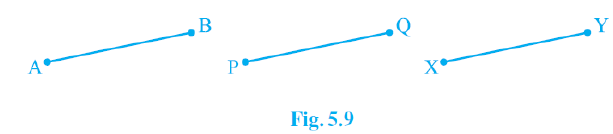
(iv) If two circles are equal, then their radii are equal. (v) In Fig. 5.9, if AB = PQ and PQ = XY, then AB = XY
Solution: (i) False
There can be infinite number of lines that can be drawn through a single point. Hence, the statement mentioned is False
(ii) False Through two distinct points there can be only one line that can be drawn. Hence, the statement mentioned is False
(iii) True
A line that is terminated can be indefinitely produced on both sides as a line can be extended on both its sides infinitely. Hence, the statement mentioned is True.
(iv) True
The radii of two circles are equal when the two circles are equal. The circumference and the centre of both the circles coincide; and thus, the radius of the two circles should be equal. Hence, the statement mentioned is True.
(v) True According to Euclid’s 1st axiom- “Things which are equal to the same thing are also equal to one another”. Hence, the statement mentioned is True.
2. Give a definition for each of the following terms. Are there other terms that need to be defined first? What are they, and how might you define them?
(i) parallel lines (ii) perpendicular lines (iii) line segment (iv) radius of a circle (v) square
Solution:
Yes, there are other terms which need to be defined first, they are: Plane: Flat surfaces in which geometric figures can be drawn are known are plane. A plane surface is a surface which lies evenly with the straight lines on itself.
Point: A dimensionless dot which is drawn on a plane surface is known as point. A point is that which has no part.
Line: A collection of points that has only length and no breadth is known as a line. And it can be extended on both directions. A line is breadth-less length.
(i) Parallel lines – Parallel lines are those lines which never intersect each other and are always at a constant distance perpendicular to each other. Parallel lines can be two or more lines.
(ii) Perpendicular lines – Perpendicular lines are those lines which intersect each other in a plane at right angles then the lines are said to be perpendicular to each other
(iii) Line Segment – When a line cannot be extended any further because of its two end points then the line is known as a line segment. A line segment has 2 end points.
(iv) Radius of circle – A radius of a circle is the line from any point on the circumference of the circle to the center of the circle.
(v) Square – A quadrilateral in which all the four sides are said to be equal and each of its internal angle is right angles is called square.
3. Consider two ‘postulates’ given below:
(i) Given any two distinct points A and B, there exists a third point C which is in between A and B.
(ii) There exist at least three points that are not on the same line.
Do these postulates contain any undefined terms? Are these postulates consistent? Do they follow from Euclid’s postulates? Explain.
Question 1. Through two points
(a) A unique line can be drawn
(b) No line can be drawn
(c) More than one line can be drawn
Answer: (a) A unique line can be drawn
According to Euclid's Axiom 5.1, given any two distinct points in a plane, exactly one unique straight line passes through them.
In simple words: If you pick any two separate points, you can only draw a single straight line that connects both of them.
Exam Tip: Always quote Axiom 5.1 ("Given two distinct points, there is a unique line that passes through them") whenever explaining this geometric property.
Question 2. Through a fixed point
(a) a unique line can be drawn
(b) No line can be drawn
(c) More than one line can be drawn
Answer: (c) More than one line can be drawn
An infinite number of distinct straight lines can be drawn extending in different directions through any single stationary point.
In simple words: You can draw endlessly many lines crossing through a single dot on a page.
Exam Tip: Do not confuse a single point with a pair of points: infinitely many lines pass through one point, whereas only one line passes through two points.
Question 3. Number of line segments required to form a closed figure
(a) 2
(b) 3
(c) 4
Answer: (b) 3
Two line segments can only meet at a common vertex to create an open angle. A minimum of three line segments is necessary to fully enclose an area in a plane, forming a triangle.
In simple words: You need at least three straight sides to close an area completely, which makes a triangle.
Exam Tip: The simplest polygon is a triangle; two straight lines cannot enclose a region in flat geometry.
Question 4. Two lines having a common point is called
(a) parallel lines
(b) intersecting lines
(c) coincident lines
Answer: (b) intersecting lines
When two distinct lines meet and share exactly one point in common, they cross each other and are known as intersecting lines.
In simple words: Lines that cross each other at a single shared point are called intersecting lines.
Exam Tip: Be clear on the categories: parallel lines share zero points, intersecting lines share one point, and coincident lines share infinite points.
Question 5. Euclid arranged all known work in the field of mathematics in his treatise called
(a) Elements
(b) Axioms
(c) Postulates
Answer: (a) Elements
The Greek mathematician Euclid brought together and methodically arranged the mathematical knowledge of his time into a renowned 13-book treatise entitled "Elements".
In simple words: Euclid organized the mathematics of his era into a famous masterwork known as the Elements.
Exam Tip: Remember that Euclid's "Elements" consists of 13 books, which laid down the foundations of plane geometry.
Question 6. The things which are double the same thing are
(a) halves of the same thing
(b) double of the same thing
(c) equals
Answer: (c) equals
Euclid's sixth common notion states that quantities that are doubles of the same quantity are equal to one another.
In simple words: If two different items are each double the size of the same original item, they are equal in measure.
Exam Tip: Memorize the standard list of Euclid's axioms; questions frequently test the exact wording of Axiom 6 and Axiom 7 (doubles and halves).
Question 7. Axioms are assumed
(a) universal truths specific to geometry
(b) universal truths in all branches of mathematics
(c) definitions
Answer: (b) universal truths in all branches of mathematics
In Euclidean terminology, axioms are foundational self-evident truths utilized across all areas of mathematics, whereas postulates are assumptions used specifically within geometry.
In simple words: Axioms apply as basic truths across all mathematics, while postulates are rules meant only for geometry.
Exam Tip: A classic board exam distinction: postulates apply only to geometry, while axioms serve as common notions across all mathematical fields.
Question 8. A mathematical statement whose truth has been logically established is called
(a) an axiom
(b) a postulate
(c) a theorem
Answer: (c) a theorem
While axioms and postulates are accepted as true without formal proof, a proposition whose validity is demonstrated through logical deduction is designated as a theorem.
In simple words: A mathematical fact that has been proven step-by-step using logic is called a theorem.
Exam Tip: Axioms and postulates require no formal proof, but theorems must always be established using deductive reasoning.
Question 9. Euclid’s second axiom is
(a) ‘if equals be subtracted from equals the remainders are equals’
(b) ‘the things which are equal to the same thing are equal to one another’
(c) ‘if equals be added to equals their wholes are equals’
Answer: (c) ‘if equals be added to equals their wholes are equals’
Euclid's second common notion asserts that adding equal quantities to already equal quantities results in totals that are also equal.
In simple words: If you start with two equal amounts and add the same value to both, the new totals stay equal.
Exam Tip: Keep the sequence clear: Axiom 1 covers things equal to the same thing, Axiom 2 covers adding equals, and Axiom 3 covers subtracting equals.
Question 10. Euclid’s fifth postulate is
(a) ‘the whole is greater than the part’
(b) ‘if a straight line falling on two straight lines make the interior angles on the same side of it taken together less than the right angles then the two straight lines if produced indefinitely meet on that side on which sum of angles is less than two right angles’
(c) ‘all right angles are equal to one another’
Answer: (b) ‘if a straight line falling on two straight lines make the interior angles on the same side of it taken together less than the right angles then the two straight lines if produced indefinitely meet on that side on which sum of angles is less than two right angles’
This statement describes Euclid's fifth (parallel) postulate. By comparison, statement (a) is Euclid's fifth axiom, and statement (c) is Euclid's fourth postulate.
In simple words: The fifth postulate says that two lines will tilt towards each other and eventually meet where the inside angles add up to less than 180 degrees.
Exam Tip: Do not confuse Postulate 5 (the parallel lines condition) with Axiom 5 ("the whole is greater than the part").
Free study material for Mathematics
Chapter 05 Introduction To Euclid's Geometry Printable Worksheets and Exercises for Class 9 Mathematics
Practice Exercises for Class 9 Mathematics Chapter 05 Introduction To Euclid's Geometry
Access structured practice worksheets for Chapter 05 Introduction To Euclid's Geometry aligned with the 2026 CBSE curriculum. These downloadable exercises for Class 9 Mathematics help students build accuracy and reinforce core concepts for upcoming school tests.
Step-by-Step Solutions and Practice Guidelines
Each worksheet draws directly from authorized standard textbooks to maintain academic accuracy. Evaluating your finished exercises against expert-verified solutions helps master the formal presentation standards expected in school evaluations.
Enhance Speed with Online Practice
Consistent engagement with these exercises builds familiarity with recurring exam themes. If specific areas within Chapter 05 Introduction To Euclid's Geometry cause trouble, utilize our dedicated NCERT solutions for Class 9 Mathematics to clear up doubts immediately.
FAQs
You can download the latest chapter-wise printable worksheets for Class 9 Mathematics Chapter 05 Introduction To Euclid's Geometry for free from StudiesToday.com. These have been made as per the latest CBSE curriculum for this academic year.
Yes, Class 9 Mathematics worksheets for Chapter 05 Introduction To Euclid's Geometry focus on activity-based learning and also competency-style questions. This helps students to apply theoretical knowledge to practical scenarios.
Yes, we have provided solved worksheets for Class 9 Mathematics Chapter 05 Introduction To Euclid's Geometry to help students verify their answers instantly.
Yes, our Class 9 Mathematics test sheets are mobile-friendly PDFs and can be printed by teachers for classroom.
For Chapter 05 Introduction To Euclid's Geometry, regular practice with our worksheets will improve question-handling speed and help students understand all technical terms and diagrams.