

Download Class 9 Mathematics Practice Worksheets
Review targeted academic worksheets with the CBSE Class 9 Mathematics Number System Worksheet Set 01. Built according to official educational standards for the 2026-27 term, these downloadable Class 9 Mathematics resources support effective daily practice and detailed self-evaluation for Chapter 01 Number Systems.
Access Chapter 01 Number Systems Practice Papers and Solutions
View or download the dedicated CBSE Class 9 Mathematics Number System Worksheet Set 01 resource below. Engaging with these practice papers under focused study conditions ensures continuous academic progress and mastery of the 2026-27 curriculum for Chapter 01 Number Systems.
1. Round each the following numbers to the nearest ten
a. 36
b. 3869
Answer.
a. 36
In, 36 is one digit 6>5 So required rounded number =40
Answer 40
b. 3869
In 173, the one digit is 9<5
So, the required rounded number = 3870
Answer 3870
2. Round each of the following numbers to nearest thousand
a. 793
b. 4826
Answer.
a. 793
In 793 the hundred digit is 7>5
So, the required rounded number1 000
Answer 1000
b. 4826 In 4826 the hundred digit is 8>5
So, the required rounded number 5000
Answer 5000
3. Estimate each sum to the nearest hundred.
a. (236+689)
b. (170+395)
Answer.
a. (236+689)
236 estimated to nearest hundred =200
689 estimated to nearest hundred is =700
So, the require estimation = (200+700)= 900
Answer 900
b. (170+395) 170 estimated to nearest hundred = 200
395 estimated to nearest hundred = 400
the require estimation = (200+400)= 600
Answer 600
4. Estimate each difference to the nearest ten.
a. (54-18)
b. (97-38)
Answer.
a. (54-18)
54 estimated to the nearest ten = 50
18 estimated to nearest ten = 20
So, the require estimation = (50-20) = 30
b. (97-38) 97 estimated to the nearest ten = 100
38 estimated to nearest ten = 40
So, the require estimation = (100-40)= 60
5. Estimate each the following product by rounding of each number to nearest ten.
a. 38×63
b. 15×34
Answer.
a. 38×63
38 estimated to the nearest ten = 40
63 estimated to nearest ten = 60
So, the require estimation = (40×60)= 2400
b. 15×34 15 estimated to the nearest ten = 20
34 estimated to nearest ten = 30
So, the require estimation = (20×30)= 600
6. Find the estimate quotient for each of the following
a. 87÷ 28
b. 275÷25
Answer.
a. 87÷ 28
87÷ 28 is approx equal to 90÷30 = 3
b. 275÷25
The estimated quotient of 275÷25 is approx equal to 300÷30 = 30÷3 = 10
7. Express each of the following as a roman numeral.
a. 43
b. 61
c. 99
d. 114
Answer.
a. 43
43 = (50-10)+3 = XLIII
Answer XLIII
b. 61
61 = 50+10+1 = LXI
Answer LXI
c. 99
99 = (100-1)+9 = XCIX
Answer XCIX
d. 114 114 = (100+10)+4 = CXIV
Answer CXIV
8. Write each of the following as a Hindu Arabic numeral.
a. XXVII
b. CCXXIV
c. DVI
d. CDLXIV
Answer.
a. XXVII = 10+10+7 = 27
Answer 27
b. CCXXIV = 100+100+10+10+4 = 224
Answer 224
c. DVI = 500+6 = 506
Answer 506
d. CDLXIV = (500-100)+ 50+10+4 = 464
Answer 464
9. Word problem.
a. The coast of a steel almirah is Rs. 22875. What is the coast of 465 such almirahs?
b. For making 16 shirt, 44 meters of cloth is needed. How much cloth is required for each shirt?
Answer.
a. The coast of a steel almirah is Rs. 22875. What is the coast of 465 such almirahs?
Solution – Cost of 1 almirah = Rs 22875
Cost of 465 almirahs = Rs. ( 22875×465)
= 10636875
Hence, the cost of 465 almirahs is Rs. 10636875
b. For making 16 shirt, 44 meters of cloth is needed. How much cloth is required for each shirt?
Cloth required for 16 shirts = 44 m
Cloth required for each shirt = (44m) ÷16
= 2 m 75 cm
Hence, the cloth required for each shirt = 2 m 75 cm
ASSERTION REASONING QUESTIONS
DIRECTION : In the following questions, a statement of assertion (A) is followed by a statement of reason (R).
Mark the correct choice as:
(a) Both assertion (A) and reason (R) are true and reason (R) is the correct explanation of assertion (A) .
(b) Both assertion (A) and reason (R) are true but reason (R) is not the correct explanation of assertion (A) .
(c) Assertion (A) is true but reason (R) is false.
(d) Assertion (A) is false but reason (R) is true.
Question. Assertion : Rational number lying between two rational numbers x and y is 1/2(x + y) .
Reason : There is one rational number lying between any two rational numbers.
(a) Both assertion (A) and reason (R) are true and reason (R) is the correct explanation of assertion (A) .
(b) Both assertion (A) and reason (R) are true but reason (R) is not the correct explanation of assertion (A) .
(c) Assertion (A) is true but reason (R) is false.
(d) Assertion (A) is false but reason (R) is true.
Answer : We know that there are infinitely many rational numbers between any two given rational numbers.
So, Reason is not correct.
One of the rational number lying between two rational numbers x and y is 1/2(x + y) .
So, Assertion is correct
Correct option is (c) Assertion (A) is true but reason (R) is false.
Question. Assertion : 5 is a rational number.
Reason : The square roots of all positive integers are irrationals.
(a) Both assertion (A) and reason (R) are true and reason (R) is the correct explanation of assertion (A) .
(b) Both assertion (A) and reason (R) are true but reason (R) is not the correct explanation of assertion (A) .
(c) Assertion (A) is true but reason (R) is false.
(d) Assertion (A) is false but reason (R) is true.
Answer : Here reason is not true.
√4 = ±2, which is not an irrational number.
Correct option is (c) Assertion (A) is true but reason (R) is false.
Question. Assertion : Sum of two irrational numbers 2 + √3 and 4 + √3 is irrational number.
Reason : Sum of two irrational numbers is always an irrational number.
(a) Both assertion (A) and reason (R) are true and reason (R) is the correct explanation of assertion (A) .
(b) Both assertion (A) and reason (R) are true but reason (R) is not the correct explanation of assertion (A) .
(c) Assertion (A) is true but reason (R) is false.
(d) Assertion (A) is false but reason (R) is true.
Answer : Here, 2 + √3 + 4 + √3 = 6 + 2√3 which is an irrational number.
So, Assertion is correct.
Now, 2 + √3 and 4 – √3 are two irrational numbers
Sum = 2 + √3 + 4 – √3 = 6 which is a rational number.
So, Reason is not correct.
Correct option is (c) Assertion (A) is true but reason (R) is false
Question. Assertion : Sum of two irrational numbers 2 + √3 is an irrational number.
Reason : Sum of a rational number and an irrational numbers is always an irrational number.
(a) Both assertion (A) and reason (R) are true and reason (R) is the correct explanation of assertion (A) .
(b) Both assertion (A) and reason (R) are true but reason (R) is not the correct explanation of assertion (A) .
(c) Assertion (A) is true but reason (R) is false.
(d) Assertion (A) is false but reason (R) is true.
Answer : We know that the sum of a rational number and an irrational numbers is always an irrational number.
So, Reason is correct.
Now, 2 + √3 is an irrational numbers
So, Assertion is also correct.
Correct option is (a) Both assertion (A) and reason (R) are true and reason (R) is the correct explanation of assertion (A) .
Question. Assertion : 113 x 114 = 1112
Reason : If a > 0 be a real number and p and q be rational numbers.
Then ap x aq = ap + q.
(a) Both assertion (A) and reason (R) are true and reason (R) is the correct explanation of assertion (A) .
(b) Both assertion (A) and reason (R) are true but reason (R) is not the correct explanation of assertion (A) .
(c) Assertion (A) is true but reason (R) is false.
(d) Assertion (A) is false but reason (R) is true.
Answer : We know that If a > 0 be a real number and p and q be rational numbers then ap x aq = ap+q.
So, Reason is true.
Now, 113 x 114 = 113+4 = 117
Here assertion is incorrect but reason is correct.
Correct option is (d) Assertion (A) is false but reason (R) is true
Question. Assertion : 78 ÷ 74 = 74
Reason : If a > 0 be a real number and p and q be rational numbers.
Then ap x aq = ap + q
(a) Both assertion (A) and reason (R) are true and reason (R) is the correct explanation of assertion (A) .
(b) Both assertion (A) and reason (R) are true but reason (R) is not the correct explanation of assertion (A) .
(c) Assertion (A) is true but reason (R) is false.
(d) Assertion (A) is false but reason (R) is true.
Answer : We know that If a > 0 be a real number and p and q be rational numbers then ap x aq = ap+q.
So, Reason is correct.
Now, 78 ÷ 74 = 78 – 4 = 74 (∴ ap ÷ aq = ap – q)
So, Assertion is also correct.
But reason (R) is not the correct explanation of assertion (A)
Correct option is (b) Both assertion (A) and reason (R) are true but reason (R) is not the correct explanation of assertion (A) .
Question. Assertion : Rational number lying between 1/4 and 1/2 is 3/8
Reason : Rational number lying between two rational numbers x and y is 1/2(x y) .
(a) Both assertion (A) and reason (R) are true and reason (R) is the correct explanation of assertion (A) .
(b) Both assertion (A) and reason (R) are true but reason (R) is not the correct explanation of assertion (A) .
(c) Assertion (A) is true but reason (R) is false.
(d) Assertion (A) is false but reason (R) is true.
Answer : We know that Rational number lying between two rational numbers x and y is 1/2(x + y) .
So, Reason is not correct.
Now, 1/2(1/4+1/2) = 1/2 (1+2/4) = 3/8
So, Assertion is correct
Correct option is (c) Assertion (A) is true but reason (R) is false.
Question. Assertion : √5 is an irrational number.
Reason : A number is called irrational, if it cannot be written in the form p/q, where p and q are integers and q ≠ 0.
(a) Both assertion (A) and reason (R) are true and reason (R) is the correct explanation of assertion (A) .
(b) Both assertion (A) and reason (R) are true but reason (R) is not the correct explanation of assertion (A) .
(c) Assertion (A) is true but reason (R) is false.
(d) Assertion (A) is false but reason (R) is true.
Answer : We know that “A number is called irrational, if it cannot be written in the form p/q, where p and q are integers and q ≠ 0.”
So, Reason is correct.
Since, √5 cannot be written in the form of p/q, therefore it is an irrational number.
Hence assertion is correct follows from reason.
Correct option is (a) Both assertion (A) and reason (R) are true and reason (R) is the correct explanation of assertion (A) .
Question. Assertion : 0.329 is a terminating decimal.
Reason : A decimal in which a digit or a set of digits is repeated periodically, is called a repeating, or a recurring, decimal.
(a) Both assertion (A) and reason (R) are true and reason (R) is the correct explanation of assertion (A) .
(b) Both assertion (A) and reason (R) are true but reason (R) is not the correct explanation of assertion (A) .
(c) Assertion (A) is true but reason (R) is false.
(d) Assertion (A) is false but reason (R) is true.
Answer : We know that a decimal in which a digit or a set of digits is repeated periodically, is called a repeating, or a recurring, decimal.
So, Reason is correct.
Also, we know that a decimal that ends after a finite number of digits is called a terminating decimal.
Hence Assertion is correct but reason is not the correct explanation of Assertion
Correct option is (b) Both assertion (A) and reason (R) are true but reason (R) is not the correct explanation of assertion (A) .
Question. Assertion : The rationalizing factor of 3 + 2√5 is 3 – 2√5.
Reason : If the product of two irrational numbers is rational then each one is called the rationalising factor of the other.
(a) Both assertion (A) and reason (R) are true and reason (R) is the correct explanation of assertion (A) .
(b) Both assertion (A) and reason (R) are true but reason (R) is not the correct explanation of assertion (A) .
(c) Assertion (A) is true but reason (R) is false.
(d) Assertion (A) is false but reason (R) is true.
Answer : We know that If the product of two irrational numbers is rational then each one is called the rationalising factor of the other.
So, Reason is correct.
Now, (3 + 2√5) x (3 – 2√5) = 32 – (2√5) 2
= 9 – 20 = – 11
So, both Assertion and Reason are correct and Reason explains Assertion.
Correct option is (a) Both assertion (A) and reason (R) are true and reason (R) is the correct explanation of assertion (A) .
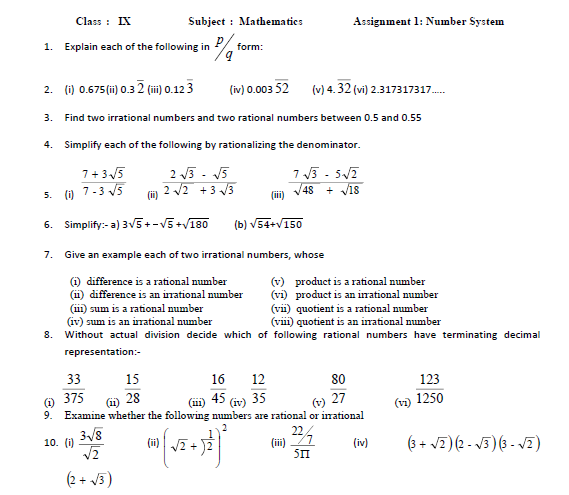
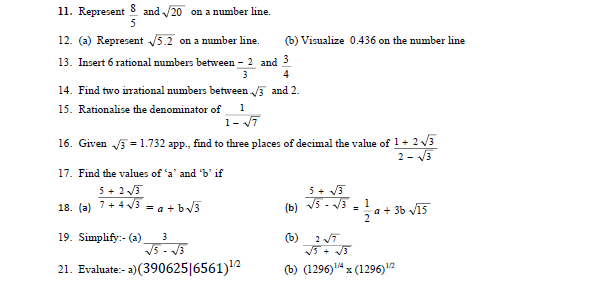
Free study material for Mathematics
Download Class 9 Mathematics Chapter 01 Number Systems Practice Worksheets
Mastering Chapter 01 Number Systems with Printable Worksheets
Access structured practice worksheets for Chapter 01 Number Systems aligned with the 2026 CBSE curriculum. These downloadable exercises for Class 9 Mathematics help students build accuracy and reinforce core concepts for upcoming school tests.
Verified Solutions and NCERT Alignment
Designed around the official curriculum for Class 9 Mathematics, these practice sheets guarantee standard compliance. Reviewing step-by-step solutions after completion sharpens your accuracy and clarifies complex sub-topics within Chapter 01 Number Systems.
Additional Study Resources for Class 9 Mathematics
Consistent engagement with these exercises builds familiarity with recurring exam themes. If specific areas within Chapter 01 Number Systems cause trouble, utilize our dedicated NCERT solutions for Class 9 Mathematics to clear up doubts immediately.
FAQs
You can download the latest chapter-wise printable worksheets for Class 9 Mathematics Chapter 01 Number Systems for free from StudiesToday.com. These have been made as per the latest CBSE curriculum for this academic year.
Yes, Class 9 Mathematics worksheets for Chapter 01 Number Systems focus on activity-based learning and also competency-style questions. This helps students to apply theoretical knowledge to practical scenarios.
Yes, we have provided solved worksheets for Class 9 Mathematics Chapter 01 Number Systems to help students verify their answers instantly.
Yes, our Class 9 Mathematics test sheets are mobile-friendly PDFs and can be printed by teachers for classroom.
For Chapter 01 Number Systems, regular practice with our worksheets will improve question-handling speed and help students understand all technical terms and diagrams.