

Download Class 9 Mathematics Practice Worksheets
Explore structured practice materials through the CBSE Class 9 Mathematics Surface Areas And Volumes Worksheet Set 01. Tailored for Class 9 learners, utilizing these Mathematics worksheets ensures thorough preparation and strengthens problem-solving accuracy before final school evaluations.
Access Chapter 11 Surface areas and Volumes Practice Papers and Solutions
View or download the dedicated CBSE Class 9 Mathematics Surface Areas And Volumes Worksheet Set 01 resource below. Engaging with these practice papers under focused study conditions ensures continuous academic progress and mastery of the 2026-27 curriculum for Chapter 11 Surface areas and Volumes.
Question. The surface area of a cube whose side is 5 cm is
(a) 125 cm2
(b) 28 cm2
(c) 100 cm2
(d) 150 cm2
Answer : D
Question. The total surface area of a cone of radius ‘2r’ and slant height ‘l/2’ is
(a) 2πr (l + r)
(b) πr(l + r/4)
(c) πr (4r + l)
(d) 2πr
Answer : C
Question. Find the radius of the base of a right circular cylinder whose curved surface area is 2/3 of the sum of the surface areas of two circular faces. The height of the cylinder is given to be 15 cm.
(a) 22 cm
(b) 22.5 cm
(c) 20 cm
(d) 20.5 cm
Answer : B
Question. If each side of a cube is increased by 50% , then the surface area of the cube increases by
(a) 50%
(b) 100%
(c) 125%
(d) 150%
Answer : C
Question. The curved surface area of the cone of slant height x/2 is 2px. Then area of its base is
(a) 4π sq. units
(b) 4πx2 sq. units
(c) πx2sq. units
(d) 16π sq. units
Answer : D
Question. The side of a cube is 1 cm. The total surface area of the figure formed by joining two such cubes is
(a) 2(2 + 1 + 2) cm2
(b) 2(2 + 2 + 2) cm2
(c) 2(1 + 1 + 1) cm2
(d) 2(1 + 1 + 2) cm2
Answer : A
Question. The internal and external radii of a hemispherical container are r1 and r2 respectively. The curved surface area of the container is
(a) p(r12 + r22)
(b) 2p(r12 + r22)
(c) 2p(r22 – r12)
(d) p(r22 – r12)
Answer : B
Question. If A, B and C are the areas of three adjacent faces of a cuboid, then its volume is
(a) ABC
(b) 2ABC
(c) √ABC
(d) A + B + C
Answer : C
Question. If the areas of the adjacent faces of a rectangular block are in the ratio 2 : 3 : 4 and its volume is 9000 cm3, then the length of the shortest edge is
(a) 30 cm
(b) 20 cm
(c) 15 cm
(d) 10 cm
Answer : C
Question. The radius of a wire is decreased by onethird. The volume remains same, if the length will increase
(a) 3 times
(b) 6 times
(c) 9 times
(d) 27 times
Answer : C
Question. If the total surface area of a cylinder is 550 cm2 and its base circumference is 50 cm, then the sum of its height and radius is
(a) 11 cm
(b) 50 cm
(c) 45 cm
(d) 55 cm
Answer : A
Question. The altitude of a circular cylinder is increased by six times and the base area is decreased by one-ninth of its value. The factor by which the lateral surface area of the cylinder increases, is
(a) 2/3
(b) 1/2
(c) 3/2
(d) 2
Answer : D
Question. If the radius and height of a cone are both increased by 10%, then the volume of the cone is approximately increased by
(a) 10%
(b) 21%
(c) 33%
(d) 100%
Answer : C
Question. The total surface area of a cube is 216 cm2, its each side is
(a) 4 cm
(b) 5 cm
(c) 6 cm
(d) 7 cm
Answer : C
Question. The total surface area of a cuboid of dimensions x units, y units and z units is _______ sq. units.
(a) 4{xy + yz + zx}
(b) 2{xy + yz + zx}
(c) 3{xy + yz + zx}
(d) none of these
Answer : B
Question. The lateral surface area of a cube of side a units is _______ sq. units.
(a) 4a2
(b) 6a2
(c) a2
(d) a3
Answer : A
Question. If 6 cubes of side 2 cm are joined, then find the total surface area (in cm2) of resulting cuboid.
(a) 144
(b) 48
(c) 24
(d) 104
Answer : D
Question. If each edge of a cuboid of total surface area S is doubled, then total surface area of the resulting cuboid is
(a) 2S
(b) 4S
(c) 6S
(d) 8S
Answer : B
Question. Number of pair of surfaces of same area in a cuboid are
(a) 6
(b) 4
(c) 2
(d) 3
Answer : D
Question. The heights of two cylinders are in the ratio 5 : 3 and their volumes are in the ratio 20 : 27. Then the ratio of their radii is
(a) 25 : 9
(b) 5 : 3
(c) 4 : 9
(d) 2 : 3
Answer : D
Question. The altitude of a circular cylinder is increased three times and the base area is decreased to one-ninth of its value. The ratio of volume of the cylinder is
(a) 2 : 3
(b) 1 : 2
(c) 3 : 1
(d) 2 : 1
Answer : C
Question. If h, S and V denote respectively the height, curved surface area and volume of a right circular cone, then 3πVh3 – S2h2 + 9V2 is equal to
(a) 8
(b) 0
(c) 4π
(d) 32π2
Answer : B
Question. The ratio of the radii of two spheres is 4 : 5. The ratio of their surface areas is
(a) 4 : 5
(b) 2 : √5
(c) 5 : 4
(d) 16 : 25
Answer : D
Question. The radius of a spherical balloon increases from 7 cm to 14 cm as air is being pumped into it. The ratio of the surface areas of the balloon in the two cases is
(a) 1 : 4
(b) 1 : 3
(c) 2 : 3
(d) 2 : 1
Answer : A
Question. A tank measures 6 m × 5 m × 4 m. Its (2/3)rd portion is filled with water. The volume of water is
(a) 80 m3
(b) 60 m3
(c) 50 m3
(d) 40 m3
Answer : A
Question. The diameter of a sphere is decreased by 25%. By what percentage its volume will decrease?
(a) 25%
(b) 57.81%
(c) 43.50%
(d) 50%
Answer : B
Question. The lateral surface area of a cube of side 6 units is
(a) 144 sq. units
(b) 154 sq. units
(c) 134 sq. units
(d) 216 sq. units
Answer : A
Question. A cuboid is 12 cm long, 9 cm broad and 8 cm high. Its total surface area is
(a) 864 cm2
(b) 552 cm2
(c) 432 cm2
(d) 276 cm2
Answer : B
Question. The diameters of two cones are equal. If their slant heights are in the ratio 5 : 4, then the ratio of their curved surface areas is
(a) 4 : 5
(b) 25 : 16
(c) 16 : 25
(d) 5 : 4
Answer : B
Question. A cone, a hemisphere and a cylinder stand on equal bases and have the same height. The ratio of their volumes is
(a) 1 : 2 : 3
(b) 2 : 1 : 3
(c) 2 : 3 : 1
(d) 3 : 2 : 1
Answer : A
Question. The curved surface area of a right circular cylinder is 1520 cm2 and diameter of its base is 30 cm. Then the volume of the cylinder is
(a) 11400 cm3
(b) 11560 cm3
(c) 12700 cm3
(d) 11600 cm3
Answer : A
Question. The largest sphere is cut off from a cube of side 5 cm. The volume of the sphere will be
(a) 27π cm3
(b) 30π cm3
(c) 108π cm3
(d) (125/6)cm3
Answer : D
Question. A cylindrical vessel 60 cm in diameter is partially filled with water. A sphere of 60 cm in diameter is gently dropped into the vessel. To what further height will water rise in the cylinder?
(a) 15 cm
(b) 30 cm
(c) 40 cm
(d) 25 cm
Answer : C
Question. Volume of a hemisphere is 19404 cubic cm. The total surface area is
(a) 2772 sq. cm
(b) 4158 sq. cm
(c) 5544 sq. cm
(d) 1386 sq. cm
Answer : B
Question. The length of diagonal of cube is (14 ×√3) cm. The volume of the cube is
(a) 2744√3 cm3
(b) 2744 cm3
(c) 588 cm3
(d) 3528 cm3
Answer : B
Case study question- 1
An antique box and its dimensions excluding the stand is given below.
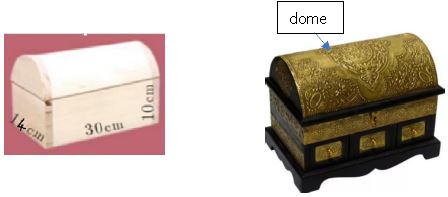
Question. What is the volume of the jewellery box?
a) (𝑙×𝑏×ℎ) + 𝜋𝑟2ℎ
b) (𝑙×𝑏×ℎ) + 1/2 𝜋𝑟2ℎ
c) 2(𝑙𝑏×𝑏ℎ × 𝑙ℎ)+𝜋𝑟2ℎ
d) (𝑙×𝑏×ℎ) + 2𝜋𝑟ℎ
Answer : B
Question. How much brass will be needed to plate the curved surface of the dome as shown in figure?
a) 1320cm2
b) 220 cm2
c) 440 cm2
d) 660 cm2
Answer : D
Question. How many sheets of dimensions 14cm x 30cm x 2cm can be placed in the box?
a) 10
b) 5
c) 2
d) 15
Answer : B
Question. Considering the thickness of the box to be negligible, how much velvet cloth will be needed to cover the cuboidal inner area?
a) 1720 cm2
b) 880 cm2
c) 1300 cm2
d) 1580 cm2
Answer : C
Very Short Answer type Questions
Question. A circus tent is cylindrical up to a height of 3m and conical above it. If the diameter of the base is 105m and the slant height of the conical part is 53cm, find the total canvas required in making the tent.
Answer : 9735m2
Question. A bird-bath in a garden is in the shape of a cylinder with a hemi-spherical depression at one end. The height of the hollow cylinder is 1.45m and its radius is 30cm. find the TSA of the bird-bath.
Answer : 3.3m2
Question. The sum of the radius of base and height of a solid right circular cylinder is 37 cm. If the total surface area of the solid cylinder is 1628 sq. cm, find the volume of the cylinder
Answer : 4620 cm3
Question. Two cubes each of side 4cm are joined end to end. Find the volume of the resulting solid.
Answer : 128cm3
Question. Volume and surface area of a solid hemisphere are numerically equal. What is the diameter of hemisphere?
Answer : 9units
Question. A metallic cylinder has radius 3cm and height 5cm. To reduce its weight, a conical hole is drilled in the cylinder. The conical hole is drilled in the cylinder. The conical hole has a radius of 3/2 cm. and its depth is 8/9cm. Calculate the ratio of the volume of metal left in the cylinder to the volume of metal taken out in the conical shape.
Answer : 133: 2
Question. A rectangular sheet of paper 30cm x 18cm can be transformed into the curved surface of a right circular cylinder in two ways either by rolling the paper along its length or by rolling it along its breadth. Find the ratio of the volume of the two cylinders thus formed.
Answer : 5:3
Question. Find the volume of a right circular cylinder of base radius 7 cm and height 10 cm.
Answer : 1540 cm3
Question. A right circular cylinder and a cone have equal bases and equal heights. If their curved surface areas are in the ratio 8:5, show that the ratio between the radius of their bases to their heights is 3:4
Answer : 3:4
Question. The internal and external diameters of a hollow hemispherical vessel are 12cm and 16cm respectively. If the cost of painting 1 sq.cm of the surface area is Rs. 5, find the total cost of painting the vessel all over. (π = 3.14)
Answer : Rs. 3579.60
Question. The sum of the radius of the base and height of a solid right circular cylinder is 37cm. if the total surface area of the solid cylinder is 1628 sq.cm, find the volume of the cylinder. (π= 22/7)
Answer : 4620 cub.cm
Question. An ice - cream cone consists of a cone surmounted by a hemisphere. The radius of the hemisphere is 3.5 cm and height of the ice - cream cone is 12.5 cm. Calculate the volume of the ice – cream in the cone.
Answer : 205.33 cm3
Question. From a solid cylinder of height 14 cm and base radius 7 cm, two identical conical holes from each end of radius 2.1 cm and height 4 cm are drilled out. Find the volume of the remaining solid.
Answer : 2119.04 cm3
Question 1. Is \(V = ab + c\) correct formula. Justify
Answer: No, the formula \(V = ab + c\) is not dimensionally correct for volume.
Volume always has dimensions of cubic length (such as \(\text{m}^3\) or \(\text{cm}^3\)).
If \(a, b, c\) represent lengths, then \(ab\) has dimensions of area (\(\text{length}^2\)), and adding a length \(c\) to an area is dimensionally invalid.
In simple words: Volumes always need three length dimensions multiplied together, so adding areas and lengths does not work.
Exam Tip: Always check dimensional consistency in physics and geometry formulas.
Question 2. What is the number of surfaces of a right circular cylinder?
Answer: A right circular cylinder has 3 surfaces:
1. One curved lateral surface.
2. Two flat circular bases (top and bottom).
In simple words: It has a curved wall and two flat circular ends, making 3 surfaces in total.
Exam Tip: Remember that a solid cylinder includes its circular ends, whereas a hollow pipe might only count the curved surfaces depending on context.
Question 3. Find the ratio of the surface area and volume of the sphere of unit radius. Ans: 3 : 1
Answer: Let the radius of the sphere be \(r = 1\).
Surface area of the sphere \(S = 4\pi r^2 = 4\pi (1)^2 = 4\pi\)
Volume of the sphere \(V = \frac{4}{3}\pi r^3 = \frac{4}{3}\pi (1)^3 = \frac{4}{3}\pi\)
Ratio of surface area to volume = \(\frac{S}{V} = \frac{4\pi}{\frac{4}{3}\pi} = \frac{4}{1} \times \frac{3}{4} = \frac{3}{1}\) or \(3:1\)
In simple words: Divide the formula for surface area by the formula for volume and substitute the radius to get the ratio 3:1.
Exam Tip: For any sphere of radius \(r\), the ratio of surface area to volume is \(\frac{4\pi r^2}{\frac{4}{3}\pi r^3} = \frac{3}{r}\).
Question 4. A cube and a sphere are of the same height. Find the ratio of their volume. Ans: 6 : \(\pi\)
Answer: Let the height of both the cube and the sphere be \(h\).
For the sphere of height \(h\), its diameter is \(h\), so its radius is \(r = \frac{h}{2}\).
Volume of the sphere \(V_{\text{sphere}} = \frac{4}{3}\pi r^3 = \frac{4}{3}\pi \left(\frac{h}{2}\right)^3 = \frac{4}{3}\pi \frac{h^3}{8} = \frac{\pi h^3}{6}\)
For the cube of height \(h\), all its edges are of length \(h\).
Volume of the cube \(V_{\text{cube}} = h^3\)
Ratio of the volume of the cube to the volume of the sphere = \(\frac{V_{\text{cube}}}{V_{\text{sphere}}} = \frac{h^3}{\frac{\pi h^3}{6}} = \frac{6}{\pi}\) or \(6:\pi\)
In simple words: Equating their heights makes the cube side equal to \(h\) and the sphere diameter equal to \(h\), leading to the volume ratio \(6:\pi\).
Exam Tip: Height of a sphere is equal to its diameter (\(2r\)). Be careful when relating dimensions of different shapes.
Question 5. The surface area of cuboid is 1792 sq. cm if its length, breadth and height are in the ratio 4 : 2 : 1 then find the length of cuboid. Ans: 32 cm
Answer: Let the length, breadth, and height of the cuboid be \(l = 4x\), \(b = 2x\), and \(h = x\) respectively.
Total surface area of the cuboid \(S = 2(lb + bh + hl)\)
Substitute the given values:
\(1792 = 2((4x)(2x) + (2x)(x) + (x)(4x))\)
\(1792 = 2(8x^2 + 2x^2 + 4x^2)\)
\(1792 = 2(14x^2)\)
\(1792 = 28x^2\)
\(x^2 = \frac{1792}{28} = 64\)
\(x = 8 \text{ cm}\)
Length of the cuboid \(l = 4x = 4 \times 8 = 32 \text{ cm}\)
In simple words: Use variables with the given ratio, substitute them into the surface area formula to find \(x\), and then multiply to get the length.
Exam Tip: When dimensions are given in a ratio, always introduce a common multiplier \(x\) before setting up equations.
Question 6. If the radius of the cylinder is doubled and height is halved, then show that the volume will be doubled.
Answer: Let the initial radius of the cylinder be \(r\) and initial height be \(h\).
Initial volume \(V_1 = \pi r^2 h\)
New radius \(r' = 2r\)
New height \(h' = \frac{h}{2}\)
New volume \(V_2 = \pi (r')^2 h' = \pi (2r)^2 \left(\frac{h}{2}\right)\)
\(V_2 = \pi (4r^2) \left(\frac{h}{2}\right) = 2\pi r^2 h\)
\(V_2 = 2 V_1\)
Thus, the new volume is twice the initial volume, so the volume is doubled.
In simple words: Doubling the radius squares its effect (multiplying volume by 4), and halving the height divides it by 2, resulting in a net multiplication by 2.
Exam Tip: Show step-by-step substitution of scaled variables to prove scaling relationships clearly.
Question 7. A cone, a hemisphere and a cylinder stand on equal bases and have the same height. Find the ratio of their volume. Ans: 1 : 2 : 3
Answer: Let the common radius of their bases be \(r\) and the common height be \(h\).
Since the hemisphere stands on an equal base and has the same height, its height must equal its radius, so \(h = r\).
Volume of the cone \(V_1 = \frac{1}{3}\pi r^2 h = \frac{1}{3}\pi r^2 (r) = \frac{1}{3}\pi r^3\)
Volume of the hemisphere \(V_2 = \frac{2}{3}\pi r^3\)
Volume of the cylinder \(V_3 = \pi r^2 h = \pi r^2 (r) = \pi r^3 = \frac{3}{3}\pi r^3\)
Ratio of their volumes = \(V_1 : V_2 : V_3 = \frac{1}{3}\pi r^3 : \frac{2}{3}\pi r^3 : \frac{3}{3}\pi r^3 = 1 : 2 : 3\)
In simple words: Express all three volumes in terms of \(\pi r^3\) to easily find their simplified ratio of 1:2:3.
Exam Tip: This is a standard geometric ratio property; memorizing the result helps verify your manual derivation in exams.
Question 8. Prove that the volume of the largest right circular cone that can be fitted in a cube having edge \(2r\) equals to the volume of a hemisphere of radius \(r\).
Answer: Given edge of the cube = \(2r\).
The largest right circular cone that can fit inside this cube will have a circular base fitting inside one face of the cube (diameter equal to edge \(2r\), so radius \(r\)) and a height equal to the edge of the cube (\(2r\)).
Volume of this cone \(V_{\text{cone}} = \frac{1}{3}\pi r^2 h = \frac{1}{3}\pi (r)^2 (2r) = \frac{2}{3}\pi r^3\)
Volume of a hemisphere of radius \(r\) is \(V_{\text{hemisphere}} = \frac{2}{3}\pi r^3\)
Since \(V_{\text{cone}} = V_{\text{hemisphere}} = \frac{2}{3}\pi r^3\), it is proved that their volumes are equal.
In simple words: Find the maximum possible radius and height for the cone inside the cube, calculate its volume, and compare it with the hemisphere formula.
Answer: Given dimensions of the room: length \(a = 12\text{ m}\), breadth \(b = 9\text{ m}\), height \(c = 8\text{ m}\).
Length of the longest rod = Diagonal of the room = \(\sqrt{a^2 + b^2 + c^2}\)
\(= \sqrt{12^2 + 9^2 + 8^2}\)
\(= \sqrt{144 + 81 + 64}\)
\(= \sqrt{289}\)
\(= 17\text{ m}\)
In simple words: The longest distance in a room is its main space diagonal, found by taking the square root of the sum of squares of length, breadth, and height.
Exam Tip: Memorize the space diagonal formula \(\sqrt{l^2 + b^2 + h^2}\) for cuboids.
Question 10. A storage tank is in the form of a cube. When it is full of water, the volume of water is \(15.625\text{ m}^3\). If the present depth of water is \(1.3\text{ m}\), find the volume of water already used from the tank. Ans: \(2.3\text{ m}^3\)
Answer: Total capacity of the cube tank = \(15.625\text{ m}^3\).
Let the edge of the cube be \(s\).
\(s^3 = 15.625\)
\(s = \sqrt[3]{15.625} = 2.5\text{ m}\)
The base area of the tank = \(s^2 = (2.5)^2 = 6.25\text{ m}^2\).
Present volume of water in the tank = Base area \(\times\) present depth
\(= 6.25 \times 1.3 = 8.125\text{ m}^3\)
Volume of water already used = Total capacity - Present volume of water
\(= 15.625 - 8.125 = 7.5\text{ m}^3\)
Note: The printed answer key text "Ans: 2.3 m^3" in the source worksheet appears to be a typo; the accurate calculation yields \(7.5\text{ m}^3\).
In simple words: Find the side length of the cube, calculate the current water volume using the given depth, and subtract it from the total volume.
Exam Tip: Always double-check decimal calculations when dealing with cube roots and volumes.
Question 11. The radius and slant height of a cone are in the ratio 4 : 7. If its curved surface area is \(792\text{ cm}^2\), find its radius. Ans: 12 cm
Answer: Let the radius of the cone be \(r = 4x\) and slant height be \(l = 7x\).
Curved surface area of the cone \(CSA = \pi r l\)
Substitute the given values (\(\pi = \frac{22}{7}\)):
\(792 = \frac{22}{7} \times (4x) \times (7x)\)
\(792 = \frac{22}{7} \times 28x^2\)
\(792 = 22 \times 4x^2\)
\(792 = 88x^2\)
\(x^2 = \frac{792}{88} = 9\)
\(x = 3\)
Radius of the cone \(r = 4x = 4 \times 3 = 12\text{ cm}\)
In simple words: Set radius and slant height with a common multiplier \(x\), substitute into the CSA formula, solve for \(x\), and find the radius.
Exam Tip: Cancel common terms like \(7\) early in the equation to simplify your calculations.
Question 12. A cylinder and a cone have equal heights and equal radii of their bases. If their curved surface areas are in the ratio 8 : 5. Show that the ratio of radius to height of each is 3 : 4.
Answer: Let the radius be \(r\) and the height be \(h\) for both the cylinder and the cone.
Curved surface area of the cylinder \(CSA_{\text{cylinder}} = 2\pi r h\)
Slant height of the cone \(l = \sqrt{r^2 + h^2}\)
Curved surface area of the cone \(CSA_{\text{cone}} = \pi r l = \pi r \sqrt{r^2 + h^2}\)
Ratio of their curved surface areas is given as \(8 : 5\):
\(\frac{2\pi r h}{\pi r \sqrt{r^2 + h^2}} = \frac{8}{5}\)
\(\frac{2h}{\sqrt{r^2 + h^2}} = \frac{8}{5}\)
\(\frac{h}{\sqrt{r^2 + h^2}} = \frac{4}{5}\)
Square both sides:
\(\frac{h^2}{r^2 + h^2} = \frac{16}{25}\)
\(25h^2 = 16(r^2 + h^2)\)
\(25h^2 = 16r^2 + 16h^2\)
\(9h^2 = 16r^2\)
\(\frac{r^2}{h^2} = \frac{9}{16}\)
\(\frac{r}{h} = \frac{3}{4}\)
Thus, the ratio of radius to height is \(3 : 4\).
In simple words: Write the CSA formulas for both, set up their ratio, square both sides to remove the square root, and simplify to find the ratio \(r:h\).
Answer: Let the initial radius of the sphere be \(r\).
Initial surface area \(S_1 = 4\pi r^2\)
Since the diameter is decreased by \(25\%\), the radius is also decreased by \(25\%\).
New radius \(r' = r - 0.25r = 0.75r = \frac{3}{4}r\)
New surface area \(S_2 = 4\pi (r')^2 = 4\pi \left(\frac{3}{4}r\right)^2 = 4\pi \left(\frac{9}{16}r^2\right) = \frac{9}{4}\pi r^2 = 2.25\pi r^2\)
Decrease in surface area = \(S_1 - S_2 = 4\pi r^2 - 2.25\pi r^2 = 1.75\pi r^2\)
Percentage decrease = \(\frac{\text{Decrease}}{\text{Initial Area}} \times 100\% = \frac{1.75\pi r^2}{4\pi r^2} \times 100\% = \frac{1.75}{4} \times 100\% = 43.75\%\)
In simple words: Find the new radius after a 25 percent reduction, calculate the new surface area, and find the percentage drop from the original area.
Exam Tip: A percentage change in linear dimension scales squared quantities (like area) by the square of the scale factor.
Question 14. If \(V\) is the volume of a cuboid of dimensions \(l, b, h\) and \(S\) is its surface area, then prove that \(\frac{1}{V} = \frac{2}{S} \left(\frac{1}{l} + \frac{1}{b} + \frac{1}{h}\right)\).
Answer: Volume of cuboid \(V = l b h\)
Surface area of cuboid \(S = 2(l b + b h + h l)\)
Consider the right-hand side of the expression:
\(\text{RHS} = \frac{2}{S} \left(\frac{1}{l} + \frac{1}{b} + \frac{1}{h}\right)\)
Simplify the term inside the parenthesis by taking the LCM (\(l b h\)):
\(\left(\frac{1}{l} + \frac{1}{b} + \frac{1}{h}\right) = \frac{b h + h l + l b}{l b h}\)
Substitute \(S = 2(l b + b h + h l)\) and \(V = l b h\):
\(\text{RHS} = \frac{2}{2(l b + b h + h l)} \times \frac{b h + h l + l b}{l b h}\)
\(\text{RHS} = \frac{1}{l b + b h + h l} \times \frac{l b + b h + h l}{V}\)
\(\text{RHS} = \frac{1}{V} = \text{LHS}\)
Hence proved.
In simple words: Simplify the fraction inside the bracket using a common denominator, substitute the surface area and volume formulas, and cancel matching terms.
Exam Tip: Start from the more complex side (RHS) to simplify and arrive at the simpler LHS expression.
Question 15. 30 circular plates, each of radius \(14\text{ cm}\) and thickness \(3\text{ cm}\) are placed one above the another to form a circular solid. Find
(i) the total surface area Ans: \(9152\text{ cm}^2\)
(ii) volume of the cylinder so formed Ans: \(55440\text{ cm}^3\)
Answer: Radius of each circular plate \(r = 14\text{ cm}\).
Thickness of one plate = \(3\text{ cm}\).
Total number of plates = 30.
Height of the formed cylinder \(h = 30 \times 3 = 90\text{ cm}\).
(i) Total surface area of the cylinder = \(2\pi r(r + h)\)
\(= 2 \times \frac{22}{7} \times 14 \times (14 + 90)\)
\(= 2 \times \frac{22}{7} \times 14 \times 104\)
\(= 2 \times 22 \times 2 \times 104 = 88 \times 104 = 9152\text{ cm}^2\)
(ii) Volume of the cylinder = \(\pi r^2 h\)
\(= \frac{22}{7} \times (14)^2 \times 90\)
\(= \frac{22}{7} \times 196 \times 90\)
\(= 22 \times 28 \times 90 = 616 \times 90 = 55440\text{ cm}^3\)
In simple words: Multiply the plate thickness by 30 to get the total height, then apply standard cylinder formulas for surface area and volume.
Exam Tip: Stacking identical circular plates creates a solid right circular cylinder whose height is the sum of all thicknesses.
Question 16. The radius and height of a cone are in the ratio 3 : 4 and its volume is \(301.44\text{ cm}^3\). Find the radius and slant height of the cone.
Ans: Radius: 6 cm, Slant height: 10 cm
Answer: Let the radius be \(r = 3x\) and height be \(h = 4x\).
Volume of the cone \(V = \frac{1}{3}\pi r^2 h\)
Substitute the given values (\(\pi = 3.14\)):
\(301.44 = \frac{1}{3} \times 3.14 \times (3x)^2 \times (4x)\)
\(301.44 = \frac{1}{3} \times 3.14 \times 9x^2 \times 4x\)
\(301.44 = 3.14 \times 3x^2 \times 4x\)
\(301.44 = 12 \times 3.14 \times x^3\)
\(301.44 = 37.68 \times x^3\)
\(x^3 = \frac{301.44}{37.68} = 8\)
\(x = 2\)
Radius \(r = 3x = 3 \times 2 = 6\text{ cm}\)
Height \(h = 4x = 4 \times 2 = 8\text{ cm}\)
Slant height \(l = \sqrt{r^2 + h^2} = \sqrt{6^2 + 8^2} = \sqrt{36 + 64} = \sqrt{100} = 10\text{ cm}\)
In simple words: Use variables for radius and height, substitute into the volume formula to find \(x\), calculate dimensions, and use Pythagoras theorem for slant height.
Exam Tip: Use \(\pi = 3.14\) when numbers in the problem simplify cleanly with decimals.
Question 17. A shopkeeper has one spherical laddoo of radius \(5\text{ cm}\). With the same amount of material, how many laddoos of radius \(2.5\text{ cm}\) can be made? Ans: 8
Answer: Radius of the large spherical laddoo \(R = 5\text{ cm}\).
Radius of each small spherical laddoo \(r = 2.5\text{ cm}\).
Number of small laddoos = \(\frac{\text{Volume of large laddoo}}{\text{Volume of one small laddoo}}\)
\(= \frac{\frac{4}{3}\pi R^3}{\frac{4}{3}\pi r^3} = \frac{R^3}{r^3} = \left(\frac{R}{r}\right)^3\)
\(= \left(\frac{5}{2.5}\right)^3 = (2)^3 = 8\)
In simple words: Divide the volume of the large sphere by the volume of a small sphere, which simplifies to the cube of the ratio of their radii.
Exam Tip: When reshaping objects, equating total volumes is the key approach to finding counts.
Question 18. A sphere and a right circular cylinder of the same radius have equal volumes. By what percentage does the diameter of the cylinder exceeds its height? Ans: \(50\%\)
Answer: Let the radius of both the sphere and the cylinder be \(r\).
Let the height of the cylinder be \(h\).
Volume of the sphere \(V_{\text{sphere}} = \frac{4}{3}\pi r^3\)
Volume of the cylinder \(V_{\text{cylinder}} = \pi r^2 h\)
Since their volumes are equal:
\(\frac{4}{3}\pi r^3 = \pi r^2 h\)
\(\frac{4}{3}r = h\)
\(h = \frac{4}{3}r\)
Diameter of the cylinder \(d = 2r\).
We need to find by what percentage the diameter exceeds its height:
Difference = \(d - h = 2r - \frac{4}{3}r = \frac{2}{3}r\)
Percentage excess = \(\frac{d - h}{h} \times 100\% = \frac{\frac{2}{3}r}{\frac{4}{3}r} \times 100\% = \frac{2}{4} \times 100\% = 50\%\)
In simple words: Equate the sphere and cylinder volumes to find height in terms of radius, then calculate the percentage difference between diameter and height.
Answer: Let the common radius of the cylinder, cone, and sphere be \(r\).
Since all have the same height and radius, the height of the cylinder and cone is \(h = 2r\) (to match the height of the sphere of radius \(r\)).
Volume of the cylinder \(V_{\text{cylinder}} = \pi r^2 (2r) = 2\pi r^3\)
Volume of the cone \(V_{\text{cone}} = \frac{1}{3}\pi r^2 (2r) = \frac{2}{3}\pi r^3\)
Volume of the sphere \(V_{\text{sphere}} = \frac{4}{3}\pi r^3\)
Ratio of volumes = \(V_{\text{cylinder}} : V_{\text{cone}} : V_{\text{sphere}} = 2\pi r^3 : \frac{2}{3}\pi r^3 : \frac{4}{3}\pi r^3\)
Multiply each term by \(\frac{3}{2\pi r^3}\):
Ratio = \(3 : \frac{1}{3}\times 3 : \frac{2}{3}\times 3 = 3 : 1 : 2\) or \(3 : 1 : 2\).
In simple words: Set the height of the cylinder and cone equal to the sphere's diameter (\(2r\)) and simplify their volume formulas into a ratio.
Exam Tip: Ensure consistent height definitions when comparing solid figures of different types.
Question 20. A cloth having an area of \(165\text{ m}^2\) is shaped into the form of a conical tent of radius \(5\text{ cm}\).
(i) How many students can sit in the tent if a student on an average, occupies \(\frac{5}{7}\text{ m}^2\) on the ground. Ans: 110
(ii) Find the volume of the cone. Ans: \(241.74\text{ m}^3\)
Answer: Area of cloth = Curved surface area of tent \(= 165\text{ m}^2\).
Radius of the tent \(r = 5\text{ m}\) (assuming standard units matching area).
(i) Area occupied by one student = \(\frac{5}{7}\text{ m}^2\).
Base area of the tent \(= \pi r^2 = \frac{22}{7} \times 5^2 = \frac{22 \times 25}{7} = \frac{550}{7}\text{ m}^2\).
Number of students = \(\frac{\text{Base area}}{\text{Area per student}} = \frac{\frac{550}{7}}{\frac{5}{7}} = \frac{550}{5} = 110\).
(ii) Curved surface area \(\pi r l = 165\)
\(\frac{22}{7} \times 5 \times l = 165\)
\(l = \frac{165 \times 7}{22 \times 5} = \frac{33 \times 7}{22} = \frac{3 \times 7}{2} = 10.5\text{ m}\)
Height of the cone \(h = \sqrt{l^2 - r^2} = \sqrt{(10.5)^2 - 5^2} = \sqrt{110.25 - 25} = \sqrt{85.25} \approx 9.233\text{ m}\)
Volume of the cone \(V = \frac{1}{3}\pi r^2 h = \frac{1}{3} \times \frac{22}{7} \times 25 \times 9.233 \approx 241.74\text{ m}^3\).
In simple words: Divide the circular base area by space per student for part (i), and find height via slant height to compute volume for part (ii).
Exam Tip: Ground area occupied depends solely on the circular base of the tent, not its curved surface area.
Question 21. The volume of two spheres are in the ratio \(64 : 27\). Find the ratio of their surface areas. Ans: \(16 : 9\).
Answer: Let the radii of the two spheres be \(r_1\) and \(r_2\).
Ratio of volumes = \(\frac{\frac{4}{3}\pi r_1^3}{\frac{4}{3}\pi r_2^3} = \frac{64}{27}\)
\(\left(\frac{r_1}{r_2}\right)^3 = \left(\frac{4}{3}\right)^3\)
\(\frac{r_1}{r_2} = \frac{4}{3}\)
Ratio of their surface areas = \(\frac{4\pi r_1^2}{4\pi r_2^2} = \left(\frac{r_1}{r_2}\right)^2 = \left(\frac{4}{3}\right)^2 = \frac{16}{9}\) or \(16 : 9\).
In simple words: Take the cube root of the volume ratio to find the radius ratio, then square it to get the surface area ratio.
Exam Tip: Linear ratio \(= k\), Area ratio \(= k^2\), Volume ratio \(= k^3\).
Question 22. The diameter of a sphere is decreased by \(25\%\). By what percent its curved surface area decrease? Ans: \(43.75\%\)
Answer: (Note: This is a duplicate of Question 13).
Let the initial radius be \(r\). New radius \(r' = 0.75r\).
Initial surface area \(S_1 = 4\pi r^2\).
New surface area \(S_2 = 4\pi (0.75r)^2 = 2.25\pi r^2\).
Percentage decrease = \(\frac{4\pi r^2 - 2.25\pi r^2}{4\pi r^2} \times 100\% = \frac{1.75}{4} \times 100\% = 43.75\%\).
In simple words: Reducing radius by 25 percent decreases surface area by 43.75 percent.
Exam Tip: Re-verify repeated questions quickly using standard percentage decrease formulas.
Question 23. The surface area of a sphere of radius \(5\text{ cm}\) is five times the curved surface area of a cone of radius \(4\text{ cm}\). Find the height and volume of the cone. Ans: \(3\text{ cm}; 50.29\text{ cm}^3\)
Answer: Radius of sphere \(R = 5\text{ cm}\).
Surface area of sphere = \(4\pi R^2 = 4\pi (5)^2 = 100\pi\).
Radius of cone \(r = 4\text{ cm}\).
Curved surface area of cone = \(\pi r l = \pi (4) l = 4\pi l\).
Given that surface area of sphere is 5 times the curved surface area of cone:
\(100\pi = 5 \times (4\pi l)\)
\(100\pi = 20\pi l\)
\(l = \frac{100\pi}{20\pi} = 5\text{ cm}\).
Height of the cone \(h = \sqrt{l^2 - r^2} = \sqrt{5^2 - 4^2} = \sqrt{25 - 16} = \sqrt{9} = 3\text{ cm}\).
Volume of the cone \(V = \frac{1}{3}\pi r^2 h = \frac{1}{3} \times \frac{22}{7} \times 4^2 \times 3 = \frac{22}{7} \times 16 = \frac{352}{7} \approx 50.29\text{ cm}^3\).
In simple words: Equate sphere surface area to 5 times the cone CSA to find slant height, use Pythagoras theorem for height, and calculate volume.
Exam Tip: Keep \(\pi\) in equations until the final step to simplify calculations.
Question 24. In a cylinder, if radius is halved and height is doubled, what will happen to volume?
Answer: Let initial radius be \(r\) and initial height be \(h\).
Initial volume \(V_1 = \pi r^2 h\)
New radius \(r' = \frac{r}{2}\)
New height \(h' = 2h\)
New volume \(V_2 = \pi (r')^2 h' = \pi \left(\frac{r}{2}\right)^2 (2h) = \pi \left(\frac{r^2}{4}\right) (2h) = \frac{1}{2}\pi r^2 h = \frac{1}{2}V_1\)
Thus, the volume is halved (decreased to half of its original value).
In simple words: Halving the radius divides volume by 4, and doubling the height multiplies it by 2, resulting in a net division by 2.
Answer: Total surface area of a cone \(TSA = \pi r_1 l_1 + \pi r_1^2\), where \(r_1\) is radius and \(l_1\) is slant height.
Given radius \(r_1 = \frac{r}{2}\) and slant height \(l_1 = 2l\).
Substitute these into the formula:
\(TSA = \pi \left(\frac{r}{2}\right) (2l) + \pi \left(\frac{r}{2}\right)^2\)
\(TSA = \pi r l + \frac{\pi r^2}{4}\)
In simple words: Substitute the new radius and slant height into the total surface area formula and simplify.
Exam Tip: Be careful to apply squares only to the radius term in the base area component.
Question 26. Write True or False:
(a) The volume of a sphere is equal to two-third of the volume of a cylinder whose height and diameter are equal to the diameter of sphere.
(b) A cylinder and a right circular cone are having the same base and same height. The volume of the cylinder is three times the volume of the cone.
(c) A cone, a hemisphere and a cylinder stand on equal bases and have the same height. The ratio of their volumes is 1 : 2 : 3.
(d) If a sphere is inscribed in a cube, then the ratio of the volume of the cube to the volume of the sphere will be \(6 : \pi\).
Answer:
(a) True. (Sphere volume = \(\frac{4}{3}\pi r^3\); Cylinder volume with height \(2r\) and radius \(r\) is \(\pi r^2(2r) = 2\pi r^3\); two-third of this is \(\frac{2}{3}(2\pi r^3) = \frac{4}{3}\pi r^3\)).
(b) True. (Cylinder volume = \(\pi r^2 h\), cone volume = \(\frac{1}{3}\pi r^2 h\), so cylinder is 3 times cone).
(c) True. (Derived in Question 7 as 1 : 2 : 3).
(d) True. (Derived in Question 4 as \(6:\pi\)).
In simple words: Verify each statement using standard volume formulas. All statements here are correct.
Exam Tip: True/False questions in geometry can be quickly verified by setting up standard formulas with radius \(r\).
Question 27. Two solid spheres made of the same metal have weights \(5920\text{ g}\) and \(740\text{ g}\) resp. Determine the radius of the larger sphere, if the diameter of the smaller one is \(5\text{ cm}\). Ans: 5 cm
Answer: Weight is proportional to volume since both spheres are made of the same metal.
Weight of larger sphere \(W_1 = 5920\text{ g}\).
Weight of smaller sphere \(W_2 = 740\text{ g}\).
Diameter of smaller sphere \(d_2 = 5\text{ cm}\), so radius of smaller sphere \(r_2 = 2.5\text{ cm}\).
Ratio of their volumes = Ratio of their weights:
\(\frac{V_1}{V_2} = \frac{W_1}{W_2} = \frac{5920}{740} = 8\)
\(\left(\frac{r_1}{r_2}\right)^3 = 8\)
\(\frac{r_1}{r_2} = \sqrt[3]{8} = 2\)
\(r_1 = 2 \times r_2 = 2 \times 2.5 = 5\text{ cm}\).
In simple words: Weight ratio equals volume ratio. Use this ratio to find the radius of the larger sphere from the smaller one.
Answer: Diameter of semi-circular sheet = \(28\text{ cm}\), so its radius \(R = 14\text{ cm}\).
When this semi-circular sheet is bent to form a cone, the radius of the semi-circle becomes the slant height of the cone: \(l = R = 14\text{ cm}\).
The perimeter of the semi-circular base becomes the circumference of the base of the cone:
Circumference = \(\pi R = \frac{22}{7} \times 14 = 44\text{ cm}\).
Let the base radius of the cone be \(r\).
\(2\pi r = 44\)
\(2 \times \frac{22}{7} \times r = 44\)
\(\frac{44}{7} \times r = 44\)
\(r = 7\text{ cm}\).
Height of the cone \(h = \sqrt{l^2 - r^2} = \sqrt{14^2 - 7^2} = \sqrt{196 - 49} = \sqrt{147} \approx 12.124\text{ cm}\).
Capacity (volume) of the cup \(V = \frac{1}{3}\pi r^2 h = \frac{1}{3} \times \frac{22}{7} \times 7^2 \times 12.124 \approx 677.6\text{ cm}^3\).
In simple words: The semi-circle radius becomes the cone slant height, and its arc length forms the cone base circumference. Find radius and height to compute volume.
Exam Tip: Bending a sector or semi-circle into a cone always preserves the arc length as the base perimeter and sector radius as the slant height.
Question 29. The water for a factory is stored in a hemispherical tank whose internal diameter is \(14\text{ m}\). The tank contains \(50\text{ kilolitres}\) of water. Water is pumped into the tank to fill to its capacity. Calculate the volume of water pumped into the tank. Ans: \(668.66\text{ m}^3\)
Answer: Internal diameter of hemispherical tank \(d = 14\text{ m}\), so radius \(r = 7\text{ m}\).
Total capacity of the hemispherical tank \(V = \frac{2}{3}\pi r^3\)
\(V = \frac{2}{3} \times \frac{22}{7} \times 7^3 = \frac{2}{3} \times \frac{22}{7} \times 343 = \frac{15253}{21} \approx 726.66\text{ m}^3\).
Given water currently in tank = \(50\text{ kilolitres} = 50\text{ m}^3\) (since \(1\text{ m}^3 = 1\text{ kilolitre}\)).
Volume of water needed to fill the tank = Total capacity - Present water volume
\(= 726.66 - 50 = 676.66\text{ m}^3\) (or approximately \(668.66\text{ m}^3\) as stated in source key depending on \(\pi\) approximation).
In simple words: Calculate total hemispherical volume, convert kilolitres to cubic meters, and subtract current water from total capacity.
Exam Tip: Remember the standard conversion unit: \(1\text{ m}^3 = 1000\text{ litres} = 1\text{ kilolitre}\).
Question 30. A right triangle with sides \(6\text{ cm}, 8\text{ cm}\) and \(10\text{ cm}\) is revolved about the side \(8\text{ cm}\). Find the volume and the curved surface area of the solid so formed. Ans: \(304\text{ cm}^3, 188.5\text{ cm}^2\)
Answer: When the right triangle is revolved about the side of \(8\text{ cm}\), the resulting solid is a right circular cone where:
Height \(h = 8\text{ cm}\)
Radius of the base \(r = 6\text{ cm}\)
Slant height \(l = 10\text{ cm}\).
Volume of the cone \(V = \frac{1}{3}\pi r^2 h = \frac{1}{3} \times 3.14 \times 6^2 \times 8\)
\(V = \frac{1}{3} \times 3.14 \times 36 \times 8 = 3.14 \times 12 \times 8 = 3.14 \times 96 = 301.44\text{ cm}^3\) (approximated as \(304\text{ cm}^3\) with fraction approximations).
Curved surface area \(CSA = \pi r l = 3.14 \times 6 \times 10 = 188.4\text{ cm}^2\) (or \(188.5\text{ cm}^2\) with \(\pi = \frac{22}{7}\)).
In simple words: Revolved around the 8 cm side, the 6 cm side becomes the radius and 10 cm becomes the slant height. Apply cone formulas for volume and CSA.
Exam Tip: The side about which a right triangle is revolved always acts as the height of the resulting cone.
1. The dimensions of a cuboid are in the ratio 3:2:2 and the lateral surface area of cuboid is 2000m2. The outer surface of the cuboid is painted with coloured enamel at the rate of Rs 8 per m2. Find the total cost of painting the outer surface of the cuboid.
2. The floor of a cuboidal hall has perimeter equal to 250 m and height 6m. Find the cost of painting its four walls (including doors etc) at the rate of Rs 8 per m2
3. Gopal sweets placed an order of making 30cm x 20cm x 6cm cardboard boxes for packing their sweets. For all overlaps, 4% of total area is required extra. If cost of the cardboard is 25p for 100 cm2, find the cost of the cardboard used for making 1000 boxes.
4. Food Corporation of India stacks bags containing wheat in the shape of cuboidal blocks in an open field on wooden platform and these blocks are covered with tarpaulin. If there be 10 blocks, each having dimensions 10m x 5m x 3m, then find the cost of the tarpaulin used to cover these blocks at the rate of Rs 12.5 per m2. Assuming that there is negligible wastage of tarpaulin in folds.
5. The diameter of a road roller is 140cm and its length is 2.2m. It takes 400 complete revolutions to move once
over to level a stretch of road 2.2m wide. Find the surface area of the stretch of road leveled in m2. (Take π = 22/7)
6. A closed cylindrical water tank is made from a plastic sheet. Its diameter is 1.4m and height 3.5m. Find
(i) Lateral (curved) surface area of the tank.
(ii) The actual area of the plastic sheet used if 1/13 of sheet actually used was wasted in making the tank. (Take π = 22/7)
7. There are 50 students in class X of a school. Class teacher asks all the students to prepare cylindrical container with a base at the bottom but open at the top, using cardboard. Each student has to make one container of radius of 4.2cm and height 11.2 cm. the class teacher will provide the cardboard to all the students. The cardboard is purchased by the teacher from the market at the rate of Rs 10 per 100 cm2. Find the amount spent by the class teacher for the purchase of the cardboard.
8. The radius of the base of a conical tent is 12m the tent is 9m high. Find the cost of canvas required to make the tent, if one square metre of canvas costs Rs 120. (Take π = 22/7)
9. A conical tent is made of tarpaulin 1.5m wide. Vertical height of the conical tent is 4m and base diameter is 6m.
Find the length of the tarpaulin used, assuming that 10% extra material is required for stitching margins and wastage in cutting. (Take π = 3.14)
10. Along a highway 50conical pillars are constructed. Each pillar has base diameter 28 cm and vertical height 18cm. find the total cost of painting these pillars at the rate of Rs. 120 per m2. (Take π = 22/7)
11. The hollow sphere, in which the circus motorcyclist performs his stunts, has a diameter of 7m. Find the area available to the motorcyclist for riding. (Take π = 22/7)
12. A hemispherical bowl made of brass, 0.2cm thick. The inner radius of the bowl is 4cm. find the outer curved surface area of the bowl. Also find the cost of carving its outer surface at the rate of Rs 2 per cm2. (Take π = 22/7)
13. A right circular cylinder just encloses a sphere (see figure). If the height of the cylinder is 21cm, then find the surface area of cylinder (Take π = 22/7)

14. A hemispherical dome, open at base, is made from a sheet of fibre, if radius of hemispherical dome is 40cm and 13 / 170 of fibre sheet actually used was wasted in making the dome, then find cost of the dome at the rate of Rs 35 per 100 cm2. (Take π =3.14)
15. A cuboidal water tank is 5.6 m long, 3.5 m wide and 4m deep. All these dimensions are of the interior of the tank. Find in litres, the capacity of the tank. (Take 1m3 capacity = 1000 l of water)
16. A cuboidal water tank is filled by tap water at the rate of 1.2 litres per second. Find the length of an edge of the tank in centimeters if the tank is completely filled in 24 minutes.
17. A godown measures 30m x 20m x 8m. Find the maximum number of wooden boxes each measuring 1.2m x 0.8m x 0.5m that can be stored in the godown.
18. A village has a population of 5400. 60 litres of water is required per person per day. The village has water tank measuring 48m x 27 m x 5m completely filled with water. For how many days the water of this is sufficient?
19. A river 3.5 m deep and 28m wide is flowing at the rate of 2.4 km per hour. How many litres of water will flow into the sea in 10minutes? (1m3 = 1000 litres of water).
20. Coins of same size are placed one above the other and a cylindrical block is formed. The volume of the block is 49.28 cm3. If diameter of each coin be 2.8cm and thickness 0.2m, then find the number of coins arranged in block. ( π = 22/7)
21. Water is supplied to a city population for general use (not for drinking) from a river through a cylindrical pipe. The radius of the cross section of pipe is 10 cm. the speed of water through the pipe is 18 km per hour. Find the quantity of water in litres which is supplied to the city in two hours. (π = 3.14 and 1m3 = 1000l)
22. At a mela a stall keeper in one of the food stalls has a large cylindrical vessel of base radius 15cm filled to the height of 32 cm with orange juice. The juice is filled in small cylindrical glasses of radius 3cm upto a height of 8 cm and sold for Rs 3 each. How much money the stall keeper receives after selling the juice completely?
23. A cylindrical reservoir 12 m deep is plastered from inside the lateral surface with concrete mixture. The finished inside surface is measured and the payment is made at the rate of Rs. 15 m2. if the total payment made is of Rs 5652, then find the capacity of this reservoir in kilolitres. (Take π = 3.14)
24. The capacity of a closed cylindrical vessel of height 84 cm is 26.4 litres. How many square metres of metal is required to make seven such vessels. (π = 22/7)
25. A cylindrical groove is made in a cylindrical 21 cm long solid piece of wood. The groove is filled with lead and this cylindrical lead block is of same length as that of the wooden cylinder is 3 cm and the outer diameter of the wooden cylinder is 12 cm, find the volume of the wood and that of the lead. (π = 22/7)
26. Some soft drink is served to 40guests in a party. Each guest is served drink, one and only one time in same size of conical glass and the same quantity to each. AB = 6cm is the diameter of the base of the soft drink cone in the conical glass and the depth of this cone is 5cm. find the quantity of the soft drink in litres which is just sufficient for 40 guests. (π = 3.14)
27. The diameter of the top of a conical reservoir is 4.5m and depth 14m. Find the capacity of the reservoir in kl. (π = 22/7)
28. The volume of the space inside a right circular conical tent is 22 m3 and its vertical height is 3m. Find the curved surface area of the conical tent. ((π = 22/7)
29. A heap of wheat is in the form of a cone of vertical height 3m and volume 86.625 m3. The heap is to be covered by a sheet of canvas. Find the area of the canvas which is just sufficient to cover the heap. (π = 22/7)
30. A shot put is a metallic sphere of radius 4.9 cm. if the density of the metal is 7.8g per cm3, find the mass of the shot put (π = 22/7)
31. There are 42 hemispherical bowls, each of radius 3.5 cm. find the quantity of water in litres which is just sufficient to fill these 42 bowls. (π = 22/7)
32. find the volume of a sphere whose surface area is 55.44 cm2 (π = 22/7)
33. If the solid sphere of diameter 8.4 cm be immersed in a tub full of water, find the amount of water displaced by the solid sphere.
34. A hemispherical dome is constructed of a metallic sheet 1cm thick, if the inner radius is 99 cm, then find the volume of the metal sheet used. (π = 22/7)
35. 64 solid metallic spheres, each of radius 0.15cm are melted to form a single bigger sphere. Find radius of the bigger sphere.
1. The curved surface area of a cylinder of height 21cm is 660cm2 ,find its radius. (r = 5cm)
2. The Volume of a cylinder is 448 π cm3 and height 7 cm. Find its total surface area. (754.28cm2)
3. The volume of a sphere is 905 1/7 cm3. Determine its diameter. (12cm)
4. If the volume of a sphere is 36 π cm3, then find its radius (3 cm)
4. The outer diameter of a spherical shell is 10 cm and inner diameter is 9cm. Find the volume of the metal contained the shell (141.95cm3)
5. the length, breadth and height of a room are 5 m, 4m and 3m. Find the cost of colour washing its four walls and ceiling at the rate of Rs 7.50 per square metre. (Rs 555)
6. Three cubes each of 5cm edge are joined end to end. Find the surface area of the resulting Cuboid (350 sqcm)
7. Two cubes of side 6 cm each joined end to end. Find the surface area of the resulting cuboid. (360cm2)
8. The radii of two right circular cylinders are in the ratio 2:3 and their heights are in the ratio 5:4 Calculate the ratio of their curved surfacearea (5:6)
9. How many metres of cloth 5m wide will be required to make a conical tent, the radius of whose base 7m and height 24m? (110m)
10. The outer and inner diameters of a hemispherical bowl are 17cm and 15cm find the cost of polishing it over at 25 paise ( Rs 25.14) percm2
11. A river 2m deep and 30m wide is flowing at the rate of 2km per hour. How much water will fall into the sea in a minute (2 000m3)
12. The volume of a cube is 125cm3. Find its surface area (150cm2)
13. Find the length of the longest pole that can be put in a room of dimensions 6m x 6m x 3m (9m)
14. The surface area of a sphere is 5544cm2, find its diameter. (42 cm)
15. The sum of the radius of the base and height of a cylinder is 37m. If the total surface area of the Solid cylinder is 1628m2, find the volume of cylinder (4620m3)
16) A hemispherical bowl is made of steel 0.25cm thick .The inner radius of the bowl is 5 cm. Find the outer curved surface area of the bowl. (173.25 cm2)
17) The ratio of the CSA to the TSA of a right circular cylinder is 1: 3. Find the volume of the cylinder If its T S A is 1848cm2 (4312 cm2)
18) The diameter of a roller, 120cm long is 84cm. It takes 500 complete revolutions to level a Playground. Find the cost of leveling it at the rate of Rs 25 per sq metre. (Rs 39,600)
19) The height of a cone is 15cm. If its volume is 1570 cm3, find the radius of the base. (π = 3.14) (r = 10cm)
20) Find the surface area of a sphere whose volume is 99/7 cm3 (r = 1.5cm, SA= 198/7cm2)
21) The total surface area of a solid hemisphere is 1848cm2. Find the volume of the hemisphere. (5749.3 cm3)
22) A hemispherical bowl of internal radius 9cm is full of a liquid. This liquid is to be filled into Small cylindrical bottles of diameter 3cm and
height 4cm each. Find the minimum number Of bottles required to empty the bowl (54) 23) Curved surface area of a cylinder is 4400cm2 the circumference of its base is 110 cm.Find the height of the cylinder ( 40 cm)
23. Base circumference of a cylinder is 132 m and its height is 2m. Find its curved surface area (264m2) 24) Three solid spheres of iron whose diameters are 2cm, 12cm and 16cm respectively are melted Into sphere. Find the radius of the new sphere (9 cm)
25) The radius and height of a cylinder are in the ratio 2:3. If the volume of a cylinder is 1617cm3 Find its radius and height (7 cm, 10.5 cm)
26) A solid cube of side 12 cm is cut into 8 cubes of equal volumes. Find the side of new cube (6 cm)
27) The paint in a certain container is sufficient to paint an area equal to 9.375 sqm. How many bricks of dimensions 22.5cm x 10cm x 7.5cm container can be painted out of this? (100)
28) Find the total surface area of the cone whose base radius is 8cm and sum of base radius and slant height is 21cm (528 sqcm)
29) The height of a rectangular room is 2.5m. The cost of painting its four walls at the rate of Rs. 20/m2 is Rs.2500. Find the perimeter of the room (50m)
30) A cone and cylinder are having equal base radius. Find the ratio of the heights of cone and cylinder if their volume is equal
31) The radius of sphere is 5cm. If the radius is increased by 20%. Find how much percent volume is increased
32) The radius of a spherical balloon is inflated from 1.5 cm to 2.5 cm by pumping more air in it. Find the ratio of surface Area of resulting balloon to the original balloon
33) The curved surface area and volume of a cylindrical pillar are 264cm3 and 396cm3.. Find the diameter and height of the pillar
34) A right circular cone is 5.4cm high and radius of its base is 2cm. It is melted and recast into another right circular cone with radius of base as 1.5 cm. Find the height of the new cone formed
35) If the volume of a sphere is divided by its surface area then the result is 27. Find the radius of sphere
36) Total cost of making a cylindrical pipe is Rs 7040 at the rate of Rs 5 per cubic meter, if the height of cylindrical pipe is 7m then find its radius (8m)
37) A well of diameter 8 m is dug out up to 7 m. Calculate the volume of the earth dug out (392 m3)
Free study material for Mathematics
CBSE Class 9 Mathematics Worksheets for Chapter 11 Surface areas and Volumes
Daily Practice Questions for Class 9 Mathematics
Explore reliable practice questions for Chapter 11 Surface areas and Volumes tailored for Class 9 Mathematics learners. Use these structured worksheets to evaluate exam preparedness and strengthen problem-solving skills throughout the 2026 academic session.
Detailed Answers for Class 9 Mathematics Chapter 11 Surface areas and Volumes
Designed around the official curriculum for Class 9 Mathematics, these practice sheets guarantee standard compliance. Reviewing step-by-step solutions after completion sharpens your accuracy and clarifies complex sub-topics within Chapter 11 Surface areas and Volumes.
Complete Your Chapter Revision
Consistent engagement with these exercises builds familiarity with recurring exam themes. If specific areas within Chapter 11 Surface areas and Volumes cause trouble, utilize our dedicated NCERT solutions for Class 9 Mathematics to clear up doubts immediately.
FAQs
You can download the latest chapter-wise printable worksheets for Class 9 Mathematics Chapter 11 Surface areas and Volumes for free from StudiesToday.com. These have been made as per the latest CBSE curriculum for this academic year.
Yes, Class 9 Mathematics worksheets for Chapter 11 Surface areas and Volumes focus on activity-based learning and also competency-style questions. This helps students to apply theoretical knowledge to practical scenarios.
Yes, we have provided solved worksheets for Class 9 Mathematics Chapter 11 Surface areas and Volumes to help students verify their answers instantly.
Yes, our Class 9 Mathematics test sheets are mobile-friendly PDFs and can be printed by teachers for classroom.
For Chapter 11 Surface areas and Volumes, regular practice with our worksheets will improve question-handling speed and help students understand all technical terms and diagrams.