

Download Class 9 Mathematics Practice Worksheets
Access comprehensive chapter-wise worksheets for Chapter 11 Surface areas and Volumes using the CBSE Class 9 Mathematics Surface Areas And Volumes Worksheet Set 02. Designed to align with the 2026-27 academic syllabus for Class 9 Mathematics, these printable practice sets help students reinforce key concepts and improve their overall exam readiness.
Access Chapter 11 Surface areas and Volumes Practice Papers and Solutions
View or download the dedicated CBSE Class 9 Mathematics Surface Areas And Volumes Worksheet Set 02 resource below. Engaging with these practice papers under focused study conditions ensures continuous academic progress and mastery of the 2026-27 curriculum for Chapter 11 Surface areas and Volumes.
Question. Sonali has about half a litre of molten wax to make a candle. Which of these candles could she have made using the entire quantity of wax? (1 cm3 = 1ml)
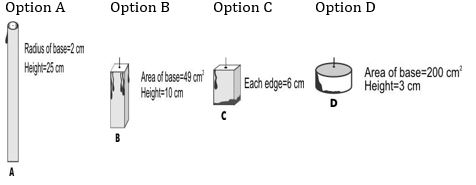
Answer : B
Question. Zubin wants to cover the CURVED SURFACE of an old waste paper basket with coloured paper. The dimensions of the basket are shown below. What is the total area that has to be covered with paper?
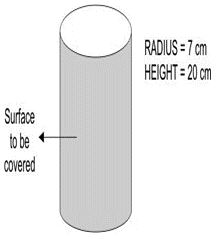
(a) 220 cm2
(b) 440 cm2
(c) 880 cm2
(d) 1760 cm2
Answer : C
Question. Travelling only along the edges and covering a distance of exactly 22 cm, how many different routes can be taken to go from corner P to corner Q of this cuboid?
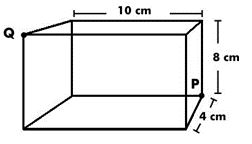
(a) 10
(b) 8
(c) 6
(d) 1
Answer : C
Question. The formula for calculating the area of the walls of a rectangular room, A is given as:
A = 2h (l + b), where h is the height of the room. l its lenght and b its breadth
Which of the following would be the correct formula to find the breadth of a room when the area, height and length are given?
(a) A - 2hl
(b) A-l/2h
(c) -2h/A-l
(d) A/2h - l
Answer : D
Question. A piece of cardboard is cut to the shape shown and 2 dots are marked on it. The cardboard is then folded along the lines to form a CUBE. Which of the cubes shown here CAN be constructed from the cardboard piece?
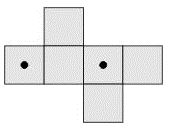
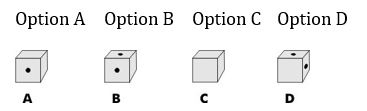
Answer : A
Question. What is the length of tape required to cover the entire outer CURVED surface of the pipe shown below if the width of the tape used is 2 cm? (Assume that there is no overlap of tape)
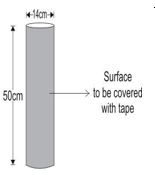
(a) 22 cm
(b) 25 cm
(c) 7.7 m
(d) 11 m
Answer : D
Question. The cuboid shown below consists of 9 cubes of side 1 unit each. If the shaded unit cube is REMOVED, what will be the surface area of the remaining solid?
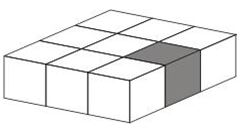
(a) 24 sq. units
(b) 28 sq. units
(c) 30 sq. units
(d) 32 sq. units
Answer : C
Question. 250 ml of water is poured into a container like the one shown below which already contains some water. Assuming that no water spills out, what will be the increase in the level of water in the container? (1 ml = 1 cm3)
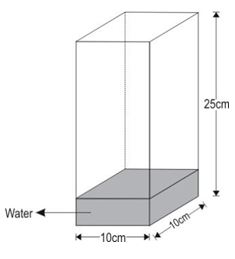
(a) 2. 5 cm
(b) 5 cm
(c) 10 cm
(d) We can't say
Answer : A
Question. A solid cylinder made of pure metal has a mass of 24 kg. What would the mass be if it were twice as thick but only half as long?

(a) 12 kg
(b) 24 kg
(c) 36 kg
(d) 48kg
Answer : D
Question. A cube of side 1 metre is stuck on top of another cube of side 2 metres, which in turn is stuck on top of a cuboid of dimensions (6 m x 5 m x 3 m) to form the solid shown below. The entire exposed surface of this solid (including the bottom of the cuboid) has to be painted. How many square metres is that?
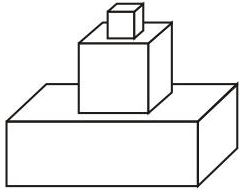
(a) 151
(b) 146
(c) 120
(d) 113
Answer : B
Question. Two squares of sides 4 cm and one square of side 5 cm are placed as shown. The shaded area is:
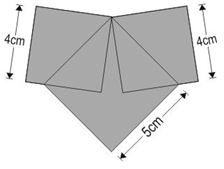
(a) 37 cm2
(b) 41 cm2
(c) 45 cm2
(d) 57 cm2
Answer : C
Question. The piece below is cut out from a circular sheet of radius 21 cm. What is the area of the piece?
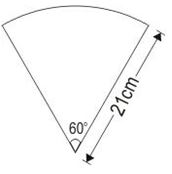
(a) 23.1 cm2
(b) 231 cm2
(c) 346.5 cm2
(d) 441 cm2
Answer : B
Question. The floor of a room that is 6 m long and 4 m 20 cm wide has to be tiled entirely with square tiles OF EQUAL SIZE. What is the MINIMUM number of square tiles with which this can be done? (No tile can be broken or cut)
(a) 30
(b) 42
(c) 60
(d) 70
Answer : D
Question. In the grid shown below, the distance between any two consecutive points marked on OP (or OQ) is taken to be the unit distance. Which point on the grid is at a distance of 5 units from O?

(a) A
(b) B
(c) C
(d) D
Answer : C
Question. Points P, Q and R are co-planar. In which of the following cases will they NECESSARILY be collinear?
(a) When PQ = PR
(b) When PQ + PR > QR
(c) When PQ + QR = PR
(d) When PR < PQ + QR
Answer : C
Question. The radius of a sphere (in cm) whose volume is 12π cm3, is
(a) 3
(b) 3√3
(c) 32/3
(d) 31/3
Answer : C
Question. If the surface area of a sphere is 144π, then its radius is
(a) 6 cm
(b) 8 cm
(c) 12 cm
(d) 10 cm
Answer : A
Question. The edge of a cube whose volume is equal to that of a cuboid of dimensions 8 cm × 4 cm × 2 cm is
(a) 6 cm
(b) 4 cm
(c) 2 cm
(d) 8 cm
Answer : B
Question. If the radii of two spheres are in the ratio 2 : 3, then the ratio of their respective volumes is
(a) 8 : 27
(b) 3 : 5
(c) 7 : 24
(d) 5 : 14
Answer : A
Question. The edge of a cube whose volume is 8x3 is
(a) x
(b) 2x
(c) 4x
(d) 8x
Answer : B
Question. If the volume of a 7 cm high right circular cylinder is 448π cm3, then its radius is equal to
(a) 2 cm
(b) 4 cm
(c) 6 cm
(d) 8 cm
Answer : D
Assertion-Reason Type Questions
In the following questions, a statement of assertion (A) is followed by a statement of reason (R). Mark the correct choice as:
(a) Both assertion (A) and reason (R) are true and reason (R) is the correct explanation of assertion (A).
(b) Both assertion (A) and reason (R) are true but reason (R) is not the correct explanation of assertion (A).
(c) Assertion (A) is true but reason (R) is false.
(d) Assertion (A) is false but reason (R) is true.
Question. Assertion (A): Total surface area of the cylinder having radius of the base 14 cm and height 30 cm is 3872 cm2.
Reason (R): If r be the radius and h be the height of the cylinder, then total surface area = (2πrh + 2πr2).
Answer : A
Question. Assertion (A): If the height of a cone is 24 cm and diameter of the base is 14 cm, then the slant height of the cone is 15 cm.
Reason (R): If r is the radius and h the height of the cone, then slant height = √h2 + r2 .
Answer : A
Answer the following.
Question. Volume and surface area of a solid hemisphere are numerically equal. What is the diameter of hemisphere?
Answer : (2/3) πr3 = 3πr2 ⇒ r = 9/2 units
∴ d = 9 units
Question. Total surface area of a cube is 216 cm2. Find its volume.
Answer : 6l2 = 216 ⇒ l2 = 36
⇒ l = 6
∴ Volume of cube = l3 = (6)3 = 216 cm3
Question. If a solid right-circular cone of height 24 cm and base radius 6 cm is melted and recast in the shape of a sphere, find the radius of the sphere.
Answer : Volume of cone = volume of sphere
∴ (1/3)π62 × 24 = (4/3)πr3
⇒ 864 = 4r3
⇒ r3 = 216
⇒ r = 6 cm
So, radius of sphere = 6 cm
Question. Find the curved surface area of a right-circular cone of height 15 cm and base diameter 16 cm.
Answer : Slant height of cone, l = √82 + 152
(∵ Diameter = 16 cm)
⇒ l = 17 cm
∴ CSA of cone = πrl = π × 8 × 17
= 136 p cm2
Question. Find the radius of the sphere whose surface area is 36 π cm2.
Let r be the radius of sphere.
Then, 4πr2 = 36π
⇒ r2 = 36π/4π = 9
⇒ r = 3 cm
Question. 12 solid spheres of the same radii are made by melting a solid metallic cylinder of base diameter 2 cm and height 16 cm. Find the diameter of the each sphere
πR2H = 12 x 4/3 πr3
1 × 1 × 16 = 4/3 × r3 × 12
r3 = 13
r = 1
d = 2 cm
Case Study Based Questions
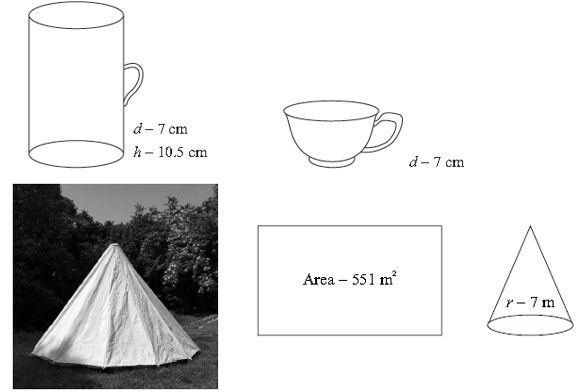
I. Adventure camps are the perfect place for the children to practise decision making for themselves without parents and teachers guiding them every move. Some students of a school reached for adventure at Sakleshpur. At the camp, the waiters served some students with a welcome drink in a cylindrical glass while some students in a hemispherical cup whose dimensions are shown below. After that they went for a jungle trek. The jungle trek was enjoyable but tiring. As
dusk fell, it was time to take shelter.
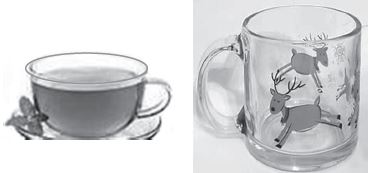
Each group of four students was given a canvas of area 551 m2. Each group had to make a conical tent to accommodate all the four students. Assuming that all the stitching and wasting incurred while cutting, would amount to 1 m2, the students put the tents. The radius of the tent is 7 m.
Question. The volume of cylindrical cup is
(a) 295.75 cm3
(b) 7415.5 cm3
(c) 384.88 cm3
(d) 404.25 cm3
Answer : D
Question. The volume of hemispherical cup is
(a) 179.67 cm3
(b) 89.83 cm3
(c) 172.25 cm3
(d) 210.60 cm3
Answer : B
Question. Which container had more juice and by how much?
(a) Hemispherical cup, 195 cm3
(b) Cylindrical glass, 207 cm3
(c) Hemispherical cup, 280.85 cm3
(d) Cylindrical glass, 314.42 cm3
Answer : D
Question. The height of the conical tent prepared to accommodate four students is
(a) 18 m
(b) 10 m
(c) 24 m
(d) 14 m
Answer : B
Question. How much space on the ground is occupied by each student in the conical tent
(a) 54 m2
(b) 38.5 m2
(c) 86 m2
(d) 24 m2
Answer : C
Short Answer Type Questions
Question. Find the area enclosed between two concentric circles of radii 4 cm and 3 cm.
Answer:
The area of the region between two concentric circles is the difference between the area of the larger circle and the area of the smaller circle.
Let the outer radius be \( R = 4\text{ cm} \) and the inner radius be \( r = 3\text{ cm} \).
Area of the enclosed region \( = \pi R^2 - \pi r^2 \)
\( = \pi(R^2 - r^2) \)
\( = \pi(4^2 - 3^2) \)
\( = \pi(16 - 9) \)
\( = 7\pi\text{ cm}^2 \)
Substituting \( \pi \approx \frac{22}{7} \):
Area \( = 7 \times \frac{22}{7} = 22\text{ cm}^2 \)
In simple words: To find the space between the two circles, subtract the area of the smaller circle from the larger one.
Exam Tip: Remember to use the formula \( \pi(R^2 - r^2) \) directly to save calculation time in exams.
Question. A cuboid has total surface area of 40 sq m and its lateral surface area is 26 sq m. Find the area of base.
Answer:
The total surface area of a cuboid is the sum of its lateral surface area and the areas of its top and bottom bases.
Total Surface Area (TSA) \( = \text{Lateral Surface Area (LSA)} + 2 \times \text{Base Area} \)
Given:
TSA \( = 40\text{ sq m} \)
LSA \( = 26\text{ sq m} \)
Substituting these values into the equation:
\( 40 = 26 + 2 \times \text{Base Area} \)
\( \implies 2 \times \text{Base Area} = 40 - 26 \)
\( \implies 2 \times \text{Base Area} = 14 \)
\( \implies \text{Base Area} = \frac{14}{2} = 7\text{ sq m} \)
Therefore, the area of the base is \( 7\text{ sq m} \).
In simple words: Total surface area is just the side walls plus the floor and the ceiling. Since the floor and ceiling are the same size, we subtract the wall area from the total area and split the remainder in half.
Exam Tip: Be careful with the relation \( \text{TSA} = \text{LSA} + 2 \times \text{Base Area} \), which is extremely useful for quick solutions.
Question. The area of three adjacent faces of a cuboid are x, y and z. If the volume is V, prove that \( V^2 = xyz \)
Answer:
Let the length, breadth, and height of the cuboid be \( l \), \( b \), and \( h \) respectively.
The areas of the three adjacent faces are given as:
\( x = l \times b \)
\( y = b \times h \)
\( z = h \times l \)
Multiplying the three face areas together:
\( x \times y \times z = (l \times b) \times (b \times h) \times (h \times l) \)
\( xyz = l^2 \times b^2 \times h^2 \)
\( xyz = (lbh)^2 \)
Since the volume \( V \) of a cuboid is \( V = lbh \), we substitute \( V \) into the equation:
\( xyz = V^2 \)
\( \implies V^2 = xyz \)
Hence proved.
In simple words: The three faces are made of combinations of length, width, and height. When you multiply all three face areas, you get the square of length times width times height, which is the volume squared.
Exam Tip: This is a standard proof. Remember that multiplying adjacent face areas of any cuboid always gives the square of its volume.
Question. A sphere is double height as the cube The ratio of their volume is:
(a) 88 : 21
(b) 44 : 21
(c) 8 : 21
(d) 88 : 23
Answer: (a) 88 : 21
Let the edge length of the cube be \( a \). The height of the cube is \( a \).
The height of a sphere is equal to its diameter, \( 2R \), where \( R \) is the radius.
According to the problem, the height of the sphere is twice the height of the cube:
\( 2R = 2a \)
\( \implies R = a \)
The volume of the sphere is:
\( V_{\text{sphere}} = \frac{4}{3}\pi R^3 = \frac{4}{3}\pi a^3 \)
The volume of the cube is:
\( V_{\text{cube}} = a^3 \)
The ratio of their volumes is:
Ratio \( = \frac{V_{\text{sphere}}}{V_{\text{cube}}} = \frac{\frac{4}{3}\pi a^3}{a^3} = \frac{4}{3}\pi \)
Using \( \pi = \frac{22}{7} \):
Ratio \( = \frac{4}{3} \times \frac{22}{7} = \frac{88}{21} \)
Therefore, the ratio is 88 : 21.
In simple words: Since the sphere's height is double the cube's height, the radius of the sphere equals the side length of the cube. Dividing the sphere's volume formula by the cube's volume formula gives a ratio of 88 to 21.
Exam Tip: Remember that the "height" of a sphere is its diameter. This is a common point where students make errors by using the radius instead of the diameter.
Question. The lateral surface area of a right circular cylinder with base radius 8m & height 14m is:
(a) 714 sq m
(b) 724 sq m
(c) 704 sq m
(d) None of the options
Answer: (c) 704 sq m
The formula for the lateral surface area of a right circular cylinder is:
LSA \( = 2\pi rh \)
Given:
Radius, \( r = 8\text{ m} \)
Height, \( h = 14\text{ m} \)
Substituting these values into the formula:
LSA \( = 2 \times \frac{22}{7} \times 8 \times 14 \)
LSA \( = 2 \times 22 \times 8 \times 2 \)
LSA \( = 44 \times 16 = 704\text{ sq m} \)
Therefore, the lateral surface area of the cylinder is \( 704\text{ sq m} \).
In simple words: Multiply the cylinder's height by its circular boundary to find the area of its curved side.
Exam Tip: Use the fractional value of \( \pi = \frac{22}{7} \) when the height or radius is a multiple of 7, as this makes cancellation much simpler.
Question. The number of surfaces in right circular cylinder is:
(a) 3
(b) 2
(c) 4
(d) 1
Answer: (a) 3
A solid right circular cylinder consists of three surfaces:
1. One curved (lateral) surface that forms the side.
2. Two flat, circular surfaces that represent the top and bottom bases.
Therefore, the total number of surfaces is 3.
In simple words: A tin can has three surfaces: the round label on the side, the circular lid at the top, and the circular base at the bottom.
Exam Tip: Be sure to read whether the question asks for "total surfaces" (which is 3) or only "curved surfaces" (which is 1).
Question. A sphere and a cube are of the same height. The ratio of their volume is-
(a) 11:21
(b) 21:11
(c) 3:4
(d) 4:3
Answer: (a) 11:21
Let the edge length of the cube be \( a \). The height of the cube is \( a \).
The height of the sphere is its diameter, \( 2R \), where \( R \) is its radius.
Since they have the same height:
\( 2R = a \)
\( \implies R = \frac{a}{2} \)
The volume of the sphere is:
\( V_{\text{sphere}} = \frac{4}{3}\pi R^3 = \frac{4}{3}\pi \left(\frac{a}{2}\right)^3 = \frac{4}{3}\pi \left(\frac{a^3}{8}\right) = \frac{\pi}{6}a^3 \)
The volume of the cube is:
\( V_{\text{cube}} = a^3 \)
The ratio of their volumes is:
Ratio \( = \frac{V_{\text{sphere}}}{V_{\text{cube}}} = \frac{\frac{\pi}{6}a^3}{a^3} = \frac{\pi}{6} \)
Using \( \pi = \frac{22}{7} \):
Ratio \( = \frac{22}{7 \times 6} = \frac{11}{21} \)
Therefore, the ratio of their volumes is 11:21.
In simple words: Since the sphere and cube have the same height, the sphere fits perfectly inside the cube. This makes the sphere's volume smaller, giving a volume ratio of 11 to 21.
Exam Tip: If the question doesn't specify the order, always write the ratio in the order the shapes are mentioned in the question (Sphere : Cube).
Question. A cylindrical rod whose height is 8 times of its radius, is melted and recast into spherical balls of same radius. The no. of balls will be:
(a) 4
(b) 3
(c) 6
(d) 8
Answer: (c) 6
Let the radius of the cylindrical rod be \( r \).
The height of the rod is \( h = 8r \).
The volume of this cylinder is:
\( V_{\text{cylinder}} = \pi r^2 h = \pi r^2 (8r) = 8\pi r^3 \)
The rod is melted to form spherical balls of the same radius \( r \).
The volume of one spherical ball is:
\( V_{\text{ball}} = \frac{4}{3}\pi r^3 \)
Let the number of balls be \( n \). Since total volume remains conserved:
\( n \times V_{\text{ball}} = V_{\text{cylinder}} \)
\( n \times \frac{4}{3}\pi r^3 = 8\pi r^3 \)
Dividing both sides by \( \pi r^3 \):
\( n \times \frac{4}{3} = 8 \)
\( \implies n = 8 \times \frac{3}{4} = 6 \)
Therefore, the number of balls formed is 6.
In simple words: When a solid metal shape is melted and turned into new shapes, the total amount of metal stays the same. Dividing the rod's total volume by the volume of one ball tells us we can make exactly 6 balls.
Exam Tip: In recasting problems, always equate the volumes of the initial and final shapes since volume is conserved during melting.
Question. The diameter of a copper sphere is 6 cm. It is beaten and drawn into a wire of diameter 0.2 cm. The length of wire is ....
(a) 3600 cm
(b) 360 cm
(c) 36 cm
(d) None of the options
Answer: (a) 3600 cm
Given:
Diameter of the sphere \( = 6\text{ cm} \), so radius \( R = 3\text{ cm} \).
Volume of the sphere:
\( V_{\text{sphere}} = \frac{4}{3}\pi R^3 = \frac{4}{3}\pi (3)^3 = \frac{4}{3}\pi (27) = 36\pi\text{ cm}^3 \)
Diameter of the cylindrical wire \( = 0.2\text{ cm} \), so radius \( r = 0.1\text{ cm} \).
Let the length of the wire be \( L \).
The volume of the wire (cylinder) is:
\( V_{\text{wire}} = \pi r^2 L = \pi (0.1)^2 L = 0.01\pi L \)
Since the volume remains conserved:
\( V_{\text{wire}} = V_{\text{sphere}} \)
\( 0.01\pi L = 36\pi \)
Dividing both sides by \( \pi \):
\( 0.01 L = 36 \)
\( \implies L = \frac{36}{0.01} = 3600\text{ cm} \)
Therefore, the length of the wire is \( 3600\text{ cm} \).
In simple words: The sphere's volume is reshaped into a very long, thin tube (a cylinder). Since the tube is extremely thin, it has to be very long (3600 cm) to contain all the copper.
Exam Tip: Pay close attention to the units (here, all are in cm) and remember that a wire is always modeled as a right circular cylinder.
Question. The height and radius of a cone are 3 cm and 4 cm respectively. Its surface area is-
(a) 12 cm2
(b) 6 cm2
(c) 62 \frac{6}{7} cm2
(d) 57 \frac{3}{4} cm2
Answer: (c) 62 \frac{6}{7} cm2
Given:
Height of the cone, \( h = 3\text{ cm} \)
Base radius of the cone, \( r = 4\text{ cm} \)
First, we calculate the slant height \( l \) of the cone using the Pythagorean theorem:
\( l = \sqrt{r^2 + h^2} = \sqrt{4^2 + 3^2} = \sqrt{16 + 9} = \sqrt{25} = 5\text{ cm} \)
The curved surface area of the cone is:
CSA \( = \pi r l \)
Using \( \pi = \frac{22}{7} \):
CSA \( = \frac{22}{7} \times 4 \times 5 = \frac{440}{7} = 62\frac{6}{7}\text{ cm}^2 \)
Therefore, the curved surface area is \( 62\frac{6}{7}\text{ cm}^2 \).
In simple words: First find the slant height of the cone, which is 5 cm. Then use the curved surface area formula to get the final area of about 62.86 sq cm, which is written as the fraction 62 6/7.
Exam Tip: Be comfortable converting improper fractions like \( \frac{440}{7} \) into mixed fractions like \( 62\frac{6}{7} \), as options are often presented in this format.
Question. The ratio of the volume & surface area of a sphere of unit radius is-
(a) 1:3
(b) 4:3
(c) 3:1
(d) 3:4
Answer: (a) 1:3
Let the radius of the sphere be \( r = 1 \) unit.
The volume of the sphere is:
\( V = \frac{4}{3}\pi r^3 = \frac{4}{3}\pi (1)^3 = \frac{4}{3}\pi \)
The surface area of the sphere is:
\( S = 4\pi r^2 = 4\pi (1)^2 = 4\pi \)
The ratio of volume to surface area is:
Ratio \( = \frac{V}{S} = \frac{\frac{4}{3}\pi}{4\pi} = \frac{1}{3} \)
This can be written as 1:3.
In simple words: The volume of a sphere with a radius of 1 is one-third of its total outer surface area.
Exam Tip: Keep formulas of sphere's volume (\( \frac{4}{3}\pi r^3 \)) and surface area (\( 4\pi r^2 \)) on your fingertips to solve such conceptual questions in seconds.
Question. Curved surface area of an ice-cream cone of slant height 12 cm is 113.04 cm2. Find the base radius? (take \(\pi\) = 3.14)
(a) 1 cm
(b) 2 cm
(c) 3 cm
(d) None of the options
Answer: (c) 3 cm
Given:
Curved surface area (CSA) \( = 113.04\text{ cm}^2 \)
Slant height, \( l = 12\text{ cm} \)
Using \( \pi = 3.14 \):
CSA \( = \pi r l \)
\( 113.04 = 3.14 \times r \times 12 \)
\( 113.04 = 37.68 \times r \)
\( \implies r = \frac{113.04}{37.68} = 3\text{ cm} \)
Therefore, the base radius of the ice-cream cone is \( 3\text{ cm} \).
In simple words: Divide the given curved surface area by the product of pi and the slant height to find the radius of the cone's circular opening.
Exam Tip: Always double check if the question specifies using \( 3.14 \) or \( \frac{22}{7} \) for \( \pi \), as using the wrong one can lead to slightly different decimal values.
Question. The height of a right circular cone is 16 cm & its base radius is 12 cm. Find the curved surface area. (take \(\pi\) = 3.14)
(a) 755 cm2
(b) 753.6 cm2
(c) 750 cm2
(d) None of the options
Answer: (b) 753.6 cm2
Given:
Height, \( h = 16\text{ cm} \)
Radius, \( r = 12\text{ cm} \)
First, we find the slant height \( l \) of the cone:
\( l = \sqrt{r^2 + h^2} = \sqrt{12^2 + 16^2} = \sqrt{144 + 256} = \sqrt{400} = 20\text{ cm} \)
Now, the curved surface area is:
CSA \( = \pi r l \)
Using \( \pi = 3.14 \):
CSA \( = 3.14 \times 12 \times 20 = 3.14 \times 240 = 753.6\text{ cm}^2 \)
Therefore, the curved surface area is \( 753.6\text{ cm}^2 \).
In simple words: First find the slant height (the diagonal side) of the cone using the height and radius. Then use it in the curved area formula to get the final answer.
Exam Tip: Remember the Pythagorean triplet (3, 4, 5) scaled by 4, which is (12, 16, 20). This helps you find the slant height instantly without calculations.
Question. The radius of the cylinder whose lateral surface area is 704 cm2 & height is 8 cm is:
(a) 14 cm
(b) 4 cm
(c) 6 cm
(d) 8 cm
Answer: (a) 14 cm
Given:
Lateral surface area (LSA) of cylinder \( = 704\text{ cm}^2 \)
Height, \( h = 8\text{ cm} \)
The formula for LSA of a cylinder is:
LSA \( = 2\pi rh \)
Using \( \pi = \frac{22}{7} \):
\( 704 = 2 \times \frac{22}{7} \times r \times 8 \)
\( 704 = \frac{352}{7} \times r \)
\( \implies r = \frac{704 \times 7}{352} \)
Since \( 704 = 352 \times 2 \):
\( r = 2 \times 7 = 14\text{ cm} \)
Therefore, the radius of the cylinder is \( 14\text{ cm} \).
In simple words: Rearrange the lateral surface area formula to solve for the radius, giving exactly 14 cm.
Exam Tip: Notice how numbers in such CBSE/ICSE problems are often designed to divide evenly (like 704 being exactly twice of 352). Always look for such factors to avoid long divisions.
Question. The radius of a cylinder is doubled but its lateral surface area is unchanged. Then its height must be-
(a) Doubled.
(b) Constant.
(c) Halved.
(d) Tripled.
Answer: (c) Halved.
The lateral surface area of a cylinder is given by:
LSA \( = 2\pi rh \)
Let the new radius be \( r' = 2r \) and the new height be \( h' \).
The new lateral surface area is:
LSA' \( = 2\pi r' h' = 2\pi (2r) h' = 4\pi r h' \)
Since the lateral surface area remains unchanged:
LSA' \( = \text{LSA} \)
\( 4\pi r h' = 2\pi rh \)
\( \implies h' = \frac{2\pi rh}{4\pi r} = \frac{h}{2} \)
Therefore, the height must be halved.
In simple words: Since the curved area depends on multiplying the radius and the height, if you make the radius twice as big, you must make the height half as tall to keep the area exactly the same.
Exam Tip: In direct variation problems involving products (like \( r \times h \)), doubling one factor requires halving the other to keep the product constant.
Question. What is the curved surface area of a right circular cone whose slant height is 21 cm & base radius is 10 cm.
(a) 620 cm2
(b) 660 cm2
(c) 600 cm2
(d) 650 cm2
Answer: (b) 660 cm2
Given:
Radius, \( r = 10\text{ cm} \)
Slant height, \( l = 21\text{ cm} \)
The formula for the curved surface area of a cone is:
CSA \( = \pi r l \)
Using \( \pi = \frac{22}{7} \):
CSA \( = \frac{22}{7} \times 10 \times 21 \)
CSA \( = 22 \times 10 \times 3 = 660\text{ cm}^2 \)
Therefore, the curved surface area of the cone is \( 660\text{ cm}^2 \).
In simple words: Multiply the base radius, the slant height, and pi (represented as 22/7) together to get the curved side's area.
Exam Tip: Since 21 is divisible by 7, using \( \pi = \frac{22}{7} \) allows for immediate cancellation, saving valuable exam time.
Question. A metallic right circular cone of height 9 cm and base radius 7 cm is melted into a cuboid whose two sides are 11 cm and 6 cm. What is the third side of the cuboid?
Answer:
Given:
For the cone:
Height, \( h = 9\text{ cm} \)
Radius, \( r = 7\text{ cm} \)
The volume of the cone is:
\( V_{\text{cone}} = \frac{1}{3}\pi r^2 h = \frac{1}{3} \times \frac{22}{7} \times 7 \times 7 \times 9 = 22 \times 7 \times 3 = 462\text{ cm}^3 \)
For the cuboid:
Two sides are \( a = 11\text{ cm} \) and \( b = 6\text{ cm} \). Let the third side be \( c \).
The volume of the cuboid is:
\( V_{\text{cuboid}} = a \times b \times c = 11 \times 6 \times c = 66c \)
Since the cone is melted into the cuboid, their volumes must be equal:
\( V_{\text{cuboid}} = V_{\text{cone}} \)
\( 66c = 462 \)
\( \implies c = \frac{462}{66} = 7\text{ cm} \)
Therefore, the third side of the cuboid is \( 7\text{ cm} \).
In simple words: The volume of metal doesn't change when melted. Calculate the cone's total volume first, and then divide it by the product of the two known sides of the cuboid to find the missing side.
Exam Tip: When equating volume, do not multiply out the factors immediately. Keeping them as products often lets you cancel numbers directly, e.g., \( c = \frac{\frac{1}{3} \times \frac{22}{7} \times 7 \times 7 \times 9}{11 \times 6} = \frac{22 \times 7 \times 3}{11 \times 6} = \frac{2 \times 7}{2} = 7 \).
Question. The lateral surface area of cylinder is 176 cm2 & base area 38.5cm2, then its volume is-
(a) 803 cm3
(b) 308 cm3
(c) 380 cm3
(d) 360 cm3
Answer: (b) 308 cm3
Given:
Base area of the cylinder, \( A_{\text{base}} = \pi r^2 = 38.5\text{ cm}^2 \)
Using \( \pi = \frac{22}{7} \):
\( \frac{22}{7}r^2 = 38.5 \)
\( r^2 = 38.5 \times \frac{7}{22} = 12.25 \)
\( r = \sqrt{12.25} = 3.5\text{ cm} \)
Lateral surface area (LSA) of the cylinder, \( \text{LSA} = 2\pi rh = 176\text{ cm}^2 \)
Substituting \( \pi = \frac{22}{7} \) and \( r = 3.5 \):
\( 2 \times \frac{22}{7} \times 3.5 \times h = 176 \)
\( 22 \times h = 176 \)
\( \implies h = \frac{176}{22} = 8\text{ cm} \)
Now, the volume of the cylinder is:
Volume \( = A_{\text{base}} \times h = 38.5 \times 8 = 308\text{ cm}^3 \).
Therefore, the volume is \( 308\text{ cm}^3 \).
In simple words: First find the radius from the base area, which is 3.5 cm. Then use the lateral surface area to find the height of 8 cm. Finally, multiply the base area by the height to find the volume.
Exam Tip: Since volume is base area times height, once you find the height \( h \), you can directly multiply it by the given base area without re-calculating \( \pi r^2 \).
Question. Ratio of volumes of two cones with same radius:
(a) r1 : r2
(b) h1 : h2
(c) h = 2h2
(d) None of them.
Answer: (b) h1 : h2
Let the common radius of the two cones be \( r \), and their heights be \( h_1 \) and \( h_2 \).
The volume of the first cone is:
\( V_1 = \frac{1}{3}\pi r^2 h_1 \)
The volume of the second cone is:
\( V_2 = \frac{1}{3}\pi r^2 h_2 \)
The ratio of their volumes is:
\( \frac{V_1}{V_2} = \frac{\frac{1}{3}\pi r^2 h_1}{\frac{1}{3}\pi r^2 h_2} = \frac{h_1}{h_2} \)
This can be written as \( h_1 : h_2 \).
In simple words: Since both cones have the same width at the bottom, the ratio of their spaces (volumes) is exactly the same as the ratio of their heights.
Exam Tip: For any similar geometric solids where only one parameter changes (like height here), the volume ratio is directly proportional to that changing parameter.
Question. Ratio of lateral surface areas of two cylinders with equal height is:
(a) 1 : 2
(b) R : 2r
(c) R : r
(d) None
Answer: (c) R : r
Let the two cylinders have equal height \( h \), and let their radii be \( R \) and \( r \).
The lateral surface area of the first cylinder is:
\( \text{LSA}_1 = 2\pi Rh \)
The lateral surface area of the second cylinder is:
\( \text{LSA}_2 = 2\pi rh \)
The ratio of their lateral surface areas is:
\( \frac{\text{LSA}_1}{\text{LSA}_2} = \frac{2\pi Rh}{2\pi rh} = \frac{R}{r} \)
This is represented as \( R : r \).
In simple words: Since both cylinders are equally tall, the ratio of their side surface areas is simply the ratio of their radii.
Exam Tip: Remember that lateral surface area depends on the radius linearly, so the ratio of the areas matches the ratio of the radii when heights are equal.
Question. Ratio of volumes of two cones with same height is:
(a) r12 : r22
(b) r1 : r2
(c) h12 : h22
(d) None
Answer: (a) r12 : r22
Let the two cones have equal height \( h \), and let their radii be \( r_1 \) and \( r_2 \).
The volume of the first cone is:
\( V_1 = \frac{1}{3}\pi r_1^2 h \)
The volume of the second cone is:
\( V_2 = \frac{1}{3}\pi r_2^2 h \)
The ratio of their volumes is:
\( \frac{V_1}{V_2} = \frac{\frac{1}{3}\pi r_1^2 h}{\frac{1}{3}\pi r_2^2 h} = \frac{r_1^2}{r_2^2} \)
This can be written as \( r_1^2 : r_2^2 \).
In simple words: Since the heights are the same, the ratio of their volumes is equal to the ratio of the squares of their bottom radii.
Exam Tip: Volume is a three-dimensional quantity. Since height is one-dimensional and constant here, the volume ratio must relate to the square of the two-dimensional radius.
Question. The lateral surface area of a right circular cylinder with base radius 7 cm & height 10 cm is:
(a) 404 cm2
(b) 240 cm2
(c) 440 cm2
(d) None
Answer: (c) 440 cm2
Given:
Base radius of cylinder, \( r = 7\text{ cm} \)
Height, \( h = 10\text{ cm} \)
The lateral surface area is:
LSA \( = 2\pi rh \)
Using \( \pi = \frac{22}{7} \):
LSA \( = 2 \times \frac{22}{7} \times 7 \times 10 = 44 \times 10 = 440\text{ cm}^2 \)
Therefore, the lateral surface area of the cylinder is \( 440\text{ cm}^2 \).
In simple words: Multiply 2, pi, the radius, and the height together to get the area of the curved surface, which is exactly 440 sq cm.
Exam Tip: This is a straightforward direct-application question. Be careful with calculations and ensure the units are correct.
Question. Vertical and horizontal cross-sections of a right circular cylinder are always respectively-
(a) Rectangle, square
(b) Rectangle, circle
(c) Square, circle
(d) Rectangle, ellipse
Answer: (b) Rectangle, circle
When we cut a cylinder vertically (from top to bottom through the center), the resulting flat surface exposed is a rectangle.
When we cut a cylinder horizontally (parallel to the base), the resulting flat surface is a circle.
Therefore, the vertical and horizontal cross-sections are a rectangle and a circle respectively.
In simple words: Slicing a straight tube top-to-bottom gives you a flat rectangular sheet view, while slicing it across from side-to-side reveals a perfect circular face.
Exam Tip: Try to mentally visualize slicing 3D solids. Vertical cuts along the axis of symmetry usually produce 2D shapes that reflect the height and diameter.
Question. The edge of cube is 20 cm. How many small cubes of edge-length 5 cmcan be formed from this cube?
(a) 100
(b) 32
(c) 4
(d) 64
Answer: (d) 64
Given:
Edge length of the larger cube, \( A = 20\text{ cm} \)
Edge length of the smaller cube, \( a = 5\text{ cm} \)
The volume of the larger cube is:
\( V_{\text{large}} = A^3 = 20^3 = 8000\text{ cm}^3 \)
The volume of each smaller cube is:
\( V_{\text{small}} = a^3 = 5^3 = 125\text{ cm}^3 \)
The number of smaller cubes that can be formed is:
Number of cubes \( = \frac{V_{\text{large}}}{V_{\text{small}}} = \frac{8000}{125} = 64 \)
Alternatively:
Number of cubes \( = \left(\frac{A}{a}\right)^3 = \left(\frac{20}{5}\right)^3 = 4^3 = 64 \)
Therefore, 64 small cubes can be formed.
In simple words: Since the larger side is 4 times longer than the smaller side, you can fit 4 small cubes along the length, 4 along the width, and 4 along the height, making 4 × 4 × 4 = 64 cubes in total.
Exam Tip: For any 3-dimensional scaling problem, the number of smaller solids is the cube of the ratio of their corresponding linear dimensions: \( \left(\frac{L_1}{L_2}\right)^3 \).
Question. A cuboidal metal of dimensions 44 cm × 30 cm × 15 cm was melted & casted into a cylinder of height 28 cm. Its radius is-
(a) 10 cm
(b) 15 cm
(c) 20 cm
(d) None of them.
Answer: (b) 15 cm
Given:
Dimensions of the cuboid: \( 44\text{ cm} \times 30\text{ cm} \times 15\text{ cm} \)
Volume of the cuboid:
\( V_{\text{cuboid}} = 44 \times 30 \times 15 = 19800\text{ cm}^3 \)
For the cylinder:
Height, \( h = 28\text{ cm} \)
Volume of the cylinder is:
\( V_{\text{cylinder}} = \pi r^2 h = \frac{22}{7} \times r^2 \times 28 = 88 r^2 \)
Since the cuboidal metal is melted and cast into a cylinder:
\( V_{\text{cylinder}} = V_{\text{cuboid}} \)
\( 88 r^2 = 19800 \)
\( \implies r^2 = \frac{19800}{88} = 225 \)
\( \implies r = \sqrt{225} = 15\text{ cm} \)
Therefore, the radius of the cylinder is \( 15\text{ cm} \).
In simple words: The total space inside the cuboid is 19,800 cubic cm. When melted into a cylinder of height 28 cm, its radius works out to be exactly 15 cm.
Exam Tip: Simplify the volume expression first (like cancelling 28 with 7 to get 4) before doing the division to make the algebra easier.
Question. The minutes hand of a clock is \( \sqrt{21} \) cm long. Find the area described by the minutes hand on the face of clock between 7.00 a.m and 7.05 a.m.
Answer:
Let the length of the minute hand represent the radius of the circle, \( r = \sqrt{21}\text{ cm} \).
The duration between 7:00 a.m. and 7:05 a.m. is 5 minutes.
Since the minute hand covers \( 360^\circ \) in 60 minutes, the angle \( \theta \) described in 5 minutes is:
\( \theta = \frac{5}{60} \times 360^\circ = 30^\circ \)
The area described by the minute hand is the area of the circular sector:
Area \( = \frac{\theta}{360^\circ} \times \pi r^2 \)
Using \( \pi = \frac{22}{7} \):
Area \( = \frac{30^\circ}{360^\circ} \times \frac{22}{7} \times (\sqrt{21})^2 \)
\( = \frac{1}{12} \times \frac{22}{7} \times 21 \)
\( = \frac{1}{12} \times 22 \times 3 \)
\( = \frac{66}{12} = 5.5\text{ cm}^2 \)
Therefore, the area described by the minute hand is \( 5.5\text{ cm}^2 \).
In simple words: The clock hand acts as a radius of length root 21 cm. In 5 minutes, it sweeps through an angle of 30 degrees, which is one-twelfth of a full circle. Slicing this sector out gives an area of 5.5 sq cm.
Exam Tip: Always remember that 1 minute of time equals \( 6^\circ \) of angular movement for the minute hand on a clock face.
Question. There is a top of the shape of a cone over a hemisphere. The radius of the hemisphere is 3.5 cm. The total height of the top is 15.5 cm. The total area of top is-
Answer:
Given:
Radius of the hemisphere and the cone, \( r = 3.5\text{ cm} \)
Total height of the top, \( H = 15.5\text{ cm} \)
The height of the conical portion is:
\( h = H - r = 15.5 - 3.5 = 12\text{ cm} \)
The slant height \( l \) of the cone is:
\( l = \sqrt{r^2 + h^2} = \sqrt{3.5^2 + 12^2} = \sqrt{12.25 + 144} = \sqrt{156.25} = 12.5\text{ cm} \)
The total surface area of the top is the sum of the curved surface areas of the cone and the hemisphere:
Total Area \( = \pi r l + 2\pi r^2 = \pi r(l + 2r) \)
Using \( \pi = \frac{22}{7} \):
Total Area \( = \frac{22}{7} \times 3.5 \times (12.5 + 2 \times 3.5) \)
\( = 11 \times (12.5 + 7) \)
\( = 11 \times 19.5 = 214.5\text{ cm}^2 \)
Therefore, the total surface area of the top is \( 214.5\text{ cm}^2 \).
In simple words: The top consists of a cone on top of a half-sphere. Subtract the half-sphere's radius to find the cone's height. Find the slant height of the cone, then add the curved areas of both parts together to get 214.5 sq cm.
Exam Tip: In combination-of-solids problems, the total surface area of the joint solid is the sum of the *curved* surface areas of the individual components, because the flat touching faces are hidden inside.
Question. A right circular cylinder just enclosed a sphere of radius r as shown in figure find the surface area of the sphere and also curved surface area of cylinder. Find their ratio
Answer:
Since the cylinder just encloses a sphere of radius \( r \):
1. The radius of the cylinder is equal to the radius of the sphere, i.e., \( R = r \).
2. The height of the cylinder is equal to the diameter of the sphere, i.e., \( h = 2r \).
Now, we find:
(i) Surface area of the sphere:
\( S_{\text{sphere}} = 4\pi r^2 \)
(ii) Curved surface area of the cylinder:
\( \text{CSA}_{\text{cylinder}} = 2\pi R h = 2\pi (r)(2r) = 4\pi r^2 \)
(iii) Ratio of their surface areas:
Ratio \( = \frac{S_{\text{sphere}}}{\text{CSA}_{\text{cylinder}}} = \frac{4\pi r^2}{4\pi r^2} = \frac{1}{1} \)
The ratio is 1:1.
In simple words: When a cylinder fits a sphere perfectly, its radius is \( r \) and its height is \( 2r \). Applying these to the curved area of the cylinder gives exactly \( 4\pi r^2 \), which is identical to the sphere's surface area. So, their ratio is 1:1.
Exam Tip: This classic result is a famous theorem discovered by Archimedes, who was so proud of it that he requested this diagram to be carved on his tombstone.
Question. The diameter of a sphere is decreased by 50%. What is the ratio between initial and final curved surface areas?
Answer:
Let the initial radius of the sphere be \( R \).
The initial surface area of the sphere is:
\( S_1 = 4\pi R^2 \)
If the diameter is decreased by 50%, the radius is also decreased by 50%:
\( R' = R - 50\% \text{ of } R = R - 0.5R = 0.5R = \frac{R}{2} \)
The new surface area is:
\( S_2 = 4\pi (R')^2 = 4\pi \left(\frac{R}{2}\right)^2 = 4\pi \frac{R^2}{4} = \pi R^2 \)
The ratio of the initial surface area to the final surface area is:
Ratio \( = \frac{S_1}{S_2} = \frac{4\pi R^2}{\pi R^2} = \frac{4}{1} \)
Therefore, the ratio is 4:1.
In simple words: Cutting the sphere's diameter in half means the radius also becomes half. Since surface area is proportional to the square of the radius, the new area becomes one-quarter of the original, making the ratio 4 to 1.
Exam Tip: For any 2-dimensional area, scaling a linear dimension by \( k \) scales the area by \( k^2 \). Here \( k = 0.5 \), so area is scaled by \( 0.25 = \frac{1}{4} \).
Question. An iron pipe 20cm long has exterior diameter equal to 25cm. If the thickness of the pipe is 1cm, find the whole surface area of the pipe.
Answer:
Given:
Length of the pipe, \( h = 20\text{ cm} \)
Exterior diameter \( = 25\text{ cm} \), so exterior radius \( R = 12.5\text{ cm} \)
Thickness of the pipe \( = 1\text{ cm} \)
Interior radius, \( r = R - \text{thickness} = 12.5 - 1 = 11.5\text{ cm} \)
The total surface area of a hollow cylindrical pipe includes the outer curved surface area, the inner curved surface area, and the area of the two circular ends:
Total Surface Area \( = 2\pi Rh + 2\pi rh + 2\pi(R^2 - r^2) \)
\( = 2\pi [ h(R + r) + (R - r)(R + r) ] \)
\( = 2\pi [ 20(12.5 + 11.5) + (12.5 - 11.5)(12.5 + 11.5) ] \)
\( = 2\pi [ 20(24) + 1(24) ] \)
\( = 2\pi [ 480 + 24 ] \)
\( = 2\pi \times 504 \)
Using \( \pi = \frac{22}{7} \):
Total Surface Area \( = 2 \times \frac{22}{7} \times 504 = 2 \times 22 \times 72 = 3168\text{ cm}^2 \)
Therefore, the whole surface area of the pipe is \( 3168\text{ cm}^2 \).
In simple words: The total surface area of this hollow pipe is the outer round surface, plus the inner hollow wall surface, plus the two ring-shaped flat edges at the ends. Putting these together, we get 3168 sq cm.
Exam Tip: Do not forget to include the area of the two circular ring ends in a hollow pipe problem when "whole" or "total" surface area is asked.
Question. A hollow sphere of internal and external diameter 4 cm and 8 cm, is melted into a cone of base diameter 8 cm. Find the height of the cone?
Answer:
Given:
For the hollow sphere:
Internal diameter \( = 4\text{ cm} \), so internal radius \( r = 2\text{ cm} \)
External diameter \( = 8\text{ cm} \), so external radius \( R = 4\text{ cm} \)
Volume of the hollow sphere is:
\( V_{\text{sphere}} = \frac{4}{3}\pi(R^3 - r^3) = \frac{4}{3}\pi(4^3 - 2^3) = \frac{4}{3}\pi(64 - 8) = \frac{4}{3}\pi(56) = \frac{224\pi}{3}\text{ cm}^3 \)
For the cone:
Base diameter \( = 8\text{ cm} \), so base radius \( r_{\text{cone}} = 4\text{ cm} \)
Let the height of the cone be \( H \). The volume is:
\( V_{\text{cone}} = \frac{1}{3}\pi r_{\text{cone}}^2 H = \frac{1}{3}\pi (4)^2 H = \frac{16\pi}{3}H \)
Since the hollow sphere is melted and cast into a cone, their volumes are equal:
\( V_{\text{cone}} = V_{\text{sphere}} \)
\( \frac{16\pi}{3}H = \frac{224\pi}{3} \)
Dividing both sides by \( \frac{\pi}{3} \):
\( 16H = 224 \)
\( \implies H = \frac{224}{16} = 14\text{ cm} \)
Therefore, the height of the cone is \( 14\text{ cm} \).
In simple words: The volume of metal in the hollow sphere equals the volume of the solid cone. Equating their volume equations and solving for the height gives exactly 14 cm.
Exam Tip: Leave \( \pi \) as-is when setting up volume equivalence because it cancels out from both sides, saving you from tedious calculations.
Question. A cylindrical box whose height is 10cm times of its radius 5cm , is melted and recast into hemispherical balls of same radius. The no. of balls will be.
Answer:
Given:
Radius of the cylinder, \( r = 5\text{ cm} \)
Height of the cylinder is 10 times its radius:
\( h = 10 \times r = 10 \times 5 = 50\text{ cm} \)
The volume of the cylinder is:
\( V_{\text{cylinder}} = \pi r^2 h = \pi (5)^2 (50) = 1250\pi\text{ cm}^3 \)
The cylinder is melted and recast into hemispherical balls of the same radius \( r = 5\text{ cm} \).
The volume of one hemispherical ball is:
\( V_{\text{ball}} = \frac{2}{3}\pi r^3 = \frac{2}{3}\pi (5)^3 = \frac{250\pi}{3}\text{ cm}^3 \)
Let the number of balls formed be \( n \). Since volume is conserved:
\( n \times V_{\text{ball}} = V_{\text{cylinder}} \)
\( n \times \frac{250\pi}{3} = 1250\pi \)
Dividing both sides by \( \pi \):
\( n \times \frac{250}{3} = 1250 \)
\( \implies n = 1250 \times \frac{3}{250} = 5 \times 3 = 15 \)
Therefore, the number of hemispherical balls formed is 15.
In simple words: The cylinder has a radius of 5 cm and a height of 50 cm. When melted down, its material can be used to make exactly 15 hemispherical bowls of the same 5 cm radius.
Exam Tip: Notice that you don't need the actual value of the radius to find the number of balls. If \( h = 10r \), the number of balls is always \( \frac{\pi r^2 (10r)}{\frac{2}{3}\pi r^3} = 15 \).
Question. The lateral surface of a cylinder is equal to the curved surface of a cone. If the radiusis the same, find the ratio of the height of the cylinder and slant height of the cone.
Answer:
Let the cylinder have radius \( r \) and height \( h \).
Let the cone have the same radius \( r \) and slant height \( l \).
Given:
Lateral surface area of cylinder \( = \) Curved surface area of cone
\( 2\pi r h = \pi r l \)
Dividing both sides by \( \pi r \):
\( 2h = l \)
The ratio of the height of the cylinder to the slant height of the cone is:
\( \frac{h}{l} = \frac{1}{2} \)
Therefore, the ratio is 1:2.
In simple words: Since the curved area of a cylinder is twice its radius times height, and for a cone it is radius times slant height, having equal areas means the cone's slant height must be exactly double the cylinder's height.
Exam Tip: Keep basic surface area formulas handy to establish quick algebraic relationships between dimensions of different solids.
Question. Find the volume of the largest right circular cone that can be fitted in a cube whose edge is 14cm.
Answer:
For the largest cone to fit inside a cube of edge \( a = 14\text{ cm} \):
1. The diameter of the base of the cone must be equal to the edge of the cube, so the radius of the cone is:
\( r = \frac{a}{2} = \frac{14}{2} = 7\text{ cm} \)
2. The height of the cone must be equal to the edge of the cube:
\( h = a = 14\text{ cm} \)
The volume of this cone is:
\( V = \frac{1}{3}\pi r^2 h \)
Using \( \pi = \frac{22}{7} \):
\( V = \frac{1}{3} \times \frac{22}{7} \times 7 \times 7 \times 14 \)
\( V = \frac{1}{3} \times 22 \times 7 \times 14 \)
\( V = \frac{2156}{3} \approx 718.67\text{ cm}^3 \)
Therefore, the volume of the largest cone is \( \frac{2156}{3}\text{ cm}^3 \) (or approximately \( 718.67\text{ cm}^3 \)).
In simple words: The largest cone you can place inside a 14 cm box will have a circular bottom of diameter 14 cm (radius 7 cm) and a height of 14 cm. Its volume is about 718.67 cubic cm.
Exam Tip: Remember that for any inscribed cone inside a cube of side \( a \), the maximum radius is \( \frac{a}{2} \) and the maximum height is \( a \).
Question. The radius of the base of a conical tent is 12 m. The tent is 9 m high. Find the cost of the canvas required to make the tent if one square meter of canvas costs Rs. 120. (take \(\pi\) = 3.14)
Answer:
Given:
Radius of base of the conical tent, \( r = 12\text{ m} \)
Height of the tent, \( h = 9\text{ m} \)
First, we find the slant height \( l \) of the tent:
\( l = \sqrt{r^2 + h^2} = \sqrt{12^2 + 9^2} = \sqrt{144 + 81} = \sqrt{225} = 15\text{ m} \)
The area of the canvas required is the curved surface area of the cone:
Area \( = \pi r l \)
Using \( \pi = 3.14 \):
Area \( = 3.14 \times 12 \times 15 = 3.14 \times 180 = 565.2\text{ m}^2 \)
Given cost of canvas per square meter \( = \text{Rs. 120} \)
Total cost of canvas \( = 565.2 \times 120 = \text{Rs. 67,824} \)
Therefore, the total cost of the canvas is Rs. 67,824.
In simple words: The slant height of the tent is 15 m. The area of canvas needed to cover the sides of this tent is 565.2 square meters. At Rs. 120 per square meter, the total cost comes to Rs. 67,824.
Exam Tip: Never include the base area of the cone when calculating canvas for a tent, as tents do not have canvas on the floor.
Free study material for Mathematics
Chapter 11 Surface areas and Volumes Printable Worksheets and Exercises for Class 9 Mathematics
Mastering Chapter 11 Surface areas and Volumes with Printable Worksheets
Explore reliable practice questions for Chapter 11 Surface areas and Volumes tailored for Class 9 Mathematics learners. Use these structured worksheets to evaluate exam preparedness and strengthen problem-solving skills throughout the 2026 academic session.
Verified Solutions and NCERT Alignment
Designed around the official curriculum for Class 9 Mathematics, these practice sheets guarantee standard compliance. Reviewing step-by-step solutions after completion sharpens your accuracy and clarifies complex sub-topics within Chapter 11 Surface areas and Volumes.
Additional Study Resources for Class 9 Mathematics
Wrap up your chapter revision by testing your knowledge against standard objective question formats. Explore our full library of free, up-to-date printable assignments to maximize your academic results in upcoming CBSE evaluations.
FAQs
You can download the latest chapter-wise printable worksheets for Class 9 Mathematics Chapter 11 Surface areas and Volumes for free from StudiesToday.com. These have been made as per the latest CBSE curriculum for this academic year.
Yes, Class 9 Mathematics worksheets for Chapter 11 Surface areas and Volumes focus on activity-based learning and also competency-style questions. This helps students to apply theoretical knowledge to practical scenarios.
Yes, we have provided solved worksheets for Class 9 Mathematics Chapter 11 Surface areas and Volumes to help students verify their answers instantly.
Yes, our Class 9 Mathematics test sheets are mobile-friendly PDFs and can be printed by teachers for classroom.
For Chapter 11 Surface areas and Volumes, regular practice with our worksheets will improve question-handling speed and help students understand all technical terms and diagrams.