

Download Class 9 Mathematics Practice Worksheets
Review targeted academic worksheets with the CBSE Class 9 Mathematics Surface Areas And Volumes Worksheet Set 03. Built according to official educational standards for the 2026-27 term, these downloadable Class 9 Mathematics resources support effective daily practice and detailed self-evaluation for Chapter 11 Surface areas and Volumes.
Access Chapter 11 Surface areas and Volumes Practice Papers and Solutions
Navigate directly to the solved Mathematics worksheets using the digital viewer below. Each practice set includes detailed step-by-step solutions, allowing students to instantly cross-check their work and identify areas requiring further revision.
Very Short Answer Type Questions:
Question: A solid cube is cut into two cuboids of equal volumes. Find the total surface area of one of the cuboids.
Answer: Let edge of the solid cube be a cm.
Then, dimensions of each of the cuboids will be a cm, a cm and a/2 cm.
∴ Total surface area of one of the cuboids
= 2( a × a + a × a/2 + a/2 × a) = 2( a2 + a2/2 + a2/2) = 4a2 cm2
Question: A metal sheet 27 cm long, 8 cm broad and 1 cm thick is melted and recast into a cube. Then find the volume of cube formed.
Answer: Volume of sheet = (27 × 8 × 1) cm3
= 216 cm3
Volume of cube formed = 216 cm3
Question: The radii of the bases of a cylinder and a cone are in the ratio 3 : 4 and their heights are in the ratio 2 : 3. Then, find the ratio of their volumes.
Answer: Let the radii of the bases of a cylinder and a cone be 3x and 4x respectively and let their heights be 2y and 3y respectively.
∴ Ratio of their volumes = π × (3x)2 × 2y / 1/3π × (4x)2× 3y = 9/8 or 9:8
Question: Area of base of a solid hemisphere is 81p sq. cm. Then find its volume.
Answer: Let r be the radius of the hemisphere.
∴ πr2 = 81π ⇒ r2 = 81 ⇒ r = 9 cm.
Volume of hemisphere = 2/3πr3 = 2/3π(9)3 = 486π cm3
Question: The dimensions of a cinema hall are 120 m, 50 m, 30 m. Then find the volume of hall.
Answer: Length(l) = 120 m, Breadth(b) = 50 m, Height (h) = 30 m
Since the shape of cinema hall is of cuboid
∴ Volume of hall = l × b × h
= 120 × 50 × 30 m3 = 180000 m3
Question. How many faces does a right circular cylinder have ?
Answer: 3
Question. Find the capacity of a tank of dimensions 8 cm × 6 cm × 2.5 cm.
Answer: Capacity of the tank = 120 cm3
Detailed Solution :
Capacity of the tank = length × breadth × height
= 8 cm × 6 cm × 2.5 cm
= 120 cm3.
Question. Two cylinders have bases of same size. The diameter of each is 7 cm. If one of the cylinder is 10 cm high and the other is 20 cm high, then find the ratio of their volumes.
Answer: Let r denotes the radius of both cylinders and h and h’ be their heights respectively.
Ratio of their volumes = 4πr2h/4πr2h’ = h/h’ = 10/20
= 1 : 2.
Question. Find the volume of a right circular cone with radius 6 cm and height 7 cm.
Answer: Volume of right circular cone = 1/3πr2h
= 1/3 × 22/7 × (6)2 × 7 = 1/3× 22/7 × 36 × 7
= 264 cm3.
Question. Calculate the volume of a cuboid whose dimensions are 3.6 cm, 8.2 cm and 11 cm.
Answer: Volume of cuboid = length × breadth × height
= 3.6 × 8.2 × 11
= 324.72 cm3.
Short Answer Type Questions:
Question: Three equal cubes are placed adjacently in a row. Find the ratio of the total surface area of the resulting cuboid to that of the sum of the surface areas of three cubes.
Answer: Let the side of each cube be a units.
∴ TSA of 1 cube = 6a2 sq. units
⇒ TSA of 3 cubes = 3 × 6a2 = 18a2 sq. units
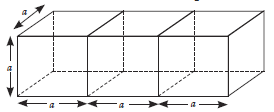
Now length, breadth and height of the resulting cuboid is 3a units, a units and a units respectively.
∴ TSA of cuboid = 2(lb + bh + hl)
= 2(3a × a + a × a + a × 3a)
=2(3a2 + a2 + 3a2) = 2 × 7a2 = 14a2 sq. units.
So, required ratio = 14a2/18a2 = 7/9 or : 7:9
Question: Find the diameter of the sphere, whose total surface area is 616 cm2.
Answer: Let r be the radius of the sphere.
Total surface area of sphere = 4πr2
⇒ 616 = 4 × 22/7 × r2 ⇒ r2 = 616 × 7/4×22 = 49 ⇒ r = 7 cm
∴ Diameter = 2r = 2 × 7 = 14 cm
Question: A cuboidal oil tin box is 4 m by 2 m by 0.75 m. Find the cost of the tin sheet required for making 20 such tin boxes, if the cost of tin sheet is Rs 20 per square metre.
Answer: Length, l = 4 m, breadth, b = 2 m and height, h = 0.75 m
Surface area of one tin box = 2(lb + bh + hl)
= 2 (4 × 2 + 2 × 0.75 + 0.75 × 4)
= 2 (8 + 1.5 + 3) = 2 × 12.5 = 25 m2
∴ Surface area of 20 such tin boxes = (20 × 25) m2
= 500 m2
Now, cost of 1 square metre of tin sheet = Rs 20
∴ Cost of 500 m2 of tin sheet = Rs(20 × 500) = Rs 10000
Question: If volume and surface area of a sphere is numerically equal then find its radius (in units).
Answer: Let r be the radius of the sphere.
∴ Volume of sphere = Surface area of sphere
∴ 4/3πr3 = 4πr2 ⇒ r3/r2 = 3 ⇒ r = units
Question: The total cost of making a solid spherical ball is Rs 67914 at the rate of Rs 14 per cubic metre. Find the radius of this ball.
Answer: Volume of spherical ball = Total cost/Cost of 1m3
⇒ 4/3πr3 = 67914/14 ⇒ 4/3 × 22/7 × r3 = 67914/14
⇒ r3 = 101871/88 ⇒ r3 = 1157.625 ⇒ r = 10.5 m
Question: The external diameter of an iron pipe is 35 cm and its length is 30 cm. If the thickness of the pipe is 2.5 cm, find the curved surface area of the pipe.
Answer: Length of the pipe, h = 30 cm
External radius of the pipe, R = 35/2 cm = 17.5 cm
∴ Thickness of the pipe = 2.5 cm
∴ Internal radius of the pipe, r = (17.5 – 2.5) cm
= 15 cm
Now, curved surface area of the pipe = External curved surface area + Internal curved surface area
= 2πRh + 2πrh = 2πh (R + r)
= 2 × 22/7 × 30(17.5 + 15) = 2 × 22/7 × 30 × 32.5
= 42900/7 = 6128.57 cm2
Question: The length and breadth of a rectangular solid are respectively 35 cm and 20 cm. If its volume is 7000 cm3, then find its height (in cm).
Answer: Let h be the height of the solid.
∴ Volume of cuboid = l × b × h
⇒ 7000 = 35 × 20 × h ⇒ h = 7000/700 = 10 cm
Question: A room is 16 m long, 9 m wide and 3 m high. It has two doors, each of dimensions (2 m × 2.5 m)and three windows, each of dimensions (1.6 m × 75 cm). Find the cost of distempering the walls of the room from inside at the rate of Rs 8 per sq. metre.
Answer: Given, length (l) = 16 m, breadth (b) = 9 m and height (h) = 3 m
∴ Area of 4 walls of the room = 2(l + b) × h
= 2(16 + 9) × 3 = 150 m2.
Area of 2 doors = 2 × (2 × 2.5) = 10 m2
Area of 3 windows = 3 × (1.6 × 75/100) = 3.6 m2.
Area not to be distempered = 10 + 3.6 = 13.6 m2
Area to be distempered = 150 – 13.6 = 136.4 m2
Cost of distempering the walls = Rs (136.4 × 8) = Rs 1091.20
Question: Three cubes each of edge 5 cm are joined end to end. Find the surface area of the resulting cuboid.
Answer: When three cubes are joined end to end, we get a cuboid such that Length of the resulting cuboid, l = 5 cm + 5 cm + 5 cm = 15 cm
Breadth of resulting cuboid, b = 5 cm
Height of the resulting cuboid, h = 5 cm
Surface area of the cuboid = 2 (lb + bh + hl)
= 2 (15 × 5 + 5 × 5 + 5 × 15) cm2
= 2 (75 + 25 + 75) cm2 = 350 cm2
Question: How many spherical balls of diameter 1 cm can be made from an iron ball of diameter 6 cm?
Answer: Volume of iron ball having diameter, 6 cm
= 4/3π(6/2)3 =4/3π(3)3
Volume of small ball of diameter, 1 cm = 4/3π(1/2)3
∴ Number of balls = 4/3π(3)3/4/3π(1/2)3 = 27 × 8 = 216
Question: The length of a cold storage is three times its breadth. Its height is 5 m. The area of its four walls (including doors) is 256 m2. Find its volume.
Answer: Let length, breadth and height of the cold storage be l, b and h respectively.
Then, l = 3b and h = 5 m.
Now, area of four walls = 256 m2
⇒ 2 (l + b)h = 256 ⇒ 2 (3b + b) × 5 = 256
⇒ 40b = 256 ⇒ b = 6.4 metres
∴ l = 3b = 3 × 6.4 = 19.2 m
Volume of the cold storage = l × b × h
= (19.2 × 6.4 × 5) m3 = 614.4 m3
Question: The curved surface area of a cone is 154 cm2. If its radius is x cm and slant height is 7 cm. Find the value of 20x.
Answer: We have, curved surface area = 154 cm2
⇒ πrl = 154 ⇒ r = 154 × 7/22 × 7 = 7
Now, r = x cm = 7 cm.
∴ x = 7 ⇒ 20x = 20 × 7 = 140
Question. A dome of a building is in the form of a hemisphere From inside, it was white washed at the cost of Rs 997.92. If the cost of white washing is 400 paise per square meter, find the volume of air inside the dome. (Take π = 22/7)
Answer: Cost of white washing hemispherical
dome = Rs 997.92
Cost of white washing per square meter
= 400 paise = Rs 4
∴ CSA = 997.92 ÷ 4 = 249.48 m2
2πr2 = 249.48
2 × 22/7 × r2 = 249.48
or, r2 = 39.69
or, r = 6.3 m
∴ Volume of air inside it
= 2/3πr3
= 2/3 × 22/7 × 6.3 × 6.3 × 6.3
= 523.90 m3.
Question. A solid piece of metal, cuboidal in shape, with dimensions 24 cm, 18 cm and 4 cm is recast into a cube. Calculate the lateral surface area of the cube.
Answer: Volume of cuboid = lbh
= 24 × 18 × 4
= 1728 cu.cm.
Edge of a cube = 3√1728
= 12 cm
LSA = 4a2
= 4 × 12 × 12
Question. The internal and external diameters of a hollow hemispherical vessel are 24 cm and 25 cm respectively. If the cost of painting 1 cm2 of the surface area is Rs 0.05, find the total cost of painting the vessel all over.
Answer: Internal radius (r) = 12 cm
External radius (R) = 12.5 cm
T.S.A = 2πr2+ 2πR2 + π(R2– r2)
= 2π(r2+ R2) + π(R – r)(R + r)
= 2π (144 + 156.25) + π (12.5 + 12)( 12.5 – 12)
= (600.50 + 12.25) × 22/7
= 1925.79 cm2
Cost of painting 1925.79 cm2 at the rate of Rs 0.05/cm2
= 1925.79 × 0.05
= Rs 96.29.
Question. The length, breadth and height of a room are 5 m, 4 m and 3 m. Find the cost of white washing the walls of the room and the ceiling at the rate of Rs 7.50 per m2.
Answer: Given, l = 5 m, b = 4 m, h = 3 m.
Area to be painted = Area of walls + Area of ceiling
= 2h(l + b) + l × b
= 2 × 3(9) + 20
= 54 + 20 = 74 m2
Cost of painting 1 m2= Rs 7.50
∴ Cost of painting 74 m2= 74 × 7.50
= Rs 555
Question. The total surface area of a solid hemisphere is 5940 cm2. Find the diameter of the hemisphere.
Answer: Let the radius of hemisphere be r
∴ 3πr2 = 5940
or, r2 = 5940 × 7/3 × 22 = 630
or, r = √630 or 3√70 cm.
So, d = 2r = 6√70 cm.
Hence diameter of the hemisphere is 6√70 cm.
Question. Find the radius of the base of a right circular cylinder whose curved surface area is 2/3 of the sum of the surface areas of two circular faces. The height of the cylinder is given to be 15 cm.
Answer: Given, h = 15
C.S.A. = 2/3 (Sum of circular faces)
2πrh = 2/3(2πr2)
15 = 2/3r
45/2 = r
r = 22.5 cm.
Question. A cuboidal water tank is 6 m long, 5 m wide and 4.5 m deep. How many litres of water can it hold ?
Answer: Cuboidal water tank
length = 6 m
width = 5 m
height = 4.5 m
Volume of tank = length × width × height
= 6 × 5 × 4.5 m3
= 135 m3
= 135 × 1000 litre
(1 m3= 1000 litre)
∴ Volume of water = 135000 litre
or Capacity of tank = 135000 litre = 135 kl
Question. The surface area of a cuboid is 1372 cm2. If its dimensions are in the ratio 4 : 2 : 1, find its length.
Answer: 2(lb + bh + hl) = 1372
l = 4x, b = 2x, h = x
2(4x × 2x + 2x × x + 4x × x) = 1372
or, 2(8x2 + 2x2 + 4x2) = 1372
or, 28x2 = 1372
or, x2 = 49
or, x = 7 cm
∴ Length = 4 × 7 = 28 cm.
Question. The total surface area of a solid right circular cylinder is 1540 cm2. If the height is four times the radius of the base, then find the height of the cylinder.
Answer: Given, T.S.A. = 1540 cm2
∴ 2πr(h + r) = 1540 cm2
Also, h = 4r
∴ 2πr (4r + r) = 1540
or, 2π × 5r2 = 1540
or, r2 = 1540 × 7/2 × 5 × 22
or, r2 = 49
or, r = 7 cm
Now h = 4r
or, h = 28 cm.
Long Answer Type Questions
Question: A sector of a circle of radius 15 cm and central angle of 120°. It is rolled up and the two bounding radii are joined together to form a cone of radius 5 cm. Find :
(i) the volume of the cone.
(ii) the total surface area of the cone.
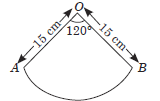
Answer: (i) The slant height of the cone = Radius of the given sector of a circle = 15 cm.
Now, let h be the height of the cone. Then,
h = √l2 − r2 [where l = slant height, r = radius of cone]
= √(15)2 − (5)2 = √225 − 25 = √200 = 10√2 cm
∴ Volume of the cone = 1/3πr2h
= 1/3π(5)2 × 10√2 = 1/3 × 22/7 × 25 ×10 × √2 = 369.29 cm
(ii) Total surface area of the cone = πr(r + l)
= 22 × 5(5 + 15) = 22/7 × 5 × 20 = 314.29 cm2
Question: Coins of same size (say 10 rupee coin) are placed one above the other and a cylindrical block is obtained. The volume of this block is 67.76 cm3. Find the number of coins arranged in the block, if thickness of each coin is 2 mm and radius of each coin is 1.4 cm.
Answer: Let h be the height of cylindrical block and n be the number of coins used to obtain it.
Volume of block = πr2h ⇒ 67.76 = 22/7× 1.4 × 1.4 × h
⇒ h = 67.76 × 7/22 × 1.4 × 1.4 =11cm = 110mm [∴ 1 cm = 10 mm]
Now, n × thickness of a coin = height of block
⇒ n × 2 = 110 ⇒ n = 55
Question: A plot of land is in the form of rectangle has dimension 240 m × 180 m. A drainlet 10 m wideis dug around it (on the outside) and the earth dug out is evenly sπread out over the plot increasing its surface level by 25 cm. Find the depth of the drainlet.
Answer: Volume of earth dug out = l × b × h
= 240 × 180 × 25/100 m3 = 10800 m3
Let the depth of the drainlet be x m.
∴ Volume of drainlet = 2[260 × 10 × x] + 2[180 × 10 × x]
= 8800 x m3
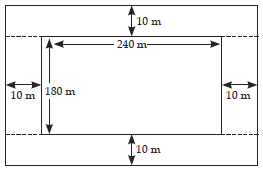
Now, volume of earth dug out = Volume of drainlet
⇒ 10800 = 8800x ⇒ x = 10800/8800 = 1.23 m (apπrox.)
Question. A pen stand is cylindrical in shape with the base radius 3.5 cm and height 10.5 cm. How much card board will be required to make 25 such pen stand ? Also, find volume of 1 pen stand.
Answer: Given, base radius of cylinder r = 3.5 cm
Height of cylinder h = 10.5 cm
Amount of card board required to make one pen stand
= πr(r + 2h)
One pen stand = 22/7 × 3.5(3.5 + 21)
= 22 × 0.5(24.5)
= 269.5 cm2
Amount of card board required to make 25 pen stand
= 269.5 × 25
= 6737.5 cm2
1 pen stand, then for 25 stands = 25 × 308
= 7700 cm2
Volume of 1 pen stand = πr2h
= 22/7 × 3.5 × 3.5 × 10.5
= 404.25 cm3.
Question. Calculate the curved surface area of a cone whose radius of base and height are in the ratio 5 : 12 and its volume is 2512 cu. cm.
Answer: Let r = 5x, h = 12x
Given : 1/3πr2h = 2512 cu. cm
∴ 1/3π × 3.14(5x)2 × 12x = 2512
or, x3 = 2512 × 3 × 100/5 × 5 × 12 × 314
= 8
or, x = 2
∴ r = 10, h = 24, l = 26
∴ CSA of cone = πrl
22/7 × 10 × 13 × 2 = 5720/7
= 817.14 cm2.
Question. A cylindrical bowl of internal diameter 18 cm and height 15 cm is full of liquid. The whole of the liquid is to be filled in small cylindrical bottles of diameter 3 cm and height 4 cm, Each bottle is sold for Rs 5, then find the amount earned.
Answer: Volume of liquid = πr2h
Given, r = 18/2 = 9 cm
and h = 15 cm
∴ Volume of liquid = π(9)2 15
= 1215 π cm3
Also, radius of small bottle
(r’) = 3/2 = 1.5 cm
and height of small bottle
(h’) = 4 cm
∴Volume of small bottle = π(r’)2h’
= π(1.5)24
= 9π
Number of bottles = 1215π/9π = 135
∴ Amount earned = 135 × 5 = Rs 675
Question. The frame of a lampshade is cylindrical in shape. It has base diameter 28 cm and height 17 cm. It is to be covered with a decorative cloth. A margin of 2 cm is to be given for folding it over top and bottom of the frame. If 1/12 of cloth is wasted in cutting and pasting, find how much cloth is required to be purchased for covering the frame.
Answer: Base diameter = 28 m
Base radius = 28/2 = 14 cm
Height of cloth required = 17 + 2 + 2 = 21 cm
Area of cloth required = Curved surface area of cylinder of radius 14 cm and height 21 cm
= 2πrh
= 2 × 22/7 × 14 × 21
= 1848 cm2
Let A sq. cm of cloth be purchased .
So, wastage of cloth for cutting and pasting
= A/12 cm2
Area of cloth actually used = A − A/12 = 11/12 A cm2
Area of cloth actually used = Area of cloth required
or, 11/12A = 1848
or, A = 1848 × 12/11 = 2016 cm2
Question. An open box is made of wood 3 cm thick. Its external dimensions are 1.4 m, 1.1 m and 0.8 m. Find the cost of painting the outer surface of box at 75 paise per 100 cm2.
Answer: l = 140 cm
b = 110 cm
h = 80 cm
Surface area of open box = lb + 2(bh + hl)
Cost of painting box = Rs 75/100 × 100 [154 + 2(88 + 112)] × 100
= Rs 3/4 [554] = Rs 3(138.5)
= Rs 415.5
Question. The area of the base of a cone is 616 sq. cm. Its height is 48 cm, then its total surface area is:
Answer:
Given:
Area of the base of the cone, \( \pi r^2 = 616\text{ cm}^2 \)
Using \( \pi = \frac{22}{7} \):
\( \frac{22}{7}r^2 = 616 \)
\( r^2 = 616 \times \frac{7}{22} = 28 \times 7 = 196 \)
\( r = \sqrt{196} = 14\text{ cm} \)
Height, \( h = 48\text{ cm} \)
The slant height \( l \) is:
\( l = \sqrt{r^2 + h^2} = \sqrt{14^2 + 48^2} = \sqrt{196 + 2304} = \sqrt{2500} = 50\text{ cm} \)
The total surface area (TSA) of the cone is:
TSA \( = \pi r(r + l) \)
\( \text{TSA} = \frac{22}{7} \times 14 \times (14 + 50) \)
\( \text{TSA} = 44 \times 64 = 2816\text{ cm}^2 \)
Therefore, the total surface area of the cone is \( 2816\text{ cm}^2 \).
In simple words: First find the base radius (14 cm) using the base area. Then find the slant height of 50 cm. Finally, use the total surface area formula to get 2816 sq cm.
Exam Tip: Be sure to read whether "curved surface area" or "total surface area" is asked. In this question, total surface area requires adding the circular base to the curved area.
Question. The semi-circular sheet of metal of diameter 28cm is bent into an open conical cup. Find the depth and the capacity of cup.
Answer:
Given:
Diameter of the semi-circular sheet \( = 28\text{ cm} \), so its radius \( R = 14\text{ cm} \).
When the semi-circular sheet is folded into an open conical cup:
1. The radius of the sheet becomes the slant height of the cone: \( l = R = 14\text{ cm} \).
2. The arc length of the semi-circle becomes the perimeter of the base of the cone:
Arc length of semi-circle \( = \pi R = 14\pi\text{ cm} \)
Let the base radius of the conical cup be \( r \).
\( 2\pi r = 14\pi \)
\( \implies r = 7\text{ cm} \)
Now, the depth (height \( h \)) of the conical cup is:
\( h = \sqrt{l^2 - r^2} = \sqrt{14^2 - 7^2} = \sqrt{196 - 49} = \sqrt{147} = 7\sqrt{3}\text{ cm} \approx 12.12\text{ cm} \)
The capacity (volume \( V \)) of the conical cup is:
\( V = \frac{1}{3}\pi r^2 h \)
Using \( \pi = \frac{22}{7} \):
\( V = \frac{1}{3} \times \frac{22}{7} \times 7^2 \times 7\sqrt{3} = \frac{343\sqrt{3}}{3}\text{ cm}^3 \approx 198.08\text{ cm}^3 \)
Therefore, the depth of the cup is \( 7\sqrt{3}\text{ cm} \) (or \( 12.12\text{ cm} \)) and the capacity of the cup is \( \frac{343\sqrt{3}}{3}\text{ cm}^3 \) (or \( 198.08\text{ cm}^3 \)).
In simple words: Bending a half-circle sheet into a cone makes the sheet's radius its diagonal side (14 cm). The circular boundary of the cone's mouth comes from the curved edge of the half-circle, giving a radius of 7 cm. Its depth is 12.12 cm and its volume is 198.08 cubic cm.
Exam Tip: Remember this key rule: folding a sector of radius \( R \) into a cone always makes the slant height \( l = R \) and the base circumference \( 2\pi r = \text{arc length of the sector} \).
Question. A metallic right circular cone of height 9 cm and base radius 7 cm is melted into a cuboid whose two sides are 11 cm and 6 cm. What is the third side of the cuboid?
Answer:
Given:
For the cone:
Height, \( h = 9\text{ cm} \)
Radius, \( r = 7\text{ cm} \)
The volume of the cone is:
\( V_{\text{cone}} = \frac{1}{3}\pi r^2 h = \frac{1}{3} \times \frac{22}{7} \times 7 \times 7 \times 9 = 22 \times 7 \times 3 = 462\text{ cm}^3 \)
For the cuboid:
Two sides are \( a = 11\text{ cm} \) and \( b = 6\text{ cm} \). Let the third side be \( c \).
The volume of the cuboid is:
\( V_{\text{cuboid}} = a \times b \times c = 11 \times 6 \times c = 66c \)
Since the cone is melted into the cuboid, their volumes must be equal:
\( V_{\text{cuboid}} = V_{\text{cone}} \)
\( 66c = 462 \)
\( \implies c = \frac{462}{66} = 7\text{ cm} \)
Therefore, the third side of the cuboid is \( 7\text{ cm} \).
In simple words: The volume of metal doesn't change when melted. Calculate the cone's total volume first, and then divide it by the product of the two known sides of the cuboid to find the missing side.
Exam Tip: When equating volume, do not multiply out the factors immediately. Keeping them as products often lets you cancel numbers directly, e.g., \( c = \frac{\frac{1}{3} \times \frac{22}{7} \times 7 \times 7 \times 9}{11 \times 6} = \frac{22 \times 7 \times 3}{11 \times 6} = \frac{2 \times 7}{2} = 7 \).
Question. A well with 10 m inside diameter is dug 14m deep. Earth taken out of it is spread all around to a width of 5 m to form an embankment. Find the height of embankment.
Answer:
Given:
For the well (cylinder):
Inner diameter \( = 10\text{ m} \), so radius \( r = 5\text{ m} \)
Depth, \( h = 14\text{ m} \)
Volume of earth dug out is:
\( V_{\text{earth}} = \pi r^2 h = \pi \times 5^2 \times 14 = 350\pi\text{ m}^3 \)
The earth is spread around the well to form a circular embankment (hollow cylinder).
Inner radius of embankment, \( r = 5\text{ m} \)
Outer radius of embankment, \( R = r + \text{width} = 5 + 5 = 10\text{ m} \)
Let the height of the embankment be \( H \).
Volume of the embankment is:
\( V_{\text{embankment}} = \pi(R^2 - r^2)H = \pi(10^2 - 5^2)H = \pi(100 - 25)H = 75\pi H \)
Since the volume of the embankment is equal to the volume of earth dug out:
\( V_{\text{embankment}} = V_{\text{earth}} \)
\( 75\pi H = 350\pi \)
Dividing both sides by \( \pi \):
\( 75H = 350 \)
\( \implies H = \frac{350}{75} = \frac{14}{3}\text{ m} \approx 4.67\text{ m} \)
Therefore, the height of the embankment is \( \frac{14}{3}\text{ m} \) (or approximately \( 4.67\text{ m} \)).
In simple words: The volume of soil dug out from the circular well is spread out in a ring around the well. Since the ring is wider than the well's radius, the height of this ring-shaped embankment is about 4.67 m.
Exam Tip: Remember that an embankment is a hollow cylinder. The area of its circular base is \( \pi(R^2 - r^2) \), where the inner radius \( r \) is the radius of the well itself.
Question. The radius and slant height of a cone are in the ratio 4:7. If its curved surface area is 792 sq cm., find its radius.
Answer:
Let the radius of the cone be \( r = 4x \) and the slant height be \( l = 7x \).
The curved surface area of a cone is:
CSA \( = \pi r l \)
Given:
CSA \( = 792\text{ cm}^2 \)
Using \( \pi = \frac{22}{7} \):
\( 792 = \frac{22}{7} \times (4x) \times (7x) \)
\( 792 = 22 \times 4x^2 \)
\( 792 = 88x^2 \)
\( \implies x^2 = \frac{792}{88} = 9 \)
\( \implies x = \sqrt{9} = 3 \)
Therefore, the radius of the cone is:
\( r = 4x = 4 \times 3 = 12\text{ cm} \).
In simple words: Using the given ratio, write the radius as 4x and slant height as 7x. Plugging these into the curved area formula lets us solve for x, which is 3. Multiplying by 4 gives the radius of 12 cm.
Exam Tip: Whenever dimensions are given as a ratio, introduce a common variable (like \( x \)) to represent the actual measurements to avoid conceptual confusion.
Question. The diameter of roller is 1.5m and 0.84m long. If it takes 100 revolution to level a playground, find the cost of leveling this ground at the rate of 50 paise per square meter.
Answer:
Given:
Diameter of the cylindrical roller \( = 1.5\text{ m} \), so radius \( r = 0.75\text{ m} \)
Length of the roller, \( h = 0.84\text{ m} \)
The area leveled by the roller in one revolution is equal to its lateral surface area (LSA):
\( \text{Area of 1 revolution} = 2\pi rh \)
Using \( \pi = \frac{22}{7} \):
\( \text{Area of 1 revolution} = 2 \times \frac{22}{7} \times 0.75 \times 0.84 \)
\( = 2 \times 22 \times 0.75 \times 0.12 \)
\( = 44 \times 0.09 = 3.96\text{ m}^2 \)
The area of the playground leveled in 100 revolutions is:
\( \text{Total Area} = 100 \times 3.96 = 396\text{ m}^2 \)
The rate of leveling is 50 paise per square meter, which is \( \text{Rs. 0.50} \) per square meter.
Total Cost \( = 396 \times 0.50 = \text{Rs. 198} \)
Therefore, the cost of leveling the playground is Rs. 198.
In simple words: The roller's curved area is 3.96 square meters, which is the space it flattens in a single spin. After spinning 100 times, it has flattened 396 square meters. At 50 paise per square meter, the total cost is Rs. 198.
Exam Tip: Be careful with units like "50 paise". Convert it to Rupees (\( \text{Rs. 0.50} \)) first to get the final cost in standard currency units.
Question. A pendulum swings through an angle of 30 degree and describes an arc of length 7.7cm. Find the length of the pendulum.
Answer:
Let the length of the pendulum be \( r \).
The path described by the pendulum is a sector of a circle of radius \( r \) with central angle \( \theta = 30^\circ \).
Given arc length \( = 7.7\text{ cm} \).
The formula for the length of an arc is:
Arc length \( = \frac{\theta}{360^\circ} \times 2\pi r \)
Using \( \pi = \frac{22}{7} \):
\( 7.7 = \frac{30^\circ}{360^\circ} \times 2 \times \frac{22}{7} \times r \)
\( 7.7 = \frac{1}{12} \times \frac{44}{7} \times r \)
\( 7.7 = \frac{11}{21} \times r \)
\( \implies r = \frac{7.7 \times 21}{11} \)
\( r = 0.7 \times 21 = 14.7\text{ cm} \)
Therefore, the length of the pendulum is \( 14.7\text{ cm} \).
In simple words: The swing of the pendulum makes a small slice of a circle. By using the arc length formula with an angle of 30 degrees, we find that the pendulum must be 14.7 cm long.
Exam Tip: Remember that a swinging pendulum describes a circular arc, so its length is always treated as the radius of the circle.
Question. A plastic box 1.25 m long,1.05 m wide and 75cm deep is to be made. It is to be open at the top. Ignoring the thickness of the plastic sheet, determine the area of the sheet required for making the box and also find the cost of sheet for it, if a sheet measuring 1sq.m. cost Rs. 20.
Answer:
Given:
Length of the box, \( l = 1.25\text{ m} \)
Width of the box, \( b = 1.05\text{ m} \)
Depth (height) of the box, \( h = 75\text{ cm} = 0.75\text{ m} \)
Since the box is open at the top, the plastic sheet is only required for the 4 walls and the base of the box.
The total area of sheet required is:
Area \( = \text{Lateral Surface Area} + \text{Area of base} \)
\( = 2h(l + b) + lb \)
Substituting the values:
Area \( = 2 \times 0.75 \times (1.25 + 1.05) + (1.25 \times 1.05) \)
\( = 1.5 \times (2.30) + 1.3125 \)
\( = 3.45 + 1.3125 = 4.7625\text{ m}^2 \)
Cost of sheet per square meter \( = \text{Rs. 20} \)
Total cost \( = 4.7625 \times 20 = \text{Rs. 95.25} \)
Therefore, the area of sheet required is \( 4.7625\text{ m}^2 \) and its cost is Rs. 95.25.
In simple words: The open box has 5 sides instead of 6. Convert the depth of 75 cm to 0.75 m so all units are in meters. Calculate the area of the 4 walls and the floor, giving 4.7625 square meters. At Rs. 20 per square meter, it costs Rs. 95.25.
Exam Tip: Always make sure to convert all dimensions to the same unit (meters or centimeters) before starting any calculations.
Question. Three metal cubes whose edges measure 3cm,4cm and 5cm respectively are melted to form a single cube. Find the edge of the new cube. Also find the surface area.
Answer:
Given:
Edges of the three cubes are \( a_1 = 3\text{ cm} \), \( a_2 = 4\text{ cm} \), and \( a_3 = 5\text{ cm} \).
The sum of volumes of the three small cubes is:
\( V = a_1^3 + a_2^3 + a_3^3 = 3^3 + 4^3 + 5^3 \)
\( V = 27 + 64 + 125 = 216\text{ cm}^3 \)
Let the edge of the new cube be \( A \).
Its volume is equal to the total volume of the melted cubes:
\( A^3 = 216 \)
\( \implies A = \sqrt[3]{216} = 6\text{ cm} \)
The total surface area of this new cube is:
\( S = 6A^2 = 6 \times (6)^2 = 6 \times 36 = 216\text{ cm}^2 \)
Therefore, the edge of the new cube is \( 6\text{ cm} \), and its surface area is \( 216\text{ cm}^2 \).
In simple words: When you melt three small cubes of sizes 3, 4, and 5 cm together, their combined volume is 216 cubic cm. This forms a larger cube with an edge of 6 cm. Its total surface area happens to also be 216 square cm.
Exam Tip: (3, 4, 5, 6) is a special cubic relationship where \( 3^3 + 4^3 + 5^3 = 6^3 \). Remembering this can help you verify your solution instantly.
Question. If V is the volume of a cuboid of dimension a,b,c and S is its surface area, then prove that \(\frac{1}{V} = \frac{2}{S} \left(\frac{1}{a} + \frac{1}{b} + \frac{1}{c}\right)\)
Answer:
For a cuboid of dimensions \( a \), \( b \), and \( c \):
Volume is given by:
\( V = abc \)
Total surface area is given by:
\( S = 2(ab + bc + ca) \)
Let us simplify the right-hand side (RHS) of the expression to be proved:
RHS \( = \frac{2}{S} \left(\frac{1}{a} + \frac{1}{b} + \frac{1}{c}\right) \)
Taking the common denominator inside the parentheses:
\( \frac{1}{a} + \frac{1}{b} + \frac{1}{c} = \frac{bc + ac + ab}{abc} = \frac{ab + bc + ca}{abc} \)
Now, substituting this and the expression for \( S \) into the RHS:
RHS \( = \frac{2}{2(ab + bc + ca)} \times \left(\frac{ab + bc + ca}{abc}\right) \)
Canceling \( 2 \) and the term \( (ab + bc + ca) \) in both the numerator and the denominator:
RHS \( = \frac{1}{abc} \)
Since \( V = abc \), we have:
RHS \( = \frac{1}{V} = \text{LHS} \)
Hence proved.
In simple words: Write out the formulas for both the volume and surface area of the cuboid. By taking a common denominator for the sum of fractions on the right side and simplifying, the terms cancel out beautifully to leave exactly 1 divided by the volume.
Exam Tip: In algebraic proof questions involving geometric formulas, starting from the more complex side (RHS here) and simplifying it to match the simpler side is usually the easiest approach.
Question. A wall of the length 10m was to be built across an open ground. The height of the wall is 4 m and thickness of the wall is 24cm. If this wall is to be built up with bricks whose dimensions are 24cmx12cmx8cm, how many bricks would be required?
Answer:
Given:
For the wall:
Length, \( L = 10\text{ m} = 1000\text{ cm} \)
Height, \( H = 4\text{ m} = 400\text{ cm} \)
Thickness, \( B = 24\text{ cm} \)
The volume of the wall is:
\( V_{\text{wall}} = L \times B \times H = 1000 \times 24 \times 400 = 9,600,000\text{ cm}^3 \)
For each brick:
Length, \( l = 24\text{ cm} \)
Width, \( b = 12\text{ cm} \)
Height, \( h = 8\text{ cm} \)
The volume of one brick is:
\( V_{\text{brick}} = l \times b \times h = 24 \times 12 \times 8 = 2304\text{ cm}^3 \)
The number of bricks required is:
Number of bricks \( = \frac{V_{\text{wall}}}{V_{\text{brick}}} = \frac{1000 \times 24 \times 400}{24 \times 12 \times 8} \)
Canceling \( 24 \):
Number of bricks \( = \frac{1000 \times 400}{96} = \frac{400,000}{96} = 4166\frac{2}{3} \approx 4167\text{ bricks} \)
Therefore, \( 4167 \) bricks are required.
In simple words: Convert all dimensions of the wall into centimeters first. Divide the total volume of the wall by the volume of a single brick. This tells us we need 4167 bricks to build the entire wall.
Exam Tip: Always make sure to write the answer in whole numbers when counting physical objects like bricks, since you cannot have a fraction of a brick in the final answer count.
Question. A circular tent is cylindrical to a height of 3 metres and conical above it. If its diameter is 105m and the slant height of the conical portion is 53m, calculate the length of canvas 5m wide to make the required tent.
Answer:
Given:
Diameter of the tent \( = 105\text{ m} \ ), so base radius \( r = 52.5\text{ m} \)
For the cylindrical part:
Height, \( h = 3\text{ m} \)
Curved surface area of the cylinder is:
\( \text{CSA}_{\text{cylinder}} = 2\pi r h \)
Using \( \pi = \frac{22}{7} \):
\( \text{CSA}_{\text{cylinder}} = 2 \times \frac{22}{7} \times 52.5 \times 3 = 2 \times 22 \times 7.5 \times 3 = 990\text{ m}^2 \)
For the conical part:
Slant height, \( l = 53\text{ m} \)
Curved surface area of the cone is:
\( \text{CSA}_{\text{cone}} = \pi r l = \frac{22}{7} \times 52.5 \times 53 = 22 \times 7.5 \times 53 = 8745\text{ m}^2 \)
The total surface area of the canvas required is:
\( \text{Total Area} = \text{CSA}_{\text{cylinder}} + \text{CSA}_{\text{cone}} = 990 + 8745 = 9735\text{ m}^2 \)
The width of the canvas is \( 5\text{ m} \). Therefore, the length required is:
Length \( = \frac{\text{Total Area}}{\text{Width}} = \frac{9735}{5} = 1947\text{ m} \)
Therefore, the length of the canvas required is \( 1947\text{ m} \).
In simple words: The tent has two parts: a cylinder at the bottom and a cone on top. Calculate the curved side areas of both and add them up to find the total canvas area needed (9735 square meters). Dividing this by the roll width of 5 m gives a required length of 1947 m.
Exam Tip: In tent problems, always use the relation \( \text{Length of canvas} \times \text{Width of canvas} = \text{Total Curved Surface Area} \) to find the required length.
Question. A cylinder is within the cube touching all the vertical face. A cone is inside the cylinder. If the height and base of a cone is same as cylinder, find the ratio of their volumes.
Answer:
Let the edge of the cube be \( a \).
1. The volume of the cube is:
\( V_{\text{cube}} = a^3 \)
2. Since the cylinder is inside the cube and touches all vertical faces:
- The diameter of the cylinder is equal to the edge of the cube, so the radius of the cylinder is \( r = \frac{a}{2} \).
- The height of the cylinder is equal to the edge of the cube, \( h = a \).
The volume of the cylinder is:
\( V_{\text{cylinder}} = \pi r^2 h = \pi \left(\frac{a}{2}\right)^2 (a) = \frac{\pi a^3}{4} \)
3. The cone is inside the cylinder with the same base and height:
- Radius of the cone, \( r = \frac{a}{2} \).
- Height of the cone, \( h = a \).
The volume of the cone is:
\( V_{\text{cone}} = \frac{1}{3}\pi r^2 h = \frac{1}{3}\pi \left(\frac{a}{2}\right)^2 (a) = \frac{\pi a^3}{12} \)
Now, let's find the ratios:
(i) The ratio of the volumes of the Cube, Cylinder, and Cone is:
\( V_{\text{cube}} : V_{\text{cylinder}} : V_{\text{cone}} = a^3 : \frac{\pi a^3}{4} : \frac{\pi a^3}{12} \)
\( = 1 : \frac{\pi}{4} : \frac{\pi}{12} \)
Multiplying the entire ratio by 12:
\( = 12 : 3\pi : \pi \)
Using \( \pi = \frac{22}{7} \):
\( = 12 : 3\left(\frac{22}{7}\right) : \frac{22}{7} \)
\( = 12 : \frac{66}{7} : \frac{22}{7} \)
Multiplying by 7:
\( = 84 : 66 : 22 \)
Dividing by 2:
\( = 42 : 33 : 11 \).
(ii) If only the ratio of the Cylinder and Cone is required:
\( V_{\text{cylinder}} : V_{\text{cone}} = \frac{\pi a^3}{4} : \frac{\pi a^3}{12} = 3 : 1 \).
In simple words: For a cube of side \( a \), the cylinder that fits inside it has a volume of \( \frac{\pi}{4}a^3 \), and the cone has a volume of \( \frac{\pi}{12}a^3 \). The ratio of their volumes (Cube : Cylinder : Cone) simplifies beautifully to 42 : 33 : 11.
Exam Tip: A cone inside a cylinder of same base and height always has exactly one-third of the cylinder's volume, so their ratio is always 3 : 1.
Question. An open box is made of wood 3cm thick. Its external length, breadth and height are 1.48m,1.16m and 8.3dm. Find the cost of painting the inner surface of Rs. 50 per sq metre.
Answer:
Given:
Thickness of the wood, \( t = 3\text{ cm} = 0.03\text{ m} \)
External dimensions:
- Length, \( L = 1.48\text{ m} \)
- Breadth, \( B = 1.16\text{ m} \)
- Height, \( H = 8.3\text{ dm} = 0.83\text{ m} \) (since \( 1\text{ dm} = 0.1\text{ m} \))
Since the box is open at the top, the thickness of the wood is subtracted twice from the length and breadth, but only once from the height (at the bottom):
- Inner Length, \( l = L - 2t = 1.48 - 0.06 = 1.42\text{ m} \)
- Inner Breadth, \( b = B - 2t = 1.16 - 0.06 = 1.10\text{ m} \)
- Inner Height, \( h = H - t = 0.83 - 0.03 = 0.80\text{ m} \)
The inner surface area of the open box to be painted consists of the 4 inner walls and the inner bottom base:
Inner Surface Area \( = 2h(l + b) + lb \)
Substituting the values:
\( = 2(0.80) \times (1.42 + 1.10) + (1.42 \times 1.10) \)
\( = 1.60 \times (2.52) + 1.562 \)
\( = 4.032 + 1.562 = 5.594\text{ m}^2 \)
The rate of painting is Rs. 50 per square meter.
Total Cost \( = 5.594 \times 50 = \text{Rs. 279.70} \)
Therefore, the cost of painting the inner surface is Rs. 279.70.
In simple words: To find the inner dimensions, subtract twice the 3 cm wood thickness from the length and width, but subtract it only once from the height because there is no lid. This gives an inner area of 5.594 square meters, which costs Rs. 279.70 to paint.
Exam Tip: Be very careful with decimeters (dm). Remember that \( 1\text{ decimeter (dm)} = 10\text{ cm} = 0.1\text{ m} \). Also, remember that for an *open* box, we subtract thickness only once from the height.
Question. If two circular cylinders of equal volume have their height in the ratio 1:4, find the ratio of their radii.
Answer:
Let the radii of the two cylinders be \( r_1 \) and \( r_2 \), and their heights be \( h_1 \) and \( h_2 \).
Given:
- The volumes are equal: \( V_1 = V_2 \)
- The heights are in the ratio \( h_1 : h_2 = 1 : 4 \), which means \( \frac{h_1}{h_2} = \frac{1}{4} \), or \( h_2 = 4h_1 \).
Equating their volumes:
\( \pi r_1^2 h_1 = \pi r_2^2 h_2 \)
Dividing both sides by \( \pi \):
\( r_1^2 h_1 = r_2^2 h_2 \)
Substitute \( h_2 = 4h_1 \):
\( r_1^2 h_1 = r_2^2 (4h_1) \)
Dividing both sides by \( h_1 \):
\( r_1^2 = 4r_2^2 \)
\( \implies \frac{r_1^2}{r_2^2} = 4 \)
Taking the square root of both sides:
\( \frac{r_1}{r_2} = \frac{2}{1} \)
Therefore, the ratio of their radii is 2:1.
In simple words: Since volume is base area (which uses radius squared) times height, if one cylinder is 4 times taller than the other but they have the same volume, the shorter one must have a radius that is 2 times larger.
Exam Tip: Since volume is proportional to \( r^2 h \), when volume is constant, the radius is inversely proportional to the square root of height: \( \frac{r_1}{r_2} = \sqrt{\frac{h_2}{h_1}} \).
Question. A wood toy is in the form of a cone surmounted on a hemisphere. The diameter of the base of the cone is 6cm and its height is 4cm. Find the cost of painting the toy at the rate of Rs. 5 per 1000 sq.cm.
Answer:
Given:
Diameter of the base of the cone \( = 6\text{ cm} \), so radius \( r = 3\text{ cm} \)
Height of the cone, \( h = 4\text{ cm} \)
First, we find the slant height \( l \) of the cone:
\( l = \sqrt{r^2 + h^2} = \sqrt{3^2 + 4^2} = \sqrt{25} = 5\text{ cm} \)
The total surface area of the toy to be painted is the sum of the curved surface areas of the cone and the hemisphere:
Total Surface Area (TSA) \( = \pi r l + 2\pi r^2 = \pi r(l + 2r) \)
Using \( \pi = \frac{22}{7} \):
\( \text{TSA} = \frac{22}{7} \times 3 \times (5 + 2 \times 3) = \frac{66}{7} \times 11 = \frac{726}{7} \approx 103.71\text{ cm}^2 \)
The rate of painting is Rs. 5 per 1000 sq.cm.
Total Cost \( = \text{TSA} \times \frac{5}{1000} = 103.71 \times \frac{5}{1000} = \text{Rs. 0.52} \) (or 52 paise).
Therefore, the cost of painting the toy is approximately Rs. 0.52.
In simple words: The toy is made of a cone on top of a hemisphere. Calculate the curved surface area of both parts and add them to get 103.71 sq cm. At Rs. 5 per 1000 sq cm, painting this small toy costs about Rs. 0.52.
Exam Tip: Be careful with the rate unit "per 1000 sq.cm". You must divide the surface area by 1000 before multiplying by the rate of Rs. 5.
Free study material for Mathematics
CBSE Class 9 Mathematics Worksheets for Chapter 11 Surface areas and Volumes
Practice Exercises for Class 9 Mathematics Chapter 11 Surface areas and Volumes
Access structured practice worksheets for Chapter 11 Surface areas and Volumes aligned with the 2026 CBSE curriculum. These downloadable exercises for Class 9 Mathematics help students build accuracy and reinforce core concepts for upcoming school tests.
Step-by-Step Solutions and Practice Guidelines
Built using official NCERT guidelines for Class 9 Mathematics, these practice sheets provide reliable academic support. Cross-reference your completed work with our detailed solutions to learn standard answer-writing formats for CBSE exams.
Enhance Speed with Online Practice
Consistent engagement with these exercises builds familiarity with recurring exam themes. If specific areas within Chapter 11 Surface areas and Volumes cause trouble, utilize our dedicated NCERT solutions for Class 9 Mathematics to clear up doubts immediately.
FAQs
You can download the latest chapter-wise printable worksheets for Class 9 Mathematics Chapter 11 Surface areas and Volumes for free from StudiesToday.com. These have been made as per the latest CBSE curriculum for this academic year.
Yes, Class 9 Mathematics worksheets for Chapter 11 Surface areas and Volumes focus on activity-based learning and also competency-style questions. This helps students to apply theoretical knowledge to practical scenarios.
Yes, we have provided solved worksheets for Class 9 Mathematics Chapter 11 Surface areas and Volumes to help students verify their answers instantly.
Yes, our Class 9 Mathematics test sheets are mobile-friendly PDFs and can be printed by teachers for classroom.
For Chapter 11 Surface areas and Volumes, regular practice with our worksheets will improve question-handling speed and help students understand all technical terms and diagrams.