

Download Class 8 Mathematics Practice Worksheets
Review targeted academic worksheets with the CBSE Class 8 Mathematics Mensuration Worksheet Set 04. Built according to official educational standards for the 2026-27 term, these downloadable Class 8 Mathematics resources support effective daily practice and detailed self-evaluation for Chapter 11 Mensuration.
Access Chapter 11 Mensuration Practice Papers and Solutions
Access the complete worksheet PDF for Class 8 Mathematics below. Regular practice with these targeted academic tasks builds familiarity with standard question patterns and helps secure higher marks in final school examinations.
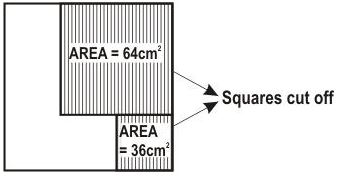
Question, Two squares of area 64 sq cm and 36 sq cm are cut off from a larger square sheet as shown in the figure:
What is the PERIMETER of the remaining part of the sheet?
A. 32 cm
B. 42 cm
C. 44 cm
D. 96 cm
Answer : C
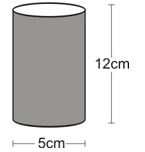
Question, Shown below is a jar which is in the shape of a right circular cylinder. What is the length of the longest stick that could fit in this jar (without bending or breaking the stick and with no part sticking out) ?
A. 12 cm
B. 13 cm
C. 14.25 cm
D. 17 cm
Answer : B
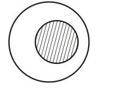
Question, A small circle is shaded inside a larger circle.
If the area of the smaller circle is half the area of the larger, the ratio of the radius of the smaller circle to that of the larger circle is
A. 1/2
B. 1/4
C. 1/√2
D. π/√2
Answer : C
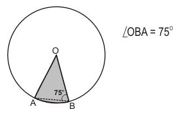
Question, What will be the area of the circle shown if the area of the shaded part is 5 sq. cm?
A. 25 sq cm
B. 60 sq cm
C. 25π sq cm
D. 150 sq cm
Answer : B
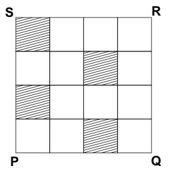
Question, PQRS is a square grid made of unit squares of side 1cm.
I want to trace a path from P to Q along the lines of this grid WITHOUT TOUCHING THE SIDES OF ANY SHADED SQUARE. (Touching the corner of a shaded square is allowed).
What would be the MINIMUM distance covered in tracing such a path?
A. 4 cm
B. 8 cm
C. 12 cm
D. 14 cm
Answer : D
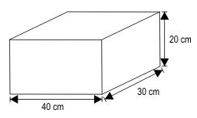
Question, What is the length of the longest stick that can be packed in the box of the dimensions shown below?
A. 90 cm
B. 70 cm
C. √2900 cm
D. √2400 cm
Answer : C
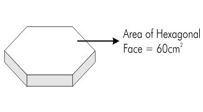
Question, Tiles identical to the one shown below are piled up one on top of another to form a tower of volume 1830 cm3. What is the height of the tower (in cm)?
A. 18.3
B. 30.5
C. 183
D. Can not say unless the number of tiles used is given.
Answer : B
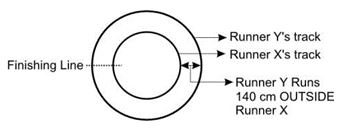
Question, Two runners X and Y have to race around the circular track shown below.
For safety, runner X is asked to run along the inner circle and runner Y along the outer, which is 140 cm outside the inner one.
If the race is of 4 laps (rounds) for runner X, how many metres ahead of him should runner Y start to make the race fair?
A. 1.4
B. 5.6
C. 8.3
D. 35.2
Answer : D
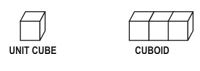
Question, The cuboid shown below is made of 3 unit cubes like the one to its left:
If the surface area of the cube is 18 sq cm, what is the surface area of the cuboid in sq cm?
A. 42
B. 48
C. 54
D. 81
Answer : D
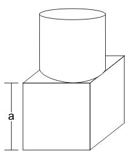
Question, Hiralal has two wooden cubes of side 'a' cm each. He carves one of them into the LARGEST POSSIBLE CYLINDER and fixes the two solids together as shown below.
He now wants to cover this solid entirely with a coat of paint. Assuming pi = 3, the total area to be painted (in cm2) will be close to
A. 8.75a2
B. 9a2
C. 5a2
D. 12a2
Answer : B
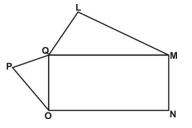
Question, In the figure, perimeter of LMQ is 24 cm, perimeter of OPQ is 14 cm and the perimeter of rectangle QMNO is 28 cm.
The perimeter of hexagon LMNOPQ (in cm) is
A. 66 cm
B. 39.3 cm
C. 38 cm
D. 19.7 cm
Answer : C
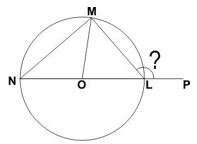
Question, Diameter NOL of the circle (with centre O) shown below is produced to P.
ONM : OML = 4 : 5.
The measure of PLM is
A. 50°
B. 100°
C. 130°
D. 140°
Answer : C
Question, The grid shown consists of unit squares. What is the perimeter of the figure shown on the grid?
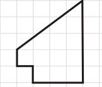
A. 14.5 units
B. 15 units
C. 16 units
D. 20 units
Answer : C
Question, The circumference of the rim of a regular sized glass would be about
A. 22cm
B. 14cm
C. 10cm
D. 08cm
Answer : A
Question, The diameter of a regular sized cricket ball would be about
A. 4 cm
B. 7 cm
C. 10 cm
D. 13 cm
Answer : B
<1M>
1.Q 1 Find the volume of a cuboid whose length is 8 cm, breadth 6 cm and height 3.5 cm.
Answer: Length (\(l\)) = 8 cm
Breadth (\(b\)) = 6 cm
Height (\(h\)) = 3.5 cm
Volume of cuboid = \(l \times b \times h\)
Volume = \(8 \times 6 \times 3.5 = 168 \text{ cm}^3\)
In simple words: Multiply length, breadth, and height to get the volume of the cuboid.
Exam Tip: Always write the formula first and include correct units (\(\text{cm}^3\)) in the final answer.
2.Find the altitude of a trapezium, the sum of the lengths of whose bases is 6.5 cm and whose area is 26 cm\(^2\).
Answer: Area of trapezium = 26 cm\(^2\)
Sum of parallel bases (\(a + b\)) = 6.5 cm
Area of trapezium = \(\frac{1}{2} \times (\text{sum of parallel sides}) \times \text{altitude}\)
\(26 = \frac{1}{2} \times 6.5 \times h\)
\(6.5 \times h = 26 \times 2 = 52\)
\(h = \frac{52}{6.5} = 8 \text{ cm}\)
In simple words: Divide twice the area by the sum of bases to find the height.
Exam Tip: Be careful with decimal division; multiplying both numerator and denominator by 10 simplifies \(520 / 65\).
3.Find the height of a cuboid whose volume is 275 cm\(^3\) and base area is 25 cm\(^2\).
Answer: Volume of cuboid = 275 cm\(^3\)
Base area = 25 cm\(^2\)
Volume = \(\text{Base Area} \times \text{Height}\)
\(275 = 25 \times h\)
\(h = \frac{275}{25} = 11 \text{ cm}\)
In simple words: The height is found by dividing the total volume by the area of the base.
Exam Tip: Remember that base area is equal to length times breadth (\(l \times b\)).
4.Find the area of a rhombus whose diagonals are of measurements 6 cm and 8 cm.
Answer: First diagonal (\(d_1\)) = 6 cm
Second diagonal (\(d_2\)) = 8 cm
Area of rhombus = \(\frac{1}{2} \times d_1 \times d_2\)
Area = \(\frac{1}{2} \times 6 \times 8 = 24 \text{ cm}^2\)
In simple words: Multiply the two diagonal lengths and divide the result by 2.
5.Find the volume of the cylinder whose base diameter is 14 cm and height is 10 cm.
Answer: Diameter (\(d\)) = 14 cm, so radius (\(r\)) = \(\frac{14}{2} = 7\) cm
Height (\(h\)) = 10 cm
Volume of cylinder = \(\pi r^2 h\)
Volume = \(\frac{22}{7} \times 7 \times 7 \times 10\)
Volume = \(22 \times 7 \times 10 = 1540 \text{ cm}^3\)
In simple words: Find the radius from the diameter, then apply the cylinder volume formula.
Exam Tip: Always convert diameter to radius before substituting into the formula.
6.Find the area of a triangle whose base is 4 cm and altitude is 6 cm.
Answer: Base (\(b\)) = 4 cm
Altitude (\(h\)) = 6 cm
Area of triangle = \(\frac{1}{2} \times \text{base} \times \text{altitude}\)
Area = \(\frac{1}{2} \times 4 \times 6 = 12 \text{ cm}^2\)
In simple words: Multiply base and height, then divide by 2.
Exam Tip: Altitude is the perpendicular distance from the base to the opposite vertex.
<2M>
7.Find the total surface area of a cube whose volume is 343 cm\(^3\).
Answer: Volume of cube = \(a^3 = 343 \text{ cm}^3\)
Side of cube (\(a\)) = \(\sqrt[3]{343} = 7\) cm
Total surface area of cube = \(6a^2\)
Total surface area = \(6 \times (7)^2 = 6 \times 49 = 294 \text{ cm}^2\)
In simple words: Find the side length by taking the cube root of the volume, then use the surface area formula.
Exam Tip: Memorize cube numbers up to 10 to quickly find cube roots.
8.Find the side of a cube whose surface area is 2400 cm\(^2\).
Answer: Total surface area = \(6a^2 = 2400 \text{ cm}^2\)
\(a^2 = \frac{2400}{6} = 400\)
\(a = \sqrt{400} = 20 \text{ cm}\)
In simple words: Divide the surface area by 6, then take the square root to find the side length.
Exam Tip: A cube has 6 identical square faces, which is why the formula is \(6a^2\).
9.How many bricks will be required for a wall which is 8 m long, 6 m high and 22.5 cm thick, if each brick measures 25 cm \(\times\) 11.25 cm \(\times\) 6 cm?
Answer: Dimensions of the wall:
Length (\(L\)) = \(8 \text{ m} = 800 \text{ cm}\)
Height (\(H\)) = \(6 \text{ m} = 600 \text{ cm}\)
Thickness (\(W\)) = 22.5 cm
Volume of the wall = \(L \times W \times H = 800 \times 22.5 \times 600 \text{ cm}^3\)
Dimensions of one brick:
Length = 25 cm, Breadth = 11.25 cm, Height = 6 cm
Volume of one brick = \(25 \times 11.25 \times 6 \text{ cm}^3\)
Number of bricks = \(\frac{\text{Volume of the wall}}{\text{Volume of one brick}}\)
Number of bricks = \(\frac{800 \times 22.5 \times 600}{25 \times 11.25 \times 6}\)
\(\frac{22.5}{11.25} = 2\)
\(\frac{800}{25} = 32\)
\(\frac{600}{6} = 100\)
Number of bricks = \(32 \times 2 \times 100 = 6400\)
In simple words: Divide the total volume of the wall by the volume of a single brick after converting all units to centimeters.
Exam Tip: Always ensure all dimensions are in the same unit (meters to centimeters) before calculating volumes.
10.The diameter of garden roller is 1.4 m and it is 2 m long. How much area will it cover in 5 revolutions?
Answer: Diameter (\(d\)) = 1.4 m, so radius (\(r\)) = \(\frac{1.4}{2} = 0.7\) m
Length of roller (\(h\)) = 2 m
Area covered in 1 revolution = Curved surface area of cylinder = \(2\pi r h\)
Area in 1 revolution = \(2 \times \frac{22}{7} \times 0.7 \times 2\)
Area in 1 revolution = \(2 \times 22 \times 0.1 \times 2 = 8.8 \text{ m}^2\)
Area covered in 5 revolutions = \(5 \times 8.8 = 44 \text{ m}^2\)
In simple words: Multiply the curved surface area of the roller by the number of revolutions.
Exam Tip: A roller covers an area equal to its curved surface area in one complete rotation.
11.Find the volume of a cuboid whose length is 8 cm, width is 3 cm and height is 5 cm.
Answer: Length (\(l\)) = 8 cm
Width (\(b\)) = 3 cm
Height (\(h\)) = 5 cm
Volume of cuboid = \(l \times b \times h\)
Volume = \(8 \times 3 \times 5 = 120 \text{ cm}^3\)
In simple words: Multiply length, width, and height together.
Exam Tip: Keep units consistent across all dimensions.
12.A cylindrical tank has a capacity of 5632 m\(^3\). If the diameter of its base is 16 m, find its depth.
Answer: Volume (Capacity) = 5632 m\(^3\)
Diameter (\(d\)) = 16 m, so radius (\(r\)) = \(\frac{16}{2} = 8\) m
Volume of cylinder = \(\pi r^2 h\)
\(5632 = \frac{22}{7} \times (8)^2 \times h\)
\(5632 = \frac{22}{7} \times 64 \times h\)
\(h = \frac{5632 \times 7}{22 \times 64}\)
\(h = \frac{39424}{1408} = 28 \text{ m}\)
In simple words: Divide the volume by the base area (\(\pi r^2\)) to find the depth/height.
Exam Tip: Simplify fractions step-by-step to avoid large multiplication errors.
13.Find the volume of 64 cubes whose one side is 4 cm.
Answer: Side of one cube (\(a\)) = 4 cm
Volume of one cube = \(a^3 = (4)^3 = 64 \text{ cm}^3\)
Volume of 64 cubes = \(64 \times 64 = 4096 \text{ cm}^3\)
In simple words: Find the volume of a single cube and multiply by 64.
Exam Tip: \(4^3\) happens to be 64, which is a coincidence with the number of cubes.
14.Find the volume of a cylinder whose base radius is 14 cm and height is 35 cm.
Answer: Radius (\(r\)) = 14 cm
Height (\(h\)) = 35 cm
Volume of cylinder = \(\pi r^2 h\)
Volume = \(\frac{22}{7} \times 14 \times 14 \times 35\)
Volume = \(22 \times 2 \times 14 \times 35 = 21560 \text{ cm}^3\)
In simple words: Substitute radius and height into the cylinder volume formula.
Exam Tip: Cancel out the denominator 7 with 14 (\(14 / 7 = 2\)) for easier calculation.
15.Find the area of a parallelogram whose measurements are given in the following figure.
Answer: Base (\(b\)) = 8 cm
Corresponding height (\(h\)) = 3 cm
Area of parallelogram = \(\text{Base} \times \text{Height}\)
Area = \(8 \times 3 = 24 \text{ cm}^2\)
In simple words: Multiply the base length by the perpendicular height.
Exam Tip: Ignore extra side lengths like 4 cm and 5 cm; only base and corresponding height are needed for area.
16.Find the total surface area of a cylinder whose base radius is 8 cm and height is 14 cm.
Answer: Radius (\(r\)) = 8 cm
Height (\(h\)) = 14 cm
Total Surface Area of cylinder = \(2\pi r(r + h)\)
Total Surface Area = \(2 \times \frac{22}{7} \times 8 \times (8 + 14)\)
Total Surface Area = \(2 \times \frac{22}{7} \times 8 \times 22\)
Total Surface Area = \(\frac{352 \times 22}{7} = \frac{7744}{7} = 1106.28 \text{ cm}^2\)
In simple words: Use the total surface area formula for a cylinder by adding curved surface area and two circular base areas.
Exam Tip: Use \(\pi = \frac{22}{7}\) unless 3.14 is specifically requested.
17.Find the area of a rhombus whose diagonals are of lengths 20 cm and 16 cm.
Answer: First diagonal (\(d_1\)) = 20 cm
Second diagonal (\(d_2\)) = 16 cm
Area of rhombus = \(\frac{1}{2} \times d_1 \times d_2\)
Area = \(\frac{1}{2} \times 20 \times 16 = 160 \text{ cm}^2\)
In simple words: Multiply the two diagonal lengths and divide by 2.
Exam Tip: Diagonals of a rhombus intersect at right angles, validating the area formula.
18.Find the height of cuboid whose volume is 490 cm\(^3\) and base area is 35 cm\(^2\).
Answer: Volume = 490 cm\(^3\)
Base area = 35 cm\(^2\)
Volume = \(\text{Base Area} \times \text{Height}\)
\(490 = 35 \times h\)
\(h = \frac{490}{35} = 14 \text{ cm}\)
In simple words: Divide the volume by the base area to find the height.
19.The diagonal of a quadrilateral shaped field is 24 cm and perpendicular dropped on it from the remaining opposite vertices are 6 m and 12 m. Find the area of the field.
Answer: Length of diagonal (\(d\)) = 24 m (Note: problem text specifies cm for diagonal and m for perpendiculars; assuming consistent units as 24 m based on standard field problems)
First perpendicular (\(h_1\)) = 6 m
Second perpendicular (\(h_2\)) = 12 m
Area of quadrilateral = \(\frac{1}{2} \times d \times (h_1 + h_2)\)
Area = \(\frac{1}{2} \times 24 \times (6 + 12)\)
Area = \(12 \times 18 = 216 \text{ m}^2\)
In simple words: Split the quadrilateral into two triangles along the diagonal and sum their areas.
Exam Tip: This formula is derived by adding the areas of two triangles sharing a common base (the diagonal).
20.A godown is in the form of a cuboid of measures 60 m \(\times\) 40 m \(\times\) 20 m. How many cuboidal boxes can be stored in it if the volume of one box is 0.8 m\(^3\)?
Answer: Dimensions of godown: Length = 60 m, Breadth = 40 m, Height = 20 m
Volume of godown = \(60 \times 40 \times 20 = 48000 \text{ m}^3\)
Volume of one box = 0.8 m\(^3$
Number of boxes = \(\frac{\text{Volume of godown}}{\text{Volume of one box}}\)
Number of boxes = \(\frac{48000}{0.8} = \frac{480000}{8} = 60000\)
In simple words: Divide the total volume of the godown by the volume of a single box.
Exam Tip: Remove decimals by multiplying numerator and denominator by 10 before dividing.
21.The internal measures of a cuboidal room are 10 m \(\times\) 8 m \(\times\) 4 m. Find the total cost of whitewashing four walls of a room, if the cost of white washing is Rs 5 per m\(^2\).
Answer: Length (\(l\)) = 10 m
Breadth (\(b\)) = 8 m
Height (\(h\)) = 4 m
Area of four walls (Lateral Surface Area) = \(2h(l + b)\)
Area = \(2 \times 4 \times (10 + 8) = 8 \times 18 = 144 \text{ m}^2\)
Cost of whitewashing per m\(^2\) = Rs 5
Total cost = \(144 \times 5 = \text{Rs } 720\)
In simple words: Find the area of the four walls using the lateral surface area formula, then multiply by the cost per square meter.
Exam Tip: Do not include the floor or ceiling area when calculating the cost of whitewashing four walls.
22.Find the area of a rhombus whose side is 5 cm and its altitude is 4 cm. If one of its diagonal is 8 cm long, find the length of the other diagonal.
Answer: A rhombus is also a parallelogram.
Side (\(b\)) = 5 cm, Altitude (\(h\)) = 4 cm
Area of rhombus = \(\text{Base} \times \text{Altitude} = 5 \times 4 = 20 \text{ cm}^2\)
Also, Area of rhombus = \(\frac{1}{2} \times d_1 \times d_2\)
Given first diagonal (\(d_1\)) = 8 cm
\(20 = \frac{1}{2} \times 8 \times d_2\)
\(20 = 4 \times d_2\)
\(d_2 = \frac{20}{4} = 5 \text{ cm}\)
In simple words: First find the area using base and altitude, then use the diagonal formula to find the missing diagonal.
Exam Tip: A rhombus has equal sides, so treating it like a parallelogram helps find its area when diagonals are not both known.
23.In a building there are 4 cylindrical pillars. The radius of each pillar is 21 cm and height is 5 m. Find the curved surface area of four pillars.
Answer: Radius (\(r\)) = 21 cm = 0.21 m
Height (\(h\)) = 5 m
Curved surface area of one pillar = \(2\pi r h\)
Curved surface area of one pillar = \(2 \times \frac{22}{7} \times 0.21 \times 5\)
Curved surface area of one pillar = \(2 \times \frac{22}{7} \times \frac{21}{100} \times 5 = \frac{44 \times 3 \times 5}{100} = \frac{660}{100} = 6.6 \text{ m}^2\)
Curved surface area of 4 pillars = \(4 \times 6.6 = 26.4 \text{ m}^2\)
In simple words: Find the curved surface area of one pillar in square meters and multiply by 4.
24.In a building there are 4 cylindrical pillars. The radius of each pillar is 21 cm and height is 5 m. Find the curved surface area of four pillars.
Answer: (Duplicate of Question 23)
Radius (\(r\)) = 21 cm = 0.21 m
Height (\(h\)) = 5 m
Curved surface area of one pillar = \(2\pi r h = 2 \times \frac{22}{7} \times 0.21 \times 5 = 6.6 \text{ m}^2\)
Curved surface area of 4 pillars = \(4 \times 6.6 = 26.4 \text{ m}^2\)
In simple words: Calculate the curved area of one pillar and multiply by 4.
Exam Tip: Ensure units are uniform before multiplying.
Q 24 A rectangular paper of width 7 cm is rolled along its width and a cylinder of radius 20 cm is formed. Find the volume of the cylinder.
Answer: When rolled along its width, the width of the paper becomes the height of the cylinder.
Height of cylinder (\(h\)) = 7 cm
Radius of cylinder (\(r\)) = 20 cm
Volume of cylinder = \(\pi r^2 h\)
Volume = \(\frac{22}{7} \times (20)^2 \times 7\)
Volume = \(\frac{22}{7} \times 400 \times 7 = 22 \times 400 = 8800 \text{ cm}^3\)
In simple words: The width of the paper is the height of the cylinder, and the given radius is used directly to calculate volume.
Exam Tip: Pay close attention to whether the paper is rolled along its length or width to determine height correctly.
25.The perimeter of a trapezium is 52 cm. Its non-parallel sides are 10 cm each and the distance between two parallel sides is 8 cm. Find the area of the trapezium.
Answer: Perimeter of trapezium = 52 cm
Sum of non-parallel sides = \(10 + 10 = 20\) cm
Sum of parallel sides (\(a + b\)) = \(\text{Perimeter} - (\text{Sum of non-parallel sides})\)
\(a + b = 52 - 20 = 32 \text{ cm}\)
Distance between parallel sides (\(h\)) = 8 cm
Area of trapezium = \(\frac{1}{2} \times (\text{sum of parallel sides}) \times h\)
Area = \(\frac{1}{2} \times 32 \times 8 = 16 \times 8 = 128 \text{ cm}^2\)
In simple words: Subtract the non-parallel sides from the perimeter to get the sum of parallel bases, then apply the area formula.
Exam Tip: Perimeter is the total outer boundary of the figure.
<4M>
26.The top surface of a box is in the shape of a regular octagon as shown in the figure. Find the area of the octagonal surface.
Answer: From the figure, a regular octagon of side 5 cm can be split into two trapeziums of parallel sides 11 cm and 5 cm, height 4 cm, and a central rectangle of dimensions \(11 \text{ cm} \times 5 \text{ cm}\).
Area of one trapezium = \(\frac{1}{2} \times (11 + 5) \times 4 = \frac{1}{2} \times 16 \times 4 = 32 \text{ cm}^2\)
Area of two trapeziums = \(2 \times 32 = 64 \text{ cm}^2$
Area of central rectangle = \(\text{length} \times \text{breadth} = 11 \times 5 = 55 \text{ cm}^2\)
Total area of the octagon = \(\text{Area of two trapeziums} + \text{Area of rectangle}\)
Total area = \(64 + 55 = 119 \text{ cm}^2\)
In simple words: Divide the regular octagon into two identical trapeziums and one middle rectangle, calculate their areas, and add them up.
Exam Tip: Splitting complex polygons into standard shapes (rectangles and trapeziums) makes area calculation straightforward.
<5M>
27.A tin is in a cylindrical shape whose base has a diameter of 14 cm and height 20 cm. A label is placed around the surface of the container. If the label is placed 2 cm from top and bottom, what is the area of the label?
Answer: Diameter of cylinder = 14 cm, so radius (\(r\)) = \(\frac{14}{2} = 7\) cm
Total height of tin = 20 cm
The label is placed 2 cm from the top and 2 cm from the bottom.
Height of the label (\(h_{\text{label}}\)) = \(\text{Total height} - 2 - 2 = 20 - 4 = 16 \text{ cm}\)
Radius of the label remains same = 7 cm
Area of the label = Curved surface area of label cylinder = \(2\pi r h_{\text{label}}\)
Area = \(2 \times \frac{22}{7} \times 7 \times 16\)
Area = \(2 \times 22 \times 16 = 44 \times 16 = 704 \text{ cm}^2\)
In simple words: Subtract 2 cm from both top and bottom to find the new height of the label, then calculate its curved surface area.
Exam Tip: Do not forget to subtract margins from both top and bottom when finding the height of the label.
28.A rectangle piece of metal sheet 11 m \(\times\) 4 m is folded without overlapping to make a cylinder of height 4 m. Find the volume of the cylinder.
Answer: Dimensions of metal sheet = \(11 \text{ m} \times 4 \text{ m}\)
Height of cylinder (\(h\)) = 4 m (since it is folded along the 4 m side)
The perimeter of the circular base of the cylinder equals the remaining side of the sheet (11 m).
Circumference of base = \(2\pi r = 11\)
\(2 \times \frac{22}{7} \times r = 11\)
\(\frac{44}{7} \times r = 11\)
\(r = \frac{11 \times 7}{44} = \frac{7}{4} = 1.75 \text{ m}\)
Volume of cylinder = \(\pi r^2 h\)
Volume = \(\frac{22}{7} \times \left(\frac{7}{4}\right)^2 \times 4\)
Volume = \(\frac{22}{7} \times \frac{49}{16} \times 4\)
Volume = \(\frac{22 \times 49 \times 4}{7 \times 16} = \frac{4312}{112} = 38.5 \text{ m}^3\)
In simple words: The sheet's length forms the circumference of the cylinder's base, from which you find the radius to calculate the volume.
Exam Tip: Understanding how flat sheet dimensions convert to cylindrical dimensions is crucial for mensuration problems.
Free study material for Mathematics
Free CBSE Practice Worksheets: Class 8 Mathematics Chapter 11 Mensuration
Practice Exercises for Class 8 Mathematics Chapter 11 Mensuration
Review targeted practice exercises for Class 8 Mathematics Chapter 11 Mensuration. Curated to match official CBSE guidelines, these printable problem sets support daily revision and improve overall test readiness.
Step-by-Step Solutions and Practice Guidelines
Each worksheet draws directly from authorized standard textbooks to maintain academic accuracy. Evaluating your finished exercises against expert-verified solutions helps master the formal presentation standards expected in school evaluations.
Enhance Speed with Online Practice
Follow up your worksheet practice by attempting the interactive online MCQ tests for Chapter 11 Mensuration to evaluate your execution speed. All printable assignments and revision sheets on our platform are updated for the 2026 session and available free of charge.
FAQs
You can download the latest chapter-wise printable worksheets for Class 8 Mathematics Chapter 11 Mensuration for free from StudiesToday.com. These have been made as per the latest CBSE curriculum for this academic year.
Yes, Class 8 Mathematics worksheets for Chapter 11 Mensuration focus on activity-based learning and also competency-style questions. This helps students to apply theoretical knowledge to practical scenarios.
Yes, we have provided solved worksheets for Class 8 Mathematics Chapter 11 Mensuration to help students verify their answers instantly.
Yes, our Class 8 Mathematics test sheets are mobile-friendly PDFs and can be printed by teachers for classroom.
For Chapter 11 Mensuration, regular practice with our worksheets will improve question-handling speed and help students understand all technical terms and diagrams.