

Class 8 Mathematics Practice Sheet: CBSE Class 8 Mathematics Visualizing Solid Shapes Worksheet Set 02
Review targeted academic worksheets with the CBSE Class 8 Mathematics Visualizing Solid Shapes Worksheet Set 02. Built according to official educational standards for the 2026-27 term, these downloadable Class 8 Mathematics resources support effective daily practice and detailed self-evaluation for Chapter 10 Visualising Solid Shapes.
Download Chapter 10 Visualising Solid Shapes Worksheet PDF with Answers
Navigate directly to the solved Mathematics worksheets using the digital viewer below. Each practice set includes detailed step-by-step solutions, allowing students to instantly cross-check their work and identify areas requiring further revision.
Q 1 What is a hexogonal prism?
Answer: A hexagonal prism is a three-dimensional solid shape that has two identical and parallel faces called bases, which are hexagons, and rectangular lateral faces connecting the corresponding sides of the two bases.
In simple words: It is a prism having two hexagonal ends and six rectangular sides.
Exam Tip: Remember that an n-sided prism has \(n + 2\) faces, \(3n\) edges, and \(2n\) vertices. For a hexagonal prism, \(n = 6\).
Q 2 How many vertices are there in a pyramid with a square base?
Answer: There are 5 vertices in a pyramid with a square base (4 vertices at the corners of the square base and 1 apex vertex at the top).
In simple words: A square pyramid has 4 corners at the bottom and 1 point at the top, making 5 vertices in total.
Exam Tip: A square pyramid has 5 faces, 8 edges, and 5 vertices.
Q 3 How many edges are there in a cuboid?
Answer: There are 12 edges in a cuboid.
In simple words: A cuboid has 12 straight line segments where its faces meet.
Q 4 How many edges are there in a triangular pyramid?
Answer: There are 6 edges in a triangular pyramid (also known as a tetrahedron).
In simple words: A triangular pyramid has 3 edges on its base and 3 edges meeting at the top vertex, giving 6 edges in total.
Exam Tip: A triangular pyramid has 4 faces, 6 edges, and 4 vertices.
Q 5 How many vertices are there in a triangular pyramid?
Answer: There are 4 vertices in a triangular pyramid (3 corners on the triangular base and 1 top apex vertex).
In simple words: It has 4 corner points.
Exam Tip: A tetrahedron is the simplest pyramid, formed entirely of triangular faces.
Q 6 How many faces are there in a triangular prism?
Answer: There are 5 faces in a triangular prism (2 triangular bases and 3 rectangular lateral faces).
In simple words: It has 2 triangles at the ends and 3 rectangles around the middle, totaling 5 faces.
Exam Tip: For any prism, Faces = \(n + 2\), where \(n\) is the number of sides of the base polygon.
Q 7 What are the three views in a solid?
Answer: The three standard views used to observe a three-dimensional solid object are:
1. Top view
2. Front view
3. Side view
In simple words: These are the perspectives of looking at an object from above, from the front, and from the side.
Exam Tip: Orthographic projections help in visualizing 3D objects on a 2D plane by using these three views.
Q 8 What are regular polyhedrons?
Answer: A polyhedron is called regular if its faces are made up of regular congruent polygons and the same number of faces meet at each vertex.
In simple words: A 3D solid whose faces are identical regular shapes (like equilateral triangles or squares) arranged identically at every corner.
Exam Tip: Examples of regular polyhedrons include the cube and the regular tetrahedron.
Q 9 A pyramid with square base has 5 faces and 8 edges. By Euler’s formula, find the vertices of the pyramid.
Answer: Given data:
Faces (\(F\)) = 5
Edges (\(E\)) = 8
Let the number of vertices be \(V\).
According to Euler's formula for polyhedrons:
\(F + V - E = 2\)
Substitute the given values into the formula:
\(5 + V - 8 = 2\)
\(V - 3 = 2\)
\(V = 2 + 3 = 5\)
Thus, the number of vertices is 5.
In simple words: Using Euler's relation \(F + V - E = 2\), we find that the pyramid has 5 vertices.
Exam Tip: Always state Euler's formula clearly before substituting values to ensure full credit.
Q 10 Can a polyhedron have 20 faces, 40 edges and 30 vertices?
Answer: Given data:
Faces (\(F\)) = 20
Edges (\(E\)) = 40
Vertices (\(V\)) = 30
Let us test these values using Euler's formula (\(F + V - E = 2\)):
Left-hand side (\(LHS\)) = \(F + V - E = 20 + 30 - 40\)
\(LHS = 50 - 40 = 10\)
Right-hand side (\(RHS\)) = 2
Since \(LHS \neq RHS\) (\(10 \neq 2\)), Euler's formula is not satisfied.
Therefore, a polyhedron cannot have 20 faces, 40 edges, and 30 vertices.
In simple words: When we substitute the numbers into Euler's formula, the left side equals 10 instead of 2, so such a polyhedron is impossible.
Exam Tip: Euler's formula \(F + V - E = 2\) must hold true for any convex polyhedron.
Q 11 For the given solid, identify the top view, front view and side view.
Answer: Based on the orientation of the given solid:
- Front view corresponds to figure (i)
- Side view corresponds to figure (iii)
- Top view corresponds to figure (ii)
In simple words: By looking at the solid from the indicated arrows, we match each perspective to its corresponding 2D grid diagram.
Exam Tip: Trace the number of visible unit cubes aligned along each projection axis to correctly identify views.
Q 12 Identify the top view, front view and side view for the given solid.
Answer: Based on the solid shown in the diagram:
- Front view corresponds to figure (ii)
- Side view corresponds to figure (iii)
- Top view corresponds to figure (i)
In simple words: Match the shape projected onto each plane (front, side, top) with the given 2D silhouettes (i), (ii), and (iii).
Exam Tip: Count the squares in each row and column of the projection to avoid counting errors.
Q 13 Give two basic differences between a prism and a pyramid.
Answer: Two basic differences between a prism and a pyramid are:
1. Bases: A prism has two identical, parallel polygonal bases (top and bottom), whereas a pyramid has only one base and its lateral faces meet at a common single top vertex (apex).
2. Lateral Faces: The lateral faces of a prism are always rectangles or parallelograms, whereas the lateral faces of a pyramid are always triangles.
In simple words: Prisms have two matching flat ends and rectangular sides, while pyramids have a single base and triangular sides sloping up to a point.
Exam Tip: Memorize these two distinguishing features as they are frequently tested in exams.
Q 14 Can a polyhedron have for its faces:
a) 3 triangles?
b) a square and four triangles?
Answer:
a) No, a polyhedron cannot have only 3 triangular faces because a minimum of 4 faces is required to enclose a 3D space (as seen in a tetrahedron).
b) Yes, a polyhedron can have a square base and four triangular faces. This specific shape is a square pyramid.
In simple words: (a) Three faces cannot enclose a volume. (b) A square pyramid has 1 square and 4 triangles.
Exam Tip: The simplest possible polyhedron is a tetrahedron, which has 4 triangular faces.
Q 15 Give the importance of the scale in a map.
Answer: The importance of a scale in a map includes:
1. It provides a ratio relationship between the distance on the map and the actual corresponding distance on the ground.
2. It allows us to accurately calculate real-world distances between different locations using a ruler on the map.
In simple words: Scale tells us how much real distance is represented by a small distance on the map.
Exam Tip: Without a scale, a map is just a pictorial sketch and cannot be used for navigation or measurement.
Q 16 Give two differences between a picture and a map.
Answer: Two differences between a picture and a map are:
1. Perspective: A picture shows an object or place from a specific side perspective as seen by an observer or camera, whereas a map represents a bird's-eye view (top view) of a region.
2. Measurement: A picture does not show precise relative distances or directions using a scale, whereas a map is drawn to scale and accurately represents distances and directions.
In simple words: A picture is a regular photo showing how things look from the side, while a map is an overhead drawing with a scale for measuring distances.
Exam Tip: Focus on 'perspective' and 'scale' as the key distinguishing points.
Q 17 State and verify the Euler’s Formula for a rectangular prism.
Answer: Statement of Euler's Formula: For any polyhedron, the relation between the number of faces (\(F\)), vertices (\(V\)), and edges (\(E\)) is given by:
\(F + V - E = 2\)
Verification for a rectangular prism (cuboid):
Number of faces (\(F\)) = 6
Number of vertices (\(V\)) = 8
Number of edges (\(E\)) = 12
Substitute into Euler's formula:
\(LHS = F + V - E = 6 + 8 - 12\)
\(LHS = 14 - 12 = 2\)
Since \(LHS = RHS = 2\), Euler's formula is verified for a rectangular prism.
In simple words: We plug the 6 faces, 8 vertices, and 12 edges of a cuboid into the formula \(F + V - E = 2\), and it results in 2.
Exam Tip: Always write down the formula, state the values of \(F\), \(V\), and \(E\), and show the substitution clearly.
Q 18 Find the number of edges, vertices and faces in a cylinder.
Answer: For a cylinder:
- Number of faces = 3 (2 flat circular circular bases and 1 curved lateral surface)
- Number of edges = 2 (circular boundaries where the curved surface meets the two flat bases)
- Number of vertices = 0 (no straight corners or vertices)
In simple words: A cylinder has 3 surfaces, 2 circular edge lines, and 0 sharp corner vertices.
Exam Tip: Note that a cylinder is a curved 3D solid and not a polyhedron, but its surface and edge properties can still be listed.
Q 19 State and verify the Euler’s Formula for a cube.
Answer: Statement of Euler's Formula: For any polyhedron, \(F + V - E = 2\).
Verification for a cube:
Faces (\(F\)) = 6
Vertices (\(V\)) = 8
Edges (\(E\)) = 12
Substitute values:
\(LHS = 6 + 8 - 12 = 14 - 12 = 2\)
Since \(LHS = RHS = 2\), Euler's formula is verified for a cube.
In simple words: A cube has 6 faces, 8 vertices, and 12 edges. Adding faces and vertices and subtracting edges gives 2.
Exam Tip: Cubes and cuboids have identical face, vertex, and edge counts.
Q 20 Draw the three views of a brick.
Answer: A brick is shaped like a rectangular prism (cuboid) with length greater than its breadth and height.
1. Front View: A rectangle showing the longest length and thickness of the brick.
2. Side View: A smaller rectangle showing the breadth and thickness.
3. Top View: A rectangle showing the length and breadth of the brick.
In simple words: The three views are rectangles of different dimensions depending on which side you look at.
Exam Tip: Draw neat rectangular boxes representing the proportions of a standard brick.
Q 21 Draw the front, side and top view of an almirah.
Answer: An almirah is a tall rectangular storage cabinet.
1. Front View: A large vertical rectangle showing doors and handles.
2. Side View: A narrow vertical rectangle showing the depth and height.
3. Top View: A small horizontal rectangle or square showing the width and depth from above.
In simple words: The front shows doors, the side shows thickness, and the top shows the roof of the almirah.
Exam Tip: Label each drawn view clearly as Front, Side, and Top.
Q 22 Find the number of edges, vertices and faces in a rectangular pyramid.
Answer: For a rectangular pyramid:
- Number of faces = 5 (1 rectangular base and 4 triangular lateral faces)
- Number of vertices = 5 (4 corners of the rectangular base and 1 apex vertex at the top)
- Number of edges = 8 (4 base edges and 4 edges connecting base corners to the apex)
In simple words: A rectangular pyramid has 5 faces, 5 vertices, and 8 edges.
Exam Tip: You can cross-check these values with Euler's formula: \(5 + 5 - 8 = 2\).
Q 23 Find the number of edges, vertices and faces in a given solid.
Answer: Analyzing the modified cube/cuboid solid shown in the figure (where a corner has been cut out or indented):
- Number of faces = 7
- Number of vertices = 10
- Number of edges = 15
In simple words: Counting the modified surfaces, corners, and edges of the depicted cut-cube gives 7 faces, 10 vertices, and 15 edges.
Exam Tip: Verify using Euler's formula: \(7 + 10 - 15 = 2\).
Q 24 State and verify the Euler’s Formula for a triangular pyramid.
Answer: Statement of Euler's Formula: \(F + V - E = 2\)
Verification for a triangular pyramid (tetrahedron):
Faces (\(F\)) = 4
Vertices (\(V\)) = 4
Edges (\(E\)) = 6
Substitute values:
\(LHS = 4 + 4 - 6 = 8 - 6 = 2\)
Since \(LHS = RHS = 2\), Euler's formula is verified for a triangular pyramid.
In simple words: A tetrahedron has 4 faces, 4 vertices, and 6 edges. Substituting them into Euler's equation yields 2.
Exam Tip: The tetrahedron is the polyhedron with the minimum possible number of faces.
Q 25 Draw the front, side and top view of a television.
Answer:
1. Front View: A rectangle showing the screen and control buttons.
2. Side View: A narrow rectangle showing the depth profile of the television cabinet.
3. Top View: A thin rectangular strip showing the top edge and thickness of the TV.
In simple words: Front shows the screen, side and top show the thickness and depth of the device.
Exam Tip: Keep proportions realistic for a modern flat screen or box television.
Q 26 By using Euler’s formula find the unknown.
a) Vertices = 12 , Faces = 4, Edges = ?
b) Faces = 5 , Edges = 8, Vertices = ?
c) Edges = 2 , Vertices = 3, Faces = ?
Answer: Using Euler's formula \(F + V - E = 2\):
a) Given \(V = 12\), \(F = 4\).
\(4 + 12 - E = 2\)
\(16 - E = 2 \implies E = 16 - 2 = 14\)
Edges = 14
b) Given \(F = 5\), \(E = 8\).
\(5 + V - 8 = 2\)
\(V - 3 = 2 \implies V = 2 + 3 = 5\)
Vertices = 5
c) Given \(E = 2\), \(V = 3\).
\(F + 3 - 2 = 2\)
\(F + 1 = 2 \implies F = 2 - 1 = 1\)
Faces = 1
In simple words: Substitute the two given values into \(F + V - E = 2\) and solve a simple linear equation to find the third unknown value.
Exam Tip: Always transpose carefully when solving for a negative variable like \(-E\).
Q 27 Look at the map given below:
Answer the following:
(a) Mark a green ‘X’ at the intersection of Church Street and High Street and a blue ‘Y’ at the intersection of North Street and Leret Way.
(b) Highlight the shortest street route followed by Annie from her current position to the Institute in pink.
(c) Which is further east, The Swan Centre or Institute?
Answer:
(a) Locate Church Street and High Street on the provided map and place an 'X' at their meeting point. Locate North Street and Leret Way and place a 'Y' at their intersection.
(b) Trace the direct and shortest walkable path from Annie's position (near Church Street) up to the Institute (near Leret Way) along the street network.
(c) Based on the compass directions (North pointing up, East pointing right), The Swan Centre is located further east than the Institute.
In simple words: (a) Find street intersections. (b) Trace the shortest path. (c) The Swan Centre lies further to the right (East) on the map.
Exam Tip: Always check the compass rose (N-S-E-W directions) before answering location and directional questions on maps.
Most Important Questions
Q 1 What are two-dimensional shapes?
Answer: Two-dimensional (2D) shapes are flat figures that have only two dimensions, namely length and breadth (or width), and do not have any thickness or height.
In simple words: Flat shapes that can be drawn on a flat piece of paper, like circles, squares, and triangles.
Exam Tip: 2D shapes occupy area but have zero volume.
Q 2 What are three-dimensional shapes?
Answer: Three-dimensional (3D) shapes are solid objects or figures that have three dimensions: length, breadth, and height (or depth), and therefore occupy space and have volume.
In simple words: Solid objects that have thickness and take up physical space in the real world, like spheres, cubes, and cylinders.
Exam Tip: Unlike 2D shapes, 3D shapes possess volume in addition to surface area.
Q 3 T/F.
If we add the dimension ‘height’ to a rectangle(with certain length & breadth), we obtain a cuboid.
Answer: True.
In simple words: Giving height to a flat rectangle turns it into a 3D cuboid.
Exam Tip: Extending any 2D polygon along a perpendicular height generates a corresponding prism.
Q 4 A three dimensional shape is _________ object.( solid/plane)
Answer: A three dimensional shape is solid object.
In simple words: 3D shapes are solid objects.
Exam Tip: 3D = solid; 2D = plane.
Q 5 A two dimensional shape is _________ shape.(solid/plane)
Answer: A two dimensional shape is plane shape.
In simple words: 2D shapes are flat plane figures.
Exam Tip: Plane shapes lie entirely within a flat two-dimensional plane.
Q 6 The three views in a solid are:
Answer: The three views in a solid are:
1. Top view
2. Front view
3. Side view
In simple words: Top, front, and side views.
Exam Tip: These views form the foundation of engineering drawing and visualization.
Q 7 The most important part of a map is the ______.(scale, location)
Answer: The most important part of a map is the scale.
In simple words: Scale is essential for accurate map reading.
Exam Tip: Scale allows conversion between map measurements and real-world distances.
Q 8 __________ are used to depict different objects/places in a map.(Symbols/landmarks)
Answer: Symbols are used to depict different objects/places in a map.
In simple words: Symbols represent real features like schools, hospitals, and roads on a map.
Exam Tip: A map key or legend explains what each symbol stands for.
Q 9 T/F:
In a map, places that are far & those that are near, will be of the same size to an observer.
Answer: False.
In simple words: On a map, everything is drawn uniformly to scale according to actual proportions, unlike a perspective photograph where distant objects appear smaller.
Exam Tip: Maps use a top-down orthogonal projection where scale remains constant regardless of distance.
Q 10 State the Euler’s Formula for polyhedrons.
Answer: Euler's formula states that for any convex polyhedron, the sum of the number of faces (\(F\)) and vertices (\(V\)) minus the number of edges (\(E\)) is always equal to 2.
Formula: \(F + V - E = 2\)
In simple words: Faces plus vertices minus edges equals 2 for any polyhedron.
Q 11 Give two examples of 2d & 3d shapes each.
Answer:
- 2D shape examples: Square, Circle
- 3D shape examples: Cube, Cylinder
In simple words: Squares and circles are flat 2D shapes; cubes and cylinders are solid 3D shapes.
Exam Tip: Other valid examples include rectangles and triangles for 2D, and spheres and cones for 3D.
Q 12 Give two differences between a picture & a map.
Answer:
1. A picture shows an object from a specific side perspective, whereas a map shows a bird's-eye (top) view of an area.
2. A picture does not have a scale for measuring distances, whereas a map is drawn to scale.
In simple words: Pictures show side views without scale; maps show top views with scale.
Exam Tip: Highlight perspective and scale in your answer.
Q 13 Give the importance of the scale in a map.
Answer: The scale of a map is crucial because it provides the ratio between map distance and actual ground distance, enabling accurate distance measurement and navigation.
In simple words: It helps us calculate real distances between places using the map.
Q 14 What are polyhedrons? Give two exs.
Answer: Polyhedrons are three-dimensional solid shapes bounded by flat polygonal faces straight edges, and sharp vertices.
Examples: Cube, Square pyramid.
In simple words: 3D shapes made entirely of flat polygon faces.
Exam Tip: Spheres, cylinders, and cones are not polyhedrons because they have curved surfaces.
Q 15 Give two basic differences between a prism & a pyramid.
Answer:
1. A prism has two identical parallel bases, while a pyramid has only one base and a top apex vertex.
2. The lateral faces of a prism are rectangles, whereas the lateral faces of a pyramid are triangles.
In simple words: Prisms have two matching ends and rectangular sides; pyramids have one base and triangular sides coming to a point.
Q 16 Verify the Euler`s formula for a Square-pyramid:
Answer: For a square pyramid:
- Number of faces (\(F\)) = 5
- Number of vertices (\(V\)) = 5
- Number of edges (\(E\)) = 8
Applying Euler's formula (\(F + V - E = 2\)):
\(LHS = 5 + 5 - 8 = 10 - 8 = 2\)
Since \(LHS = RHS = 2\), Euler's formula is verified for a square pyramid.
In simple words: Plugging 5 faces, 5 vertices, and 8 edges into \(F + V - E = 2\) gives 2, verifying the formula.
Exam Tip: Draw a neat sketch of the square pyramid alongside your verification.
Q 17 Draw the three views of a brick.
Answer:
1. Front View: A rectangle showing length and thickness.
2. Side View: A rectangle showing breadth and thickness.
3. Top View: A rectangle showing length and breadth.
In simple words: The three orthographic views of a brick are rectangles of varying dimensions.
Exam Tip: Clearly label Front, Side, and Top beneath each rectangular drawing.
Q 18 Define :
a) Face
b) Edge
c) Vertex
Answer:
a) Face: A flat or curved surface that makes up the boundary of a solid object.
b) Edge: A line segment where two faces of a solid object meet.
c) Vertex: A corner point where two or more edges of a solid object meet.
In simple words: Face is the flat side, edge is the line where sides meet, and vertex is the corner point.
Exam Tip: Learn these three fundamental definitions word-for-word.
Q 19 A pentagonal prism has ______ faces, ______ edges & _____ vertices.
Answer: A pentagonal prism has 7 faces, 15 edges & 10 vertices.
In simple words: A pentagonal prism has 7 faces, 15 edges, and 10 vertices.
Exam Tip: Use formulas: Faces = \(n+2\), Edges = \(3n\), Vertices = \(2n\) where \(n = 5\).
Q 20 A hexagonal pyramid has ______ faces, ______ edges & _____ vertices.
Answer: A hexagonal pyramid has 7 faces, 12 edges & 7 vertices.
In simple words: A hexagonal pyramid has 7 faces, 12 edges, and 7 vertices.
Exam Tip: Use pyramid formulas: Faces = \(n+1\), Edges = \(2n\), Vertices = \(n+1\) where \(n = 6\).
Q 21 Match the front, side & top views of the following :
Answer: Based on the given composite solid object:
- Front view matches with figure (i)
- Side view matches with figure (iii)
- Top view matches with figure (ii)
In simple words: Correctly pairing each orthogonal projection with its corresponding view grid (i), (ii), and (iii).
Exam Tip: Double-check alignment by counting unit square blocks along each viewing direction.
10. Visualizing Solid Shapes
Q 1 What is a hexogonal prism?
Answer: A hexagonal prism is a three-dimensional solid shape that has two identical and parallel faces called bases, which are hexagons, and rectangular lateral faces connecting the corresponding sides of the two bases.
In simple words: It is a prism having two hexagonal ends and six rectangular sides.
Exam Tip: Remember that an n-sided prism has \(n + 2\) faces, \(3n\) edges, and \(2n\) vertices. For a hexagonal prism, \(n = 6\).
Q 2 How many vertices are there in a pyramid with a square base?
Answer: There are 5 vertices in a pyramid with a square base (4 vertices at the corners of the square base and 1 apex vertex at the top).
In simple words: A square pyramid has 4 corners at the bottom and 1 point at the top, making 5 vertices in total.
Exam Tip: A square pyramid has 5 faces, 8 edges, and 5 vertices.
Q 3 How many edges are there in a cuboid?
Answer: There are 12 edges in a cuboid.
In simple words: A cuboid has 12 straight line segments where its faces meet.
Q 4 How many edges are there in a triangular pyramid?
Answer: There are 6 edges in a triangular pyramid (also known as a tetrahedron).
In simple words: A triangular pyramid has 3 edges on its base and 3 edges meeting at the top vertex, giving 6 edges in total.
Exam Tip: A triangular pyramid has 4 faces, 6 edges, and 4 vertices.
Q 5 How many vertices are there in a triangular pyramid?
Answer: There are 4 vertices in a triangular pyramid (3 corners on the triangular base and 1 top apex vertex).
In simple words: It has 4 corner points.
Exam Tip: A tetrahedron is the simplest pyramid, formed entirely of triangular faces.
Q 6 How many faces are there in a triangular prism?
Answer: There are 5 faces in a triangular prism (2 triangular bases and 3 rectangular lateral faces).
In simple words: It has 2 triangles at the ends and 3 rectangles around the middle, totaling 5 faces.
Exam Tip: For any prism, Faces = \(n + 2\), where \(n\) is the number of sides of the base polygon.
Q 7 What are the three views in a solid?
Answer: The three standard views used to observe a three-dimensional solid object are:
1. Top view
2. Front view
3. Side view
In simple words: These are the perspectives of looking at an object from above, from the front, and from the side.
Exam Tip: Orthographic projections help in visualizing 3D objects on a 2D plane by using these three views.
Q 8 What are regular polyhedrons?
Answer: A polyhedron is called regular if its faces are made up of regular congruent polygons and the same number of faces meet at each vertex.
In simple words: A 3D solid whose faces are identical regular shapes (like equilateral triangles or squares) arranged identically at every corner.
Exam Tip: Examples of regular polyhedrons include the cube and the regular tetrahedron.
Q 9 A pyramid with square base has 5 faces and 8 edges. By Euler’s formula, find the vertices of the pyramid.
Answer: Given data:
Faces (\(F\)) = 5
Edges (\(E\)) = 8
Let the number of vertices be \(V\).
According to Euler's formula for polyhedrons:
\(F + V - E = 2\)
Substitute the given values into the formula:
\(5 + V - 8 = 2\)
\(V - 3 = 2\)
\(V = 2 + 3 = 5\)
Thus, the number of vertices is 5.
In simple words: Using Euler's relation \(F + V - E = 2\), we find that the pyramid has 5 vertices.
Exam Tip: Always state Euler's formula clearly before substituting values to ensure full credit.
Q 10 Can a polyhedron have 20 faces, 40 edges and 30 vertices?
Answer: Given data:
Faces (\(F\)) = 20
Edges (\(E\)) = 40
Vertices (\(V\)) = 30
Let us test these values using Euler's formula (\(F + V - E = 2\)):
Left-hand side (\(LHS\)) = \(F + V - E = 20 + 30 - 40\)
\(LHS = 50 - 40 = 10\)
Right-hand side (\(RHS\)) = 2
Since \(LHS \neq RHS\) (\(10 \neq 2\)), Euler's formula is not satisfied.
Therefore, a polyhedron cannot have 20 faces, 40 edges, and 30 vertices.
In simple words: When we substitute the numbers into Euler's formula, the left side equals 10 instead of 2, so such a polyhedron is impossible.
Exam Tip: Euler's formula \(F + V - E = 2\) must hold true for any convex polyhedron.
Q 11 For the given solid, identify the top view, front view and side view.
Answer: Based on the orientation of the given solid:
- Front view corresponds to figure (i)
- Side view corresponds to figure (iii)
- Top view corresponds to figure (ii)
In simple words: By looking at the solid from the indicated arrows, we match each perspective to its corresponding 2D grid diagram.
Exam Tip: Trace the number of visible unit cubes aligned along each projection axis to correctly identify views.
Q 12 Identify the top view, front view and side view for the given solid.
Answer: Based on the solid shown in the diagram:
- Front view corresponds to figure (ii)
- Side view corresponds to figure (iii)
- Top view corresponds to figure (i)
In simple words: Match the shape projected onto each plane (front, side, top) with the given 2D silhouettes (i), (ii), and (iii).
Exam Tip: Count the squares in each row and column of the projection to avoid counting errors.
Q 13 Give two basic differences between a prism and a pyramid.
Answer: Two basic differences between a prism and a pyramid are:
1. Bases: A prism has two identical, parallel polygonal bases (top and bottom), whereas a pyramid has only one base and its lateral faces meet at a common single top vertex (apex).
2. Lateral Faces: The lateral faces of a prism are always rectangles or parallelograms, whereas the lateral faces of a pyramid are always triangles.
In simple words: Prisms have two matching flat ends and rectangular sides, while pyramids have a single base and triangular sides sloping up to a point.
Exam Tip: Memorize these two distinguishing features as they are frequently tested in exams.
Q 14 Can a polyhedron have for its faces:
a) 3 triangles?
b) a square and four triangles?
Answer:
a) No, a polyhedron cannot have only 3 triangular faces because a minimum of 4 faces is required to enclose a 3D space (as seen in a tetrahedron).
b) Yes, a polyhedron can have a square base and four triangular faces. This specific shape is a square pyramid.
In simple words: (a) Three faces cannot enclose a volume. (b) A square pyramid has 1 square and 4 triangles.
Exam Tip: The simplest possible polyhedron is a tetrahedron, which has 4 triangular faces.
Q 15 Give the importance of the scale in a map.
Answer: The importance of a scale in a map includes:
1. It provides a ratio relationship between the distance on the map and the actual corresponding distance on the ground.
2. It allows us to accurately calculate real-world distances between different locations using a ruler on the map.
In simple words: Scale tells us how much real distance is represented by a small distance on the map.
Exam Tip: Without a scale, a map is just a pictorial sketch and cannot be used for navigation or measurement.
Q 16 Give two differences between a picture and a map.
Answer: Two differences between a picture and a map are:
1. Perspective: A picture shows an object or place from a specific side perspective as seen by an observer or camera, whereas a map represents a bird's-eye view (top view) of a region.
2. Measurement: A picture does not show precise relative distances or directions using a scale, whereas a map is drawn to scale and accurately represents distances and directions.
In simple words: A picture is a regular photo showing how things look from the side, while a map is an overhead drawing with a scale for measuring distances.
Exam Tip: Focus on 'perspective' and 'scale' as the key distinguishing points.
Q 17 State and verify the Euler’s Formula for a rectangular prism.
Answer: Statement of Euler's Formula: For any polyhedron, the relation between the number of faces (\(F\)), vertices (\(V\)), and edges (\(E\)) is given by:
\(F + V - E = 2\)
Verification for a rectangular prism (cuboid):
Number of faces (\(F\)) = 6
Number of vertices (\(V\)) = 8
Number of edges (\(E\)) = 12
Substitute into Euler's formula:
\(LHS = F + V - E = 6 + 8 - 12\)
\(LHS = 14 - 12 = 2\)
Since \(LHS = RHS = 2\), Euler's formula is verified for a rectangular prism.
In simple words: We plug the 6 faces, 8 vertices, and 12 edges of a cuboid into the formula \(F + V - E = 2\), and it results in 2.
Exam Tip: Always write down the formula, state the values of \(F\), \(V\), and \(E\), and show the substitution clearly.
Q 18 Find the number of edges, vertices and faces in a cylinder.
Answer: For a cylinder:
- Number of faces = 3 (2 flat circular circular bases and 1 curved lateral surface)
- Number of edges = 2 (circular boundaries where the curved surface meets the two flat bases)
- Number of vertices = 0 (no straight corners or vertices)
In simple words: A cylinder has 3 surfaces, 2 circular edge lines, and 0 sharp corner vertices.
Exam Tip: Note that a cylinder is a curved 3D solid and not a polyhedron, but its surface and edge properties can still be listed.
Q 19 State and verify the Euler’s Formula for a cube.
Answer: Statement of Euler's Formula: For any polyhedron, \(F + V - E = 2\).
Verification for a cube:
Faces (\(F\)) = 6
Vertices (\(V\)) = 8
Edges (\(E\)) = 12
Substitute values:
\(LHS = 6 + 8 - 12 = 14 - 12 = 2\)
Since \(LHS = RHS = 2\), Euler's formula is verified for a cube.
In simple words: A cube has 6 faces, 8 vertices, and 12 edges. Adding faces and vertices and subtracting edges gives 2.
Exam Tip: Cubes and cuboids have identical face, vertex, and edge counts.
Q 20 Draw the three views of a brick.
Answer: A brick is shaped like a rectangular prism (cuboid) with length greater than its breadth and height.
1. Front View: A rectangle showing the longest length and thickness of the brick.
2. Side View: A smaller rectangle showing the breadth and thickness.
3. Top View: A rectangle showing the length and breadth of the brick.
In simple words: The three views are rectangles of different dimensions depending on which side you look at.
Exam Tip: Draw neat rectangular boxes representing the proportions of a standard brick.
Q 21 Draw the front, side and top view of an almirah.
Answer: An almirah is a tall rectangular storage cabinet.
1. Front View: A large vertical rectangle showing doors and handles.
2. Side View: A narrow vertical rectangle showing the depth and height.
3. Top View: A small horizontal rectangle or square showing the width and depth from above.
In simple words: The front shows doors, the side shows thickness, and the top shows the roof of the almirah.
Exam Tip: Label each drawn view clearly as Front, Side, and Top.
Q 22 Find the number of edges, vertices and faces in a rectangular pyramid.
Answer: For a rectangular pyramid:
- Number of faces = 5 (1 rectangular base and 4 triangular lateral faces)
- Number of vertices = 5 (4 corners of the rectangular base and 1 apex vertex at the top)
- Number of edges = 8 (4 base edges and 4 edges connecting base corners to the apex)
In simple words: A rectangular pyramid has 5 faces, 5 vertices, and 8 edges.
Exam Tip: You can cross-check these values with Euler's formula: \(5 + 5 - 8 = 2\).
Q 23 Find the number of edges, vertices and faces in a given solid.
Answer: Analyzing the modified cube/cuboid solid shown in the figure (where a corner has been cut out or indented):
- Number of faces = 7
- Number of vertices = 10
- Number of edges = 15
In simple words: Counting the modified surfaces, corners, and edges of the depicted cut-cube gives 7 faces, 10 vertices, and 15 edges.
Exam Tip: Verify using Euler's formula: \(7 + 10 - 15 = 2\).
Q 24 State and verify the Euler’s Formula for a triangular pyramid.
Answer: Statement of Euler's Formula: \(F + V - E = 2\)
Verification for a triangular pyramid (tetrahedron):
Faces (\(F\)) = 4
Vertices (\(V\)) = 4
Edges (\(E\)) = 6
Substitute values:
\(LHS = 4 + 4 - 6 = 8 - 6 = 2\)
Since \(LHS = RHS = 2\), Euler's formula is verified for a triangular pyramid.
In simple words: A tetrahedron has 4 faces, 4 vertices, and 6 edges. Substituting them into Euler's equation yields 2.
Exam Tip: The tetrahedron is the polyhedron with the minimum possible number of faces.
Q 25 Draw the front, side and top view of a television.
Answer:
1. Front View: A rectangle showing the screen and control buttons.
2. Side View: A narrow rectangle showing the depth profile of the television cabinet.
3. Top View: A thin rectangular strip showing the top edge and thickness of the TV.
In simple words: Front shows the screen, side and top show the thickness and depth of the device.
Exam Tip: Keep proportions realistic for a modern flat screen or box television.
Q 26 By using Euler’s formula find the unknown.
a) Vertices = 12 , Faces = 4, Edges = ?
b) Faces = 5 , Edges = 8, Vertices = ?
c) Edges = 2 , Vertices = 3, Faces = ?
Answer: Using Euler's formula \(F + V - E = 2\):
a) Given \(V = 12\), \(F = 4\).
\(4 + 12 - E = 2\)
\(16 - E = 2 \implies E = 16 - 2 = 14\)
Edges = 14
b) Given \(F = 5\), \(E = 8\).
\(5 + V - 8 = 2\)
\(V - 3 = 2 \implies V = 2 + 3 = 5\)
Vertices = 5
c) Given \(E = 2\), \(V = 3\).
\(F + 3 - 2 = 2\)
\(F + 1 = 2 \implies F = 2 - 1 = 1\)
Faces = 1
In simple words: Substitute the two given values into \(F + V - E = 2\) and solve a simple linear equation to find the third unknown value.
Exam Tip: Always transpose carefully when solving for a negative variable like \(-E\).
Q 27 Look at the map given below:
Answer the following:
(a) Mark a green ‘X’ at the intersection of Church Street and High Street and a blue ‘Y’ at the intersection of North Street and Leret Way.
(b) Highlight the shortest street route followed by Annie from her current position to the Institute in pink.
(c) Which is further east, The Swan Centre or Institute?
Answer:
(a) Locate Church Street and High Street on the provided map and place an 'X' at their meeting point. Locate North Street and Leret Way and place a 'Y' at their intersection.
(b) Trace the direct and shortest walkable path from Annie's position (near Church Street) up to the Institute (near Leret Way) along the street network.
(c) Based on the compass directions (North pointing up, East pointing right), The Swan Centre is located further east than the Institute.
In simple words: (a) Find street intersections. (b) Trace the shortest path. (c) The Swan Centre lies further to the right (East) on the map.
Exam Tip: Always check the compass rose (N-S-E-W directions) before answering location and directional questions on maps.
Most Important Questions
Q 1 What are two-dimensional shapes?
Answer: Two-dimensional (2D) shapes are flat figures that have only two dimensions, namely length and breadth (or width), and do not have any thickness or height.
In simple words: Flat shapes that can be drawn on a flat piece of paper, like circles, squares, and triangles.
Exam Tip: 2D shapes occupy area but have zero volume.
Q 2 What are three-dimensional shapes?
Answer: Three-dimensional (3D) shapes are solid objects or figures that have three dimensions: length, breadth, and height (or depth), and therefore occupy space and have volume.
In simple words: Solid objects that have thickness and take up physical space in the real world, like spheres, cubes, and cylinders.
Exam Tip: Unlike 2D shapes, 3D shapes possess volume in addition to surface area.
Q 3 T/F.
If we add the dimension ‘height’ to a rectangle(with certain length & breadth), we obtain a cuboid.
Answer: True.
In simple words: Giving height to a flat rectangle turns it into a 3D cuboid.
Exam Tip: Extending any 2D polygon along a perpendicular height generates a corresponding prism.
Q 4 A three dimensional shape is _________ object.( solid/plane)
Answer: A three dimensional shape is solid object.
In simple words: 3D shapes are solid objects.
Exam Tip: 3D = solid; 2D = plane.
Q 5 A two dimensional shape is _________ shape.(solid/plane)
Answer: A two dimensional shape is plane shape.
In simple words: 2D shapes are flat plane figures.
Exam Tip: Plane shapes lie entirely within a flat two-dimensional plane.
Q 6 The three views in a solid are:
Answer: The three views in a solid are:
1. Top view
2. Front view
3. Side view
In simple words: Top, front, and side views.
Exam Tip: These views form the foundation of engineering drawing and visualization.
Q 7 The most important part of a map is the ______.(scale, location)
Answer: The most important part of a map is the scale.
In simple words: Scale is essential for accurate map reading.
Exam Tip: Scale allows conversion between map measurements and real-world distances.
Q 8 __________ are used to depict different objects/places in a map.(Symbols/landmarks)
Answer: Symbols are used to depict different objects/places in a map.
In simple words: Symbols represent real features like schools, hospitals, and roads on a map.
Exam Tip: A map key or legend explains what each symbol stands for.
Q 9 T/F:
In a map, places that are far & those that are near, will be of the same size to an observer.
Answer: False.
In simple words: On a map, everything is drawn uniformly to scale according to actual proportions, unlike a perspective photograph where distant objects appear smaller.
Exam Tip: Maps use a top-down orthogonal projection where scale remains constant regardless of distance.
Q 10 State the Euler’s Formula for polyhedrons.
Answer: Euler's formula states that for any convex polyhedron, the sum of the number of faces (\(F\)) and vertices (\(V\)) minus the number of edges (\(E\)) is always equal to 2.
Formula: \(F + V - E = 2\)
In simple words: Faces plus vertices minus edges equals 2 for any polyhedron.
Q 11 Give two examples of 2d & 3d shapes each.
Answer:
- 2D shape examples: Square, Circle
- 3D shape examples: Cube, Cylinder
In simple words: Squares and circles are flat 2D shapes; cubes and cylinders are solid 3D shapes.
Exam Tip: Other valid examples include rectangles and triangles for 2D, and spheres and cones for 3D.
Q 12 Give two differences between a picture & a map.
Answer:
1. A picture shows an object from a specific side perspective, whereas a map shows a bird's-eye (top) view of an area.
2. A picture does not have a scale for measuring distances, whereas a map is drawn to scale.
In simple words: Pictures show side views without scale; maps show top views with scale.
Exam Tip: Highlight perspective and scale in your answer.
Q 13 Give the importance of the scale in a map.
Answer: The scale of a map is crucial because it provides the ratio between map distance and actual ground distance, enabling accurate distance measurement and navigation.
In simple words: It helps us calculate real distances between places using the map.
Q 14 What are polyhedrons? Give two exs.
Answer: Polyhedrons are three-dimensional solid shapes bounded by flat polygonal faces straight edges, and sharp vertices.
Examples: Cube, Square pyramid.
In simple words: 3D shapes made entirely of flat polygon faces.
Exam Tip: Spheres, cylinders, and cones are not polyhedrons because they have curved surfaces.
Q 15 Give two basic differences between a prism & a pyramid.
Answer:
1. A prism has two identical parallel bases, while a pyramid has only one base and a top apex vertex.
2. The lateral faces of a prism are rectangles, whereas the lateral faces of a pyramid are triangles.
In simple words: Prisms have two matching ends and rectangular sides; pyramids have one base and triangular sides coming to a point.
Q 16 Verify the Euler`s formula for a Square-pyramid:
Answer: For a square pyramid:
- Number of faces (\(F\)) = 5
- Number of vertices (\(V\)) = 5
- Number of edges (\(E\)) = 8
Applying Euler's formula (\(F + V - E = 2\)):
\(LHS = 5 + 5 - 8 = 10 - 8 = 2\)
Since \(LHS = RHS = 2\), Euler's formula is verified for a square pyramid.
In simple words: Plugging 5 faces, 5 vertices, and 8 edges into \(F + V - E = 2\) gives 2, verifying the formula.
Exam Tip: Draw a neat sketch of the square pyramid alongside your verification.
Q 17 Draw the three views of a brick.
Answer:
1. Front View: A rectangle showing length and thickness.
2. Side View: A rectangle showing breadth and thickness.
3. Top View: A rectangle showing length and breadth.
In simple words: The three orthographic views of a brick are rectangles of varying dimensions.
Exam Tip: Clearly label Front, Side, and Top beneath each rectangular drawing.
Q 18 Define :
a) Face
b) Edge
c) Vertex
Answer:
a) Face: A flat or curved surface that makes up the boundary of a solid object.
b) Edge: A line segment where two faces of a solid object meet.
c) Vertex: A corner point where two or more edges of a solid object meet.
In simple words: Face is the flat side, edge is the line where sides meet, and vertex is the corner point.
Exam Tip: Learn these three fundamental definitions word-for-word.
Q 19 A pentagonal prism has ______ faces, ______ edges & _____ vertices.
Answer: A pentagonal prism has 7 faces, 15 edges & 10 vertices.
In simple words: A pentagonal prism has 7 faces, 15 edges, and 10 vertices.
Exam Tip: Use formulas: Faces = \(n+2\), Edges = \(3n\), Vertices = \(2n\) where \(n = 5\).
Q 20 A hexagonal pyramid has ______ faces, ______ edges & _____ vertices.
Answer: A hexagonal pyramid has 7 faces, 12 edges & 7 vertices.
In simple words: A hexagonal pyramid has 7 faces, 12 edges, and 7 vertices.
Exam Tip: Use pyramid formulas: Faces = \(n+1\), Edges = \(2n\), Vertices = \(n+1\) where \(n = 6\).
Q 21 Match the front, side & top views of the following :
Answer: Based on the given composite solid object:
- Front view matches with figure (i)
- Side view matches with figure (iii)
- Top view matches with figure (ii)
In simple words: Correctly pairing each orthogonal projection with its corresponding view grid (i), (ii), and (iii).
Exam Tip: Double-check alignment by counting unit square blocks along each viewing direction.
1 Which is the three-dimensional figure formed by rotating a triangle ?
(A) Cone
(B) Quadrilateral
(C) Prism
(D) Square
Answer : A
2 Which is/are three dimensional shapes?
(A) Sphere
(C) Cone
(B) Cylinder
(D) All of the above
Answer : D
3 What is the flat surface of a solid figure called?
(A) Vertex
(C) Edge
(B) Face
(D) Solid
Answer : B
4 What is the number of flat surfaces of a cone?
(A) 1
(C) 3
(B) 2
(D) 0
Answer : A
5 Of which shape are the faces of a cuboid?
(A) Square
(C) Circle
(B) Rectangle
(D) Triangle
Answer : B
6 What is the the number of corners in a cone?
(A) 1
(C) 3
(B) 2
(D) 0
Answer : A
7 What is the number of corners in a cylinder?
(A) 1
(C) 3
(B) 2
(D) 0
Answer : D
8 What do you call solid figures with line segments as their edges ?
(A) Polygons
(B) Squares
(C) Cylinders
(D) Polyhedrons
Answer : D
9 What is the difference between a rectangle and a cube ?
(A) A rectangle is 3-dimensional and a cube is 2-dimensional.
(B) A rectangle and a cube are both 2-dimensional.
(C) A rectangle is 2-dimensional and a cube is 3-dimensional.
(D) A rectangle and a cube are both 3-dimensional.
Answer : C
10 How many edges does a cuboid have ?
(A) 6
(B) 12
(C) 8
(D) 16
Answer : B
11 Of what shape are the bases of a cylinder?
(A) Square
(B) Rectangle
(C) Circle
(D) Triangle
Answer : C
12 Which of the following statements is false?
(A) A sphere has one flat surface .
(B) A cone has one flat face.
(C) A cylinder has two circular faces.
(D) A sphere has one curved face.
Answer : A
13 What does the following figure represent?
(A) A polygon
(B) A convex polyhedron
(C) A cylinder
(D) A pyramid
Answer : B
14 A rectangular photoframe is an example of which of the following ?
(A) A rectangular path
(B) A groove
(C) A circular path
(D) A cylindrical shell
Answer : A
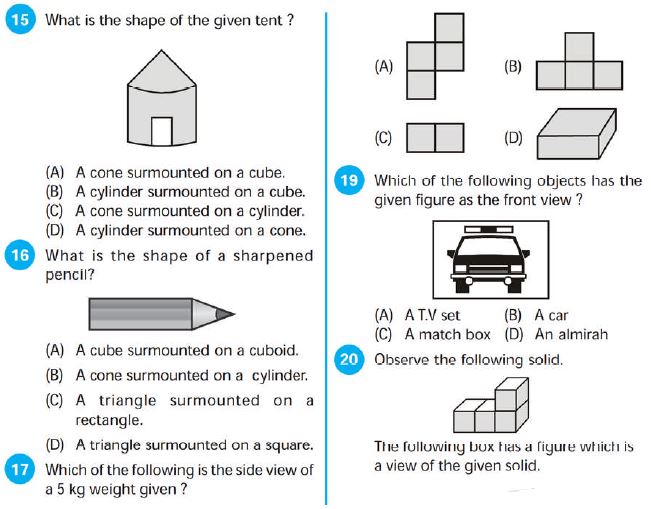
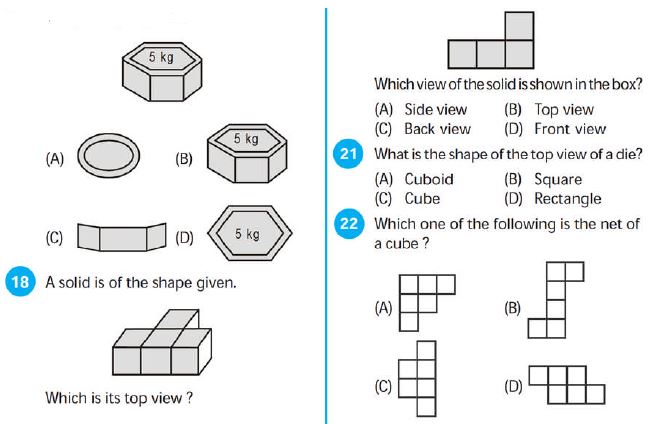
Answer 15: C
Answer 16: B
Answer 17: C
Answer 18: B
Answer 19: B
Answer 20: D
Answer 21: B
Answer 22: B
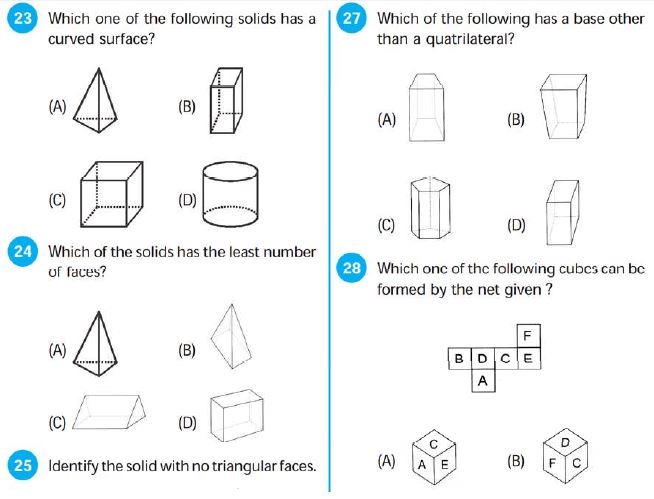
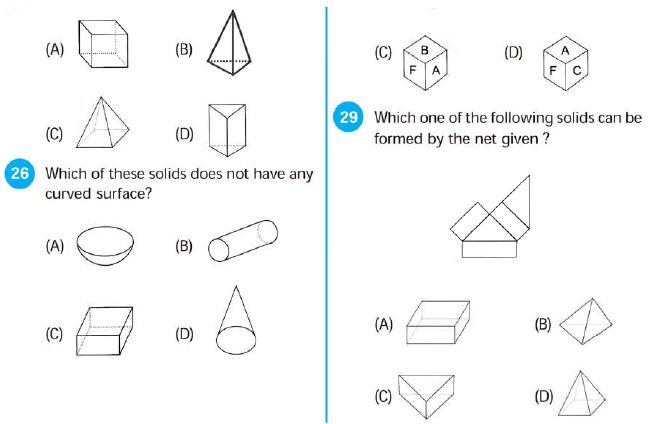
Answer 23: D
Answer 24: A
Answer 25: A
Answer 26: C
Answer 27: C
Answer 28: A
Answer 29: C
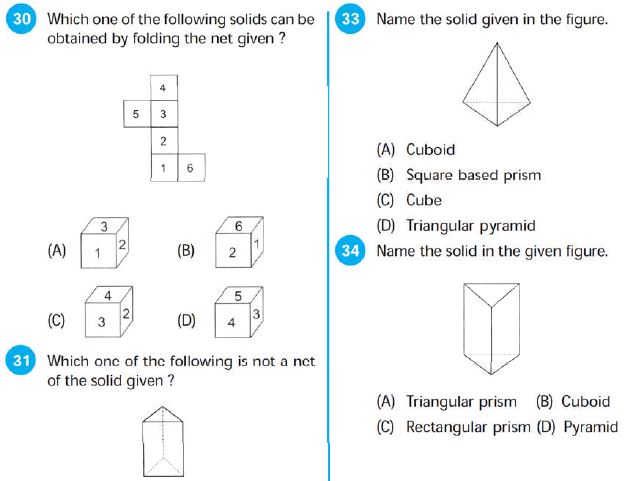
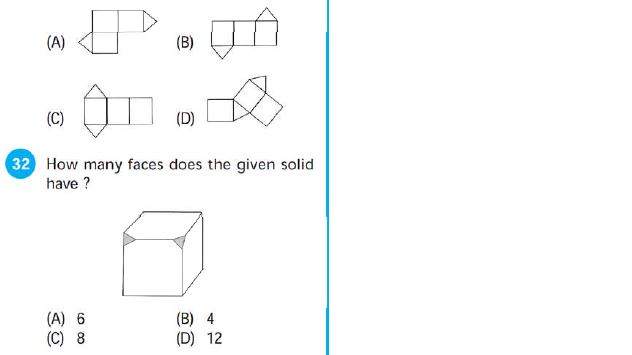
Answer 30: B
Answer 31: A
Answer 32: C
Answer 33: D
Answer 34: A
Please refer to the link below for CBSE Class 8 Mathematics Worksheet - Visualizing Solid Shapes
Free study material for Mathematics
CBSE Class 8 Mathematics Worksheets for Chapter 10 Visualising Solid Shapes
Practice Exercises for Class 8 Mathematics Chapter 10 Visualising Solid Shapes
Access structured practice worksheets for Chapter 10 Visualising Solid Shapes aligned with the 2026 CBSE curriculum. These downloadable exercises for Class 8 Mathematics help students build accuracy and reinforce core concepts for upcoming school tests.
Step-by-Step Solutions and Practice Guidelines
Each worksheet draws directly from authorized standard textbooks to maintain academic accuracy. Evaluating your finished exercises against expert-verified solutions helps master the formal presentation standards expected in school evaluations.
Enhance Speed with Online Practice
Follow up your worksheet practice by attempting the interactive online MCQ tests for Chapter 10 Visualising Solid Shapes to evaluate your execution speed. All printable assignments and revision sheets on our platform are updated for the 2026 session and available free of charge.
FAQs
You can download the latest chapter-wise printable worksheets for Class 8 Mathematics Chapter 10 Visualising Solid Shapes for free from StudiesToday.com. These have been made as per the latest CBSE curriculum for this academic year.
Yes, Class 8 Mathematics worksheets for Chapter 10 Visualising Solid Shapes focus on activity-based learning and also competency-style questions. This helps students to apply theoretical knowledge to practical scenarios.
Yes, we have provided solved worksheets for Class 8 Mathematics Chapter 10 Visualising Solid Shapes to help students verify their answers instantly.
Yes, our Class 8 Mathematics test sheets are mobile-friendly PDFs and can be printed by teachers for classroom.
For Chapter 10 Visualising Solid Shapes, regular practice with our worksheets will improve question-handling speed and help students understand all technical terms and diagrams.