

Download Class 8 Mathematics Practice Worksheets
Explore structured practice materials through the CBSE Class 8 Mathematics Visualizing Solid Shapes Worksheet Set 01. Tailored for Class 8 learners, utilizing these Mathematics worksheets ensures thorough preparation and strengthens problem-solving accuracy before final school evaluations.
Access Chapter 10 Visualising Solid Shapes Practice Papers and Solutions
Access the complete worksheet PDF for Class 8 Mathematics below. Regular practice with these targeted academic tasks builds familiarity with standard question patterns and helps secure higher marks in final school examinations.
Very Short Answer type Questions
Question. Find the no. of edges in a Pyramid with hexagonal base.
Answer : 12
Question. Find the no. of faces in a Prism with hexagonal base.
Answer : 8
Question. A polyhedron has 6 edges and 4 faces find its no. of vertices.
Answer : 4
Question. Find the no. of faces in a cube.
Answer : 6
Question. Find the no. of vertices in a Pyramid with pentagon base.
Answer : 6
Question. A polyhedron has 8 faces, 12 vertices find its no. of edges.
Answer : 18
Question. Find the odd one out : coin, birthday cap, match box, triangle.
Answer : Triangle
Question. Find the odd one out : Football, Table, Chalk, Floor.
Answer : Floor
Question. Find the odd one out : triangle, sphere, rectangle, circle.
Answer : Sphere
Question. Find the no. of edges in a Prism with square base.
Answer : 12
Question. Find the no. of vertices in a triangular Prism.
Answer : 6
Question. In the given solid how many no. of squares are visible in the side view of the given figure.
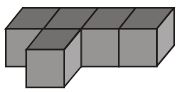
Answer : 2
Question. In the given solid how many no. of squares are visible in the front view of the given figure.
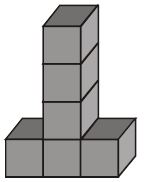
Answer : 6
Question. Name the shape and also tell the type of the given figure.

Answer : Cone, 3-D
Question. Find the no. of faces in the given figure.

Answer : 6
Question. Name the shape and also tell the type of the given figure.

Answer : Circle, 2-D
Question. Find the no. of vertices in the given figure.
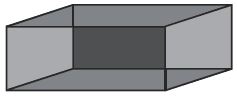
Answer : 8
Question 1. Tick the correct alternative :
i. The number of faces of an octagonal pyramid
(a) 8
(b) 9
(c) 16
(d) 17
Answer: (b) 9
An octagonal pyramid has a base with 8 sides (an octagon) and 8 triangular faces meeting at a top vertex. Total number of faces = \(8 + 1 = 9\).
In simple words: An octagonal pyramid has 8 triangular side faces plus 1 octagonal base face, making 9 faces in total.
Exam Tip: For any pyramid with an \(n\)-sided base, the number of faces is given by \(n + 1\).
Question 1. ii. The Euler’s formula cannot be applied for
(a) Cone
(b) Sphere
(c) Cylinder
(d) All of the options
Answer: (d) All of the options
Euler's formula (\(F + V - E = 2\)) applies strictly to polyhedra whose surfaces are made up of flat polygonal faces straight edges and sharp vertices. Cones, spheres, and cylinders have curved surfaces and therefore lack proper flat faces, straight edges, and vertices, making Euler's formula inapplicable.
In simple words: Euler's formula only works for solid shapes made of flat flat surfaces and straight lines, not curved shapes like cones, spheres, or cylinders.
Exam Tip: Always check if a 3D shape is a polyhedron before attempting to apply Euler's formula.
Question 1. iii. Euler’s formula is
(a) V + F – 2 = E
(b) F + E – V = 2
(c) E + V + F = 2
(d) F + V – E = 2
Answer: (d) F + V – E = 2
Euler's formula for any convex polyhedron states that the sum of the number of faces (\(F\)) and vertices (\(V\)) minus the number of edges (\(E\)) is always equal to 2, which can be written as \(F + V - E = 2\).
In simple words: Faces plus vertices minus edges equals 2 for any standard polyhedron.
Exam Tip: Memorize the standard form \(F + V - E = 2\) or rearranged as \(F + V = E + 2\).
Question 1. iv. If F = 20 and V = 12, then value of E is
(a) 8
(b) 15
(c) 30
(d) 34
Answer: (c) 30
Using Euler's formula:
\(F + V - E = 2\)
\(20 + 12 - E = 2\)
\(32 - E = 2\)
\(E = 32 - 2 = 30\)
In simple words: Substitute the given values of faces and vertices into Euler's formula to find the number of edges.
Exam Tip: You can rearrange Euler's formula to solve for edges as \(E = F + V - 2\).
Question 2. Can a polyhedron have for its faces:
i. 3 triangles?
Answer: No, a polyhedron cannot be formed with only 3 triangular faces because at least 4 faces are required to enclose a 3-dimensional space (which forms a tetrahedron).
In simple words: Three flat faces cannot close up to make a 3D solid shape.
Exam Tip: The minimum number of faces for any polyhedron is 4.
Question 2. ii. 4 triangles?
Answer: Yes, a polyhedron can have 4 triangular faces. This shape is called a tetrahedron (triangular pyramid).
In simple words: Four triangles can join together to form a triangular pyramid.
Exam Tip: A tetrahedron is the simplest possible polyhedron.
Question 2. iii. A square and four triangles?
Answer: Yes, a polyhedron can have one square face and four triangular faces. This shape is a square pyramid.
In simple words: A square base with four triangles meeting at the top forms a square pyramid.
Exam Tip: This is the shape commonly associated with Egyptian pyramids.
Question 3. Is it possible to have a polyhedron with any given number of faces?
Answer: No, it is not possible to have a polyhedron with any arbitrary number of faces. Specifically, a polyhedron cannot have fewer than 4 faces (since a minimum of 4 faces is needed to enclose space).
In simple words: You cannot have a polyhedron with 1, 2, or 3 faces.
Exam Tip: Remember that 4 is the absolute minimum number of faces for any polyhedron.
Question 4. Is a square prism same as cube?
Answer: No, a square prism is not necessarily the same as a cube. A square prism has rectangular side faces and square bases, where the height can be different from the side length of the base. A cube is a special type of square prism where all dimensions (length, breadth, and height) are equal.
In simple words: All cubes are square prisms, but not all square prisms are cubes because a prism can be taller than it is wide.
Exam Tip: A cube is a regular square prism.
Question 5. Can a polyhedron have 10 faces, 20 edges and 15 vertices?
Answer: Let us verify using Euler's formula (\(F + V - E = 2\)):
Given: \(F = 10\), \(V = 15\), \(E = 20\)
LHS = \(F + V = 10 + 15 = 25\)
RHS = \(E + 2 = 20 + 2 = 22\)
Since LHS (\(25\)) is not equal to RHS (\(22\)), Euler's formula is not satisfied.
Therefore, a polyhedron cannot have 10 faces, 20 edges and 15 vertices.
In simple words: Testing the numbers in Euler's formula gives 25 on one side and 22 on the other, so such a shape cannot exist.
Exam Tip: Always check \(F + V = E + 2\) to test if a set of faces, vertices, and edges is valid.
Question 6. How many faces, vertices and edges does a tetrahedron have? Verify Euler’s formula for the same.
Answer: For a tetrahedron:
Number of faces (\(F\)) = 4
Number of vertices (\(V\)) = 4
Number of edges (\(E\)) = 6
Verification of Euler's formula (\(F + V - E = 2\)):
LHS = \(F + V - E = 4 + 4 - 6 = 8 - 6 = 2\)
RHS = 2
Since LHS = RHS, Euler's formula is verified for a tetrahedron.
In simple words: A tetrahedron has 4 faces, 4 vertices, and 6 edges, which successfully satisfies Euler's formula.
Exam Tip: A tetrahedron is a triangular pyramid and serves as the standard example for basic polyhedra calculations.
Question 7. Verify Euler’s formula for a hexagonal prism.
Answer: For a hexagonal prism:
Number of faces (\(F\)) = 2 (hexagonal bases) + 6 (rectangular lateral faces) = 8
Number of vertices (\(V\)) = 6 (top base) + 6 (bottom base) = 12
Number of edges (\(E\)) = 6 (top base) + 6 (bottom base) + 6 (vertical edges) = 18
Verification of Euler's formula (\(F + V - E = 2\)):
LHS = \(F + V - E = 8 + 12 - 18 = 20 - 18 = 2\)
RHS = 2
Since LHS = RHS, Euler's formula is verified for a hexagonal prism.
In simple words: A hexagonal prism has 8 faces, 12 vertices, and 18 edges, which satisfies Euler's formula.
Exam Tip: For any \(n\)-gonal prism: \(F = n + 2\), \(V = 2n\), and \(E = 3n\).
Question 8. How many edges does a polyhedron have which has four faces and four vertices?
Answer: Given: \(F = 4\), \(V = 4\)
Using Euler's formula (\(F + V - E = 2\)):
\(4 + 4 - E = 2\)
\(8 - E = 2\)
\(E = 8 - 2 = 6\)
The polyhedron has 6 edges.
In simple words: Using Euler's formula with 4 faces and 4 vertices gives 6 edges.
Exam Tip: A polyhedron with 4 faces and 4 vertices is a tetrahedron, which always has 6 edges.
Question 9. A polyhedron has 30 edges and 20 vertices. How many faces does this polyhedron have?
Answer: Given: \(E = 30\), \(V = 20\)
Using Euler's formula (\(F + V - E = 2\)):
\(F + 20 - 30 = 2\)
\(F - 10 = 2\)
\(F = 2 + 10 = 12\)
The polyhedron has 12 faces.
In simple words: Substitute edges = 30 and vertices = 20 into Euler's formula to find 12 faces.
Exam Tip: This set of properties describes a regular dodecahedron.
Question 10. A polyhedron has 7 faces and 15 edges. How many vertices does this polyhedron have? Can you give a special name to this polyhedron?
Answer: Given: \(F = 7\), \(E = 15\)
Using Euler's formula (\(F + V - E = 2\)):
\(7 + V - 15 = 2\)
\(V - 8 = 2\)
\(V = 2 + 8 = 10\)
Number of vertices = 10.
Special name: Since it has 7 faces (1 heptagonal base and 6 triangular faces), it is a pentagonal prism or hexagonal-based structure? Wait, let us check base sides: for a prism/pyramid, if faces \(F = 7\), and it is a pyramid, the base has \(7 - 1 = 6\) sides (hexagonal pyramid). For a hexagonal pyramid, faces = \(6 + 1 = 7\), vertices = \(6 + 1 = 7\) (incorrect here since vertices = 10). If it is a prism, faces = \(n + 2 = 7 \Rightarrow n = 5\) (pentagonal prism). For a pentagonal prism: faces = 7, edges = \(3 \times 5 = 15\), vertices = \(2 \times 5 = 10\). Thus, it is a pentagonal prism.
In simple words: The polyhedron has 10 vertices and is called a pentagonal prism.
Exam Tip: Match the values of \(F\), \(V\), and \(E\) to standard prism and pyramid formulas to identify the special name.
Question 11. Calculate the number of faces of a polyhedron which has 9 edges and 6 vertices. What special name can you give to this polyhedron?
Answer: Given: \(E = 9\), \(V = 6\)
Using Euler's formula (\(F + V - E = 2\)):
\(F + 6 - 9 = 2\)
\(F - 3 = 2\)
\(F = 2 + 3 = 5\)
Number of faces = 5.
Special name: Since it has 5 faces, 6 vertices, and 9 edges, this is a square pyramid (base has 4 sides: faces = \(4 + 1 = 5\), vertices = \(4 + 1 = 5\)? Wait, for square pyramid vertices = 5, but here vertices = 6. For a triangular prism: faces = \(3 + 2 = 5\), vertices = \(2 \times 3 = 6\), edges = \(3 \times 3 = 9\). Thus, the special name is a triangular prism.
In simple words: The polyhedron has 5 faces and is called a triangular prism.
Exam Tip: A triangular prism has 5 faces, 6 vertices, and 9 edges.
Question 12. Calculate the number of vertices of a polyhedron which has 16 faces and 30 edges.
Answer: Given: \(F = 16\), \(E = 30\)
Using Euler's formula (\(F + V - E = 2\)):
\(16 + V - 30 = 2\)
\(V - 14 = 2\)
\(V = 2 + 14 = 16\)
The polyhedron has 16 vertices.
In simple words: Substitute faces = 16 and edges = 30 into Euler's formula to get 16 vertices.
Exam Tip: This shape is an icosahedron, which has 20 faces, 30 edges, and 12 vertices? Wait, let us check: an icosahedron has 20 faces and 30 edges, vertices = 12. Here \(F = 16\) and \(E = 30\), which corresponds to a truncated tetrahedron or similar Archimedean solid.
Question 13. How many faces, edges and vertices does
i. a prism have?
Answer: For an \(n\)-gonal prism (where the base is a polygon with \(n\) sides):
Number of faces (\(F\)) = \(n + 2\)
Number of vertices (\(V\)) = \(2n\)
Number of edges (\(E\)) = \(3n\)
In simple words: An \(n\)-gonal prism has \(n+2\) faces, \(2n\) vertices, and \(3n\) edges.
Exam Tip: Remember these general expressions for any prism with an \(n\)-sided base.
Question 13. ii. a pyramid whose base is a polygon of \(n\) sides have?
Answer: For an \(n\)-gonal pyramid (where the base is a polygon with \(n\) sides):
Number of faces (\(F\)) = \(n + 1\)
Number of vertices (\(V\)) = \(n + 1\)
Number of edges (\(E\)) = \(2n\)
In simple words: An \(n\)-gonal pyramid has \(n+1\) faces, \(n+1\) vertices, and \(2n\) edges.
Exam Tip: Note that for pyramids, the number of faces always equals the number of vertices (\(F = V = n + 1\)).
Question 13. (repeated numbering). If a polyhedron has 6 faces and 8 vertices, find its number of edges.
Answer: Given: \(F = 6\), \(V = 8\)
Using Euler's formula (\(F + V - E = 2\)):
\(6 + 8 - E = 2\)
\(14 - E = 2\)
\(E = 14 - 2 = 12\)
The number of edges is 12.
In simple words: Substitute faces = 6 and vertices = 8 into Euler's formula to find 12 edges (this is a cube or square prism).
Exam Tip: A cube has 6 faces, 8 vertices, and 12 edges.
Question 14. A polyhedron has 30 edges and 20 vertices. Find the number of its faces.
Answer: Given: \(E = 30\), \(V = 20\)
Using Euler's formula (\(F + V - E = 2\)):
\(F + 20 - 30 = 2\)
\(F - 10 = 2\)
\(F = 2 + 10 = 12\)
The number of faces is 12.
In simple words: Using Euler's formula with 30 edges and 20 vertices gives 12 faces.
Exam Tip: This is a regular dodecahedron.
Free study material for Mathematics
Free CBSE Practice Worksheets: Class 8 Mathematics Chapter 10 Visualising Solid Shapes
Practice Exercises for Class 8 Mathematics Chapter 10 Visualising Solid Shapes
Explore reliable practice questions for Chapter 10 Visualising Solid Shapes tailored for Class 8 Mathematics learners. Use these structured worksheets to evaluate exam preparedness and strengthen problem-solving skills throughout the 2026 academic session.
Step-by-Step Solutions and Practice Guidelines
Each worksheet draws directly from authorized standard textbooks to maintain academic accuracy. Evaluating your finished exercises against expert-verified solutions helps master the formal presentation standards expected in school evaluations.
Enhance Speed with Online Practice
Wrap up your chapter revision by testing your knowledge against standard objective question formats. Explore our full library of free, up-to-date printable assignments to maximize your academic results in upcoming CBSE evaluations.
FAQs
You can download the latest chapter-wise printable worksheets for Class 8 Mathematics Chapter 10 Visualising Solid Shapes for free from StudiesToday.com. These have been made as per the latest CBSE curriculum for this academic year.
Yes, Class 8 Mathematics worksheets for Chapter 10 Visualising Solid Shapes focus on activity-based learning and also competency-style questions. This helps students to apply theoretical knowledge to practical scenarios.
Yes, we have provided solved worksheets for Class 8 Mathematics Chapter 10 Visualising Solid Shapes to help students verify their answers instantly.
Yes, our Class 8 Mathematics test sheets are mobile-friendly PDFs and can be printed by teachers for classroom.
For Chapter 10 Visualising Solid Shapes, regular practice with our worksheets will improve question-handling speed and help students understand all technical terms and diagrams.