

Class 8 Mathematics Practice Sheet: CBSE Class 8 Mathematics Understanding Quadrilaterals Worksheet Set 14
Access comprehensive chapter-wise worksheets for Chapter 03 Understanding Quadrilaterals using the CBSE Class 8 Mathematics Understanding Quadrilaterals Worksheet Set 14. Designed to align with the 2026-27 academic syllabus for Class 8 Mathematics, these printable practice sets help students reinforce key concepts and improve their overall exam readiness.
Download Chapter 03 Understanding Quadrilaterals Worksheet PDF with Answers
Access the complete worksheet PDF for Class 8 Mathematics below. Regular practice with these targeted academic tasks builds familiarity with standard question patterns and helps secure higher marks in final school examinations.
Triangles
Question 1. Draw a rough sketch of \(\Delta PQR\) in which PS is an altitude interior of triangle.
Answer: Construct an acute-angled triangle \(PQR\). From vertex \(P\), drop a perpendicular line segment \(PS\) onto the opposite side \(QR\) such that point \(S\) lies between \(Q\) and \(R\), and the angle formed at \(S\) is \(90^\circ\).
In simple words: An altitude is a perpendicular line drawn from a vertex to the opposite side, which lies inside for an acute triangle.
Exam Tip: Always use a ruler and right-angle symbol (\(\llcorner\) or \(\perp\)) to indicate the altitude.
Question 2. \(\Delta XYZ\) is right angled a X, where the three altitudes meet?
Answer: In a right-angled triangle, the three altitudes meet (intersect) at the vertex containing the right angle.
Therefore, for \(\Delta XYZ\) right-angled at \(X\), the orthocenter (the point where all three altitudes concur) is vertex \(X\).
In simple words: The altitudes of a right-angled triangle intersect at the vertex of the \(90^\circ\) angle.
Exam Tip: Remember that for a right-angled triangle, the two perpendicular sides serve as two of the altitudes themselves.
Question 3. Two angles of a triangle are \(30^\circ\) and \(70^\circ\). Find the third angle.
Answer: Let the third angle be \(x\).
By the Angle Sum Property of a triangle, the sum of all interior angles is \(180^\circ\).
\(30^\circ + 70^\circ + x = 180^\circ\)
\(100^\circ + x = 180^\circ\)
\(x = 180^\circ - 100^\circ = 80^\circ\)
The third angle is \(80^\circ\).
In simple words: Subtract the sum of the two given angles from \(180^\circ\) to find the remaining angle.
Exam Tip: Always state the angle sum property theorem before setting up your equation.
Question 4. In a triangle measures of two angles are equal and third angle is \(40^\circ\). What are the measures of the equal angles?
Answer: Let each of the two equal angles be \(x\).
The third angle is given as \(40^\circ\).
Using the Angle Sum Property:
\(x + x + 40^\circ = 180^\circ\)
\(2x + 40^\circ = 180^\circ\)
\(2x = 180^\circ - 40^\circ\)
\(2x = 140^\circ\)
\(x = \frac{140^\circ}{2} = 70^\circ\)
Each of the equal angles measures \(70^\circ\).
In simple words: Subtract the third angle from \(180^\circ\) and divide the remaining sum by 2.
Exam Tip: Let the unknown equal angles be represented by the same variable, such as \(x\) and \(x\).
Question 5. Measures of two angles of a triangle are equal and third angle is thrice the measure of one of the equal angles. Find the measures of the angles of the triangle.
Answer: Let each of the two equal angles be \(x\).
The third angle is thrice one equal angle, so the third angle = \(3x\).
Using the Angle Sum Property:
\(x + x + 3x = 180^\circ\)
\(5x = 180^\circ\)
\(x = \frac{180^\circ}{5} = 36^\circ\)
The two equal angles are \(36^\circ\) each.
The third angle = \(3 \times 36^\circ = 108^\circ\).
The measures of the angles are \(36^\circ\), \(36^\circ\), and \(108^\circ\).
In simple words: Set up the equation \(x + x + 3x = 180^\circ\) and solve for \(x\).
Exam Tip: Verify your answer by adding the three angles: \(36^\circ + 36^\circ + 108^\circ = 180^\circ\).
Question 6. The angles of a triangle are in the ratio \(1:3:5\), find the angles of the triangle.
Answer: Let the angles be \(1x\), \(3x\), and \(5x\).
Using the Angle Sum Property:
\(1x + 3x + 5x = 180^\circ\)
\(9x = 180^\circ\)
\(x = \frac{180^\circ}{9} = 20^\circ\)
First angle = \(1 \times 20^\circ = 20^\circ\)
Second angle = \(3 \times 20^\circ = 60^\circ\)
Third angle = \(5 \times 20^\circ = 100^\circ\)
The angles are \(20^\circ\), \(60^\circ\), and \(100^\circ\).
In simple words: Multiply each ratio term by \(x\), sum them to \(180^\circ\), find \(x\), and then find each angle.
Question 7. Exterior angle of a triangle is \(120^\circ\) and one of its opposite interior angle is \(70^\circ\), find the measure of the other two angles.
Answer: Let the two opposite interior angles be \(70^\circ\) and \(y\).
By the Exterior Angle Property, the measure of an exterior angle is equal to the sum of its two interior opposite angles.
\(70^\circ + y = 120^\circ\)
\(y = 120^\circ - 70^\circ = 50^\circ\)
Now, let the third interior angle (adjacent to the exterior angle) be \(z\).
The interior angle and exterior angle form a linear pair:
\(z + 120^\circ = 180^\circ\)
\(z = 180^\circ - 120^\circ = 60^\circ\)
The other two interior angles are \(50^\circ\) and \(60^\circ\).
In simple words: Use the exterior angle theorem to find the second opposite interior angle, and use linear pair to find the third interior angle.
Exam Tip: Recall that exterior angle = sum of interior opposite angles.
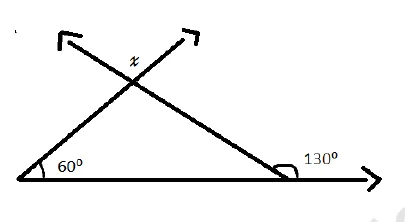
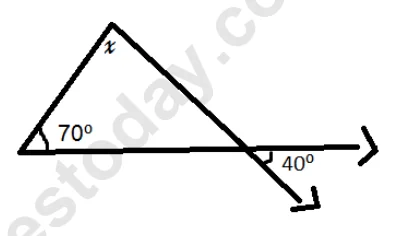
Question 8. From the figure find the value of x.
(i) For figure (i):
The exterior angle is equal to the sum of the two interior opposite angles.
\(x + 60^\circ = 130^\circ\)
\(x = 130^\circ - 60^\circ = 70^\circ\)
(ii) For figure (ii):
By vertical angles or triangle exterior angle property, let us examine the triangle where \(x\) is an interior angle. The exterior angle is \(40^\circ\) at the top or use angle sum properties. In figure (ii), the vertical angle to \(70^\circ\) is \(70^\circ\). In the lower triangle, the exterior angle is \(x\), which is the third angle of the triangle, since the 40\(^\circ\) angle at the crossing point is vertically opposite to the interior angle there.
\(x = 180^\circ - 70^\circ - 40^\circ = 70^\circ\)
Answer: For (i) \(x = 70^\circ\); For (ii) \(x = 70^\circ\).
In simple words: Use the exterior angle property of triangles to find \(x\) in both diagrams.
Exam Tip: Identify the triangle and its exterior angle clearly before applying the theorem.
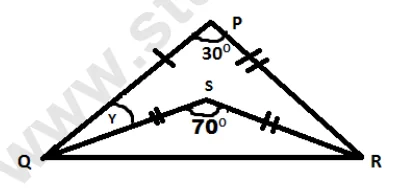
Question 9. Find the value of Y from the following figure, if PQ = PR and QS = QR \(\llcorner QPR = 30^\circ\) ; \(\llcorner QSR = 70^\circ\).
Answer: In \(\Delta PQR\), given \(PQ = PR\), so \(\llcorner PRQ = \llcorner PQR\).
Given \(\llcorner QPR = 30^\circ\).
Using the Angle Sum Property in \(\Delta PQR\):
\(\llcorner PQR + \llcorner PRQ + \llcorner QPR = 180^\circ\)
\(2\llcorner PQR + 30^\circ = 180^\circ\)
\(2\llcorner PQR = 150^\circ\)
\(\llcorner PQR = 75^\circ\)
Also, in \(\Delta QSR\), given \(QS = QR\), so \(\llcorner QRS = \llcorner QSR = 70^\circ\).
From the figure, \(\llcorner PQR = \llcorner PQS + \llcorner SQR\).
Wait, looking at the figure, \(Y\) is marked as angle \(\llcorner PQS\).
Since \(\llcorner PQR = 75^\circ\) and \(\llcorner SQR = \llcorner QSR = 70^\circ\) is incorrect because in \(\Delta QSR\), the angles are \(\llcorner SQR\), \(\llcorner SRQ\), and \(\llcorner QSR = 70^\circ\). Since \(QS = QR\), \(\llcorner QSR = \llcorner QRS = 70^\circ\).
Thus, in \(\Delta QSR\), \(\llcorner SQR + 70^\circ + 70^\circ = 180^\circ \implies \llcorner SQR = 40^\circ\).
Since \(\llcorner PQR = 75^\circ\) and \(\llcorner PQR = Y + \llcorner SQR\):
\(Y + 40^\circ = 75^\circ\)
\(Y = 75^\circ - 40^\circ = 35^\circ\)
Answer: \(Y = 35^\circ\).
In simple words: Find angle \(\llcorner PQR\) using isosceles triangle properties, find angle \(\llcorner SQR\), and subtract to find \(Y\).
Exam Tip: Angles opposite to equal sides of an isosceles triangle are equal.
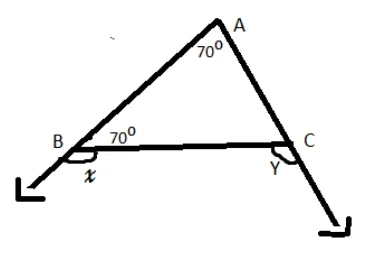
Question 10. In figure \(\llcorner A = 70^\circ\), \(\llcorner CBA = 70^\circ\). Find x and y.
Answer: In the given figure, consider triangle \(ABC\) with \(\llcorner A = 70^\circ\) and \(\llcorner CBA = 70^\circ\).
By the angle sum property of \(\Delta ABC\):
\(\llcorner A + \llcorner CBA + \llcorner ACB = 180^\circ\)
\(70^\circ + 70^\circ + \llcorner ACB = 180^\circ\)
\(140^\circ + \llcorner ACB = 180^\circ\)
\(\llcorner ACB = 40^\circ\)
Now, \(y\) and \(\llcorner ACB\) form a linear pair (or exterior angle relationship):
\(y = \llcorner A + \llcorner CBA = 70^\circ + 70^\circ = 140^\circ\) (Exterior angle theorem)
Similarly, for angle \(x\) at vertex \(B\):
The angle \(\llcorner CBA\) and \(x\) form a linear pair:
\(x + 70^\circ = 180^\circ \implies x = 110^\circ$
Answer: \(x = 110^\circ\), \(y = 140^\circ\).
In simple words: Use linear pairs and exterior angle properties to find \(x\) and \(y\).
Exam Tip: A linear pair of angles always adds up to \(180^\circ\).
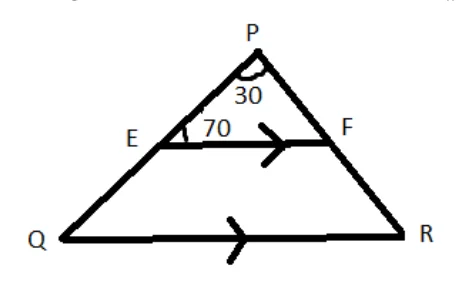
Question 11. In figure \(\llcorner P = 30^\circ\), \(\llcorner PEF = 70^\circ\) and \(EF \parallel QR\). Find \(\llcorner Q\) and \(\llcorner R\).
Answer: Since \(EF \parallel QR\) and \(PQ\) is a transversal line:
Corresponding angles are equal, so \(\llcorner Q = \llcorner PEF = 70^\circ\).
Now, in \(\Delta PQR\), we know:
\(\llcorner P + \llcorner Q + \llcorner R = 180^\circ\)
Substitute the known values:
\(30^\circ + 70^\circ + \llcorner R = 180^\circ\)
\(100^\circ + \llcorner R = 180^\circ\)
\(\llcorner R = 180^\circ - 100^\circ = 80^\circ\)
Answer: \(\llcorner Q = 70^\circ\) and \(\llcorner R = 80^\circ\).
In simple words: Use corresponding angles for parallel lines to find \(\llcorner Q\), then use the angle sum property of the triangle to find \(\llcorner R\).
Exam Tip: Parallel lines cut by a transversal create equal corresponding angles.
Free study material for Mathematics
Free CBSE Practice Worksheets: Class 8 Mathematics Chapter 03 Understanding Quadrilaterals
Mastering Chapter 03 Understanding Quadrilaterals with Printable Worksheets
Review targeted practice exercises for Class 8 Mathematics Chapter 03 Understanding Quadrilaterals. Curated to match official CBSE guidelines, these printable problem sets support daily revision and improve overall test readiness.
Verified Solutions and NCERT Alignment
Built using official NCERT guidelines for Class 8 Mathematics, these practice sheets provide reliable academic support. Cross-reference your completed work with our detailed solutions to learn standard answer-writing formats for CBSE exams.
Additional Study Resources for Class 8 Mathematics
Consistent engagement with these exercises builds familiarity with recurring exam themes. If specific areas within Chapter 03 Understanding Quadrilaterals cause trouble, utilize our dedicated NCERT solutions for Class 8 Mathematics to clear up doubts immediately.
FAQs
You can download the latest chapter-wise printable worksheets for Class 8 Mathematics Chapter 03 Understanding Quadrilaterals for free from StudiesToday.com. These have been made as per the latest CBSE curriculum for this academic year.
Yes, Class 8 Mathematics worksheets for Chapter 03 Understanding Quadrilaterals focus on activity-based learning and also competency-style questions. This helps students to apply theoretical knowledge to practical scenarios.
Yes, we have provided solved worksheets for Class 8 Mathematics Chapter 03 Understanding Quadrilaterals to help students verify their answers instantly.
Yes, our Class 8 Mathematics test sheets are mobile-friendly PDFs and can be printed by teachers for classroom.
For Chapter 03 Understanding Quadrilaterals, regular practice with our worksheets will improve question-handling speed and help students understand all technical terms and diagrams.