

Class 8 Mathematics Practice Sheet: CBSE Class 8 Mathematics Playing With Numbers Worksheet Set 02
Review targeted academic worksheets with the CBSE Class 8 Mathematics Playing With Numbers Worksheet Set 02. Built according to official educational standards for the 2026-27 term, these downloadable Class 8 Mathematics resources support effective daily practice and detailed self-evaluation for Chapter 16 Playing with Numbers.
Download Chapter 16 Playing with Numbers Worksheet PDF with Answers
View or download the dedicated CBSE Class 8 Mathematics Playing With Numbers Worksheet Set 02 resource below. Engaging with these practice papers under focused study conditions ensures continuous academic progress and mastery of the 2026-27 curriculum for Chapter 16 Playing with Numbers.
Question. Which of these would be equal to the number itself?
(a) 50% of 50% of a number
(b) 100% of 200% of a number
(c) 75% of 25% of a number
(d) 200% of 50% of a number
Answer : D
Question. 23418 is exactly divisible by 6. Which of the following numbers will leave a remainder 2 when divided by 6?
(a) 23412
(b) 23416
(c) 23420
(d) 23422
Answer : C
Question. The average height of Radhika, Gopu, Ashish and Komal shown above, is 118 cm. What is the SUM of their heights?
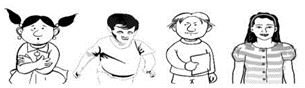
(a) 156 cm
(b) 472 cm
(c) 590 cm
(d) We can't say from the given information.
Answer : B
Question. Which of the following lists has numbers arranged in INCREASING order?
(a) -1/8, -1/7, 1/8, 1/8
(b) -1/8, -1/7, 1/8, 1/8
(c) -1/8, -1/7, 1/8, 1/7
(d) -1/7, -1/8, 1/8, 1/7
Answer : D
Question. 9.03 ÷ 899. 8 is closest to
(a) 0.01
(b) 0.001
(c) 1
(d) 100
Answer : A
Question. n! is defined as the product of the first n natural numbers. For example, 4! = 1 x 2 x 3 x 4 = 24.
What is? 8!/6!
(a) 40320
(b) 720
(c) 56
(d) 8
Answer : C
Question. Which of the following will have the maximum number of 6's when written in decimal form?
(a) 666/1000
(b) 3/6
(c) 3/5
(d) 2/3
Answer : D
Question. If n is a negative number, which of the following would be a positive number for ALL values of n?
(a) 2n
(b) n + 5
(c) n3
(d) 3n4
Answer : D
Question. What is 7799 ÷ 19?
(a) Quotient = 41, Remainder = 0
(b) Quotient = 41, Remainder = 9
(c) Quotient = 41.4, Remainder = 14
(d) Quotient = 410, Remainder = 9
Answer : D
Question. x is an integer and 5 - x > 15.
The largest possible value that x can take is
(a) 10
(b) -10
(c) -11
(d) 15
Answer : C
Question. If the pattern above is continued, what will it look like between 93 and 95?
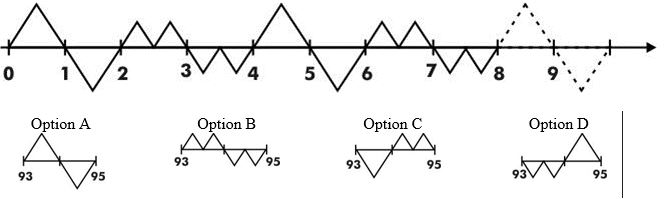
Answer : C
Question. Which of these numbers will reduce the most in value if the 7 in it is changed to a 6?
(a) 7.045 × 10²
(b) 375.6 × 100
(c) 0.72 × 10⁴
(d) 3.00007 × 10⁵
Answer : C
Question. How many times would you have written the letter 'c' if you complete writing this pattern up to the end of the TENTH row?
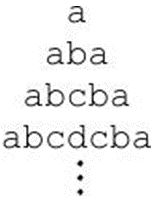
(a) 10
(b) 15
(c) 19
(d) 45
Answer : B
Question. In which row will there be 49 letters?
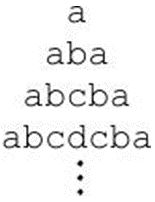
(a) 7th
(b) 24th
(c) 25th
(d) 49th
Answer : C
Question. The sum of two numbers is -6. 5 and their difference is 4. 5. What are the numbers?
(a) -1. 25 and -5. 25
(b) 1. 25 and -5. 25
(c) -1 and -5. 5
(d) 1 and -7.5
Answer : C
Question. When is a number always divisible by 90?
(A) If it is divisible by both 2 and 45.
(B) If it is not divisible by both 5 and 18.
(C) If it is not divisible by both 9 and 10.
(D) If it is divisible by 3 and 20.
Answer : A
Question. 32 + m is a prime number. What is the least value of 'm'?
(A) 3
(B) 5
(C) 6
(D) 4
Answer : B
Question. By which of these numbers is the number 31 16365 divisible?
(A) 5
(B) 7
(C) Both 5 and 7
(D) 6
Answer : C
Question. Which is the least number of 4 digits that is exactly divisible by 13?
(A) 1052
(B) 1039
(C) 1032
(D) 1001
Answer : D
Question. N is a 5-digit number divisible by 5. If N is bigger than 10000 and smaller than 10010, what is the value of N?
(A) 10000
(B) 10010
(C) 10005
(D) 10001
Answer : C
Question. By which of the following numbers is 477 not divisible?
(A) 3
(B) 7
(C) 53
(D) 9
Answer : B
Question. A prime number is greater than 30 and lesser than 60. What is the greatest possible such number?
(A) 37
(B) 53
(C) 43
(D) 59
Answer : D
Question. If a number is divisible by 9, it is also divisible by which number?
(A) 3
(B) 6
(C) 2
(D) 4
Answer : A
Question. Identify the even prime number.
(A) 132
(B) 102
(C) 284
(D) 2
Answer : D
Question. What value should be given to * so that the number 653*47 is divisible by 11 ?
(A) 1
(B) 6
(C) 2
(D) 9
Answer : A
Question. Which of the given numbers is composite?
(A) 137
(B) 147
(C) 157
(D) 167
Answer : B
Question. Which of the following statements is true?
(A) A number is divisible by 4 if it is divisible by 2.
(B) A number is divisible by 9 if it is divisible by 3 .
(C) A number is divisible by 11 if the number formed by its last two digits is divisible by 11.
(D) A number is divisible by 8 if the number formed by its last three digits is divisible by 8.
Answer : D
Question. How many prime numbers are there between 1 00 and 200?
(A) 25
(B) 19
(C) 21
(D) 20
Answer : C
Question. If a - b is a multiple of 7, which of the following is also a multiple of 7?
(A) b- a
(B) ab
(C) a+ b
(D) a + b
Answer : A
Question. Identify the multiple of 8.
(A) 487718
(B) 505672
(C) 216428
(D) 763121
Answer : B
Question. Find D + E + F from the following.
DEF x D = 10 DF
(A) 12
(B) 4
(C) 3
(D) 5
Answer : A
Question. When 'n' is divided by 5, the remainder is 4. When 'n' is divided by 4, the remainder is 3. If 0 < n < 100, what is a possible value of 'n'?
(A) 9
(B) 14
(C) 19
(D) 24
Answer : C
Question. Which of the following is divisible by 12?
(A) 284382
(B) 624876
(C) 926248
(D) 746174
Answer : B
Question. Which of the following is not prime?
(A) 107
(B) 127
(C) 153
(D) 197
Answer : C
Question. Which of the following statements is false?
(A) If a number is divisible by 8, it must be divisible by 4.
(B) If a number is divisible by both 9 and 10, it is divisible by 90.
(C) The sum of two consecutive odd numbers is always divisible by 4.
(D) If a number is not divisible by both 3 and 4, it is divisible by 12.
Answer : D
Question. X is the least composite number between 85 and 100. What is the value of X?
(A) 85
(B) 99
(C) 100
(D) 86
Answer : D
Students must free download and practice these worksheets to gain more marks in exams. CBSE Class 8 Mathematics Worksheet - Playing with Numbers
Free study material for Mathematics
Free CBSE Practice Worksheets: Class 8 Mathematics Chapter 16 Playing with Numbers
Practice Exercises for Class 8 Mathematics Chapter 16 Playing with Numbers
Review targeted practice exercises for Class 8 Mathematics Chapter 16 Playing with Numbers. Curated to match official CBSE guidelines, these printable problem sets support daily revision and improve overall test readiness.
Step-by-Step Solutions and Practice Guidelines
Built using official NCERT guidelines for Class 8 Mathematics, these practice sheets provide reliable academic support. Cross-reference your completed work with our detailed solutions to learn standard answer-writing formats for CBSE exams.
Enhance Speed with Online Practice
Consistent engagement with these exercises builds familiarity with recurring exam themes. If specific areas within Chapter 16 Playing with Numbers cause trouble, utilize our dedicated NCERT solutions for Class 8 Mathematics to clear up doubts immediately.
FAQs
You can download the latest chapter-wise printable worksheets for Class 8 Mathematics Chapter 16 Playing with Numbers for free from StudiesToday.com. These have been made as per the latest CBSE curriculum for this academic year.
Yes, Class 8 Mathematics worksheets for Chapter 16 Playing with Numbers focus on activity-based learning and also competency-style questions. This helps students to apply theoretical knowledge to practical scenarios.
Yes, we have provided solved worksheets for Class 8 Mathematics Chapter 16 Playing with Numbers to help students verify their answers instantly.
Yes, our Class 8 Mathematics test sheets are mobile-friendly PDFs and can be printed by teachers for classroom.
For Chapter 16 Playing with Numbers, regular practice with our worksheets will improve question-handling speed and help students understand all technical terms and diagrams.