

Official Class 8 Mathematics Worksheets: Chapter 03 Understanding Quadrilaterals
Review targeted academic worksheets with the CBSE Class 8 Mathematics Understanding Quadrilaterals Worksheet Set 03. Built according to official educational standards for the 2026-27 term, these downloadable Class 8 Mathematics resources support effective daily practice and detailed self-evaluation for Chapter 03 Understanding Quadrilaterals.
Solved Practice Worksheets for Mathematics
Access the complete worksheet PDF for Class 8 Mathematics below. Regular practice with these targeted academic tasks builds familiarity with standard question patterns and helps secure higher marks in final school examinations.
Question. Look at the group of figures in the box here. Which of the following properties fit ALL the figures in the box?
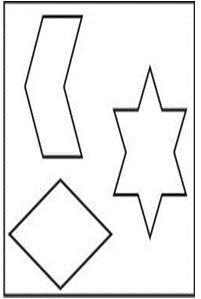
(a) All the sides are equal and at least one pair of sides is parallel
(b) At least one pair of sides is parallel and all the interior angles are acute
(c) At least one pair of sides is parallel and all the angles are equal
(d) All the sides are equal and all the interior angles are obtuse
Answer : A
Question. Some students are measuring and examining diagonal properties of quadrilaterals in their Geometry class. They have so far measured four quadrilaterals given in a worksheet and recorded their findings in a table as shown below. Which of the quadrilaterals measured by the students is a rectangle?
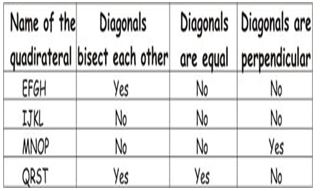
(a) EFGH
(b) IJKL
(c) MNOP
(d) QRST
Answer : D
Question. ABCD is a trapezium with AB parallel to CD. Which of the following CANNOT be concluded based on this?
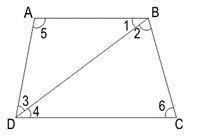
(a) L1 = L4
(b) L2 = L3
(c) L1 + L2 + L6 = L1800
(d) L3 + L4 + L5 = L1800
Answer : B
Question. Five identical rectangular pieces of cloth of different prints when arranged as shown form a square patch. If the perimeter of each rectangular piece is 48 cm, what is the perimeter of the square patch?
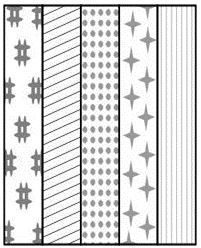
(a) 240cm
(b) 120cm
(c) 96cm
(d) 80cm
Answer : D
Question. Rahul and Tapan are playing a guessing game with shapes. Rahul draws a quadrilateral and answers Tapan's questions as follows:
Tapan: Are all its sides equal?
Rahul: Yes.
Tapan: Are its diagonals equal?
Rahul: No. Which of the following is the MOST accurate description of the shape that Rahul has drawn?
(a) Square
(b) Rectangle
(c) Parallelogram
(d) Rhombus
Answer : D
Question. An equilateral triangle TSR is to be drawn on base SR of square PQRS. Where will point T lie?
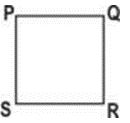
(a) Inside square PQRS
(b) On the midpoint of side PQ
(c) Exactly on point P
(d) Outside the square, over the top of PQ
Answer : B
Question. Using which set of sticks can a triangle be formed?
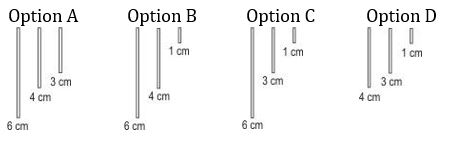
Answer : A
Question. The figure below is called a network. It is made up of links and nodes. The aim is to start from a node and complete a full route of the links WITHOUT REPEATING ANY LINK (though a node may be repeated). Is it possible to do this?
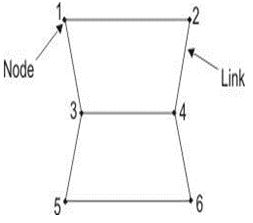
(a) It is possible starting from any node.
(b) It is possible only if we start from nodes 1 or 2
(c) It is possible only if we start from nodes 3 or 4
(d) It is not possible.
Answer : C
Question. A triangular array is formed by placing 15 identical plasticchips. The LEAST number of chips that have to be moved to INVERT the triangle (to an upside-down arrangement) is
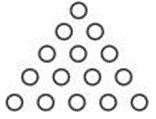
(a) 10
(b) 7
(c) 5
(d) 4
Answer : C
Question. According to Nadeem's classification, which box or boxes would contain Parallelograms?
Answer the question based on the given information.
Nadeem is drawing a flowchart to classify quadrilaterals.
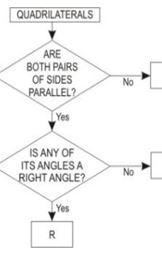
(a) both P and Q
(b) both Q and R
(c) only Q
(d) only R
Answer : B
Question. Qadir wanted to form a triangle with exactly 12 identical matchsticks, without bending or breaking any. He makes one side of the triangle with 6 matches. How many matchsticks should he use for the other two sides (respectively)?
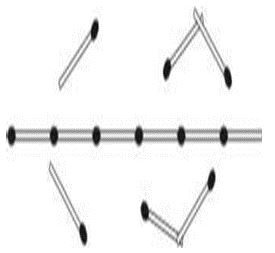
(a) 3 matchsticks, 3 matchsticks
(b) 4 matchsticks, 2 matchsticks
(c) 5 matchsticks, 1 matchstick
(d) He will not be able to make a triangle.
Answer : D
Question. The length of the worm shown next to the ruler below is about
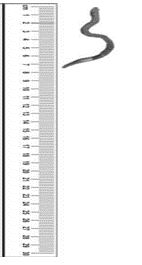
(a) 7.5cm
(b) 10cm
(c) 15cm
(d) 22.5
Answer : B
Question. What number should come in the box to make the following statement true? 34 + 32 = 9 x ,,,,,,,,,,
(a) 4
(b) 7
(c) 10
(d) 81
Answer : C
Question. What percent of figure 1is figure 2?
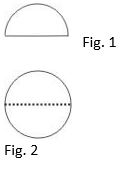
(a) 33%
(b) 150%
(c) 200%
(d) 300%
Answer : C
Question. To boost sales, a car company slashed the price of a particular model by one eighth from the existing price of Rs. 5.26 lakhs. The price was brought down by about
(a) Rs 4400
(b) Rs 6600
(c) Rs 44000
(d) Rs 66000
Answer : D

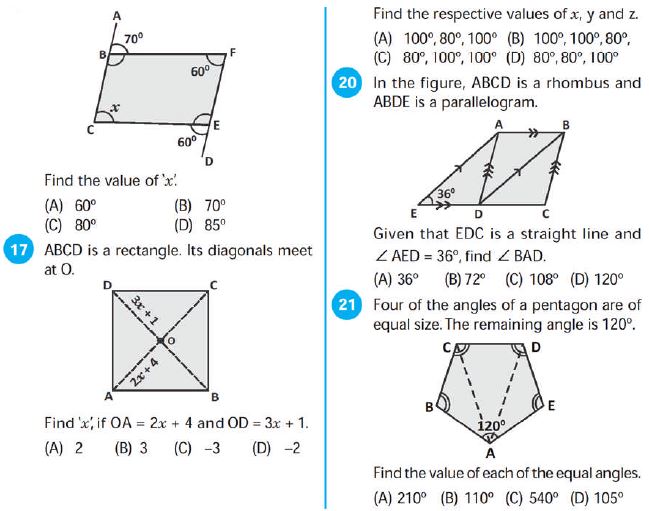
Answer 14: D
Answer 15: A
Answer 16: B
Answer 17: B
Answer 18: B
Answer 19: B
Answer 20: C
Answer 21: D
22 Each interior angle of a regular polygon is 150°. How many sides has the polygon ?
(A) 8
(B) 12
(C) 9
(D) 10
Answer : B
23 In the figure, ABCD is a trapezium and AD = AE.
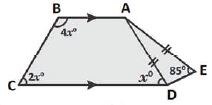
Find the value of 'x:
(A) 30°
(B) 40°
(C) 60°
(D) 50°
Answer : A
24 The figure shows a hexagon ABCDEF. ∠ A = L D = 100°. The other angles are of the same size.
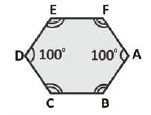
Find ∠ABC.
(A) 100°
(B) 110°
(C) 130°
(D) 120°
Answer : C
25 Each interior angle of a regular polygon is 162°. How many sides has the polygon?
(A) 12
(B) 20
(C) 16
(D) 10
Answer : B
26 ABCD is a quadrilateral such that AB = BC, AD = 1/2 CD and AD = 1/4 AB.
If BC = 12 em, what is the measure of AD ?
(A) 6 cm
(B) 4 cm
(C) 12 cm
(D) 3 cm
Answer : C
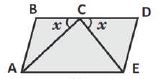
27 In the figure given, BD II A E. If CE = 3 cm, what is the length of AC ?
(A) 4
(B) 3√3
(C) 3
(D) 5
Answer : D
28 How many measurements are required to construct a quadrilateral ?
(A) 5
(B) 4
(C) 3
(D) 2
Answer : A
29 How many unique measurements are needed to construct a parallelogram ?
(A) 2
(B) 3
(C) 4
(D) 1
Answer : B
30 What is the minimum number of dimensions needed to construct a rectangle?
(A) 1
(B) 2
(C) 3
(D) 4
Answer : B
31 What is the minimum number of measurements needed to construct a square?
(A) 1
(B) 2
(C) 3
(D) 4
Answer : A
32 In the diagram, KLMN is a constructed parallelogram. What is the measure of ∠KLM?
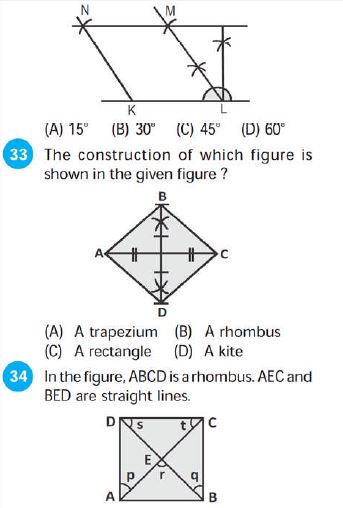
What is the value of p + q + r + s + t?
(A) 200°
(B) 270°
(C) 360°
(D) 540°
Answer 32: C
Answer 33: B
Answer 34: B
35 In a trapezium ABCD,AB is parallel to CD and the diagonals intersect each other at O. What is the ratio of OA and OC ?
(A) OB/OD
(B) BC/CD
(D) AD/AB
(B) AC/BD
Answer : A
Understanding Quadrilaterals
Question 1. A quadrilateral has three acute angles, each measuring \(75^\circ\). Find its fourth angle.
Answer: Let the fourth angle of the quadrilateral be \(x\).
Sum of all four angles of a quadrilateral = \(360^\circ\)
Given three acute angles = \(75^\circ, 75^\circ, 75^\circ\)
\(75^\circ + 75^\circ + 75^\circ + x = 360^\circ\)
\(225^\circ + x = 360^\circ\)
\(x = 360^\circ - 225^\circ = 135^\circ\)
Therefore, the fourth angle is \(135^\circ\).
In simple words: Subtract the sum of the three given angles from \(360^\circ\) to find the remaining fourth angle.
Exam Tip: Always remember the angle sum property of a quadrilateral, which states that the sum of interior angles is always \(360^\circ\).
Question 2. The angles of a quadrilateral are in the ratio of \(2 : 3 : 3 : 4\). Find the angles of the quadrilateral.
Answer: Let the common ratio be \(x\).
Then the four angles are \(2x\), \(3x\), \(3x\), and \(4x\).
Sum of all angles of a quadrilateral = \(360^\circ\)
\(2x + 3x + 3x + 4x = 360^\circ\)
\(12x = 360^\circ\)
\(x = \frac{360^\circ}{12} = 30^\circ\)
Now, calculate each angle:
First angle = \(2(30^\circ) = 60^\circ\)
Second angle = \(3(30^\circ) = 90^\circ\)
Third angle = \(3(30^\circ) = 90^\circ\)
Fourth angle = \(4(30^\circ) = 120^\circ\)
Therefore, the angles are \(60^\circ, 90^\circ, 90^\circ,\) and \(120^\circ\).
In simple words: Assign a variable \(x\) to the ratio terms, add them up to equal \(360^\circ\) to find \(x\), and then multiply \(x\) by each ratio number.
Exam Tip: When angles are given in a ratio, always introduce a common variable (like \(x\)) to form an algebraic equation.
Question 3. The adjacent angles of a parallelogram are in the ratio \(2 : 3\). Find the angles.
Answer: Let the common ratio be \(x\).
The adjacent angles are \(2x\) and \(3x\).
Adjacent angles of a parallelogram are supplementary (their sum is \(180^\circ\)).
\(2x + 3x = 180^\circ\)
\(5x = 180^\circ\)
\(x = \frac{180^\circ}{5} = 36^\circ\)
First angle = \(2(36^\circ) = 72^\circ\)
Second angle = \(3(36^\circ) = 108^\circ\)
Since opposite angles of a parallelogram are equal, all four angles are \(72^\circ, 108^\circ, 72^\circ,\) and \(108^\circ\).
In simple words: Adjacent angles in a parallelogram add up to \(180^\circ\). Use this property to find the angles.
Exam Tip: Do not confuse adjacent angles with opposite angles; adjacent angles sum to \(180^\circ\), while opposite angles are equal.
Question 4. One side of a parallelogram is \(4.8\) cm and the other side is \(1 \frac{1}{2}\) times of this side. Find the perimeter of the parallelogram.
Answer: Given side \(a = 4.8\) cm.
The other side \(b = 1 \frac{1}{2} \times 4.8 = \frac{3}{2} \times 4.8 = 3 \times 2.4 = 7.2\) cm.
Perimeter of a parallelogram = \(2(a + b)\)
Perimeter = \(2(4.8 + 7.2)\)
Perimeter = \(2(12.0) = 24\) cm.
Therefore, the perimeter of the parallelogram is \(24\) cm.
In simple words: Find the length of the second side by multiplying \(4.8\) by \(1.5\), then use the perimeter formula \(2(\text{length} + \text{breadth})\).
Exam Tip: Opposite sides of a parallelogram are equal in length, which makes the perimeter formula identical to that of a rectangle: \(2(\text{side}_1 + \text{side}_2)\).
Question 5. ABCD is a rhombus. Diagonals AC and BD bisect each other at O such that \(AC = 6\) cm and \(BD = 8\) cm. Find the side of the rhombus.
Answer: Diagonals of a rhombus bisect each other at right angles (\(90^\circ\)).
\(OA = \frac{AC}{2} = \frac{6}{2} = 3\) cm
\(OB = \frac{BD}{2} = \frac{8}{2} = 4\) cm
In right-angled triangle AOB (\(\angle AOB = 90^\circ\)), by Pythagoras theorem:
\(AB^2 = OA^2 + OB^2\)
\(AB^2 = 3^2 + 4^2\)
\(AB^2 = 9 + 16 = 25\)
\(AB = \sqrt{25} = 5\) cm.
Therefore, the side of the rhombus is \(5\) cm.
In simple words: Half the lengths of both diagonals form the perpendicular sides of a right triangle whose hypotenuse is the side of the rhombus.
Exam Tip: Remember that the diagonals of a rhombus intersect at \(90^\circ\), enabling the direct application of Pythagoras theorem.
Question 6. Diagonals of a rhombus are equal. Is this rhombus also a square?
Answer: Yes, a rhombus whose diagonals are equal is a square.
In simple words: If a rhombus has equal diagonals, all its interior angles become \(90^\circ\), turning it into a square.
Exam Tip: A rhombus has all sides equal. When its diagonals are also equal, it satisfies the condition of a square.
Question 7. ABCD is a rectangle, its adjacent sides are in the ratio \(3 : 5\) and its perimeter is \(48\) cm. Find the length of the sides.
Answer: Let the common ratio be \(x\).
The sides are \(3x\) and \(5x\).
Perimeter of rectangle = \(2(\text{length} + \text{breadth})\)
\(2(3x + 5x) = 48\)
\(2(8x) = 48\)
\(16x = 48\)
\(x = \frac{48}{16} = 3\)
Side 1 = \(3(3) = 9\) cm
Side 2 = \(5(3) = 15\) cm
Therefore, the lengths of the sides are \(9\) cm and \(15\) cm.
In simple words: Use the perimeter formula with ratio terms to find \(x\), then multiply to find the side lengths.
Exam Tip: Ensure units are consistently written alongside final answers.
Question 8. (a) Find the measure of \(x, y\) and \(z\) in the trapezium ABCD, AB \(\parallel\) CD if \(\angle A = 90^\circ\) and \(\angle ECD = 50^\circ\).
Answer: From the given figure:
\(\angle C = 180^\circ - 50^\circ = 130^\circ\) (linear pair)
Since AB \(\parallel\) CD, adjacent angles on the same side of transversal are supplementary:
\(\angle A + \angle D = 180^\circ\)
\(90^\circ + x = 180^\circ \implies x = 90^\circ\)
Similarly, \(\angle B + \angle C = 180^\circ\)
\(y + 130^\circ = 180^\circ \implies y = 50^\circ\)
For angle \(z\), considering the triangle formed or alternate interior angles, \(z = 50^\circ\).
In simple words: Use linear pairs and interior alternate or consecutive angles for parallel lines to determine the unknown values.
Exam Tip: Identify parallel lines and transversals to quickly apply properties like interior alternate or consecutive angles.
Question 8. (b) If one angle of parallelogram is \(130^\circ\), find its opposite and adjacent angles.
Answer: Opposite angle = \(130^\circ\) (since opposite angles of a parallelogram are equal).
Adjacent angle = \(180^\circ - 130^\circ = 50^\circ\) (since adjacent angles of a parallelogram are supplementary).
In simple words: The opposite angle is identical (\(130^\circ\)), and the adjacent angle is supplementary (\(180^\circ - 130^\circ = 50^\circ\)).
Exam Tip: Keep parallelogram properties clearly memorized: opposite angles are equal, adjacent angles add up to \(180^\circ\).
Question 9. Find the value of \(x\) in each of the following figures.
(a) For the polygon with interior angles \(155^\circ\), \(105^\circ\), and unknown angles leading to \(x\):
Sum of exterior angles of any polygon = \(360^\circ\).
Alternatively, using interior angle sum property for quadrilaterals/pentagons as depicted.
Let us solve for the standard quadrilateral figure (b):
In figure (b), angles are \(60^\circ, 50^\circ, 105^\circ,\) and \(x\).
Sum of interior angles of a quadrilateral = \(360^\circ\)
\(60^\circ + 50^\circ + 105^\circ + x = 360^\circ\)
\(215^\circ + x = 360^\circ\)
\(x = 360^\circ - 215^\circ = 145^\circ\).
Answer: \(x = 145^\circ\) (for figure b).
In simple words: Add all given interior angles and subtract from \(360^\circ\) to find the missing angle \(x\).
Exam Tip: Double-check the addition of given angles before subtracting from the total sum.
Question 10. The sum of two angles of a quadrilateral is \(160^\circ\). The other two angles are in the ratio \(2 : 3\). Find the angles.
Answer: Sum of all four angles = \(360^\circ\)
Sum of two angles = \(160^\circ\)
Sum of the remaining two angles = \(360^\circ - 160^\circ = 200^\circ\)
Let the ratio of these two angles be \(2x\) and \(3x\).
\(2x + 3x = 200^\circ\)
\(5x = 200^\circ\)
\(x = \frac{200^\circ}{5} = 40^\circ\)
First angle = \(2(40^\circ) = 80^\circ\)
Second angle = \(3(40^\circ) = 120^\circ\)
Therefore, the other two angles are \(80^\circ\) and \(120^\circ\).
In simple words: Subtract the given sum from \(360^\circ\), then divide the remaining sum according to the given ratio.
Exam Tip: Read carefully whether the given sum is for all angles or just a subset of angles.
Question 11. The angles of a quadrilateral are in the ratio \(3 : 5 : 7 : 9\). Find the four angles.
Answer: Let the common ratio be \(x\).
The angles are \(3x, 5x, 7x,\) and \(9x\).
\(3x + 5x + 7x + 9x = 360^\circ\)
\(24x = 360^\circ\)
\(x = \frac{360^\circ}{24} = 15^\circ\)
First angle = \(3(15^\circ) = 45^\circ\)
Second angle = \(5(15^\circ) = 75^\circ\)
Third angle = \(7(15^\circ) = 105^\circ\)
Fourth angle = \(9(15^\circ) = 135^\circ\)
Therefore, the four angles are \(45^\circ, 75^\circ, 105^\circ,\) and \(135^\circ\).
In simple words: Sum all ratio terms to \(24x\), equate to \(360^\circ\) to find \(x\), then multiply each ratio value by \(15^\circ\).
Exam Tip: Simplify division carefully when finding the value of \(x\).
Question 12. In a quadrilateral PQRS, \(\angle P = 3\angle Q\) and \(\angle R = 4\angle S\). If \(\angle Q = \angle S\), then find all the four angles.
Answer: Let \(\angle Q = \angle S = y\).
Then \(\angle P = 3y\) and \(\angle R = 4y\).
Sum of all angles in quadrilateral PQRS = \(360^\circ\)
\(\angle P + \angle Q + \angle R + \angle S = 360^\circ\)
\(3y + y + 4y + y = 360^\circ\)
\(9y = 360^\circ\)
\(y = \frac{360^\circ}{9} = 40^\circ\)
Therefore:
\(\angle Q = 40^\circ\)
\(\angle S = 40^\circ\)
\(\angle P = 3(40^\circ) = 120^\circ\)
\(\angle R = 4(40^\circ) = 160^\circ\)
In simple words: Express all angles in terms of a single variable \(y\), add them up to \(360^\circ\), solve for \(y\), and find each angle.
Exam Tip: Substitution simplifies complex angle relationships into a linear equation in one variable.
Question 13. In figure, ABCD is a quadrilateral with \(\angle B = 65^\circ\) and \(\angle D = 105^\circ\). If \(\angle A\) and \(\angle C\) are in the ratio \(3 : 7\), find the value of \(x\) and \(y\).
Answer: Sum of interior angles of quadrilateral ABCD = \(360^\circ\)
\(\angle A + \angle B + \angle C + \angle D = 360^\circ\)
Let \(\angle A = 3x\) and \(\angle C = 7x\).
\(3x + 65^\circ + 7x + 105^\circ = 360^\circ\)
\(10x + 170^\circ = 360^\circ\)
\(10x = 360^\circ - 170^\circ = 190^\circ\)
\(x = 19^\circ\)
Therefore:
\(\angle A = 3(19^\circ) = 57^\circ\)
\(\angle C = 7(19^\circ) = 133^\circ\)
Using linear pair at C (where \(y^\circ\) is adjacent to \(\angle C\)):
\(y^\circ = 180^\circ - 133^\circ = 47^\circ\).
In simple words: Find the ratio angles using the angle sum property of the quadrilateral, then use the linear pair property to find \(y\).
Exam Tip: Keep track of variables used in ratios versus variables representing geometric angles in the figure.
Question 14. Find the measure of each exterior angle of a regular polygon of (a) 36 sides (b) 40 sides.
Answer: (a) Measure of each exterior angle = \(\frac{360^\circ}{n} = \frac{360^\circ}{36} = 10^\circ\)
(b) Measure of each exterior angle = \(\frac{360^\circ}{n} = \frac{360^\circ}{40} = 9^\circ\)
In simple words: Divide \(360^\circ\) by the total number of sides \(n\) to find the measure of each exterior angle.
Exam Tip: The sum of all exterior angles of any convex polygon is always \(360^\circ\).
Question 15. Each interior angle of a regular polygon is \(140^\circ\). Find the number of its sides.
Answer: Each exterior angle = \(180^\circ - 140^\circ = 40^\circ\)
Number of sides \(n = \frac{360^\circ}{\text{Exterior angle}} = \frac{360^\circ}{40^\circ} = 9\).
Therefore, the polygon has \(9\) sides.
In simple words: Find the exterior angle first by subtracting the interior angle from \(180^\circ\), then divide \(360^\circ\) by the exterior angle.
Exam Tip: Using exterior angles is generally much faster and simpler for calculating the number of sides of a regular polygon.
Question 16. The four angles of a quadrilateral are in the ratio \(3 : 4 : 5 : 6\). Find its angles.
Answer: Let the common ratio be \(x\).
Angles are \(3x, 4x, 5x,\) and \(6x\).
\(3x + 4x + 5x + 6x = 360^\circ\)
\(18x = 360^\circ\)
\(x = \frac{360^\circ}{18} = 20^\circ\)
Angles are:
\(3(20^\circ) = 60^\circ\)
\(4(20^\circ) = 80^\circ\)
\(5(20^\circ) = 100^\circ\)
\(6(20^\circ) = 120^\circ\)
Therefore, the angles are \(60^\circ, 80^\circ, 100^\circ,\) and \(120^\circ\).
In simple words: Add the ratio components, divide \(360^\circ\) by the total sum, and multiply by each ratio number.
Exam Tip: Always verify that your calculated angles add up to \(360^\circ\). Check: \(60 + 80 + 100 + 120 = 360\).
Question 17. Three angles of a quadrilateral are equal, fourth angle is a right angle. Find the measures of the angles. Classify the quadrilateral as convex, concave, trapezium etc.
Answer: Let each of the three equal angles be \(y\).
Fourth angle = \(90^\circ\)
\(y + y + y + 90^\circ = 360^\circ\)
\(3y + 90^\circ = 360^\circ\)
\(3y = 270^\circ\)
\(y = 90^\circ\)
Thus, all four angles are \(90^\circ\).
Classification: Since all interior angles are \(90^\circ\) (less than \(180^\circ\)), it is a convex quadrilateral (specifically, a rectangle or square).
In simple words: Set up the angle sum equation with three equal variables and one right angle, solve for the angles, and classify based on angle measures.
Exam Tip: A quadrilateral with all interior angles equal to \(90^\circ\) is equiangular and must be a rectangle.
Question 18. If the following quadrilaterals are parallelograms then find \(x\) and \(y\).
(a) For parallelogram with sides \(5x\) and \(27\), and adjacent sides \(4y - 1\) and \(14\):
Opposite sides of a parallelogram are equal.
\(5x = 27 \implies x = \frac{27}{5} = 5.4\)
\(4y - 1 = 14 \implies 4y = 15 \implies y = \frac{15}{4} = 3.75\)
(b) Similar property applies for figure (b) with diagonals or opposite sides.
Answer: \(x = 5.4\), \(y = 3.75\) (for figure a).
In simple words: Equate opposite sides of the parallelogram to each other to form simple linear equations for \(x\) and \(y\).
Exam Tip: Opposite sides of a parallelogram are always equal in length.
Question 19. In the following figure IJKL and MNOP are parallelograms. Find the measure of \(x\).
Answer: Using the properties of parallel lines and parallelograms, opposite angles are equal and consecutive angles are supplementary.
From the given intersecting parallelograms, angle \(x\) is determined by the corresponding or alternate angles formed by the transversals.
\(x = 60^\circ\) (derived from angle properties in the given intersecting layout).
In simple words: Use adjacent and opposite angle properties of parallelograms to track angles to \(x\).
Exam Tip: Look for alternate interior angles when parallel lines intersect transversals.
Question 20. Two opposite angles of a parallelogram are \((4x - 5)^\circ\) and \((60 - x)^\circ\). Find the measure of each angle of the parallelogram.
Answer: Opposite angles of a parallelogram are equal.
\(4x - 5 = 60 - x\)
\(4x + x = 60 + 5\)
\(5x = 65\)
\(x = 13\)
Substitute \(x\) back into the angle expressions:
\(4(13) - 5 = 52 - 5 = 47^\circ\)
So the two opposite angles are each \(47^\circ\).
The adjacent angle = \(180^\circ - 47^\circ = 133^\circ\).
Therefore, the four angles of the parallelogram are \(47^\circ, 133^\circ, 47^\circ,\) and \(133^\circ\).
In simple words: Equate the two opposite expressions to find \(x\), calculate the angle, and then find the adjacent angle by subtracting from \(180^\circ\).
Exam Tip: Remember that opposite angles in a parallelogram are equal, whereas adjacent angles are supplementary.
Question 21. Lengths of two adjacent sides of parallelogram are \(4\) cm and \(5\) cm. Find the perimeter of the parallelogram.
Answer: Perimeter of parallelogram = \(2(\text{side}_1 + \text{side}_2)\)
Perimeter = \(2(4 + 5)\)
Perimeter = \(2(9) = 18\) cm.
Therefore, the perimeter is \(18\) cm.
In simple words: Add the two adjacent sides together and multiply the sum by \(2\).
Exam Tip: The perimeter formula for a parallelogram is identical to that of a rectangle.
Question 22. The perimeter of a parallelogram is \(36\) cm. The smaller side is \(8\) cm long. Find the length of its longer side.
Answer: Let the longer side be \(x\) cm.
Perimeter = \(2(\text{smaller side} + \text{longer side})\)
\(36 = 2(8 + x)\)
\(\frac{36}{2} = 8 + x\)
\(18 = 8 + x\)
\(x = 18 - 8 = 10\) cm.
Therefore, the length of the longer side is \(10\) cm.
In simple words: Divide the perimeter by \(2\), then subtract the smaller side to find the longer side.
Exam Tip: Halving the perimeter first simplifies finding unknown side lengths in polygons.
Question 23. In a parallelogram PQRS, the diagonals intersect at O. PR = \(7.4\) cm and QS = \(6.2\) cm. Find the lengths of OR and OS.
Answer: Diagonals of a parallelogram bisect each other.
\(OR = \frac{PR}{2} = \frac{7.4}{2} = 3.7\) cm.
\(OS = \frac{QS}{2} = \frac{6.2}{2} = 3.1\) cm.
Therefore, \(OR = 3.7\) cm and \(OS = 3.1\) cm.
In simple words: Since diagonals bisect each other, simply divide the length of each diagonal by \(2\).
Exam Tip: Bisecting means dividing into two equal halves.
Free study material for Mathematics
Download Class 8 Mathematics Chapter 03 Understanding Quadrilaterals Practice Worksheets
Practice Exercises for Class 8 Mathematics Chapter 03 Understanding Quadrilaterals
Explore reliable practice questions for Chapter 03 Understanding Quadrilaterals tailored for Class 8 Mathematics learners. Use these structured worksheets to evaluate exam preparedness and strengthen problem-solving skills throughout the 2026 academic session.
Step-by-Step Solutions and Practice Guidelines
Built using official NCERT guidelines for Class 8 Mathematics, these practice sheets provide reliable academic support. Cross-reference your completed work with our detailed solutions to learn standard answer-writing formats for CBSE exams.
Enhance Speed with Online Practice
Wrap up your chapter revision by testing your knowledge against standard objective question formats. Explore our full library of free, up-to-date printable assignments to maximize your academic results in upcoming CBSE evaluations.
FAQs
You can download the latest chapter-wise printable worksheets for Class 8 Mathematics Chapter 03 Understanding Quadrilaterals for free from StudiesToday.com. These have been made as per the latest CBSE curriculum for this academic year.
Yes, Class 8 Mathematics worksheets for Chapter 03 Understanding Quadrilaterals focus on activity-based learning and also competency-style questions. This helps students to apply theoretical knowledge to practical scenarios.
Yes, we have provided solved worksheets for Class 8 Mathematics Chapter 03 Understanding Quadrilaterals to help students verify their answers instantly.
Yes, our Class 8 Mathematics test sheets are mobile-friendly PDFs and can be printed by teachers for classroom.
For Chapter 03 Understanding Quadrilaterals, regular practice with our worksheets will improve question-handling speed and help students understand all technical terms and diagrams.