

Download Class 8 Mathematics Practice Worksheets
Review targeted academic worksheets with the CBSE Class 8 Mathematics Understanding Quadrilaterals Worksheet Set 01. Built according to official educational standards for the 2026-27 term, these downloadable Class 8 Mathematics resources support effective daily practice and detailed self-evaluation for Chapter 03 Understanding Quadrilaterals.
Access Chapter 03 Understanding Quadrilaterals Practice Papers and Solutions
View or download the dedicated CBSE Class 8 Mathematics Understanding Quadrilaterals Worksheet Set 01 resource below. Engaging with these practice papers under focused study conditions ensures continuous academic progress and mastery of the 2026-27 curriculum for Chapter 03 Understanding Quadrilaterals.
Question. ABCD is a quadrilateral. Find x.
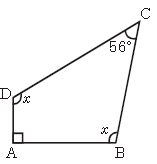
Answer : 107°
Question. Find y.
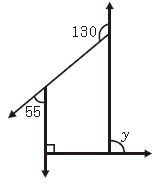
Answer : 85°
Question. What is the measure of each exterior angle of a regular polygon of 10 sides?
Answer : 36°
Question. What is x + y + z + w ?
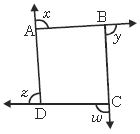
Answer : 360°
Question. ABCD is a quadrilateral in which AB||CD. Find x and y.
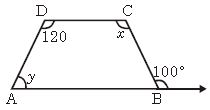
Answer : x = 100°, y = 60°
Question. What is the value of the variable x in the rhombus RICE?
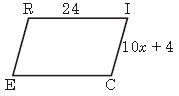
Answer : x = 2
Question. Find x.
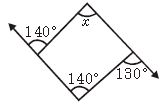
Answer : x = 130°
Question. What is x + y + w ?
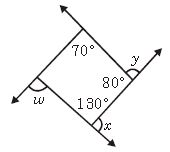
Answer : 250°
Question. ABCDEF is regular hexagon. What is the value of the exterior angle x?
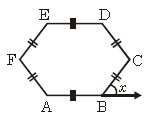
Answer : 60°
Question. ABCD is a quadrilateral. Find x.

Answer : 110°
Question. How many sides does a regular polygon has if each of its interior angle is 160°?
Answer : 18
Question. SONI is a rectangle. What is the length of IN ?

Answer : 45
Question. If the total angle sum of a polygon is 108° then how many sides does polygon has?
Answer : 8 sides
Question. In the adjoining figure. Find x.
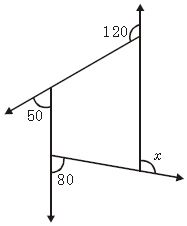
Answer : 110°
Question. In Fig. what is the value of x if ABCD is a parallelogram and CBE is an isosceles triangle.
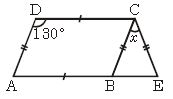
Answer : 80°
Question. Name the polygon whose each exterior angle is 72°.
Answer : Pentagon
Question. ABCD is a parallelogram. What is the value of x?
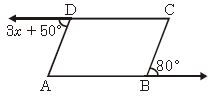
Answer : x = 10
Question. ABCD is a parallelogram. What is the value of x?
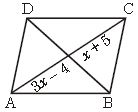
Answer : x = 9/2
Question. Find x and y.
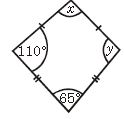
Answer : x = 75, y = 110
Question. ABCD is a parallelogram. If AB = 5 cm then CD = ?

Answer : 5 cm
Question 1. Name the regular polygon with 8 sides.
Answer: A regular polygon with 8 sides is called an octagon.
In simple words: An 8-sided closed figure with equal sides and equal angles is an octagon.
Exam Tip: Memorize polygon names based on side count: Triangle (3), Quadrilateral (4), Pentagon (5), Hexagon (6), Heptagon (7), Octagon (8), Nonagon (9), Decagon (10).
Question 2. Find the number of diagonals in the figure given below.
Answer: The given figure is a pentagon with 5 sides.
The formula for the number of diagonals in a polygon of \(n\) sides is \(\frac{n(n - 3)}{2}\).
Substitute \(n = 5\):
Number of diagonals = \(\frac{5(5 - 3)}{2} = \frac{5 \times 2}{2} = 5\)
In simple words: A pentagon has 5 vertices, and drawing lines from vertex to non-adjacent vertices gives 5 diagonals.
Exam Tip: Always state the formula \(\frac{n(n - 3)}{2}\) before substituting the value of \(n\).
Question 3. Find x in the following figure.
Answer: The given figure is a quadrilateral with angles \(x\), \(110^\circ\), \(60^\circ\), and a right angle \(90^\circ\) (indicated by the perpendicular symbol).
The sum of all interior angles of a quadrilateral is \(360^\circ\).
\(x + 110^\circ + 60^\circ + 90^\circ = 360^\circ\)
\(x + 260^\circ = 360^\circ\)
\(x = 360^\circ - 260^\circ = 100^\circ\)
In simple words: The four angles in a quadrilateral always add up to \(360^\circ\). Subtract the known angles from \(360^\circ\) to find \(x\).
Exam Tip: A square corner symbol always represents \(90^\circ\).
Question 4. Find the measure of each exterior angle of a regular polygon of 9 sides.
Answer: The sum of all exterior angles of any convex polygon is \(360^\circ\).
For a regular polygon with \(n\) sides, all exterior angles are equal.
Number of sides \(n = 9\)
Measure of each exterior angle = \(\frac{360^\circ}{n} = \frac{360^\circ}{9} = 40^\circ\)
In simple words: Divide \(360^\circ\) by the number of sides to find the measure of one exterior angle.
Exam Tip: Exterior angle and interior angle are supplementary (\(\text{Exterior} + \text{Interior} = 180^\circ\)).
Question 5. Name the quadrilateral whose diagonals are perpendicular bisector of each other.
Answer: Rhombus and Square.
In simple words: Both a rhombus and a square have diagonals that intersect at right angles (\(90^\circ\)) and cut each other into two equal halves.
Exam Tip: Remember that rectangle and parallelogram diagonals bisect each other, but they are not perpendicular.
Question 6. Name a quadrilateral with exactly one pair of parallel sides.
Answer: Trapezium.
In simple words: A trapezium is defined by having one pair of opposite sides parallel and one pair non-parallel.
Answer: The given figure is a quadrilateral with interior angles \(60^\circ\), \(130^\circ\), \(120^\circ\), and \(x\).
The sum of interior angles of a quadrilateral is \(360^\circ\).
\(60^\circ + 130^\circ + 120^\circ + x = 360^\circ\)
\(310^\circ + x = 360^\circ\)
\(x = 360^\circ - 310^\circ = 50^\circ\)
In simple words: Add the three given angles and subtract the sum from \(360^\circ\).
Exam Tip: Always double-check your addition before subtracting from \(360^\circ\).
Question 8. Use the figure given below to find x + y + z.
Answer: From the exterior angle property of a triangle, the sum of exterior angles of any polygon taken in order is \(360^\circ\).
Alternatively, using linear pairs at each vertex of the triangle:
At vertex with interior angle \(60^\circ\): \(x + 60^\circ = 180^\circ \implies x = 120^\circ\)
At vertex with interior angle \(80^\circ\): \(y + 80^\circ = 180^\circ \implies y = 100^\circ\)
At vertex with interior angle \(40^\circ\): \(z + 40^\circ = 180^\circ \implies z = 140^\circ\)
Now find the sum \(x + y + z\):
\(x + y + z = 120^\circ + 100^\circ + 140^\circ = 360^\circ\)
In simple words: The sum of exterior angles of any triangle is always \(360^\circ\).
Exam Tip: For any convex polygon, the sum of exterior angles is always \(360^\circ\), regardless of the number of sides.
Question 9. Find the sum of the angles in the figure given below.
Answer: The given figure is a pentagon (5-sided polygon), labeled with vertices A, B, C, D, E.
The formula for the sum of interior angles of an \(n\)-sided polygon is \((n - 2) \times 180^\circ\).
Substitute \(n = 5\):
Sum = \((5 - 2) \times 180^\circ = 3 \times 180^\circ = 540^\circ\)
In simple words: Split the pentagon into triangles from one vertex to get 3 triangles. Multiply 3 by \(180^\circ\).
Answer: The given figure is a hexagon (6-sided polygon), labeled A, B, C, D, E, F.
Using the angle sum formula \((n - 2) \times 180^\circ\) with \(n = 6\):
Sum = \((6 - 2) \times 180^\circ = 4 \times 180^\circ = 720^\circ\)
In simple words: A hexagon has 6 sides. The sum of its interior angles is \(720^\circ\).
Exam Tip: Remember that each increase of one side in a polygon increases the angle sum by \(180^\circ\).
Question 11. Find the number of sides of a regular polygon whose each exterior angle has a measure of \(60^\circ\).
Answer: Let the number of sides be \(n\).
The sum of all exterior angles is \(360^\circ\).
Measure of each exterior angle = \(\frac{360^\circ}{n}\)
\(60^\circ = \frac{360^\circ}{n}\)
\(n = \frac{360^\circ}{60^\circ} = 6\)
In simple words: Divide \(360^\circ\) by the given exterior angle to get the number of sides, which is 6 (a hexagon).
Exam Tip: Number of sides \(n = \frac{360^\circ}{\text{Exterior Angle}}\).
Question 12. ABCD is a trapezium in which AB || DC. If \(\angle A = \angle B = 40^\circ\), find the measures of other two angles.
Answer: In trapezium ABCD with \(AB \parallel DC\), the adjacent angles between the parallel lines are supplementary (co-interior angles).
Therefore, \(\angle A + \angle D = 180^\circ\) and \(\angle B + \angle C = 180^\circ\).
Given \(\angle A = 40^\circ\):
\(40^\circ + \angle D = 180^\circ \implies \angle D = 180^\circ - 40^\circ = 140^\circ\)
Given \(\angle B = 40^\circ\):
\(40^\circ + \angle C = 180^\circ \implies \angle C = 180^\circ - 40^\circ = 140^\circ\)
Thus, the measures of the other two angles are \(140^\circ\) and \(140^\circ\).
In simple words: Consecutive angles between parallel lines add up to \(180^\circ\). Subtract \(40^\circ\) from \(180^\circ\) to find each missing angle.
Exam Tip: Mention the property "co-interior angles are supplementary when lines are parallel" to justify your steps.
Question 13. The length of two adjacent sides of a parallelogram are 4 cm and 3 cm. Find its perimeter.
Answer: In a parallelogram, opposite sides are equal in length.
Let the adjacent sides be \(a = 4\) cm and \(b = 3\) cm.
Perimeter of a parallelogram = \(2 \times (a + b)\)
Perimeter = \(2 \times (4 + 3) = 2 \times 7 = 14\) cm
In simple words: Add the two adjacent sides and multiply the sum by 2.
Exam Tip: Perimeter is the total distance around the outside, so adding all 4 sides (\(4 + 4 + 3 + 3\)) gives the same result.
Question 14. In the following figure, given a parallelogram ABCD. Find x and y.
Answer: In parallelogram ABCD, opposite sides are equal in length.
Therefore, \(AD = BC\) and \(AB = CD\).
Given \(CD = 26\) and \(AB = 3y - 1\):
\(3y - 1 = 26\)
\(3y = 27 \implies y = 9\)
Given \(AD = 3x\) and \(BC = 18\):
\(3x = 18 \implies x = 6\)
Thus, \(x = 6\) and \(y = 9\).
In simple words: Set opposite sides equal to each other (\(3x = 18\) and \(3y - 1 = 26\)) and solve for the variables.
Exam Tip: State the property "opposite sides of a parallelogram are equal" clearly before writing equations.
Question 15. The diagonals AC and BD of rectangle ABCD intersect each other at point O. If OA = 5 cm, find AC and BD.
Answer: In a rectangle, diagonals are equal in length and they bisect each other.
Since diagonals bisect each other at point O, \(OA = OC = 5\) cm and \(OB = OD = 5\) cm.
Length of diagonal \(AC = OA + OC = 5 + 5 = 10\) cm.
Since diagonals of a rectangle are equal, \(BD = AC = 10\) cm.
In simple words: The diagonal half \(OA\) is 5 cm, so the full diagonal \(AC\) is 10 cm. Since rectangle diagonals are equal, \(BD\) is also 10 cm.
Exam Tip: Remember two key rectangle diagonal properties: (1) they are equal, (2) they bisect each other.
Question 16. In parallelogram PQRS, given that OQ = 4 cm, and PR is 5 more than SQ. Find OP.
Answer: In parallelogram PQRS, diagonals PR and SQ bisect each other at point O.
Given \(OQ = 4\) cm.
Since SQ is bisected at O, the full length \(SQ = 2 \times OQ = 2 \times 4 = 8\) cm.
Given that PR is 5 more than SQ:
\(PR = SQ + 5 = 8 + 5 = 13\) cm.
Since diagonals bisect each other, \(OP\) is half of \(PR\):
\(OP = \frac{PR}{2} = \frac{13}{2} = 6.5\) cm.
In simple words: Find full diagonal SQ, add 5 to get PR, then divide PR by 2 to find OP.
Answer: In the given trapezium ABCD, side AB is parallel to side DC, and BC is a transversal line.
The consecutive interior angles on the same side of transversal BC are supplementary.
Given \(m\angle B = 120^\circ\):
\(m\angle B + m\angle C = 180^\circ\)
\(120^\circ + m\angle C = 180^\circ\)
\(m\angle C = 180^\circ - 120^\circ = 60^\circ\)
In simple words: Co-interior angles between parallel lines add up to \(180^\circ\). Subtract \(120^\circ\) from \(180^\circ\) to get \(60^\circ\).
Exam Tip: Identify which sides are parallel before applying the supplementary rule for consecutive angles.
Question 18. In parallelogram HOPE, find x and y.
Answer: In parallelogram HOPE, opposite sides are equal.
Therefore, \(HE = OP\) and \(HO = EP\).
Given \(OP = 26\) and \(HE = 3x\):
\(3x = 26 \implies x = \frac{26}{3}\) cm.
Given \(EP = 18\) and \(HO = 3y - 1\):
\(3y - 1 = 18\)
\(3y = 19 \implies y = \frac{19}{3}\).
In simple words: Equate opposite side lengths and solve the linear equations for \(x\) and \(y\).
Exam Tip: Fractions in answers are completely normal; do not panic if numbers do not divide evenly.
Question 19. Find the measure of x in the following figure.
Answer: Using parallel line properties:
The angle vertically opposite to \(110^\circ\) is \(110^\circ\).
The corresponding or alternate interior angle relationships apply to the parallel lines.
Using consecutive interior angles between the parallel lines: the interior angle adjacent to \(110^\circ\) is \(180^\circ - 110^\circ = 70^\circ\).
The alternate interior angle to this is \(70^\circ\).
Finally, angle \(x\) and the interior angle form a linear pair or corresponding angle relation giving \(x = 110^\circ\).
In simple words: Corresponding and alternate angles make alternate interior angles equal between parallel lines, leading to \(x = 110^\circ\).
Exam Tip: Extend intersecting lines if needed to clearly visualize alternate and corresponding angles.
Question 20. The measure of two adjacent angles of a parallelogram are in the ratio of 2 : 3. Find the measure of each of the angles of the parallelogram.
Answer: Let the two adjacent angles be \(2x\) and \(3x\).
Adjacent angles of a parallelogram are supplementary (their sum is \(180^\circ\)).
\(2x + 3x = 180^\circ\)
\(5x = 180^\circ \implies x = 36^\circ\)
First angle = \(2x = 2 \times 36^\circ = 72^\circ\)
Second angle = \(3x = 3 \times 36^\circ = 108^\circ\)
Since opposite angles of a parallelogram are equal, all four angles are \(72^\circ\), \(108^\circ\), \(72^\circ\), and \(108^\circ\).
In simple words: Adjacent angles add up to \(180^\circ\). Divide \(180^\circ\) in the ratio 2:3 to find the two unique angle measures.
Exam Tip: Always state both pairs of opposite angles as your final answer.
Question 21. Two adjacent angles of a parallelogram have equal measure. Find the measure of each of the angles of the parallelogram.
Answer: Let each adjacent angle be \(y\).
Adjacent angles of a parallelogram are supplementary: \(y + y = 180^\circ\)
\(2y = 180^\circ \implies y = 90^\circ\)
Since all four angles are equal (each measuring \(90^\circ\)), the parallelogram is a rectangle or square.
In simple words: If adjacent angles are equal and add up to \(180^\circ\), each angle must be \(90^\circ\).
Exam Tip: A parallelogram with all \(90^\circ\) angles is a rectangle.
Question 22. EFGH is a parallelogram. Find the angle measures x, y and z.
Answer: In parallelogram EFGH with diagonal EG:
1. Alternate interior angles are equal: \(z = 40^\circ\) (since \(EG\) is a transversal intersecting parallel lines \(EH\) and \(FG\)).
2. Opposite angles of a parallelogram are equal, or using angle sum in triangle EFG:
Given exterior angle at F is \(70^\circ\), so interior angle \(\angle GFE = 180^\circ - 70^\circ = 110^\circ\).
Using triangle EFG where angles are \(z\), \(y\), and \(\angle GFE\):
\(z + y + 110^\circ = 180^\circ\)
Substitute \(z = 40^\circ\):
\(40^\circ + y + 110^\circ = 180^\circ\)
\(150^\circ + y = 180^\circ \implies y = 30^\circ\)
3. For angle \(x\) (\(\angle HEG\)): alternate interior angle to \(y\) is \(x = y = 30^\circ\), or using angle sum in triangle EHG.
Thus, \(x = 30^\circ\), \(y = 30^\circ\), \(z = 40^\circ\).
In simple words: Use alternate interior angles for parallel lines and the angle sum property of triangles (\(180^\circ\)) to find \(x\), \(y\), and \(z\).
Exam Tip: Look for Z-shapes formed by diagonals to identify alternate interior angles quickly.
Question 23. The diagonal AC of rhombus ABCD is equal to one of its sides BC. Find all the angles of rhombus.
Answer: In rhombus ABCD, all sides are equal: \(AB = BC = CD = DA\).
Given that diagonal \(AC = BC\), it follows that \(AB = BC = AC\).
Thus, triangle ABC is an equilateral triangle.
Therefore, \(\angle BAC = \angle BCA = \angle ABC = 60^\circ\).
Similarly, diagonal AC divides the rhombus into two congruent equilateral triangles (ABC and ADC).
\(\angle ADC = 60^\circ\).
Since opposite angles of a rhombus are equal and adjacent angles are supplementary:
\(\angle DAB = \angle BCD = 180^\circ - 60^\circ = 120^\circ\).
The angles of the rhombus are \(60^\circ\), \(120^\circ\), \(60^\circ\), and \(120^\circ\).
In simple words: The diagonal creates an equilateral triangle with sides, giving \(60^\circ\) angles, while the remaining angles are \(120^\circ\).
Exam Tip: Equilateral triangle properties (\(60^\circ\) each) are vital when a diagonal equals the side of a rhombus.
Question 24. Two adjacent angles of a parallelogram are \((3x - 4)\) and \((3x + 10)\). Find the angles of the parallelogram.
Answer: Adjacent angles of a parallelogram are supplementary.
\((3x - 4) + (3x + 10) = 180^\circ\)
\(6x + 6 = 180^\circ\)
\(6x = 174^\circ \implies x = 29^\circ\)
First angle = \(3(29) - 4 = 87 - 4 = 83^\circ\)
Second angle = \(3(29) + 10 = 87 + 10 = 97^\circ\)
The four angles of the parallelogram are \(83^\circ\), \(97^\circ\), \(83^\circ\), and \(97^\circ\).
In simple words: Set the sum of the two adjacent expressions equal to \(180^\circ\), solve for \(x\), and substitute back.
Exam Tip: Always verify that \(83^\circ + 97^\circ = 180^\circ\).
Question 25. ABCD is a rectangle with AB = 12 and BC = 5. Find AC.
Answer: In rectangle ABCD, each interior angle is a right angle (\(90^\circ\)).
Consider right-angled triangle ABC with \(\angle B = 90^\circ\), base \(AB = 12\), and height \(BC = 5\).
Using Pythagoras theorem:\(AC^2 = AB^2 + BC^2\)
\(AC^2 = 12^2 + 5^2 = 144 + 25 = 169\)
\(AC = \sqrt{169} = 13\) cm.
In simple words: Apply Pythagoras theorem in the right-angled triangle formed by the sides and diagonal of the rectangle.
Exam Tip: Memorize Pythagorean triples like \(5, 12, 13\) to save time.
Question 26. In the following figure, ABCD is a rectangle and its diagonals meet at O. Find x, if \(OA = 2x + 4\) and \(OD = 3x + 1\). Also find BD.
Answer: In a rectangle, diagonals are equal in length and they bisect each other.
Therefore, \(OA = OC\) and \(OB = OD\), and all four half-diagonals are equal (\(OA = OB = OC = OD\)).
Given \(OA = 2x + 4\) and \(OD = 3x + 1\):
\(2x + 4 = 3x + 1\)
\(4 - 1 = 3x - 2x \implies x = 3\)
Now find length of \(OA\):
\(OA = 2(3) + 4 = 6 + 4 = 10\)
Since diagonals bisect each other, \(OD = OA = 10\).
Full diagonal \(BD = OB + OD = 10 + 10 = 20\).
In simple words: Set half-diagonals \(OA\) and \(OD\) equal, solve for \(x\), find one half-diagonal, and double it to get full diagonal \(BD\).
Exam Tip: All four segments from the intersection point O to vertices (OA, OB, OC, OD) are equal in a rectangle.
Question 27. Find the values of x, y and z in a parallelogram ABCD shown in the figure given below.
Answer: In parallelogram ABCD:
1. Opposite angles are equal: \(\angle B = \angle D \implies 3y = 114^\circ \implies y = \frac{114}{3} = 38^\circ\).
2. Consecutive angles are supplementary: \(\angle A + \angle D = 180^\circ\).
\((42^\circ + z) + 114^\circ = 180^\circ\)
\(156^\circ + z = 180^\circ \implies z = 180^\circ - 156^\circ = 24^\circ\).
3. Alternate interior angles are equal: \(x = z = 24^\circ\) (since diagonal AC intersects parallel lines AB and CD).
Thus, \(x = 24^\circ\), \(y = 38^\circ\), and \(z = 24^\circ\).
In simple words: Use opposite angles for \(y\), co-interior angles for \(z\), and alternate interior angles for \(x\).
Exam Tip: Double-check your angles by ensuring all internal angle sums match parallelogram rules.
Question 28. Find \(x + y + z + w\) shown in the following figure:
Answer: The figure is a quadrilateral with exterior angles \(x, y, z, w\).
The sum of exterior angles of any convex polygon is always \(360^\circ\).
Therefore, \(x + y + z + w = 360^\circ\).
In simple words: The sum of all exterior angles of any polygon is always \(360^\circ\).
Exam Tip: Do not waste time calculating individual exterior angles if you know the polygon exterior angle sum theorem.
Question 29. Find the measure of angle x in the following figure: (i)
Answer: The given figure is a triangle with interior angles \(50^\circ\), exterior angles \(130^\circ\) and \(120^\circ\), and angle \(2x\).
Let us find the interior angles of the triangle:
Interior angle adjacent to \(130^\circ\) is \(180^\circ - 130^\circ = 50^\circ\).
Interior angle adjacent to \(120^\circ\) is \(180^\circ - 120^\circ = 60^\circ\).
Using the angle sum property of a triangle (\(180^\circ\)):
\(50^\circ + 60^\circ + 2x = 180^\circ\)
\(110^\circ + 2x = 180^\circ\)
\(2x = 70^\circ \implies x = 35^\circ\)
In simple words: Find the interior angles of the triangle using linear pairs, then subtract their sum from \(180^\circ\) to solve for \(2x\) and \(x\).
Exam Tip: Always convert exterior angles to interior angles when working inside a triangle.
Question 29. (ii) Find the measure of angle x in the following figure:
Answer: The given figure is a pentagon with exterior angles \(70^\circ\) and \(60^\circ\) on a straight line, and interior angles \(30^\circ\), \(2x\), and \(2x\).
First, find the interior angles at the base:
Interior angle at M-A line = \(180^\circ - 70^\circ = 110^\circ\).
Interior angle at E-N line = \(180^\circ - 60^\circ = 120^\circ\).
The sum of interior angles of a pentagon is \((5 - 2) \times 180^\circ = 540^\circ\).
\(30^\circ + 2x + 2x + 110^\circ + 120^\circ = 540^\circ\)
\(4x + 260^\circ = 540^\circ\)
\(4x = 280^\circ \implies x = 70^\circ\)
In simple words: Find all interior angles using linear pairs, use the pentagon angle sum formula (\(540^\circ\)), and solve for \(x\).
Answer: Similar to Q29(i), interior angles are found using linear pairs: \(180^\circ - 130^\circ = 50^\circ\) and \(180^\circ - 120^\circ = 60^\circ\).
Using triangle angle sum property:
\(50^\circ + 60^\circ + x = 180^\circ\)
\(110^\circ + x = 180^\circ \implies x = 70^\circ\)
In simple words: Sum of angles in a triangle is \(180^\circ\). Subtract \(110^\circ\) from \(180^\circ\).
Exam Tip: Direct triangle angle sum makes quick work of this problem.
Question 30. (ii) Find the measure of angle x in the following figure:
Answer: Interior angles at the base are \(180^\circ - 70^\circ = 110^\circ\) and \(180^\circ - 60^\circ = 120^\circ\).
Pentagon angle sum = \(540^\circ\).
\(30^\circ + x + x + 110^\circ + 120^\circ = 540^\circ\)
\(2x + 260^\circ = 540^\circ\)
\(2x = 280^\circ \implies x = 140^\circ\)
In simple words: Set up the pentagon angle sum equation with \(x\) instead of \(2x\) and solve.
Exam Tip: Watch out for coefficient differences between sub-parts (i) and (ii).
Question 31. Find \(x + y + z\) shown in the following figure:
Answer: In the given right-angled triangle with exterior angles \(z\) and \(y\), and interior right angle \(90^\circ\):
Let the third interior angle be \(A\).
Using triangle angle sum: \(50^\circ + 90^\circ + A = 180^\circ \implies A = 40^\circ\).
Now find exterior angles \(z, y, x\):
\(z = 180^\circ - 50^\circ = 130^\circ\)
\(y = 180^\circ - 40^\circ = 140^\circ\)
\(x = 180^\circ - 90^\circ = 90^\circ\)
Sum \(x + y + z = 90^\circ + 140^\circ + 130^\circ = 360^\circ\).
In simple words: The sum of exterior angles of any triangle is always \(360^\circ\).
Exam Tip: Exterior angle sum theorem applies universally to all convex polygons.
Question 32. Find the values of x, y and z in a parallelogram ABCD shown in the figure given below.
Answer: (Identical to Q27):
1. Opposite angles: \(3y = 114^\circ \implies y = 38^\circ\).
2. Consecutive angles: \((42^\circ + z) + 114^\circ = 180^\circ \implies z = 24^\circ\).
3. Alternate interior angles: \(x = z = 24^\circ\).
Thus, \(x = 24^\circ\), \(y = 38^\circ\), \(z = 24^\circ\).
In simple words: Use parallelogram properties for opposite angles, consecutive angles, and alternate interior angles.
Exam Tip: Label all known angles directly on your rough diagram to avoid confusion.
Question 33. Find \(x + y + z + w\) shown in the following figure:
Answer: (Identical to Q28):
The sum of exterior angles of any convex polygon is \(360^\circ\).
Therefore, \(x + y + z + w = 360^\circ\).
In simple words: Exterior angles always sum to \(360^\circ\).
Exam Tip: This is a standard property question requiring zero calculation.
Question 34. (i) In the figure given below, ABCD is a parallelogram. Find the value of x, y and z.
Answer: 1. Opposite angles of a parallelogram are equal: \(x = y\). Also, adjacent angle to \(110^\circ\) is \(180^\circ - 110^\circ = 70^\circ\), so \(y = 70^\circ\).
2. Since \(x = y\), \(x = 70^\circ\).
3. Corresponding or alternate angle for \(z\): line AB is parallel to DC, making \(z = 70^\circ\).
In simple words: Use linear pairs with \(110^\circ\) and opposite angle properties to find \(x, y, z\).
Exam Tip: Identify parallel line extensions to spot corresponding angles easily.
Question 34. (ii) Figure HELP shown below is a parallelogram. It is given that OE = 3 cm and HL is 7 more than PE, find OH.
Answer: In parallelogram HELP, diagonals HL and PE bisect each other at point O.
Given \(OE = 3\) cm.
Since PE is bisected at O, \(PE = 2 \times OE = 2 \times 3 = 6\) cm.
Given HL is 7 more than PE:
\(HL = PE + 7 = 6 + 7 = 13\) cm.
Since diagonals bisect each other, \(OH\) is half of \(HL\):
\(OH = \frac{HL}{2} = \frac{13}{2} = 6.5\) cm.
In simple words: Find full diagonal PE from half diagonal OE, add 7 to get HL, then divide HL by 2 to find OH.
Exam Tip: Be careful with diagonal bisecting halves versus full diagonal lengths.
Question 35. Find \(x + y + z\) shown in the following figure:
Answer: (Identical to Q31):
Sum of exterior angles of a triangle is \(360^\circ\).
\(x + y + z = 360^\circ\).
In simple words: Exterior angles of any polygon always add up to \(360^\circ\).
Exam Tip: Memorize this universal polygon theorem.
Question 36. (i) In the figure given below, ABCD is a parallelogram. Find the value of x, y and z.
Answer: Linear pair with \(100^\circ\) gives interior angle \(180^\circ - 100^\circ = 80^\circ\).
Opposite angles are equal: \(y = 80^\circ\) and \(x = 80^\circ\).
Alternate interior angle \(z = 80^\circ\).
In simple words: Use linear pairs and parallelogram opposite angle rules.
Exam Tip: Check parallel lines for alternate interior angles.
Question 36. (ii) Figure HELP shown below is a parallelogram. It is given that OE = 4 cm and HL is 7 more than PE, find OH.
Answer: Given \(OE = 4\) cm.
\(PE = 2 \times 4 = 8\) cm.
\(HL = PE + 7 = 8 + 7 = 15\) cm.
\(OH = \frac{HL}{2} = \frac{15}{2} = 7.5\) cm.
In simple words: Double OE to get PE, add 7 to get HL, and take half of HL for OH.
Exam Tip: Follow the exact same algebraic steps for similar diagonal word problems.
Question 37. The lengths of the diagonals AC and BD of a rhombus are 6 cm and 8 cm respectively. Find the length of each side of the rhombus.
Answer: Diagonals of a rhombus bisect each other at right angles (\(90^\circ\)).
Let diagonals AC and BD intersect at O.
\(AO = \frac{AC}{2} = \frac{6}{2} = 3\) cm.
\(BO = \frac{BD}{2} = \frac{8}{2} = 4\) cm.
In right-angled triangle AOB, using Pythagoras theorem:
\(AB^2 = AO^2 + BO^2\)
\(AB^2 = 3^2 + 4^2 = 9 + 16 = 25\)
\(AB = \sqrt{25} = 5\) cm.
Since all sides of a rhombus are equal, the length of each side is 5 cm.
In simple words: Half the diagonals form a right-angled triangle with the side of the rhombus. Apply Pythagoras theorem to find the side.
Exam Tip: This is a very important 5-mark question format. Always draw the perpendicular intersection of diagonals in your working explanation.
Most Important Questions
Question 1. What is the sum of all the angles of a 11-sided polygon?
Answer: Using the angle sum formula \((n - 2) \times 180^\circ\) with \(n = 11\):
Sum = \((11 - 2) \times 180^\circ = 9 \times 180^\circ = 1620^\circ\)
In simple words: Subtract 2 from 11 and multiply by \(180^\circ\).
Exam Tip: State formula \((n - 2) \times 180^\circ\) clearly.
Question 2. Five angles of a hexagon are \(150^\circ\), \(95^\circ\), \(80^\circ\), \(135^\circ\) and \(125^\circ\). Find the sixth angle.
Answer: A hexagon has 6 sides, so the sum of its interior angles is \((6 - 2) \times 180^\circ = 720^\circ\).
Let the sixth angle be \(x\).
\(150^\circ + 95^\circ + 80^\circ + 135^\circ + 125^\circ + x = 720^\circ\)
\(585^\circ + x = 720^\circ\)
\(x = 720^\circ - 585^\circ = 135^\circ\)
In simple words: Add the five known angles and subtract the sum from \(720^\circ\).
Exam Tip: Total sum for a hexagon is always \(720^\circ\).
Question 3. Find the measure of each angle of a regular pentagon.
Answer: Sum of interior angles of a pentagon = \((5 - 2) \times 180^\circ = 540^\circ\).
Since it is a regular pentagon, all 5 interior angles are equal.
Measure of each angle = \(\frac{540^\circ}{5} = 108^\circ\)
In simple words: Divide the total angle sum (\(540^\circ\)) by 5.
Exam Tip: Regular polygon angles are always equal.
Question 4. How many diagonals are there in a hexagon?
Answer: Using the diagonal formula \(\frac{n(n - 3)}{2}\) with \(n = 6\):
Number of diagonals = \(\frac{6(6 - 3)}{2} = \frac{6 \times 3}{2} = 9\)
In simple words: Substitute 6 for \(n\) in the diagonal formula.
Exam Tip: Memorize the diagonal formula for any \(n\)-sided polygon.
Question 5. How many diagonals are there in an octagon?
Answer: Using \(n = 8\) in \(\frac{n(n - 3)}{2}\):
Number of diagonals = \(\frac{8(8 - 3)}{2} = \frac{8 \times 5}{2} = 20\)
In simple words: An octagon has 20 diagonals.
Answer: The exterior angle is supplementary to the interior angle:
Exterior angle = \(180^\circ - 144^\circ = 36^\circ\)
Number of sides \(n = \frac{360^\circ}{\text{Exterior Angle}} = \frac{360^\circ}{36^\circ} = 10\)
In simple words: Find the exterior angle first by subtracting from \(180^\circ\), then divide \(360^\circ\) by the exterior angle.
Exam Tip: Using exterior angles is much faster than solving interior angle equations for \(n\).
Question 7. An exterior angle and the interior angle of a regular polygon are in the ratio 2:7. Find the number of sides in the polygon?
Answer: Let exterior angle be \(2x\) and interior angle be \(7x\).
Since exterior and interior angles are supplementary:
\(2x + 7x = 180^\circ\)
\(9x = 180^\circ \implies x = 20^\circ\)
Exterior angle = \(2 \times 20^\circ = 40^\circ\)
Number of sides \(n = \frac{360^\circ}{40^\circ} = 9\)
In simple words: Use the ratio to find the exterior angle, then divide \(360^\circ\) by it.
Exam Tip: Ratio problems are solved easily by introducing a variable \(x\).
Question 8. Find the sum of the interior angles of a polygon with 8 sides.
Answer: Using \(n = 8\) in \((n - 2) \times 180^\circ\):
Sum = \((8 - 2) \times 180^\circ = 6 \times 180^\circ = 1080^\circ\)
In simple words: Multiply 6 by \(180^\circ\).
Exam Tip: An 8-sided polygon is an octagon.
Question 9. Complete the following:
A quadrilateral has 4 sides.
A quadrilateral has 4 angles.
A quadrilateral has 2 diagonals.
A quadrilateral has 4 vertices.
Answer: 4, 4, 2, 4.
In simple words: Basic properties of a 4-sided polygon.
Exam Tip: Memorize basic polygon definitions.
Question 10. Can a polygon have the sum of its interior angles as: (i) \(2160^\circ\) (ii) \(2400^\circ\)?
Answer: (i) Let sum = \(2160^\circ\).
\((n - 2) \times 180^\circ = 2160^\circ\)
\(n - 2 = \frac{2160}{180} = 12\)
\(n = 14\). Since 14 is a whole number, a polygon can have this angle sum.
(ii) Let sum = \(2400^\circ\).
\((n - 2) \times 180^\circ = 2400^\circ\)
\(n - 2 = \frac{2400}{180} = \frac{40}{3} = 13.33\)
\(n = 15.33\). Since \(n\) must be a whole number, a polygon cannot have this angle sum.
In simple words: Divide the given sum by \(180^\circ\) and add 2. If the result is a whole number, it is valid.
Exam Tip: Number of sides \(n\) must always be a positive integer greater than or equal to 3.
Question 11. The angle of a quadrilateral are in the ratio 3 : 4 : 5 : 6. Find all its angles.
Answer: Let the angles be \(3x, 4x, 5x, 6x\).
Sum of angles in a quadrilateral is \(360^\circ\).
\(3x + 4x + 5x + 6x = 360^\circ\)
\(18x = 360^\circ \implies x = 20^\circ\)
Angles are:
\(3(20^\circ) = 60^\circ\)
\(4(20^\circ) = 80^\circ\)
\(5(20^\circ) = 100^\circ\)
\(6(20^\circ) = 120^\circ\)
In simple words: Set the sum of ratio terms with \(x\) equal to \(360^\circ\), solve for \(x\), and multiply.
Exam Tip: Always verify that \(60^\circ + 80^\circ + 100^\circ + 120^\circ = 360^\circ\).
Question 12. Three angle of a quadrilateral are in the ratio 4 : 6 : 3. If the fourth angle is \(100^\circ\). Find the other three angles of the quadrilateral.
Answer: Let the three angles be \(4x, 6x, 3x\).
Sum of all four angles = \(360^\circ\).
\(4x + 6x + 3x + 100^\circ = 360^\circ\)
\(13x + 100^\circ = 360^\circ\)
\(13x = 260^\circ \implies x = 20^\circ\)
The three angles are:
\(4(20^\circ) = 80^\circ\)
\(6(20^\circ) = 120^\circ\)
\(3(20^\circ) = 60^\circ\)
In simple words: Subtract the known fourth angle from \(360^\circ\), then divide the remaining sum among the ratio parts.
Exam Tip: Check that all four angles add up to \(360^\circ\).
Question 13. In the given figure, ABCD is a rectangle. BM and DN are perpendicular to AC from B and D respectively.
(i) \(AB = CD\)? Why?
Answer: Yes, opposite sides of a rectangle are equal.
(ii) Is \(\angle BMA = \angle DNC\)? Why?
Answer: Yes, both are right angles (\(90^\circ\)) because BM and DN are perpendicular to AC.
(iii) Is \(\angle BAM = \angle DCN\)? Why?
Answer: Yes, alternate interior angles are equal since \(AB \parallel CD\) and AC is a transversal.
(iv) Is \(\Delta BMA \cong \Delta DNC\)? By which congruence condition?
Answer: Yes, by AAS (Angle-Angle-Side) congruence condition (\(\angle BMA = \angle DNC = 90^\circ\), \(\angle BAM = \angle DCN\), and \(AB = CD\)).
(v) Is \(BM = DN\)? Why?
Answer: Yes, corresponding parts of congruent triangles (CPCT) are equal.
In simple words: Prove the two triangles are congruent using rectangle properties and AAS, then conclude \(BM = DN\) by CPCT.
Exam Tip: Write each step clearly with geometric reasons in brackets.
Question 14. In the given figure, diagonals AC and BD of a rectangle ABCD intersect each other at a point O. If OA = 4 cm, find AC and BD.
Answer: In a rectangle, diagonals bisect each other and are equal in length.
Given \(OA = 4\) cm, so \(AC = 2 \times OA = 2 \times 4 = 8\) cm.
Since diagonals of a rectangle are equal, \(BD = AC = 8\) cm.
In simple words: Double OA to get AC, and set BD equal to AC.
Exam Tip: Remember diagonal bisecting and equality rules for rectangles.
Question 15. In figure ABCD is parallelogram in which \(\angle DAB = 75^\circ\) and \(\angle DBC = 60^\circ\), calculate \(\angle CDB\) and \(\angle ADB\).
Answer: In parallelogram ABCD:
1. Opposite angles are equal, so \(\angle DCB = \angle DAB = 75^\circ\).
2. In triangle BCD, the sum of angles is \(180^\circ\):
\(\angle CDB + \angle DBC + \angle DCB = 180^\circ\)
\(\angle CDB + 60^\circ + 75^\circ = 180^\circ\)
\(\angle CDB + 135^\circ = 180^\circ \implies \angle CDB = 45^\circ\)
3. Since \(AB \parallel DC\), alternate interior angles are equal: \(\angle ADB = \angle DBC = 60^\circ\).
In simple words: Use triangle angle sum in BCD for \(\angle CDB\) and alternate interior angles for \(\angle ADB\).
Exam Tip: Identify triangles inside parallelograms to apply triangle angle sum properties.
Question 16. The diagonal of a Rhombus is 6cm and 8cm find the length of a side of rhombus.
Answer: Diagonals bisect at \(90^\circ\).
Half diagonals = \(\frac{6}{2} = 3\) cm and \(\frac{8}{2} = 4\) cm.
Side \(= \sqrt{3^2 + 4^2} = \sqrt{9 + 16} = \sqrt{25} = 5\) cm.
In simple words: Use half diagonals in Pythagoras theorem.
Exam Tip: Side length of rhombus is the hypotenuse of the right triangle formed by half-diagonals.
Question 17. ABCD is a parallelogram. What special name will you give it if the following additional facts are known?
(i) \(AB = AD\)
Answer: Rhombus (adjacent sides are equal).
(ii) \(\angle DAB = 90^\circ\)
Answer: Rectangle (one angle is a right angle).
(iii) \(AB = AD\) and \(\angle DAB = 90^\circ\)
Answer: Square (equal adjacent sides and a right angle).
In simple words: A parallelogram with equal adjacent sides is a rhombus; with a right angle it is a rectangle; with both it is a square.
Answer: True.
(ii) A square is a rectangle.
Answer: True.
(iii) A rectangle is a rhombus.
Answer: False.
(iv) A square is a rhombus.
Answer: True.
(v) A rectangle is a square.
Answer: False.
In simple words: Review quadrilateral subset relationships carefully.
Exam Tip: Squares possess properties of both rectangles and rhombuses.
Question 19. Which of the following are true for a rhombus?
(i) It has two pairs of parallel sides. - True
(ii) It has two pairs of equal angles. - True
(iii) It has only two pairs of equal sides. - False (all 4 sides equal)
(iv) Two of its angles are right angle. - False
(v) Its diagonals bisect each other at right angle. - True
(vi) Its diagonals are equal and perpendicular to each other. - False (diagonals are not equal in general)
(vii) It has all its sides of equal lengths. - True
Answer: True: (i), (ii), (v), (vii).
In simple words: Rhombus has parallel sides, equal opposite angles, perpendicular bisecting diagonals, and all equal sides.
Exam Tip: Remember rhombus diagonals are perpendicular but not equal in length.
Question 20. How does a trapezium differ from a parallelogram?
Answer: A trapezium has only one pair of parallel sides, whereas a parallelogram has both pairs of opposite sides parallel and equal.
In simple words: Trapezium = 1 pair of parallel sides; Parallelogram = 2 pairs of parallel sides.
Exam Tip: Emphasize the number of parallel side pairs.
Question 21. How does a rhombus differ from a square?
Answer: A rhombus has equal sides but its interior angles are not necessarily \(90^\circ\), whereas a square has all sides equal and every interior angle is exactly \(90^\circ\).
In simple words: All squares are rhombuses, but rhombuses do not have \(90^\circ\) corners.
Exam Tip: Angle measure is the key distinguishing feature.
Question 22. How does a kite differ from a parallelogram?
Answer: A kite has two pairs of equal adjacent sides and its diagonals intersect at right angles, whereas a parallelogram has opposite sides parallel and equal with diagonals that do not necessarily intersect at right angles.
In simple words: Kite has adjacent equal sides; parallelogram has opposite parallel sides.
Answer: Rhombus.
(b) \(\angle ABC = 90^\circ\)
Answer: Rectangle.
(c) \(AB = AD\) and \(\angle ABC = 90^\circ\)
Answer: Square.
In simple words: Equal adjacent sides = rhombus; right angle = rectangle; both = square.
Exam Tip: Revisit quadrilateral classification conditions often.
Free study material for Mathematics
Chapter 03 Understanding Quadrilaterals Printable Worksheets and Exercises for Class 8 Mathematics
Practice Exercises for Class 8 Mathematics Chapter 03 Understanding Quadrilaterals
Review targeted practice exercises for Class 8 Mathematics Chapter 03 Understanding Quadrilaterals. Curated to match official CBSE guidelines, these printable problem sets support daily revision and improve overall test readiness.
Step-by-Step Solutions and Practice Guidelines
Designed around the official curriculum for Class 8 Mathematics, these practice sheets guarantee standard compliance. Reviewing step-by-step solutions after completion sharpens your accuracy and clarifies complex sub-topics within Chapter 03 Understanding Quadrilaterals.
Enhance Speed with Online Practice
Follow up your worksheet practice by attempting the interactive online MCQ tests for Chapter 03 Understanding Quadrilaterals to evaluate your execution speed. All printable assignments and revision sheets on our platform are updated for the 2026 session and available free of charge.
FAQs
You can download the latest chapter-wise printable worksheets for Class 8 Mathematics Chapter 03 Understanding Quadrilaterals for free from StudiesToday.com. These have been made as per the latest CBSE curriculum for this academic year.
Yes, Class 8 Mathematics worksheets for Chapter 03 Understanding Quadrilaterals focus on activity-based learning and also competency-style questions. This helps students to apply theoretical knowledge to practical scenarios.
Yes, we have provided solved worksheets for Class 8 Mathematics Chapter 03 Understanding Quadrilaterals to help students verify their answers instantly.
Yes, our Class 8 Mathematics test sheets are mobile-friendly PDFs and can be printed by teachers for classroom.
For Chapter 03 Understanding Quadrilaterals, regular practice with our worksheets will improve question-handling speed and help students understand all technical terms and diagrams.