

Official Class 8 Mathematics Worksheets: Chapter 03 Understanding Quadrilaterals
Explore structured practice materials through the CBSE Class 8 Mathematics Understanding Quadrilaterals Worksheet Set 02. Tailored for Class 8 learners, utilizing these Mathematics worksheets ensures thorough preparation and strengthens problem-solving accuracy before final school evaluations.
Solved Practice Worksheets for Mathematics
Navigate directly to the solved Mathematics worksheets using the digital viewer below. Each practice set includes detailed step-by-step solutions, allowing students to instantly cross-check their work and identify areas requiring further revision.
Question. If the measure of one angle of an isosceles triangle is 400, another angle of the triangle CANNOT measure
(a) 400
(b) 700
(c) 800
(d) 1000
Answer : C
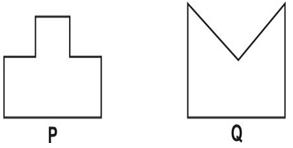
Question. Kusum drew m figures like P on a page 1 and figure Q on page 2.
Compared to page 2, how many more straight lines are there on page 1
(a) 3
(b) 3m
(c) 8m - 1
(d) 8m - 5
Answer : D
Question. The roads connecting the houses of Ravi, Sunil, Kapil and Roger form a quadrilateral as shown here. Let us refer to the quadrilateral as KLMN. It is not known which corner is K, which is L, etc.
It is known that ∠ K + ∠ M > 180° and that ∠ L is not the smallest angle of the quadrilateral.
(a) Ravi
(b) Sunil
(c) Kapil
(d) Roger
Answer : A
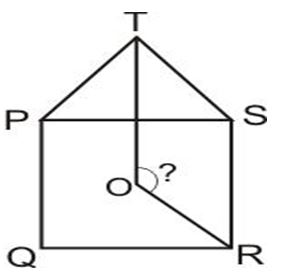
Question. In the figure shown below, PQRS is a square and TPS is an equilateral triangle. The bisectors of
angle PTS and angle QRS meet at point O.
What is the measure of angle TOR?
(a) 1350
(b) 1400
(c) 1450
(d) 1500
Answer : A
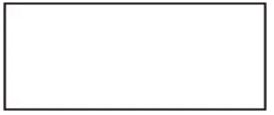
Question. Venu has a rectangular sheet of cardboard:
With a single straight cut, he cuts the rectangular sheet into two pieces.
The total number of corners on the two resulting pieces COULD be
(a) 4
(b) 5
(c) 7
(d) 10
Answer : C
Question. Look at the polygons shown below. In each of them, ALL the diagonals drawn from ONE vertex are shown.
From these we can say that the number of diagonals that can be drawn from any one vertex of a 20-sided polygon is

(a) 20
(b) 19
(c) 17
(d) 16
Answer : C
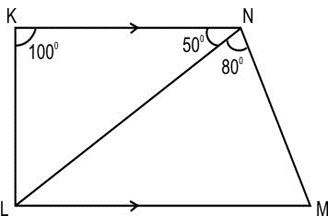
Question. The figure given is NOT to scale.)
If KN | | LM, the sides of KLMN in increasing order are
(a) KL, KN, MN, LM
(b) KN, KL, MN, LM
(c) MN, KL, KN, LM
(d) KN, MN, KL, LM
Answer : B
Question. In the above figure, lines l and m are parallel.
What is the measure of ∠R?
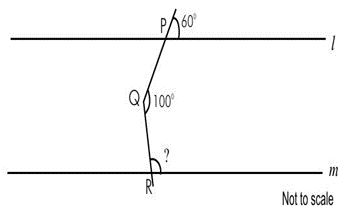
(a) 100°
(b) 120°
(c) 120°
(d) 160°
Answer : C
Question. A part of quadrilateral EFGH is covered with an object X. Which of the following is DEFINITELY true about quadrilateral EFGH?

(a) It must be a parallelogram
(b) It must be a rectangle
(c) It must be a square
(d) none of the above
Answer : D
Question. What is the sum of all the interior angles (marked in the figure) of polygon PQRSTUV
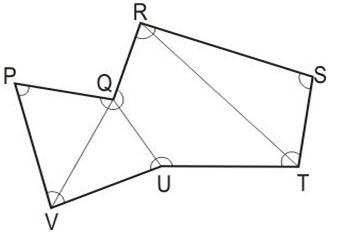
(a) 3600
(b) 4200
(c) 7200
(d) 9000
Answer : D
Question. The chart given below puts quadrilaterals in different boxes according to certain conditions.
According to the conditions in this chart, which type of quadrilaterals will be placed in the box marked X?
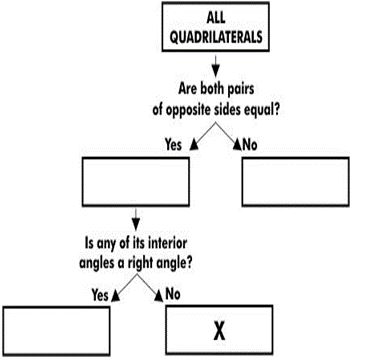
(a) all those parallelograms which are not rectangles
(b) all those rhombuses which are not squares
(c) all rectangles
(d) all those rectangles which are not squares
Answer : A
Question. The roads connecting the houses of Ravi, Sunil, Kapil and Roger form a quadrilateral as shown here. Let us refer to the quadrilateral as KLMN. It is not known which corner is K, which is L, etc.
It is known that ∠ K + ∠ M > 180° and that ∠ L is not the smallest angle of the quadrilateral.
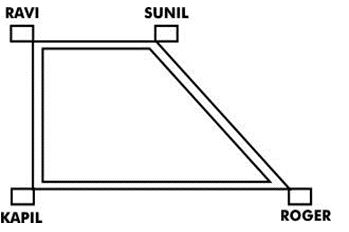
(a) Ravi
(b) Sunil
(c) Kapil
(d) Roger
Answer : A
Question. A parallelogram MNOP will be a rectangle when diagonals MO and NP
(a) are equal
(b) are perpendicular
(c) bisect each other
(d) intersect at an angle of 450
Answer : A
Question. According to the angle measures given, in which figure are lines l and m parallel? (The figures are NOT to scale)
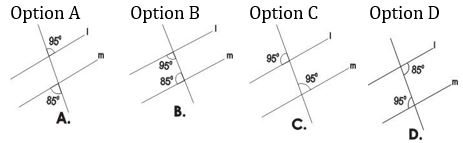
Answer : D
Question. Nadeem wants to extend the flowchart further from R to specify whether a given quadrilateral is a square. What question should he put in the box below R?
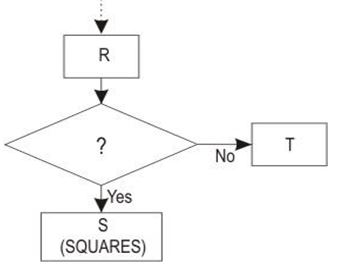
(a) Are all the angles in the figure right angles?""
(b) Are the opposite sides equal?""
(c) Are any two adjacent sides of the figure equal?" "
(d) Are the opposite angles of the figure equal?""
Answer : C
Question. ABCD is a quadrilateral. If AC and BD bisect each other, what is ABCD ?
(A) A square
(B) A parallelogram
(C) A rectangle
(D) All the above
Answer : D
Question. What do you call a parallelogram which has equal diagonals?
(A) A trapezium
(B) A rectangle
(C) A rhombus
(D) A kite
Answer : B
Question. In a square ABCD, the diagonals bisect at 0. What type of a triangle is AOB ?
(A) An equilateral triangle.
(B) An isosceles but not a right angled triangle.
(C) A right angled but not an isosceles triangle.
(D) An isosceles right angled triangle.
Answer : D
Question. The perimeter of a parallelogram is 180 cm. If one side exceeds the other by 1 0 cm, what are the sides of the parallelogram?
(A) 40 cm, 50 cm
(B) 45 cm each
(C) 50 cm each
(D) 45 cm, 50 cm
Answer : A
Question. ABCD and MNOP are quadrilaterals as shown in the figure.
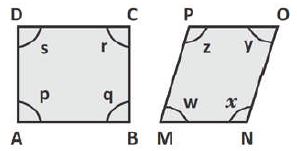
Which of the following is correct?
(A) p + q + r + s = w + X + y + z
(B) p + q + r + s < w + x + y + z
(C) p + q + r + s > w + x + y + z
(D) Either (B) or (C)
Answer : A
Question. If ABCD is an isosceles trapezium, what is the measure of ∠ C?
(A) ∠ B
(B) ∠ A
(C) ∠ D
(D) 90°
Answer : C
Question. ABCD is a parallelogram. The angle bisectors of ∠ A and ∠ D meet at 0. What is the measure of ∠ AOD?
(A) 45°
(B) 90°
(C) 75°
(D) 180°
Answer : B
Question. The diagonal of a rectangle is 10 em and its breadth is 6 em. What is its length ?
(A) 6 cm
(B) 5 cm
(C) 8 cm
(D) 4 cm
Answer : C
Question. A diagonal of a rectangle is inclined to one side of the rectangle at 25°. What is the measure of the acute angle between the diagonals ?
(A) 25°
(B) 40°
(C) 50°
(D) 55°
Answer : C
Question. If angles P, Q, R and S of the quadrilateral PQRS, taken in order, are in the ratio 3 : 7 : 6 : 4, what is PQRS?
(A) A rhombus
(B) A parallelogram
(C) A trapezium
(D) A kite
Answer : C
Question. In the quadrilateral ABCD, the diagonals AC and BD are equal and perpendicular to each other. What type of a quadrilateral is ABCD?
(A) A square
(B) A parallelogram
(C) A rhombus
(D) A trapezium
Answer : A
Question. ABCD is a parallelogram as shown in the figure. If AB = 2AD and Pis the mid-point of AB, what is the measure of ∠ CPD?
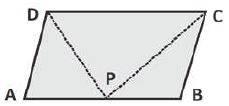
(A) 90°
(B) 60°
(C) 45°
(D) 135°
Answer : A
Question. In a parallelogram ABCD, if AB = 2x + 5, CD = y + 1, AD = y + 5 and BC = 3x - 4, what is the ratio of AB and BC ?
(A) 71 : 21
(C) 31:35
(B) 12: 11
(D) 4:7
Answer : C
Please refer to attached file for CBSE Class 8 Mathematics Worksheet - Understanding Quadrilaterals
Free study material for Mathematics
Download Class 8 Mathematics Chapter 03 Understanding Quadrilaterals Practice Worksheets
Practice Exercises for Class 8 Mathematics Chapter 03 Understanding Quadrilaterals
Explore reliable practice questions for Chapter 03 Understanding Quadrilaterals tailored for Class 8 Mathematics learners. Use these structured worksheets to evaluate exam preparedness and strengthen problem-solving skills throughout the 2026 academic session.
Step-by-Step Solutions and Practice Guidelines
Each worksheet draws directly from authorized standard textbooks to maintain academic accuracy. Evaluating your finished exercises against expert-verified solutions helps master the formal presentation standards expected in school evaluations.
Enhance Speed with Online Practice
Consistent engagement with these exercises builds familiarity with recurring exam themes. If specific areas within Chapter 03 Understanding Quadrilaterals cause trouble, utilize our dedicated NCERT solutions for Class 8 Mathematics to clear up doubts immediately.
FAQs
You can download the latest chapter-wise printable worksheets for Class 8 Mathematics Chapter 03 Understanding Quadrilaterals for free from StudiesToday.com. These have been made as per the latest CBSE curriculum for this academic year.
Yes, Class 8 Mathematics worksheets for Chapter 03 Understanding Quadrilaterals focus on activity-based learning and also competency-style questions. This helps students to apply theoretical knowledge to practical scenarios.
Yes, we have provided solved worksheets for Class 8 Mathematics Chapter 03 Understanding Quadrilaterals to help students verify their answers instantly.
Yes, our Class 8 Mathematics test sheets are mobile-friendly PDFs and can be printed by teachers for classroom.
For Chapter 03 Understanding Quadrilaterals, regular practice with our worksheets will improve question-handling speed and help students understand all technical terms and diagrams.