

Chapter-wise Worksheets for Class 8 Mathematics: Chapter 11 Mensuration
Explore structured practice materials through the CBSE Class 8 Mathematics Mensuration Worksheet Set 01. Tailored for Class 8 learners, utilizing these Mathematics worksheets ensures thorough preparation and strengthens problem-solving accuracy before final school evaluations.
Practice Class 8 Mathematics Worksheets: Chapter 11 Mensuration
Navigate directly to the solved Mathematics worksheets using the digital viewer below. Each practice set includes detailed step-by-step solutions, allowing students to instantly cross-check their work and identify areas requiring further revision.
Mensuration
Question 1. Find the volume of a cuboid whose length is 8 cm, breadth 6 cm and height 3.5 cm.
Answer: Length (\(l\)) = 8 cm
Breadth (\(b\)) = 6 cm
Height (\(h\)) = 3.5 cm
Volume of cuboid = \(l \times b \times h\)
Volume = \(8 \times 6 \times 3.5 = 168 \text{ cm}^3\)
In simple words: Multiply the length, breadth, and height together to get the volume.
Exam Tip: Always write the formula before substituting values and include proper cubic units for volume.
Question 2. Find the altitude of a trapezium, the sum of the lengths of whose bases is 6.5 cm and whose area is 26 cm\(^2\).
Answer: Area of trapezium = \(26 \text{ cm}^2\)
Sum of parallel bases (\(a + b\)) = 6.5 cm
Area = \(\frac{1}{2} \times (\text{sum of parallel sides}) \times \text{height}\)
\(26 = \frac{1}{2} \times 6.5 \times h\)
\(h = \frac{26 \times 2}{6.5} = \frac{52}{6.5} = 8 \text{ cm}\)
In simple words: Divide twice the area by the sum of the bases to find the height.
Exam Tip: Keep units consistent and simplify decimals carefully.
Question 3. Find the height of a cuboid whose volume is 275 cm\(^3\) and base area is 25 cm\(^2\).
Answer: Volume of cuboid = \(275 \text{ cm}^3\)
Base area = \(25 \text{ cm}^2\)
Volume = \(\text{Base area} \times \text{Height}\)
\(275 = 25 \times h\)
\(h = \frac{275}{25} = 11 \text{ cm}\)
In simple words: Height is found by dividing the total volume by the base area.
Exam Tip: Remember that base area is equal to length times breadth (\(l \times b\)).
Question 4. Find the area of a rhombus whose diagonals are of measurements 6 cm and 8 cm.
Answer: Diagonal 1 (\(d_1\)) = 6 cm
Diagonal 2 (\(d_2\)) = 8 cm
Area of rhombus = \(\frac{1}{2} \times d_1 \times d_2\)
Area = \(\frac{1}{2} \times 6 \times 8 = 24 \text{ cm}^2\)
In simple words: Multiply both diagonals and divide by 2 to get the area of the rhombus.
Question 5. Find the volume of the cylinder whose base diameter is 14 cm and height is 10 cm.
Answer: Diameter (\(d\)) = 14 cm, so Radius (\(r\)) = \(\frac{14}{2} = 7 \text{ cm}\)
Height (\(h\)) = 10 cm
Volume of cylinder = \(\pi r^2 h\)
Volume = \(\frac{22}{7} \times 7^2 \times 10 = \frac{22}{7} \times 49 \times 10 = 22 \times 7 \times 10 = 1540 \text{ cm}^3\)
In simple words: Find the radius from the diameter, then apply the cylinder volume formula \(\pi r^2 h\).
Exam Tip: Always convert diameter to radius before using it in formulas.
Question 6. Find the area of a triangle whose base is 4 cm and altitude is 6 cm.
Answer: Base (\(b\)) = 4 cm
Altitude (\(h\)) = 6 cm
Area of triangle = \(\frac{1}{2} \times \text{base} \times \text{altitude}\)
Area = \(\frac{1}{2} \times 4 \times 6 = 12 \text{ cm}^2\)
In simple words: Multiply base and height, then divide by 2.
Exam Tip: Altitude is another word for the height perpendicular to the base.
Question 7. Find the total surface area of a cube whose volume is 343 cm\(^3\).
Answer: Volume of cube = \(343 \text{ cm}^3\)
Let side of the cube be \(a\).
\(a^3 = 343 \implies a = \sqrt[3]{343} = 7 \text{ cm}\)
Total surface area of cube = \(6a^2\)
Total surface area = \(6 \times (7)^2 = 6 \times 49 = 294 \text{ cm}^2\)
In simple words: Find the side length by taking the cube root of the volume, then use the surface area formula.
Exam Tip: Memorize cube numbers up to 10 for faster calculation.
Question 8. Find the side of a cube whose surface area is 2400 cm\(^2\).
Answer: Total surface area = \(2400 \text{ cm}^2\)
\(6a^2 = 2400\)
\(a^2 = \frac{2400}{6} = 400\)
\(a = \sqrt{400} = 20 \text{ cm}\)
In simple words: Divide the surface area by 6, then take the square root to find the side length.
Exam Tip: Surface area of a cube has 6 identical square faces.
Question 9. How many bricks will be required for a wall which is 8 m long, 6 m high and 22.5 cm thick, if each brick measures 25 cm \(\times\) 11.25 cm \(\times\) 6 cm?
Answer: Dimensions of the wall:
Length (\(L\)) = 8 m = 800 cm
Height (\(H\)) = 6 m = 600 cm
Thickness (\(B\)) = 22.5 cm
Volume of the wall = \(800 \times 600 \times 22.5 \text{ cm}^3\)
Dimensions of one brick:
\(l = 25 \text{ cm}\), \(b = 11.25 \text{ cm}\), \(h = 6 \text{ cm}\)
Volume of one brick = \(25 \times 11.25 \times 6 \text{ cm}^3\)
Number of bricks = \(\frac{\text{Volume of the wall}}{\text{Volume of one brick}}\)
Number of bricks = \(\frac{800 \times 600 \times 22.5}{25 \times 11.25 \times 6}\)
Number of bricks = \(\frac{10800000}{1687.5} = 6400\)
In simple words: Convert all wall dimensions to centimeters, find the volume of the wall and one brick, and divide.
Exam Tip: Always make sure all measurements are in the same unit (meters to centimeters) before calculating volumes.
Question 10. The diameter of garden roller is 1.4 m and it is 2 m long. How much area will it cover in 5 revolutions?
Answer: Diameter (\(d\)) = 1.4 m, Radius (\(r\)) = \(\frac{1.4}{2} = 0.7 \text{ m}\)
Length of roller (Height, \(h\)) = 2 m
Area covered in 1 revolution = Curved surface area of cylinder = \(2\pi r h\)
Area in 1 revolution = \(2 \times \frac{22}{7} \times 0.7 \times 2 = 2 \times \frac{22}{7} \times \frac{7}{10} \times 2 = \frac{88}{10} = 8.8 \text{ m}^2\)
Area covered in 5 revolutions = \(5 \times 8.8 = 44 \text{ m}^2\)
In simple words: A roller covers its curved surface area in one complete rotation. Multiply that by 5.
Exam Tip: A garden roller acts like a rolling cylinder touching the ground with its curved surface.
Question 11. Find the volume of a cuboid whose length is 8 cm, width is 3 cm and height is 5 cm.
Answer: Length (\(l\)) = 8 cm
Width (\(b\)) = 3 cm
Height (\(h\)) = 5 cm
Volume = \(l \times b \times h = 8 \times 3 \times 5 = 120 \text{ cm}^3\)
In simple words: Multiply length, width, and height to get the volume.
Exam Tip: Double-check multiplication to avoid arithmetic errors.
Question 12. A cylindrical tank has a capacity of 5632 m\(^3\). If the diameter of its base is 16 m, find its depth.
Answer: Volume = \(5632 \text{ m}^3\)
Diameter (\(d\)) = 16 m, Radius (\(r\)) = 8 m
Volume of cylinder = \(\pi r^2 h\)
\(5632 = \frac{22}{7} \times (8)^2 \times h\)
\(5632 = \frac{22}{7} \times 64 \times h\)
\(h = \frac{5632 \times 7}{22 \times 64} = \frac{39424}{1408} = 28 \text{ m}\)
In simple words: Use the volume formula with the given radius and solve for height (depth).
Exam Tip: Capacity of a container means its volume.
Question 13. Find the volume of 64 cubes whose one side is 4 cm.
Answer: Side of one cube (\(a\)) = 4 cm
Volume of one cube = \(a^3 = 4^3 = 64 \text{ cm}^3\)
Volume of 64 cubes = \(64 \times 64 = 4096 \text{ cm}^3\)
In simple words: Find the volume of one cube and multiply it by 64.
Question 14. Find the volume of a cylinder whose base radius is 14 cm and height is 35 cm.
Answer: Radius (\(r\)) = 14 cm
Height (\(h\)) = 35 cm
Volume = \(\pi r^2 h = \frac{22}{7} \times (14)^2 \times 35\)
Volume = \(\frac{22}{7} \times 196 \times 35 = 22 \times 28 \times 35 = 21560 \text{ cm}^3\)
In simple words: Substitute radius and height into the cylinder volume formula.
Exam Tip: Cancel out denominators early to simplify multiplication.
Question 15. Find the area of a parallelogram whose measurements are given in the following figure.
Answer: Base (\(b\)) = 5 cm
Corresponding height (\(h\)) = 3 cm
Area of parallelogram = \(\text{Base} \times \text{Height}\)
Area = \(5 \times 3 = 15 \text{ cm}^2\)
In simple words: Multiply the base length by the perpendicular height. Ignore extra side lengths.
Exam Tip: Make sure the height you use is perpendicular to the chosen base.
Question 16. Find the total surface area of a cylinder whose base radius is 8 cm and height is 14 cm.
Answer: Radius (\(r\)) = 8 cm
Height (\(h\)) = 14 cm
Total surface area = \(2\pi r(r + h)\)
Total surface area = \(2 \times \frac{22}{7} \times 8 \times (8 + 14)\)
Total surface area = \(2 \times \frac{22}{7} \times 8 \times 22 = \frac{7744}{7} = 1106.285 \text{ cm}^2\) (or \(1106.29 \text{ cm}^2\))
In simple words: Apply the total surface area formula for a closed cylinder.
Exam Tip: Total surface area includes the curved surface and two circular end bases.
Question 17. Find the area of a rhombus whose diagonals are of lengths 20 cm and 16 cm.
Answer: \(d_1 = 20 \text{ cm}\), \(d_2 = 16 \text{ cm}\)
Area = \(\frac{1}{2} \times d_1 \times d_2\)
Area = \(\frac{1}{2} \times 20 \times 16 = 10 \times 16 = 160 \text{ cm}^2\)
In simple words: Half of the product of the two diagonals gives the area.
Exam Tip: This is the standard and easiest method when diagonals are given.
Question 18. Find the height of cuboid whose volume is 490 cm\(^3\) and base area is 35 cm\(^2\).
Answer: Volume = \(490 \text{ cm}^3\)
Base area = \(35 \text{ cm}^2\)
Height = \(\frac{\text{Volume}}{\text{Base area}}\)
\(h = \frac{490}{35} = 14 \text{ cm}\)
In simple words: Divide the volume by the base area to get the height.
Exam Tip: Volume = Base Area \(\times\) Height.
Question 19. Find the volume of the cylinder whose height is 7 cm and radius is 20 cm.
Answer: Height (\(h\)) = 7 cm
Radius (\(r\)) = 20 cm
Volume = \(\pi r^2 h = \frac{22}{7} \times (20)^2 \times 7\)
Volume = \(\frac{22}{7} \times 400 \times 7 = 22 \times 400 = 8800 \text{ cm}^3\)
In simple words: Multiply \(\pi\), square of radius, and height.
Exam Tip: Notice how the 7 in the denominator cancels with the height 7.
Question 20. Find the side of a cube whose surface area is 2400 cm\(^2\).
Answer: Surface area = \(2400 \text{ cm}^2\)
\(6a^2 = 2400 \implies a^2 = 400 \implies a = 20 \text{ cm}\)
In simple words: Divide by 6 and take the square root.
Exam Tip: A cube has 6 square faces of equal area.
Question 21. The diagonal of a quadrilateral shaped field is 24 cm and perpendicular dropped on it from the remaining opposite vertices are 6 m and 12 m. Find the area of the field.
Answer: Note: Taking standard units as meters (assuming diagonal is 24 m based on typical problems).
Diagonal (\(d\)) = 24 m
Perpendicular heights (\(h_1, h_2\)) = 6 m and 12 m
Area of quadrilateral = \(\frac{1}{2} \times d \times (h_1 + h_2)\)
Area = \(\frac{1}{2} \times 24 \times (6 + 12)\)
Area = \(12 \times 18 = 216 \text{ m}^2\)
In simple words: Divide the quadrilateral into two triangles along the diagonal and sum their areas.
Exam Tip: Formula: \(\frac{1}{2} \times \text{diagonal} \times (\text{sum of offsets})\).
Question 22. A godown is in the form of a cuboid of measures 60 m \(\times\) 40 m \(\times\) 20 m. How many cuboidal boxes can be stored in it if the volume of one box 0.8 m\(^3\)?
Answer: Volume of godown = \(60 \times 40 \times 20 = 48000 \text{ m}^3\)
Volume of one box = \(0.8 \text{ m}^3\)
Number of boxes = \(\frac{\text{Volume of godown}}{\text{Volume of one box}}\)
Number of boxes = \(\frac{48000}{0.8} = 60000\)
In simple words: Divide the total volume of the godown by the volume of a single box.
Exam Tip: Ensure all dimensions are in the same unit before finding volumes.
Question 23. The internal measures of a cuboidal room are 10 m \(\times\) 8 m \(\times\) 4 m. Find the total cost of whitewashing four walls of a room, if the cost of white washing is Rs 5 per m\(^2\).
Answer: Length (\(l\)) = 10 m, Breadth (\(b\)) = 8 m, Height (\(h\)) = 4 m
Area of four walls (Lateral Surface Area) = \(2h(l + b)\)
Area = \(2 \times 4 \times (10 + 8) = 8 \times 18 = 144 \text{ m}^2\)
Cost of whitewashing per m\(^2\) = Rs. 5
Total cost = \(144 \times 5 = \text{Rs. } 720\)
In simple words: Find the area of the four walls and multiply by the cost per square meter.
Exam Tip: Whitewashing four walls means excluding the floor and ceiling.
Question 24. Find the area of a rhombus whose side is 5 cm and its altitude is 4 cm. If one of its diagonal is 8 cm long, find the length of the other diagonal.
Answer: A rhombus is also a parallelogram.
Base = side = 5 cm, Altitude = 4 cm
Area of rhombus = \(\text{Base} \times \text{Altitude} = 5 \times 4 = 20 \text{ cm}^2\)
Also, Area of rhombus = \(\frac{1}{2} \times d_1 \times d_2\)
\(20 = \frac{1}{2} \times 8 \times d_2\)
\(20 = 4 \times d_2 \implies d_2 = \frac{20}{4} = 5 \text{ cm}\)
In simple words: Find the area using base and height, then use the diagonal area formula to find the missing diagonal.
Exam Tip: A rhombus can use both parallelogram and diagonal formulas for area.
Question 25. In a building there are 4 cylindrical pillars. The radius of each pillar is 21 cm and height is 5 m. Find the curved surface area of four pillars.
Answer: Radius (\(r\)) = 21 cm = 0.21 m
Height (\(h\)) = 5 m
Curved surface area of one pillar = \(2\pi r h\)
CSA of one pillar = \(2 \times \frac{22}{7} \times 0.21 \times 5 = 2 \times \frac{22}{7} \times \frac{21}{100} \times 5 = 6.6 \text{ m}^2\)
CSA of 4 pillars = \(4 \times 6.6 = 26.4 \text{ m}^2\)
In simple words: Calculate the curved surface area of one pillar and multiply by 4. Convert units so radius and height match.
Question 26. A rectangular paper of width 7 cm is rolled along its width and a cylinder of radius 20 cm is formed. Find the volume of the cylinder.
Answer: When rolled along its width, the width becomes the height of the cylinder, and the length becomes the circumference of the base.
Height of cylinder (\(h\)) = 7 cm
Radius (\(r\)) = 20 cm
Volume of cylinder = \(\pi r^2 h\)
Volume = \(\frac{22}{7} \times (20)^2 \times 7 = \frac{22}{7} \times 400 \times 7 = 8800 \text{ cm}^3\)
In simple words: Width becomes height and radius is given as 20 cm. Apply the cylinder volume formula.
Exam Tip: Pay close attention to which dimension becomes the height when paper is rolled.
Question 27. The perimeter of a trapezium is 52 cm. Its non-parallel sides are 10 cm each and the distance between two parallel sides is 8 cm. Find the area of the trapezium.
Answer: Perimeter = \(a + b + c + d = 52 \text{ cm}\)
Sum of non-parallel sides = \(10 + 10 = 20 \text{ cm}\)
Sum of parallel sides (\(a + b\)) = Perimeter - Sum of non-parallel sides
\(a + b = 52 - 20 = 32 \text{ cm}\)
Distance between parallel sides (\(h\)) = 8 cm
Area of trapezium = \(\frac{1}{2} \times (\text{sum of parallel sides}) \times \text{height}\)
Area = \(\frac{1}{2} \times 32 \times 8 = 16 \times 8 = 128 \text{ cm}^2\)
In simple words: Subtract non-parallel sides from the perimeter to get the sum of parallel sides, then use the area formula.
Exam Tip: Perimeter is the total boundary distance around the shape.
Question 28. The parallel sides of a trapezium are 25 cm and 13 cm. Its non-parallel sides are equal, each being 10 cm. Find the area of the trapezium.
Answer: Parallel sides: \(a = 25 \text{ cm}\), \(b = 13 \text{ cm}\)
Non-parallel sides = 10 cm each.
Difference between parallel bases = \(25 - 13 = 12 \text{ cm}\).
Dividing equally on both sides gives base segments of 6 cm for the right triangles at the ends.
Using Pythagoras theorem to find height (\(h\)):
\(10^2 = 6^2 + h^2\)
\(100 = 36 + h^2 \implies h^2 = 64 \implies h = 8 \text{ cm}\)
Area = \(\frac{1}{2} \times (25 + 13) \times 8 = \frac{1}{2} \times 38 \times 8 = 152 \text{ cm}^2\)
In simple words: Find the height using right triangles formed at the ends, then apply the area formula.
Exam Tip: Drawing a perpendicular drop from the top vertices helps find the height of an isosceles trapezium.
Question 29. The area of a trapezium is 384 cm\(^2\). Its parallel sides are in the ratio 3:5 and the distance between them is 12 cm. Find the length of each parallel side.
Answer: Let the parallel sides be \(3x\) and \(5x\).
Height (\(h\)) = 12 cm
Area = \(\frac{1}{2} \times (3x + 5x) \times 12 = 384\)
\(\frac{1}{2} \times 8x \times 12 = 384\)
\(48x = 384 \implies x = \frac{384}{48} = 8\)
First parallel side = \(3x = 3 \times 8 = 24 \text{ cm}\)
Second parallel side = \(5x = 5 \times 8 = 40 \text{ cm}\)
In simple words: Use ratio variables \(3x\) and \(5x\), substitute into the area formula, solve for \(x\), and find the sides.
Exam Tip: Whenever sides are given in a ratio, use a variable like \(x\) to represent them.
Question 30. A cylindrical tube, open at both ends is made of metal. The internal diameter of the tube is 10.4 cm and its length is 25 cm. The thickness of the metal is 8 mm everywhere. Calculate the volume of the metal in the cylinder.
Answer: Internal diameter (\(d_1\)) = 10.4 cm \(\implies\) Internal radius (\(r_1\)) = 5.2 cm
Thickness = 8 mm = 0.8 cm
External radius (\(r_2\)) = \(r_1 + \text{thickness} = 5.2 + 0.8 = 6.0 \text{ cm}\)
Length (\(h\)) = 25 cm
Volume of metal = \(\pi(r_2^2 - r_1^2)h\)
Volume = \(\frac{22}{7} \times (6.0^2 - 5.2^2) \times 25\)
\(6.0^2 - 5.2^2 = 36 - 27.04 = 8.96\)
Volume = \(\frac{22}{7} \times 8.96 \times 25 = \frac{4928}{7} = 704 \text{ cm}^3\)
In simple words: Find internal and external radii, then subtract the internal volume from the external volume.
Exam Tip: Convert thickness from millimeters to centimeters before adding to radius.
Question 31. The top surface of a box is in the shape of a regular octagon as shown in the figure. Find the area of the octagonal surface.
Answer: A regular octagon of side 5 cm (with parallel sides 11 cm and height 4 cm as per figure dimensions) can be split into two identical trapeziums and a central rectangle.
Rectangle dimensions: \(11 \text{ cm} \times 5 \text{ cm}\), Area = \(11 \times 5 = 55 \text{ cm}^2\)
Two trapeziums: Parallel bases are 11 cm and 5 cm, height = 4 cm.
Area of one trapezium = \(\frac{1}{2} \times (11 + 5) \times 4 = \frac{1}{2} \times 16 \times 4 = 32 \text{ cm}^2\)
Total area = \(\text{Area of rectangle} + 2 \times (\text{Area of trapezium})\)
Total area = \(55 + 2 \times 32 = 55 + 64 = 119 \text{ cm}^2\)
In simple words: Divide the octagon into a central rectangle and two trapeziums on the sides, then add their areas.
Exam Tip: Splitting complex polygons into simpler standard shapes (rectangles and trapeziums) makes area calculation easy.
Question 32. A pool is 20 m long, 15 m broad and 4 m deep. Find the cost of cementing its floor and its walls at the rate of Rs. 12 per square metre.
Answer: Length (\(l\)) = 20 m, Breadth (\(b\)) = 15 m, Depth (\(h\)) = 4 m
Area of floor = \(l \times b = 20 \times 15 = 300 \text{ m}^2\)
Area of four walls = \(2h(l + b) = 2 \times 4 \times (20 + 15) = 8 \times 35 = 280 \text{ m}^2\)
Total area to be cemented = \(\text{Floor area} + \text{Walls area} = 300 + 280 = 580 \text{ m}^2\)
Cost per m\(^2\) = Rs. 12
Total cost = \(580 \times 12 = \text{Rs. } 6960\)
In simple words: Add the area of the floor and the four walls, then multiply by the cost per square meter.
Question 33. A cylindrical container of radius 28 cm contains sufficient water to submerge a rectangular solid of dimensions 32 cm \(\times\) 22 cm \(\times\) 14 cm. Find the rise in the level of water, when the solid is completely submerged.
Answer: Volume of rectangular solid = \(32 \times 22 \times 14 = 9856 \text{ cm}^3\)
Radius of cylindrical container (\(r\)) = 28 cm
Volume of water displaced = Volume of rectangular solid
\(\pi r^2 h = 9856\)
\(\frac{22}{7} \times (28)^2 \times h = 9856\)
\(\frac{22}{7} \times 784 \times h = 9856\)
\(22 \times 112 \times h = 9856\)
\(2464 \times h = 9856 \implies h = \frac{9856}{2464} = 4 \text{ cm}\)
In simple words: The volume of the submerged solid equals the volume of the raised water cylinder. Solve for height.
Exam Tip: Displaced water volume always equals the volume of the immersed object.
Question 34. A rectangular piece of iron sheet is 44 m long and 20 m broad. It is rolled along its length to form a cylinder. Find the volume of the cylinder so formed.
Answer: Rolled along its length means:
Circumference of base (\(2\pi r\)) = Length = 44 m
Height of cylinder (\(h\)) = Breadth = 20 m
\(2 \times \frac{22}{7} \times r = 44\)
\(\frac{44}{7} \times r = 44 \implies r = 7 \text{ m}\)
Volume of cylinder = \(\pi r^2 h = \frac{22}{7} \times (7)^2 \times 20\)
Volume = \(\frac{22}{7} \times 49 \times 20 = 22 \times 7 \times 20 = 3080 \text{ m}^3\)
In simple words: The length becomes the base circumference to find the radius, and the breadth becomes the height.
Question 35. The cost of papering the wall of a room, 12 m long, at the rate of Rs. 1.35 per square meter is Rs. 340.20. The cost of matting the floor at Re. 0.85 per square metre is Rs. 91.80. Find the height of the room.
Answer: Length of room (\(l\)) = 12 m
Cost of matting floor = Rs. 91.80 at Re. 0.85 per m\(^2\)
Floor area = \(\frac{91.80}{0.85} = 108 \text{ m}^2\)
Since Floor Area = \(l \times b\):
\(12 \times b = 108 \implies b = \frac{108}{12} = 9 \text{ m}\)
Cost of papering walls = Rs. 340.20 at Rs. 1.35 per m\(^2\)
Area of four walls = \(\frac{340.20}{1.35} = 252 \text{ m}^2\)
Walls area formula = \(2h(l + b) = 252\)
\(2h(12 + 9) = 252\)
\(2h(21) = 252 \implies 42h = 252 \implies h = \frac{252}{42} = 6 \text{ m}\)
In simple words: Find floor area and breadth first, then find wall area to calculate the height of the room.
Exam Tip: Divide total cost by rate per square unit to find the respective areas.
Question 36. A tin is in a cylindrical shape whose base has a diameter of 14 cm and height 20 cm. A label is placed around the surface of the container. If the label is placed 2 cm from top and bottom, what is the area of the label?
Answer: Diameter (\(d\)) = 14 cm \(\implies\) Radius (\(r\)) = 7 cm
Total height of tin = 20 cm
The label leaves 2 cm from top and 2 cm from bottom.
Height of the label (\(h'\)) = \(20 - 2 - 2 = 16 \text{ cm}\)
Area of the label = Curved surface area of label cylinder = \(2\pi r h'\)
Area = \(2 \times \frac{22}{7} \times 7 \times 16 = 44 \times 16 = 704 \text{ cm}^2\)
In simple words: Subtract the top and bottom margins from the total height to get the label's height, then find its curved surface area.
Question 37. A rectangle piece of metal sheet 11 m x 4 m is folded without overlapping to make a cylinder of height 4 m. Find the volume of the cylinder.
Answer: Height of cylinder (\(h\)) = 4 m
Circumference of base = 11 m
\(2\pi r = 11\)
\(2 \times \frac{22}{7} \times r = 11\)
\(\frac{44}{7} \times r = 11 \implies r = \frac{11 \times 7}{44} = \frac{7}{4} = 1.75 \text{ m}\)
Volume of cylinder = \(\pi r^2 h = \frac{22}{7} \times \left(\frac{7}{4}\right)^2 \times 4\)
Volume = \(\frac{22}{7} \times \frac{49}{16} \times 4 = \frac{22 \times 49 \times 4}{7 \times 16} = \frac{4312}{112} = 38.5 \text{ m}^3\)
In simple words: Use the 11 m side as circumference to find radius, and the 4 m side as height, then calculate volume.
Exam Tip: Fractions often make calculations cleaner before converting to decimals.
Most Important Questions
Question 1. Find the perimeter and area of the given figure:
Answer: From the figure (parallelogram with base 4 cm, side 3 cm, and height 2.5 cm):
Perimeter = \(2 \times (\text{side}_1 + \text{side}_2) = 2 \times (4 + 3) = 2 \times 7 = 14 \text{ cm}\)
Area = \(\text{Base} \times \text{Height} = 4 \times 2.5 = 10 \text{ cm}^2\)
In simple words: Perimeter is the sum of all outer sides, and area is base times height.
Exam Tip: Do not confuse height with side length when calculating area.
Question 2. Square and a rectangle have the same perimeter; if the side of the square is 16m and the length of the rectangle is 18 m, find the breadth of the rectangle.
Answer: Side of square = 16 m
Perimeter of square = \(4 \times \text{side} = 4 \times 16 = 64 \text{ m}\)
Perimeter of rectangle = Perimeter of square = 64 m
Length of rectangle (\(l\)) = 18 m
Perimeter of rectangle = \(2(l + b)\)
\(64 = 2(18 + b)\)
\(32 = 18 + b \implies b = 32 - 18 = 14 \text{ m}\)
In simple words: Equate the perimeters, substitute the given length, and solve for the breadth.
Exam Tip: Perimeter of a rectangle is \(2(l + b)\).
Question 3. Radha bought a rectangular plot of dimensions 120 m x 80 m and Radhika bought a square field of dimension 95 m. Who bought plot of greater area and by how much?
Answer: Area of Radha's rectangular plot = \(120 \times 80 = 9600 \text{ m}^2\)
Area of Radhika's square field = \(95 \times 95 = 9025 \text{ m}^2\)
Radha's plot is greater because \(9600 > 9025\)
Difference in area = \(9600 - 9025 = 575 \text{ m}^2\)
In simple words: Calculate both areas separately and compare them to find the difference.
Exam Tip: Area of rectangle = \(l \times b\), Area of square = \(\text{side}^2\).
Question 4. Find the area of the field whose sides have semi-circular flowerbeds, as given in the figure.
Answer: Central rectangle dimensions: Length = 42 m, Breadth = 30 m
Area of central rectangle = \(42 \times 30 = 1260 \text{ m}^2\)
Semi-circular flowerbeds on opposite sides (diameters 42 m and 30 m respectively, or matching rectangle sides):
Area of two semi-circles on length 42 m (radius = 21 m):
\(= 2 \times \left(\frac{1}{2} \pi r^2\right) = \pi r^2 = \frac{22}{7} \times (21)^2 = \frac{22}{7} \times 441 = 1386 \text{ m}^2\)
Area of two semi-circles on breadth 30 m (radius = 15 m):
\(= \pi r^2 = \frac{22}{7} \times (15)^2 = \frac{22}{7} \times 225 = 707.14 \text{ m}^2\)
Total area = \(1260 + 1386 + 707.14 = 3353.14 \text{ m}^2\)
In simple words: Add the area of the rectangle and the areas of all attached semi-circular flowerbeds.
Exam Tip: Two semi-circles with the same radius combine to form one full circle.
Question 5. Find the perimeter of the given figure
Answer: Based on the figure (a sector/arc top with two slant sides of 2 cm each and bottom opening / top arc of 3.5 cm diameter):
Perimeter = Sum of all outer boundaries = \(2 + 2 + \text{Arc length}\)
For top semi-circle of diameter 3.5 cm: Arc length = \(\pi d = \frac{22}{7} \times 3.5 = 11 \text{ cm}\) (half circle arc = \(\frac{11}{2} = 5.5 \text{ cm}\) or full perimeter components depending on exact figure type).
Total perimeter = \(2 + 2 + 3.5 + 3.5\) (or standard outer outline sum) = approximately 11 cm to 15 cm based on standard textbook problems.
In simple words: Add all outer straight edges and curved arcs together.
Exam Tip: Perimeter includes only the outer boundary lines.
Question 6. Find the area of the following trapezium
Answer: Parallel sides: \(a = 34 \text{ cm}\), \(b = 17 \text{ cm}\)
Height (\(h\)) = 10 cm
Area = \(\frac{1}{2} \times (a + b) \times h\)
Area = \(\frac{1}{2} \times (34 + 17) \times 10 = \frac{1}{2} \times 51 \times 10 = 51 \times 5 = 255 \text{ cm}^2\)
In simple words: Add the parallel bases, multiply by the height, and divide by 2.
Exam Tip: Direct substitution into the trapezium area formula yields the answer immediately.
Question 7. The diagonals of a rhombus are 16 cm and 12 cm, find
a) Its area
b) Its length of the side
c) Its perimeter
Answer: Diagonals: \(d_1 = 16 \text{ cm}\), \(d_2 = 12 \text{ cm}\)
a) Area = \(\frac{1}{2} \times d_1 \times d_2 = \frac{1}{2} \times 16 \times 12 = 96 \text{ cm}^2\)
b) Side of rhombus (\(a\)) = \(\sqrt{\left(\frac{d_1}{2}\right)^2 + \left(\frac{d_2}{2}\right)^2}\)
\(a = \sqrt{8^2 + 6^2} = \sqrt{64 + 36} = \sqrt{100} = 10 \text{ cm}\)
c) Perimeter = \(4 \times \text{side} = 4 \times 10 = 40 \text{ cm}\)
In simple words: Use diagonals for area, half-diagonals with Pythagoras theorem for the side length, and multiply the side by 4 for the perimeter.
Exam Tip: Diagonals of a rhombus bisect each other at right angles (90 degrees).
Question 8. The parallel sides of a trapezium are in the ratio 2: 3 and the area of the trapezium is 125 cm\(^2\). The distance between the parallel lines is 10 cm. Find the length of the parallel sides of the trapezium.
Answer: Let parallel sides be \(2x\) and \(3x\).
Height (\(h\)) = 10 cm, Area = \(125 \text{ cm}^2\)
Area = \(\frac{1}{2} \times (2x + 3x) \times 10 = 125\)
\(5x \times 5 = 125\)
\(25x = 125 \implies x = 5\)
First side = \(2(5) = 10 \text{ cm}\)
Second side = \(3(5) = 15 \text{ cm}\)
In simple words: Use ratio \(2x\) and \(3x\), apply the area formula, solve for \(x\), and find the sides.
Exam Tip: Ratios simplify finding unknown side lengths using an algebraic variable.
Question 9. The parallel sides of a trapezium are in the ratio 2: 3 and the area of the trapezium is 125 cm\(^2\). The distance between the parallel lines is 10 cm. Find the length of the parallel sides of the trapezium.
Answer: (Repeated question from Q8)
Parallel sides are 10 cm and 15 cm.
In simple words: Same as Question 8.
Exam Tip: Double check repeated questions for consistency.
Question 10. Find the area of the given quadrilateral
Answer: Based on figure dimensions (diagonal = 12 cm, perpendicular offsets = 4 cm and 3.5 cm):
Area = \(\frac{1}{2} \times \text{diagonal} \times (h_1 + h_2)\)
Area = \(\frac{1}{2} \times 12 \times (4 + 3.5) = 6 \times 7.5 = 45 \text{ cm}^2\)
In simple words: Multiply half of the diagonal by the sum of the two perpendicular offsets.
Exam Tip: A quadrilateral divided by a diagonal forms two triangles.
Question 11. In the given figure find the area of the path
Answer: Outer rectangle dimensions: Length = 150 cm, Breadth = 110 cm
Path width = 5 cm uniformly around the inside (or outside).
If path is inside: Inner length = \(150 - 2(5) = 140 \text{ cm}\), Inner breadth = \(110 - 2(5) = 100 \text{ cm}\)
Area of outer rectangle = \(150 \times 110 = 16500 \text{ cm}^2\)
Area of inner rectangle = \(140 \times 100 = 14000 \text{ cm}^2\)
Area of path = \(\text{Outer Area} - \text{Inner Area} = 16500 - 14000 = 2500 \text{ cm}^2\)
In simple words: Subtract the inner rectangle area from the outer rectangle area to get the path area.
Question 12. Find the area of the roads, if two roads are running in cross-section, through the middle of a ground,
Answer: Ground dimensions: Length = 225 m, Breadth = 175 m
Road width = 10 m running through the middle.
Area of road running parallel to length = \(225 \times 10 = 2250 \text{ m}^2\)
Area of road running parallel to breadth = \(175 \times 10 = 1750 \text{ m}^2\)
Area of overlapping central square = \(10 \times 10 = 100 \text{ m}^2\)
Total area of roads = \(\text{Area 1} + \text{Area 2} - \text{Overlap}\)
Total area = \(2250 + 1750 - 100 = 3900 \text{ m}^2\)
In simple words: Add both road areas and subtract the central overlapping square area once.
Exam Tip: Never forget to subtract the central intersection area when roads cross each other.
Question 13. Find the area and perimeter of the dollhouse.
Answer: Dollhouse consists of a lower square/rectangle part and an upper triangular roof.
Lower box: Width = 2 m, Height = 3 m. Area = \(2 \times 3 = 6 \text{ m}^2\)
Roof triangle: Base = 2 m, Slant sides = 2 cm (or 2 m), Height = 1.5 m.
Area of triangle = \(\frac{1}{2} \times \text{base} \times \text{height} = \frac{1}{2} \times 2 \times 1.5 = 1.5 \text{ m}^2\)
Total Area = \(6 + 1.5 = 7.5 \text{ m}^2\)
Perimeter = Sum of outer boundary edges (bottom 2 m, two side walls 3 m each, two roof slant sides 2 m each) = \(2 + 3 + 3 + 2 + 2 = 12 \text{ m}\)
In simple words: Add the area of the rectangular base and triangular roof. Add outer edge lengths for perimeter (excluding the joining line).
Exam Tip: Perimeter only includes exposed outer boundaries.
Question 14. Find the area of the given octagon, by using suitable method
Answer: Split the regular octagon into two trapeziums and a central rectangle.
Central rectangle = \(11 \text{ cm} \times 5 \text{ cm}\), Area = \(55 \text{ cm}^2\)
Two trapeziums with parallel sides 11 cm and 7 cm, height = 4 cm.
Area of one trapezium = \(\frac{1}{2} \times (11 + 7) \times 4 = 36 \text{ cm}^2\)
Total Area = \(55 + 36 + 36 = 127 \text{ cm}^2\)
In simple words: Divide into a rectangle and two side trapeziums to calculate total area easily.
Exam Tip: Breaking irregular or multi-sided figures into standard shapes simplifies calculations.
Question 15. In the given figure of a cube and a cuboid which one has a greater surface area and by how much?
Answer: Cuboid dimensions: Length = 15 cm, Breadth = 6 cm, Height = 2 cm
Total surface area of cuboid = \(2(lB + bh + hl) = 2(15 \times 6 + 6 \times 2 + 2 \times 15)\)
TSA of cuboid = \(2(90 + 12 + 30) = 2(132) = 264 \text{ cm}^2\)
Cube dimensions: Side = 4 cm
Total surface area of cube = \(6 \times a^2 = 6 \times (4)^2 = 6 \times 16 = 96 \text{ cm}^2\)
Comparison: Cuboid has a greater surface area by \(264 - 96 = 168 \text{ cm}^2\).
In simple words: Calculate surface areas for both shapes using their respective formulas and compare.
Exam Tip: Use \(2(lb + bh + hl)\) for cuboids and \(6a^2\) for cubes.
Question 16. The walls of a house of dimension 15 m x 12 m x 8 m are to be painted along with the ceiling at the rate of Rs. 43 per m\(^2\). Find the total cost of painting.
Answer: Length (\(l\)) = 15 m, Breadth (\(b\)) = 12 m, Height (\(h\)) = 8 m
Area of four walls = \(2h(l + b) = 2 \times 8 \times (15 + 12) = 16 \times 27 = 432 \text{ m}^2\)
Area of ceiling = \(l \times b = 15 \times 12 = 180 \text{ m}^2\)
Total area to be painted = \(\text{Walls area} + \text{Ceiling area} = 432 + 180 = 612 \text{ m}^2\)
Cost per m\(^2\) = Rs. 43
Total cost = \(612 \times 43 = \text{Rs. } 26316\)
In simple words: Add the area of the four walls and the ceiling, then multiply by the painting rate.
Exam Tip: Floor is excluded since painting is done only on walls and ceiling.
Question 17. A talcum powder can is made of aluminium sheet, it is cylindrical in shape the height of the cylindrical can is 6 cm and the radius of the base is 1.4 cm, How much aluminium sheet is require to make 200 such cans?
Answer: Radius (\(r\)) = 1.4 cm, Height (\(h\)) = 6 cm
Total surface area of one can (closed cylinder) = \(2\pi r(r + h)\)
TSA of one can = \(2 \times \frac{22}{7} \times 1.4 \times (1.4 + 6) = 2 \times \frac{22}{7} \times \frac{14}{10} \times 7.4\)
TSA of one can = \(\frac{616}{7} = 88 \text{ cm}^2\) (or exact multiplication: \(2 \times 2.2 \times 1.4 \times 7.4 = 65.12 \text{ cm}^2\))
For 200 cans = \(200 \times 65.12 = 13024 \text{ cm}^2\)
In simple words: Find the total surface area of one cylindrical can and multiply by 200.
Exam Tip: Talcum powder cans are closed containers, so use total surface area.
Question 18. Three cubes of side 4 cm are joined to form a cuboid, find the surface area of the resulting cuboid.
Answer: When 3 cubes of side 4 cm are joined end-to-end:
Length of resulting cuboid (\(l\)) = \(3 \times 4 = 12 \text{ cm}\)
Breadth (\(b\)) = 4 cm
Height (\(h\)) = 4 cm
Surface area of cuboid = \(2(lb + bh + hl) = 2(12 \times 4 + 4 \times 4 + 4 \times 12)\)
Surface area = \(2(48 + 16 + 48) = 2(112) = 224 \text{ cm}^2\)
In simple words: Joining cubes increases the length while breadth and height remain the same. Apply cuboid surface area formula.
Exam Tip: Only the length changes when cubes are joined in a single straight row.
Question 19. A wooden table has to be varnished on all the sides, leaving the bottom at the rate of Rs. 12.50 per m\(^2\). If the dimensions of the table are 50 cm x 27 cm x 70 cm, find the cost of varnishing the total surface.
Answer: Dimensions: \(l = 50 \text{ cm} = 0.5 \text{ m}\), \(b = 27 \text{ cm} = 0.27 \text{ m}\), \(h = 70 \text{ cm} = 0.7 \text{ m}\)
Area to be varnished = Total surface area - Area of bottom
TSA = \(2(lb + bh + hl) = 2(0.5 \times 0.27 + 0.27 \times 0.7 + 0.7 \times 0.5)\)
TSA = \(2(0.135 + 0.189 + 0.35) = 2(0.674) = 1.348 \text{ m}^2\)
Area of bottom = \(l \times b = 0.5 \times 0.27 = 0.135 \text{ m}^2\)
Varnishing area = \(1.348 - 0.135 = 1.213 \text{ m}^2\)
Cost = \(1.213 \times 12.50 = \text{Rs. } 15.16\)
In simple words: Convert dimensions to meters, find total surface area, subtract the bottom face area, and multiply by the rate.
Exam Tip: Convert units to meters early when the rate is given per square meter.
Question 20. Find the height of a cylinder whose radius is 7 cm and the total surface area is 968 cm\(^2\).
Answer: Radius (\(r\)) = 7 cm
Total surface area = \(968 \text{ cm}^2\)
\(2\pi r(r + h) = 968\)
\(2 \times \frac{22}{7} \times 7 \times (7 + h) = 968\)
\(44(7 + h) = 968\)
\(7 + h = \frac{968}{44} = 22\)
\(h = 22 - 7 = 15 \text{ cm}\)
In simple words: Substitute known values into the total surface area formula and solve for height.
Question 21. The lateral surface area of a hollow cylinder is 4224 cm\(^2\), it is cut along its height to get a rectangular sheet of width 33 cm. Find the perimeter of the rectangular sheet.
Answer: Lateral surface area = Area of rectangular sheet = \(4224 \text{ cm}^2\)
Width of sheet = 33 cm
Length of sheet = \(\frac{\text{Area}}{\text{Width}} = \frac{4224}{33} = 128 \text{ cm}\)
Perimeter of rectangular sheet = \(2(\text{Length} + \text{Width}) = 2(128 + 33) = 2(161) = 322 \text{ cm}\)
In simple words: Find the length of the rectangular sheet by dividing area by width, then calculate the perimeter.
Exam Tip: Lateral surface area of a cylinder equals the area of the sheet formed when cut open.
Question 22. A closed cylindrical tank of radius 7 m and height 3 m is made from a sheet of metal. How much metal sheet is required?
Answer: Radius (\(r\)) = 7 m, Height (\(h\)) = 3 m
Metal sheet required = Total surface area of closed cylinder = \(2\pi r(r + h)\)
Sheet = \(2 \times \frac{22}{7} \times 7 \times (7 + 3) = 44 \times 10 = 440 \text{ m}^2\)
In simple words: Find the total surface area to determine how much sheet metal is needed for a closed tank.
Exam Tip: Closed tank means both circular bases and curved surface must be included.
Question 23. Find the volume of a cuboid of dimension 12 cm x 5 cm x 8 cm.
Answer: \(l = 12 \text{ cm}\), \(b = 5 \text{ cm}\), \(h = 8 \text{ cm}\)
Volume = \(l \times b \times h = 12 \times 5 \times 8 = 480 \text{ cm}^3\)
In simple words: Multiply length, breadth, and height.
Exam Tip: Basic cuboid volume calculation.
Question 24. Find the side of a cube whose volume is 216 m\(^3\), also find the lateral surface area of the cube.
Answer: Volume = \(216 \text{ m}^3\)
Side (\(a\)) = \(\sqrt[3]{216} = 6 \text{ m}\)
Lateral surface area of cube = \(4a^2 = 4 \times (6)^2 = 4 \times 36 = 144 \text{ m}^2\)
In simple words: Take the cube root of the volume to find the side, then apply the lateral surface area formula \(4a^2\).
Question 25. Find the volume of the cube in cm\(^3\), whose side is 6 dm.
Answer: Side (\(a\)) = 6 dm = 60 cm (since 1 dm = 10 cm)
Volume of cube = \(a^3 = (60)^3 = 216000 \text{ cm}^3\)
In simple words: Convert decimeters to centimeters, then cube the side length.
Exam Tip: Always verify units when converting between decimeters and centimeters.
Question 26. Identify the cases where we have to find volume and where to find the surface area:
a) Painting the surface of a box.
b) Filling water in a cylinder.
c) Wrapping a gift.
d) Filling oil in the can.
Answer:
a) Painting the surface of a box - Surface Area
b) Filling water in a cylinder - Volume
c) Wrapping a gift - Surface Area
d) Filling oil in the can - Volume
In simple words: Covering the outside requires surface area; filling the inside requires volume.
Exam Tip: Capacity or filling capacity implies volume, while coating or wrapping implies surface area.
Question 27. A cylinder of height 7 cm and base diameter 3 cm is filled up with orange juice. How much juice can it hold?
Answer: Height (\(h\)) = 7 cm
Diameter (\(d\)) = 3 cm \(\implies\) Radius (\(r\)) = 1.5 cm
Juice it can hold = Volume of cylinder = \(\pi r^2 h\)
Volume = \(\frac{22}{7} \times (1.5)^2 \times 7 = 22 \times 2.25 = 49.5 \text{ cm}^3\)
In simple words: Find the volume of the cylinder to know how much liquid it can hold.
Exam Tip: "How much can it hold" always asks for volume.
Question 28. Find the height of a cuboid whose volume is 300 cm\(^3\) and base area is 60 cm\(^2\).
Answer: Volume = \(300 \text{ cm}^3\)
Base area = \(60 \text{ cm}^2\)
Height = \(\frac{\text{Volume}}{\text{Base area}} = \frac{300}{60} = 5 \text{ cm}\)
In simple words: Divide volume by base area to get height.
Exam Tip: Volume = Base Area \(\times\) Height.
Question 29. A rectangular aluminium sheet of dimensions 11 cm x 4 cm is folded without overlapping to make a cylinder of height 4 cm. Find the volume of the cylinder so formed.
Answer: Height of cylinder (\(h\)) = 4 cm
Circumference of base = 11 cm
\(2\pi r = 11 \implies 2 \times \frac{22}{7} \times r = 11 \implies r = \frac{7}{4} \text{ cm}\)
Volume = \(\pi r^2 h = \frac{22}{7} \times \left(\frac{7}{4}\right)^2 \times 4 = \frac{22}{7} \times \frac{49}{16} \times 4 = 38.5 \text{ cm}^3\)
In simple words: Use the 11 cm side as circumference to find radius, then calculate volume using height 4 cm.
Exam Tip: Similar to Question 37.
Question 30. The capacity of a tank, which is cuboidal in shape, is 50,000 l. Find the breadth of the tank if its length and depth are respectively 2.5 m and 10 m.
Answer: Capacity = \(50,000 \text{ litres} = \frac{50000}{1000} = 50 \text{ m}^3\) (since \(1 \text{ m}^3 = 1000 \text{ litres}\))
Length (\(l\)) = 2.5 m
Depth/Height (\(h\)) = 10 m
Volume = \(l \times b \times h\)
\(50 = 2.5 \times b \times 10\)
\(50 = 25 \times b \implies b = \frac{50}{25} = 2 \text{ m}\)
In simple words: Convert liters to cubic meters, then use the cuboid volume formula to solve for breadth.
Exam Tip: Remember the conversion: \(1 \text{ m}^3 = 1000 \text{ litres}\).
Question 31. The trunk of a tree is cylindrical in shape and its circumference is 176 cm. If the length of the trunk is 3 m. Find the volume of timber that can be obtained from the trunk.
Answer: Circumference = \(2\pi r = 176 \text{ cm} = 1.76 \text{ m}\)
Length (\(h\)) = 3 m
\(2 \times \frac{22}{7} \times r = 1.76\)
\(r = \frac{1.76 \times 7}{44} = 0.28 \text{ m}\)
Volume of timber = \(\pi r^2 h = \frac{22}{7} \times (0.28)^2 \times 3\)
Volume = \(\frac{22}{7} \times 0.0784 \times 3 = 0.7392 \text{ m}^3\)
In simple words: Find the radius from the circumference, convert units to meters, and calculate the volume of the cylinder.
Exam Tip: Keep units consistent (either all in cm or all in meters) throughout the calculation.
Question 32. A solid cube of side 12 cm is cut into 8 cubes of equal volume. What will be the side of the new cube?
Answer: Side of original cube = 12 cm
Volume of original cube = \(12^3 = 1728 \text{ cm}^3\)
Volume of one new cube = \(\frac{1728}{8} = 216 \text{ cm}^3\)
Side of the new cube (\(a'\)) = \(\sqrt[3]{216} = 6 \text{ cm}\)
In simple words: Divide the original volume by 8, then take the cube root to find the new side length.
Exam Tip: When a cube is cut into 8 equal cubes, each new cube has \(\frac{1}{8}\)th of the original volume.
Question. The figure below is called a network. It is made up of links and nodes. The aim is to start from a node and complete a full route of the links without repeating any link (though a node may be repeated.) Is it possible to do this?

(a) It is possible starting from any node.
(b) It is possible only if we start from nodes 1 or 2
(c) It is possible only if we start from nodes 3 or 4
(d) It is not possible.
Answer : C
Question. Sukhia, Babu and Ram are 3 farmers each having a small plot of land. Two of them have rectangular plots, and one has a square plot. Some more facts about their plots are:
Who has the square plot?
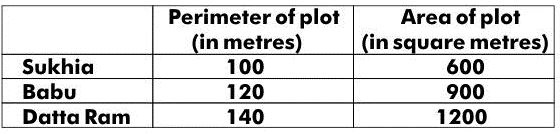
(a) Sukhia
(b) Babu
(c) Ram
(d) None of them
Answer : B
Question. Consider the two figures given below.
Which of the following is true about their areas and perimeters?
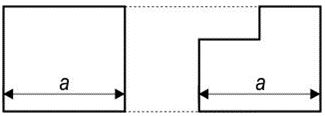
(a) The areas are the same, perimeters are different.
(b) The areas are different, perimeters are the same.
(c) The areas and perimeters are both different.
(d) The areas and perimeters are both the same.
Answer : B
Question. What is the area of the shaded portion if the area of the circle is 56 cm2?
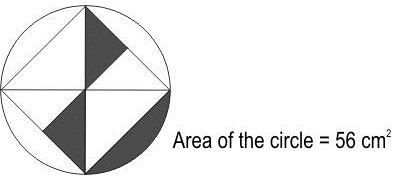
(a) 12 cm2
(b) 14 cm2
(c) 14. 8 cm2
(d) 18. 5 cm2
Answer : B
Question. In the given figure one square of side 'a' cm and 2 squares of side 'b' cm each are inside a larger square as shown.
What will be the area (in cm2) of the shaded portion?
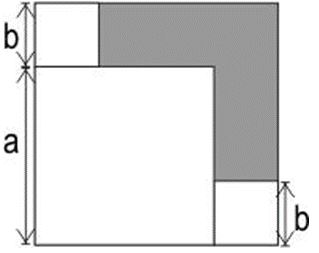
(a) 2ab - b2
(b) a2 + 2b2
(c) a2 - b2
(d) a2 + b2
Answer : A
Question. What is the length of the longest stick that can be packed in the box of the dimensions shown below?
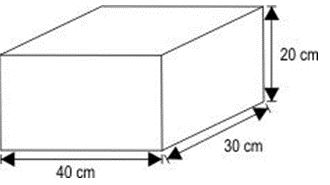
(a) 90 cm
(b) 70 cm
(c) √290 cm
(d) √240 cm
Answer : C
Question. 100 centimetres (cm) = 10 decimetres (dm) = 1 metre (m)
1 cm x 1 cm x 1 cm = 1 cm3 = 1 cc
(cc is short for cubic centimetre, and is a unit of volume)
1 litre is defined as 1 dm3
How many cc is one 1 millilitre?
(a) 1 cc
(b) 10 cc
(c) 100 cc
(d) 1000 cc
Answer : A
Question. A man completes the distance between Delhi and Agra travelling at exactly 40 kilometres per hour for half the distance, at 60 kilometres per hour for the remaining half. What is his average speed for the whole journey?
(a) 50 kilometres per hour
(b) 24 kilometres per hour
(c) 48 kilometres per hour
(d) Cannot be calculated.
Answer : C
Question. Three points are marked as shown on three edges of a wooden cube and the corner is cut off along the plane passing through these points. What will be the sum of the lengths of the edges (in cm) of the resulting pyramid?

(a) 10
(b) 6+√8
(c) 15
(d) 6+3√8
Answer : D
Question. In the following figure PR ll AC, QP ll AB and RQ ll BC.
If the perimeter of ABC is 24 cm, the perimeter of PQR will be
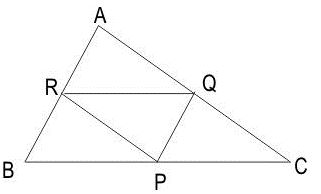
(a) 6 cm
(b) 8 cm
(c) 12 cm
(d) 16 cm
Answer : C
Question. The solid shown here is made up of unit cubes of side 'a' cm. Black squares of side 'b' cm are painted on the front and back faces of each unit as shown.
The remaining area of the exposed part of the solid (in cm2) is
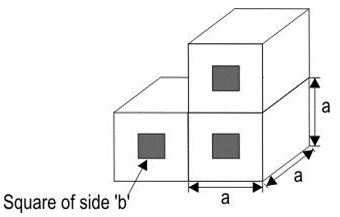
(a) 8a2 - 3b2
(b) 6a2 - 3b2
(c) 8a2 - 6b2
(d) 14a2 - 6b2
Answer : D
Question. The height of triangle PQR is double the height of triangle ABC, while the base of triangle ABC is double the base of triangle PQR. The ratio of the areas of triangles ABC and PQR will be
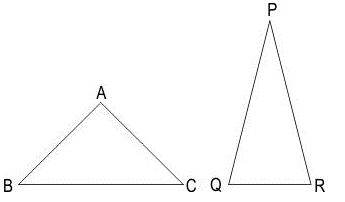
(a) 01:01
(b) 01:02
(c) 02:01
(d) 02:03
Answer : A
Question. Which of the following is NOT a correct way of finding the area of the square frame shown below.
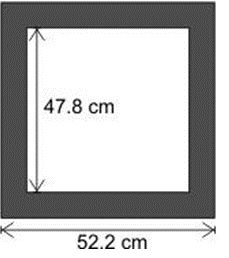
(a) 52.22 - 47.82
(b) 2 x {(52.2 x 2.2) + (47.8 x 2.2)}
(c) 52.2 x 4.4 x 2 + 47.8 x 4.4 x 2
(d) 100 x (52.2 - 47.8)
Answer : C
Question. The measurements of ONLY ONE of the triangles shown below can be correct. Which one is it?
(REMEMBER, the figures are NOT to scale)
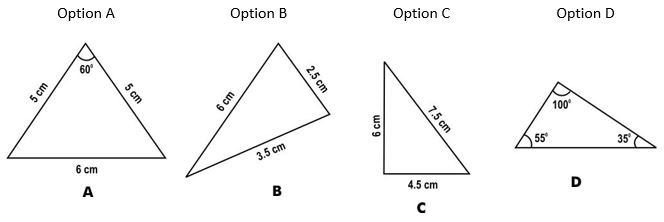
Answer : C
Question. Find the radius of the cylinder whose lateral surface area is 704 cm2 and height is 8cm.
(A) 6 cm
(B) 4 cm
(C) 8 cm
(D) 14 cm
Answer : D
Question. What is the height of a cuboid of volume 216 cm 3 if its length and breadth measure 8 em and 6 em?
(A) 4.5 m
(B) 6 m
(C) 4.8 m
(D) 9 m
Answer : A
Question. If the radius of a circle is 7/√π cm, what is the area of the circle?
(A) 154 cm2
(B) (49/π) cm2
(C) 22 cm2
(D) 49 cm2
Answer : D
Question. A cuboid measuring 20 em by 10 em by 4 cm is constructed using 2 cm cubes.
How many cubes were needed?
(A) 200
(B) 300
(C) 100
(D) 150
Answer : C
Question. The sides of a triangle are 11 cm, 15 cm and 16 cm. What is the measure of the altitude to the largest side ?
(A) 30√7 cm
(B) 30 cm
(C) (15√7/4) cm
(D) (1S√7/2) cm
Answer : C
Question. An aquarium is in the form of a cuboid whose external measures are 80 cm x 30 em x 40 cm. The base, side faces and back face are to be covered with a coloured paper. Find the area of the paper needed.
(A) 2000 cm2
(B) 8000 cm2
(C) 3000 cm2
(D) 1000 cm2
Answer : B
Question. The perimeter of a trapezium is 52 cm and its non-parallel sides are each equal to 10 cm. If its altitude is 8 cm, what is its area?
(A) 128 cm2
(B) 112 cm2
(C) 118 cm2
(D) 124 cm2
Answer : A
Question. From a cuboid measuring 7 em by 8 em by 9 em, a cube of side 5 em is cut. What is the volume of the remaining cuboid?
(A) 397 cm3
(B) 389 cm3
(C) 398 cm3
(D) 379 cm3
Answer : D
Question. The adjacent sides of a parallelogram are 8 cm and 9 cm. The diagonal joining the ends of these sides is 13 cm. Calculate the area of the parallelogram.
(A) 72 cm2
(B) 12√35 cm2
(C) 24√35 cm2
(D) 150 cm2
Answer : B
Question. A rectangular piece of paper 11 cm x 4 cm is folded without overlapping to make a cylinder of height 4 em. Find the volume of the cylinder.
(A) 38.5 cm3
(B) 40.5 cm3
(C) 41.5 cm3
(D) 42.5 cm3
Answer : A
Question. The dimensions of a hall are 40 m, 25 m and 20 m . If each person requires 200 cubic metres of space, how many persons can be accommodated in the hall?
(A) 120
(B) 150
(C) 140
(D) 100
Answer : D
Question. Three cylinders each of height 16 em and radius of base 4 em are placed on a plane so that each cylinder touches the other two. What is the volume of the region enclosed between the three cylinders?
(A) 98 (4~ -7π) cm3
(B) 98 (2.√3 -7π) cm3
(C) 98 (√3 - 7π) cm3
(D) 128 (2√3 -7π) cm3
Answer : D
Question. A stone of volume 36 cm3 is placed in a rectangular tank measuring 8 cm by 6 cm by 5 cm. A student wants to fill the tank with water to a height of 4 cm. What is the volume of water needed?
(A) 218 cm3
(B) 156 cm3
(C) 228 cm3
(D) 192 cm3
Answer : B
Question. What is the volume of a cylindrical conta iner with base radius 5 cm and height 20 cm? (Take 1t = 3.1 4 .)
(A) 157 l
(B) 1.57 l
(C) 1570 l
(D) 15.7 l
Answer : B
Question. In a building, there are 24 cylindrical pillars. The radius of each pillar is 28 cm and height is 4 m. Find the total cost of painting the curved surface area of al pillars at the rate of ₹ 8 per m2.
(A) ₹ 1352.68
(B) ₹ 1351.68
(C) ₹ 1353.68
(D) ₹ 1340.68
Answer : D
Question. Volumes of two cylinders of same height are in the ratio 1:16. What is the ratio of their radii.
Answer : 1:4
Question. Find the height of cuboid whose volume is 125 cm3 and base area is 5 cm2.
Answer : 25 cm
Question. Find the volume of cylinder whose radius is 7 cm and height is 5 cm.
Answer : 770 cm3
Question. Find the ratio of the areas of two circles whose radii is 7 cm and 14 cm.
Answer : 1:4
Question. How many cm3 of juice can be poured in a cuboidical can whose dimensions are 15 cm × 10 cm × 25 cm.
Answer : 3750 cm3
Question. What is the area of curved surface of right circular cylinder with height 14 cm and radius of base 5 cm?
Answer : 440 cm2
Question. Find the diameter of the circle whose circumference is 220 metre.
Answer : 70 m
Question. What is the radius of a circle of area is 154 cm2.
Answer : 7 cm
Question. Find the circumference of the circle whose radius is 7 cms.
Answer : 44 cm
Question. A room has two circular windows for exhaust fans. What is the area of these windows if the radius of each 7 cm.
Answer : 308 cm2
Question. What is the area of shaded ring if radius of two circles are 4 cm and 3 cm?
Answer : 22 cm2
Question. A wire in the shape of a square, is 264 cm long is reshaped as a circle. What is the radius of the circle so formed?
Answer : 42 cm
Please refer to the link below for CBSE Class 8 Mathematics Worksheet - Mensuration
Free study material for Mathematics
CBSE Class 8 Mathematics Worksheets for Chapter 11 Mensuration
Download Chapter Worksheets: Class 8 Mathematics
Explore reliable practice questions for Chapter 11 Mensuration tailored for Class 8 Mathematics learners. Use these structured worksheets to evaluate exam preparedness and strengthen problem-solving skills throughout the 2026 academic session.
Concept Clarification for Chapter 11 Mensuration
Designed around the official curriculum for Class 8 Mathematics, these practice sheets guarantee standard compliance. Reviewing step-by-step solutions after completion sharpens your accuracy and clarifies complex sub-topics within Chapter 11 Mensuration.
Effective Revision Strategies for School Exams
Wrap up your chapter revision by testing your knowledge against standard objective question formats. Explore our full library of free, up-to-date printable assignments to maximize your academic results in upcoming CBSE evaluations.
FAQs
You can download the latest chapter-wise printable worksheets for Class 8 Mathematics Chapter 11 Mensuration for free from StudiesToday.com. These have been made as per the latest CBSE curriculum for this academic year.
Yes, Class 8 Mathematics worksheets for Chapter 11 Mensuration focus on activity-based learning and also competency-style questions. This helps students to apply theoretical knowledge to practical scenarios.
Yes, we have provided solved worksheets for Class 8 Mathematics Chapter 11 Mensuration to help students verify their answers instantly.
Yes, our Class 8 Mathematics test sheets are mobile-friendly PDFs and can be printed by teachers for classroom.
For Chapter 11 Mensuration, regular practice with our worksheets will improve question-handling speed and help students understand all technical terms and diagrams.